CLASS XII
NAME REACTION
ALDEHYDES, KETONES
& CARBOXYLIC ACID
PRESENTED BY
BRAJENDRA KUMAR PATEL
PGT CHEMISTRY
JAWAHAR NAVODAYA
VIDYALAYA
MOB. 9893179244
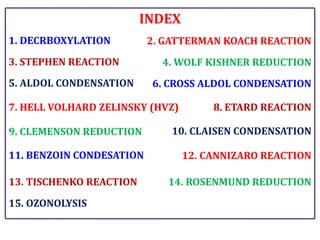
INDEX
15. OZONOLYSIS
14. ROSENMUND REDUCTION
3. STEPHEN REACTION
8. ETARD REACTION
2. GATTERMAN KOACH REACTION
5. ALDOL CONDENSATION 6. CROSS ALDOL CONDENSATION
12. CANNIZARO REACTION
1. DECRBOXYLATION
7. HELL VOLHARD ZELINSKY (HVZ)
9. CLEMENSON REDUCTION
4. WOLF KISHNER REDUCTION
11. BENZOIN CONDESATION
10. CLAISEN CONDENSATION
13. TISCHENKO REACTION
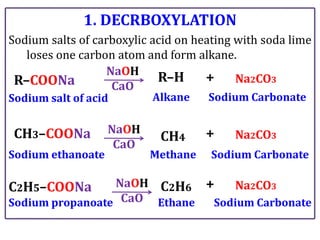
1. DECRBOXYLATION
Sodium salts of carboxylic acid on heating with soda lime
loses one carbon atom and form alkane.
R–H
R–COONa
NaOH
CaO
+ Na2CO3
Sodium salt of acid Alkane Sodium Carbonate
CH4
CH3–COONa NaOH
CaO
+ Na2CO3
Sodium ethanoate Methane Sodium Carbonate
C2H6
C2H5–COONa NaOH
CaO
+ Na2CO3
Sodium propanoate Ethane Sodium Carbonate
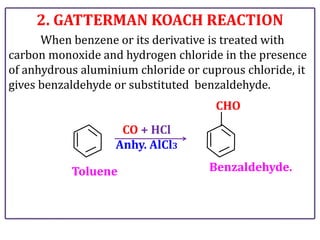
2. GATTERMAN KOACH REACTION
When benzene or its derivative is treated with
carbon monoxide and hydrogen chloride in the presence
of anhydrous aluminium chloride or cuprous chloride, it
gives benzaldehyde or substituted benzaldehyde.
CO + HCl
Anhy. AlCl3
Toluene Benzaldehyde.
CHO
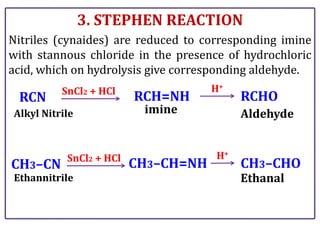
3. STEPHEN REACTION
Nitriles (cynaides) are reduced to corresponding imine
with stannous chloride in the presence of hydrochloric
acid, which on hydrolysis give corresponding aldehyde.
H+
RCHO
RCH=NH
SnCl2 + HCl
RCN
H+
CH3–CHO
CH3–CH=NH
SnCl2 + HCl
CH3–CN
Aldehyde
imine
Alkyl Nitrile
Ethanal
Ethannitrile
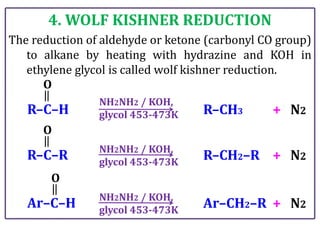
4. WOLF KISHNER REDUCTION
The reduction of aldehyde or ketone (carbonyl CO group)
to alkane by heating with hydrazine and KOH in
ethylene glycol is called wolf kishner reduction.
R–C–H
O
NH2NH2 / KOH,
glycol 453-473K R–CH3 + N2
R–C–R
O
NH2NH2 / KOH,
glycol 453-473K
R–CH2–R + N2
Ar–C–H
O
NH2NH2 / KOH,
glycol 453-473K
Ar–CH2–R + N2
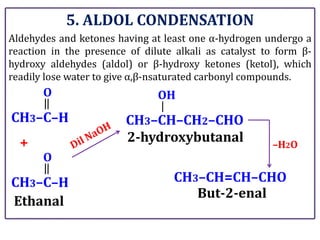
5. ALDOL CONDENSATION
Aldehydes and ketones having at least one α-hydrogen undergo a
reaction in the presence of dilute alkali as catalyst to form β-
hydroxy aldehydes (aldol) or β-hydroxy ketones (ketol), which
readily lose water to give α,β-nsaturated carbonyl compounds.
CH3–C
Ethanal
O
CH3–CH–CH2–CHO
OH
+ –H2O
CH3–CH=CH–CHO
2-hydroxybutanal
But-2-enal
–H
CH3–C
O
–H
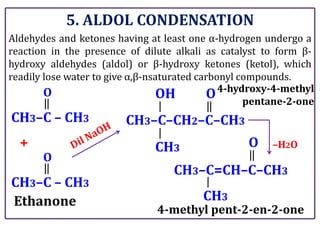
5. ALDOL CONDENSATION
Aldehydes and ketones having at least one α-hydrogen undergo a
reaction in the presence of dilute alkali as catalyst to form β-
hydroxy aldehydes (aldol) or β-hydroxy ketones (ketol), which
readily lose water to give α,β-nsaturated carbonyl compounds.
CH3–C – CH3
Ethanone
O
CH3–C–CH2–C–CH3
+ –H2O
CH3–C – CH3
O
OH
CH3
O
CH3–C=CH–C–CH3
CH3
O
4-hydroxy-4-methyl
pentane-2-one
4-methyl pent-2-en-2-one
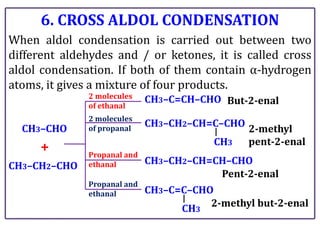
6. CROSS ALDOL CONDENSATION
When aldol condensation is carried out between two
different aldehydes and / or ketones, it is called cross
aldol condensation. If both of them contain α-hydrogen
atoms, it gives a mixture of four products.
CH3–CHO
CH3–CH2–CHO
+
CH3–C=CH–CHO
CH3–CH2–CH=C–CHO
CH3–C=C–CHO
CH3–CH2–CH=CH–CHO
CH3
CH3
2 molecules
of ethanal
2 molecules
of propanal
Propanal and
ethanal
Propanal and
ethanal
But-2-enal
2-methyl
pent-2-enal
Pent-2-enal
2-methyl but-2-enal
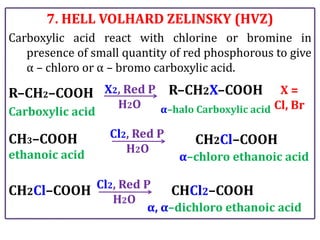
7. HELL VOLHARD ZELINSKY (HVZ)
Carboxylic acid react with chlorine or bromine in
presence of small quantity of red phosphorous to give
α – chloro or α – bromo carboxylic acid.
R–CH2X–COOH
R–CH2–COOH X2, Red P
H2O
X =
Cl, Br
Carboxylic acid α–halo Carboxylic acid
CH2Cl–COOH
CH3–COOH Cl2, Red P
H2O
ethanoic acid α–chloro ethanoic acid
CHCl2–COOH
CH2Cl–COOH Cl2, Red P
H2O
α, α–dichloro ethanoic acid
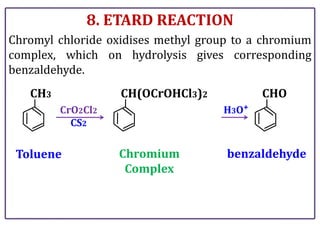
8. ETARD REACTION
Chromyl chloride oxidises methyl group to a chromium
complex, which on hydrolysis gives corresponding
benzaldehyde.
CH3
CrO2Cl2
CS2
CH(OCrOHCl3)2
H3O+
CHO
Toluene Chromium
Complex
benzaldehyde
9. CLEMENSON REDUCTION
The reduction of aldehyde or ketone (carbonyl CO group)
to alkane with amalgamated zinc and concentrated
hydrochloride acid.
R–C–H
O
+ 4[H]
Zn/Hg + Conc. HCl
R–CH3 + H2O
R–C–R
O
+ 4[H]
Zn/Hg + Conc. HCl
R–CH2–R + H2O
Ar–C–H
O
+ 4[H]
Zn/Hg + Conc. HCl
Ar–CH2–R + H2O
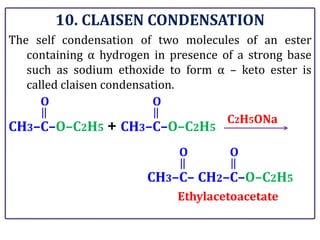
10. CLAISEN CONDENSATION
The self condensation of two molecules of an ester
containing α hydrogen in presence of a strong base
such as sodium ethoxide to form α – keto ester is
called claisen condensation.
CH3–C–O–C2H5
O
+ CH3–C–O–C2H5
O
C2H5ONa
CH3–C–
O
CH2–C–O–C2H5
O
Ethylacetoacetate
11. BENZOIN CONDESATION
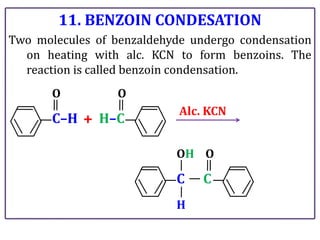
Two molecules of benzaldehyde undergo condensation
on heating with alc. KCN to form benzoins. The
reaction is called benzoin condensation.
C–H
O
H–C
O
+
Alc. KCN
C
OH
H
C
O
12. CANNIZARO REACTION
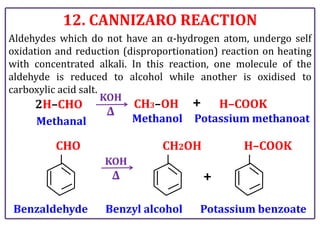
Aldehydes which do not have an α-hydrogen atom, undergo self
oxidation and reduction (disproportionation) reaction on heating
with concentrated alkali. In this reaction, one molecule of the
aldehyde is reduced to alcohol while another is oxidised to
carboxylic acid salt.
CH3–OH
2H–CHO
KOH
Δ
+ H–COOK
Benzaldehyde
CHO
KOH
Δ
Benzyl alcohol
CH2OH
Potassium benzoate
H–COOK
+
Methanal Methanol Potassium methanoat
13. TISCHENKO REACTION
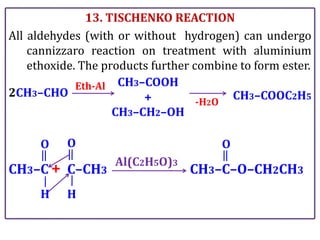
All aldehydes (with or without hydrogen) can undergo
cannizzaro reaction on treatment with aluminium
ethoxide. The products further combine to form ester.
2CH3–CHO
Eth-Al CH3–COOH
+
CH3–CH2–OH
CH3–COOC2H5
-H2O
CH3–C
O
H
+ C–CH3
O
H
Al(C2H5O)3
CH3–C–O–CH2CH3
O
14. ROSENMUND REDUCTION
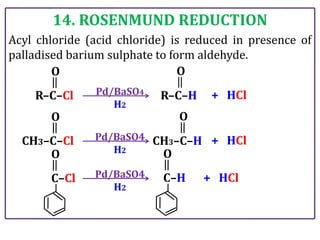
Acyl chloride (acid chloride) is reduced in presence of
palladised barium sulphate to form aldehyde.
R–C–H
R–C–Cl Pd/BaSO4
H2
+ HCl
O O
CH3–C–H
CH3–C–Cl Pd/BaSO4
H2
+ HCl
O O
C–Cl Pd/BaSO4
H2
+ HCl
O
C–H
O
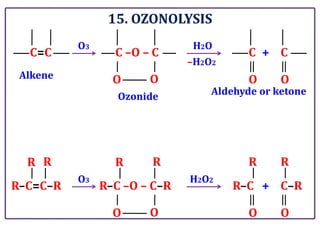
15. OZONOLYSIS
C=C
O3
C –O – C
H2O
O O
C
O
C
O
+
H2C=CH2
O3
H2C –O – CH2
H2O2
O O
H2C
O
CH2
O
+
H–C=C–H
O3
H–C –O – C–H
H2O2
O O
H–C
O
C–H
O
+
R R R R R R
Ozonide
Alkene
Aldehyde or ketone
–H2O2
Ethene
15. OZONOLYSIS
C=C
O3
C –O – C
H2O
O O
C
O
C
O
+
R–C=C–R
O3
R–C –O – C–R
H2O2
O O
R–C
O
C–R
O
+
R R R R R R
Ozonide
Alkene
Aldehyde or ketone
–H2O2
12. ALDEHYDE.pptx

12. ALDEHYDE.pptx

  • 1.
    CLASS XII NAME REACTION ALDEHYDES,KETONES & CARBOXYLIC ACID PRESENTED BY BRAJENDRA KUMAR PATEL PGT CHEMISTRY JAWAHAR NAVODAYA VIDYALAYA MOB. 9893179244
  • 2.
    INDEX 15. OZONOLYSIS 14. ROSENMUNDREDUCTION 3. STEPHEN REACTION 8. ETARD REACTION 2. GATTERMAN KOACH REACTION 5. ALDOL CONDENSATION 6. CROSS ALDOL CONDENSATION 12. CANNIZARO REACTION 1. DECRBOXYLATION 7. HELL VOLHARD ZELINSKY (HVZ) 9. CLEMENSON REDUCTION 4. WOLF KISHNER REDUCTION 11. BENZOIN CONDESATION 10. CLAISEN CONDENSATION 13. TISCHENKO REACTION
  • 3.
    1. DECRBOXYLATION Sodium saltsof carboxylic acid on heating with soda lime loses one carbon atom and form alkane. R–H R–COONa NaOH CaO + Na2CO3 Sodium salt of acid Alkane Sodium Carbonate CH4 CH3–COONa NaOH CaO + Na2CO3 Sodium ethanoate Methane Sodium Carbonate C2H6 C2H5–COONa NaOH CaO + Na2CO3 Sodium propanoate Ethane Sodium Carbonate
  • 4.
    2. GATTERMAN KOACHREACTION When benzene or its derivative is treated with carbon monoxide and hydrogen chloride in the presence of anhydrous aluminium chloride or cuprous chloride, it gives benzaldehyde or substituted benzaldehyde. CO + HCl Anhy. AlCl3 Toluene Benzaldehyde. CHO
  • 5.
    3. STEPHEN REACTION Nitriles(cynaides) are reduced to corresponding imine with stannous chloride in the presence of hydrochloric acid, which on hydrolysis give corresponding aldehyde. H+ RCHO RCH=NH SnCl2 + HCl RCN H+ CH3–CHO CH3–CH=NH SnCl2 + HCl CH3–CN Aldehyde imine Alkyl Nitrile Ethanal Ethannitrile
  • 6.
    4. WOLF KISHNERREDUCTION The reduction of aldehyde or ketone (carbonyl CO group) to alkane by heating with hydrazine and KOH in ethylene glycol is called wolf kishner reduction. R–C–H O NH2NH2 / KOH, glycol 453-473K R–CH3 + N2 R–C–R O NH2NH2 / KOH, glycol 453-473K R–CH2–R + N2 Ar–C–H O NH2NH2 / KOH, glycol 453-473K Ar–CH2–R + N2
  • 7.
    5. ALDOL CONDENSATION Aldehydesand ketones having at least one α-hydrogen undergo a reaction in the presence of dilute alkali as catalyst to form β- hydroxy aldehydes (aldol) or β-hydroxy ketones (ketol), which readily lose water to give α,β-nsaturated carbonyl compounds. CH3–C Ethanal O CH3–CH–CH2–CHO OH + –H2O CH3–CH=CH–CHO 2-hydroxybutanal But-2-enal –H CH3–C O –H
  • 8.
    5. ALDOL CONDENSATION Aldehydesand ketones having at least one α-hydrogen undergo a reaction in the presence of dilute alkali as catalyst to form β- hydroxy aldehydes (aldol) or β-hydroxy ketones (ketol), which readily lose water to give α,β-nsaturated carbonyl compounds. CH3–C – CH3 Ethanone O CH3–C–CH2–C–CH3 + –H2O CH3–C – CH3 O OH CH3 O CH3–C=CH–C–CH3 CH3 O 4-hydroxy-4-methyl pentane-2-one 4-methyl pent-2-en-2-one
  • 9.
    6. CROSS ALDOLCONDENSATION When aldol condensation is carried out between two different aldehydes and / or ketones, it is called cross aldol condensation. If both of them contain α-hydrogen atoms, it gives a mixture of four products. CH3–CHO CH3–CH2–CHO + CH3–C=CH–CHO CH3–CH2–CH=C–CHO CH3–C=C–CHO CH3–CH2–CH=CH–CHO CH3 CH3 2 molecules of ethanal 2 molecules of propanal Propanal and ethanal Propanal and ethanal But-2-enal 2-methyl pent-2-enal Pent-2-enal 2-methyl but-2-enal
  • 10.
    7. HELL VOLHARDZELINSKY (HVZ) Carboxylic acid react with chlorine or bromine in presence of small quantity of red phosphorous to give α – chloro or α – bromo carboxylic acid. R–CH2X–COOH R–CH2–COOH X2, Red P H2O X = Cl, Br Carboxylic acid α–halo Carboxylic acid CH2Cl–COOH CH3–COOH Cl2, Red P H2O ethanoic acid α–chloro ethanoic acid CHCl2–COOH CH2Cl–COOH Cl2, Red P H2O α, α–dichloro ethanoic acid
  • 11.
    8. ETARD REACTION Chromylchloride oxidises methyl group to a chromium complex, which on hydrolysis gives corresponding benzaldehyde. CH3 CrO2Cl2 CS2 CH(OCrOHCl3)2 H3O+ CHO Toluene Chromium Complex benzaldehyde
  • 12.
    9. CLEMENSON REDUCTION Thereduction of aldehyde or ketone (carbonyl CO group) to alkane with amalgamated zinc and concentrated hydrochloride acid. R–C–H O + 4[H] Zn/Hg + Conc. HCl R–CH3 + H2O R–C–R O + 4[H] Zn/Hg + Conc. HCl R–CH2–R + H2O Ar–C–H O + 4[H] Zn/Hg + Conc. HCl Ar–CH2–R + H2O
  • 13.
    10. CLAISEN CONDENSATION Theself condensation of two molecules of an ester containing α hydrogen in presence of a strong base such as sodium ethoxide to form α – keto ester is called claisen condensation. CH3–C–O–C2H5 O + CH3–C–O–C2H5 O C2H5ONa CH3–C– O CH2–C–O–C2H5 O Ethylacetoacetate
  • 14.
    11. BENZOIN CONDESATION Twomolecules of benzaldehyde undergo condensation on heating with alc. KCN to form benzoins. The reaction is called benzoin condensation. C–H O H–C O + Alc. KCN C OH H C O
  • 15.
    12. CANNIZARO REACTION Aldehydeswhich do not have an α-hydrogen atom, undergo self oxidation and reduction (disproportionation) reaction on heating with concentrated alkali. In this reaction, one molecule of the aldehyde is reduced to alcohol while another is oxidised to carboxylic acid salt. CH3–OH 2H–CHO KOH Δ + H–COOK Benzaldehyde CHO KOH Δ Benzyl alcohol CH2OH Potassium benzoate H–COOK + Methanal Methanol Potassium methanoat
  • 16.
    13. TISCHENKO REACTION Allaldehydes (with or without hydrogen) can undergo cannizzaro reaction on treatment with aluminium ethoxide. The products further combine to form ester. 2CH3–CHO Eth-Al CH3–COOH + CH3–CH2–OH CH3–COOC2H5 -H2O CH3–C O H + C–CH3 O H Al(C2H5O)3 CH3–C–O–CH2CH3 O
  • 17.
    14. ROSENMUND REDUCTION Acylchloride (acid chloride) is reduced in presence of palladised barium sulphate to form aldehyde. R–C–H R–C–Cl Pd/BaSO4 H2 + HCl O O CH3–C–H CH3–C–Cl Pd/BaSO4 H2 + HCl O O C–Cl Pd/BaSO4 H2 + HCl O C–H O
  • 18.
    15. OZONOLYSIS C=C O3 C –O– C H2O O O C O C O + H2C=CH2 O3 H2C –O – CH2 H2O2 O O H2C O CH2 O + H–C=C–H O3 H–C –O – C–H H2O2 O O H–C O C–H O + R R R R R R Ozonide Alkene Aldehyde or ketone –H2O2 Ethene
  • 19.
    15. OZONOLYSIS C=C O3 C –O– C H2O O O C O C O + R–C=C–R O3 R–C –O – C–R H2O2 O O R–C O C–R O + R R R R R R Ozonide Alkene Aldehyde or ketone –H2O2