Chemistry
Project
CONTENT:
 INTRODUCTION
 MECHANISM
 CROSSED ALDOL CONDENSATION
 MECHANISM OF CROSSED ALDOL CONDENSATION
 SELF ALDOL CONDENSATION
 INTRAMOLECULAR ALDOL CONDENSATION
 MECHANISM OF INTRAMOLECULAR ALDOL CONDENSATION
 ALDOX PROCESS
 PERKIN REACTION
 MEERWEIN PONNDORF VERLEY REACTION
 MECHANISM OF MEERWEIN PONNDORF VERLEY REACTION
 CONCLUSION
Introduction :
 An Aldol Condensation is an organic reaction in which an enolate ion reacts
with a carbonyl compound to form a β-hydroxyaldehyde or β-hydroxyketone,
followed by dehydration to give a conjugated enone Aldol condensations are
important in organic synthesis, providing a good way to form carbon–carbon
bonds. The Robinson annulation reaction sequence features an aldol
condensation; the Wieland-Miescher ketone product is an important starting
material for many organic syntheses.
 Aldol condensations are also commonly discussed in university level organic
chemistry classes as a good bond-forming reaction that demonstrates
important reaction mechanisms. In its usual form, it involves the nucleophilic
addition of a ketone enolate to an aldehyde to form a β-hydroxy ketone, or
“aldol” (aldehyde + alcohol), a structural unit found in many naturally
occurring molecules and pharmaceuticals.
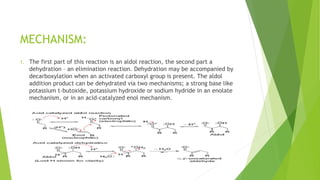
MECHANISM:
1. The first part of this reaction is an aldol reaction, the second part a
dehydration – an elimination reaction. Dehydration may be accompanied by
decarboxylation when an activated carboxyl group is present. The aldol
addition product can be dehydrated via two mechanisms; a strong base like
potassium t-butoxide, potassium hydroxide or sodium hydride in an enolate
mechanism, or in an acid-catalyzed enol mechanism.
CROSSED ALDOL CONDENSATION:
1. Crossed aldol condensation is a variation of aldol condensation in which two dissimilar
carbonyl compounds (each containing alpha hydrogens) undergo the condensation
reaction together. In such reactions, up to four different products may be formed.
MECHANISM OF CROSSED ALDOL
CONDENSATION:
1. When condensation is between two different carbonyl compounds, it is called
crossed aldol condensation. When both aldehydes have alpha hydrogens, both
can form carbanions and can also act as carbanion acceptors. Hence a
mixture of four products is formed which has little synthetic value.
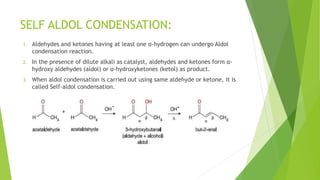
SELF ALDOL CONDENSATION:
1. Aldehydes and ketones having at least one α-hydrogen can undergo Aldol
condensation reaction.
2. In the presence of dilute alkali as catalyst, aldehydes and ketones form α-
hydroxy aldehydes (aldol) or α-hydroxyketones (ketol) as product.
3. When aldol condensation is carried out using same aldehyde or ketone, it is
called Self-aldol condensation.
Intramolecular aldol condensation
reactions:
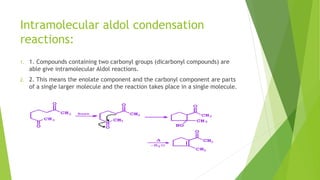
1. 1. Compounds containing two carbonyl groups (dicarbonyl compounds) are
able give intramolecular Aldol reactions.
2. 2. This means the enolate component and the carbonyl component are parts
of a single larger molecule and the reaction takes place in a single molecule.
MECHANISM OF INTRAMOLECULAR ALDOL
CONDENSATION:
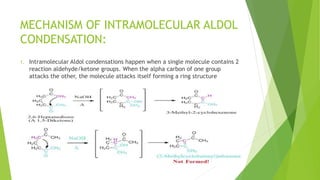
1. Intramolecular Aldol condensations happen when a single molecule contains 2
reaction aldehyde/ketone groups. When the alpha carbon of one group
attacks the other, the molecule attacks itself forming a ring structure
ALDOX PROCESS:
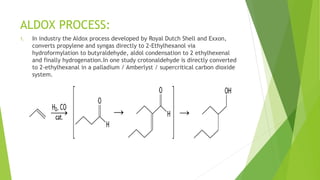
1. In industry the Aldox process developed by Royal Dutch Shell and Exxon,
converts propylene and syngas directly to 2-Ethylhexanol via
hydroformylation to butyraldehyde, aldol condensation to 2 ethylhexenal
and finally hydrogenation.In one study crotonaldehyde is directly converted
to 2-ethylhexanal in a palladium / Amberlyst / supercritical carbon dioxide
system.
Perkin Reaction:
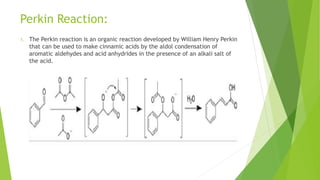
1. The Perkin reaction is an organic reaction developed by William Henry Perkin
that can be used to make cinnamic acids by the aldol condensation of
aromatic aldehydes and acid anhydrides in the presence of an alkali salt of
the acid.
MEERWEIN PONNDORF VERLEY
REACTION:
1. The Meerwein Ponndorf Verley Reduction in organic chemistry is the reduction
of ketones to secondary alcohols with aluminumisopropylate catalysis in
isopropanol solutions.
2. Reduction of a ketone 1 to the alcohol 3 in the presence of
aluminumisopropylate 2.
MECHANISM OF MEERWEIN PONNDORF VERLEY
REACTION:
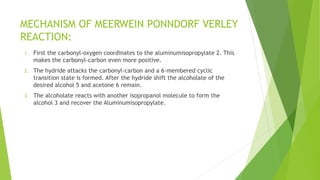
1. First the carbonyl-oxygen coordinates to the aluminumisopropylate 2. This
makes the carbonyl-carbon even more positive.
2. The hydride attacks the carbonyl-carbon and a 6-membered cyclic
transition state is formed. After the hydride shift the alcoholate of the
desired alcohol 5 and acetone 6 remain.
3. The alcoholate reacts with another isopropanol molecule to form the
alcohol 3 and recover the Aluminumisopropylate.
CONCLUSION:
1. All of these reactions are reversible, and complete conversion can be
achieved by employing excess alcohol as the reaction solvent or by removal of
acetone from the reaction mixture by distillation.
2. The same process in the opposite direction is called Oppenauer oxidation
THANK YOU
PRESENTED BY:
-NOWSHIYANTH RAJ R
BIBLIOGRAPH:
 https://chem.libretexts.org/
 https://www.slideshare.net/
 https://www.google.com/url?sa=t&source=web&rct=j&url=https://magritek.c
om/wp-content/uploads/2020/03/Lab-Manual-Aldol-Condensation-
web.pdf&ved=2ahUKEwjCs5S4mqn8AhXlRmwGHRMAAvUQFnoECBgQAQ&usg=A
OvVaw3e6zYOTtTqysac3PSlqjtW
 https://www.toppr.com/ask/
 https://leah4sci.com/

Chemistry project.pptx

  • 1.
  • 2.
    CONTENT:  INTRODUCTION  MECHANISM CROSSED ALDOL CONDENSATION  MECHANISM OF CROSSED ALDOL CONDENSATION  SELF ALDOL CONDENSATION  INTRAMOLECULAR ALDOL CONDENSATION  MECHANISM OF INTRAMOLECULAR ALDOL CONDENSATION  ALDOX PROCESS  PERKIN REACTION  MEERWEIN PONNDORF VERLEY REACTION  MECHANISM OF MEERWEIN PONNDORF VERLEY REACTION  CONCLUSION
  • 3.
    Introduction :  AnAldol Condensation is an organic reaction in which an enolate ion reacts with a carbonyl compound to form a β-hydroxyaldehyde or β-hydroxyketone, followed by dehydration to give a conjugated enone Aldol condensations are important in organic synthesis, providing a good way to form carbon–carbon bonds. The Robinson annulation reaction sequence features an aldol condensation; the Wieland-Miescher ketone product is an important starting material for many organic syntheses.  Aldol condensations are also commonly discussed in university level organic chemistry classes as a good bond-forming reaction that demonstrates important reaction mechanisms. In its usual form, it involves the nucleophilic addition of a ketone enolate to an aldehyde to form a β-hydroxy ketone, or “aldol” (aldehyde + alcohol), a structural unit found in many naturally occurring molecules and pharmaceuticals.
  • 4.
    MECHANISM: 1. The firstpart of this reaction is an aldol reaction, the second part a dehydration – an elimination reaction. Dehydration may be accompanied by decarboxylation when an activated carboxyl group is present. The aldol addition product can be dehydrated via two mechanisms; a strong base like potassium t-butoxide, potassium hydroxide or sodium hydride in an enolate mechanism, or in an acid-catalyzed enol mechanism.
  • 5.
    CROSSED ALDOL CONDENSATION: 1.Crossed aldol condensation is a variation of aldol condensation in which two dissimilar carbonyl compounds (each containing alpha hydrogens) undergo the condensation reaction together. In such reactions, up to four different products may be formed.
  • 6.
    MECHANISM OF CROSSEDALDOL CONDENSATION: 1. When condensation is between two different carbonyl compounds, it is called crossed aldol condensation. When both aldehydes have alpha hydrogens, both can form carbanions and can also act as carbanion acceptors. Hence a mixture of four products is formed which has little synthetic value.
  • 7.
    SELF ALDOL CONDENSATION: 1.Aldehydes and ketones having at least one α-hydrogen can undergo Aldol condensation reaction. 2. In the presence of dilute alkali as catalyst, aldehydes and ketones form α- hydroxy aldehydes (aldol) or α-hydroxyketones (ketol) as product. 3. When aldol condensation is carried out using same aldehyde or ketone, it is called Self-aldol condensation.
  • 8.
    Intramolecular aldol condensation reactions: 1.1. Compounds containing two carbonyl groups (dicarbonyl compounds) are able give intramolecular Aldol reactions. 2. 2. This means the enolate component and the carbonyl component are parts of a single larger molecule and the reaction takes place in a single molecule.
  • 9.
    MECHANISM OF INTRAMOLECULARALDOL CONDENSATION: 1. Intramolecular Aldol condensations happen when a single molecule contains 2 reaction aldehyde/ketone groups. When the alpha carbon of one group attacks the other, the molecule attacks itself forming a ring structure
  • 10.
    ALDOX PROCESS: 1. Inindustry the Aldox process developed by Royal Dutch Shell and Exxon, converts propylene and syngas directly to 2-Ethylhexanol via hydroformylation to butyraldehyde, aldol condensation to 2 ethylhexenal and finally hydrogenation.In one study crotonaldehyde is directly converted to 2-ethylhexanal in a palladium / Amberlyst / supercritical carbon dioxide system.
  • 11.
    Perkin Reaction: 1. ThePerkin reaction is an organic reaction developed by William Henry Perkin that can be used to make cinnamic acids by the aldol condensation of aromatic aldehydes and acid anhydrides in the presence of an alkali salt of the acid.
  • 12.
    MEERWEIN PONNDORF VERLEY REACTION: 1.The Meerwein Ponndorf Verley Reduction in organic chemistry is the reduction of ketones to secondary alcohols with aluminumisopropylate catalysis in isopropanol solutions. 2. Reduction of a ketone 1 to the alcohol 3 in the presence of aluminumisopropylate 2.
  • 13.
    MECHANISM OF MEERWEINPONNDORF VERLEY REACTION: 1. First the carbonyl-oxygen coordinates to the aluminumisopropylate 2. This makes the carbonyl-carbon even more positive. 2. The hydride attacks the carbonyl-carbon and a 6-membered cyclic transition state is formed. After the hydride shift the alcoholate of the desired alcohol 5 and acetone 6 remain. 3. The alcoholate reacts with another isopropanol molecule to form the alcohol 3 and recover the Aluminumisopropylate.
  • 14.
    CONCLUSION: 1. All ofthese reactions are reversible, and complete conversion can be achieved by employing excess alcohol as the reaction solvent or by removal of acetone from the reaction mixture by distillation. 2. The same process in the opposite direction is called Oppenauer oxidation
  • 15.
  • 16.
    BIBLIOGRAPH:  https://chem.libretexts.org/  https://www.slideshare.net/ https://www.google.com/url?sa=t&source=web&rct=j&url=https://magritek.c om/wp-content/uploads/2020/03/Lab-Manual-Aldol-Condensation- web.pdf&ved=2ahUKEwjCs5S4mqn8AhXlRmwGHRMAAvUQFnoECBgQAQ&usg=A OvVaw3e6zYOTtTqysac3PSlqjtW  https://www.toppr.com/ask/  https://leah4sci.com/

Editor's Notes

  • #2 CHEMISTRY PROJECT