Dr. Pravin N. Khatale
Professor
Dept. of Pharmaceutical Chemistry
Dr. Rajendra Gode Institute of Pharmacy, Amravati.
Email: pnkhatale@gmail.com
ELIMINATION REACTIONS
In an elimination reaction some fragments of a
molecule are removed.
Elimination reaction are classified into two general
headings
 α-eliminations
 β-eliminations i
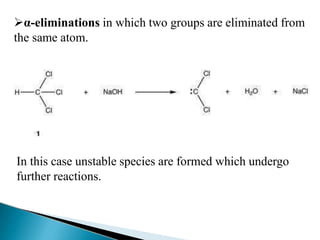
α-eliminations in which two groups are eliminated from
the same atom.
In this case unstable species are formed which undergo
further reactions.
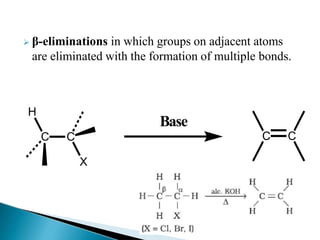
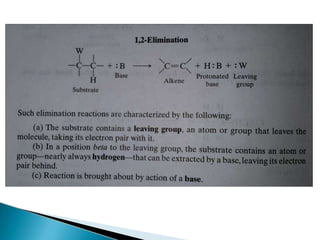
 β-eliminations in which groups on adjacent atoms
are eliminated with the formation of multiple bonds.
C C
H
X
Base
C C
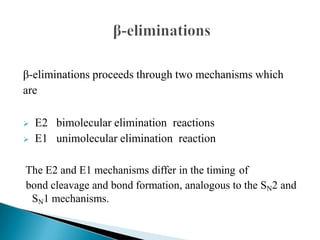
β-eliminations proceeds through two mechanisms which
are
 E2 bimolecular elimination reactions
 E1 unimolecular elimination reaction
The E2 and E1 mechanisms differ in the timing of
bond cleavage and bond formation, analogous to the SN2 and
SN1 mechanisms.
The E2 elimination
 = k [substrate] [base]
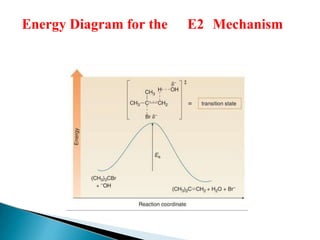
Reaction involves a single step: base pulls a proton away from
carbon; simultaneously a halide ion departs and the double
bond forms. Halogen takes its electron pair with it; hydrogen
leaves the electron pair behind, to form the double bond
In this transition
state, two bonds are
being broken: C-H
and C-X.
Effect of the LG on E2 Reactivity
Energy Diagram for the E2 Mechanism
Evidences For the E2 Mechanism
(a) Follow second-order kinetics; also
(a) Are not accompanied by rearrangements;
(a) Show large hydrogen isotope effect;
(a) Are not accompained by hydrogen exchane; and
(a) Show large element effect
(a) Follow second-order kinetics; also
(b) Are not accompanied by rearrangements;
Facts (a) and (b) are, of course, exactly what we
would expect for the E2 mechanism. The rate-
determining step (the only step) involves reaction
between a molecule of alkyl halide and a molecule of
base; the result is second-order kinetics. This single
step simply provides no opportunity for
rearrangement.
Evidences For the E2 Mechanism
(c) Show large hydrogen isotope effect;
A difference in rate due to a difference in the isotope
present in the reaction system is called an isotope effect.
If a particular atom is less tightly bound in the transition state of
a reaction than in the reactant, the reaction involving the
heavier isotope of that atom will go more slowly.
Here we will consider primary hydrogen isotope effect: a bond to
protium (H) is broken faster than a bond to deuterium (D)
Evidences For the E2 Mechanism
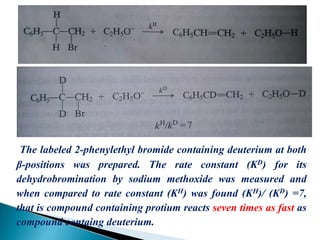
The labeled 2-phenylethyl bromide containing deuterium at both
β-positions was prepared. The rate constant (KD) for its
dehydrobromination by sodium methoxide was measured and
when compared to rate constant (KH) was found (KH)/ (KD) =7,
that is compound containing protium reacts seven times as fast as
compound containg deuterium.
(d) Are not accompained by hydrogen exchane;
Evidences For the E2 Mechanism
(d) Show large element effect;
Evidences For the E2 Mechanism
E2 Reaction: Orientation and Reactivity
In sec-butyl bromide attack by base at any one of three β-
hydrogens (on C-1)can lead to the formation of 1-butene; attack
at either of two β-hydrogens (on C-3) can lead to the formation of
2-butene. 2-Butene is preffered over 1-butene despite the
probability factor o 3:2.
Russian chemist Alexander Saytzeff in 1875 formuleted
rule: “ In dehydrohalogenation the preffered product is the
alkane that has the greater number of alkyl group attached
to the doubly bonded carbon atom.
E1 indicates a elimination, unimolecular reaction.
The E1 reaction proceeds via a two-step mechanism:
the bond to the leaving group breaks first before the π
bond is formed. The slow step is unimolecular,
involving only the alkyl halide.
The E1 elimination
The dehydrohalogenation of (CH3)3CI with H2O to form
(CH3)2C=CH2 can be used to illustrate the E1mechanism.
Energy diagram for E1 reaction
Evidences For the E1 Mechanism
(a) Follow First-order kinetics; also
(a) Are not accompanied by a primaary hydrogen
isotope effect;
(a) Where the structure permits, are accomapined by
rearrangements;
(a) Show the effect of structure on reactivity as SN1
reactions do.
Reactivity in E1
Tertiary> Secondary>Primary
In E1, as in SN1, reactivity is determined by the rate of
formation of the carbocation; and this depends upon
stability of the carbocation.
Where the structutes permits , first order eliminations
are accomapined by rearrangement.
The E1 reaction: Orientation
How fast the substrate reacts is determined by the rate of step
(1). But which alkane is produced is clearly determined by which
β-proton is lost faster from the carbocation in step (2). The 2-
pentyl cation, for example, can lose either a proton from C-3 to
form 2-pentene or a proton from C-1
1) Substrate effect
2) Base effect
3) Isotope effect
4) Orientation of elimination
The order of the reactivity of the alkyl groupsis
Tertiary> Secondary>Primary
This is because the rate determining step is the
formation of carbocation and the stability of
these ions increases.
Tertiary (3o) > secondary (2o) > primary (1o)
It is hard (but not impossible) to get primary
compounds to go by E1. The reason for this is
that primary carbocations are not stable!
In reactions of removal of hydrogen halides
from alkyl halides or the removal of water
from alcohols, the hydrogen which is lost will
come from the more highly-branched b-
carbon.
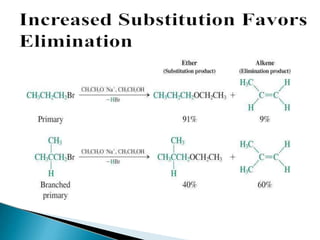
Factors to Consider:
1. How Basic is the Nucleophile?
2. 2. Steric Hindrance at Reacting Carbon
3. 3. Steric Hindrance at Nucleophile
Elimination Reaction.pptx

Elimination Reaction.pptx

  • 1.
    Dr. Pravin N.Khatale Professor Dept. of Pharmaceutical Chemistry Dr. Rajendra Gode Institute of Pharmacy, Amravati. Email: pnkhatale@gmail.com ELIMINATION REACTIONS
  • 2.
    In an eliminationreaction some fragments of a molecule are removed. Elimination reaction are classified into two general headings  α-eliminations  β-eliminations i
  • 3.
    α-eliminations in whichtwo groups are eliminated from the same atom. In this case unstable species are formed which undergo further reactions.
  • 4.
     β-eliminations inwhich groups on adjacent atoms are eliminated with the formation of multiple bonds. C C H X Base C C
  • 6.
    β-eliminations proceeds throughtwo mechanisms which are  E2 bimolecular elimination reactions  E1 unimolecular elimination reaction The E2 and E1 mechanisms differ in the timing of bond cleavage and bond formation, analogous to the SN2 and SN1 mechanisms.
  • 7.
    The E2 elimination = k [substrate] [base] Reaction involves a single step: base pulls a proton away from carbon; simultaneously a halide ion departs and the double bond forms. Halogen takes its electron pair with it; hydrogen leaves the electron pair behind, to form the double bond In this transition state, two bonds are being broken: C-H and C-X.
  • 9.
    Effect of theLG on E2 Reactivity
  • 10.
    Energy Diagram forthe E2 Mechanism
  • 11.
    Evidences For theE2 Mechanism (a) Follow second-order kinetics; also (a) Are not accompanied by rearrangements; (a) Show large hydrogen isotope effect; (a) Are not accompained by hydrogen exchane; and (a) Show large element effect
  • 12.
    (a) Follow second-orderkinetics; also (b) Are not accompanied by rearrangements; Facts (a) and (b) are, of course, exactly what we would expect for the E2 mechanism. The rate- determining step (the only step) involves reaction between a molecule of alkyl halide and a molecule of base; the result is second-order kinetics. This single step simply provides no opportunity for rearrangement. Evidences For the E2 Mechanism
  • 13.
    (c) Show largehydrogen isotope effect; A difference in rate due to a difference in the isotope present in the reaction system is called an isotope effect. If a particular atom is less tightly bound in the transition state of a reaction than in the reactant, the reaction involving the heavier isotope of that atom will go more slowly. Here we will consider primary hydrogen isotope effect: a bond to protium (H) is broken faster than a bond to deuterium (D) Evidences For the E2 Mechanism
  • 14.
    The labeled 2-phenylethylbromide containing deuterium at both β-positions was prepared. The rate constant (KD) for its dehydrobromination by sodium methoxide was measured and when compared to rate constant (KH) was found (KH)/ (KD) =7, that is compound containing protium reacts seven times as fast as compound containg deuterium.
  • 15.
    (d) Are notaccompained by hydrogen exchane; Evidences For the E2 Mechanism
  • 17.
    (d) Show largeelement effect; Evidences For the E2 Mechanism
  • 18.
  • 19.
    In sec-butyl bromideattack by base at any one of three β- hydrogens (on C-1)can lead to the formation of 1-butene; attack at either of two β-hydrogens (on C-3) can lead to the formation of 2-butene. 2-Butene is preffered over 1-butene despite the probability factor o 3:2.
  • 20.
    Russian chemist AlexanderSaytzeff in 1875 formuleted rule: “ In dehydrohalogenation the preffered product is the alkane that has the greater number of alkyl group attached to the doubly bonded carbon atom.
  • 22.
    E1 indicates aelimination, unimolecular reaction. The E1 reaction proceeds via a two-step mechanism: the bond to the leaving group breaks first before the π bond is formed. The slow step is unimolecular, involving only the alkyl halide. The E1 elimination
  • 23.
    The dehydrohalogenation of(CH3)3CI with H2O to form (CH3)2C=CH2 can be used to illustrate the E1mechanism.
  • 24.
    Energy diagram forE1 reaction
  • 26.
    Evidences For theE1 Mechanism (a) Follow First-order kinetics; also (a) Are not accompanied by a primaary hydrogen isotope effect; (a) Where the structure permits, are accomapined by rearrangements; (a) Show the effect of structure on reactivity as SN1 reactions do.
  • 27.
    Reactivity in E1 Tertiary>Secondary>Primary In E1, as in SN1, reactivity is determined by the rate of formation of the carbocation; and this depends upon stability of the carbocation. Where the structutes permits , first order eliminations are accomapined by rearrangement.
  • 30.
    The E1 reaction:Orientation
  • 31.
    How fast thesubstrate reacts is determined by the rate of step (1). But which alkane is produced is clearly determined by which β-proton is lost faster from the carbocation in step (2). The 2- pentyl cation, for example, can lose either a proton from C-3 to form 2-pentene or a proton from C-1
  • 32.
    1) Substrate effect 2)Base effect 3) Isotope effect 4) Orientation of elimination
  • 33.
    The order ofthe reactivity of the alkyl groupsis Tertiary> Secondary>Primary This is because the rate determining step is the formation of carbocation and the stability of these ions increases.
  • 34.
    Tertiary (3o) >secondary (2o) > primary (1o) It is hard (but not impossible) to get primary compounds to go by E1. The reason for this is that primary carbocations are not stable!
  • 38.
    In reactions ofremoval of hydrogen halides from alkyl halides or the removal of water from alcohols, the hydrogen which is lost will come from the more highly-branched b- carbon.
  • 40.
    Factors to Consider: 1.How Basic is the Nucleophile? 2. 2. Steric Hindrance at Reacting Carbon 3. 3. Steric Hindrance at Nucleophile