Geometric Probability
The student is able to (I can):
• Calculate geometric probabilites
• Use geometric probability to predict results in real-world
situations
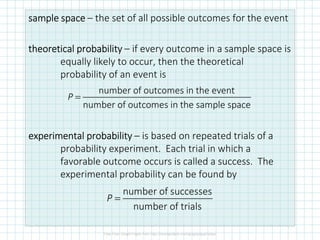
sample spacesample spacesample spacesample space – the set of all possible outcomes for the event
theoretical probabilitytheoretical probabilitytheoretical probabilitytheoretical probability – if every outcome in a sample space is
equally likely to occur, then the theoretical
probability of an event is
experimental probabilityexperimental probabilityexperimental probabilityexperimental probability – is based on repeated trials of a
probability experiment. Each trial in which a
favorable outcome occurs is called a success. The
experimental probability can be found by
number of outcomes in the event
number of outcomes in the sample space
=P
number of successes
number of trials
P =
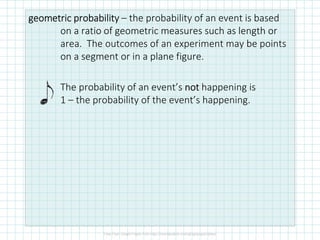
geometric probabilitygeometric probabilitygeometric probabilitygeometric probability – the probability of an event is based
on a ratio of geometric measures such as length or
area. The outcomes of an experiment may be points
on a segment or in a plane figure.
The probability of an event’s notnotnotnot happening is
1 – the probability of the event’s happening.
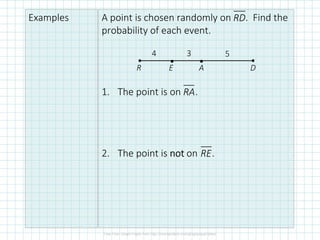
Examples A point is chosen randomly on . Find the
probability of each event.
1. The point is on .
2. The point is notnotnotnot on .
RD
••
DAER
4 3 5
RA
RE
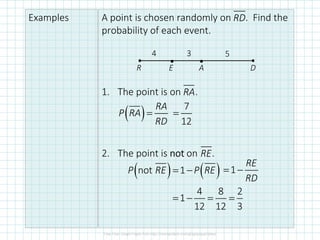
Examples A point is chosen randomly on . Find the
probability of each event.
1. The point is on .
2. The point is notnotnotnot on .
RD
••
DAER
4 3 5
RA
( ) RA
P RA
RD
=
7
12
=
RE
( ) ( )not 1P RE P RE= − 1
RE
RD
= −
4 8 2
1
12 12 3
= − = =
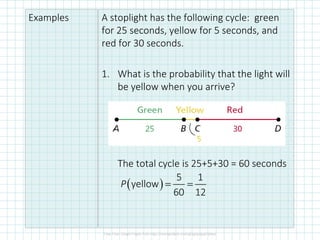
Examples A stoplight has the following cycle: green
for 25 seconds, yellow for 5 seconds, and
red for 30 seconds.
1. What is the probability that the light will
be yellow when you arrive?
The total cycle is 25+5+30 = 60 seconds
( )
5 1
yellow
60 12
P = =
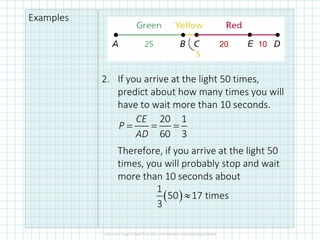
Examples
2. If you arrive at the light 50 times,
predict about how many times you will
have to wait more than 10 seconds.
Therefore, if you arrive at the light 50
times, you will probably stop and wait
more than 10 seconds about
•
10E20
20 1
60 3
CE
P
AD
= = =
( )
1
50 17 times
3
≈
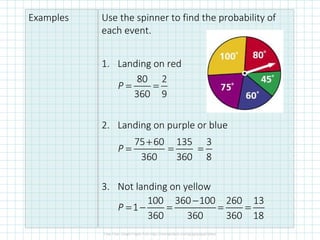
Examples Use the spinner to find the probability of
each event.
1. Landing on red
2. Landing on purple or blue
3. Not landing on yellow
80 2
360 9
P = =
75 60
360
P
+
=
135
360
=
3
8
=
100 360 100
1
360 360
P
−
= − =
260 13
360 18
= =
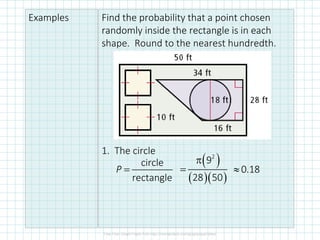
Examples Find the probability that a point chosen
randomly inside the rectangle is in each
shape. Round to the nearest hundredth.
1. The circle
circle
rectangle
P =
( )
( )( )
2
9
28 50
π
= 0.18≈
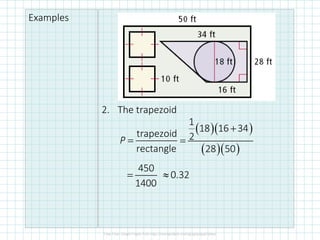
Examples
2. The trapezoid
trapezoid
rectangle
P =
( )( )
( )( )
1
18 16 34
2
28 50
+
=
450
1400
= 0.32≈
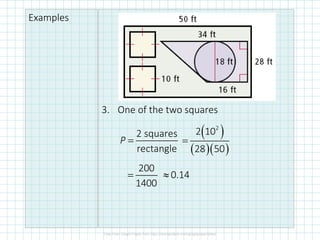
Examples
3. One of the two squares
2 squares
rectangle
=P
( )
( )( )
2
2 10
28 50
=
200
1400
= 0.14≈
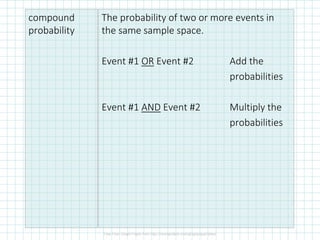
compound
probability
The probability of two or more events in
the same sample space.
Event #1 OR Event #2 Add the
probabilities
Event #1 AND Event #2 Multiply the
probabilities

11.4 Geometric Probability

  • 1.
    Geometric Probability The studentis able to (I can): • Calculate geometric probabilites • Use geometric probability to predict results in real-world situations
  • 2.
    sample spacesample spacesamplespacesample space – the set of all possible outcomes for the event theoretical probabilitytheoretical probabilitytheoretical probabilitytheoretical probability – if every outcome in a sample space is equally likely to occur, then the theoretical probability of an event is experimental probabilityexperimental probabilityexperimental probabilityexperimental probability – is based on repeated trials of a probability experiment. Each trial in which a favorable outcome occurs is called a success. The experimental probability can be found by number of outcomes in the event number of outcomes in the sample space =P number of successes number of trials P =
  • 3.
    geometric probabilitygeometric probabilitygeometricprobabilitygeometric probability – the probability of an event is based on a ratio of geometric measures such as length or area. The outcomes of an experiment may be points on a segment or in a plane figure. The probability of an event’s notnotnotnot happening is 1 – the probability of the event’s happening.
  • 4.
    Examples A pointis chosen randomly on . Find the probability of each event. 1. The point is on . 2. The point is notnotnotnot on . RD •• DAER 4 3 5 RA RE
  • 5.
    Examples A pointis chosen randomly on . Find the probability of each event. 1. The point is on . 2. The point is notnotnotnot on . RD •• DAER 4 3 5 RA ( ) RA P RA RD = 7 12 = RE ( ) ( )not 1P RE P RE= − 1 RE RD = − 4 8 2 1 12 12 3 = − = =
  • 6.
    Examples A stoplighthas the following cycle: green for 25 seconds, yellow for 5 seconds, and red for 30 seconds. 1. What is the probability that the light will be yellow when you arrive? The total cycle is 25+5+30 = 60 seconds ( ) 5 1 yellow 60 12 P = =
  • 7.
    Examples 2. If youarrive at the light 50 times, predict about how many times you will have to wait more than 10 seconds. Therefore, if you arrive at the light 50 times, you will probably stop and wait more than 10 seconds about • 10E20 20 1 60 3 CE P AD = = = ( ) 1 50 17 times 3 ≈
  • 8.
    Examples Use thespinner to find the probability of each event. 1. Landing on red 2. Landing on purple or blue 3. Not landing on yellow 80 2 360 9 P = = 75 60 360 P + = 135 360 = 3 8 = 100 360 100 1 360 360 P − = − = 260 13 360 18 = =
  • 9.
    Examples Find theprobability that a point chosen randomly inside the rectangle is in each shape. Round to the nearest hundredth. 1. The circle circle rectangle P = ( ) ( )( ) 2 9 28 50 π = 0.18≈
  • 10.
    Examples 2. The trapezoid trapezoid rectangle P= ( )( ) ( )( ) 1 18 16 34 2 28 50 + = 450 1400 = 0.32≈
  • 11.
    Examples 3. One ofthe two squares 2 squares rectangle =P ( ) ( )( ) 2 2 10 28 50 = 200 1400 = 0.14≈
  • 12.
    compound probability The probability oftwo or more events in the same sample space. Event #1 OR Event #2 Add the probabilities Event #1 AND Event #2 Multiply the probabilities