Probability and Sample
Space…….
Vocabulary To Know
 Probability Experiment: A
chance process that leads to well
defined results called outcomes.
 Outcome: The result of a single
trial of a probability experiment.
Sample Space
 Sample Space:
the set of ALL
possible outcomes
of a probability
experiment.
 Example:
 Flipping a coin
has 2 possible
outcomes
1. Heads
2. Tails
You Try
 Find the sample space for the
following probability experiments.
1. Toss One Coin
2. Roll a Die
3. Answer a T/F Question
4. Toss 2 Coins
Answers
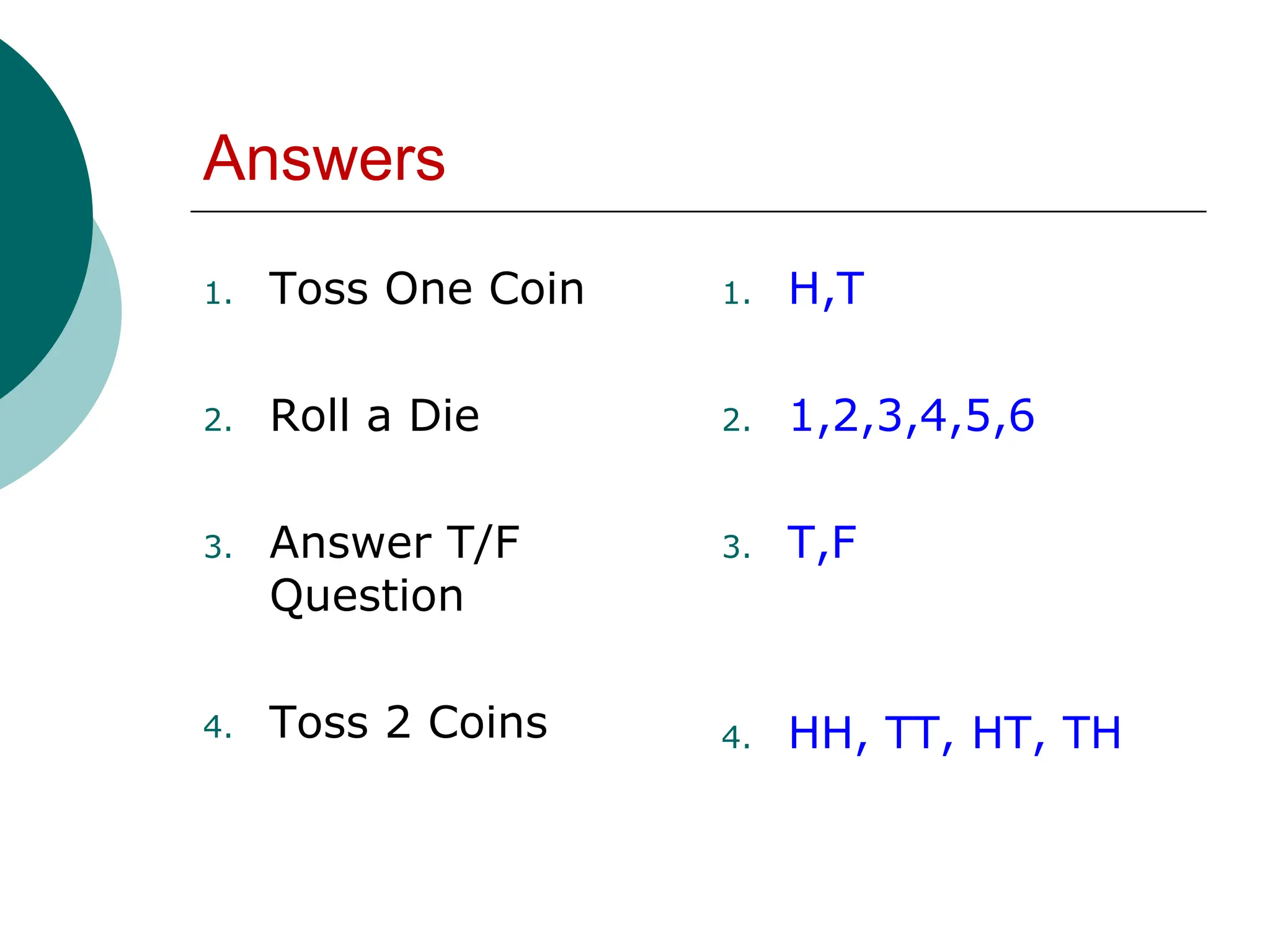
1. Toss One Coin
2. Roll a Die
3. Answer T/F
Question
4. Toss 2 Coins
1. H,T
2. 1,2,3,4,5,6
3. T,F
4. HH, TT, HT, TH
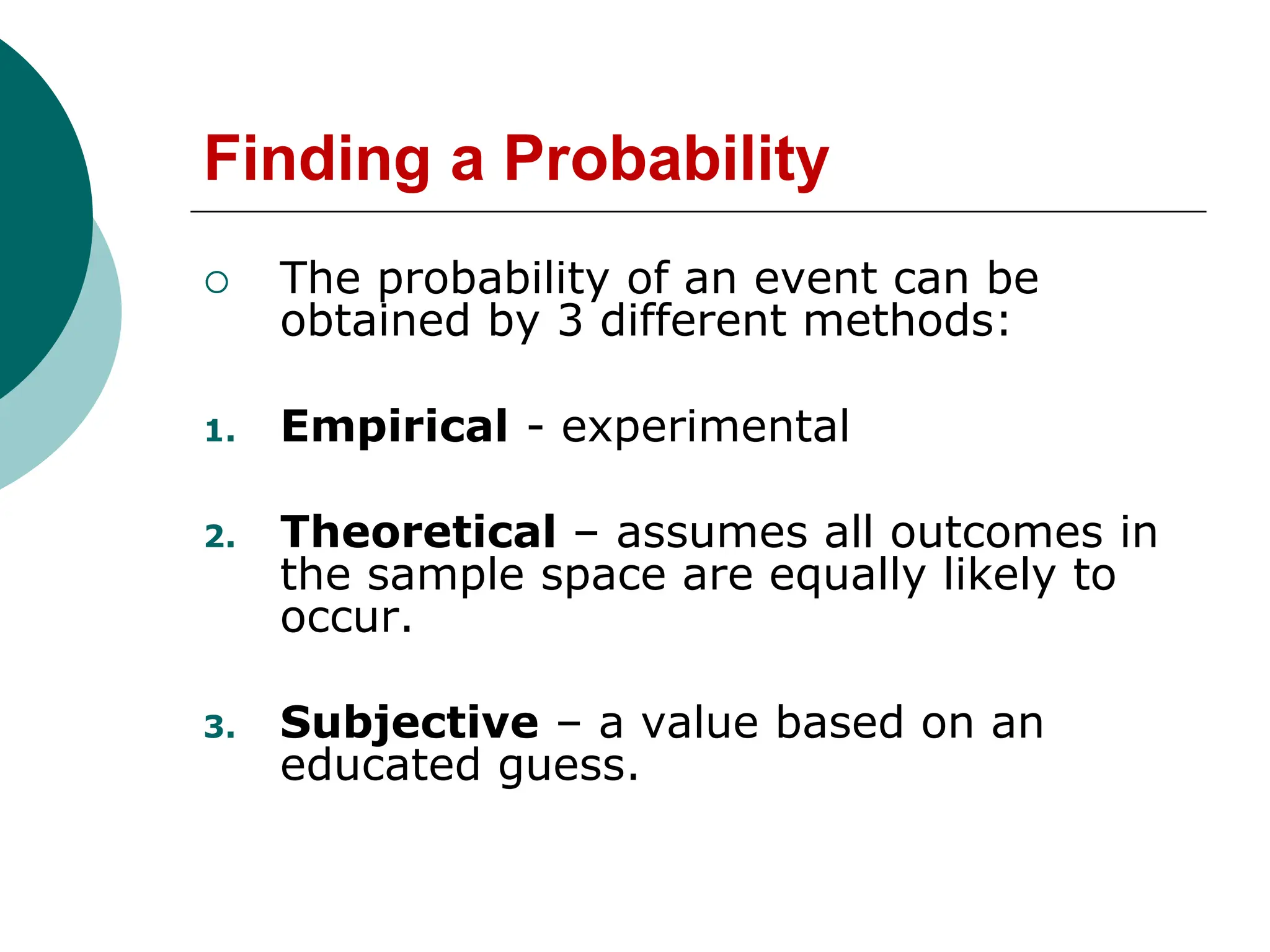
Finding a Probability
 The probability of an event can be
obtained by 3 different methods:
1. Empirical - experimental
2. Theoretical – assumes all outcomes in
the sample space are equally likely to
occur.
3. Subjective – a value based on an
educated guess.
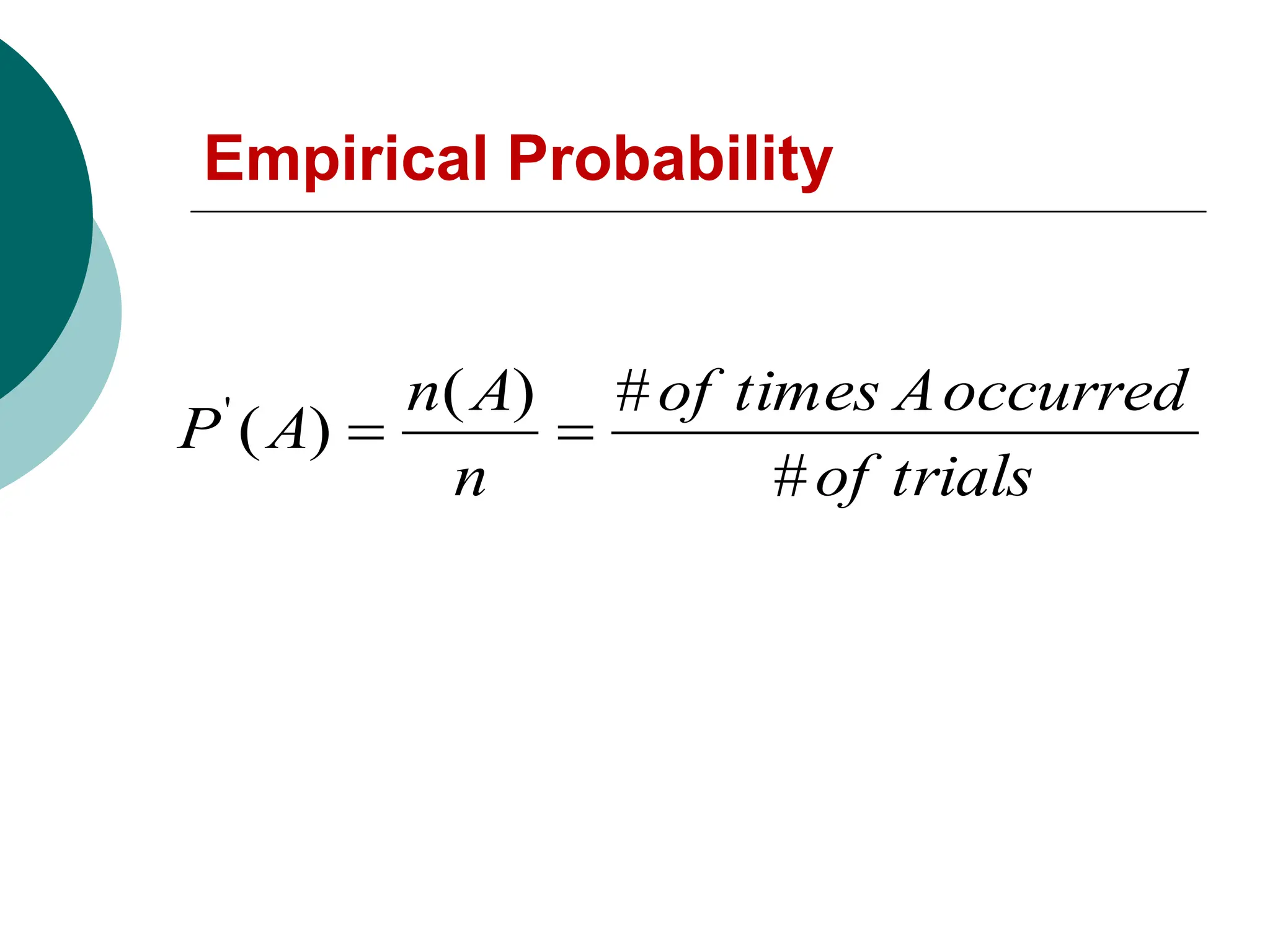
Empirical Probability
trials
of
occurred
A
times
of
n
A
n
A
P
#
#
)
(
)
(
'


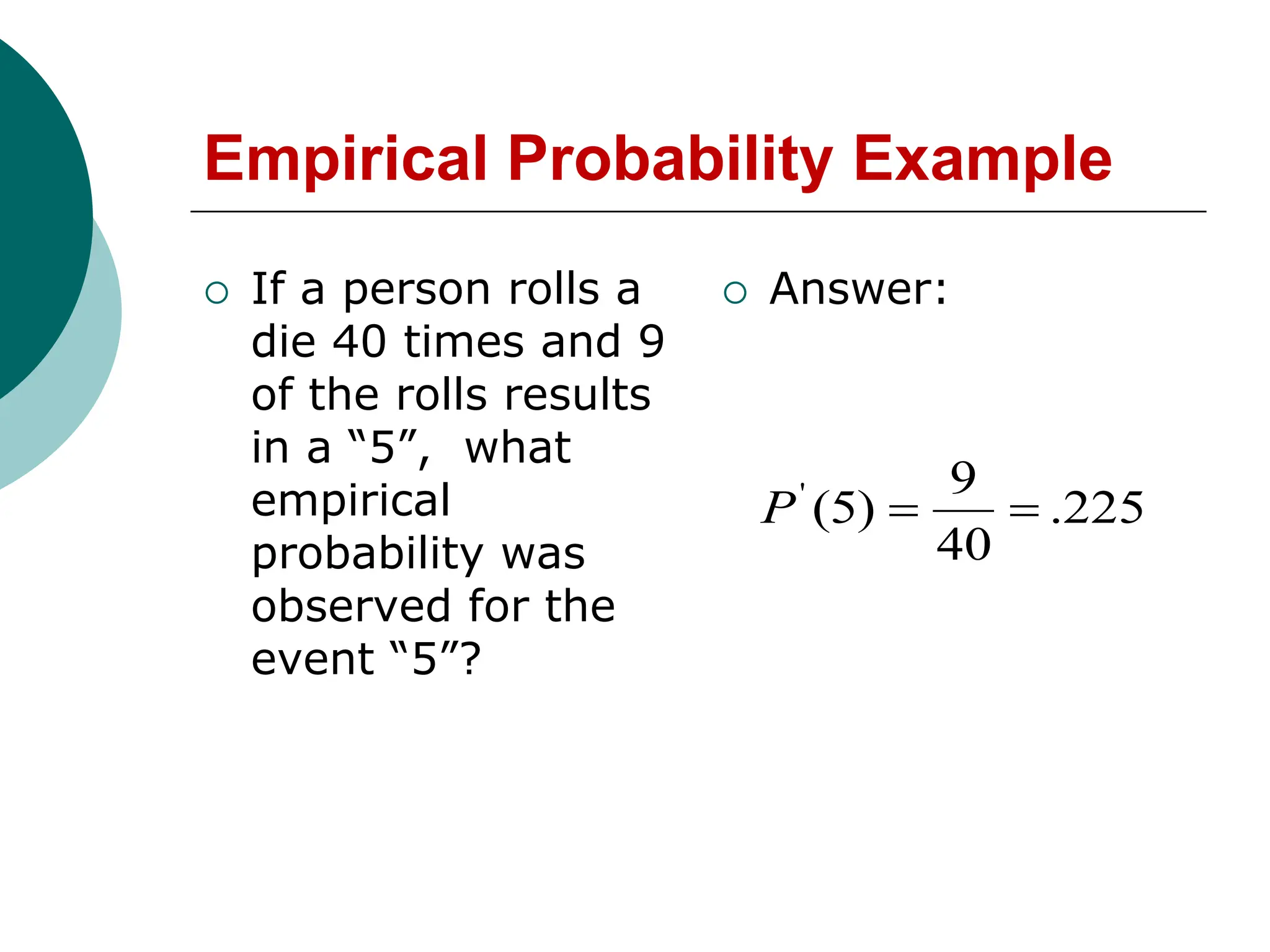
Empirical Probability Example
 If a person rolls a
die 40 times and 9
of the rolls results
in a “5”, what
empirical
probability was
observed for the
event “5”?
 Answer:
225
.
40
9
)
5
(
'


P
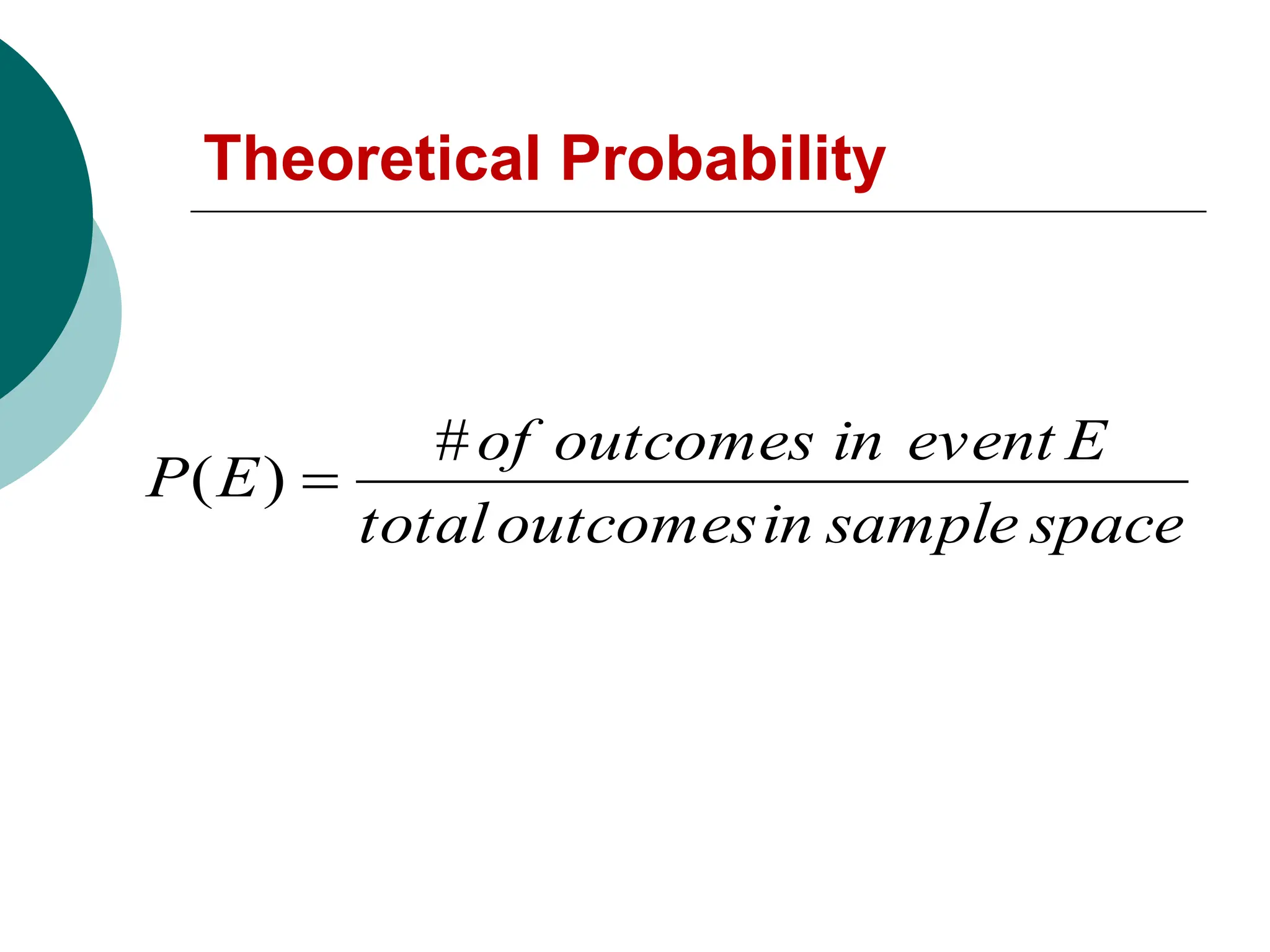
Theoretical Probability
space
sample
in
outcomes
total
E
event
in
outcomes
of
E
P
#
)
( 
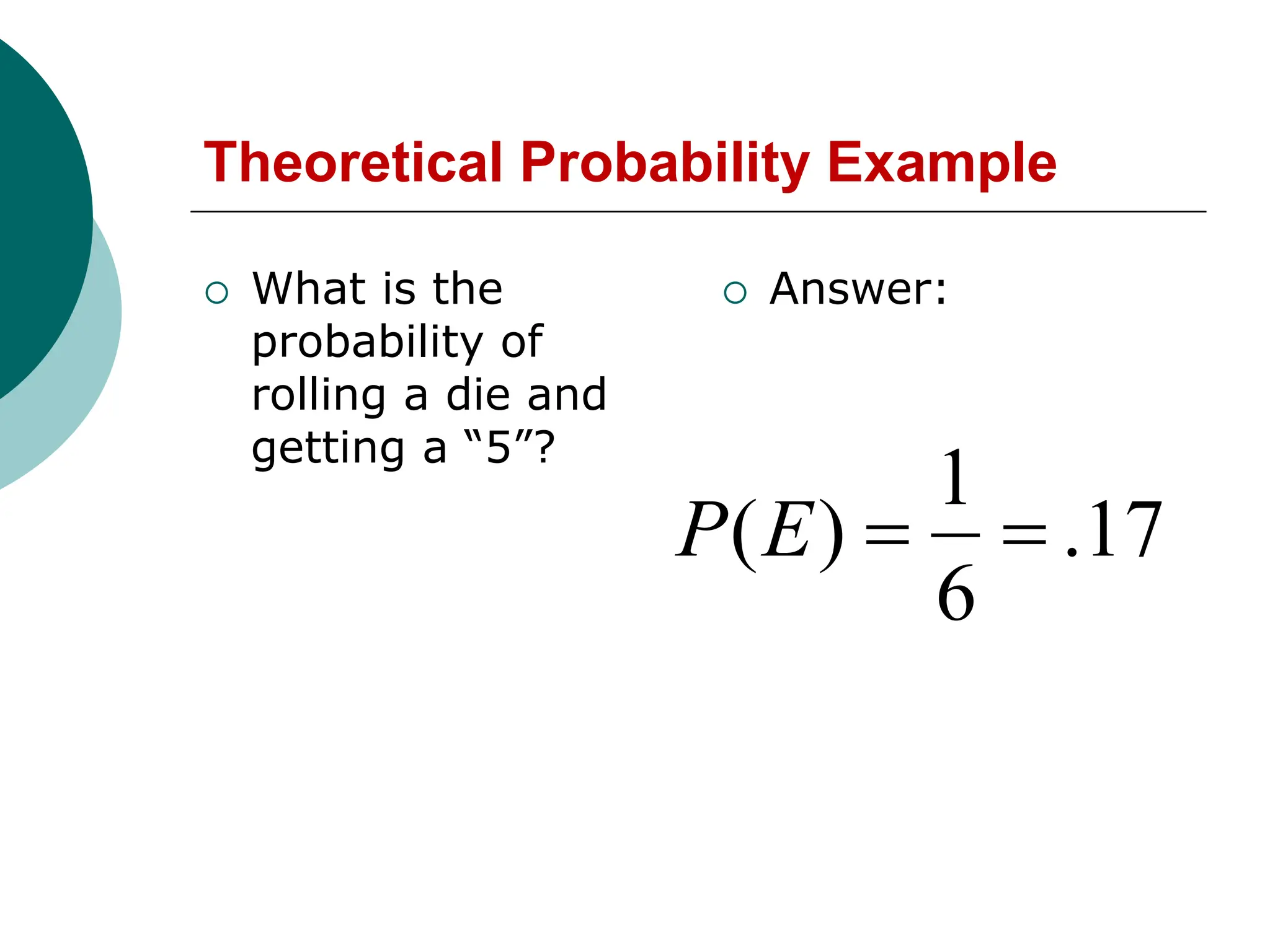
Theoretical Probability Example
 What is the
probability of
rolling a die and
getting a “5”?
 Answer:
17
.
6
1
)
( 

E
P
 The difference between theoretical
and empirical probability is that
theoretical assumes that certain
outcomes are equally likely while
empirical probability relies on actual
experience to determine the
likelihood of outcomes.
Law of Large Numbers
 The Law of Large Numbers says
that as the # of trials in an
experiment increases, the empirical
probability approaches the
theoretical probability.
 If an experiment is done many
times, everything tends to “even
out.”
Labs
Let’s try to see how the Law of
Large Numbers works……..
Theoretical Probability…..
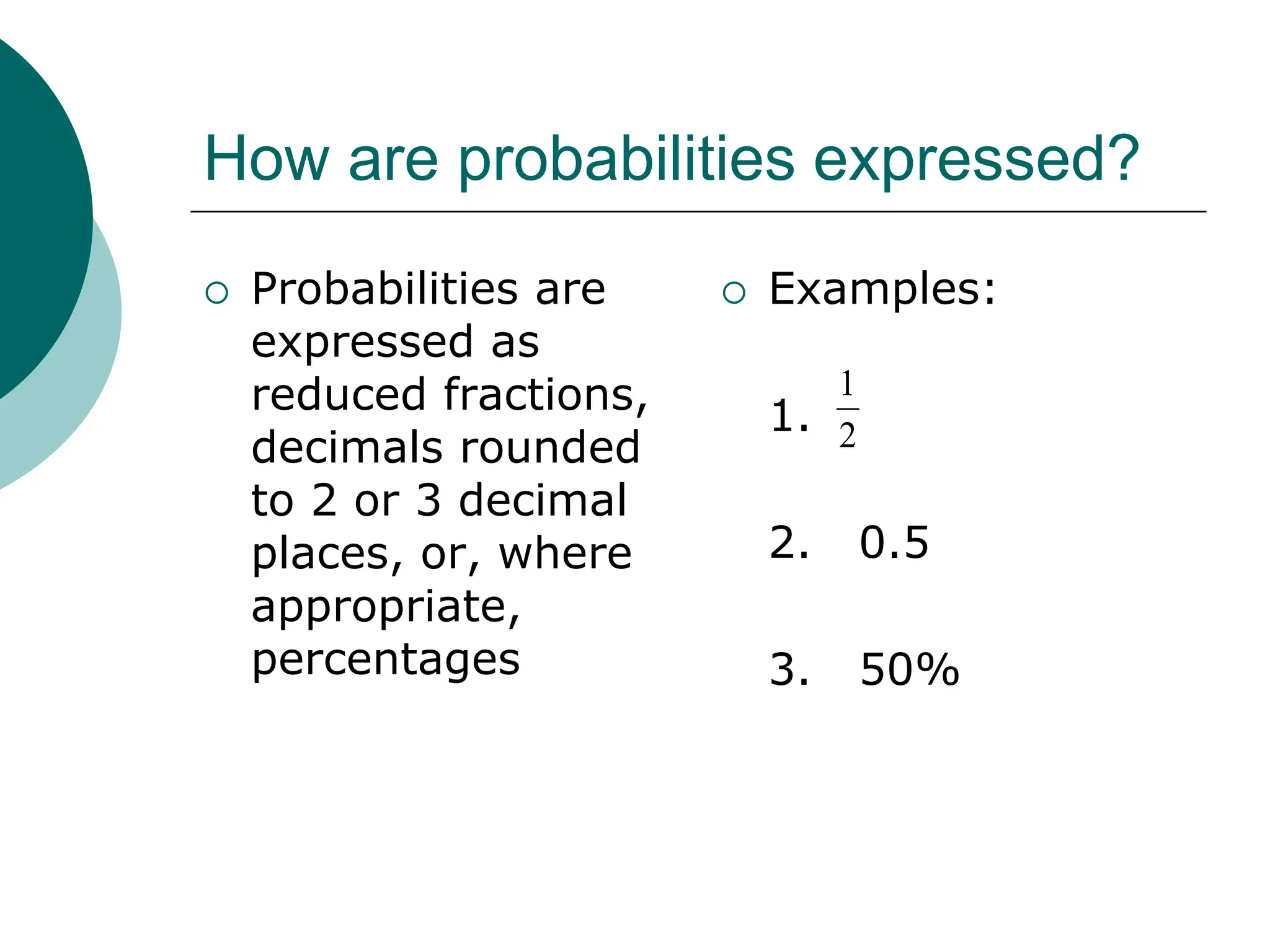
How are probabilities expressed?
 Probabilities are
expressed as
reduced fractions,
decimals rounded
to 2 or 3 decimal
places, or, where
appropriate,
percentages
 Examples:
1.
2. 0.5
3. 50%
2
1
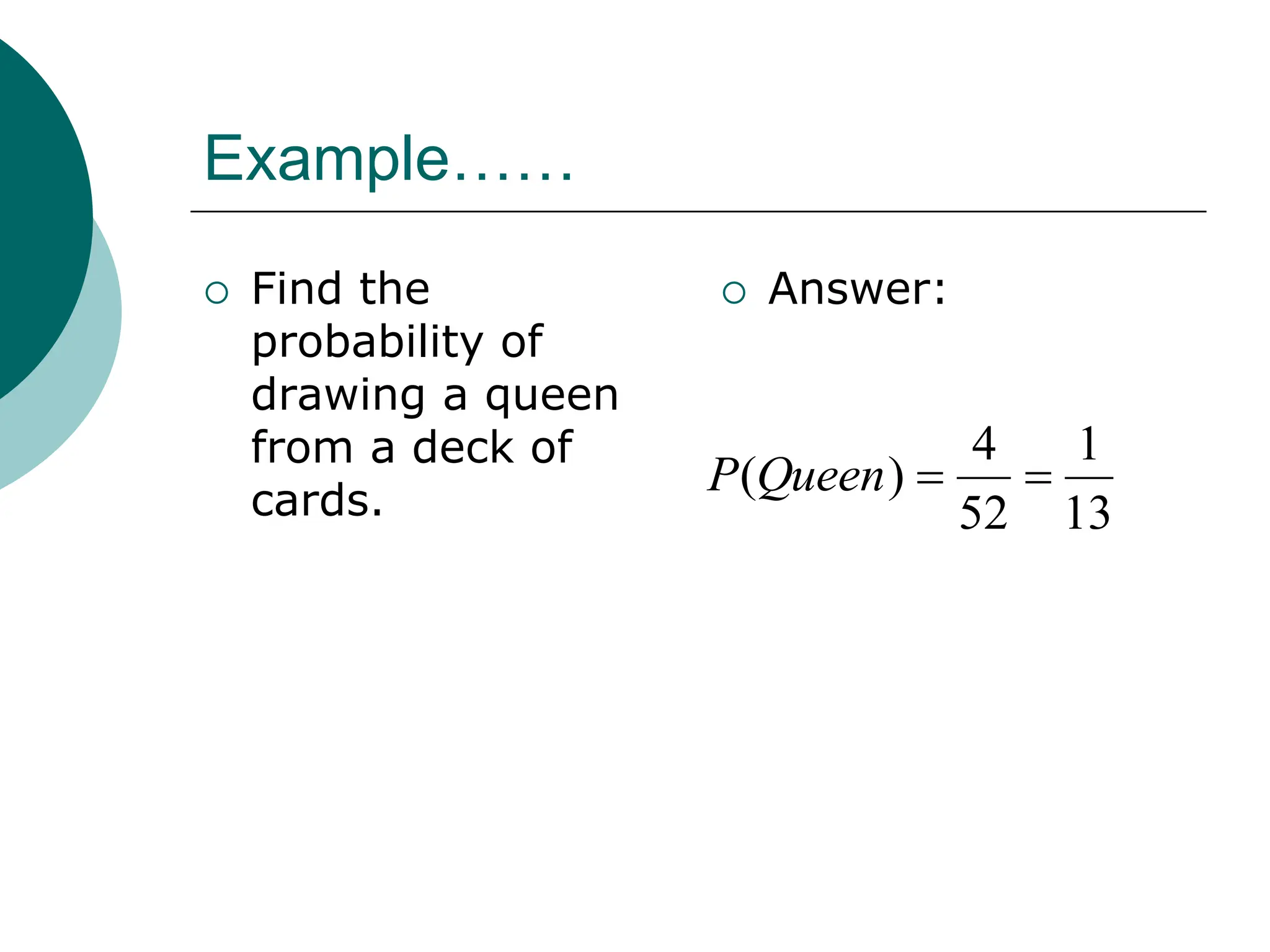
Example……
 Find the
probability of
drawing a queen
from a deck of
cards.
 Answer:
13
1
52
4
)
( 

Queen
P
Example……
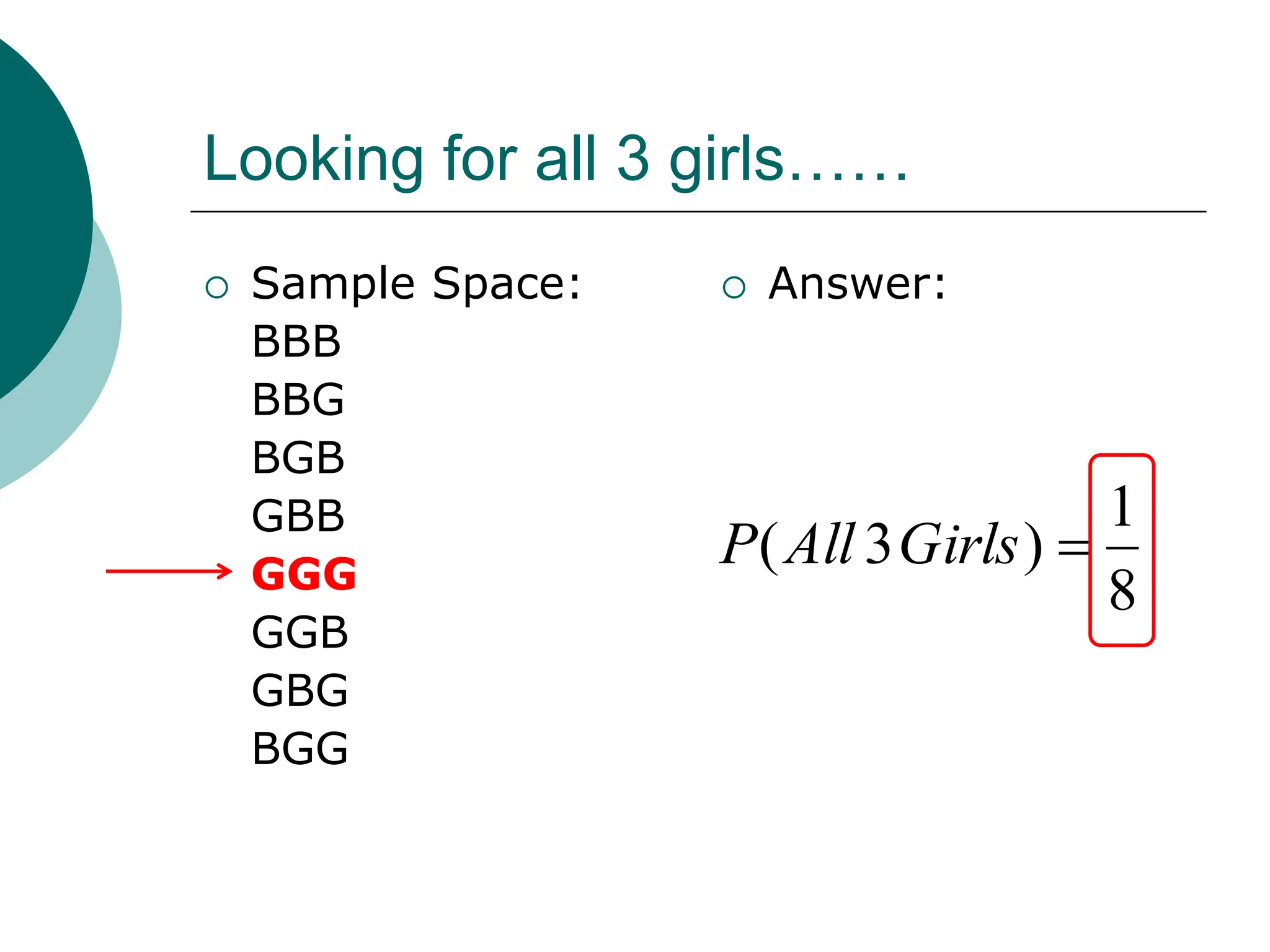
 If a family has 3 children, find the
probability that all 3 children are
girls.
 You are going to have to look at the
sample space before you can
answer this one.
Looking for all 3 girls……
 Sample Space:
BBB
BBG
BGB
GBB
GGG
GGB
GBG
BGG
 Answer:
8
1
)
3
( 
Girls
All
P
Example……
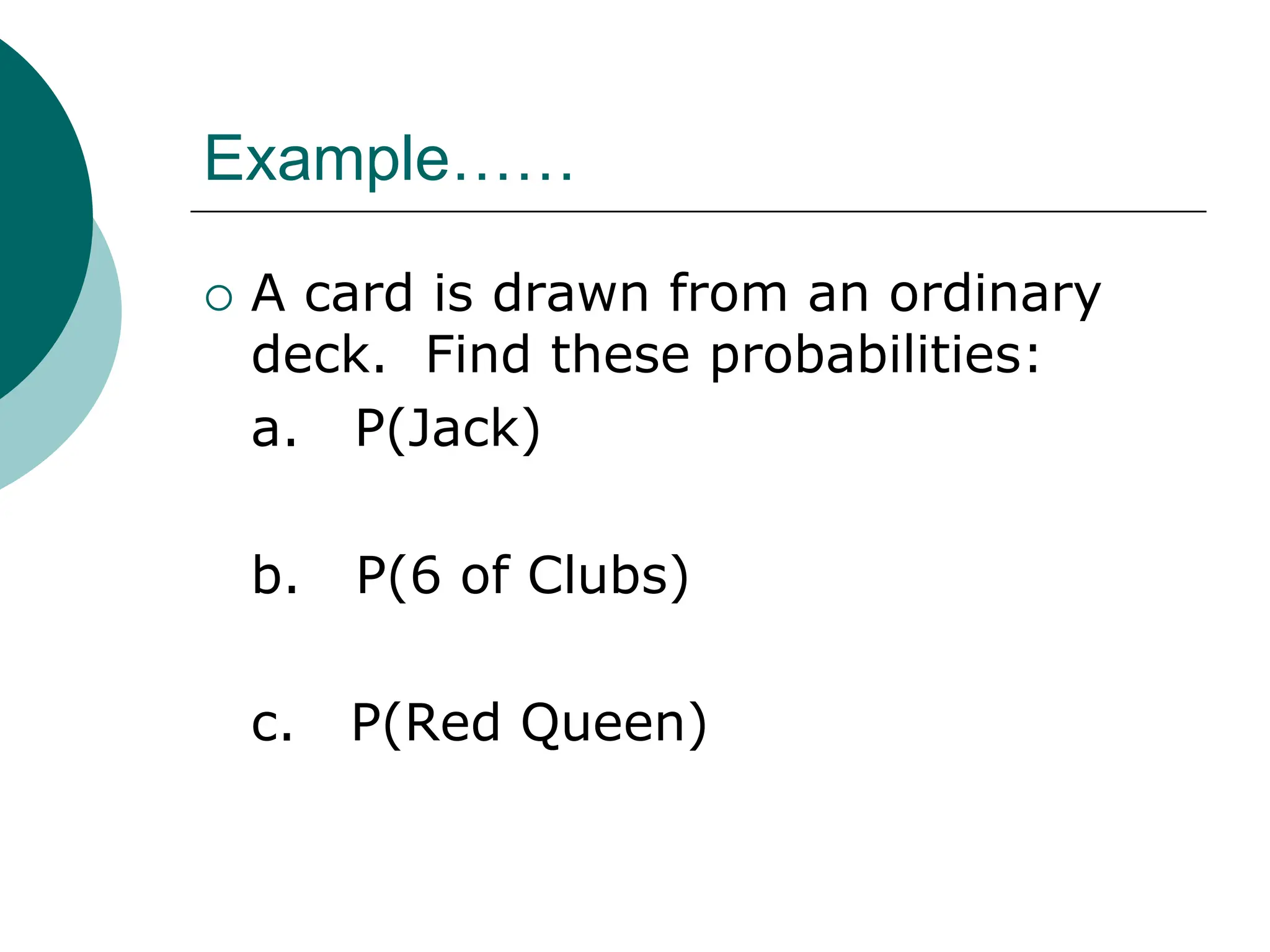
 A card is drawn from an ordinary
deck. Find these probabilities:
a. P(Jack)
b. P(6 of Clubs)
c. P(Red Queen)
Answers……
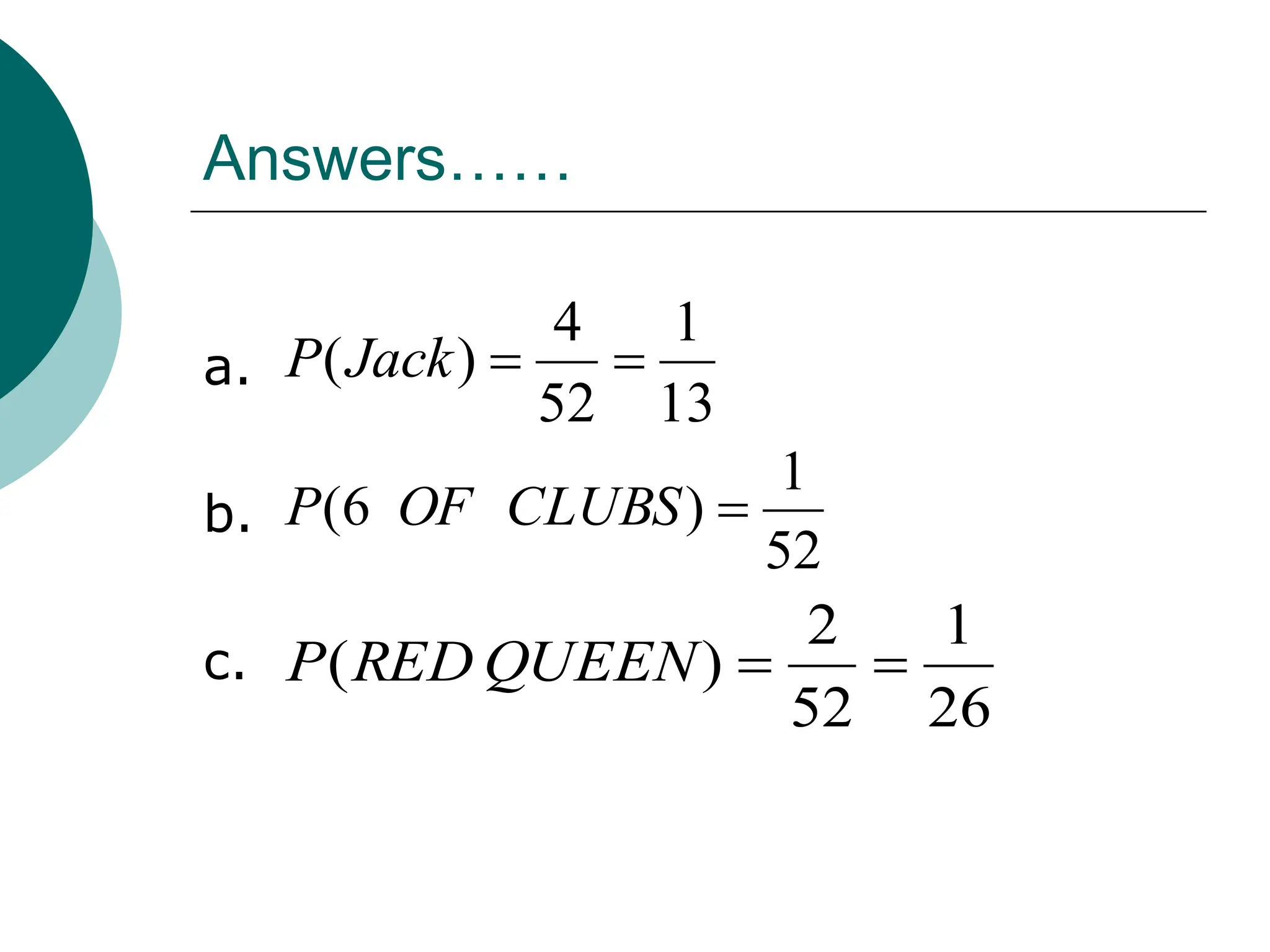
a.
b.
c.
13
1
52
4
)
( 

Jack
P
52
1
)
6
( 
CLUBS
OF
P
26
1
52
2
)
( 

QUEEN
RED
P
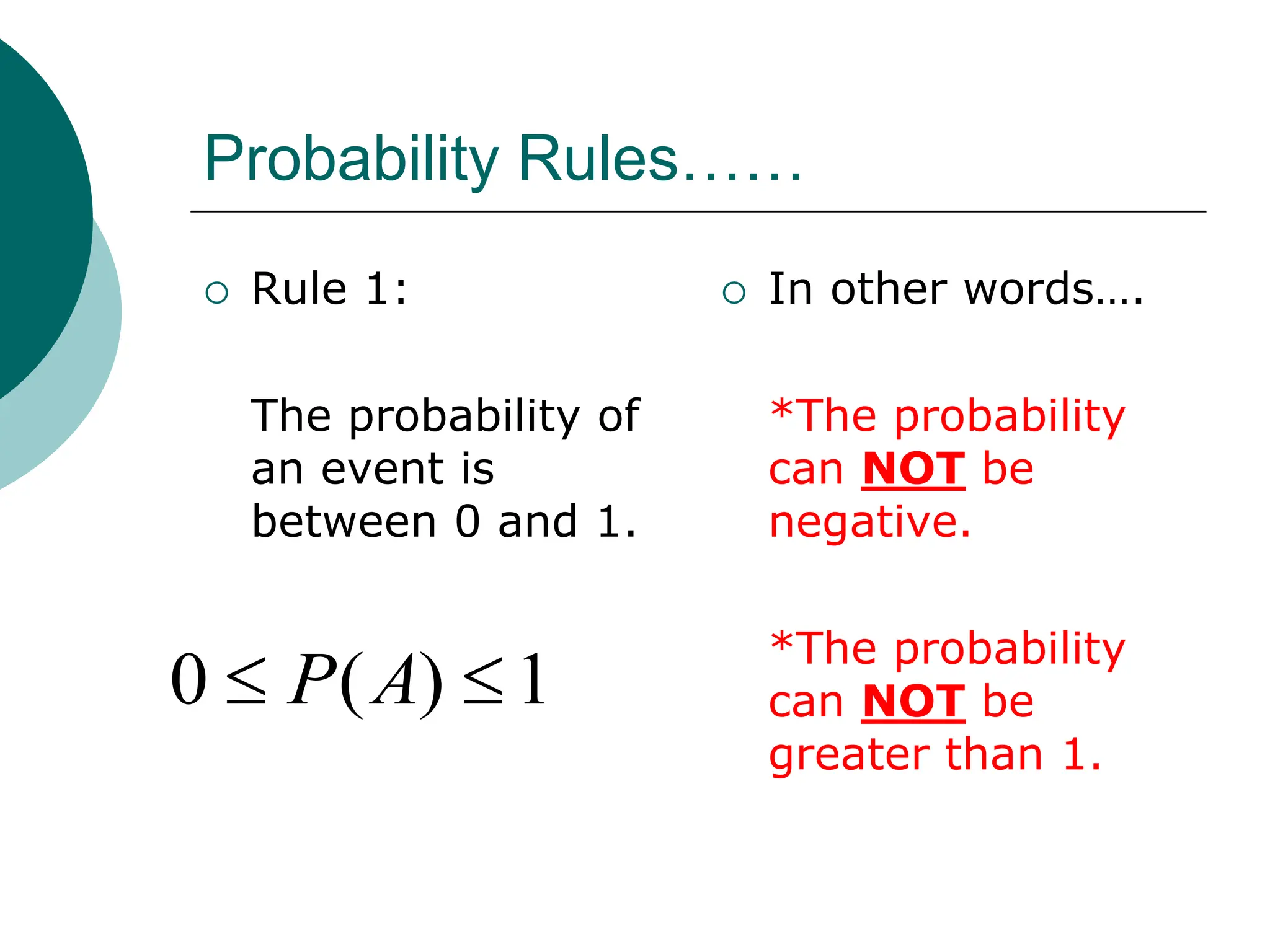
Probability Rules……
 Rule 1:
The probability of
an event is
between 0 and 1.
 In other words….
*The probability
can NOT be
negative.
*The probability
can NOT be
greater than 1.
1
)
(
0 
 A
P
 Rule 2:
If an event can
NOT occur, then
the probability is
0.
 Example:
Find the P(9) on a
die.
 Answer:
P(9) = 0
 Rule 3:
If an event is
certain, then the
probability is 1.
 Example:
Roll a die. What is
the probability of
getting a number
less than 7?
 Answer:
P(# less than 7) =
1
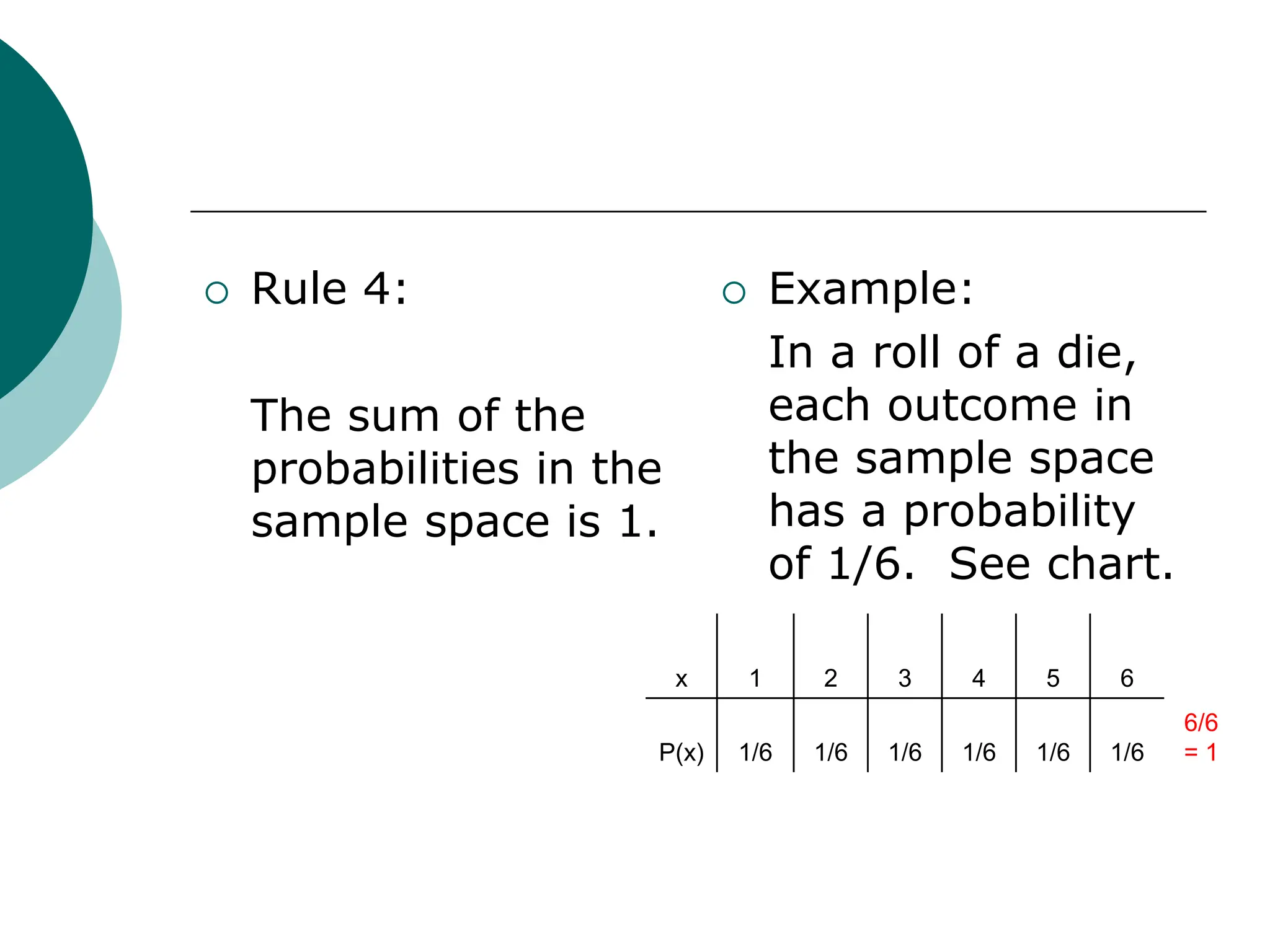
 Rule 4:
The sum of the
probabilities in the
sample space is 1.
 Example:
In a roll of a die,
each outcome in
the sample space
has a probability
of 1/6. See chart.
x 1 2 3 4 5 6
P(x) 1/6 1/6 1/6 1/6 1/6 1/6
6/6
= 1
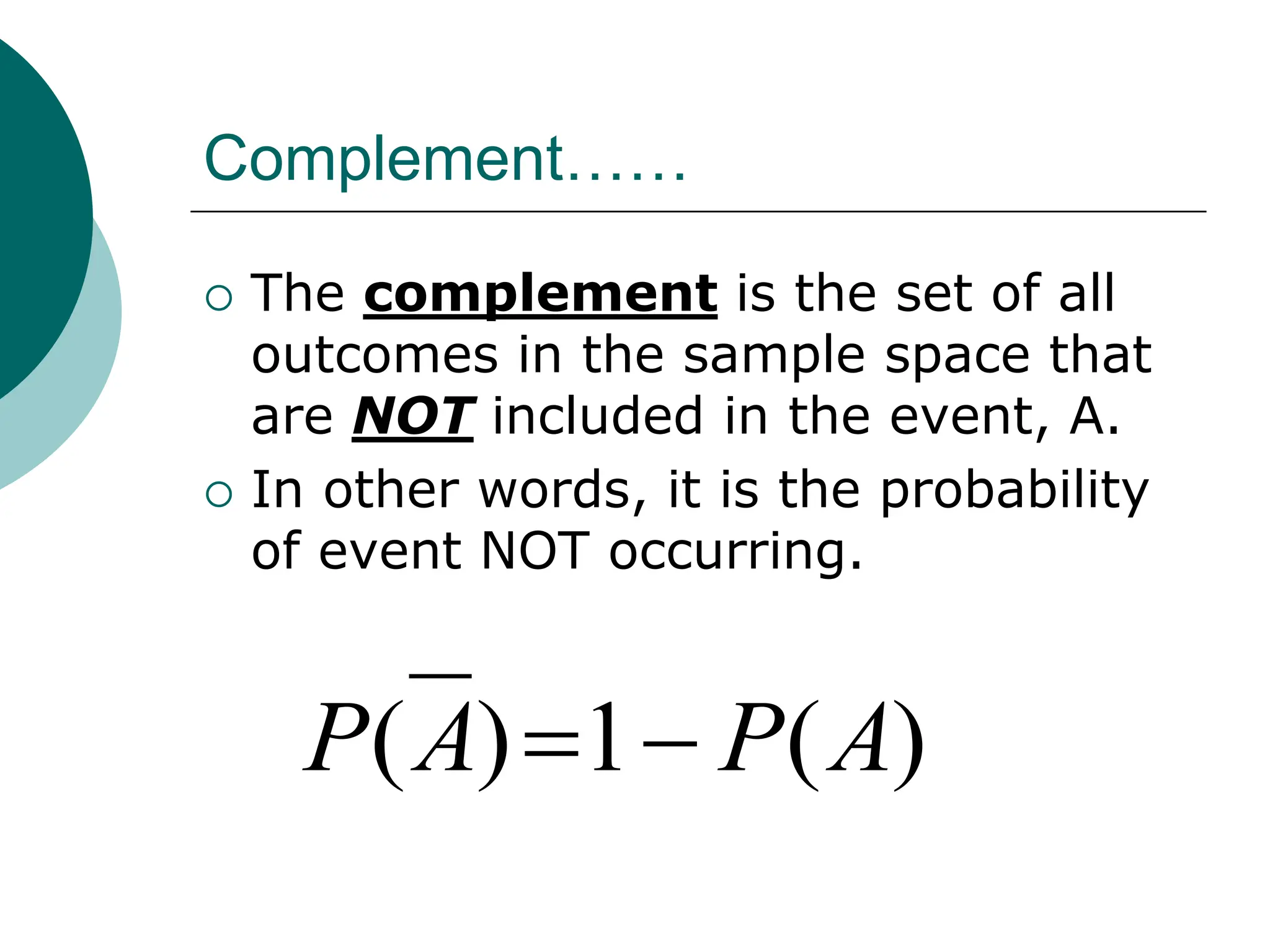
Complement……
 The complement is the set of all
outcomes in the sample space that
are NOT included in the event, A.
 In other words, it is the probability
of event NOT occurring.
)
(
1
)
( A
P
A
P 

Example……
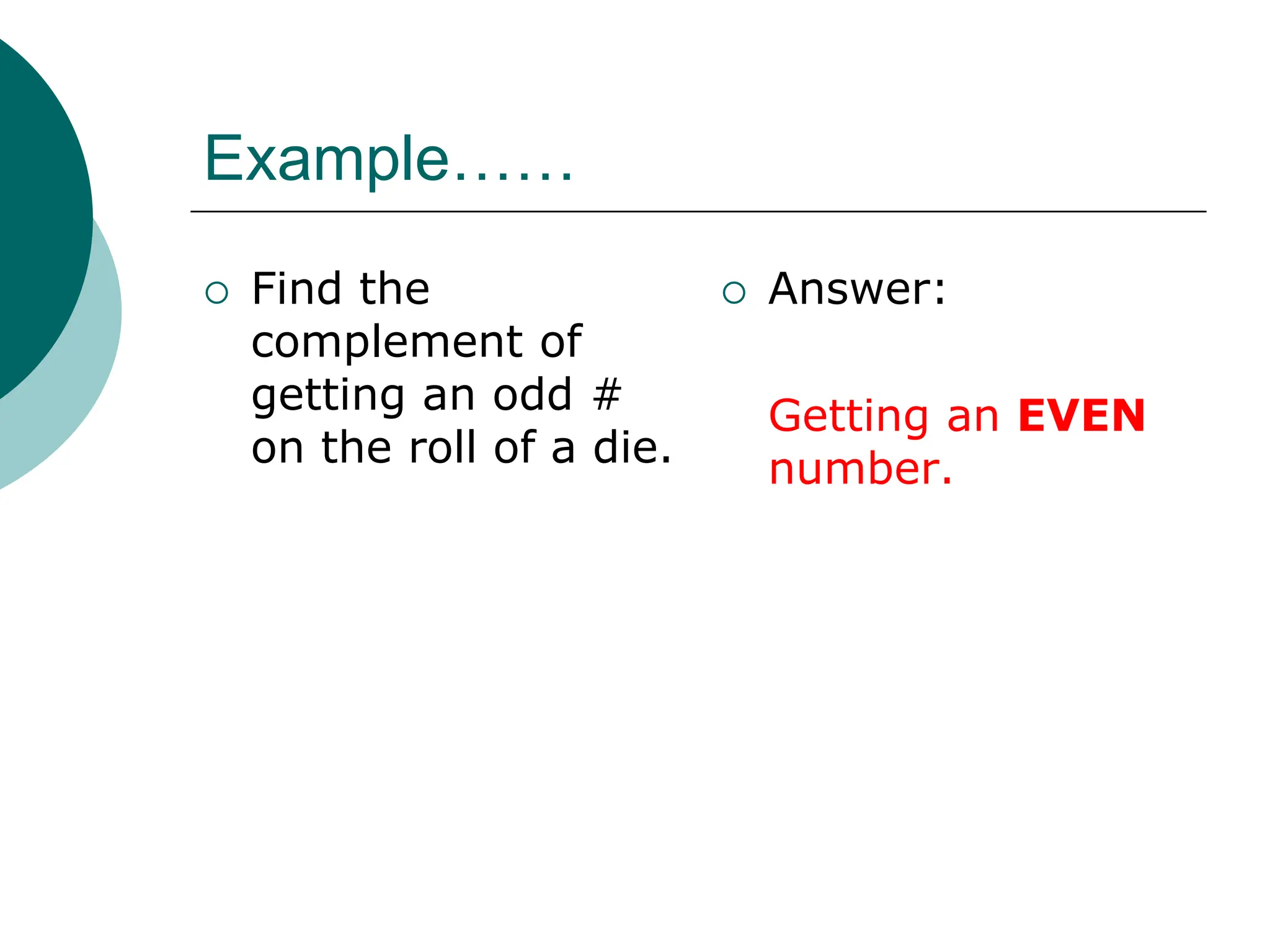
 Find the
complement of
getting an odd #
on the roll of a die.
 Answer:
Getting an EVEN
number.
Example……
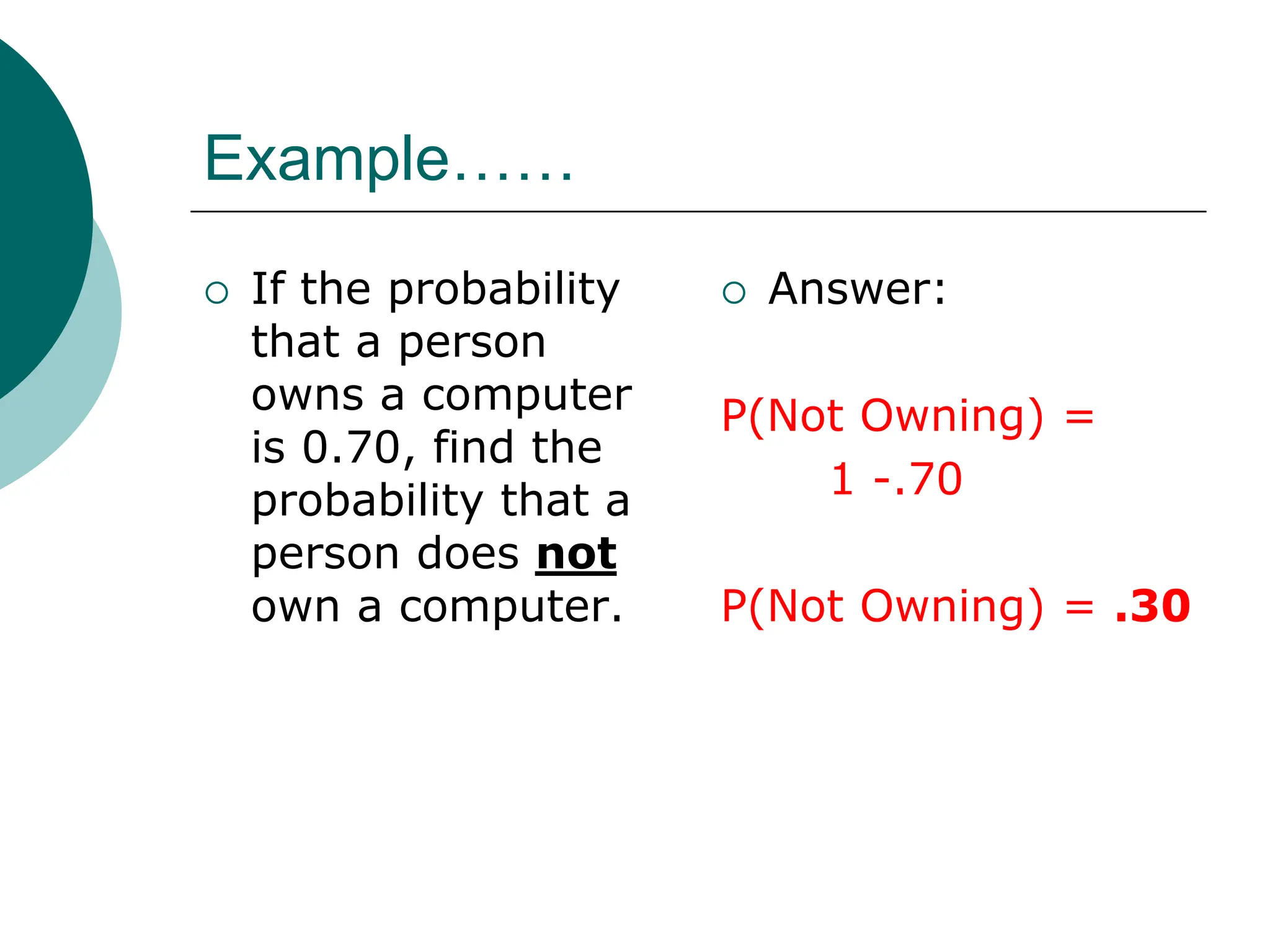
 If the probability
that a person
owns a computer
is 0.70, find the
probability that a
person does not
own a computer.
 Answer:
P(Not Owning) =
1 -.70
P(Not Owning) = .30
Example……
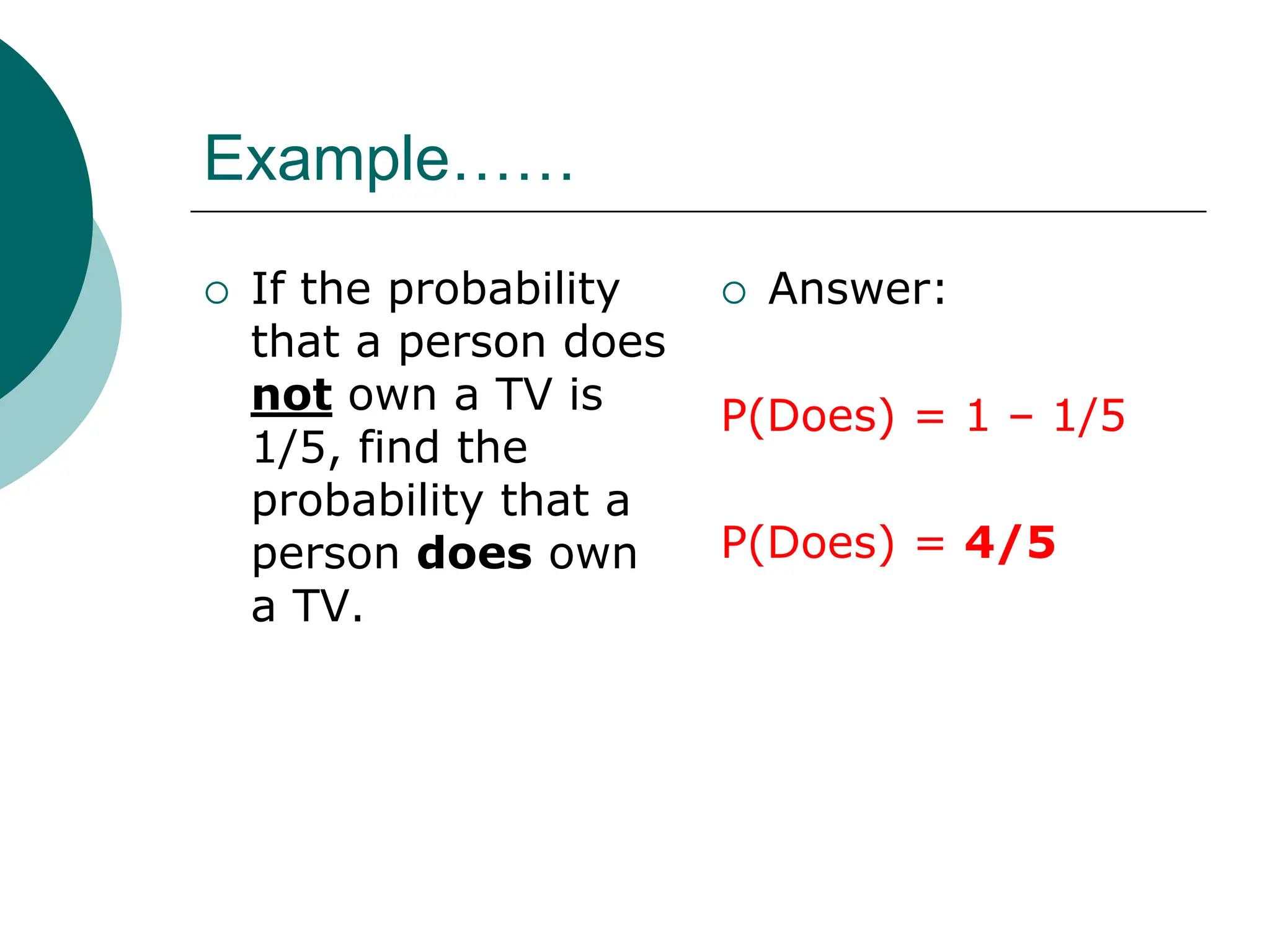
 If the probability
that a person does
not own a TV is
1/5, find the
probability that a
person does own
a TV.
 Answer:
P(Does) = 1 – 1/5
P(Does) = 4/5
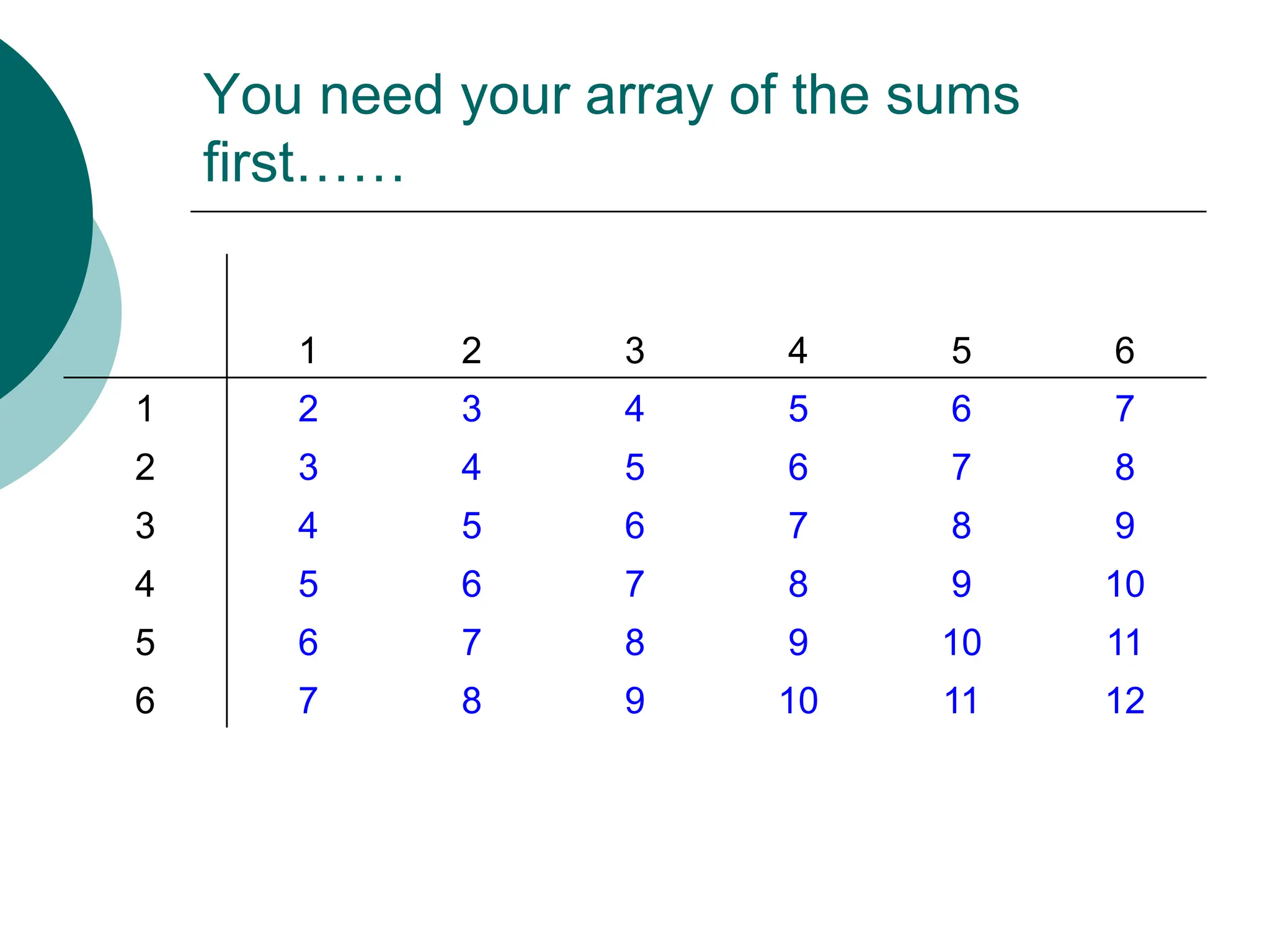
Example……
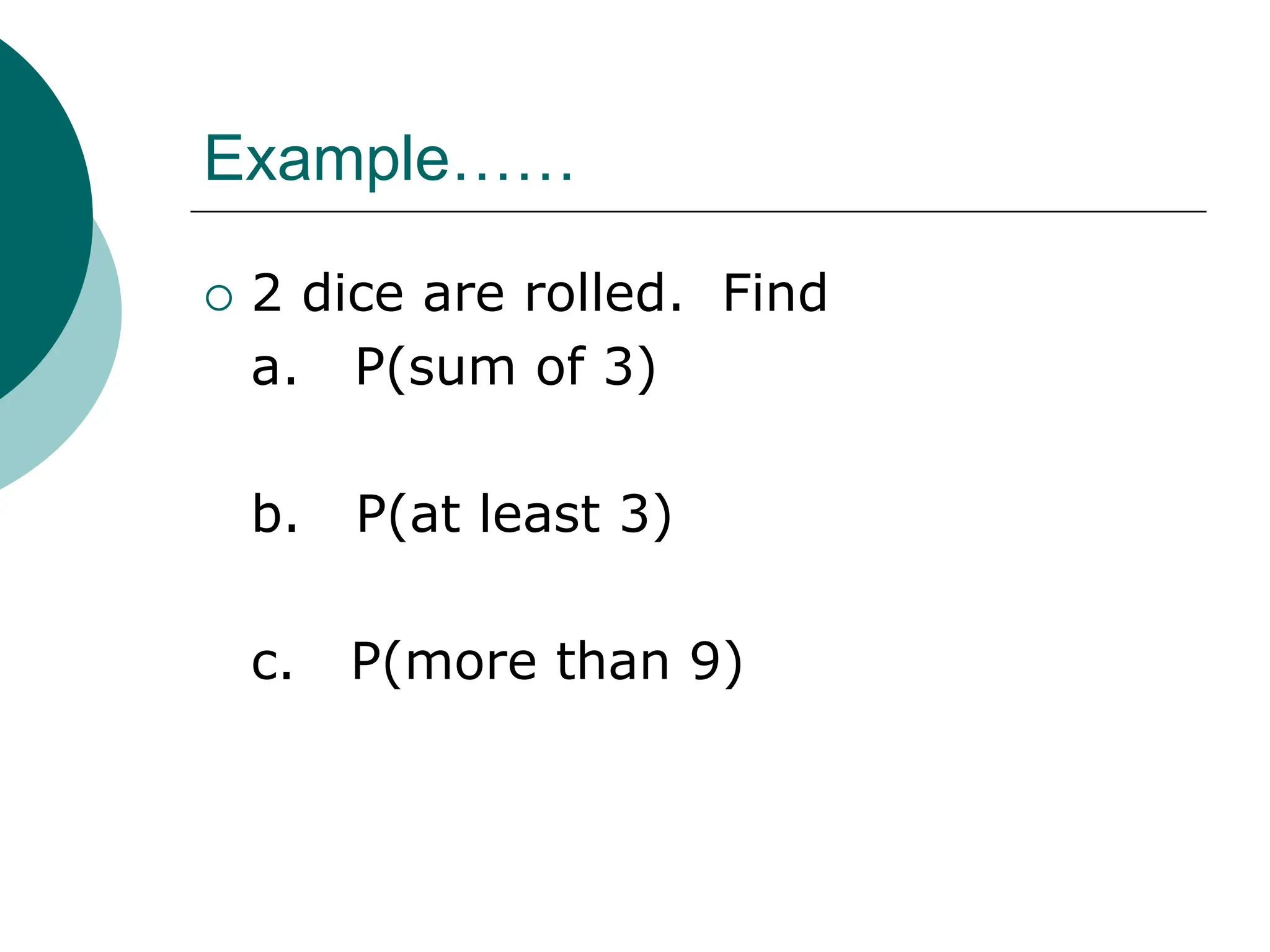
 2 dice are rolled. Find
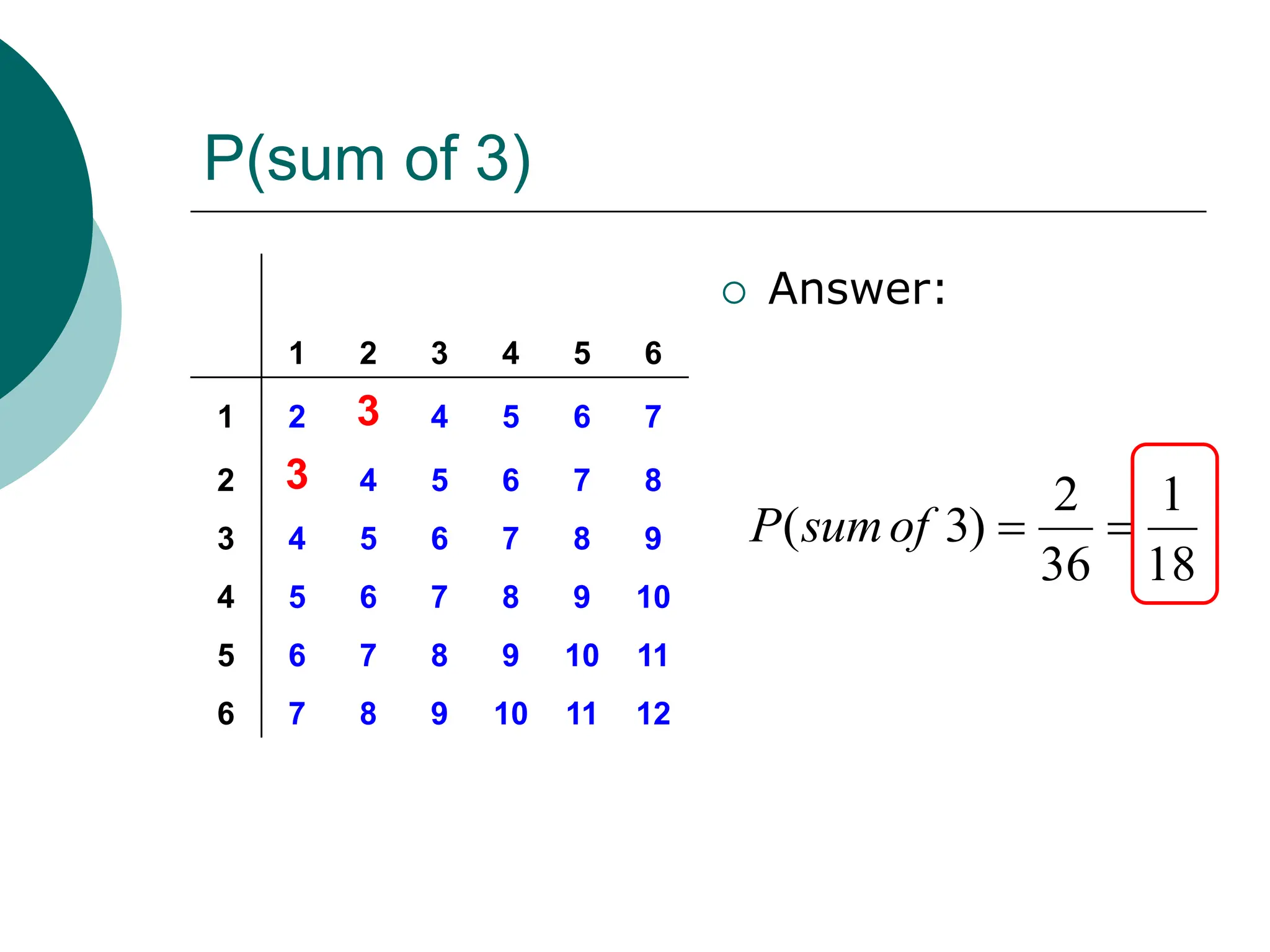
a. P(sum of 3)
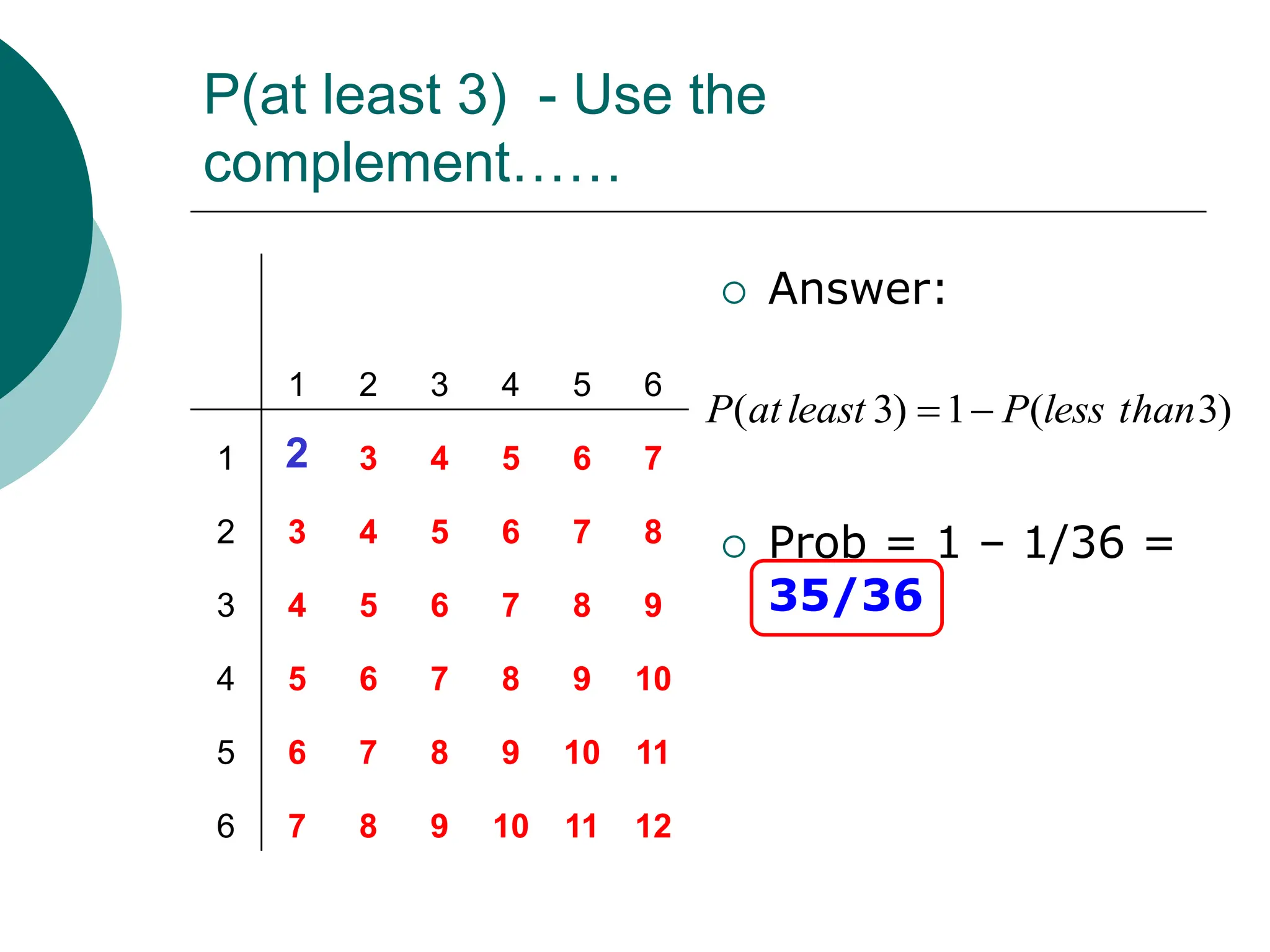
b. P(at least 3)
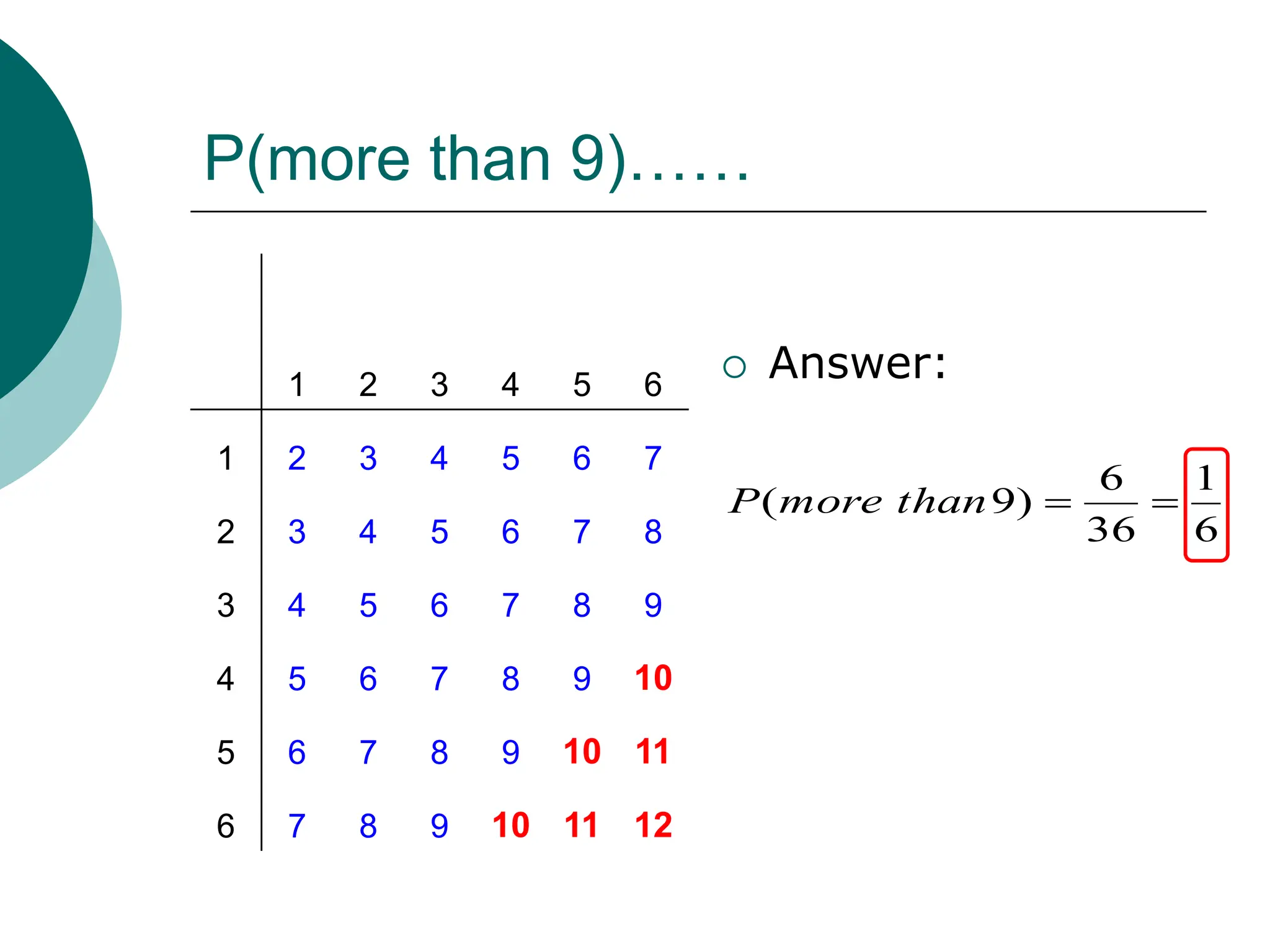
c. P(more than 9)
You need your array of the sums
first……
1 2 3 4 5 6
1 2 3 4 5 6 7
2 3 4 5 6 7 8
3 4 5 6 7 8 9
4 5 6 7 8 9 10
5 6 7 8 9 10 11
6 7 8 9 10 11 12
P(sum of 3)
 Answer:
1 2 3 4 5 6
1 2 3 4 5 6 7
2 3 4 5 6 7 8
3 4 5 6 7 8 9
4 5 6 7 8 9 10
5 6 7 8 9 10 11
6 7 8 9 10 11 12
18
1
36
2
)
3
( 

of
sum
P
P(at least 3) - Use the
complement……
 Answer:
 Prob = 1 – 1/36 =
35/36
1 2 3 4 5 6
1 2 3 4 5 6 7
2 3 4 5 6 7 8
3 4 5 6 7 8 9
4 5 6 7 8 9 10
5 6 7 8 9 10 11
6 7 8 9 10 11 12
)
3
(
1
)
3
( than
less
P
least
at
P 

P(more than 9)……
 Answer:
1 2 3 4 5 6
1 2 3 4 5 6 7
2 3 4 5 6 7 8
3 4 5 6 7 8 9
4 5 6 7 8 9 10
5 6 7 8 9 10 11
6 7 8 9 10 11 12
6
1
36
6
)
9
( 

than
more
P

Day 1 - Law of Large Numbers and Probability (1).ppt

  • 1.
  • 2.
    Vocabulary To Know Probability Experiment: A chance process that leads to well defined results called outcomes.  Outcome: The result of a single trial of a probability experiment.
  • 3.
    Sample Space  SampleSpace: the set of ALL possible outcomes of a probability experiment.  Example:  Flipping a coin has 2 possible outcomes 1. Heads 2. Tails
  • 4.
    You Try  Findthe sample space for the following probability experiments. 1. Toss One Coin 2. Roll a Die 3. Answer a T/F Question 4. Toss 2 Coins
  • 5.
    Answers 1. Toss OneCoin 2. Roll a Die 3. Answer T/F Question 4. Toss 2 Coins 1. H,T 2. 1,2,3,4,5,6 3. T,F 4. HH, TT, HT, TH
  • 6.
    Finding a Probability The probability of an event can be obtained by 3 different methods: 1. Empirical - experimental 2. Theoretical – assumes all outcomes in the sample space are equally likely to occur. 3. Subjective – a value based on an educated guess.
  • 7.
  • 8.
    Empirical Probability Example If a person rolls a die 40 times and 9 of the rolls results in a “5”, what empirical probability was observed for the event “5”?  Answer: 225 . 40 9 ) 5 ( '   P
  • 9.
  • 10.
    Theoretical Probability Example What is the probability of rolling a die and getting a “5”?  Answer: 17 . 6 1 ) (   E P
  • 11.
     The differencebetween theoretical and empirical probability is that theoretical assumes that certain outcomes are equally likely while empirical probability relies on actual experience to determine the likelihood of outcomes.
  • 12.
    Law of LargeNumbers  The Law of Large Numbers says that as the # of trials in an experiment increases, the empirical probability approaches the theoretical probability.  If an experiment is done many times, everything tends to “even out.”
  • 13.
    Labs Let’s try tosee how the Law of Large Numbers works……..
  • 14.
  • 15.
    How are probabilitiesexpressed?  Probabilities are expressed as reduced fractions, decimals rounded to 2 or 3 decimal places, or, where appropriate, percentages  Examples: 1. 2. 0.5 3. 50% 2 1
  • 16.
    Example……  Find the probabilityof drawing a queen from a deck of cards.  Answer: 13 1 52 4 ) (   Queen P
  • 17.
    Example……  If afamily has 3 children, find the probability that all 3 children are girls.  You are going to have to look at the sample space before you can answer this one.
  • 18.
    Looking for all3 girls……  Sample Space: BBB BBG BGB GBB GGG GGB GBG BGG  Answer: 8 1 ) 3 (  Girls All P
  • 19.
    Example……  A cardis drawn from an ordinary deck. Find these probabilities: a. P(Jack) b. P(6 of Clubs) c. P(Red Queen)
  • 20.
  • 21.
    Probability Rules……  Rule1: The probability of an event is between 0 and 1.  In other words…. *The probability can NOT be negative. *The probability can NOT be greater than 1. 1 ) ( 0   A P
  • 22.
     Rule 2: Ifan event can NOT occur, then the probability is 0.  Example: Find the P(9) on a die.  Answer: P(9) = 0
  • 23.
     Rule 3: Ifan event is certain, then the probability is 1.  Example: Roll a die. What is the probability of getting a number less than 7?  Answer: P(# less than 7) = 1
  • 24.
     Rule 4: Thesum of the probabilities in the sample space is 1.  Example: In a roll of a die, each outcome in the sample space has a probability of 1/6. See chart. x 1 2 3 4 5 6 P(x) 1/6 1/6 1/6 1/6 1/6 1/6 6/6 = 1
  • 25.
    Complement……  The complementis the set of all outcomes in the sample space that are NOT included in the event, A.  In other words, it is the probability of event NOT occurring. ) ( 1 ) ( A P A P  
  • 26.
    Example……  Find the complementof getting an odd # on the roll of a die.  Answer: Getting an EVEN number.
  • 27.
    Example……  If theprobability that a person owns a computer is 0.70, find the probability that a person does not own a computer.  Answer: P(Not Owning) = 1 -.70 P(Not Owning) = .30
  • 28.
    Example……  If theprobability that a person does not own a TV is 1/5, find the probability that a person does own a TV.  Answer: P(Does) = 1 – 1/5 P(Does) = 4/5
  • 29.
    Example……  2 diceare rolled. Find a. P(sum of 3) b. P(at least 3) c. P(more than 9)
  • 30.
    You need yourarray of the sums first…… 1 2 3 4 5 6 1 2 3 4 5 6 7 2 3 4 5 6 7 8 3 4 5 6 7 8 9 4 5 6 7 8 9 10 5 6 7 8 9 10 11 6 7 8 9 10 11 12
  • 31.
    P(sum of 3) Answer: 1 2 3 4 5 6 1 2 3 4 5 6 7 2 3 4 5 6 7 8 3 4 5 6 7 8 9 4 5 6 7 8 9 10 5 6 7 8 9 10 11 6 7 8 9 10 11 12 18 1 36 2 ) 3 (   of sum P
  • 32.
    P(at least 3)- Use the complement……  Answer:  Prob = 1 – 1/36 = 35/36 1 2 3 4 5 6 1 2 3 4 5 6 7 2 3 4 5 6 7 8 3 4 5 6 7 8 9 4 5 6 7 8 9 10 5 6 7 8 9 10 11 6 7 8 9 10 11 12 ) 3 ( 1 ) 3 ( than less P least at P  
  • 33.
    P(more than 9)…… Answer: 1 2 3 4 5 6 1 2 3 4 5 6 7 2 3 4 5 6 7 8 3 4 5 6 7 8 9 4 5 6 7 8 9 10 5 6 7 8 9 10 11 6 7 8 9 10 11 12 6 1 36 6 ) 9 (   than more P