Surface Area of SolidsMarch 22, 2010
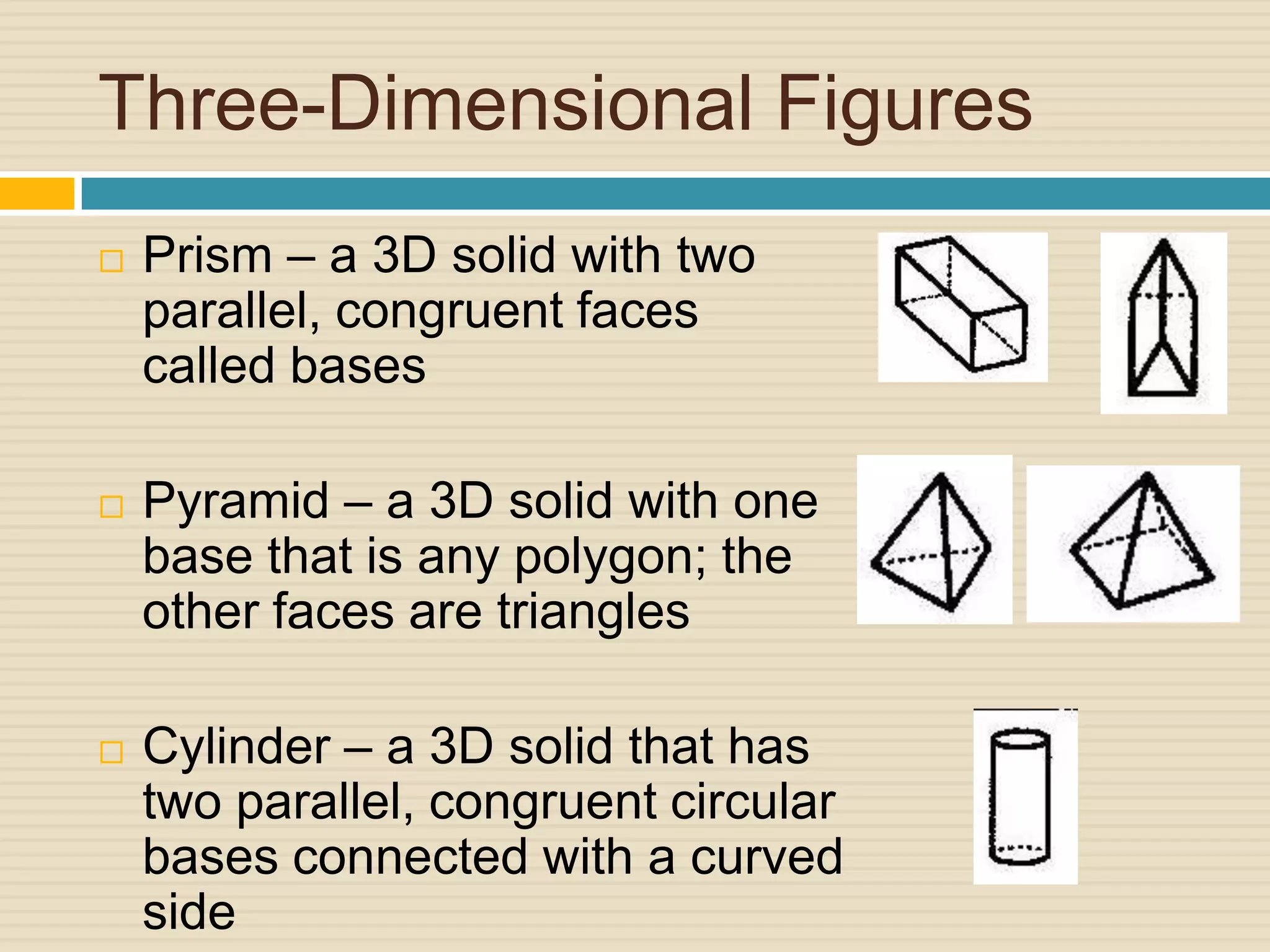
Three-Dimensional FiguresPrism – a 3D solid with two parallel, congruent faces called basesPyramid –a 3D solid with one base that is any polygon; the other faces are trianglesCylinder – a 3D solid that has two parallel, congruent circular bases connected with a curved side
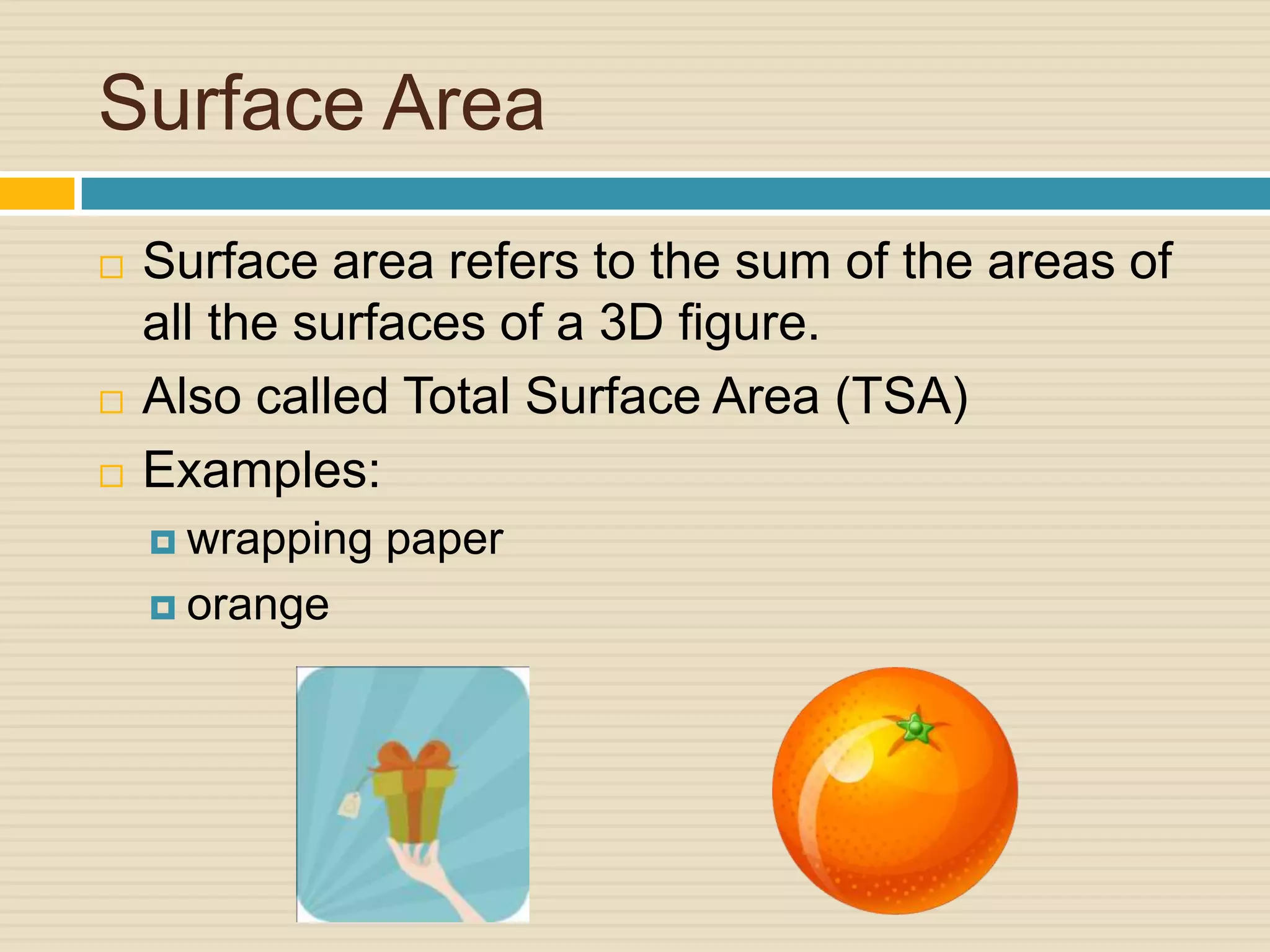
Surface AreaSurface area refers to the sum of the areas of all the surfaces of a 3D figure.  Also called Total Surface Area (TSA)Examples: wrapping paperorange
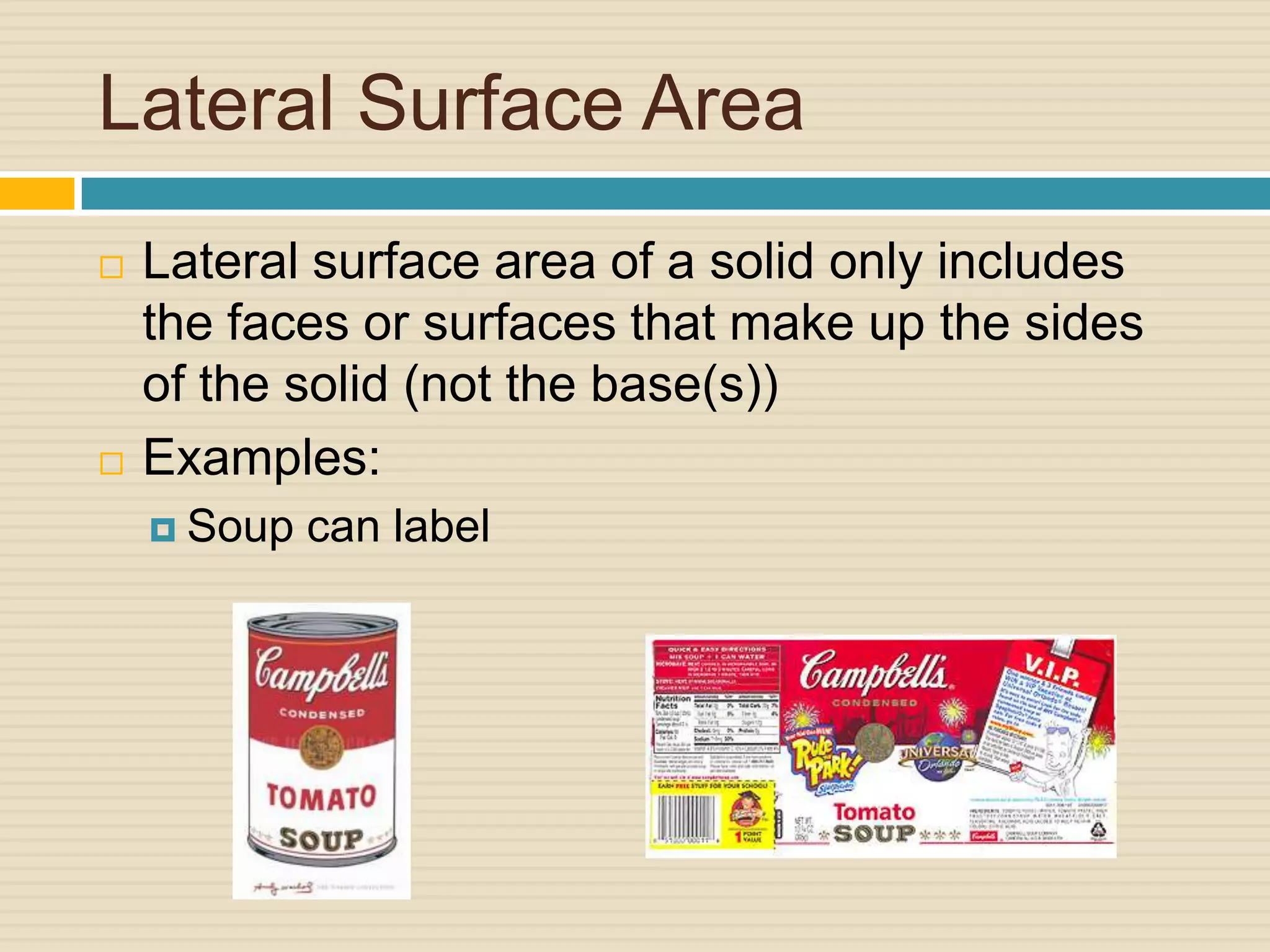
Lateral Surface AreaLateral surface area of a solid only includes the faces or surfaces that make up the sides of the solid (not the base(s))Examples: Soup can label
With a partner, you will determine the surface area of various geometric solids. How Do You Find the Surface Area of a Solid?
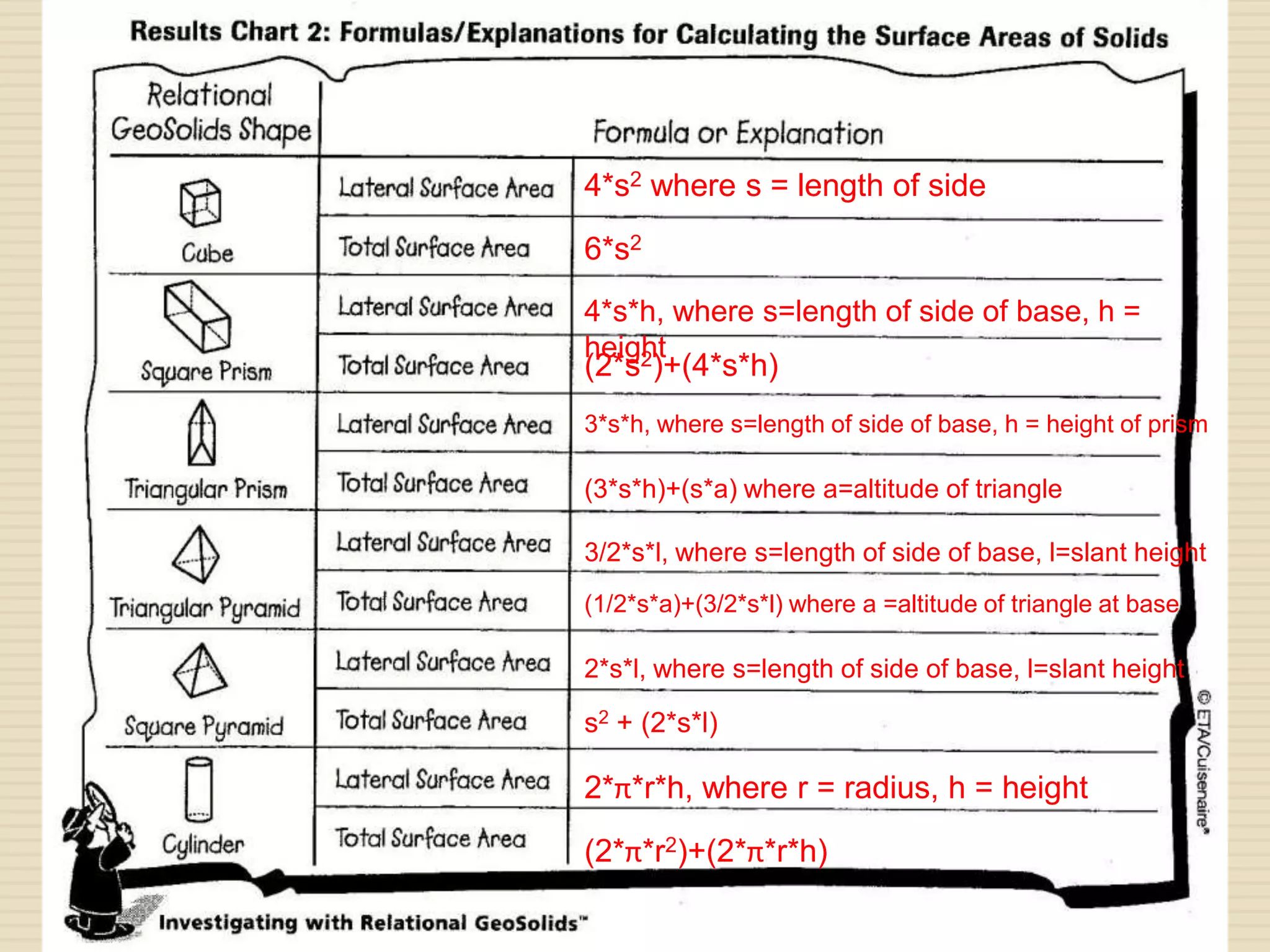
4*s2 where s = length of side6*s24*s*h, where s=length of side of base, h = height(2*s2)+(4*s*h)3*s*h, where s=length of side of base, h = height of prism(3*s*h)+(s*a) where a=altitude of triangle3/2*s*l, where s=length of side of base, l=slant height(1/2*s*a)+(3/2*s*l) where a =altitude of triangle at base2*s*l, where s=length of side of base, l=slant heights2 + (2*s*l)2*π*r*h, where r = radius, h = height(2*π*r2)+(2*π*r*h)

Surface Area Of Solids

  • 1.
    Surface Area ofSolidsMarch 22, 2010
  • 2.
    Three-Dimensional FiguresPrism –a 3D solid with two parallel, congruent faces called basesPyramid –a 3D solid with one base that is any polygon; the other faces are trianglesCylinder – a 3D solid that has two parallel, congruent circular bases connected with a curved side
  • 3.
    Surface AreaSurface arearefers to the sum of the areas of all the surfaces of a 3D figure. Also called Total Surface Area (TSA)Examples: wrapping paperorange
  • 4.
    Lateral Surface AreaLateralsurface area of a solid only includes the faces or surfaces that make up the sides of the solid (not the base(s))Examples: Soup can label
  • 5.
    With a partner,you will determine the surface area of various geometric solids. How Do You Find the Surface Area of a Solid?
  • 6.
    4*s2 where s= length of side6*s24*s*h, where s=length of side of base, h = height(2*s2)+(4*s*h)3*s*h, where s=length of side of base, h = height of prism(3*s*h)+(s*a) where a=altitude of triangle3/2*s*l, where s=length of side of base, l=slant height(1/2*s*a)+(3/2*s*l) where a =altitude of triangle at base2*s*l, where s=length of side of base, l=slant heights2 + (2*s*l)2*π*r*h, where r = radius, h = height(2*π*r2)+(2*π*r*h)

Editor's Notes

  • #3 Beginning course details and/or books/materials needed for a class/project.
  • #4 Beginning course details and/or books/materials needed for a class/project.
  • #5 Beginning course details and/or books/materials needed for a class/project.
  • #6 Beginning course details and/or books/materials needed for a class/project.
  • #7 Beginning course details and/or books/materials needed for a class/project.