Author(s): Louis D’Alecy, 2009

License: Unless otherwise noted, this material is made available under the terms of the
Creative Commons Attribution–Non-commercial–Share Alike 3.0 License:
http://creativecommons.org/licenses/by-nc-sa/3.0/

We have reviewed this material in accordance with U.S. Copyright Law and have tried to maximize your ability to use,
share, and adapt it. The citation key on the following slide provides information about how you may share and adapt this
material.

Copyright holders of content included in this material should contact open.michigan@umich.edu with any questions,
corrections, or clarification regarding the use of content.

For more information about how to cite these materials visit http://open.umich.edu/education/about/terms-of-use.

Any medical information in this material is intended to inform and educate and is not a tool for self-diagnosis or a
replacement for medical evaluation, advice, diagnosis or treatment by a healthcare professional. Please speak to your
physician if you have questions about your medical condition.

Viewer discretion is advised: Some medical content is graphic and may not be suitable for all viewers.
Citation Key
                          for more information see: http://open.umich.edu/wiki/CitationPolicy


Use + Share + Adapt
  { Content the copyright holder, author, or law permits you to use, share and adapt. }
               Public Domain – Government: Works that are produced by the U.S. Government. (USC 17 § 105)
               Public Domain – Expired: Works that are no longer protected due to an expired copyright term.
               Public Domain – Self Dedicated: Works that a copyright holder has dedicated to the public domain.

               Creative Commons – Zero Waiver

               Creative Commons – Attribution License
               Creative Commons – Attribution Share Alike License
               Creative Commons – Attribution Noncommercial License
               Creative Commons – Attribution Noncommercial Share Alike License
               GNU – Free Documentation License

Make Your Own Assessment
  { Content Open.Michigan believes can be used, shared, and adapted because it is ineligible for copyright. }
               Public Domain – Ineligible: Works that are ineligible for copyright protection in the U.S. (USC 17 § 102(b)) *laws in
               your jurisdiction may differ
   { Content Open.Michigan has used under a Fair Use determination. }
               Fair Use: Use of works that is determined to be Fair consistent with the U.S. Copyright Act. (USC 17 § 107) *laws in
               your jurisdiction may differ
               Our determination DOES NOT mean that all uses of this 3rd-party content are Fair Uses and we DO NOT guarantee
               that your use of the content is Fair.
               To use this content you should do your own independent analysis to determine whether or not your use will be Fair.
O2 and CO2 Transport

              M1 – Cardiovascular/
              Respiratory Sequence
               Louis D’Alecy, Ph.D.


Fall 2008                             3
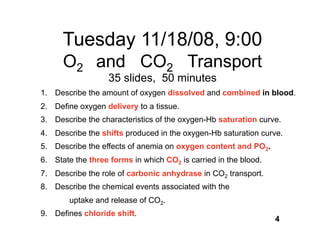
Tuesday 11/18/08, 9:00 

        O2 and CO2 Transport

            35 slides, 50 minutes
1.  Describe the amount of oxygen dissolved and combined in blood.
2.  Define oxygen delivery to a tissue.
3.  Describe the characteristics of the oxygen-Hb saturation curve.
4.  Describe the shifts produced in the oxygen-Hb saturation curve.
5.  Describe the effects of anemia on oxygen content and PO2.
6.  State the three forms in which CO2 is carried in the blood.
7.  Describe the role of carbonic anhydrase in CO2 transport.
8.  Describe the chemical events associated with the 
    
   uptake and release of CO2.
9.  Defines chloride shift.
                                                                   4
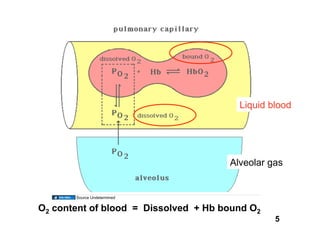
Liquid blood


                                      Alveolar gas


       Source Undetermined


O2 content of blood = Dissolved + Hb bound O2
                                                5
How much gas is dissolved ?

A gas dissolves in a liquid in direct proportion to

its partial    pressure and solubility.

             “Henry’s Law”

                                                6
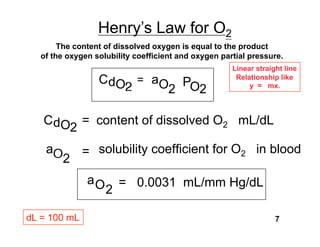
Henry’s Law for O2
        The content of dissolved oxygen is equal to the product
   of the oxygen solubility coefficient and oxygen partial pressure.
                                                      Linear straight line
                  C
 
 
 =
 a
                   dO        O
 P
 2
                                                       Relationship like
                                                                       
                               2
 O
                       y = mx.


   C
 
 
 =
 content of dissolved O2 mL/dL
    dO2

    a
         =
 solubility coefficient for O2 in blood
         2
               a
                O
 =
 0.0031 mL/mm Hg/dL
                  2

dL = 100 mL
                                                       7
Dissolved O2
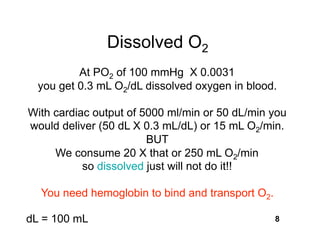
          At PO2 of 100 mmHg X 0.0031
  you get 0.3 mL O2/dL dissolved oxygen in blood.

With cardiac output of 5000 ml/min or 50 dL/min you
would deliver (50 dL X 0.3 mL/dL) or 15 mL O2/min.
                        BUT
     We consume 20 X that or 250 mL O2/min
           so dissolved just will not do it!!

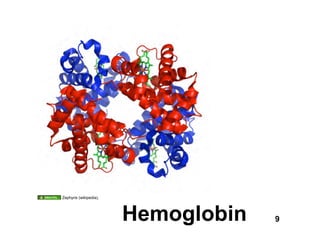
  You need hemoglobin to bind and transport O2.

dL = 100 mL                                       8
Zephyris (wikipedia),


                        Hemoglobin   9
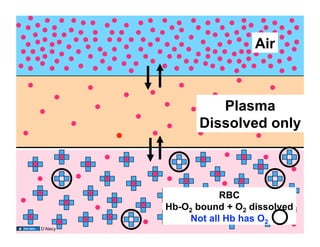
Air
                          Air


                    Plasma
                 Dissolved only


                     RBC
          Hb-O2 bound + O2 dissolved
              Not all Hb has O2
10
D’Alecy
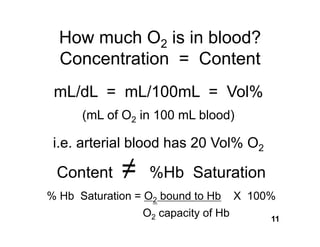
How much O2 is in blood?

  Concentration = Content
 mL/dL = mL/100mL = Vol%
      (mL of O2 in 100 mL blood)

 i.e. arterial blood has 20 Vol% O2

 Content     ≠    %Hb Saturation
% Hb Saturation = O2 bound to Hb     X 100%
                 O2 capacity of Hb        11
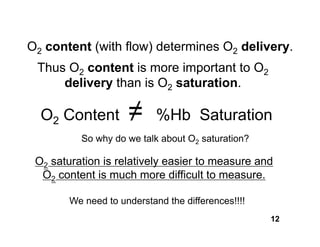
O2 content (with flow) determines O2 delivery.
 Thus O2 content is more important to O2
     delivery than is O2 saturation.

  O2 Content         ≠      %Hb Saturation
          So why do we talk about O2 saturation?

 O2 saturation is relatively easier to measure and
  O2 content is much more difficult to measure.

        We need to understand the differences!!!!
                                                    12
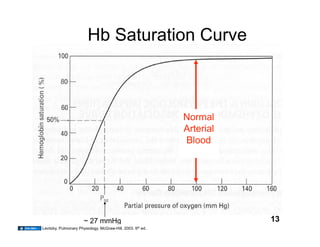
Hb Saturation Curve


                                                             Normal
                                                             Arterial
                                                             Blood


                       ~ 27 mmHg                                        13
Levitzky. Pulmonary Physiology. McGraw-Hill, 2003. 6th ed.
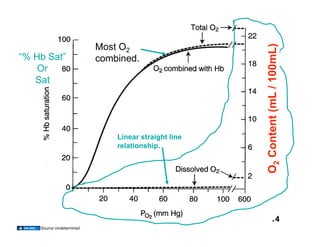
Most O2


                                                      O2 Content (mL / 100mL)
“% Hb Sat”
               combined.   
    Or 
   Sat


                              Linear straight line
                              relationship.  


                                                             14
    Source Undetermined
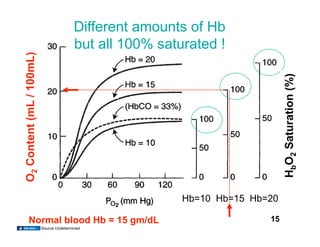
Different amounts of Hb 
                                         but all 100% saturated !
O2 Content (mL / 100mL)


                                                                             HbO2 Saturation (%)
                                                         Hb=10 Hb=15 Hb=20

       Normal blood Hb = 15 gm/dL
                                      15
                          Source Undetermined
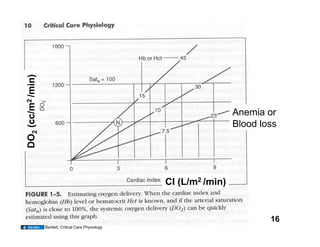
DO2 (cc/m2 /min)


                                                                         Anemia or
                                                                         Blood loss


                                                        CI (L/m2 /min)


                                                                                 16
                   Bartlett, Critical Care Physiology
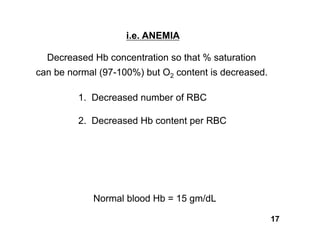
i.e. ANEMIA

  Decreased Hb concentration so that % saturation
can be normal (97-100%) but O2 content is decreased.

         1. Decreased number of RBC

         2. Decreased Hb content per RBC


            Normal blood Hb = 15 gm/dL

                                                       17
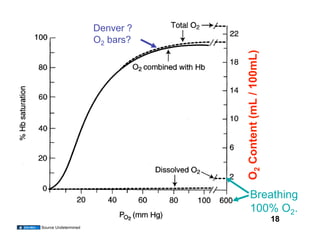
Denver ?
                      O2 bars?


                                 O2 Content (mL / 100mL)
                                      Breathing
                                      100% O2.
                                                           18
Source Undetermined
Hemoglobin Bound Oxygen Content mL O2 /dL


        Cb    = S O [ Hb ] Hb s
           O2      2


S O = % Hb saturation = O2 bound to Hb X 100%
                         O2 capacity of Hb

[ Hb ] = hemoglobin content gm/dL blood

 Hb s = saturated Hb O2 content mL O2 /gm Hb

 Hbs = 1.36 mL O2 /gm Hb = O2 capacity
                                             19
Typical Arterial Blood Oxygen Content
    P        = 100 mm Hg               S     = 97%   [ Hb ] = 15 gm/dL
        O                                  O
            2                               2

Dissolved O
   Cd        a
        O2 =   O             P
                                  O2
                                       = 0.0031 x 100 = 0.31 mL / dL
                      2
Bound O
    C        = S [ Hb ] Hb = 0.97 x 15 x 1.36 = 19.79 mL / dL
        b       O         s
            O     2
             2
Total Oxygen Content
     Cd              C
             O2 +        b        = 0.31 + 19.79 = 20.1 mL / dL
                             O
                              2
                                                                20
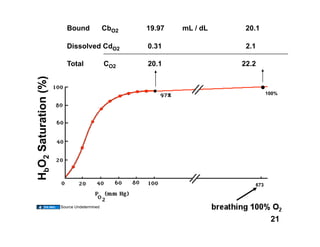
Bound              CbO2   19.97   mL / dL    20.1

                         Dissolved CdO2            0.31               2.1

                         Total              CO2    20.1              22.2
HbO2 Saturation (%)


                                                                              100%


                                                                        673


                      Source Undetermined


                                                                               21
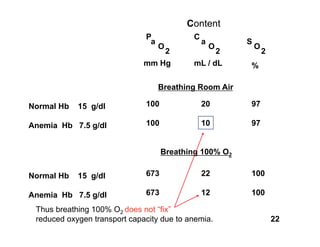
Content
                              P
            C
                               a
             a
          S
                                    O
             O
       O
                                     2
             2
       2
                              mm Hg 
       mL / dL 
      %

                                    Breathing Room Air

Normal Hb   15 g/dl
          100
            20
          97

Anemia Hb 7.5 g/dl 
          100
            10
          97


                                    Breathing 100% O2


Normal Hb   15 g/dl
          673
            22
          100

Anemia Hb 7.5 g/dl 
          673
            12
          100

 Thus breathing 100% O2 does not “fix” 
 reduced oxygen transport capacity due to anemia.   
             22
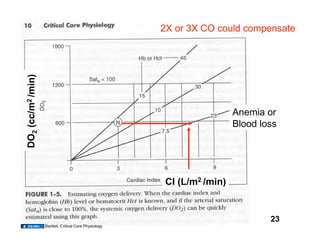
DO2 (cc/m2 /min)                                        2X or 3X CO could compensate


                                                                         Anemia or
                                                                         Blood loss


                                                        CI (L/m2 /min)


                                                                                 23
                   Bartlett, Critical Care Physiology
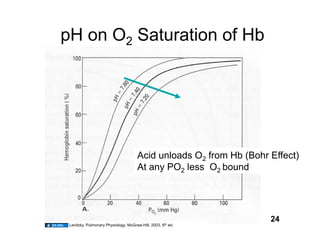
pH on O2 Saturation of Hb


                                      Acid unloads O2 from Hb (Bohr Effect)
                                      At any PO2 less O2 bound


                                                                    24
 Levitzky. Pulmonary Physiology. McGraw-Hill, 2003. 6th ed.
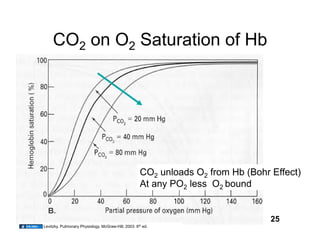
CO2 on O2 Saturation of Hb


                                                       CO2 unloads O2 from Hb (Bohr Effect)
                                                       At any PO2 less O2 bound


                                                                                    25
Levitzky. Pulmonary Physiology. McGraw-Hill, 2003.   6th   ed.
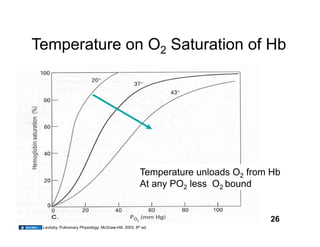
Temperature on O2 Saturation of Hb


                                                        Temperature unloads O2 from Hb
                                                        At any PO2 less O2 bound


                                                                                    26
 Levitzky. Pulmonary Physiology. McGraw-Hill, 2003.   6th   ed.
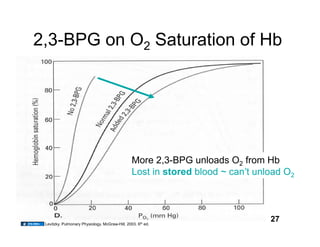
2,3-BPG on O2 Saturation of Hb


                                                 More 2,3-BPG unloads O2 from Hb
                                                 Lost in stored blood ~ canʼt unload O2 


 Levitzky. Pulmonary Physiology. McGraw-Hill, 2003. 6th ed.
                                                                                  27
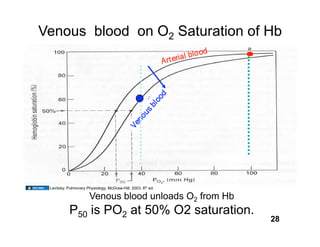
Venous blood on O2 Saturation of Hb


 Levitzky. Pulmonary Physiology. McGraw-Hill, 2003. 6th ed.

                       Venous blood unloads O2 from Hb
           P50 is PO2 at 50% O2 saturation.
                                                              28
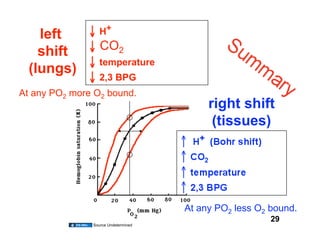
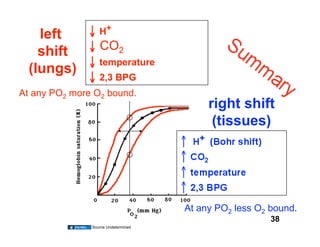
left  ↓ H+
    shift ↓ CO2
          ↓ temperature
  (lungs)
          ↓ 2,3 BPG
At any PO2 more O2 bound.
                                          right shift
                                           (tissues)


                                     At any PO2 less O2 bound.
                                                        29
               Source Undetermined
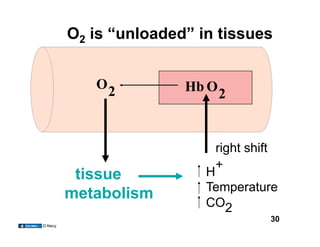
O2 is “unloaded” in tissues


             O
          Hb
O
              2
             2


                             right shift
                             +
           tissue
          H
                            Temperature
          metabolism
                            CO
2
                                       30
D’Alecy
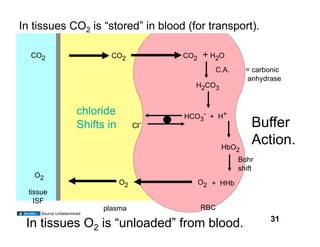
In tissues CO2 is “stored” in blood (for transport).

  CO2                          CO2            CO2    + H2O
                                                       C.A.      = carbonic
                                                                 anhydrase
                                                H2CO3


                       chloride               HCO3- + H+
                       Shifts in        Cl-                        Buffer
                                                          HbO2
                                                                   Action.
                                                               Bohr
                                                               shift
   O2
                                   O2               O2 + HHb
  tissue
    ISF
                             plasma                 RBC
      Source Undetermined
                                                                        31
 In tissues O2 is “unloaded” from blood.
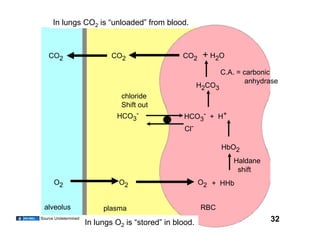
In lungs CO2 is “unloaded” from blood.


    CO2                       CO2                  CO2     + H2O
                                                                  C.A. = carbonic
                                                                          anhydrase
                                                          H2CO3
                                 chloride
                                 Shift out
                               HCO3-               HCO3- + H+
                                                    Cl-

                                                                  HbO2
                                                                     Haldane
                                                                      shift
      O2                        O2                        O2 + HHb


 alveolus                  plasma                         RBC
Source Undetermined
                      In lungs O2 is “stored” in blood.                         32
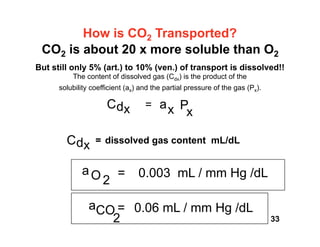
How is CO2 Transported?
 CO2 is about 20 x more soluble than O2
But still only 5% (art.) to 10% (ven.) of transport is dissolved!!
          The content of dissolved gas (Cdx) is the product of the
      solubility coefficient (ax) and the partial pressure of the gas (Px).

                      C
 
 
 =
 a
 P
                       dx        x
 x

        C
 
 
 =
         dx          dissolved gas content mL/dL 


             a
O
 =
 0.003 mL / mm Hg /dL
                 2
                a
 =
 0.06 mL / mm Hg /dL
                 CO
                   2
                                                         33
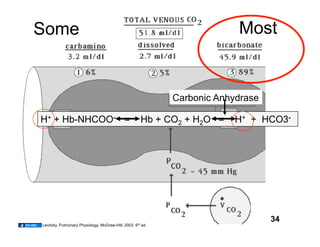
Some
                                                                     Most


                                                             Carbonic Anhydrase

H+ + Hb-NHCOO- =                                      Hb + CO2 + H2O =    H+ + HCO3-


                                                                                  34
Levitzky. Pulmonary Physiology. McGraw-Hill, 2003. 6th ed.
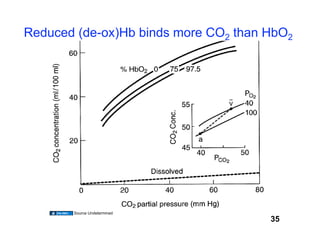
Reduced (de-ox)Hb binds more CO2 than HbO2


       Source Undetermined
                                      35
Source Undetermined
                      36
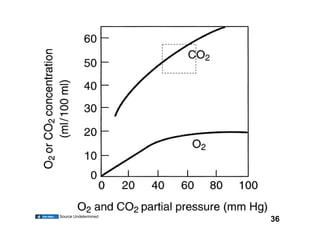
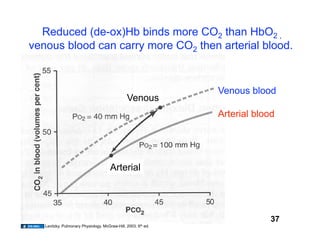
Reduced (de-ox)Hb binds more CO2 than HbO2 ,
venous blood can carry more CO2 then arterial blood.


                                                                Venous blood
                                                Venous
                                                                Arterial blood


                                       Arterial


                                                                             37
   Levitzky. Pulmonary Physiology. McGraw-Hill, 2003. 6th ed.
left  ↓ H+
    shift ↓ CO2
          ↓ temperature
  (lungs)
          ↓ 2,3 BPG
At any PO2 more O2 bound.
                                          right shift
                                           (tissues)


                                     At any PO2 less O2 bound.
                                                        38
               Source Undetermined
Additional Source Information
                                    for more information see: http://open.umich.edu/wiki/CitationPolicy

Slide 5: Source Undetermined
Slide 9: GFDL, Zephyris (wikipedia), http://en.wikipedia.org/wiki/GNU_Free_Documentation_License
Slide 10: D’Alecy
Slide 13: Levitzky. Pulmonary Physiology. McGraw-Hill, 2003. 6th ed.
Slide 14: Source Undetermined
Slide 15: Source Undetermined
Slide 16: Bartlett, Critical Care Physiology
Slide 18: Source Undetermined
Slide 21: Source Undetermined
Slide 23: Bartlett, Critical Care Physiology
Slide 24: Levitzky. Pulmonary Physiology. McGraw-Hill, 2003. 6th ed.
Slide 25: Levitzky. Pulmonary Physiology. McGraw-Hill, 2003. 6th ed.
Slide 26: Levitzky. Pulmonary Physiology. McGraw-Hill, 2003. 6th ed.
Slide 27: Levitzky. Pulmonary Physiology. McGraw-Hill, 2003. 6th ed.
Slide 28: Levitzky. Pulmonary Physiology. McGraw-Hill, 2003. 6th ed.
Slide 29: Source Undetermined
Slide 30: D’Alecy
Slide 31: Source Undetermined
Slide 32: Source Undetermined
Slide 34: Levitzky. Pulmonary Physiology. McGraw-Hill, 2003. 6th ed.
Slide 35: Source Undetermined
Slide 36: Source Undetermined
Slide 37: Levitzky. Pulmonary Physiology. McGraw-Hill, 2003. 6th ed.
Slide 38: Source Undetermined

11.18.08(a): O2 and CO2 Transport

  • 1.
    Author(s): Louis D’Alecy,2009 License: Unless otherwise noted, this material is made available under the terms of the Creative Commons Attribution–Non-commercial–Share Alike 3.0 License: http://creativecommons.org/licenses/by-nc-sa/3.0/ We have reviewed this material in accordance with U.S. Copyright Law and have tried to maximize your ability to use, share, and adapt it. The citation key on the following slide provides information about how you may share and adapt this material. Copyright holders of content included in this material should contact open.michigan@umich.edu with any questions, corrections, or clarification regarding the use of content. For more information about how to cite these materials visit http://open.umich.edu/education/about/terms-of-use. Any medical information in this material is intended to inform and educate and is not a tool for self-diagnosis or a replacement for medical evaluation, advice, diagnosis or treatment by a healthcare professional. Please speak to your physician if you have questions about your medical condition. Viewer discretion is advised: Some medical content is graphic and may not be suitable for all viewers.
  • 2.
    Citation Key for more information see: http://open.umich.edu/wiki/CitationPolicy Use + Share + Adapt { Content the copyright holder, author, or law permits you to use, share and adapt. } Public Domain – Government: Works that are produced by the U.S. Government. (USC 17 § 105) Public Domain – Expired: Works that are no longer protected due to an expired copyright term. Public Domain – Self Dedicated: Works that a copyright holder has dedicated to the public domain. Creative Commons – Zero Waiver Creative Commons – Attribution License Creative Commons – Attribution Share Alike License Creative Commons – Attribution Noncommercial License Creative Commons – Attribution Noncommercial Share Alike License GNU – Free Documentation License Make Your Own Assessment { Content Open.Michigan believes can be used, shared, and adapted because it is ineligible for copyright. } Public Domain – Ineligible: Works that are ineligible for copyright protection in the U.S. (USC 17 § 102(b)) *laws in your jurisdiction may differ { Content Open.Michigan has used under a Fair Use determination. } Fair Use: Use of works that is determined to be Fair consistent with the U.S. Copyright Act. (USC 17 § 107) *laws in your jurisdiction may differ Our determination DOES NOT mean that all uses of this 3rd-party content are Fair Uses and we DO NOT guarantee that your use of the content is Fair. To use this content you should do your own independent analysis to determine whether or not your use will be Fair.
  • 3.
    O2 and CO2Transport M1 – Cardiovascular/ Respiratory Sequence Louis D’Alecy, Ph.D. Fall 2008 3
  • 4.
    Tuesday 11/18/08, 9:00
 O2 and CO2 Transport
 35 slides, 50 minutes 1.  Describe the amount of oxygen dissolved and combined in blood. 2.  Define oxygen delivery to a tissue. 3.  Describe the characteristics of the oxygen-Hb saturation curve. 4.  Describe the shifts produced in the oxygen-Hb saturation curve. 5.  Describe the effects of anemia on oxygen content and PO2. 6.  State the three forms in which CO2 is carried in the blood. 7.  Describe the role of carbonic anhydrase in CO2 transport. 8.  Describe the chemical events associated with the uptake and release of CO2. 9.  Defines chloride shift. 4
  • 5.
    Liquid blood Alveolar gas Source Undetermined O2 content of blood = Dissolved + Hb bound O2 5
  • 6.
    How much gasis dissolved ? A gas dissolves in a liquid in direct proportion to its partial pressure and solubility. “Henry’s Law” 6
  • 7.
    Henry’s Law forO2 The content of dissolved oxygen is equal to the product of the oxygen solubility coefficient and oxygen partial pressure. Linear straight line C = a dO O P 2 Relationship like 2 O y = mx. C = content of dissolved O2 mL/dL dO2 a = solubility coefficient for O2 in blood 2 a O = 0.0031 mL/mm Hg/dL 2 dL = 100 mL 7
  • 8.
    Dissolved O2 At PO2 of 100 mmHg X 0.0031 you get 0.3 mL O2/dL dissolved oxygen in blood. With cardiac output of 5000 ml/min or 50 dL/min you would deliver (50 dL X 0.3 mL/dL) or 15 mL O2/min. BUT We consume 20 X that or 250 mL O2/min so dissolved just will not do it!! You need hemoglobin to bind and transport O2. dL = 100 mL 8
  • 9.
  • 10.
    Air Air Plasma Dissolved only RBC Hb-O2 bound + O2 dissolved Not all Hb has O2 10 D’Alecy
  • 11.
    How much O2is in blood?
 Concentration = Content mL/dL = mL/100mL = Vol% (mL of O2 in 100 mL blood) i.e. arterial blood has 20 Vol% O2 Content ≠ %Hb Saturation % Hb Saturation = O2 bound to Hb X 100% O2 capacity of Hb 11
  • 12.
    O2 content (withflow) determines O2 delivery. Thus O2 content is more important to O2 delivery than is O2 saturation. O2 Content ≠ %Hb Saturation So why do we talk about O2 saturation? O2 saturation is relatively easier to measure and O2 content is much more difficult to measure. We need to understand the differences!!!! 12
  • 13.
    Hb Saturation Curve Normal Arterial Blood ~ 27 mmHg 13 Levitzky. Pulmonary Physiology. McGraw-Hill, 2003. 6th ed.
  • 14.
    Most O2 O2 Content (mL / 100mL) “% Hb Sat” combined. Or Sat Linear straight line relationship. 14 Source Undetermined
  • 15.
    Different amounts ofHb but all 100% saturated ! O2 Content (mL / 100mL) HbO2 Saturation (%) Hb=10 Hb=15 Hb=20 Normal blood Hb = 15 gm/dL 15 Source Undetermined
  • 16.
    DO2 (cc/m2 /min) Anemia or Blood loss CI (L/m2 /min) 16 Bartlett, Critical Care Physiology
  • 17.
    i.e. ANEMIA Decreased Hb concentration so that % saturation can be normal (97-100%) but O2 content is decreased. 1. Decreased number of RBC 2. Decreased Hb content per RBC Normal blood Hb = 15 gm/dL 17
  • 18.
    Denver ? O2 bars? O2 Content (mL / 100mL) Breathing 100% O2. 18 Source Undetermined
  • 19.
    Hemoglobin Bound OxygenContent mL O2 /dL Cb = S O [ Hb ] Hb s O2 2 S O = % Hb saturation = O2 bound to Hb X 100% O2 capacity of Hb [ Hb ] = hemoglobin content gm/dL blood Hb s = saturated Hb O2 content mL O2 /gm Hb Hbs = 1.36 mL O2 /gm Hb = O2 capacity 19
  • 20.
    Typical Arterial BloodOxygen Content P = 100 mm Hg S = 97% [ Hb ] = 15 gm/dL O O 2 2 Dissolved O Cd a O2 = O P O2 = 0.0031 x 100 = 0.31 mL / dL 2 Bound O C = S [ Hb ] Hb = 0.97 x 15 x 1.36 = 19.79 mL / dL b O s O 2 2 Total Oxygen Content Cd C O2 + b = 0.31 + 19.79 = 20.1 mL / dL O 2 20
  • 21.
    Bound CbO2 19.97 mL / dL 20.1 Dissolved CdO2 0.31 2.1 Total CO2 20.1 22.2 HbO2 Saturation (%) 100% 673 Source Undetermined 21
  • 22.
    Content P C a a S O O O 2 2 2 mm Hg mL / dL % Breathing Room Air Normal Hb 15 g/dl 100 20 97 Anemia Hb 7.5 g/dl 100 10 97 Breathing 100% O2 Normal Hb 15 g/dl 673 22 100 Anemia Hb 7.5 g/dl 673 12 100 Thus breathing 100% O2 does not “fix” reduced oxygen transport capacity due to anemia. 22
  • 23.
    DO2 (cc/m2 /min) 2X or 3X CO could compensate Anemia or Blood loss CI (L/m2 /min) 23 Bartlett, Critical Care Physiology
  • 24.
    pH on O2Saturation of Hb Acid unloads O2 from Hb (Bohr Effect) At any PO2 less O2 bound 24 Levitzky. Pulmonary Physiology. McGraw-Hill, 2003. 6th ed.
  • 25.
    CO2 on O2Saturation of Hb CO2 unloads O2 from Hb (Bohr Effect) At any PO2 less O2 bound 25 Levitzky. Pulmonary Physiology. McGraw-Hill, 2003. 6th ed.
  • 26.
    Temperature on O2Saturation of Hb Temperature unloads O2 from Hb At any PO2 less O2 bound 26 Levitzky. Pulmonary Physiology. McGraw-Hill, 2003. 6th ed.
  • 27.
    2,3-BPG on O2Saturation of Hb More 2,3-BPG unloads O2 from Hb Lost in stored blood ~ canʼt unload O2 Levitzky. Pulmonary Physiology. McGraw-Hill, 2003. 6th ed. 27
  • 28.
    Venous blood onO2 Saturation of Hb Levitzky. Pulmonary Physiology. McGraw-Hill, 2003. 6th ed. Venous blood unloads O2 from Hb P50 is PO2 at 50% O2 saturation. 28
  • 29.
    left ↓H+ shift ↓ CO2 ↓ temperature (lungs) ↓ 2,3 BPG At any PO2 more O2 bound. right shift (tissues) At any PO2 less O2 bound. 29 Source Undetermined
  • 30.
    O2 is “unloaded”in tissues O Hb O 2 2 right shift + tissue H Temperature metabolism CO 2 30 D’Alecy
  • 31.
    In tissues CO2is “stored” in blood (for transport). CO2 CO2 CO2 + H2O C.A. = carbonic anhydrase H2CO3 chloride HCO3- + H+ Shifts in Cl- Buffer HbO2 Action. Bohr shift O2 O2 O2 + HHb tissue ISF plasma RBC Source Undetermined 31 In tissues O2 is “unloaded” from blood.
  • 32.
    In lungs CO2is “unloaded” from blood. CO2 CO2 CO2 + H2O C.A. = carbonic anhydrase H2CO3 chloride Shift out HCO3- HCO3- + H+ Cl- HbO2 Haldane shift O2 O2 O2 + HHb alveolus plasma RBC Source Undetermined In lungs O2 is “stored” in blood. 32
  • 33.
    How is CO2Transported? CO2 is about 20 x more soluble than O2 But still only 5% (art.) to 10% (ven.) of transport is dissolved!! The content of dissolved gas (Cdx) is the product of the solubility coefficient (ax) and the partial pressure of the gas (Px). C = a P dx x x C = dx dissolved gas content mL/dL a O = 0.003 mL / mm Hg /dL 2 a = 0.06 mL / mm Hg /dL CO 2 33
  • 34.
    Some Most Carbonic Anhydrase H+ + Hb-NHCOO- = Hb + CO2 + H2O = H+ + HCO3- 34 Levitzky. Pulmonary Physiology. McGraw-Hill, 2003. 6th ed.
  • 35.
    Reduced (de-ox)Hb bindsmore CO2 than HbO2 Source Undetermined 35
  • 36.
  • 37.
    Reduced (de-ox)Hb bindsmore CO2 than HbO2 , venous blood can carry more CO2 then arterial blood. Venous blood Venous Arterial blood Arterial 37 Levitzky. Pulmonary Physiology. McGraw-Hill, 2003. 6th ed.
  • 38.
    left ↓H+ shift ↓ CO2 ↓ temperature (lungs) ↓ 2,3 BPG At any PO2 more O2 bound. right shift (tissues) At any PO2 less O2 bound. 38 Source Undetermined
  • 39.
    Additional Source Information for more information see: http://open.umich.edu/wiki/CitationPolicy Slide 5: Source Undetermined Slide 9: GFDL, Zephyris (wikipedia), http://en.wikipedia.org/wiki/GNU_Free_Documentation_License Slide 10: D’Alecy Slide 13: Levitzky. Pulmonary Physiology. McGraw-Hill, 2003. 6th ed. Slide 14: Source Undetermined Slide 15: Source Undetermined Slide 16: Bartlett, Critical Care Physiology Slide 18: Source Undetermined Slide 21: Source Undetermined Slide 23: Bartlett, Critical Care Physiology Slide 24: Levitzky. Pulmonary Physiology. McGraw-Hill, 2003. 6th ed. Slide 25: Levitzky. Pulmonary Physiology. McGraw-Hill, 2003. 6th ed. Slide 26: Levitzky. Pulmonary Physiology. McGraw-Hill, 2003. 6th ed. Slide 27: Levitzky. Pulmonary Physiology. McGraw-Hill, 2003. 6th ed. Slide 28: Levitzky. Pulmonary Physiology. McGraw-Hill, 2003. 6th ed. Slide 29: Source Undetermined Slide 30: D’Alecy Slide 31: Source Undetermined Slide 32: Source Undetermined Slide 34: Levitzky. Pulmonary Physiology. McGraw-Hill, 2003. 6th ed. Slide 35: Source Undetermined Slide 36: Source Undetermined Slide 37: Levitzky. Pulmonary Physiology. McGraw-Hill, 2003. 6th ed. Slide 38: Source Undetermined