Basic mechanical ventilation Charles Gomersall Dept of Anaesthesia & Intensive Care The Chinese University of Hong Kong Prince of Wales Hospital Version 1.0 May 2003
Configure Powerpoint If you have not already configured Powerpoint to advance slides using timings stop now and do so. From Slide Show drop down menu select Set Up Show. In the Advance Slides option select Use timings, if present. Click OK. Already configured Stop Click on the relevant button
Disclaimer Although considerable care has been taken in the preparation of this tutorial, the author, the Prince of Wales Hospital and The Chinese University of Hong Kong take no responsibility for any adverse event resulting from its use.
O 2 CO 2
Getting oxygen in Depends on P A O 2 F I O 2 P A CO 2 Alveolar pressure Ventilation Diffusing capacity Perfusion Ventilation-perfusion matching     
Carbon dioxide out Respiratory rate Tidal volume Deadspace
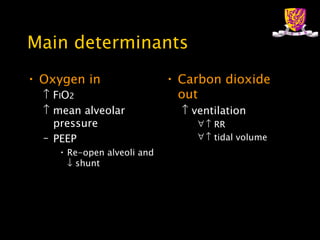
Main determinants Oxygen in    F I O 2    mean alveolar pressure PEEP Re-open alveoli and    shunt Carbon dioxide out    ventilation    RR    tidal volume
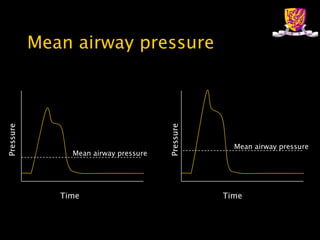
Mean airway pressure Time Pressure Time Pressure Mean airway pressure Mean airway pressure
Inspiratory time Set as: % of respiratory cycle I:E ratio Expiratory time not set Remaining time after inspiration before next breath
Inspiratory time Increased inspiratory time Improved oxygenation Unnatural pattern of breathing Deeper sedation Increased risk of gas trapping
Mean airway pressure Time Pressure Time Pressure Mean airway pressure Mean airway pressure
PEEP Improves oxygenation   mean alveolar pressure   shunting
Other settings Trigger sensitivity   sensitivity preferable Flow triggering general more sensitive than pressure triggering   flow or    pressure       sensitivity
Other settings Rise time Inspiratory time Pressure Time Rise time Inspiratory time Flow Time
Respiratory complications Nosocomial pneumonia Barotrauma Gas trapping
Barotrauma High pressures (barotrauma) High volumes (volutrauma) Shear injury
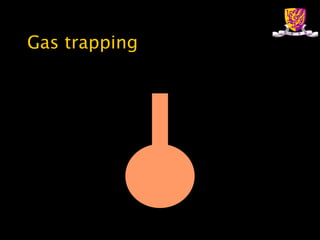
Gas trapping
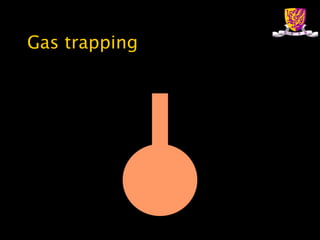
Gas trapping
Gas trapping
Gas trapping
Gas trapping
Gas trapping
Gas trapping
Gas trapping Predisposing factors: asthma or COPD long inspiratory time (   expiratory time short) high respiratory rate (   absolute expiratory time short) Effects progressive hyperinflation of alveoli progressive rise in end-expiratory pressure (intrinsic PEEP)
Intrinsic PEEP (PEEP i ) Time Pressure PEEP e PEEP tot
Gas trapping Adverse effects Barotrauma Cardiovascular compromise
Cardiovascular effects Preload positive intrathoracic pressure reduces venous return exacerbated by high inspiratory pressure prolonged inspiratory time PEEP
Cardiovascular effects decreased afterload due to decreased LV transmural pressure
Cardiovascular effects Overall effect depends on whether ventricular contractility is normal or abnormal   contractility   cardiac output normal contractility   cardiac output
Hypotension Consider Drug induced Gas trapping Tension pneumothorax
Modes To learn about specific modes of ventilation (eg PRVC) download the appropriate lectures by clicking on the button Download

Basic Mechanical Ventilation

Editor's Notes

  • #5 The function of the ventilator is to help get oxygen into the patient and carbon dioxide out
  • #6 Getting oxygen in is dependent on a number of factors. Some of these can be manipulated to a large extent by mechanical ventilation
  • #7 Carbon dioxide elimination is dependent on the respiratory rate, tidal volume and ventilation perfusion matching
  • #8 In summary, the most important means of improving oxygenation are increasing the inspired concentration of oxygen, increasing the mean airway and therefore the mean alveolar pressure and applying PEEP to re-open alveoli. Carbon dioxide removal can be increased by increasing the respiratory rate or tidal volume
  • #9 Airway pressure can be increased in a number of ways. It is easier to understand why these methods increase mean pressure if one remembers that the mean airway pressure refers to the mean across the entire respiratory cycle, both inspiration and expiration. The most obvious method of increasing the pressure is to increase the tidal volume but this will also increase the peak and plateau airway pressures and therefore increase the chance of ventilator induced lung injury.
  • #10 Prolonging the inspiratory time increases the mean pressure without increasing the peak pressure
  • #11 It can be set as a percentage of the respiratory cycle or as a ratio of inspiration to expiration, the so called I:E ratio. Note that on most ventilators the expiratory time is not set directly but is merely the remaining time after inspiration before the next breath
  • #12 Although increasing the inspiratory time may improve oxygenation inspiratory times of >30% or I:E ratios of >1:2 are often uncomfortable for the patient resulting in a need for a deeper level of sedation. In addition less time is available for expiration resulting in an increased risk of gas trapping.
  • #13 Finally increasing the positive end-expiratory pressure or PEEP will increase the mean pressure but may also increase the peak and plateau pressures.
  • #14 However PEEP has the major advantage that it may decrease shunting by re-opening alveoli.
  • #15 The trigger sensitivity determines how easy it is for the patient to trigger the ventilator to deliver a breath. In general increased sensitivity is preferable in order to improve patient-ventilator synchrony (ie to stop the patient "fighting" the ventilator) but excessively high sensitivity may result in false or auto-triggering (ie ventilator detects what it "thinks" is an attempt by the patient to breath although the patient is apnoeic). Triggering may be flow-triggered or pressure triggered. Flow triggering is generally more sensitive. The smaller the flow or the smaller the negative pressure the more sensitive the trigger
  • #16 The rise time determines speed of rise of flow (volume control mode) or pressure (pressure control and pressure regulated volume control modes). Very short rise times may be more uncomfortable for the patient . Long rise times may result in a lower tidal volume being delivered or higher pressure being required.
  • #17 Respiratory complications of mechanical ventilation include nosocomial pneumonia, barotrauma and gas trapping
  • #18 Barotrauma is actually a misnomer because ventilator associated lung injury is thought to be due to due to high volumes and shear injury as well high pressures. Shear injury is the result of repetitive collapse and re-expansion of alveoli and due to tension at the interface between open and collapsed alveoli
  • #19 Gas trapping occurs if there is insufficient time for alveoli to empty before the next breath
  • #26 It is more likely to occur in patients with asthma or COPD, when inspiratory time is long (and therefore expiratory time short) or when respiratory rate is high and therefore the absolute expiratory time short. Gas trapping results in progressive hyperinflation of alveoli and a progressive rise in end-expiratory pressure (as this increase in PEEP is not due to an increase in set PEEP it is known as intrinsic PEEP)
  • #27 Intrinsic PEEP can be measured on most ventilators by using the expiratory pause hold control. As the pressures in the respiratory system equilibrate the expiratory pressure measured by the ventilator rises. This occurs after a few seconds. The pressure displayed is the total PEEP. Intrinsic PEEP is obtained by subtracting the set or extrinsic PEEP from the total PEEP.
  • #28 Adverse effects include barotrauma and cardiovascular compromise due to high intrathoracic pressure. In an extreme case this can lead to cardiac arrest with pulseless electrical activity.
  • #29 Preload is reduced. This is predominantly due to reduced venous return. Normally venous return is enhanced by the negative intrathoracic pressure during inspiration. Not only is this abolished by positive pressure ventilation but venous return is actually impeded by the positive intrathoracic pressures. This effect will by exacerbated by any factors that increase the mean intrathoracic pressure such as high inspiratory pressures, prolonged inspiratory times and the application of PEEP.
  • #30 LV afterload is directly related to LV transmural pressure
  • #33 If the patient becomes hypotensive shortly after intubation and ventilation the most likely causes are drug induced hypotension due to the vasodilating properties of anaesthetic induction agents, gas trapping due to over-enthusiastic ventilation and tension pneumothorax. Drug induced hypotension usually responds to fluid loading. If gas trapping is suspected disconnect the patient from the ventilator. As the trapped gas is released the hypotension will resolve, usually within 30-60 seconds. A tension pneumothorax is rare but the possibility should be considered as it is easily treated and failure to diagnose it may be fatal. Treatment is by needle thoracostomy.