DDrr LLeeaahh EEaasstt RRNN BBNN ((HHoonnss)) PPhhDD 
SSeenniioorr LLeeccttuurreerr,, SSCCUU
 
 Major public health issue 
 High morbidity and mortality (WHO, 2007) 
 Over 30 pathogens responsible for STIs (WHO, 2012) 
 Genital herpes, human papilloma virus (HPV), 
chlamydia, gonorrhoea, syphilis, trichomoniasis, 
HIV, hepatitis 
 Cause significant physical and psychological harm 
(WHO, 2001) 
background
Statistics 
 
 Herpes: 1/8 (Cunningham et al. 2006) 
 HPV: 4/5 people (Cancer Council NSW, 2013) 
 33.2 million people around the world are living with 
HIV (6,000 young people are infected with HIV 
daily) (UNAIDS, 2003; UNAIDS &WHO, 2007) 
 Over 498.9 million new cases per annum of 
chlamydia, gonorrhoea, syphilis and trichomoniasis 
(15 - 49 years) (WHO, 2012)
Women and STIs 
 
 Have severe consequences for women 
 Women are vulnerable to STI acquisition due to 
 social norms, gender roles (Hird & Jackson, 2001; Reddy & Dunne, 
2007) 
 condom negotiation (De Visser & Smith, 2001; Ehrhardt et al., 2002)
Young people and STIs 
 
Young people are at an increased risk of STI due to: 
 Invulnerability 
 Risk behaviour 
 Social changes 
 Inexperience (Dehne & Riedner, 2005; WHO, 2004)
Aim 
 
 To explore young women’s stories of having a 
sexually transmitted infection from a feminist 
perspective
Methodology 
 
 Feminist methodology 
 Qualitative online interviews- email and Instant 
messenger 
 Inclusion criteria: any women that experienced an 
STI between the ages of 18-30 years 
 HIV was excluded from this study
Participants 
 
 Ten women participants 
 Aged 21-39 years 
 Various backgrounds 
 Cervical HPV, genital warts, herpes, chlamydia, 
pubic lice 
 Casual partners, husbands, boyfriends, long-term 
partners, rape 
 Pseudonyms are used
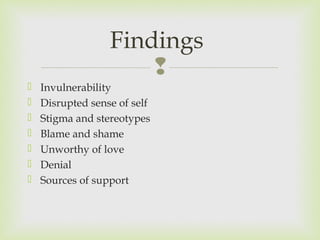
Findings 
 
 Invulnerability 
 Disrupted sense of self 
 Stigma and stereotypes 
 Blame and shame 
 Unworthy of love 
 Denial 
 Sources of support
Invulnerability 
 
 I didn't think I was at risk. I felt immortal; 
I thought it didn't happen to people like 
me, until I was diagnosed with warts 
[Rita].
Disrupted sense of self 
 
 I was ashamed because I was now infected 
with this virus and would always be.... I 
felt tainted [Lilly]
Stigma and sterotypes 
 
 ... [I felt] Dirty, because my views on 
contracting an STD like this have been the 
same as the rest of society... Only someone 
who sleeps around regularly gets STDs ... 
It’s like going from being a cool kid in the 
playground, to being an outcast, I’m on the 
other side of the fence, and it’s not nice 
[Bree].
Blame and shame 
 
 I felt ashamed. Looking back I know I did 
not do wrong but I felt dirty and used and I 
felt like I was just disgusting. … I was 
filled with shame and it turned into self-hatred 
in a way. I still can't believe I was 
treated so badly [Ruby].
Unworthy of love 
 
 I didn’t feel that I deserved anything to do 
with relationships. I didn’t think I deserved 
to be loved or wanted by anyone [Cathy].
Denial 
 
 With the herpes it was diagnosed with a 
blood test but I don’t ever remember having 
it so I suppose I have been in a bit of denial 
about that. … I never told these men I slept 
with about it or any of them. With herpes I 
have read that it is painful so I think I 
would know if I had it [Ruby].
Sources of support 
 
 I went online and read other’s people’s 
experiences, and had really supportive 
feedback from others who were experiencing 
the same thing [Lilly].
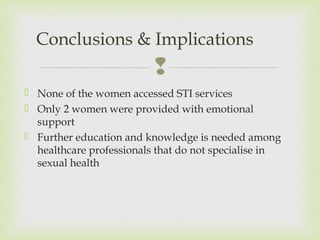
Conclusions & Implications 
 
 None of the women accessed STI services 
 Only 2 women were provided with emotional 
support 
 Further education and knowledge is needed among 
healthcare professionals that do not specialise in 
sexual health
leah.east@scu.edu.au
  Cancer Council New South Wales (2013) New research on human papillomavirus: Q&A. Available at: 
http://www.cancercouncil.com.au/508/get-informed/diagnosis-symptoms/cancer-screening-cancer-screening-early-detection/new-research-on-hpv-qa/?pp=of February 2013). 
 Cunningham, A. L., Taylor, R., Taylor, J., Marks, C., Shaw, J., & Mindel, A. (2006). Prevalence of infection with herpes simplex virus types 1 and 2 in 
Australia. Sexually Transmitted Infections, 82(2), 164-168. 
 Dehne, K. L., & Riedner, G. (2005). Sexually transmitted infections among adolescents: The need for adequate health services. Geneva: World Health 
Organisation and Deutsche Gesellechaft fuer Technische Zusammenarbeit. 
 De Visser, R. O., & Smith, A. M. A. (2001). Inconsistent users of condoms: a challenge to traditional models of health behaviour. Psychology, 
Health & Medicine, 6(1), 41-46 
 Ehrhardt, A. A., Exner, T. M., Hoffman, S., Silberman, I., Yingling, S., Adams-Skinner, J. et al. (2002). HIV/STD risk and sexual strategies 
among women family planning clients in New York: Project FIO. AIDS and Behavior, 6(1), 1-13 
 Hird, M. J., & Jackson, S. (2001). Where ‘angels’ and ‘wusses’ fear to tread: sexual coercion in adolescent dating relationships. Journal of 
Sociology, 37(1), 27-43 
 Joint United Nations Programme on HIV/AIDS (UNAIDS). (2003). HIV/AIDS and young people: Hope for tomorrow. Geneva: Author. 
 Joint United Nations Programme on HIV/AIDS (UNAIDS), & World Health Organisation. (2007). AIDS epidemic update: December 2007. Geneva: 
Authors. 
 Reddy, S., & Dunne, M. (2007). Risking it: Young heterosexual femininities in South Africa context of HIV/AIDS. Sexualities, 10(2), 160-172. 
 World Health Organisation. (2004). Contraception: Issues in adolescent health and development. Geneva: Author. 
 World Health Organisation (2012) Global incidence and prevalence of selected curable sexually transmitted infections-2008, Geneva. 
 World Health Organisation. (2001). Global prevalence and incidence of selected curable sexually transmitted infections: Overview and estimates. Geneva: 
Author. 
 World Health Organisation. (2007). Global strategy for the prevention and control of sexually transmitted infections: 2006-2015: Breaking the chain of 
transmission. Geneva: Author. 
References

1.1.1 dr leah east

  • 1.
    DDrr LLeeaahh EEaassttRRNN BBNN ((HHoonnss)) PPhhDD SSeenniioorr LLeeccttuurreerr,, SSCCUU
  • 2.
      Majorpublic health issue  High morbidity and mortality (WHO, 2007)  Over 30 pathogens responsible for STIs (WHO, 2012)  Genital herpes, human papilloma virus (HPV), chlamydia, gonorrhoea, syphilis, trichomoniasis, HIV, hepatitis  Cause significant physical and psychological harm (WHO, 2001) background
  • 3.
    Statistics  Herpes: 1/8 (Cunningham et al. 2006)  HPV: 4/5 people (Cancer Council NSW, 2013)  33.2 million people around the world are living with HIV (6,000 young people are infected with HIV daily) (UNAIDS, 2003; UNAIDS &WHO, 2007)  Over 498.9 million new cases per annum of chlamydia, gonorrhoea, syphilis and trichomoniasis (15 - 49 years) (WHO, 2012)
  • 4.
    Women and STIs   Have severe consequences for women  Women are vulnerable to STI acquisition due to  social norms, gender roles (Hird & Jackson, 2001; Reddy & Dunne, 2007)  condom negotiation (De Visser & Smith, 2001; Ehrhardt et al., 2002)
  • 5.
    Young people andSTIs  Young people are at an increased risk of STI due to:  Invulnerability  Risk behaviour  Social changes  Inexperience (Dehne & Riedner, 2005; WHO, 2004)
  • 6.
    Aim  To explore young women’s stories of having a sexually transmitted infection from a feminist perspective
  • 7.
    Methodology  Feminist methodology  Qualitative online interviews- email and Instant messenger  Inclusion criteria: any women that experienced an STI between the ages of 18-30 years  HIV was excluded from this study
  • 8.
    Participants  Ten women participants  Aged 21-39 years  Various backgrounds  Cervical HPV, genital warts, herpes, chlamydia, pubic lice  Casual partners, husbands, boyfriends, long-term partners, rape  Pseudonyms are used
  • 9.
    Findings  Invulnerability  Disrupted sense of self  Stigma and stereotypes  Blame and shame  Unworthy of love  Denial  Sources of support
  • 10.
    Invulnerability  I didn't think I was at risk. I felt immortal; I thought it didn't happen to people like me, until I was diagnosed with warts [Rita].
  • 11.
    Disrupted sense ofself   I was ashamed because I was now infected with this virus and would always be.... I felt tainted [Lilly]
  • 12.
    Stigma and sterotypes   ... [I felt] Dirty, because my views on contracting an STD like this have been the same as the rest of society... Only someone who sleeps around regularly gets STDs ... It’s like going from being a cool kid in the playground, to being an outcast, I’m on the other side of the fence, and it’s not nice [Bree].
  • 13.
    Blame and shame   I felt ashamed. Looking back I know I did not do wrong but I felt dirty and used and I felt like I was just disgusting. … I was filled with shame and it turned into self-hatred in a way. I still can't believe I was treated so badly [Ruby].
  • 14.
    Unworthy of love   I didn’t feel that I deserved anything to do with relationships. I didn’t think I deserved to be loved or wanted by anyone [Cathy].
  • 15.
    Denial  With the herpes it was diagnosed with a blood test but I don’t ever remember having it so I suppose I have been in a bit of denial about that. … I never told these men I slept with about it or any of them. With herpes I have read that it is painful so I think I would know if I had it [Ruby].
  • 16.
    Sources of support   I went online and read other’s people’s experiences, and had really supportive feedback from others who were experiencing the same thing [Lilly].
  • 17.
    Conclusions & Implications   None of the women accessed STI services  Only 2 women were provided with emotional support  Further education and knowledge is needed among healthcare professionals that do not specialise in sexual health
  • 18.
  • 19.
      CancerCouncil New South Wales (2013) New research on human papillomavirus: Q&A. Available at: http://www.cancercouncil.com.au/508/get-informed/diagnosis-symptoms/cancer-screening-cancer-screening-early-detection/new-research-on-hpv-qa/?pp=of February 2013).  Cunningham, A. L., Taylor, R., Taylor, J., Marks, C., Shaw, J., & Mindel, A. (2006). Prevalence of infection with herpes simplex virus types 1 and 2 in Australia. Sexually Transmitted Infections, 82(2), 164-168.  Dehne, K. L., & Riedner, G. (2005). Sexually transmitted infections among adolescents: The need for adequate health services. Geneva: World Health Organisation and Deutsche Gesellechaft fuer Technische Zusammenarbeit.  De Visser, R. O., & Smith, A. M. A. (2001). Inconsistent users of condoms: a challenge to traditional models of health behaviour. Psychology, Health & Medicine, 6(1), 41-46  Ehrhardt, A. A., Exner, T. M., Hoffman, S., Silberman, I., Yingling, S., Adams-Skinner, J. et al. (2002). HIV/STD risk and sexual strategies among women family planning clients in New York: Project FIO. AIDS and Behavior, 6(1), 1-13  Hird, M. J., & Jackson, S. (2001). Where ‘angels’ and ‘wusses’ fear to tread: sexual coercion in adolescent dating relationships. Journal of Sociology, 37(1), 27-43  Joint United Nations Programme on HIV/AIDS (UNAIDS). (2003). HIV/AIDS and young people: Hope for tomorrow. Geneva: Author.  Joint United Nations Programme on HIV/AIDS (UNAIDS), & World Health Organisation. (2007). AIDS epidemic update: December 2007. Geneva: Authors.  Reddy, S., & Dunne, M. (2007). Risking it: Young heterosexual femininities in South Africa context of HIV/AIDS. Sexualities, 10(2), 160-172.  World Health Organisation. (2004). Contraception: Issues in adolescent health and development. Geneva: Author.  World Health Organisation (2012) Global incidence and prevalence of selected curable sexually transmitted infections-2008, Geneva.  World Health Organisation. (2001). Global prevalence and incidence of selected curable sexually transmitted infections: Overview and estimates. Geneva: Author.  World Health Organisation. (2007). Global strategy for the prevention and control of sexually transmitted infections: 2006-2015: Breaking the chain of transmission. Geneva: Author. References

Editor's Notes

  • #4 498.9 in 2008 an increase from 340 in 2001 Genitial herpes approximately effects one in 8 adults HPV is the most common viral STI throughout the world and is estimated to effect 4 out of 5 women at some some stage throughout their lives, this infection s responsible for causing genital warts, and is a prominent cause of cervical cancer in fact 99% of cervical cancer diagnoses are associated with HPV . There are approximately 33.2 million people living with HIV throughout the world with approximately 6,000 young people are infected with HIV daily And there re over 340 million new cases per annum of chlamydia, gonorrhoea, syphilis and trichomoniasis among 15 - 49 years old although this is problably grossly underestimated due to many STIS remaining asymptomatic and going undiagnosed
  • #12 Failure to fulfil social expectations and self-perceptions (Cederstrom, 2002). Questioning of the self Experience self-doubt (Estes, 1992; Fisher, 2008). Perceive the self through flaws rather than their individual characters (Estes, 1992).
  • #13 Stereotypical views Internalised Perceived being stigmatised from others Fear of rejection Also from healthcare professionals