Sexually Transmitted
Infections or Diseases
(STIs or STDs)
Last updated: November 17, 2022
Together, we can change the course of the HIV epidemic…one woman at a time.
#onewomanatatime #thewellproject
www.thewellproject.org
The Basics
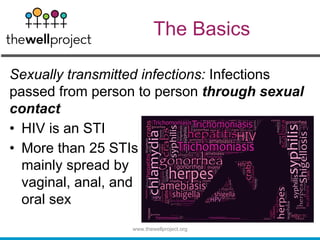
Sexually transmitted infections: Infections
passed from person to person through sexual
contact
• HIV is an STI
• More than 25 STIs
mainly spread by
vaginal, anal, and
oral sex
www.thewellproject.org
The Basics
• World Health Organization (WHO): more than 1
million people get an STI every day worldwide
• STIs are similar to, but not the same as, STDs
– Most people with STIs do not have any symptoms
• Often don’t know they can pass infection on
– Left untreated, STIs can cause serious problems:
• Cervical cancer
• Liver disease
• Pelvic inflammatory disease (PID)
• Infertility
• Pregnancy problems
www.thewellproject.org
The Basics
• Having some STIs can increase risk of acquiring
HIV if you are HIV-negative and get exposed to HIV:
– Chancroid
– Herpes
– Syphilis
– Trichomoniasis
• People living with HIV may also be at greater risk
of getting or passing on other STIs
• People living with HIV often experience more
serious problems if/when they get STIs
www.thewellproject.org
The Basics
US has highest rate of STIs in resource-rich world
• About 20 million new infections each year
• Over half among young people (15-24 years old) –
more at risk for STIs than older adults because:
– Young people’s cervical cells more vulnerable to STIs
– Teenagers, young adults may have problems getting
information, services, supplies they need to avoid STIs
• May have trouble getting STI prevention services
• May not feel comfortable in places designed for adults
• May have concerns about confidentiality
www.thewellproject.org
The Basics
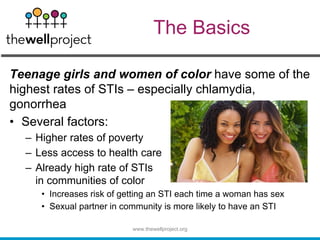
Teenage girls and women of color have some of the
highest rates of STIs – especially chlamydia,
gonorrhea
• Several factors:
– Higher rates of poverty
– Less access to health care
– Already high rate of STIs
in communities of color
• Increases risk of getting an STI each time a woman has sex
• Sexual partner in community is more likely to have an STI
www.thewellproject.org
The Basics
• Regardless of race or age, less than half of those
who should be tested for STIs receive screening
– Especially important for women
– More frequent/serious complications from STIs than men
• STIs without symptoms can still be transmitted
– Many people who have an STI do not know it
– Only way to know for sure is regular STI screenings
• STIs can be prevented by practicing safer sex
• STIs can be cured or managed with treatment
www.thewellproject.org
The Basics
• Many people with STIs have no or symptoms
– When there are signs of STIs, likely to be in genital area
– For cisgender women, this includes:
• Vulva (area around vagina including lips)
• Vagina (opening where menstrual blood comes out)
• Buttocks
• Urethra (opening above vagina where urine comes out)
• Anus (opening where bowel movement – “poop” – comes out)
– For cisgender men, this includes:
• Penis
• Scrotum (“balls”)
• Urethra
• Anus
www.thewellproject.org
Chlamydia
• Among most common STIs
• Caused by bacterium in vaginal secretions, semen
• Can be spread by:
– Vaginal, oral, or anal sex without a condom or other latex
or polyurethane barrier
– Pregnant people can pass it on to babies during delivery
• If there are symptoms, they may include:
– Vaginal discharge
– Burning during urination
www.thewellproject.org
Chlamydia
• Can be successfully treated with antibiotics
– Left untreated, can spread to ovaries and fallopian tubes, cause
pelvic inflammatory disease (PID)
– PID can lead to infertility, make it difficult to become pregnant
• Yearly screening recommended by CDC for:
– All sexually active women under 25
– Older women with new or multiple sex partners
– Recent reports show less than half of sexually active women under 25
are screened
• If treated, partner must be treated, too
www.thewellproject.org
Genital Warts
• Caused by viruses
– HPV (Human Papillomavirus) is large group of viruses
– Certain types of HPV cause infections in genital area
• Genital warts, cancer of cervix, vulva, vagina, anus, penis
• Genital HPV is spread easily:
– Skin-to-skin contact during vaginal, oral, or anal sex
• Condoms do not entirely prevent transmission
– People living with HIV more likely to have HPV, develop
genital warts, cervical or anal cancer
www.thewellproject.org
Genital Warts
• Important to find HPV early and get treatment to
prevent health problems
• Also three effective HPV vaccines
– Since HPV vaccine introduction several years ago, # of
14- to 19-year-old girls with HPV in US has dropped by
more than half
• Young people should get vaccinated before they
have sex (before they have been exposed to HPV)
– People who are already infected with HPV may not be
protected by vaccines
www.thewellproject.org
Gonorrhea (“The
Clap”)
• Caused by bacterium in vaginal secretions, semen
• Can be spread by:
– Vaginal, anal, oral sex without condom or latex/polyurethane barrier
• If there are symptoms, they may include:
– Yellowish or greenish vaginal discharge
– Burning feeling when urinating
– Can also affect anus and throat
• Can be treated with antibiotics
– Left untreated, can cause PID, infertility
– All sexually active women should be screened
• If treated, partner must be treated, too
www.thewellproject.org
Herpes
• Caused by a virus in nerves; two common types
– Herpes simplex type 1 causes cold sores around mouth
– Herpes simplex type 2 causes sores in genital area
– Possible to get HSV-2 in mouth, HSV-1 in genital area
• Symptoms include itchy or painful blisters
• Spread through skin-to-skin contact with sores
– May also spread even before sores can be seen
– In most people, sores come and go; virus stays in body
for life
www.thewellproject.org
Herpes
• Sometimes no symptoms; virus "hiding" in nerves
– Some women living with HIV never had blisters or sores before
acquiring HIV; surprised by "outbreak" of sores
– Women living with HIV may have more frequent difficult to treat
outbreaks
• No cure; antiviral drugs can:
– Reduce # of outbreaks if taken daily
– Shorten and ease outbreaks if taken when symptoms begin
– Valtrex also shown to lower transmission risk
• Pregnant people can transmit herpes to babies
– Tell your provider if you have genital herpes and are pregnant or
planning pregnancy
www.thewellproject.org
HIV
• HIV stands for Human Immunodeficiency Virus
– Virus that causes AIDS
• Is in blood, vaginal secretions, semen, breast milk
• Can be spread through vaginal, oral, or anal sex
without condom or latex/polyurethane barrier
– 13% of people living with HIV in US do not know it
• Getting tested for HIV is part of routine, regular
health care in many countries
• Different testing recommendations for different
areas of the world
www.thewellproject.org
HIV
• Important that you get tested if you:
– Have ever had vaginal, anal, or oral sex without a condom
– Have shared needles, syringes to inject drugs, other substances
– Are uncertain of partner’s HIV status; have a partner living with HIV
– Are pregnant or are considering becoming pregnant
– Have ever been diagnosed with an STI or STD
– Have hepatitis C
– Begin treatment for tuberculosis (TB)
• HIV drugs
– Help people living with HIV stay well
– Can prevent people from acquiring HIV (PrEP)
• Cannot transmit if undetectable viral load (U=U)
www.thewellproject.org
Syphilis
• Caused by bacterium
• Can be spread by:
– Vaginal, anal, or oral sex without condom or other barrier
• Has several phases:
– Primary syphilis (early disease): pain-free open sores
(chancres) in genital or anal area or around mouth
• Usually heal on their own in 3-6 weeks
– Secondary syphilis (later stage): rash and/or hair loss
– Left untreated, can proceed to latent stage
• Can damage heart, brain, eyes, ears, other organs even without
symptoms
www.thewellproject.org
Syphilis
• Can be successfully treated with antibiotics
• Pregnant people can pass syphilis to their babies
during pregnancy and childbirth
– Important that pregnant people get tested for syphilis
• If treated, partner must be treated, too
www.thewellproject.org
Other STIs to Know
About
• Chancroid
• Hepatitis
• Pubic Lice (“Crabs”)
• Trichomoniasis
www.thewellproject.org
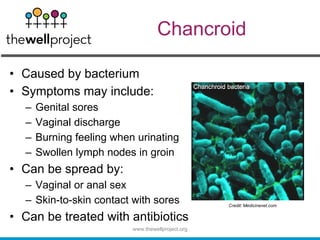
Chancroid
• Caused by bacterium
• Symptoms may include:
– Genital sores
– Vaginal discharge
– Burning feeling when urinating
– Swollen lymph nodes in groin
• Can be spread by:
– Vaginal or anal sex
– Skin-to-skin contact with sores
• Can be treated with antibiotics
www.thewellproject.org
Credit: Medicinenet.com
Hepatitis
• Inflammation (irritation) of liver
• Some types of hepatitis caused by viruses in blood,
vaginal secretions, semen, breast milk
– Hepatitis B (HBV), C (HCV) can be sexually transmitted
– Can become chronic (long-term), very serious
– May have no symptoms
• Vaccine to prevent HBV
• Cure for HCV
• People living with HIV should be tested and treated
for HBV, HCV
www.thewellproject.org
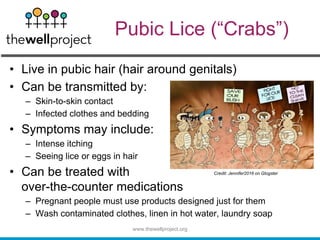
Pubic Lice (“Crabs”)
• Live in pubic hair (hair around genitals)
• Can be transmitted by:
– Skin-to-skin contact
– Infected clothes and bedding
• Symptoms may include:
– Intense itching
– Seeing lice or eggs in hair
• Can be treated with
over-the-counter medications
– Pregnant people must use products designed just for them
– Wash contaminated clothes, linen in hot water, laundry soap
www.thewellproject.org
Credit: Jennifer2016 on Glogster
Trichomoniasis
• Caused by protozoa (single-celled germ)
• Can be spread during vaginal, oral, or anal sex
without a condom or latex/polyurethane barrier
– Common cause of vaginal infections
• Symptoms may include:
– Foamy, foul-smelling vaginal discharge
– Itching
– Sometimes there are no symptoms at all
• Can be successfully treated with antibiotics
– Sexual partner must also be treated
www.thewellproject.org
Protecting Yourself
and Others
You can greatly reduce risk of getting many STIs:
• Use a latex or plastic condom for vaginal and anal sex
– Female condom can also prevent many STIs
– Use condoms without lubricant for oral sex on a man
• Use latex or plastic barriers (dental dams, plastic wrap) for
oral sex on a woman or for oral-anal sex; use latex or
plastic gloves if you have cuts or sores on your hands
• Use water-based lubricants with latex barriers
• DO NOT use oil-based products
• Do not use lubricants or condoms that contain nonoxynol-9
(N-9)
www.thewellproject.org
Protecting Yourself
and Others
• Wash shared sex toys or use fresh condom between users
• Use a latex condom with methods of birth control that do
not protect you from STIs
• Talk with your sex partner(s) about STIs and condoms
• Talk honestly with your provider, sex partner(s), about any
STIs you or your partner has or has had
• Have regular pelvic exams, cervical cancer screenings
• Talk to your provider about having a routine STI screening
• Do not share needles or syringes for injecting drugs or
other substances
– If you do share drug equipment, clean your works
www.thewellproject.org
The Bottom Line
• There are many STIs, including HIV
• Some can be cured; many can be managed
– Many can cause serious health and fertility
problems or even death if untreated
• If needed, get treatment your provider recommends
• Even if symptoms go away, still need to finish
treatment
– Make sure your partner(s) gets treated, so that
you do not pass an infection back and forth
www.thewellproject.org
• To learn more about this topic, and for links
to articles featuring more details, please
read the full fact sheet on this topic:
– Fact sheet: Sexually Transmitted Infections or
Diseases (STIs or STDs)
• For more fact sheets and to connect to our
community of women living with HIV, visit:
– www.thewellproject.org
– www.facebook.com/thewellproject
– www.twitter.com/thewellproject
www.thewellproject.org
Learn More!

STIs_2022.pdf

  • 1.
    Sexually Transmitted Infections orDiseases (STIs or STDs) Last updated: November 17, 2022 Together, we can change the course of the HIV epidemic…one woman at a time. #onewomanatatime #thewellproject www.thewellproject.org
  • 2.
    The Basics Sexually transmittedinfections: Infections passed from person to person through sexual contact • HIV is an STI • More than 25 STIs mainly spread by vaginal, anal, and oral sex www.thewellproject.org
  • 3.
    The Basics • WorldHealth Organization (WHO): more than 1 million people get an STI every day worldwide • STIs are similar to, but not the same as, STDs – Most people with STIs do not have any symptoms • Often don’t know they can pass infection on – Left untreated, STIs can cause serious problems: • Cervical cancer • Liver disease • Pelvic inflammatory disease (PID) • Infertility • Pregnancy problems www.thewellproject.org
  • 4.
    The Basics • Havingsome STIs can increase risk of acquiring HIV if you are HIV-negative and get exposed to HIV: – Chancroid – Herpes – Syphilis – Trichomoniasis • People living with HIV may also be at greater risk of getting or passing on other STIs • People living with HIV often experience more serious problems if/when they get STIs www.thewellproject.org
  • 5.
    The Basics US hashighest rate of STIs in resource-rich world • About 20 million new infections each year • Over half among young people (15-24 years old) – more at risk for STIs than older adults because: – Young people’s cervical cells more vulnerable to STIs – Teenagers, young adults may have problems getting information, services, supplies they need to avoid STIs • May have trouble getting STI prevention services • May not feel comfortable in places designed for adults • May have concerns about confidentiality www.thewellproject.org
  • 6.
    The Basics Teenage girlsand women of color have some of the highest rates of STIs – especially chlamydia, gonorrhea • Several factors: – Higher rates of poverty – Less access to health care – Already high rate of STIs in communities of color • Increases risk of getting an STI each time a woman has sex • Sexual partner in community is more likely to have an STI www.thewellproject.org
  • 7.
    The Basics • Regardlessof race or age, less than half of those who should be tested for STIs receive screening – Especially important for women – More frequent/serious complications from STIs than men • STIs without symptoms can still be transmitted – Many people who have an STI do not know it – Only way to know for sure is regular STI screenings • STIs can be prevented by practicing safer sex • STIs can be cured or managed with treatment www.thewellproject.org
  • 8.
    The Basics • Manypeople with STIs have no or symptoms – When there are signs of STIs, likely to be in genital area – For cisgender women, this includes: • Vulva (area around vagina including lips) • Vagina (opening where menstrual blood comes out) • Buttocks • Urethra (opening above vagina where urine comes out) • Anus (opening where bowel movement – “poop” – comes out) – For cisgender men, this includes: • Penis • Scrotum (“balls”) • Urethra • Anus www.thewellproject.org
  • 9.
    Chlamydia • Among mostcommon STIs • Caused by bacterium in vaginal secretions, semen • Can be spread by: – Vaginal, oral, or anal sex without a condom or other latex or polyurethane barrier – Pregnant people can pass it on to babies during delivery • If there are symptoms, they may include: – Vaginal discharge – Burning during urination www.thewellproject.org
  • 10.
    Chlamydia • Can besuccessfully treated with antibiotics – Left untreated, can spread to ovaries and fallopian tubes, cause pelvic inflammatory disease (PID) – PID can lead to infertility, make it difficult to become pregnant • Yearly screening recommended by CDC for: – All sexually active women under 25 – Older women with new or multiple sex partners – Recent reports show less than half of sexually active women under 25 are screened • If treated, partner must be treated, too www.thewellproject.org
  • 11.
    Genital Warts • Causedby viruses – HPV (Human Papillomavirus) is large group of viruses – Certain types of HPV cause infections in genital area • Genital warts, cancer of cervix, vulva, vagina, anus, penis • Genital HPV is spread easily: – Skin-to-skin contact during vaginal, oral, or anal sex • Condoms do not entirely prevent transmission – People living with HIV more likely to have HPV, develop genital warts, cervical or anal cancer www.thewellproject.org
  • 12.
    Genital Warts • Importantto find HPV early and get treatment to prevent health problems • Also three effective HPV vaccines – Since HPV vaccine introduction several years ago, # of 14- to 19-year-old girls with HPV in US has dropped by more than half • Young people should get vaccinated before they have sex (before they have been exposed to HPV) – People who are already infected with HPV may not be protected by vaccines www.thewellproject.org
  • 13.
    Gonorrhea (“The Clap”) • Causedby bacterium in vaginal secretions, semen • Can be spread by: – Vaginal, anal, oral sex without condom or latex/polyurethane barrier • If there are symptoms, they may include: – Yellowish or greenish vaginal discharge – Burning feeling when urinating – Can also affect anus and throat • Can be treated with antibiotics – Left untreated, can cause PID, infertility – All sexually active women should be screened • If treated, partner must be treated, too www.thewellproject.org
  • 14.
    Herpes • Caused bya virus in nerves; two common types – Herpes simplex type 1 causes cold sores around mouth – Herpes simplex type 2 causes sores in genital area – Possible to get HSV-2 in mouth, HSV-1 in genital area • Symptoms include itchy or painful blisters • Spread through skin-to-skin contact with sores – May also spread even before sores can be seen – In most people, sores come and go; virus stays in body for life www.thewellproject.org
  • 15.
    Herpes • Sometimes nosymptoms; virus "hiding" in nerves – Some women living with HIV never had blisters or sores before acquiring HIV; surprised by "outbreak" of sores – Women living with HIV may have more frequent difficult to treat outbreaks • No cure; antiviral drugs can: – Reduce # of outbreaks if taken daily – Shorten and ease outbreaks if taken when symptoms begin – Valtrex also shown to lower transmission risk • Pregnant people can transmit herpes to babies – Tell your provider if you have genital herpes and are pregnant or planning pregnancy www.thewellproject.org
  • 16.
    HIV • HIV standsfor Human Immunodeficiency Virus – Virus that causes AIDS • Is in blood, vaginal secretions, semen, breast milk • Can be spread through vaginal, oral, or anal sex without condom or latex/polyurethane barrier – 13% of people living with HIV in US do not know it • Getting tested for HIV is part of routine, regular health care in many countries • Different testing recommendations for different areas of the world www.thewellproject.org
  • 17.
    HIV • Important thatyou get tested if you: – Have ever had vaginal, anal, or oral sex without a condom – Have shared needles, syringes to inject drugs, other substances – Are uncertain of partner’s HIV status; have a partner living with HIV – Are pregnant or are considering becoming pregnant – Have ever been diagnosed with an STI or STD – Have hepatitis C – Begin treatment for tuberculosis (TB) • HIV drugs – Help people living with HIV stay well – Can prevent people from acquiring HIV (PrEP) • Cannot transmit if undetectable viral load (U=U) www.thewellproject.org
  • 18.
    Syphilis • Caused bybacterium • Can be spread by: – Vaginal, anal, or oral sex without condom or other barrier • Has several phases: – Primary syphilis (early disease): pain-free open sores (chancres) in genital or anal area or around mouth • Usually heal on their own in 3-6 weeks – Secondary syphilis (later stage): rash and/or hair loss – Left untreated, can proceed to latent stage • Can damage heart, brain, eyes, ears, other organs even without symptoms www.thewellproject.org
  • 19.
    Syphilis • Can besuccessfully treated with antibiotics • Pregnant people can pass syphilis to their babies during pregnancy and childbirth – Important that pregnant people get tested for syphilis • If treated, partner must be treated, too www.thewellproject.org
  • 20.
    Other STIs toKnow About • Chancroid • Hepatitis • Pubic Lice (“Crabs”) • Trichomoniasis www.thewellproject.org
  • 21.
    Chancroid • Caused bybacterium • Symptoms may include: – Genital sores – Vaginal discharge – Burning feeling when urinating – Swollen lymph nodes in groin • Can be spread by: – Vaginal or anal sex – Skin-to-skin contact with sores • Can be treated with antibiotics www.thewellproject.org Credit: Medicinenet.com
  • 22.
    Hepatitis • Inflammation (irritation)of liver • Some types of hepatitis caused by viruses in blood, vaginal secretions, semen, breast milk – Hepatitis B (HBV), C (HCV) can be sexually transmitted – Can become chronic (long-term), very serious – May have no symptoms • Vaccine to prevent HBV • Cure for HCV • People living with HIV should be tested and treated for HBV, HCV www.thewellproject.org
  • 23.
    Pubic Lice (“Crabs”) •Live in pubic hair (hair around genitals) • Can be transmitted by: – Skin-to-skin contact – Infected clothes and bedding • Symptoms may include: – Intense itching – Seeing lice or eggs in hair • Can be treated with over-the-counter medications – Pregnant people must use products designed just for them – Wash contaminated clothes, linen in hot water, laundry soap www.thewellproject.org Credit: Jennifer2016 on Glogster
  • 24.
    Trichomoniasis • Caused byprotozoa (single-celled germ) • Can be spread during vaginal, oral, or anal sex without a condom or latex/polyurethane barrier – Common cause of vaginal infections • Symptoms may include: – Foamy, foul-smelling vaginal discharge – Itching – Sometimes there are no symptoms at all • Can be successfully treated with antibiotics – Sexual partner must also be treated www.thewellproject.org
  • 25.
    Protecting Yourself and Others Youcan greatly reduce risk of getting many STIs: • Use a latex or plastic condom for vaginal and anal sex – Female condom can also prevent many STIs – Use condoms without lubricant for oral sex on a man • Use latex or plastic barriers (dental dams, plastic wrap) for oral sex on a woman or for oral-anal sex; use latex or plastic gloves if you have cuts or sores on your hands • Use water-based lubricants with latex barriers • DO NOT use oil-based products • Do not use lubricants or condoms that contain nonoxynol-9 (N-9) www.thewellproject.org
  • 26.
    Protecting Yourself and Others •Wash shared sex toys or use fresh condom between users • Use a latex condom with methods of birth control that do not protect you from STIs • Talk with your sex partner(s) about STIs and condoms • Talk honestly with your provider, sex partner(s), about any STIs you or your partner has or has had • Have regular pelvic exams, cervical cancer screenings • Talk to your provider about having a routine STI screening • Do not share needles or syringes for injecting drugs or other substances – If you do share drug equipment, clean your works www.thewellproject.org
  • 27.
    The Bottom Line •There are many STIs, including HIV • Some can be cured; many can be managed – Many can cause serious health and fertility problems or even death if untreated • If needed, get treatment your provider recommends • Even if symptoms go away, still need to finish treatment – Make sure your partner(s) gets treated, so that you do not pass an infection back and forth www.thewellproject.org
  • 28.
    • To learnmore about this topic, and for links to articles featuring more details, please read the full fact sheet on this topic: – Fact sheet: Sexually Transmitted Infections or Diseases (STIs or STDs) • For more fact sheets and to connect to our community of women living with HIV, visit: – www.thewellproject.org – www.facebook.com/thewellproject – www.twitter.com/thewellproject www.thewellproject.org Learn More!