
HIV/AIDS and Infectious Diseases: Prevalence and Attitudes Among U.S. Latinos Dr Li Loriz, PhD, ARNP, BC Director, School of Nursing College of Health University of North Florida
Description of Latinos Largest ethnic/racial minority group in the US (13% of the population) Mexican Americans -60% Puerto Ricans -15% Cuban Americans -10% Other Immigrants -15% Dominican Republic Central America South America
Prevalence of HIV/AIDS Latinos represent 14% of the US population 20% cases of AIDS cases are Latinos (8,000+) This percentage has increased from 18% in 1993 19% of deaths due to AIDS HIV is the 2 nd  cause of death for Latino males 35-44 (5 th  for White men)
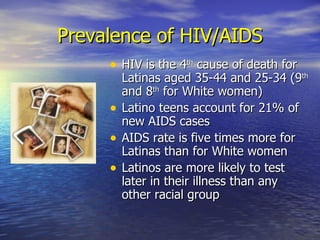
Prevalence of HIV/AIDS HIV is the 4 th  cause of death for Latinas aged 35-44 and 25-34 (9 th  and 8 th  for White women) Latino teens account for 21% of new AIDS cases AIDS rate is five times more for Latinas than for White women Latinos are more likely to test later in their illness than any other racial group
Prevalence of Sexually Transmitted Diseases Latinos are twice as likely to have gonorrhea or syphilis Among minorities, Latinas report the second highest number of cases of gonorrhea Latinos are at  High-Risk  of contracting the hepatitis C virus
HIV Transmission in Latinos Males 42% men who have sex with men 34% contaminated syringes 8% heterosexually Females 38% contaminated syringes 47% sex with HIV positive male
Opinions on Key Issues 40% view HIV/AIDS as the most urgent health problem in the US 64% consider the problem to be more urgent problem for the country than a few years ago 7 in 10 state AIDS is a problem for someone they know 53% are personally concerned about becoming infected
Information Needed 64% want more information about HIV/AIDS Most want guidance on how to talk about HIV transmission with their children 33% want more information on how to wear condoms
Misperceptions HIV is transmitted through kissing You can become infected by touching a toilet seat or sharing a drinking glass 50% Inner city women stated using a diaphragm or having sex with a man who has had a vasectomy are successful ways of preventing HIV infection ( Hobfoll, 1994 ) Unprotected sex means having sex with someone that you do not know.
Beliefs There is a cure for HIV, but not for AIDS. HIV/AIDS is an agent of genocide created by the US government HIV resulted from laboratory experiments that got out of control There is a cure for HIV, but the government is withholding this information from minorities AIDS is a disease that affects gays and foreigners Essien,E. J., Meshack, A, and Ross,M (2002)
Barriers to Prevention More than  1 in 5 Latinos live in poverty Reluctance to acknowledge risky behaviors (males) Reluctance to discuss condom use (females) Barriers to access to appropriate health care Stigma Funding Racial discrimination Fear of deportation Cultural and language insensitivity Weak or fragile community-based capacity
Barriers to Prevention Machismo-female passivity, male dominance and virility Reduce safer sex practices and negatively influence Marianismo-women maintain traditional gender roles
Barriers to Prevention Lack of sex and health education at home and school Abstinence and virginity until marriage Sexual knowledge promotes sexual activity Prohibition of contraceptive use by the Catholic Church
Barriers to Prevention   Latinas Most approaches used to prevent HIV are based on men who have sex with men View Latinas as not a “risk group” (being married protects them from infection) Have other priorities and focus on HIV when it has a demonstrated impact on role in family Ability to negotiate safer sex is difficult
Prevention for Latino Youths School-based programs are critical before behaviors are established Comprehensive programs with a focus on delaying sexual behavior and how sexually active can protect themselves Community-based programs to reach out-of-school youth Address sexual and drug-related risk STD treatment
Prevention for HIV Drug Users Needle prevention programs Drug treatment programs Use community outreach programs to reach drug users on the streets Improve access to quality substance abuse treatment centers HIV prevention programs in jails and prisons Education on safe injection use.
Prevention Programs Routine HIV testing as part of medical care New models for diagnosing HIV infections outside medical settings Preventing HIV infections by working with HIV-infected persons and their partners Decreasing perinatal transmission
Specific Prevention Strategies Encourage adherence to antiretroviral therapy Decreased concentration in semen Decreased maternal-fetal transmission Dual approach to risk reduction Abstinence/safer sex practices Discontinuation of drug use/safer use practices
Specific Prevention Strategies Disseminate prevention information through community organizations that represent and promote family life and health. Tailor public information messages to emphasize the impact of HIV/AIDS on the family unit. Market health promotion programs in a way that barriers originating in family structures are eliminated
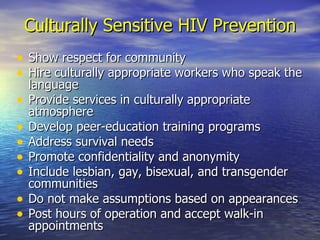
Culturally Sensitive HIV Prevention Show respect for community Hire culturally appropriate workers who speak the language Provide services in culturally appropriate atmosphere Develop peer-education training programs Address survival needs Promote confidentiality and anonymity Include lesbian, gay, bisexual, and transgender communities Do not make assumptions based on appearances Post hours of operation and accept walk-in appointments
THANK YOU

Aetna Presentation HIV/AIDS and Latinos

  • 1.
    HIV/AIDS and InfectiousDiseases: Prevalence and Attitudes Among U.S. Latinos Dr Li Loriz, PhD, ARNP, BC Director, School of Nursing College of Health University of North Florida
  • 2.
    Description of LatinosLargest ethnic/racial minority group in the US (13% of the population) Mexican Americans -60% Puerto Ricans -15% Cuban Americans -10% Other Immigrants -15% Dominican Republic Central America South America
  • 3.
    Prevalence of HIV/AIDSLatinos represent 14% of the US population 20% cases of AIDS cases are Latinos (8,000+) This percentage has increased from 18% in 1993 19% of deaths due to AIDS HIV is the 2 nd cause of death for Latino males 35-44 (5 th for White men)
  • 4.
    Prevalence of HIV/AIDSHIV is the 4 th cause of death for Latinas aged 35-44 and 25-34 (9 th and 8 th for White women) Latino teens account for 21% of new AIDS cases AIDS rate is five times more for Latinas than for White women Latinos are more likely to test later in their illness than any other racial group
  • 5.
    Prevalence of SexuallyTransmitted Diseases Latinos are twice as likely to have gonorrhea or syphilis Among minorities, Latinas report the second highest number of cases of gonorrhea Latinos are at High-Risk of contracting the hepatitis C virus
  • 6.
    HIV Transmission inLatinos Males 42% men who have sex with men 34% contaminated syringes 8% heterosexually Females 38% contaminated syringes 47% sex with HIV positive male
  • 7.
    Opinions on KeyIssues 40% view HIV/AIDS as the most urgent health problem in the US 64% consider the problem to be more urgent problem for the country than a few years ago 7 in 10 state AIDS is a problem for someone they know 53% are personally concerned about becoming infected
  • 8.
    Information Needed 64%want more information about HIV/AIDS Most want guidance on how to talk about HIV transmission with their children 33% want more information on how to wear condoms
  • 9.
    Misperceptions HIV istransmitted through kissing You can become infected by touching a toilet seat or sharing a drinking glass 50% Inner city women stated using a diaphragm or having sex with a man who has had a vasectomy are successful ways of preventing HIV infection ( Hobfoll, 1994 ) Unprotected sex means having sex with someone that you do not know.
  • 10.
    Beliefs There isa cure for HIV, but not for AIDS. HIV/AIDS is an agent of genocide created by the US government HIV resulted from laboratory experiments that got out of control There is a cure for HIV, but the government is withholding this information from minorities AIDS is a disease that affects gays and foreigners Essien,E. J., Meshack, A, and Ross,M (2002)
  • 11.
    Barriers to PreventionMore than 1 in 5 Latinos live in poverty Reluctance to acknowledge risky behaviors (males) Reluctance to discuss condom use (females) Barriers to access to appropriate health care Stigma Funding Racial discrimination Fear of deportation Cultural and language insensitivity Weak or fragile community-based capacity
  • 12.
    Barriers to PreventionMachismo-female passivity, male dominance and virility Reduce safer sex practices and negatively influence Marianismo-women maintain traditional gender roles
  • 13.
    Barriers to PreventionLack of sex and health education at home and school Abstinence and virginity until marriage Sexual knowledge promotes sexual activity Prohibition of contraceptive use by the Catholic Church
  • 14.
    Barriers to Prevention Latinas Most approaches used to prevent HIV are based on men who have sex with men View Latinas as not a “risk group” (being married protects them from infection) Have other priorities and focus on HIV when it has a demonstrated impact on role in family Ability to negotiate safer sex is difficult
  • 15.
    Prevention for LatinoYouths School-based programs are critical before behaviors are established Comprehensive programs with a focus on delaying sexual behavior and how sexually active can protect themselves Community-based programs to reach out-of-school youth Address sexual and drug-related risk STD treatment
  • 16.
    Prevention for HIVDrug Users Needle prevention programs Drug treatment programs Use community outreach programs to reach drug users on the streets Improve access to quality substance abuse treatment centers HIV prevention programs in jails and prisons Education on safe injection use.
  • 17.
    Prevention Programs RoutineHIV testing as part of medical care New models for diagnosing HIV infections outside medical settings Preventing HIV infections by working with HIV-infected persons and their partners Decreasing perinatal transmission
  • 18.
    Specific Prevention StrategiesEncourage adherence to antiretroviral therapy Decreased concentration in semen Decreased maternal-fetal transmission Dual approach to risk reduction Abstinence/safer sex practices Discontinuation of drug use/safer use practices
  • 19.
    Specific Prevention StrategiesDisseminate prevention information through community organizations that represent and promote family life and health. Tailor public information messages to emphasize the impact of HIV/AIDS on the family unit. Market health promotion programs in a way that barriers originating in family structures are eliminated
  • 20.
    Culturally Sensitive HIVPrevention Show respect for community Hire culturally appropriate workers who speak the language Provide services in culturally appropriate atmosphere Develop peer-education training programs Address survival needs Promote confidentiality and anonymity Include lesbian, gay, bisexual, and transgender communities Do not make assumptions based on appearances Post hours of operation and accept walk-in appointments
  • 21.