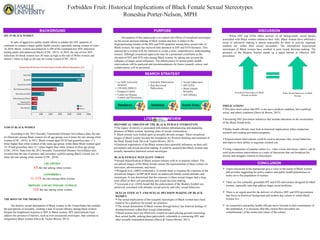
SEARCH STRATEGY
DISCUSSION
LITERATURE REVIEW
PURPOSE
HISTORICAL ORIGINS OF THE BLACK FEMALE STEREOTYPE
The legacy of slavery is associated with distinct dehumanizing and degrading
practices of Black women, fostering years of sexual victimization.
 Black women were looked upon as sexually deviant savages. These sexualized
images of Black women became the foundation for Western thinking and treatment of
the black female body Davis & Tucker-Brown, 2013).
Historical experiences of the Black women have powerful influences on their self-
perceptions and sexual decision making. It could be assumed that Black women may
actually internalize historical sexual stereotypes.
BACKGROUND
HIV IN BLACK WOMEN
In spite of aggressive public health efforts to subdue the HIV epidemic it
continues to remain a major public health concern, especially among women of color.
In 2010, Black women accounted for 6,100 of the estimated new HIV infections
among adults and adolescent blacks (CDC, 2013). In 2010, the rate of new HIV
infections for black women was 20 times as high as the rate of White women and
almost 5 times as high as the rate for Latina women (CDC, 2013).
STDS IN BLACK WOMEN
According to the 2012 Sexually Transmitted Diseases Surveillance data, the rate
of chlamydia among Black women for all age groups was 6 times the rate among white
women (CDC, 2014). In 2012, Black women aged 20-24 had gonorrhea rates 11.1
times higher than white women of the same age group, while those Black women aged
15-19 had gonorrhea rates 15.1 times higher than white women in their age group
(CDC, 2014). Data from the 2012 Sexually Transmitted Diseases Surveillance also
revealed that the rate of primary and secondary syphilis among Black women was 16
times the rate among white women (CDC, 2014).
CHLAMYDIA
6X the rate among white women
GONORRHEA
11-15X the rate among white women
PRIMARY AND SECONDARY SYPHILIS
16X the rate among white women
THE ROOT OF THE PROBLEM
The historic sexual domination of Black women in the United States has molded
the perceptions of sexuality, creating a lack of sexual efficacy among black women.
Despite the heightened response to HIV in Black women, HIV interventions must
address the presence of barriers, such as over-sexualized stereotypes, that continue to
marginalize Black women (Davis & Tucker-Brown, 2013).
BLACK FEMALE SEXUALITY TODAY
Sexual objectification of Black women remains with us in popular culture. The
sexualized images of the Black female remain the representation of these women on
television, advertisements, and music.
Wingood et al. (2003) conducted a 12-month study to examine the exposure of the
sexualized imagery in HIP HOP music on adolescent female sexual attitudes and
stereotypes. It was determined that the exposure to these sexual images had a long-
term effect on their self-perceptions and sexual decision making.
Townsend et al. (2010) found that the endorsement of the Modern Jezebel was
positively correlated with attitudes sexual activity and risky sexual behaviors.
While HIV and STDs affect persons of all backgrounds, social factors
associated with Black women enhances their risks. Black women have inherited a
sense of inferiority making it almost impossible for them to actively negotiate
condom use within their sexual encounters. The internalized hypersexual
stereotypes of Black women have resulted in poor sexual decision making. The
presence of the Modern Jezebel stands as a major barrier to effective HIV
prevention.
IMPLICATIONS
Providers must realize that HIV is not just a medical condition, but a political,
social, and ethnic condition (Davis & Brown, 2013).
Increasing HIV prevention initiatives that include education on the sexulization
of the Black female body.
Public health officials must look at historical implications when conduction
research and creating prevention programs.
Empowerment interventions could be used to decrease risky sexual behaviors
and improve their ability to negotiate condom use.
Using components of popular culture (i.e. video vixens and music videos), cab be
used in prevention interventions as a topic of discussion that can broadcast the
lessons and struggles relation to stereotypes.
CONCLUSION
 Topics discussed in the manuscript give a voice to the needs of Black women
and provides suggesting for policy makers and public health practitioners to
better serve this population of women.
 There are few culturally grounded HIV and STD intervention designed for black
women, especially ones that address larger social problems.
 There is an urgent need for the delivery of effective HIV and STD preventions
that focus on historical background and modern day culture in which Black
women live.
 As researchers and public health officials move forward in their examination of
this population, it is necessary that they ensure their procedure are
complimentary of the norms and values of the culture.
The purpose of this manuscript is to explore the effects of sexualized stereotypes
on the sexual decision making of black women and how it relates to the
disproportionate burden of the HIV and STD epidemic among these sexual risks of
Black women, the topic has received little attention in HIV and STD literature. This
manuscript is written with the intention to create a more comprehensive understanding
women. Although sexualized oppression may be a prominent contributor to the
elevated of HIV and STD risks among Black women, by taking into account the
influence of larger social influences. The effectiveness of current public health
interventions will be analyzed and recommendations for future research, action, and
collaborations will be presented.
SEXUAL EFFICACY AND SEXUAL DECISION MAKING OF BLACK
WOMEN
The social implications of the sexuality stereotypes of Black women have been
found to be a predictor for unsafe sex practices.
The sexual domination of Black women through history has fostered feelings of
disempowerment within their sexual relationships.
Black women have not effectively created an equal playing ground concerning
their sexual health, making them particularly vulnerable to contracting HIV and
other sexually transmitted diseases (Davis & Tucker-Brown, 2013).
Sexualized Stereotypes of Black
Women in Media
Risky Sexual Behaviors in Black
Women

Nelson Capstone Poster_Final

  • 1.
    SEARCH STRATEGY DISCUSSION LITERATURE REVIEW PURPOSE HISTORICALORIGINS OF THE BLACK FEMALE STEREOTYPE The legacy of slavery is associated with distinct dehumanizing and degrading practices of Black women, fostering years of sexual victimization.  Black women were looked upon as sexually deviant savages. These sexualized images of Black women became the foundation for Western thinking and treatment of the black female body Davis & Tucker-Brown, 2013). Historical experiences of the Black women have powerful influences on their self- perceptions and sexual decision making. It could be assumed that Black women may actually internalize historical sexual stereotypes. BACKGROUND HIV IN BLACK WOMEN In spite of aggressive public health efforts to subdue the HIV epidemic it continues to remain a major public health concern, especially among women of color. In 2010, Black women accounted for 6,100 of the estimated new HIV infections among adults and adolescent blacks (CDC, 2013). In 2010, the rate of new HIV infections for black women was 20 times as high as the rate of White women and almost 5 times as high as the rate for Latina women (CDC, 2013). STDS IN BLACK WOMEN According to the 2012 Sexually Transmitted Diseases Surveillance data, the rate of chlamydia among Black women for all age groups was 6 times the rate among white women (CDC, 2014). In 2012, Black women aged 20-24 had gonorrhea rates 11.1 times higher than white women of the same age group, while those Black women aged 15-19 had gonorrhea rates 15.1 times higher than white women in their age group (CDC, 2014). Data from the 2012 Sexually Transmitted Diseases Surveillance also revealed that the rate of primary and secondary syphilis among Black women was 16 times the rate among white women (CDC, 2014). CHLAMYDIA 6X the rate among white women GONORRHEA 11-15X the rate among white women PRIMARY AND SECONDARY SYPHILIS 16X the rate among white women THE ROOT OF THE PROBLEM The historic sexual domination of Black women in the United States has molded the perceptions of sexuality, creating a lack of sexual efficacy among black women. Despite the heightened response to HIV in Black women, HIV interventions must address the presence of barriers, such as over-sexualized stereotypes, that continue to marginalize Black women (Davis & Tucker-Brown, 2013). BLACK FEMALE SEXUALITY TODAY Sexual objectification of Black women remains with us in popular culture. The sexualized images of the Black female remain the representation of these women on television, advertisements, and music. Wingood et al. (2003) conducted a 12-month study to examine the exposure of the sexualized imagery in HIP HOP music on adolescent female sexual attitudes and stereotypes. It was determined that the exposure to these sexual images had a long- term effect on their self-perceptions and sexual decision making. Townsend et al. (2010) found that the endorsement of the Modern Jezebel was positively correlated with attitudes sexual activity and risky sexual behaviors. While HIV and STDs affect persons of all backgrounds, social factors associated with Black women enhances their risks. Black women have inherited a sense of inferiority making it almost impossible for them to actively negotiate condom use within their sexual encounters. The internalized hypersexual stereotypes of Black women have resulted in poor sexual decision making. The presence of the Modern Jezebel stands as a major barrier to effective HIV prevention. IMPLICATIONS Providers must realize that HIV is not just a medical condition, but a political, social, and ethnic condition (Davis & Brown, 2013). Increasing HIV prevention initiatives that include education on the sexulization of the Black female body. Public health officials must look at historical implications when conduction research and creating prevention programs. Empowerment interventions could be used to decrease risky sexual behaviors and improve their ability to negotiate condom use. Using components of popular culture (i.e. video vixens and music videos), cab be used in prevention interventions as a topic of discussion that can broadcast the lessons and struggles relation to stereotypes. CONCLUSION  Topics discussed in the manuscript give a voice to the needs of Black women and provides suggesting for policy makers and public health practitioners to better serve this population of women.  There are few culturally grounded HIV and STD intervention designed for black women, especially ones that address larger social problems.  There is an urgent need for the delivery of effective HIV and STD preventions that focus on historical background and modern day culture in which Black women live.  As researchers and public health officials move forward in their examination of this population, it is necessary that they ensure their procedure are complimentary of the norms and values of the culture. The purpose of this manuscript is to explore the effects of sexualized stereotypes on the sexual decision making of black women and how it relates to the disproportionate burden of the HIV and STD epidemic among these sexual risks of Black women, the topic has received little attention in HIV and STD literature. This manuscript is written with the intention to create a more comprehensive understanding women. Although sexualized oppression may be a prominent contributor to the elevated of HIV and STD risks among Black women, by taking into account the influence of larger social influences. The effectiveness of current public health interventions will be analyzed and recommendations for future research, action, and collaborations will be presented. SEXUAL EFFICACY AND SEXUAL DECISION MAKING OF BLACK WOMEN The social implications of the sexuality stereotypes of Black women have been found to be a predictor for unsafe sex practices. The sexual domination of Black women through history has fostered feelings of disempowerment within their sexual relationships. Black women have not effectively created an equal playing ground concerning their sexual health, making them particularly vulnerable to contracting HIV and other sexually transmitted diseases (Davis & Tucker-Brown, 2013). Sexualized Stereotypes of Black Women in Media Risky Sexual Behaviors in Black Women