Breast cancer screening 
patterns: Rural and urban 
differences 
Presenter: Janni Leung 
Co-authors: Deirdre McLaughlin, Sam McKenzie, Jennifer 
Martin, Annette Dobson
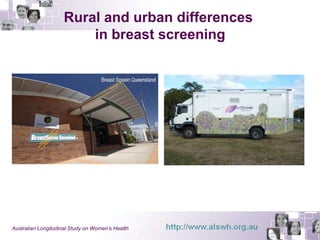
Rural and urban differences 
in breast screening 
Australian Longitudinal Study on Women’s Health
Data 
The Australian Longitudinal Study on Women’s 
Health 
•Longitudinal cohort study of the health and well-being 
of Australian women from 1996 
•Funded by the Australian Government Department of 
Health and Ageing 
•Initial random sample of over 40,000 women 
•1973-78 birth cohort (18-23 years) 
•1946-51 birth cohort (45-50 years) 
•1921-26 birth cohort (70-75 years) 
•Women re-surveyed every 3 years 
Australian Longitudinal Study on Women’s Health
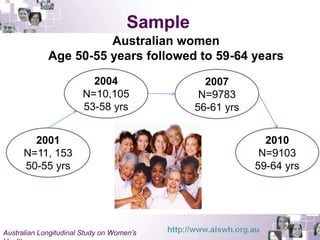
Sample 
Australian women 
Age 50-55 years followed to 59-64 years 
2001 
N=11, 153 
50-55 yrs 
2004 
N=10,105 
53-58 yrs 
Australian Longitudinal Study on Women’s 
Health 
2007 
N=9783 
56-61 yrs 
2010 
N=9103 
59-64 yrs
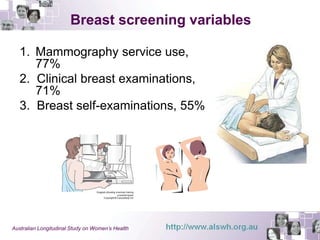
Breast screening variables 
1. Mammography service use, 
77% 
2. Clinical breast examinations, 
71% 
3. Breast self-examinations, 55% 
Australian Longitudinal Study on Women’s Health
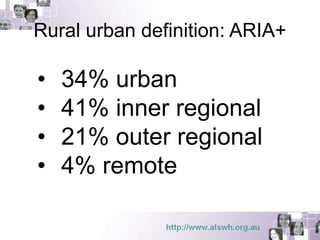
Rural urban definition: ARIA+ 
• 34% urban 
• 41% inner regional 
• 21% outer regional 
• 4% remote
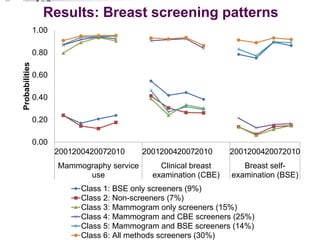
Results: Breast screening patterns 
1.00 
0.80 
0.60 
0.40 
0.20 
0.00 
2001200420072010 2001200420072010 2001200420072010 
Mammography service 
use 
Clinical breast 
examination (CBE) 
Breast self-examination 
(BSE) 
Probabilities 
Class 1: BSE only screeners (9%) 
Class 2: Non-screeners (7%) 
Class 3: Mammogram only screeners (15%) 
Class 4: Mammogram and CBE screeners (25%) 
Class 5: Mammogram and BSE screeners (14%) 
Class 6: All methods screeners (30%)
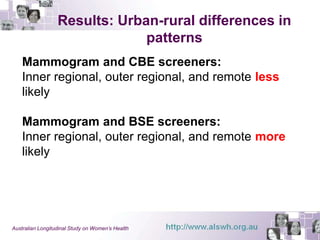
Results: Urban-rural differences in 
patterns 
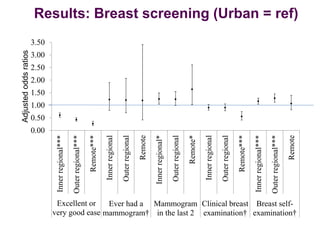
Mammogram and CBE screeners: 
Inner regional, outer regional, and remote less 
likely 
Mammogram and BSE screeners: 
Inner regional, outer regional, and remote more 
likely 
Australian Longitudinal Study on Women’s Health
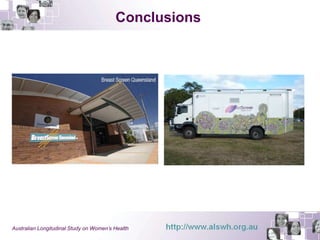
Conclusions 
Australian Longitudinal Study on Women’s Health
Thank you 
www.alswh.org.au 
Janni Leung 
j.leung1@uq.edu.au
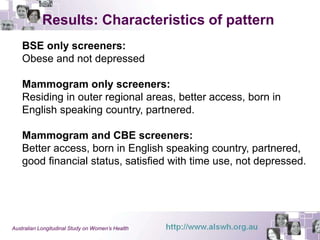
Results: Characteristics of pattern 
BSE only screeners: 
Obese and not depressed 
Mammogram only screeners: 
Residing in outer regional areas, better access, born in 
English speaking country, partnered. 
Mammogram and CBE screeners: 
Better access, born in English speaking country, partnered, 
good financial status, satisfied with time use, not depressed. 
Australian Longitudinal Study on Women’s Health
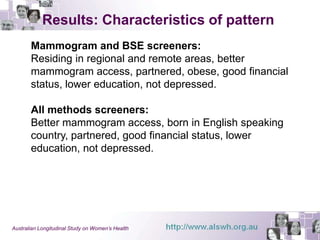
Results: Characteristics of pattern 
Mammogram and BSE screeners: 
Residing in regional and remote areas, better 
mammogram access, partnered, obese, good financial 
status, lower education, not depressed. 
All methods screeners: 
Better mammogram access, born in English speaking 
country, partnered, good financial status, lower 
education, not depressed. 
Australian Longitudinal Study on Women’s Health
Results: Breast screening (Urban = ref) 
3.50 
3.00 
2.50 
2.00 
1.50 
1.00 
0.50 
0.00 
Inner regional*** 
Outer regional*** 
Remote*** 
Inner regional 
Outer regional 
Remote 
Inner regional* 
Outer regional 
Remote* 
Inner regional 
Outer regional 
Remote*** 
Inner regional*** 
Outer regional*** 
Remote 
Excellent or 
very good ease 
of obtaining a 
Ever had a 
mammogram† 
Mammogram 
in the last 2 
years† 
Clinical breast 
examination† 
Breast self-examination† 
Adjusted odds ratios

1.9.3 miss janni leung

  • 1.
    Breast cancer screening patterns: Rural and urban differences Presenter: Janni Leung Co-authors: Deirdre McLaughlin, Sam McKenzie, Jennifer Martin, Annette Dobson
  • 2.
    Rural and urbandifferences in breast screening Australian Longitudinal Study on Women’s Health
  • 3.
    Data The AustralianLongitudinal Study on Women’s Health •Longitudinal cohort study of the health and well-being of Australian women from 1996 •Funded by the Australian Government Department of Health and Ageing •Initial random sample of over 40,000 women •1973-78 birth cohort (18-23 years) •1946-51 birth cohort (45-50 years) •1921-26 birth cohort (70-75 years) •Women re-surveyed every 3 years Australian Longitudinal Study on Women’s Health
  • 4.
    Sample Australian women Age 50-55 years followed to 59-64 years 2001 N=11, 153 50-55 yrs 2004 N=10,105 53-58 yrs Australian Longitudinal Study on Women’s Health 2007 N=9783 56-61 yrs 2010 N=9103 59-64 yrs
  • 5.
    Breast screening variables 1. Mammography service use, 77% 2. Clinical breast examinations, 71% 3. Breast self-examinations, 55% Australian Longitudinal Study on Women’s Health
  • 6.
    Rural urban definition:ARIA+ • 34% urban • 41% inner regional • 21% outer regional • 4% remote
  • 7.
    Results: Breast screeningpatterns 1.00 0.80 0.60 0.40 0.20 0.00 2001200420072010 2001200420072010 2001200420072010 Mammography service use Clinical breast examination (CBE) Breast self-examination (BSE) Probabilities Class 1: BSE only screeners (9%) Class 2: Non-screeners (7%) Class 3: Mammogram only screeners (15%) Class 4: Mammogram and CBE screeners (25%) Class 5: Mammogram and BSE screeners (14%) Class 6: All methods screeners (30%)
  • 8.
    Results: Urban-rural differencesin patterns Mammogram and CBE screeners: Inner regional, outer regional, and remote less likely Mammogram and BSE screeners: Inner regional, outer regional, and remote more likely Australian Longitudinal Study on Women’s Health
  • 9.
    Conclusions Australian LongitudinalStudy on Women’s Health
  • 10.
    Thank you www.alswh.org.au Janni Leung j.leung1@uq.edu.au
  • 11.
    Results: Characteristics ofpattern BSE only screeners: Obese and not depressed Mammogram only screeners: Residing in outer regional areas, better access, born in English speaking country, partnered. Mammogram and CBE screeners: Better access, born in English speaking country, partnered, good financial status, satisfied with time use, not depressed. Australian Longitudinal Study on Women’s Health
  • 12.
    Results: Characteristics ofpattern Mammogram and BSE screeners: Residing in regional and remote areas, better mammogram access, partnered, obese, good financial status, lower education, not depressed. All methods screeners: Better mammogram access, born in English speaking country, partnered, good financial status, lower education, not depressed. Australian Longitudinal Study on Women’s Health
  • 13.
    Results: Breast screening(Urban = ref) 3.50 3.00 2.50 2.00 1.50 1.00 0.50 0.00 Inner regional*** Outer regional*** Remote*** Inner regional Outer regional Remote Inner regional* Outer regional Remote* Inner regional Outer regional Remote*** Inner regional*** Outer regional*** Remote Excellent or very good ease of obtaining a Ever had a mammogram† Mammogram in the last 2 years† Clinical breast examination† Breast self-examination† Adjusted odds ratios