Reproductive Health, Social Determinants, Health Disparities, and Public Policy:  Let’s Come Up with Solutions Melva Thompson-Robinson, DrPH Associate Professor Executive Director, Center for Health Disparities Research School of Community Health Sciences University of Nevada Las Vegas
Conclusion Among women of color, particularly those in disenfranchised communities, the recession will have a tremendous effect on reproductive health. Why? Sex is a commodity. Risk becomes more prevalent. Relationships become important. Treatment becomes less important.
Conclusion Social determinants that affect reproductive health need multi-level, multi-factorial interventions. Particularly in communities of color and disenfranchised communities.
Community Assessment and Examination of HIV Services in Fort Pierce, FL Project 1
Fort Pierce, FL Rising HIV/AIDS epidemic community in FL People were admitted to the hospital, receiving an AIDS diagnosis, and dying in 30 days Local health department wanted to review the cultural competence of their HIV/AIDS services.
Methodology Community health survey Windshield surveys/observation Focus Groups Activities occurred from Jan. to Sept. 2002.
Results—Survey  Sexual Practices 61.6% do not use either a condom or dam during sexual activity (n=98/159) Small numbers of respondents reported knowingly having sex with someone who was HIV positive or who had AIDS Small number of these respondents reported not using a condom or dam during sexual activity with an infected person
Results—Survey  HIV Counseling and Testing 78.3% reporting ever having an HIV test (n=144) Primary reason for not having a test—don’t want to know (45.7%, n=16)
Results—Survey  HIV Knowledge More than 10% of respondents reported that a person can become infected with HIV by: Kissing Sharing a drinking glass Touching a toilet seat Using the same eating utensils as someone with HIV/AIDS Mosquitoes
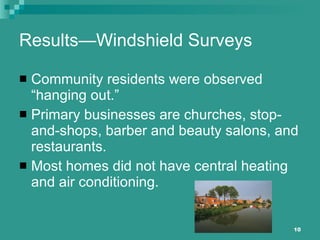
Results—Windshield Surveys Community residents were observed “hanging out.” Primary businesses are churches, stop-and-shops, barber and beauty salons, and restaurants. Most homes did not have central heating and air conditioning.
Results—Focus Groups Even when someone is HIV+, persons are willing to have unprotected sex with this person. Immigration is a HUGE issue.
Conclusions Residents have appropriate knowledge, attitudes, and beliefs regarding HIV/AIDS in their community. Contextual factors need to be addressed.
Trans-Association Partnership Project Project 2
Methods 21 focus groups with 151 African American men and women in SC, FL, and GA Focus group guide based upon the Ecological Model.
Participants Demographics:  African American men and women currently attending Historically Black College and Universities and from rural and urban locations Between the ages of 18-25 Separated by Gender  Recruitment:   Campus contact person Community Leaders
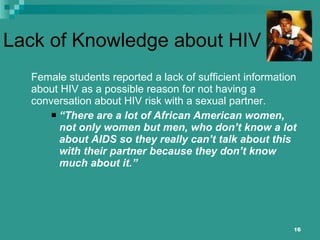
Lack of Knowledge about HIV Female students reported a lack of sufficient information about HIV as a possible reason for not having a conversation about HIV risk with a sexual partner. “ There are a lot of African American women, not only women but men, who don’t know a lot about AIDS so they really can’t talk about this with their partner because they don’t know much about it.”
Fear of Jeopardizing Relationship Female students indicated that many young women may have feelings of distress or discomfort when discussing issues related to HIV/AIDS with their partners because they feared the topic would  result in the loss of the relationship.  “ Some females… they think that if they come out and say something about it they might offend their partner”
Trust of Male Partner The female students also indicated that in a relationship they have a tendency to trust their partners and may feel as though there is not a risk for HIV/AIDS and therefore a discussion about HIV/AIDS is not necessary.  “ Women [are] feeling like they can  trust their partners or just having  their mind on some other things other than HIV risk not even thinking about it.”
Males’ Lack of Concern About HIV Both the men and the women that participated in the focus group expressed the perception that many men did not consider HIV risk in casual sexual relationships.  “ A lot of times we never think about HIV.  It’s not on our minds.  Second of all, we just trying to get ours.  We’re not thinking about anything afterwards or the consequences.  A lot of times in the heat of the moment something happens.  It’s a then and there thing.”
Females as Initiators of  HIV Discussion Both the male and female participants reported that African American women most often broached the subject of HIV with their partners and that women were more comfortable in doing so than were men. “ If we’re getting ready to have sex, maybe not physically but within the week or the next couple of days and we both know it, she’ll come out and ask ‘Have you ever been tested?’” “ I think women are more comfortable and would bring it up more often than men.  They’re more careful, too.”
Males as Initiators of HIV Discussion Male students that participated in the focus groups indicated that they occasionally had initiated a conversation about HIV and HIV testing with their potential partners, but more often left the responsibility to their female sexual partners.  “ I’m kind of a blunt person.  I’m just gonna go ahead and get it out of the way.  I tell her, look, I get tested.  How about you?  Do you get tested?”
Belated Timing of HIV Discussion In many cases, the male students indicated that the conversation about HIV was initiated only after the couple had already engaged in sexual intercourse.  “ I never had the conversation beforehand … the only time I ever had it was afterwards.  It was months afterwards, later along in the relationship after we’d been having sex… It could have been more volatile earlier in our relationship. After a while, you gotta have that conversation.”
Timing of Discussion Both male and female participants stated that, ideally, issues related to HIV/AIDS should be discussed openly in the early stages of the relationship. One male participant stated: “ I really think that should be one of the first conversations in a relationship. One of the first things, because, I mean, you can’t tell who has it just by looking at them.”
Conclusions African Americans currently attending HBCUs do not perceive that they have the knowledge, skills or self-efficacy to have an appropriately timed HIV discussion with sexual partners. Lack of knowledge about HIV/AIDS and fear acts as barriers to discussions. Timing of discussion is often delayed until after sexual intercourse has occurred. Women bear the brunt of HIV/AIDS in the African American community, in terms of both incidence and perceived responsibility for prevention. Both the male and female participants indicated that most often if a discussion about HIV/AIDS is to occur the onus of initiating that discussion is on the woman.
In the Gap Project 3
Methods Collaboration between: UNLV Center for Health Disparities Research YO-ACAP, Philadelphia, PA Street Works, Inc, Nashville, TN Bethelhem House, Inc., Indianapolis, IN Working for Togetherness, Chicago, IL Implemented an assessment tool to identify the HIV/STI risk behaviors, perceptions and beliefs that place heterosexual African American males at risk for HIV/STI
Findings 50.3% reported having ever been tested for HIV 31.8% reported having being been told by a doctor or nurse that he had an STI/STD
Findings 53.6% reported ever discussion condoms with at least one sex partner 41.1% reported wanting to use condoms 20.3% reported using a condom during anal intercourse 63.7% reported using a condom during vaginal intercourse 29.8% reported having ever discussed having HIV test before having sex the first time.
Southern Nevada Teen Pregnancy Prevention Project Project 4
Project Partners UNLV Center for Health Disparities Research Education for Quality Living Community Partners for Better Health First AME Church
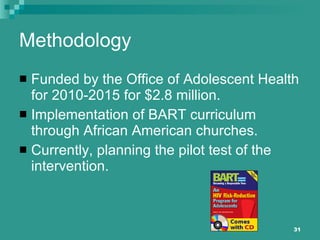
Methodology Funded by the Office of Adolescent Health for 2010-2015 for $2.8 million. Implementation of BART curriculum through African American churches. Currently, planning the pilot test of the intervention.
Public Policy
Perinatal HIV Transmission in NV Increase in number of perinatal HIV transmission cases in NV between 2004 and 2006 Revised HIV testing recommendations from CDC  Legislation requiring HIV testing for pregnant women and infants
Conclusions:  Revisited
Conclusion Among women of color, particularly those in disenfranchised communities, the recession will have a tremendous effect on reproductive health. Why? Sex is a commodity. Risk becomes more prevalent. Relationships become important. Treatment becomes less important.
Conclusion Social determinants that affect reproductive health need multi-level, multi-factorial interventions. Particularly in communities of color and disenfranchised communities.
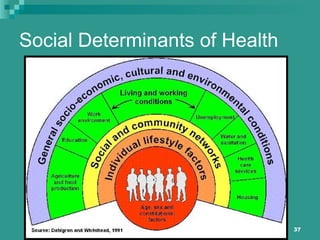
Social Determinants of Health
Questions??? Of all the forms of inequality, injustice in health care is the most shocking and inhumane.   Martin Luther King, Jr. Thanks to so many for your support in all of these efforts!

MTR Rosa Parks Lecture 2.10.11

  • 1.
    Reproductive Health, SocialDeterminants, Health Disparities, and Public Policy: Let’s Come Up with Solutions Melva Thompson-Robinson, DrPH Associate Professor Executive Director, Center for Health Disparities Research School of Community Health Sciences University of Nevada Las Vegas
  • 2.
    Conclusion Among womenof color, particularly those in disenfranchised communities, the recession will have a tremendous effect on reproductive health. Why? Sex is a commodity. Risk becomes more prevalent. Relationships become important. Treatment becomes less important.
  • 3.
    Conclusion Social determinantsthat affect reproductive health need multi-level, multi-factorial interventions. Particularly in communities of color and disenfranchised communities.
  • 4.
    Community Assessment andExamination of HIV Services in Fort Pierce, FL Project 1
  • 5.
    Fort Pierce, FLRising HIV/AIDS epidemic community in FL People were admitted to the hospital, receiving an AIDS diagnosis, and dying in 30 days Local health department wanted to review the cultural competence of their HIV/AIDS services.
  • 6.
    Methodology Community healthsurvey Windshield surveys/observation Focus Groups Activities occurred from Jan. to Sept. 2002.
  • 7.
    Results—Survey SexualPractices 61.6% do not use either a condom or dam during sexual activity (n=98/159) Small numbers of respondents reported knowingly having sex with someone who was HIV positive or who had AIDS Small number of these respondents reported not using a condom or dam during sexual activity with an infected person
  • 8.
    Results—Survey HIVCounseling and Testing 78.3% reporting ever having an HIV test (n=144) Primary reason for not having a test—don’t want to know (45.7%, n=16)
  • 9.
    Results—Survey HIVKnowledge More than 10% of respondents reported that a person can become infected with HIV by: Kissing Sharing a drinking glass Touching a toilet seat Using the same eating utensils as someone with HIV/AIDS Mosquitoes
  • 10.
    Results—Windshield Surveys Communityresidents were observed “hanging out.” Primary businesses are churches, stop-and-shops, barber and beauty salons, and restaurants. Most homes did not have central heating and air conditioning.
  • 11.
    Results—Focus Groups Evenwhen someone is HIV+, persons are willing to have unprotected sex with this person. Immigration is a HUGE issue.
  • 12.
    Conclusions Residents haveappropriate knowledge, attitudes, and beliefs regarding HIV/AIDS in their community. Contextual factors need to be addressed.
  • 13.
  • 14.
    Methods 21 focusgroups with 151 African American men and women in SC, FL, and GA Focus group guide based upon the Ecological Model.
  • 15.
    Participants Demographics: African American men and women currently attending Historically Black College and Universities and from rural and urban locations Between the ages of 18-25 Separated by Gender Recruitment: Campus contact person Community Leaders
  • 16.
    Lack of Knowledgeabout HIV Female students reported a lack of sufficient information about HIV as a possible reason for not having a conversation about HIV risk with a sexual partner. “ There are a lot of African American women, not only women but men, who don’t know a lot about AIDS so they really can’t talk about this with their partner because they don’t know much about it.”
  • 17.
    Fear of JeopardizingRelationship Female students indicated that many young women may have feelings of distress or discomfort when discussing issues related to HIV/AIDS with their partners because they feared the topic would result in the loss of the relationship. “ Some females… they think that if they come out and say something about it they might offend their partner”
  • 18.
    Trust of MalePartner The female students also indicated that in a relationship they have a tendency to trust their partners and may feel as though there is not a risk for HIV/AIDS and therefore a discussion about HIV/AIDS is not necessary. “ Women [are] feeling like they can trust their partners or just having their mind on some other things other than HIV risk not even thinking about it.”
  • 19.
    Males’ Lack ofConcern About HIV Both the men and the women that participated in the focus group expressed the perception that many men did not consider HIV risk in casual sexual relationships. “ A lot of times we never think about HIV. It’s not on our minds. Second of all, we just trying to get ours. We’re not thinking about anything afterwards or the consequences. A lot of times in the heat of the moment something happens. It’s a then and there thing.”
  • 20.
    Females as Initiatorsof HIV Discussion Both the male and female participants reported that African American women most often broached the subject of HIV with their partners and that women were more comfortable in doing so than were men. “ If we’re getting ready to have sex, maybe not physically but within the week or the next couple of days and we both know it, she’ll come out and ask ‘Have you ever been tested?’” “ I think women are more comfortable and would bring it up more often than men. They’re more careful, too.”
  • 21.
    Males as Initiatorsof HIV Discussion Male students that participated in the focus groups indicated that they occasionally had initiated a conversation about HIV and HIV testing with their potential partners, but more often left the responsibility to their female sexual partners. “ I’m kind of a blunt person. I’m just gonna go ahead and get it out of the way. I tell her, look, I get tested. How about you? Do you get tested?”
  • 22.
    Belated Timing ofHIV Discussion In many cases, the male students indicated that the conversation about HIV was initiated only after the couple had already engaged in sexual intercourse. “ I never had the conversation beforehand … the only time I ever had it was afterwards. It was months afterwards, later along in the relationship after we’d been having sex… It could have been more volatile earlier in our relationship. After a while, you gotta have that conversation.”
  • 23.
    Timing of DiscussionBoth male and female participants stated that, ideally, issues related to HIV/AIDS should be discussed openly in the early stages of the relationship. One male participant stated: “ I really think that should be one of the first conversations in a relationship. One of the first things, because, I mean, you can’t tell who has it just by looking at them.”
  • 24.
    Conclusions African Americanscurrently attending HBCUs do not perceive that they have the knowledge, skills or self-efficacy to have an appropriately timed HIV discussion with sexual partners. Lack of knowledge about HIV/AIDS and fear acts as barriers to discussions. Timing of discussion is often delayed until after sexual intercourse has occurred. Women bear the brunt of HIV/AIDS in the African American community, in terms of both incidence and perceived responsibility for prevention. Both the male and female participants indicated that most often if a discussion about HIV/AIDS is to occur the onus of initiating that discussion is on the woman.
  • 25.
    In the GapProject 3
  • 26.
    Methods Collaboration between:UNLV Center for Health Disparities Research YO-ACAP, Philadelphia, PA Street Works, Inc, Nashville, TN Bethelhem House, Inc., Indianapolis, IN Working for Togetherness, Chicago, IL Implemented an assessment tool to identify the HIV/STI risk behaviors, perceptions and beliefs that place heterosexual African American males at risk for HIV/STI
  • 27.
    Findings 50.3% reportedhaving ever been tested for HIV 31.8% reported having being been told by a doctor or nurse that he had an STI/STD
  • 28.
    Findings 53.6% reportedever discussion condoms with at least one sex partner 41.1% reported wanting to use condoms 20.3% reported using a condom during anal intercourse 63.7% reported using a condom during vaginal intercourse 29.8% reported having ever discussed having HIV test before having sex the first time.
  • 29.
    Southern Nevada TeenPregnancy Prevention Project Project 4
  • 30.
    Project Partners UNLVCenter for Health Disparities Research Education for Quality Living Community Partners for Better Health First AME Church
  • 31.
    Methodology Funded bythe Office of Adolescent Health for 2010-2015 for $2.8 million. Implementation of BART curriculum through African American churches. Currently, planning the pilot test of the intervention.
  • 32.
  • 33.
    Perinatal HIV Transmissionin NV Increase in number of perinatal HIV transmission cases in NV between 2004 and 2006 Revised HIV testing recommendations from CDC Legislation requiring HIV testing for pregnant women and infants
  • 34.
  • 35.
    Conclusion Among womenof color, particularly those in disenfranchised communities, the recession will have a tremendous effect on reproductive health. Why? Sex is a commodity. Risk becomes more prevalent. Relationships become important. Treatment becomes less important.
  • 36.
    Conclusion Social determinantsthat affect reproductive health need multi-level, multi-factorial interventions. Particularly in communities of color and disenfranchised communities.
  • 37.
  • 38.
    Questions??? Of allthe forms of inequality, injustice in health care is the most shocking and inhumane. Martin Luther King, Jr. Thanks to so many for your support in all of these efforts!