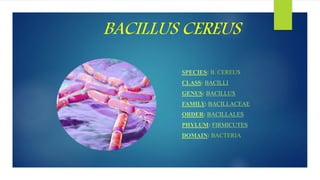
BACILLUS CEREUS
SPECIES: B. CEREUS
CLASS: BACILLI
GENUS: BACILLUS
FAMILY: BACILLACEAE
ORDER: BACILLALES
PHYLUM: FIRMICUTES
DOMAIN: BACTERIA
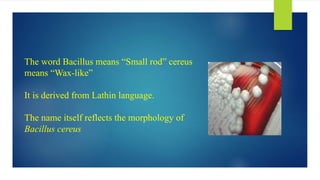
The word Bacillus means “Small rod” cereus
means “Wax-like”
It is derived from Lathin language.
The name itself reflects the morphology of
Bacillus cereus
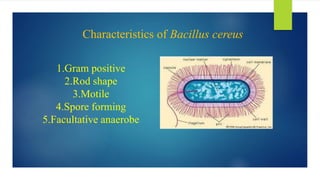
1.Gram positive
2.Rod shape
3.Motile
4.Spore forming
5.Facultative anaerobe
Characteristics of Bacillus cereus
Size
Length : 3-5 μm
Width : 1-1.2 μm
Optimum condition for growth
Temperature : 30-37⁰c
pH: 6-7
Maximum toxin production occur at 20-
25⁰c
Bacillus cereus contains two enzymes
ALKC
ALKD
Involved in DNA repair
For survival :
Temperature :
Spores more resistant to dry heat than moist heat.
It also more resistant in oily foods.
Cooking at or below 100⁰C may allow spore
survival.
pH:
Vegetative cells decline generally rapidly in
stomach acid. Some may survive depending on
food and level of stomach acidity.
Spores are resistant to gastric acidity between
pH 1-5.2.
Sources of B.cereus
It is wide spread in nature and frequently
isolated from soil and growing plants, but it
also adapted for growth in the intestinal tract
of insects and mammals
It is becoming one of the important causes of
food poisoning in the industrialized world.
Bacillus cereus produce two
type of toxins:
1.Diarrheal toxin: 38-57k Da
2.Emetic toxin: 10k Da
Transmission is predominantly food borne for both.
Diarrheal type
1.Found in food such as vegetables, meat, poultry,
grains.
2.It causes fever, diarrhoea.
3.Incubation period 8-16 hrs.
4.Cause sick at night or early in the morning.
5.Toxin secreted in our intestine.
6.Toxin-Heat labile.
Emetic type
1.Found specifically in rice.
2.Commonly called fried rice syndrome.
3.It cause vomiting, abdominal pain.
4.Very short incubation period 1-5 hrs.
5.Toxin-Heat labile.
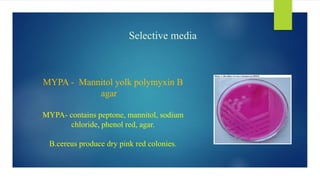
Selective media
MYPA - Mannitol yolk polymyxin B
agar
MYPA- contains peptone, mannitol, sodium
chloride, phenol red, agar.
B.cereus produce dry pink red colonies.
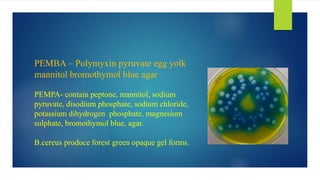
PEMBA – Polymyxin pyruvate egg yolk
mannitol bromothymol blue agar
PEMPA- contain peptone, mannitol, sodium
pyruvate, disodium phosphate, sodium chloride,
potassium dihydrogen phosphate, magnesium
sulphate, bromothymol blue, agar.
B.cereus produce forest green opaque gel forms.
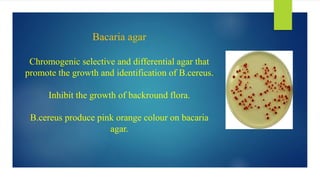
Bacaria agar
Chromogenic selective and differential agar that
promote the growth and identification of B.cereus.
Inhibit the growth of backround flora.
B.cereus produce pink orange colour on bacaria
agar.
Bacillus cereus
Susceptible to Clindamycin, Erythromycin,
Vancomycin.
Resistance to
Penicillin, Trimethoprim.
Bacillus cereus as probiotic
Certain strain producing small amount of toxin at 37⁰C.It have been
approved probiotic.
Bacillus cereus used as a probiotic food additive to reduce
salmonella in the animal intestines & cecum.
This improve animal growth as well as food safety for human who
eat them.
Preservatives
Sorbic acid
Benzoate
Sorbate
Polyphosphates
EDTA
Disinfectants
Chlorine
Sodium hypochloride are effective against B.cereus but
not spores.
Sporocidal
Formaldehyde
Iodine
Acid
Alkalis
peroxy acids
Ozone
Phenolics,Alcohols,Organic acids,Esters,Mercurial have
little sporocidal effects.
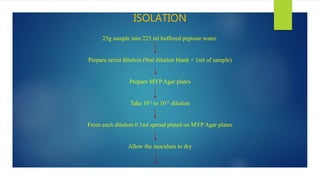
ISOLATION
25g sample into 225 ml buffered peptone water.
Prepare serial dilution (9ml dilution blank + 1ml of sample)
Prepare MYP Agar plates
Take 10-1 to 10-3 dilution
From each dilution 0.1ml spread plated on MYP Agar plates
Allow the inoculum to dry
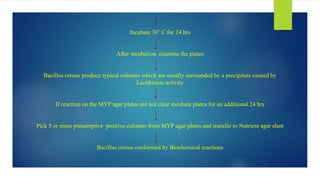
Incubate 30˚ C for 24 hrs
After incubation, examine the plates
Bacillus cereus produce typical colonies which are usually surrounded by a precipitate caused by
Lacithinase activity
If reaction on the MYP agar plates are not clear incubate plates for an additional 24 hrs
Pick 5 or more presumptive positive colonies from MYP agar plates and transfer to Nutrient agar slant
Bacillus cereus conformed by Biochemical reactions
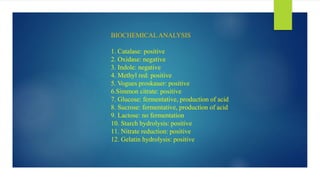
BIOCHEMICAL ANALYSIS
1. Catalase: positive
2. Oxidase: negative
3. Indole: negative
4. Methyl red: positive
5. Vogues proskauer: positive
6.Simmon citrate: positive
7. Glucose: fermentative, production of acid
8. Sucrose: fermentative, production of acid
9. Lactose: no fermentation
10. Starch hydrolysis: positive
11. Nitrate reduction: positive
12. Gelatin hydrolysis: positive
THANK YOU

BACILLUS CEREUS.pptx

  • 1.
    BACILLUS CEREUS SPECIES: B.CEREUS CLASS: BACILLI GENUS: BACILLUS FAMILY: BACILLACEAE ORDER: BACILLALES PHYLUM: FIRMICUTES DOMAIN: BACTERIA
  • 2.
    The word Bacillusmeans “Small rod” cereus means “Wax-like” It is derived from Lathin language. The name itself reflects the morphology of Bacillus cereus
  • 3.
    1.Gram positive 2.Rod shape 3.Motile 4.Sporeforming 5.Facultative anaerobe Characteristics of Bacillus cereus
  • 4.
    Size Length : 3-5μm Width : 1-1.2 μm Optimum condition for growth Temperature : 30-37⁰c pH: 6-7 Maximum toxin production occur at 20- 25⁰c
  • 5.
    Bacillus cereus containstwo enzymes ALKC ALKD Involved in DNA repair
  • 6.
    For survival : Temperature: Spores more resistant to dry heat than moist heat. It also more resistant in oily foods. Cooking at or below 100⁰C may allow spore survival. pH: Vegetative cells decline generally rapidly in stomach acid. Some may survive depending on food and level of stomach acidity. Spores are resistant to gastric acidity between pH 1-5.2.
  • 7.
    Sources of B.cereus Itis wide spread in nature and frequently isolated from soil and growing plants, but it also adapted for growth in the intestinal tract of insects and mammals It is becoming one of the important causes of food poisoning in the industrialized world.
  • 8.
    Bacillus cereus producetwo type of toxins: 1.Diarrheal toxin: 38-57k Da 2.Emetic toxin: 10k Da Transmission is predominantly food borne for both.
  • 9.
    Diarrheal type 1.Found infood such as vegetables, meat, poultry, grains. 2.It causes fever, diarrhoea. 3.Incubation period 8-16 hrs. 4.Cause sick at night or early in the morning. 5.Toxin secreted in our intestine. 6.Toxin-Heat labile.
  • 10.
    Emetic type 1.Found specificallyin rice. 2.Commonly called fried rice syndrome. 3.It cause vomiting, abdominal pain. 4.Very short incubation period 1-5 hrs. 5.Toxin-Heat labile.
  • 11.
    Selective media MYPA -Mannitol yolk polymyxin B agar MYPA- contains peptone, mannitol, sodium chloride, phenol red, agar. B.cereus produce dry pink red colonies.
  • 12.
    PEMBA – Polymyxinpyruvate egg yolk mannitol bromothymol blue agar PEMPA- contain peptone, mannitol, sodium pyruvate, disodium phosphate, sodium chloride, potassium dihydrogen phosphate, magnesium sulphate, bromothymol blue, agar. B.cereus produce forest green opaque gel forms.
  • 13.
    Bacaria agar Chromogenic selectiveand differential agar that promote the growth and identification of B.cereus. Inhibit the growth of backround flora. B.cereus produce pink orange colour on bacaria agar.
  • 14.
    Bacillus cereus Susceptible toClindamycin, Erythromycin, Vancomycin. Resistance to Penicillin, Trimethoprim.
  • 15.
    Bacillus cereus asprobiotic Certain strain producing small amount of toxin at 37⁰C.It have been approved probiotic. Bacillus cereus used as a probiotic food additive to reduce salmonella in the animal intestines & cecum. This improve animal growth as well as food safety for human who eat them.
  • 16.
  • 17.
  • 18.
    ISOLATION 25g sample into225 ml buffered peptone water. Prepare serial dilution (9ml dilution blank + 1ml of sample) Prepare MYP Agar plates Take 10-1 to 10-3 dilution From each dilution 0.1ml spread plated on MYP Agar plates Allow the inoculum to dry
  • 19.
    Incubate 30˚ Cfor 24 hrs After incubation, examine the plates Bacillus cereus produce typical colonies which are usually surrounded by a precipitate caused by Lacithinase activity If reaction on the MYP agar plates are not clear incubate plates for an additional 24 hrs Pick 5 or more presumptive positive colonies from MYP agar plates and transfer to Nutrient agar slant Bacillus cereus conformed by Biochemical reactions
  • 20.
    BIOCHEMICAL ANALYSIS 1. Catalase:positive 2. Oxidase: negative 3. Indole: negative 4. Methyl red: positive 5. Vogues proskauer: positive 6.Simmon citrate: positive 7. Glucose: fermentative, production of acid 8. Sucrose: fermentative, production of acid 9. Lactose: no fermentation 10. Starch hydrolysis: positive 11. Nitrate reduction: positive 12. Gelatin hydrolysis: positive
  • 21.