Speed Graphs
Objectives: SWBAT
1. Recognize distance vs. time graphs;
2. Know that distance vs. time graphs
shows the speed;
3. Read and interpret graphs.
Standards 1f: Students know how to interpret
graphs of position vs. time for motion in
single direction.
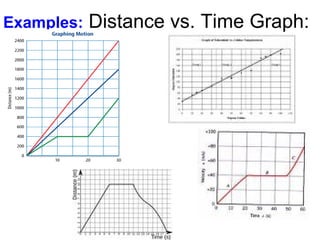
Examples: Distance vs. Time Graph:
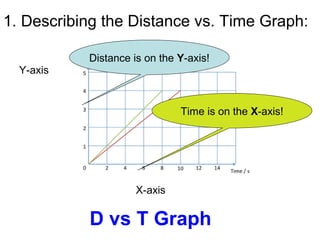
1. Describing the Distance vs. Time Graph:
Y-axis
X-axis
Distance is on the Y-axis!
Time is on the X-axis!
D vs T Graph
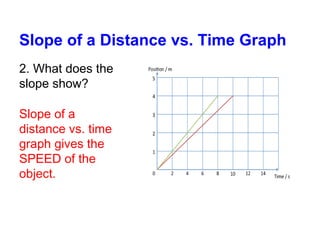
Slope of a Distance vs. Time Graph
2. What does the
slope show?
Slope of a
distance vs. time
graph gives the
SPEED of the
object.
How the graph
looks like…
What the graph is telling
about the motion…
Draw here the
graph…
you will need
your ruler!
Write here what
the graph means…
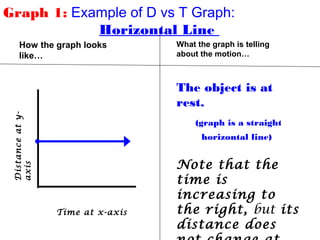
Graph 1: Example of D vs T Graph:
Horizontal Line
How the graph looks
like…
What the graph is telling
about the motion…
Time at x-axis
Distanceaty-
axis
The object is at
rest.
(graph is a straight
horizontal line)
Note that the
time is
increasing to
the right, but its
distance does
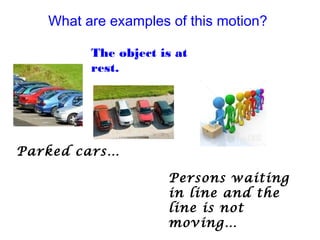
What are examples of this motion?
The object is at
rest.
Parked cars…
Persons waiting
in line and the
line is not
moving…
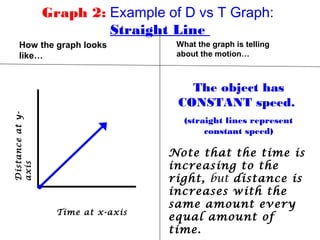
Graph 2: Example of D vs T Graph:
Straight Line
How the graph looks
like…
What the graph is telling
about the motion…
Time at x-axis
Distanceaty-
axis
The object has
CONSTANT speed.
(straight lines represent
constant speed)
Note that the time is
increasing to the
right, but distance is
increases with the
same amount every
equal amount of
time.
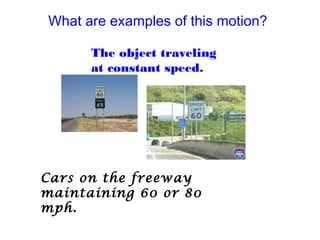
What are examples of this motion?
The object traveling
at constant speed.
Cars on the freeway
maintaining 60 or 80
mph.
Graph 2: Example of D vs T Graph:
Steeper Straight Line
How the graph looks
like…
What the graph is telling
about the motion…
Time at x-axis
Distanceaty-
axis
The object with RED
line has CONSTANT
speed but speed is
faster than the object
with BLUE line.
(straight lines represent constant
speed)
Note that the RED line took
shorter amount of time to
cover the same distance, so it is
faster.
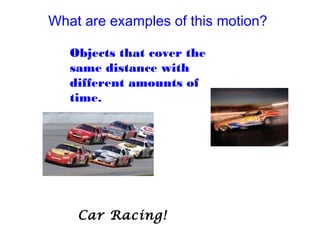
What are examples of this motion?
Objects that cover the
same distance with
different amounts of
time.
Car Racing!
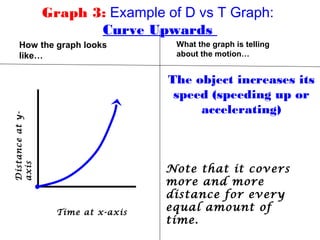
Graph 3: Example of D vs T Graph:
Curve Upwards
How the graph looks
like…
What the graph is telling
about the motion…
The object increases its
speed (speeding up or
accelerating)
Note that it covers
more and more
distance for every
equal amount of
time.
Time at x-axis
Distanceaty-
axis
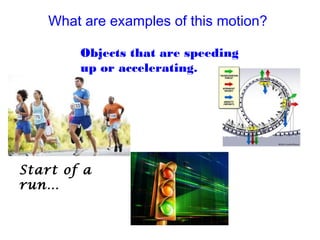
What are examples of this motion?
Objects that are speeding
up or accelerating.
Start of a
run…
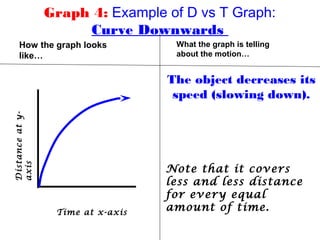
Graph 4: Example of D vs T Graph:
Curve Downwards
How the graph looks
like…
What the graph is telling
about the motion…
The object decreases its
speed (slowing down).
Note that it covers
less and less distance
for every equal
amount of time.Time at x-axis
Distanceaty-
axis
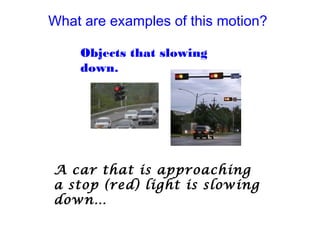
What are examples of this motion?
Objects that slowing
down.
A car that is approaching
a stop (red) light is slowing
down…
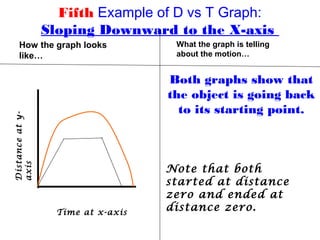
Fifth Example of D vs T Graph:
Sloping Downward to the X-axis
How the graph looks
like…
What the graph is telling
about the motion…
Time at x-axis
Distanceaty-
axis
Both graphs show that
the object is going back
to its starting point.
Note that both
started at distance
zero and ended at
distance zero.
What are examples of this motion?
Objects that return to
their starting point.
You! You go to school everyday
but at night, you go back home!
(You are going back to your
starting point!)
Summary
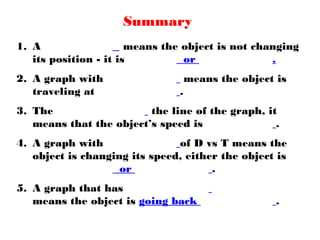
1. A means the object is not changing
its position - it is or .
2. A graph with means the object is
traveling at .
3. The the line of the graph, it
means that the object’s speed is .
4. A graph with of D vs T means the
object is changing its speed, either the object is
or .
5. A graph that has
means the object is going back .
Summary
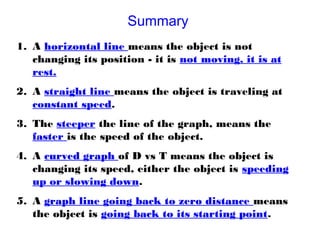
1. A horizontal line means the object is not
changing its position - it is not moving, it is at
rest.
2. A straight line means the object is traveling at
constant speed.
3. The steeper the line of the graph, means the
faster is the speed of the object.
4. A curved graph of D vs T means the object is
changing its speed, either the object is speeding
up or slowing down.
5. A graph line going back to zero distance means
the object is going back to its starting point.
Practice
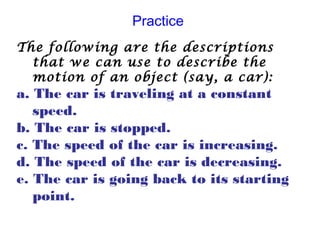
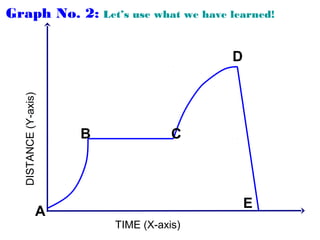
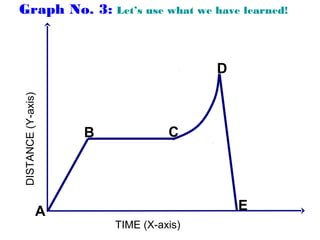
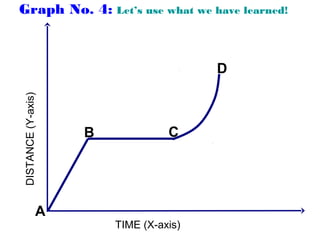
The following are the descriptions
that we can use to describe the
motion of an object (say, a car):
a. The car is traveling at a constant
speed.
b. The car is stopped.
c. The speed of the car is increasing.
d. The speed of the car is decreasing.
e. The car is going back to its starting
point.
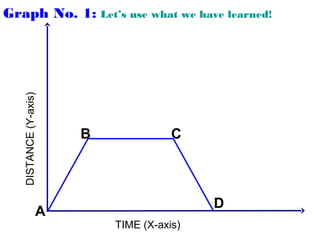
Graph No. 1: Let’s use what we have learned!
TIME (X-axis)
DISTANCE(Y-axis)
A
B
D
C
Graph No. 2: Let’s use what we have learned!
TIME (X-axis)
DISTANCE(Y-axis)
A
B
D
C
E
Graph No. 3: Let’s use what we have learned!
TIME (X-axis)
DISTANCE(Y-axis)
A
B
D
C
E
Graph No. 4: Let’s use what we have learned!
TIME (X-axis)
DISTANCE(Y-axis)
A
B
D
C
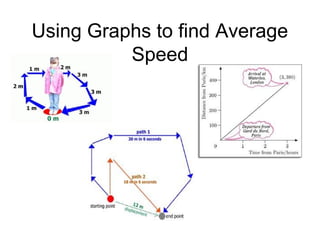
Using Graphs to find Average
Speed
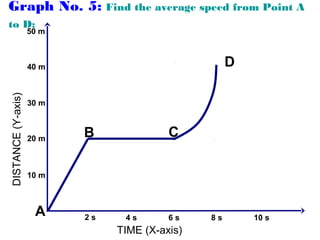
Graph No. 5: Find the average speed from Point A
to D:
TIME (X-axis)
DISTANCE(Y-axis)
A
B
D
C
10 m
20 m
30 m
40 m
2 s 4 s 6 s 8 s 10 s
50 m
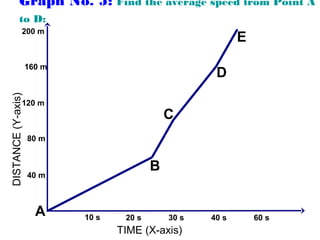
Graph No. 5: Find the average speed from Point A
to D:
TIME (X-axis)
DISTANCE(Y-axis)
A
B
D
C
40 m
80 m
120 m
160 m
10 s 20 s 30 s 40 s 60 s
200 m
E

11. notes on speed graphs

  • 1.
    Speed Graphs Objectives: SWBAT 1.Recognize distance vs. time graphs; 2. Know that distance vs. time graphs shows the speed; 3. Read and interpret graphs. Standards 1f: Students know how to interpret graphs of position vs. time for motion in single direction.
  • 2.
  • 3.
    1. Describing theDistance vs. Time Graph: Y-axis X-axis Distance is on the Y-axis! Time is on the X-axis! D vs T Graph
  • 4.
    Slope of aDistance vs. Time Graph 2. What does the slope show? Slope of a distance vs. time graph gives the SPEED of the object.
  • 5.
    How the graph lookslike… What the graph is telling about the motion… Draw here the graph… you will need your ruler! Write here what the graph means…
  • 6.
    Graph 1: Exampleof D vs T Graph: Horizontal Line How the graph looks like… What the graph is telling about the motion… Time at x-axis Distanceaty- axis The object is at rest. (graph is a straight horizontal line) Note that the time is increasing to the right, but its distance does
  • 7.
    What are examplesof this motion? The object is at rest. Parked cars… Persons waiting in line and the line is not moving…
  • 8.
    Graph 2: Exampleof D vs T Graph: Straight Line How the graph looks like… What the graph is telling about the motion… Time at x-axis Distanceaty- axis The object has CONSTANT speed. (straight lines represent constant speed) Note that the time is increasing to the right, but distance is increases with the same amount every equal amount of time.
  • 9.
    What are examplesof this motion? The object traveling at constant speed. Cars on the freeway maintaining 60 or 80 mph.
  • 10.
    Graph 2: Exampleof D vs T Graph: Steeper Straight Line How the graph looks like… What the graph is telling about the motion… Time at x-axis Distanceaty- axis The object with RED line has CONSTANT speed but speed is faster than the object with BLUE line. (straight lines represent constant speed) Note that the RED line took shorter amount of time to cover the same distance, so it is faster.
  • 11.
    What are examplesof this motion? Objects that cover the same distance with different amounts of time. Car Racing!
  • 12.
    Graph 3: Exampleof D vs T Graph: Curve Upwards How the graph looks like… What the graph is telling about the motion… The object increases its speed (speeding up or accelerating) Note that it covers more and more distance for every equal amount of time. Time at x-axis Distanceaty- axis
  • 13.
    What are examplesof this motion? Objects that are speeding up or accelerating. Start of a run…
  • 14.
    Graph 4: Exampleof D vs T Graph: Curve Downwards How the graph looks like… What the graph is telling about the motion… The object decreases its speed (slowing down). Note that it covers less and less distance for every equal amount of time.Time at x-axis Distanceaty- axis
  • 15.
    What are examplesof this motion? Objects that slowing down. A car that is approaching a stop (red) light is slowing down…
  • 16.
    Fifth Example ofD vs T Graph: Sloping Downward to the X-axis How the graph looks like… What the graph is telling about the motion… Time at x-axis Distanceaty- axis Both graphs show that the object is going back to its starting point. Note that both started at distance zero and ended at distance zero.
  • 17.
    What are examplesof this motion? Objects that return to their starting point. You! You go to school everyday but at night, you go back home! (You are going back to your starting point!)
  • 18.
    Summary 1. A meansthe object is not changing its position - it is or . 2. A graph with means the object is traveling at . 3. The the line of the graph, it means that the object’s speed is . 4. A graph with of D vs T means the object is changing its speed, either the object is or . 5. A graph that has means the object is going back .
  • 19.
    Summary 1. A horizontalline means the object is not changing its position - it is not moving, it is at rest. 2. A straight line means the object is traveling at constant speed. 3. The steeper the line of the graph, means the faster is the speed of the object. 4. A curved graph of D vs T means the object is changing its speed, either the object is speeding up or slowing down. 5. A graph line going back to zero distance means the object is going back to its starting point.
  • 20.
    Practice The following arethe descriptions that we can use to describe the motion of an object (say, a car): a. The car is traveling at a constant speed. b. The car is stopped. c. The speed of the car is increasing. d. The speed of the car is decreasing. e. The car is going back to its starting point.
  • 21.
    Graph No. 1:Let’s use what we have learned! TIME (X-axis) DISTANCE(Y-axis) A B D C
  • 22.
    Graph No. 2:Let’s use what we have learned! TIME (X-axis) DISTANCE(Y-axis) A B D C E
  • 23.
    Graph No. 3:Let’s use what we have learned! TIME (X-axis) DISTANCE(Y-axis) A B D C E
  • 24.
    Graph No. 4:Let’s use what we have learned! TIME (X-axis) DISTANCE(Y-axis) A B D C
  • 25.
    Using Graphs tofind Average Speed
  • 26.
    Graph No. 5:Find the average speed from Point A to D: TIME (X-axis) DISTANCE(Y-axis) A B D C 10 m 20 m 30 m 40 m 2 s 4 s 6 s 8 s 10 s 50 m
  • 27.
    Graph No. 5:Find the average speed from Point A to D: TIME (X-axis) DISTANCE(Y-axis) A B D C 40 m 80 m 120 m 160 m 10 s 20 s 30 s 40 s 60 s 200 m E