Failure Modes Effect Analysis
Presented By:
Preksha Das
Shreya Surve
A Failure Mode and Effect Analysis is a systemized team activity intended to:
• Recognize and evaluate potential failure and its effects.
• Identify actions which will reduce or eliminate the chance of
failure.
• Document analysis findings.
When to use FMEA:
• FMEA is designed to prevent failures from occurring or from getting to internal and
external customers.
• FMEA is essential for situations where failures might occur and the effects of those failures
occurring are potentially serious.
• FMEA can be used on all improvement projects.
• FMEA serves as on overall control document for any given process.
Introduction
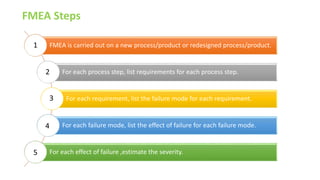
FMEA Steps
FMEA is carried out on a new process/product or redesigned process/product.
For each process step, list requirements for each process step.
For each requirement, list the failure mode for each requirement.
For each failure mode, list the effect of failure for each failure mode.
For each effect of failure ,estimate the severity.
1
2
3
4
5
Cont…
For each failure mode, list causes.
For each cause of failure, estimate the likelihood of occurrence.
For each cause of failure , list the current process controls.
For each process control, estimate the detection.
For each cause of Failure, calculate the Risk Priority Number by multiplying the
scores associated with severity, occurrence and detection.
6
7
8
9
10
Cont…
For high priority causes of failure and/or failure modes, develop
recommended actions.
For each recommended action, assign responsibility and
completion dates.
For each recommended action, implement the action and note its
effect.
For each implemented action, re-estimate the severity, occurrence
and detection rankings and recalculate the RPN
11
12
13
14
Severity Scale
Rating Criteria- A failure could:
10 Injure a customer or employee.
9 Be illegal
8 Render product or service unfit for use
7 Cause extreme customer dissatisfaction
6 Result in partial malfunction
5 Cause a loss of performance which is
likely to result in a complaint
4 Cause minor performance loss.
3 Cause a minor nuisance, but be
overcome with no performance loss.
2 Be unnoticed and have only minor
effect on performance
1 Be unnoticed and not affect the
performance.
Occurrence Scale
Rating Criteria- A failure could:
10 More than once per day
9 Once every 3-4 days.
8 Once per week.
7 Once per month.
6 Once every 3 months.
5 Once every 6 months.
4 Once per year.
3 Once every 1-3 years.
2 Once every 3-6 years.
1 Once every 6-100 years.
High High
Low Low
More the severity,
higher is the rating
More often it occurs,
higher is the rating
Detection Scale
Rating Definition
10 Defect caused by failure is not detectable.
9 Occasional units are checked for defect.
8 Units are systematically sampled and inspected.
7 All units are manually inspected.
6 Units are manually inspected and mistake-proofing
modifications.
5 Process is monitored(SPC) and manually inspected.
4 SPC is used with an immediate reaction of out-of
control conditions
3 SPC as above with 100% inspection surrounding out-
of-control conditions.
2 All units are automatically inspected.
1 Defect is obvious and can be kept from affecting the
customer.
High
Low
Lower the ability to detect,
higher is the rating.

Fmea

  • 1.
    Failure Modes EffectAnalysis Presented By: Preksha Das Shreya Surve
  • 2.
    A Failure Modeand Effect Analysis is a systemized team activity intended to: • Recognize and evaluate potential failure and its effects. • Identify actions which will reduce or eliminate the chance of failure. • Document analysis findings. When to use FMEA: • FMEA is designed to prevent failures from occurring or from getting to internal and external customers. • FMEA is essential for situations where failures might occur and the effects of those failures occurring are potentially serious. • FMEA can be used on all improvement projects. • FMEA serves as on overall control document for any given process. Introduction
  • 3.
    FMEA Steps FMEA iscarried out on a new process/product or redesigned process/product. For each process step, list requirements for each process step. For each requirement, list the failure mode for each requirement. For each failure mode, list the effect of failure for each failure mode. For each effect of failure ,estimate the severity. 1 2 3 4 5
  • 4.
    Cont… For each failuremode, list causes. For each cause of failure, estimate the likelihood of occurrence. For each cause of failure , list the current process controls. For each process control, estimate the detection. For each cause of Failure, calculate the Risk Priority Number by multiplying the scores associated with severity, occurrence and detection. 6 7 8 9 10
  • 5.
    Cont… For high prioritycauses of failure and/or failure modes, develop recommended actions. For each recommended action, assign responsibility and completion dates. For each recommended action, implement the action and note its effect. For each implemented action, re-estimate the severity, occurrence and detection rankings and recalculate the RPN 11 12 13 14
  • 6.
    Severity Scale Rating Criteria-A failure could: 10 Injure a customer or employee. 9 Be illegal 8 Render product or service unfit for use 7 Cause extreme customer dissatisfaction 6 Result in partial malfunction 5 Cause a loss of performance which is likely to result in a complaint 4 Cause minor performance loss. 3 Cause a minor nuisance, but be overcome with no performance loss. 2 Be unnoticed and have only minor effect on performance 1 Be unnoticed and not affect the performance. Occurrence Scale Rating Criteria- A failure could: 10 More than once per day 9 Once every 3-4 days. 8 Once per week. 7 Once per month. 6 Once every 3 months. 5 Once every 6 months. 4 Once per year. 3 Once every 1-3 years. 2 Once every 3-6 years. 1 Once every 6-100 years. High High Low Low More the severity, higher is the rating More often it occurs, higher is the rating
  • 7.
    Detection Scale Rating Definition 10Defect caused by failure is not detectable. 9 Occasional units are checked for defect. 8 Units are systematically sampled and inspected. 7 All units are manually inspected. 6 Units are manually inspected and mistake-proofing modifications. 5 Process is monitored(SPC) and manually inspected. 4 SPC is used with an immediate reaction of out-of control conditions 3 SPC as above with 100% inspection surrounding out- of-control conditions. 2 All units are automatically inspected. 1 Defect is obvious and can be kept from affecting the customer. High Low Lower the ability to detect, higher is the rating.