Statistical
Quality
Control
Production and operation management
Unit 5
1
B.V. Patel Institute of BMC & IT Prepared by Divya Paulose
What is SQC ?
Statistical quality control (SQC) is the
term used to describe the set of statistical
tools used by quality professionals.
2
Prepared by Divya Paulose
History
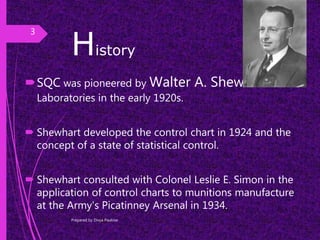
SQC was pioneered by Walter A. Shewhart at Bell
Laboratories in the early 1920s.
 Shewhart developed the control chart in 1924 and the
concept of a state of statistical control.
 Shewhart consulted with Colonel Leslie E. Simon in the
application of control charts to munitions manufacture
at the Army's Picatinney Arsenal in 1934.
3
Prepared by Divya Paulose
History
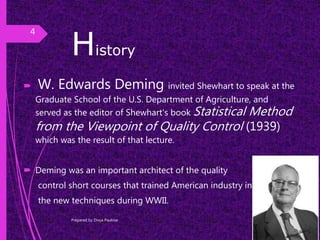
 W. Edwards Deming invited Shewhart to speak at the
Graduate School of the U.S. Department of Agriculture, and
served as the editor of Shewhart's book Statistical Method
from the Viewpoint of Quality Control (1939)
which was the result of that lecture.
 Deming was an important architect of the quality
control short courses that trained American industry in
the new techniques during WWII.
4
Prepared by Divya Paulose
 Deming traveled to Japan during the Allied Occupation and met with the
Union of Japanese Scientists and Engineers(JUSE)in an effort to introduce
SQC methods to Japanese industry
5
Prepared by Divya Paulose
SQC Categories6
Descriptive statistics
Statistical process control
(SPC)
Acceptance sampling
Prepared by Divya Paulose
Descriptive Statistics
Descriptive statistics are used to
describe quality characteristics and
relationships.
7
Prepared by Divya Paulose
Descriptive Statistics
The Mean- measure of central
tendency.
The Range- difference between
largest/smallest observations in a
set of data.
Standard Deviation measures the
amount of data dispersion around
mean.
8
Prepared by Divya Paulose
The Mean
 To compute the mean we simply sum all the
observations and divide by the total no. of observations.
9
Prepared by Divya Paulose
The Range
Range, which is the difference between
the largest and smallest observations.
10
Prepared by Divya Paulose
Standard Deviation
Standard deviation is a measure of
dispersion of a curve.
It measures the extent to which these
values are scattered around the central
mean.
11
Prepared by Divya Paulose
• Extend the use of descriptive statistics to
monitor the quality of the product and
process.
• Statistical process control help to
determine the amount of variation.
• To make sure the process is in a state of
control.
12 Statistical process
control
Prepared by Divya Paulose
STATISTICAL QUALITY CONTROL:
Application of statistical techniques to
accept or reject products already produced
or to control the process while it is being
carried out.
 STATISTICAL PROCESS CONTROL: Statistical
evaluation of the output of a process during
production.
13
Prepared by Divya Paulose
Variation in Quality
 No two items are exactly alike.
 Some sort of variations in the two items is bound to be there. In
fact it is an integral part of any manufacturing process.
 This difference in characteristics known as variation.
 This variation may be due to substandard quality of raw material,
carelessness on the part of operator, fault in machinery system etc..
14
Prepared by Divya Paulose
Types Of Variations15
Prepared by Divya Paulose
Variation due to chance
causes/common causes
Variation occurred due to chance.
This variation is NOT due to defect in
machine, Raw material or any other
factors.
Behave in “random manner”.
Negligible but Inevitable
The process is said to be under the
state of statistical control.
16
Prepared by Divya Paulose
Variation due to
assignable causes
Non – random causes like:
Difference in quality of raw material
Difference in machines
Difference in operators
Difference of time
17
Prepared by Divya Paulose
18
Prepared by Divya Paulose
Specification and control limits
 No item in the world can be a true copy of another item.
 It is not expressed in absolute values but in terms of a range.
 For Eg:
The diameter of a pen is expected by its manufacturer not
as 7mm but as 7mm ± 0.05.
Thus, the diameter of a pen produced by the
manufacturer can vary from 6.95 mm to 7.05 mm.
19
Prepared by Divya Paulose
Setting Control Limits20
Prepared by Divya Paulose
HOW CONTROL LIMITS ARE USEFUL…..?
21
Prepared by Divya Paulose
SPC Methods-Control Charts
 Control Charts show sample data plotted on a graph
with CL, UCL, and LCL
 Control chart for variables are used to monitor
characteristics that can be measured, e.g. length, weight,
diameter, time
 Control charts for attributes are used to monitor
characteristics that have discrete values and can be counted,
e.g. % defective, number of flaws in a shirt, number of
broken eggs in a box
22
Prepared by Divya Paulose
Control Charts for Variables
x-bar charts (Average
Quality)
It is used to monitor the changes in the mean of a process
(central tendencies).
R-bar charts (Variation)
It is used to monitor the dispersion or variability of the
process
23
Prepared by Divya Paulose
Thank You
24
Prepared by Divya Paulose

Statistical Quality control

  • 1.
    Statistical Quality Control Production and operationmanagement Unit 5 1 B.V. Patel Institute of BMC & IT Prepared by Divya Paulose
  • 2.
    What is SQC? Statistical quality control (SQC) is the term used to describe the set of statistical tools used by quality professionals. 2 Prepared by Divya Paulose
  • 3.
    History SQC was pioneeredby Walter A. Shewhart at Bell Laboratories in the early 1920s.  Shewhart developed the control chart in 1924 and the concept of a state of statistical control.  Shewhart consulted with Colonel Leslie E. Simon in the application of control charts to munitions manufacture at the Army's Picatinney Arsenal in 1934. 3 Prepared by Divya Paulose
  • 4.
    History  W. EdwardsDeming invited Shewhart to speak at the Graduate School of the U.S. Department of Agriculture, and served as the editor of Shewhart's book Statistical Method from the Viewpoint of Quality Control (1939) which was the result of that lecture.  Deming was an important architect of the quality control short courses that trained American industry in the new techniques during WWII. 4 Prepared by Divya Paulose
  • 5.
     Deming traveledto Japan during the Allied Occupation and met with the Union of Japanese Scientists and Engineers(JUSE)in an effort to introduce SQC methods to Japanese industry 5 Prepared by Divya Paulose
  • 6.
    SQC Categories6 Descriptive statistics Statisticalprocess control (SPC) Acceptance sampling Prepared by Divya Paulose
  • 7.
    Descriptive Statistics Descriptive statisticsare used to describe quality characteristics and relationships. 7 Prepared by Divya Paulose
  • 8.
    Descriptive Statistics The Mean-measure of central tendency. The Range- difference between largest/smallest observations in a set of data. Standard Deviation measures the amount of data dispersion around mean. 8 Prepared by Divya Paulose
  • 9.
    The Mean  Tocompute the mean we simply sum all the observations and divide by the total no. of observations. 9 Prepared by Divya Paulose
  • 10.
    The Range Range, whichis the difference between the largest and smallest observations. 10 Prepared by Divya Paulose
  • 11.
    Standard Deviation Standard deviationis a measure of dispersion of a curve. It measures the extent to which these values are scattered around the central mean. 11 Prepared by Divya Paulose
  • 12.
    • Extend theuse of descriptive statistics to monitor the quality of the product and process. • Statistical process control help to determine the amount of variation. • To make sure the process is in a state of control. 12 Statistical process control Prepared by Divya Paulose
  • 13.
    STATISTICAL QUALITY CONTROL: Applicationof statistical techniques to accept or reject products already produced or to control the process while it is being carried out.  STATISTICAL PROCESS CONTROL: Statistical evaluation of the output of a process during production. 13 Prepared by Divya Paulose
  • 14.
    Variation in Quality No two items are exactly alike.  Some sort of variations in the two items is bound to be there. In fact it is an integral part of any manufacturing process.  This difference in characteristics known as variation.  This variation may be due to substandard quality of raw material, carelessness on the part of operator, fault in machinery system etc.. 14 Prepared by Divya Paulose
  • 15.
  • 16.
    Variation due tochance causes/common causes Variation occurred due to chance. This variation is NOT due to defect in machine, Raw material or any other factors. Behave in “random manner”. Negligible but Inevitable The process is said to be under the state of statistical control. 16 Prepared by Divya Paulose
  • 17.
    Variation due to assignablecauses Non – random causes like: Difference in quality of raw material Difference in machines Difference in operators Difference of time 17 Prepared by Divya Paulose
  • 18.
  • 19.
    Specification and controllimits  No item in the world can be a true copy of another item.  It is not expressed in absolute values but in terms of a range.  For Eg: The diameter of a pen is expected by its manufacturer not as 7mm but as 7mm ± 0.05. Thus, the diameter of a pen produced by the manufacturer can vary from 6.95 mm to 7.05 mm. 19 Prepared by Divya Paulose
  • 20.
  • 21.
    HOW CONTROL LIMITSARE USEFUL…..? 21 Prepared by Divya Paulose
  • 22.
    SPC Methods-Control Charts Control Charts show sample data plotted on a graph with CL, UCL, and LCL  Control chart for variables are used to monitor characteristics that can be measured, e.g. length, weight, diameter, time  Control charts for attributes are used to monitor characteristics that have discrete values and can be counted, e.g. % defective, number of flaws in a shirt, number of broken eggs in a box 22 Prepared by Divya Paulose
  • 23.
    Control Charts forVariables x-bar charts (Average Quality) It is used to monitor the changes in the mean of a process (central tendencies). R-bar charts (Variation) It is used to monitor the dispersion or variability of the process 23 Prepared by Divya Paulose
  • 24.