Real Numbers
Real Numbers
 By Kristle Wilson
By Kristle Wilson
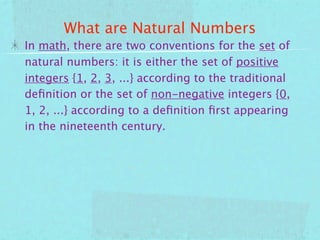
What are Natural Numbers
In math, there are two conventions for the set of
natural numbers: it is either the set of positive
integers {1, 2, 3, ...} according to the traditional
definition or the set of non-negative integers {0,
1, 2, ...} according to a definition first appearing
in the nineteenth century.
What are Natural Numbers
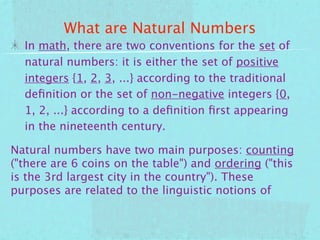
  In math, there are two conventions for the set of
  natural numbers: it is either the set of positive
  integers {1, 2, 3, ...} according to the traditional
  definition or the set of non-negative integers {0,
  1, 2, ...} according to a definition first appearing
  in the nineteenth century.

Natural numbers have two main purposes: counting
("there are 6 coins on the table") and ordering ("this
is the 3rd largest city in the country"). These
purposes are related to the linguistic notions of
What are Natural Numbers


Natural numbers have two main purposes: counting
("there are 6 coins on the table") and ordering ("this
is the 3rd largest city in the country"). These
purposes are related to the linguistic notions of
What are Natural Numbers
What Is a Whole Number
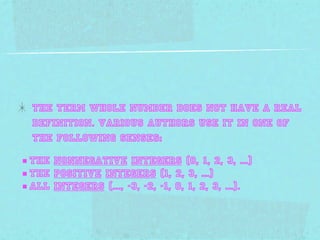
The term whole number does not have a Real
definition. Various authors use it in one of
the following senses:
The term whole number does not have a Real
  definition. Various authors use it in one of
  the following senses:

■ the nonnegative integers (0, 1, 2, 3, ...)
The term whole number does not have a Real
  definition. Various authors use it in one of
  the following senses:

■ the nonnegative integers (0, 1, 2, 3, ...)
■ the positive integers (1, 2, 3, ...)
The term whole number does not have a Real
  definition. Various authors use it in one of
  the following senses:

■ the nonnegative integers (0, 1, 2, 3, ...)
■ the positive integers (1, 2, 3, ...)
■ all integers (..., -3, -2, -1, 0, 1, 2, 3, ...).
■ the nonnegative integers (0, 1, 2, 3, ...)
■ the positive integers (1, 2, 3, ...)
■ all integers (..., -3, -2, -1, 0, 1, 2, 3, ...).
■ the positive integers (1, 2, 3, ...)
■ all integers (..., -3, -2, -1, 0, 1, 2, 3, ...).
What Are Integers
S: (n) integer, whole number (any of the natural numbers (positive or
negative) or zero) "an integer is a number that is not a fraction"
What is A real Number
In Math the real numbers may be described
informally in several different ways. The real
numbers include both rational numbers, such as
42 and −23/129, and irrational numbers, such
as pi and the square root of two; or, a real
number can be given by an infinite decimal
representation, such as 2.4871773339..., where
the digits continue in some way; or, the real
numbers may be thought of as points on an
infinitely long number line.
Rational Numbers
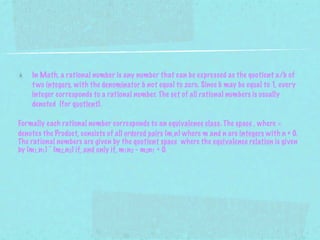
In Math, a rational number is any number that can be expressed as the quotient a/b of
t wo integers, with the denominator b not equal to zero. Since b may be equal to 1, every
integer corresponds to a rational number. The set of all rational numbers is usually
denoted (for quotient).
In Math, a rational number is any number that can be expressed as the quotient a/b of
    t wo integers, with the denominator b not equal to zero. Since b may be equal to 1, every
    integer corresponds to a rational number. The set of all rational numbers is usually
    denoted (for quotient).

Formally each rational number corresponds to an equivalence class. The space , where ×
denotes the Product, consists of all ordered pairs (m,n) where m and n are integers with n ≠ 0.
The rational numbers are given by the quotient space where the equivalence relation is given
by (m1,n1) ~ (m2,n2) if, and only if, m1n2 - m2n1 = 0.
In Math, a rational number is any number that can be expressed as the quotient a/b of
    t wo integers, with the denominator b not equal to zero. Since b may be equal to 1, every
    integer corresponds to a rational number. The set of all rational numbers is usually
    denoted (for quotient).

Formally each rational number corresponds to an equivalence class. The space , where ×
denotes the Product, consists of all ordered pairs (m,n) where m and n are integers with n ≠ 0.
The rational numbers are given by the quotient space where the equivalence relation is given
by (m1,n1) ~ (m2,n2) if, and only if, m1n2 - m2n1 = 0.
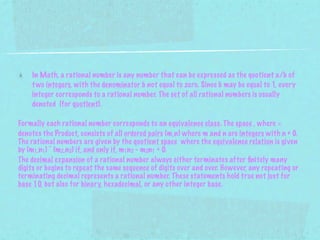
The decimal expansion of a rational number always either terminates after finitely many
digits or begins to repeat the same sequence of digits over and over. However, any repeating or
terminating decimal represents a rational number. These statements hold true not just for
base 10, but also for binary, hexadecimal, or any other integer base.
In Math, a rational number is any number that can be expressed as the quotient a/b of
    t wo integers, with the denominator b not equal to zero. Since b may be equal to 1, every
    integer corresponds to a rational number. The set of all rational numbers is usually
    denoted (for quotient).

Formally each rational number corresponds to an equivalence class. The space , where ×
denotes the Product, consists of all ordered pairs (m,n) where m and n are integers with n ≠ 0.
The rational numbers are given by the quotient space where the equivalence relation is given
by (m1,n1) ~ (m2,n2) if, and only if, m1n2 - m2n1 = 0.
The decimal expansion of a rational number always either terminates after finitely many
digits or begins to repeat the same sequence of digits over and over. However, any repeating or
terminating decimal represents a rational number. These statements hold true not just for
base 10, but also for binary, hexadecimal, or any other integer base.
A real number that is not rational is called irrational. Irrational numbers include √2, π, and e.
The decimal expansion of an irrational number continues forever without repeating. Since the

set of rational numbers is countable, and the set of real numbers is uncountable, almost every
real number is irrational.
Formally each rational number corresponds to an equivalence class. The space , where ×
denotes the Product, consists of all ordered pairs (m,n) where m and n are integers with n ≠ 0.
The rational numbers are given by the quotient space where the equivalence relation is given
by (m1,n1) ~ (m2,n2) if, and only if, m1n2 - m2n1 = 0.
The decimal expansion of a rational number always either terminates after finitely many
digits or begins to repeat the same sequence of digits over and over. However, any repeating or
terminating decimal represents a rational number. These statements hold true not just for
base 10, but also for binary, hexadecimal, or any other integer base.
A real number that is not rational is called irrational. Irrational numbers include √2, π, and e.
The decimal expansion of an irrational number continues forever without repeating. Since the

set of rational numbers is countable, and the set of real numbers is uncountable, almost every
real number is irrational.
The decimal expansion of a rational number always either terminates after finitely many
digits or begins to repeat the same sequence of digits over and over. However, any repeating or
terminating decimal represents a rational number. These statements hold true not just for
base 10, but also for binary, hexadecimal, or any other integer base.
A real number that is not rational is called irrational. Irrational numbers include √2, π, and e.
The decimal expansion of an irrational number continues forever without repeating. Since the

set of rational numbers is countable, and the set of real numbers is uncountable, almost every
real number is irrational.
A real number that is not rational is called irrational. Irrational numbers include √2, π, and e.
The decimal expansion of an irrational number continues forever without repeating. Since the

set of rational numbers is countable, and the set of real numbers is uncountable, almost every
real number is irrational.
What Is A Irrational
A real number !at " not rational " called irrational. Irrational numbers include


√2, π, and e. &e decimal expansion of an irrational number continues forever


wi!(t repeating. Since ) set of rational numbers " c(ntable, and ) set of real


numbers " unc(ntable, almo* every real number " irrational.
A real number !at " not rational " called irrational. Irrational numbers include


√2, π, and e. &e decimal expansion of an irrational number continues forever


wi!(t repeating. Since ) set of rational numbers " c(ntable, and ) set of real


numbers " unc(ntable, almo* every real number " irrational.


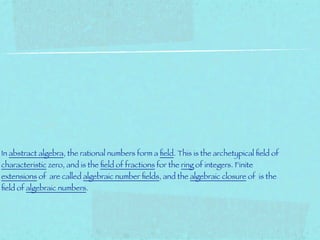
In abstract algebra, the rational numbers form a field. This is the archetypical field of
characteristic zero, and is the field of fractions for the ring of integers. Finite
extensions of are called algebraic number fields, and the algebraic closure of is the
field of algebraic numbers.
A real number !at " not rational " called irrational. Irrational numbers include


√2, π, and e. &e decimal expansion of an irrational number continues forever


wi!(t repeating. Since ) set of rational numbers " c(ntable, and ) set of real


numbers " unc(ntable, almo* every real number " irrational.


In abstract algebra, the rational numbers form a field. This is the archetypical field of
characteristic zero, and is the field of fractions for the ring of integers. Finite
extensions of are called algebraic number fields, and the algebraic closure of is the
field of algebraic numbers.
A real number !at " not rational " called irrational. Irrational numbers include


√2, π, and e. &e decimal expansion of an irrational number continues forever


wi!(t repeating. Since ) set of rational numbers " c(ntable, and ) set of real


numbers " unc(ntable, almo* every real number " irrational.


In abstract algebra, the rational numbers form a field. This is the archetypical field of
characteristic zero, and is the field of fractions for the ring of integers. Finite
extensions of are called algebraic number fields, and the algebraic closure of is the
field of algebraic numbers.
In abstract algebra, the rational numbers form a field. This is the archetypical field of
characteristic zero, and is the field of fractions for the ring of integers. Finite
extensions of are called algebraic number fields, and the algebraic closure of is the
field of algebraic numbers.
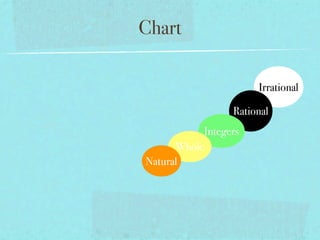
Chart

                      Irrational

                 Rational
           Integers
      Whole
Natural
Bibliography
Bibliography
Bibliography

http://en.wikipedia.org/wiki/Natural_number
Bibliography

http://en.wikipedia.org/wiki/Natural_number

http://en.wikipedia.org/wiki/Whole_number
Bibliography

http://en.wikipedia.org/wiki/Natural_number

http://en.wikipedia.org/wiki/Whole_number

http://wordnetweb.princeton.edu/perl/webwn?s=integer
Bibliography

http://en.wikipedia.org/wiki/Natural_number

http://en.wikipedia.org/wiki/Whole_number

http://wordnetweb.princeton.edu/perl/webwn?s=integer

http://en.wikipedia.org/wiki/Real_number
Bibliography

http://en.wikipedia.org/wiki/Natural_number

http://en.wikipedia.org/wiki/Whole_number

http://wordnetweb.princeton.edu/perl/webwn?s=integer

http://en.wikipedia.org/wiki/Real_number

http://en.wikipedia.org/wiki/Rational_numbers
Bibliography

http://en.wikipedia.org/wiki/Natural_number

http://en.wikipedia.org/wiki/Whole_number

http://wordnetweb.princeton.edu/perl/webwn?s=integer

http://en.wikipedia.org/wiki/Real_number

http://en.wikipedia.org/wiki/Rational_numbers
Bibliography


http://en.wikipedia.org/wiki/Whole_number

http://wordnetweb.princeton.edu/perl/webwn?s=integer

http://en.wikipedia.org/wiki/Real_number

http://en.wikipedia.org/wiki/Rational_numbers
Bibliography


http://wordnetweb.princeton.edu/perl/webwn?s=integer

http://en.wikipedia.org/wiki/Real_number

http://en.wikipedia.org/wiki/Rational_numbers
Bibliography


http://en.wikipedia.org/wiki/Real_number

http://en.wikipedia.org/wiki/Rational_numbers
Bibliography


http://en.wikipedia.org/wiki/Rational_numbers
Bibliography
Bibliography

Math Project

  • 1.
  • 2.
    Real Numbers ByKristle Wilson
  • 3.
  • 5.
  • 6.
    What are NaturalNumbers In math, there are two conventions for the set of natural numbers: it is either the set of positive integers {1, 2, 3, ...} according to the traditional definition or the set of non-negative integers {0, 1, 2, ...} according to a definition first appearing in the nineteenth century.
  • 7.
    What are NaturalNumbers In math, there are two conventions for the set of natural numbers: it is either the set of positive integers {1, 2, 3, ...} according to the traditional definition or the set of non-negative integers {0, 1, 2, ...} according to a definition first appearing in the nineteenth century. Natural numbers have two main purposes: counting ("there are 6 coins on the table") and ordering ("this is the 3rd largest city in the country"). These purposes are related to the linguistic notions of
  • 8.
    What are NaturalNumbers Natural numbers have two main purposes: counting ("there are 6 coins on the table") and ordering ("this is the 3rd largest city in the country"). These purposes are related to the linguistic notions of
  • 9.
  • 11.
    What Is aWhole Number
  • 13.
    The term wholenumber does not have a Real definition. Various authors use it in one of the following senses:
  • 14.
    The term wholenumber does not have a Real definition. Various authors use it in one of the following senses: ■ the nonnegative integers (0, 1, 2, 3, ...)
  • 15.
    The term wholenumber does not have a Real definition. Various authors use it in one of the following senses: ■ the nonnegative integers (0, 1, 2, 3, ...) ■ the positive integers (1, 2, 3, ...)
  • 16.
    The term wholenumber does not have a Real definition. Various authors use it in one of the following senses: ■ the nonnegative integers (0, 1, 2, 3, ...) ■ the positive integers (1, 2, 3, ...) ■ all integers (..., -3, -2, -1, 0, 1, 2, 3, ...).
  • 17.
    ■ the nonnegativeintegers (0, 1, 2, 3, ...) ■ the positive integers (1, 2, 3, ...) ■ all integers (..., -3, -2, -1, 0, 1, 2, 3, ...).
  • 18.
    ■ the positiveintegers (1, 2, 3, ...) ■ all integers (..., -3, -2, -1, 0, 1, 2, 3, ...).
  • 19.
    ■ all integers(..., -3, -2, -1, 0, 1, 2, 3, ...).
  • 22.
  • 24.
    S: (n) integer,whole number (any of the natural numbers (positive or negative) or zero) "an integer is a number that is not a fraction"
  • 27.
    What is Areal Number
  • 29.
    In Math thereal numbers may be described informally in several different ways. The real numbers include both rational numbers, such as 42 and −23/129, and irrational numbers, such as pi and the square root of two; or, a real number can be given by an infinite decimal representation, such as 2.4871773339..., where the digits continue in some way; or, the real numbers may be thought of as points on an infinitely long number line.
  • 32.
  • 34.
    In Math, arational number is any number that can be expressed as the quotient a/b of t wo integers, with the denominator b not equal to zero. Since b may be equal to 1, every integer corresponds to a rational number. The set of all rational numbers is usually denoted (for quotient).
  • 35.
    In Math, arational number is any number that can be expressed as the quotient a/b of t wo integers, with the denominator b not equal to zero. Since b may be equal to 1, every integer corresponds to a rational number. The set of all rational numbers is usually denoted (for quotient). Formally each rational number corresponds to an equivalence class. The space , where × denotes the Product, consists of all ordered pairs (m,n) where m and n are integers with n ≠ 0. The rational numbers are given by the quotient space where the equivalence relation is given by (m1,n1) ~ (m2,n2) if, and only if, m1n2 - m2n1 = 0.
  • 36.
    In Math, arational number is any number that can be expressed as the quotient a/b of t wo integers, with the denominator b not equal to zero. Since b may be equal to 1, every integer corresponds to a rational number. The set of all rational numbers is usually denoted (for quotient). Formally each rational number corresponds to an equivalence class. The space , where × denotes the Product, consists of all ordered pairs (m,n) where m and n are integers with n ≠ 0. The rational numbers are given by the quotient space where the equivalence relation is given by (m1,n1) ~ (m2,n2) if, and only if, m1n2 - m2n1 = 0. The decimal expansion of a rational number always either terminates after finitely many digits or begins to repeat the same sequence of digits over and over. However, any repeating or terminating decimal represents a rational number. These statements hold true not just for base 10, but also for binary, hexadecimal, or any other integer base.
  • 37.
    In Math, arational number is any number that can be expressed as the quotient a/b of t wo integers, with the denominator b not equal to zero. Since b may be equal to 1, every integer corresponds to a rational number. The set of all rational numbers is usually denoted (for quotient). Formally each rational number corresponds to an equivalence class. The space , where × denotes the Product, consists of all ordered pairs (m,n) where m and n are integers with n ≠ 0. The rational numbers are given by the quotient space where the equivalence relation is given by (m1,n1) ~ (m2,n2) if, and only if, m1n2 - m2n1 = 0. The decimal expansion of a rational number always either terminates after finitely many digits or begins to repeat the same sequence of digits over and over. However, any repeating or terminating decimal represents a rational number. These statements hold true not just for base 10, but also for binary, hexadecimal, or any other integer base. A real number that is not rational is called irrational. Irrational numbers include √2, π, and e. The decimal expansion of an irrational number continues forever without repeating. Since the set of rational numbers is countable, and the set of real numbers is uncountable, almost every real number is irrational.
  • 38.
    Formally each rationalnumber corresponds to an equivalence class. The space , where × denotes the Product, consists of all ordered pairs (m,n) where m and n are integers with n ≠ 0. The rational numbers are given by the quotient space where the equivalence relation is given by (m1,n1) ~ (m2,n2) if, and only if, m1n2 - m2n1 = 0. The decimal expansion of a rational number always either terminates after finitely many digits or begins to repeat the same sequence of digits over and over. However, any repeating or terminating decimal represents a rational number. These statements hold true not just for base 10, but also for binary, hexadecimal, or any other integer base. A real number that is not rational is called irrational. Irrational numbers include √2, π, and e. The decimal expansion of an irrational number continues forever without repeating. Since the set of rational numbers is countable, and the set of real numbers is uncountable, almost every real number is irrational.

  • 39.
    The decimal expansionof a rational number always either terminates after finitely many digits or begins to repeat the same sequence of digits over and over. However, any repeating or terminating decimal represents a rational number. These statements hold true not just for base 10, but also for binary, hexadecimal, or any other integer base. A real number that is not rational is called irrational. Irrational numbers include √2, π, and e. The decimal expansion of an irrational number continues forever without repeating. Since the set of rational numbers is countable, and the set of real numbers is uncountable, almost every real number is irrational.

  • 40.
    A real numberthat is not rational is called irrational. Irrational numbers include √2, π, and e. The decimal expansion of an irrational number continues forever without repeating. Since the set of rational numbers is countable, and the set of real numbers is uncountable, almost every real number is irrational.

  • 43.
    What Is AIrrational
  • 46.
    A real number!at " not rational " called irrational. Irrational numbers include √2, π, and e. &e decimal expansion of an irrational number continues forever wi!(t repeating. Since ) set of rational numbers " c(ntable, and ) set of real numbers " unc(ntable, almo* every real number " irrational.
  • 47.
    A real number!at " not rational " called irrational. Irrational numbers include √2, π, and e. &e decimal expansion of an irrational number continues forever wi!(t repeating. Since ) set of rational numbers " c(ntable, and ) set of real numbers " unc(ntable, almo* every real number " irrational. In abstract algebra, the rational numbers form a field. This is the archetypical field of characteristic zero, and is the field of fractions for the ring of integers. Finite extensions of are called algebraic number fields, and the algebraic closure of is the field of algebraic numbers.

  • 48.
    A real number!at " not rational " called irrational. Irrational numbers include √2, π, and e. &e decimal expansion of an irrational number continues forever wi!(t repeating. Since ) set of rational numbers " c(ntable, and ) set of real numbers " unc(ntable, almo* every real number " irrational. In abstract algebra, the rational numbers form a field. This is the archetypical field of characteristic zero, and is the field of fractions for the ring of integers. Finite extensions of are called algebraic number fields, and the algebraic closure of is the field of algebraic numbers.
  • 49.
    A real number!at " not rational " called irrational. Irrational numbers include √2, π, and e. &e decimal expansion of an irrational number continues forever wi!(t repeating. Since ) set of rational numbers " c(ntable, and ) set of real numbers " unc(ntable, almo* every real number " irrational. In abstract algebra, the rational numbers form a field. This is the archetypical field of characteristic zero, and is the field of fractions for the ring of integers. Finite extensions of are called algebraic number fields, and the algebraic closure of is the field of algebraic numbers.

  • 50.
    In abstract algebra,the rational numbers form a field. This is the archetypical field of characteristic zero, and is the field of fractions for the ring of integers. Finite extensions of are called algebraic number fields, and the algebraic closure of is the field of algebraic numbers.
  • 53.
    Chart Irrational Rational Integers Whole Natural
  • 54.
  • 56.
  • 57.
  • 58.
  • 59.
  • 60.
  • 61.
  • 62.
  • 63.
  • 64.
  • 65.
  • 66.
  • 67.
  • 68.