REVIEW OF REPRESENTATION OF NATURAL NUMBERS,
INTEGERS, RATIONAL NUMBERS ON THE NUMBER LINE.
REPRESENTATION OF TERMINATING/NON TERMINATING
RECCURING DECIMALS,ON THE NUMBER LINE THROUGH
SUCCESSIVE MAGNIFICATION.RATIONAL NUMBERS AS
RECCURING/TERMINATING DECIMALS.
EXAMPLES OF NONRECCURING/NON TERMINATING
DECIMALS SUCH AS √2, √3, √5 ETC. EXISTENCE OF NON-
RATIONAL NUMBERS (IRRATIONAL NUMBERS) SUCH √2 ,√3
AND THEIR REPRESENTATION ON THE NUMBER LINE AND
CONVERSELY, EVERY POINT ON THE NUMBER LINE
REPRESENTS A UNIQUE REAL NUMBER.
 Natural Numbers-Counting
numbers are known as
natural numbers.
Thus,1,2,3,4,5,6,7,…..,etc., are
all natural numbers.
 Whole Numbers-All
natural numbers together
with 0 form the collection
of all whole numbers.
Thus,1,2,3,4,5,6,7,….,etc., are
all whole numbers.
 Integers-All natural
numbers,0 and negatives of
natural numbers form the
collection of all integers.
Thus,..., -5, -4, -3, -2, -1, 0, 1, 2, 3,
4, 5,…..,etc., are all integers.
On the number line, each point corresponds to
a unique real number. And ,every real number
can be represented by a unique point on the
real line.
Between any two real numbers, there exist
infinitely many real numbers.
(i) CLOSURE PROPERTY- The sum of two real numbers
is always a real number.
(ii) ASSOCIATIVE LAW- (a+b)+c=a+(b+c) for all real
numbers a, b, c.
(iii) COMMUTATIVE LAW- a+b=b+a for all real numbers a
and b.
(iv) EXISTENCE OF ADDITIVE IDENTITY- Clearly 0 is a
real number such that 0+a=a+0=a for every real
number a.
0 is called the additive identity for real numbers.
(v) EXISTENCE OF ADDITIVE INVERSE-For each real
number a ,there exists a real number(-a)such that a+(-
a)=(-a)+a=0.
a and(-a) are called the additive inverse of each other.
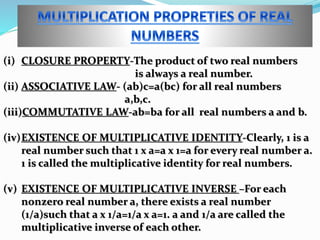
(i) CLOSURE PROPERTY-The product of two real numbers
is always a real number.
(ii) ASSOCIATIVE LAW- (ab)c=a(bc) for all real numbers
a,b,c.
(iii)COMMUTATIVE LAW-ab=ba for all real numbers a and b.
(iv)EXISTENCE OF MULTIPLICATIVE IDENTITY-Clearly, 1 is a
real number such that 1 x a=a x 1=a for every real number a.
1 is called the multiplicative identity for real numbers.
(v) EXISTENCE OF MULTIPLICATIVE INVERSE –For each
nonzero real number a, there exists a real number
(1/a)such that a x 1/a=1/a x a=1. a and 1/a are called the
multiplicative inverse of each other.
For all positive real numbers a
and b, we have:
(i) √ab=√a x √b
(ii)√a/b=√a/√b
The numbers in the form p/q, where p and q are integers
and q≠0,are known as rational numbers.
REMARKS- (i) 0 is a rational number, since we can
write,0=0/1.
(ii) Every natural number is a rational
number, since we can write, 1=1/1, 2=2/1,
3=3/1, etc.
(iii) Every integer is a rational number ,since an
integer is a rational number ,since an
integer can be written as a/1.
If a/b and c/d are two rational numbers
then their sum and product are given by
a/b + c/d= a x d + b x c/b x d and a/b x c/d=
a x c/b x d.
a/b and c/d are said to be equal if ad=bc.
Rational numbers follow the commutative and associative law
of addition and multiplication .They also follow the
distributive law of multiplication over addition.
If a, b and c are three numbers, then
a+b=b+a (commutative law of addition)
a x b=b x a (commutative law of multiplication)
a+(b+c)=(a+b)+c (associative law of addition)
a x (b x c)=(a x b)x c (associative law of multiplication)
a x (b+c)=a x b + a x c (law of distribution)
(b +c)a=b x a + c x a (law of distribution)
A number which can neither be
expressed as a terminating decimal
nor as a repeating decimal, is called
an irrational number.
Thus, non terminating, non
repeating decimals are irrational
numbers.
(i)Irrational numbers satisfy the commutative,
associative and distributive laws for addition and
multiplication.
(ii)-(i)Sum of a rational and irrational is irrational.
(ii)Difference of a rational and an irrational is
irrational.
(iii)Product of a rational and an irrational is
irrational.
(iv)Quotient of a rational and an irrational is
irrational.
NUMBER SYSTEM

NUMBER SYSTEM

  • 3.
    REVIEW OF REPRESENTATIONOF NATURAL NUMBERS, INTEGERS, RATIONAL NUMBERS ON THE NUMBER LINE. REPRESENTATION OF TERMINATING/NON TERMINATING RECCURING DECIMALS,ON THE NUMBER LINE THROUGH SUCCESSIVE MAGNIFICATION.RATIONAL NUMBERS AS RECCURING/TERMINATING DECIMALS. EXAMPLES OF NONRECCURING/NON TERMINATING DECIMALS SUCH AS √2, √3, √5 ETC. EXISTENCE OF NON- RATIONAL NUMBERS (IRRATIONAL NUMBERS) SUCH √2 ,√3 AND THEIR REPRESENTATION ON THE NUMBER LINE AND CONVERSELY, EVERY POINT ON THE NUMBER LINE REPRESENTS A UNIQUE REAL NUMBER.
  • 4.
     Natural Numbers-Counting numbersare known as natural numbers. Thus,1,2,3,4,5,6,7,…..,etc., are all natural numbers.  Whole Numbers-All natural numbers together with 0 form the collection of all whole numbers. Thus,1,2,3,4,5,6,7,….,etc., are all whole numbers.  Integers-All natural numbers,0 and negatives of natural numbers form the collection of all integers. Thus,..., -5, -4, -3, -2, -1, 0, 1, 2, 3, 4, 5,…..,etc., are all integers.
  • 5.
    On the numberline, each point corresponds to a unique real number. And ,every real number can be represented by a unique point on the real line. Between any two real numbers, there exist infinitely many real numbers.
  • 6.
    (i) CLOSURE PROPERTY-The sum of two real numbers is always a real number. (ii) ASSOCIATIVE LAW- (a+b)+c=a+(b+c) for all real numbers a, b, c. (iii) COMMUTATIVE LAW- a+b=b+a for all real numbers a and b. (iv) EXISTENCE OF ADDITIVE IDENTITY- Clearly 0 is a real number such that 0+a=a+0=a for every real number a. 0 is called the additive identity for real numbers. (v) EXISTENCE OF ADDITIVE INVERSE-For each real number a ,there exists a real number(-a)such that a+(- a)=(-a)+a=0. a and(-a) are called the additive inverse of each other.
  • 7.
    (i) CLOSURE PROPERTY-Theproduct of two real numbers is always a real number. (ii) ASSOCIATIVE LAW- (ab)c=a(bc) for all real numbers a,b,c. (iii)COMMUTATIVE LAW-ab=ba for all real numbers a and b. (iv)EXISTENCE OF MULTIPLICATIVE IDENTITY-Clearly, 1 is a real number such that 1 x a=a x 1=a for every real number a. 1 is called the multiplicative identity for real numbers. (v) EXISTENCE OF MULTIPLICATIVE INVERSE –For each nonzero real number a, there exists a real number (1/a)such that a x 1/a=1/a x a=1. a and 1/a are called the multiplicative inverse of each other.
  • 8.
    For all positivereal numbers a and b, we have: (i) √ab=√a x √b (ii)√a/b=√a/√b
  • 9.
    The numbers inthe form p/q, where p and q are integers and q≠0,are known as rational numbers. REMARKS- (i) 0 is a rational number, since we can write,0=0/1. (ii) Every natural number is a rational number, since we can write, 1=1/1, 2=2/1, 3=3/1, etc. (iii) Every integer is a rational number ,since an integer is a rational number ,since an integer can be written as a/1.
  • 10.
    If a/b andc/d are two rational numbers then their sum and product are given by a/b + c/d= a x d + b x c/b x d and a/b x c/d= a x c/b x d. a/b and c/d are said to be equal if ad=bc.
  • 11.
    Rational numbers followthe commutative and associative law of addition and multiplication .They also follow the distributive law of multiplication over addition. If a, b and c are three numbers, then a+b=b+a (commutative law of addition) a x b=b x a (commutative law of multiplication) a+(b+c)=(a+b)+c (associative law of addition) a x (b x c)=(a x b)x c (associative law of multiplication) a x (b+c)=a x b + a x c (law of distribution) (b +c)a=b x a + c x a (law of distribution)
  • 12.
    A number whichcan neither be expressed as a terminating decimal nor as a repeating decimal, is called an irrational number. Thus, non terminating, non repeating decimals are irrational numbers.
  • 13.
    (i)Irrational numbers satisfythe commutative, associative and distributive laws for addition and multiplication. (ii)-(i)Sum of a rational and irrational is irrational. (ii)Difference of a rational and an irrational is irrational. (iii)Product of a rational and an irrational is irrational. (iv)Quotient of a rational and an irrational is irrational.