ENGINEERING DESIGN PROCESS
 It is a series of steps that engineers follow for
creating functional products and processes.
 It is a highly iterative process.
 It is a decision making process in which the basic
sciences, mathematics ,and engineering sciences are
applied to convert resources optimally to meet a
stated objective.
1. INDENTIFY THE PROBLEM
 Engineers are Problem Solvers.
 Understand the scope and the nature of the
problem
 Identify the correct issues and background of
the problem
2. DEFINE WORKING CRITERIA AND GOALS
 Establish preliminary goals
 Develop working criteria to compare possible
solutions
 Specifications
 Constraints
3. RESEARCH AND GATHER DATA
 Stay consistent with working criteria while
researching
 Use resources to help research including:
Internet, Library, newspaper, etc.
 Keep info found through all steps of the design
process and add to it
4. BRAINSTORM AND GENERATE CREATIVE IDEAS
 Develop as many creative ideas as possible
 No idea is a bad idea
 Document all ideas
 Combine ideas to create new ideas
 Do not evaluate
 If time permitted, hold a second session to give
people time to consider additional options
 Goal: Long list of ideas!
5. ANALYZE POTENTIAL SOLUTIONS
 Eliminate duplicate ideas
 Clarify ideas
 Select ideas to analyse in more detail
 Qualitative analysis
 Quantitative analysis
 Democratic analysis
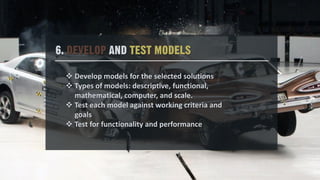
6. DEVELOP AND TEST MODELS
 Develop models for the selected solutions
 Types of models: descriptive, functional,
mathematical, computer, and scale.
 Test each model against working criteria and
goals
 Test for functionality and performance
7. MAKE THE DECISION
 Evaluate the results of testing to determine the
solution to use
 If none of the solutions are ideal, return to
stage 4 or 5
 Once a solution is selected, continue to stage 8
8. COMMUNICATE AND SPECIFY
 Document the design’s specifications and
measurements and communicate to all groups
 Communication between groups is especially
important in this stage
 Meetings
 Presentations
 Reports
 Drawings
9. IMPLEMENT & COMMERCIALIZE
 Final design revisions
 All groups should agree on the proposed
project, including: Management, Technical,
Business, and legal support representatives
 Production
10. POST-IMPLEMENTATION REVIEW AND
ASSESSMENT
 Review the product’s performance
 Assess the product’s strength and weaknesses
and document
 Make suggestions for future improvements
CREATED BY – DIVYANSH BATHAM

10 Steps of Engineering Design Process

  • 1.
    ENGINEERING DESIGN PROCESS It is a series of steps that engineers follow for creating functional products and processes.  It is a highly iterative process.  It is a decision making process in which the basic sciences, mathematics ,and engineering sciences are applied to convert resources optimally to meet a stated objective.
  • 2.
    1. INDENTIFY THEPROBLEM  Engineers are Problem Solvers.  Understand the scope and the nature of the problem  Identify the correct issues and background of the problem
  • 3.
    2. DEFINE WORKINGCRITERIA AND GOALS  Establish preliminary goals  Develop working criteria to compare possible solutions  Specifications  Constraints
  • 4.
    3. RESEARCH ANDGATHER DATA  Stay consistent with working criteria while researching  Use resources to help research including: Internet, Library, newspaper, etc.  Keep info found through all steps of the design process and add to it
  • 5.
    4. BRAINSTORM ANDGENERATE CREATIVE IDEAS  Develop as many creative ideas as possible  No idea is a bad idea  Document all ideas  Combine ideas to create new ideas  Do not evaluate  If time permitted, hold a second session to give people time to consider additional options  Goal: Long list of ideas!
  • 6.
    5. ANALYZE POTENTIALSOLUTIONS  Eliminate duplicate ideas  Clarify ideas  Select ideas to analyse in more detail  Qualitative analysis  Quantitative analysis  Democratic analysis
  • 7.
    6. DEVELOP ANDTEST MODELS  Develop models for the selected solutions  Types of models: descriptive, functional, mathematical, computer, and scale.  Test each model against working criteria and goals  Test for functionality and performance
  • 8.
    7. MAKE THEDECISION  Evaluate the results of testing to determine the solution to use  If none of the solutions are ideal, return to stage 4 or 5  Once a solution is selected, continue to stage 8
  • 9.
    8. COMMUNICATE ANDSPECIFY  Document the design’s specifications and measurements and communicate to all groups  Communication between groups is especially important in this stage  Meetings  Presentations  Reports  Drawings
  • 10.
    9. IMPLEMENT &COMMERCIALIZE  Final design revisions  All groups should agree on the proposed project, including: Management, Technical, Business, and legal support representatives  Production
  • 11.
    10. POST-IMPLEMENTATION REVIEWAND ASSESSMENT  Review the product’s performance  Assess the product’s strength and weaknesses and document  Make suggestions for future improvements
  • 12.
    CREATED BY –DIVYANSH BATHAM