AI for COVID-19: An online virtual care
approach (Q42020 update)
Xavier Amatriain (@xamat)
https://curai.com
11/06/2020
ToC
●
●
○
●
○
○
2
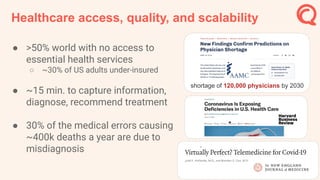
● >50% world with no access to
essential health services
○ ~30% of US adults under-insured
● ~15 min. to capture information,
diagnose, recommend treatment
● 30% of the medical errors causing
~400k deaths a year are due to
misdiagnosis
Healthcare access, quality, and scalability
shortage of 120,000 physicians by 2030
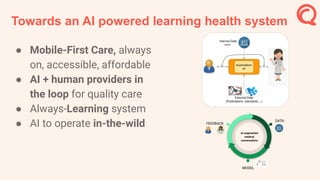
Towards an AI powered learning health system
● Mobile-First Care, always
on, accessible, affordable
● AI + human providers in
the loop for quality care
● Always-Learning system
● AI to operate in-the-wild
(EHR)
FEEDBACK
DATA
MODEL
AI-augmented
medical
conversations
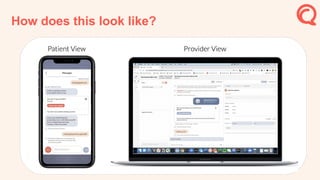
How does this look like?
ToC
●
●
○
●
○
○
6
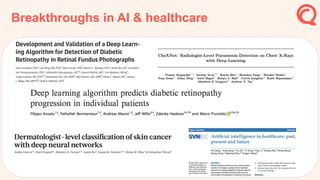
Breakthroughs in AI & healthcare
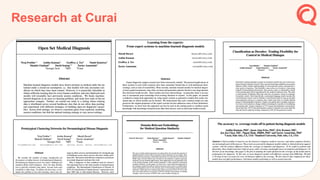
Research at Curai
Research areas at Curai
● Medical Reasoning and Diagnosis
○ Learning from the Experts: combining expert systems and deep
learning
● NLP
○ Medical dialogue summarization
○ Transfer Learning for Similar Questions
○ Medical entity recognition: An active learning approach
● Multimodal healthcare AI
○ Few-shot dermatology image classification
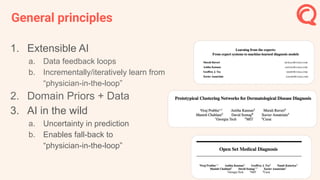
General principles
1. Extensible AI
a. Data feedback loops
b. Incrementally/iteratively learn from
“physician-in-the-loop”
2. Domain Priors + Data
3. AI in the wild
a. Uncertainty in prediction
b. Enables fall-back to
“physician-in-the-loop”
ToC
●
●
○
●
○
○
11
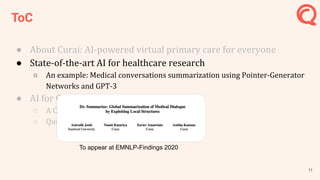
To appear at EMNLP-Findings 2020
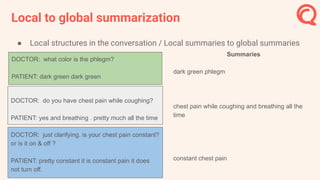
Local to global summarization
DOCTOR: what color is the phlegm?
PATIENT: dark green dark green
DOCTOR: do you have chest pain while coughing?
PATIENT: yes and breathing . pretty much all the time
DOCTOR: just clarifying. is your chest pain constant?
or is it on & off ?
PATIENT: pretty constant it is constant pain it does
not turn off.
Summaries
dark green phlegm
chest pain while coughing and breathing all the
time
constant chest pain
● Local structures in the conversation / Local summaries to global summaries
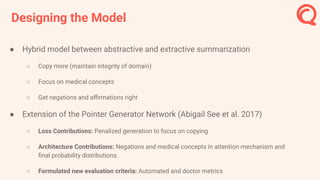
Designing the Model
● Hybrid model between abstractive and extractive summarization
○ Copy more (maintain integrity of domain)
○ Focus on medical concepts
○ Get negations and affirmations right
● Extension of the Pointer Generator Network (Abigail See et al. 2017)
○ Loss Contributions: Penalized generation to focus on copying
○ Architecture Contributions: Negations and medical concepts in attention mechanism and
final probability distributions.
○ Formulated new evaluation criteria: Automated and doctor metrics
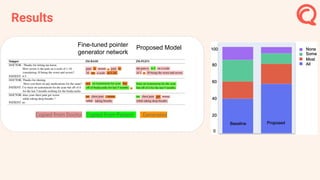
Results
Copied from Doctor Copied from Patient Generated
Proposed ModelFine-tuned pointer
generator network
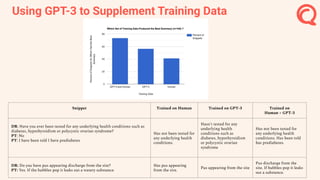
Using GPT-3 to Supplement Training Data
Snippet Trained on Human Trained on GPT-3 Trained on
Human + GPT-3
DR: Have you ever been tested for any underlying health conditions such as
diabetes, hypothyroidism or polycystic ovarian syndrome?
PT: No
PT: I have been told I have prediabetes
Has not been tested for
any underlying health
conditions.
Hasn't tested for any
underlying health
conditions such as
diabetes, hypothyroidism
or polycystic ovarian
syndrome
Has not been tested for
any underlying health
conditions. Has been told
has prediabetes.
DR: Do you have pus appearing discharge from the site?
PT: Yes. If the bubbles pop it leaks out a watery substance
Has pus appearing
from the sire.
Pus appearing from the site
Pus discharge from the
site. If bubbles pop it leaks
out a substance.
ToC
●
●
○
●
○
○
16
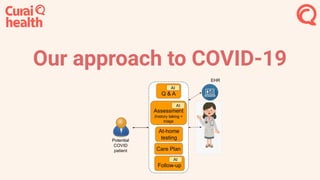
Our approach to COVID-19
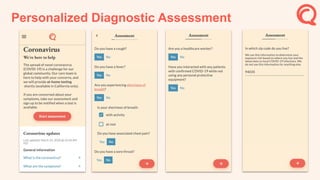
Personalized Diagnostic Assessment
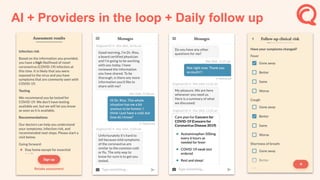
AI + Providers in the loop + Daily follow up
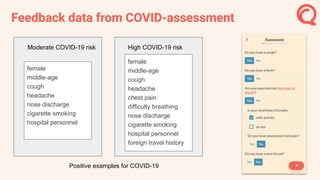
Feedback data from COVID-assessment
female
middle-age
cough
headache
nose discharge
cigarette smoking
hospital personnel
Moderate COVID-19 risk
female
middle-age
cough
headache
chest pain
difficulty breathing
nose discharge
cigarette smoking
hospital personnel
foreign travel history
High COVID-19 risk
Positive examples for COVID-19
ToC
●
●
○
●
○
○
21
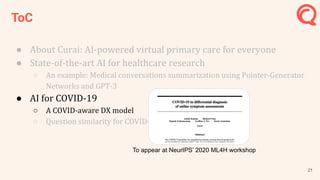
To appear at NeurIPS’ 2020 ML4H workshop
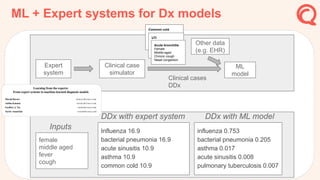
ML + Expert systems for Dx models
female
middle aged
fever
cough
Influenza 16.9
bacterial pneumonia 16.9
acute sinusitis 10.9
asthma 10.9
common cold 10.9
influenza 0.753
bacterial pneumonia 0.205
asthma 0.017
acute sinusitis 0.008
pulmonary tuberculosis 0.007
Inputs
DDx with expert system DDx with ML model
Expert
system
Clinical case
simulator
Clinical cases
DDx
ML
model
Common cold
UTI
Acute bronchitis
Female
Middle-aged
Chronic cough
Nasal congestion
Other data
(e.g. EHR)
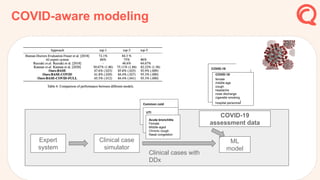
COVID-aware modeling
Expert
system
Clinical case
simulator
Clinical cases with
DDx
ML
model
Common cold
UTI
Acute bronchitis
Female
Middle-aged
Chronic cough
Nasal congestion
COVID-19
assessment data
COVID-19
COVID-19
female
middle-age
cough
headache
nose discharge
cigarette smoking
hospital personnel
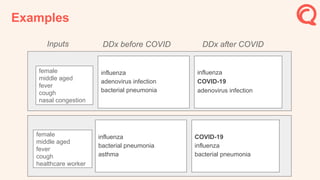
Examples
Inputs DDx before COVID DDx after COVID
female
middle aged
fever
cough
healthcare worker
influenza
bacterial pneumonia
asthma
COVID-19
influenza
bacterial pneumonia
female
middle aged
fever
cough
nasal congestion
influenza
adenovirus infection
bacterial pneumonia
influenza
COVID-19
adenovirus infection
ToC
●
●
○
●
○
○
25
Proceedings of the 2020 ACM SIGKDD
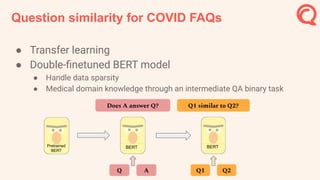
Question similarity for COVID FAQs
● Transfer learning
● Double-finetuned BERT model
● Handle data sparsity
● Medical domain knowledge through an intermediate QA binary task
Does A answer Q?
Q A
Pretrained
BERT
BERT
Q1 similar to Q2?
Q1 Q2
BERT
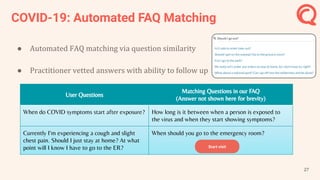
COVID-19: Automated FAQ Matching
●
●
User Questions
Matching Questions in our FAQ
(Answer not shown here for brevity)
When do COVID symptoms start after exposure? How long is it between when a person is exposed to
the virus and when they start showing symptoms?
Currently I’m experiencing a cough and slight
chest pain. Should I just stay at home? At what
point will I know I have to go to the ER?
When should you go to the emergency room?
27
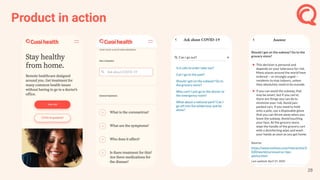
Product in action
28
Conclusions
● Healthcare needs to scale quickly, and this has become obvious in a global
pandemic like the one we are facing
● The only way to scale healthcare while improving quality and accessibility is
through technology and AI
● AI cannot be simply “dropped” in the middle of old workflows and processes
○ It needs to be integrated in end-to-end medical care benefitting both patients and providers
https://curai.com/work

AI for COVID-19 - Q42020 update

  • 1.
    AI for COVID-19:An online virtual care approach (Q42020 update) Xavier Amatriain (@xamat) https://curai.com 11/06/2020
  • 2.
  • 3.
    ● >50% worldwith no access to essential health services ○ ~30% of US adults under-insured ● ~15 min. to capture information, diagnose, recommend treatment ● 30% of the medical errors causing ~400k deaths a year are due to misdiagnosis Healthcare access, quality, and scalability shortage of 120,000 physicians by 2030
  • 4.
    Towards an AIpowered learning health system ● Mobile-First Care, always on, accessible, affordable ● AI + human providers in the loop for quality care ● Always-Learning system ● AI to operate in-the-wild (EHR) FEEDBACK DATA MODEL AI-augmented medical conversations
  • 5.
    How does thislook like?
  • 6.
  • 7.
    Breakthroughs in AI& healthcare
  • 8.
  • 9.
    Research areas atCurai ● Medical Reasoning and Diagnosis ○ Learning from the Experts: combining expert systems and deep learning ● NLP ○ Medical dialogue summarization ○ Transfer Learning for Similar Questions ○ Medical entity recognition: An active learning approach ● Multimodal healthcare AI ○ Few-shot dermatology image classification
  • 10.
    General principles 1. ExtensibleAI a. Data feedback loops b. Incrementally/iteratively learn from “physician-in-the-loop” 2. Domain Priors + Data 3. AI in the wild a. Uncertainty in prediction b. Enables fall-back to “physician-in-the-loop”
  • 11.
  • 12.
    Local to globalsummarization DOCTOR: what color is the phlegm? PATIENT: dark green dark green DOCTOR: do you have chest pain while coughing? PATIENT: yes and breathing . pretty much all the time DOCTOR: just clarifying. is your chest pain constant? or is it on & off ? PATIENT: pretty constant it is constant pain it does not turn off. Summaries dark green phlegm chest pain while coughing and breathing all the time constant chest pain ● Local structures in the conversation / Local summaries to global summaries
  • 13.
    Designing the Model ●Hybrid model between abstractive and extractive summarization ○ Copy more (maintain integrity of domain) ○ Focus on medical concepts ○ Get negations and affirmations right ● Extension of the Pointer Generator Network (Abigail See et al. 2017) ○ Loss Contributions: Penalized generation to focus on copying ○ Architecture Contributions: Negations and medical concepts in attention mechanism and final probability distributions. ○ Formulated new evaluation criteria: Automated and doctor metrics
  • 14.
    Results Copied from DoctorCopied from Patient Generated Proposed ModelFine-tuned pointer generator network
  • 15.
    Using GPT-3 toSupplement Training Data Snippet Trained on Human Trained on GPT-3 Trained on Human + GPT-3 DR: Have you ever been tested for any underlying health conditions such as diabetes, hypothyroidism or polycystic ovarian syndrome? PT: No PT: I have been told I have prediabetes Has not been tested for any underlying health conditions. Hasn't tested for any underlying health conditions such as diabetes, hypothyroidism or polycystic ovarian syndrome Has not been tested for any underlying health conditions. Has been told has prediabetes. DR: Do you have pus appearing discharge from the site? PT: Yes. If the bubbles pop it leaks out a watery substance Has pus appearing from the sire. Pus appearing from the site Pus discharge from the site. If bubbles pop it leaks out a substance.
  • 16.
  • 17.
  • 18.
  • 19.
    AI + Providersin the loop + Daily follow up
  • 20.
    Feedback data fromCOVID-assessment female middle-age cough headache nose discharge cigarette smoking hospital personnel Moderate COVID-19 risk female middle-age cough headache chest pain difficulty breathing nose discharge cigarette smoking hospital personnel foreign travel history High COVID-19 risk Positive examples for COVID-19
  • 21.
    ToC ● ● ○ ● ○ ○ 21 To appear atNeurIPS’ 2020 ML4H workshop
  • 22.
    ML + Expertsystems for Dx models female middle aged fever cough Influenza 16.9 bacterial pneumonia 16.9 acute sinusitis 10.9 asthma 10.9 common cold 10.9 influenza 0.753 bacterial pneumonia 0.205 asthma 0.017 acute sinusitis 0.008 pulmonary tuberculosis 0.007 Inputs DDx with expert system DDx with ML model Expert system Clinical case simulator Clinical cases DDx ML model Common cold UTI Acute bronchitis Female Middle-aged Chronic cough Nasal congestion Other data (e.g. EHR)
  • 23.
    COVID-aware modeling Expert system Clinical case simulator Clinicalcases with DDx ML model Common cold UTI Acute bronchitis Female Middle-aged Chronic cough Nasal congestion COVID-19 assessment data COVID-19 COVID-19 female middle-age cough headache nose discharge cigarette smoking hospital personnel
  • 24.
    Examples Inputs DDx beforeCOVID DDx after COVID female middle aged fever cough healthcare worker influenza bacterial pneumonia asthma COVID-19 influenza bacterial pneumonia female middle aged fever cough nasal congestion influenza adenovirus infection bacterial pneumonia influenza COVID-19 adenovirus infection
  • 25.
  • 26.
    Question similarity forCOVID FAQs ● Transfer learning ● Double-finetuned BERT model ● Handle data sparsity ● Medical domain knowledge through an intermediate QA binary task Does A answer Q? Q A Pretrained BERT BERT Q1 similar to Q2? Q1 Q2 BERT
  • 27.
    COVID-19: Automated FAQMatching ● ● User Questions Matching Questions in our FAQ (Answer not shown here for brevity) When do COVID symptoms start after exposure? How long is it between when a person is exposed to the virus and when they start showing symptoms? Currently I’m experiencing a cough and slight chest pain. Should I just stay at home? At what point will I know I have to go to the ER? When should you go to the emergency room? 27
  • 28.
  • 29.
    Conclusions ● Healthcare needsto scale quickly, and this has become obvious in a global pandemic like the one we are facing ● The only way to scale healthcare while improving quality and accessibility is through technology and AI ● AI cannot be simply “dropped” in the middle of old workflows and processes ○ It needs to be integrated in end-to-end medical care benefitting both patients and providers https://curai.com/work