



IP CCTV Design
Eng Nader Elmansi
IP CCTV Design
1. INTRODUCTION
• CCTV systems provide surveillance
capabilities used in the protection of
people, assets, and systems.
• CCTV systems are often used to
support comprehensive security
systems by incorporating video
coverage and security alarms for
barriers, intrusion detection, and access
control.
• A CCTV system links a camera to a
video monitor using a direct
transmission system. This differs from
broadcast television where the signal is
transmitted over the air and viewed with
a television.
• CCTV systems have many components
with a variety of functions, features, and
specifications. Key components include
cameras, lenses, data distribution,
power, and lighting, among others.
• CCTV technologies continuously
undergo feature refinements to improve
performance in areas such as digital
equipment options, data storage,
component miniaturization, wireless
communications, and automated image
analysis.
IP CCTV Design
2. CCTV SYSTEM DESIGN
• Following design process enables
organizations to make purchasing
decisions that result in the procurement
and installation of a CCTV system that
meets functional and operational
requirements.
• As CCTV is part of a multi-layered
security approach, a system design
should begin with a comprehensive
needs assessment to ensure security
risks and mitigation plans are identified.
• Clear requirements, a comprehensive
site survey, and proper equipment
selection and installation must all be
considered when designing a CCTV
system.
IP CCTV Design
2. CCTV SYSTEM DESIGN
2.1 Defining System Requirements
•In order for an organization to properly
implement a CCTV system, site-specific
characteristics need to be assessed by a
knowledgeable multidisciplinary team of
personnel.
•This team is critical to identifying key
functional and operational requirements.
•Functional requirements consist of
determining the area of surveillance, such
as a perimeter area or an access point.
•Operational requirements define what
information a CCTV system will be
expected to provide given the existing
operating conditions.
IP CCTV Design
2. CCTV SYSTEM DESIGN
2.1 Defining System Requirements
2.1.1 Multidisciplinary System Design
Team
•Organizations should begin by establishing a
team of people with relevant knowledge to
help guide the CCTV system design process.
•The system design team should be involved
in all phases of the project to include: needs
assessment, requirements development,
system design and layout, procurement,
installation, and final check-out of the system.
• Personnel should be included from varied
internal disciplines such as security, facility
maintenance and management, and those
who work directly with assets on-site or in
controlled monitoring environments.
• The team may opt to consult with external
subject matter experts, such as electricians,
systems engineers, and information
technology (IT) professionals.
IP CCTV Design
2. CCTV SYSTEM DESIGN
2.1 Defining System Requirements
2.1.2 Needs Assessment
•Organizations can enhance the security of facilities
and critical infrastructure most effectively by defining
their overall goals and objectives for CCTV systems in
terms of the requirements
•A needs assessment gathers and analyzes four sets
of requirements: functional, operational,
infrastructure, and video retention.
•Functional requirements–Define camera coverage
needs such as surveillance of perimeters, parking
lots, and storage areas; surveillance of approaches
to, and spaces within, buildings or other structures;
and surveillance of waterfronts;
•Operational requirements–day and night
operations, lighting, weather conditions, and
temperature changes. Infrastructure requirements–
Define needs for installing or accessing fiber or hard-
wire cables, wireless networks, and power sources
•Video retention requirements–Define the
organization’s video retention and storage needs..
IP CCTV Design
2. CCTV SYSTEM DESIGN
2.1 Defining System Requirements
2.1.3 CCTV Site Survey
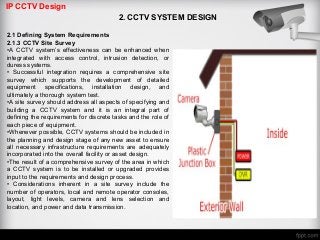
•A CCTV system’s effectiveness can be enhanced when
integrated with access control, intrusion detection, or
duress systems.
• Successful integration requires a comprehensive site
survey which supports the development of detailed
equipment specifications, installation design, and
ultimately a thorough system test.
•A site survey should address all aspects of specifying and
building a CCTV system and it is an integral part of
defining the requirements for discrete tasks and the role of
each piece of equipment.
•Whenever possible, CCTV systems should be included in
the planning and design stage of any new asset to ensure
all necessary infrastructure requirements are adequately
incorporated into the overall facility or asset design.
•The result of a comprehensive survey of the area in which
a CCTV system is to be installed or upgraded provides
input to the requirements and design process.
• Considerations inherent in a site survey include the
number of operators, local and remote operator consoles,
layout, light levels, camera and lens selection and
location, and power and data transmission.
IP CCTV Design
2. CCTV SYSTEM DESIGN
2.1 Defining System Requirements
2.1.4 System Layout Considerations
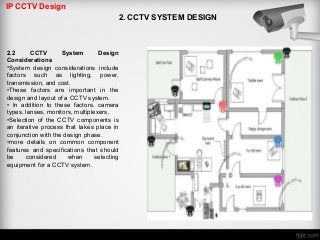
•satellite photographs, local government files, privately
contracted aerial photography services, and a host of
free web-based mapping applications.
•Aerial photographs can provide information regarding
on-site distances and blind areas where outdoor video
coverage may be needed.
•Interior surveys are similar to exterior surveys.
•Aerial photographs can be replaced with scaled
computer aided drawings or blueprints of the facility
being surveyed.
•These can be used to mark potential camera site
locations to identify the necessary coverage of access
points, critical assets, and desired fields of view.
•A camcorder is often used to determine camera
positions and evaluate video images from proposed
camera locations.
•An important factor in the design and layout of a CCTV
system is the location of its transmission hubs.
•Transmission routes channeled through a primary
transmission hub could lead to a single point of failure in
which an outage of one transmitter could disable the
transmission of data from other camera sites.
IP CCTV Design
2. CCTV SYSTEM DESIGN
2.2 CCTV System Design
Considerations
•System design considerations include
factors such as lighting, power,
transmission, and cost.
•These factors are important in the
design and layout of a CCTV system.
• In addition to these factors, camera
types, lenses, monitors, multiplexers,
•Selection of the CCTV components is
an iterative process that takes place in
conjunction with the design phase.
•more details on common component
features and specifications that should
be considered when selecting
equipment for a CCTV system.
IP CCTV Design
2. CCTV SYSTEM DESIGN
2.2 CCTV System Design Considerations
2.2.1 Lighting
•Lighting strategies, camera selection, and camera
location should be considered together in the design
of a CCTV system
•Light (or illumination) levels, natural and artificial,
affect system requirements at different times of the
day for exterior systems.
• Exterior cameras often require lenses with automatic
apertures to compensate for changes in light levels.
• Interior cameras may require internal software to
compensate for backlight, which is the contrast
between low interior light levels and high exterior
daytime light levels.
• For example, backlight compensation allows security
personnel to see details of a person moving in front of
a brightly lit window.
• Artificial lighting can affect the appearance of the
image as well as the operation of the CCTV system.
IP CCTV Design
2. CCTV SYSTEM DESIGN
2.2 CCTV System Design Considerations
2.2.2 Power Distribution
•it is advisable to locate power sources close to
CCTV equipment
•Placing low-voltage power components near
high-voltage lines can induce currents in the low-
voltage system, presenting a hazard to
personnel and equipment of radiated heat.
•placing a power source too far away can cause
drive the installation costs up due to the larger
conductor sizes needed to reduce voltage drop
over long distances
•uninterruptible power supplies (UPSs) are
beneficial in protecting equipment and
conditioning the power
•Voltage spikes and lightning are common
phenomena affecting CCTV systems. Lightning,
a common cause of voltage spikes, may cause
failures and disable major pieces of equipment in
buildings.
•all pieces of electronic equipment should have
sufficient lightning suppression to help reduce
damage and failures
IP CCTV Design
2. CCTV SYSTEM DESIGN
2.2 CCTV System Design Considerations
2.2.3 Video Transmission
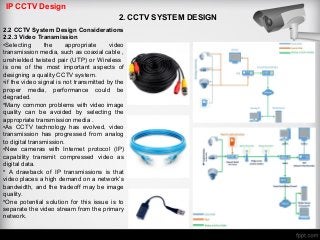
•Selecting the appropriate video
transmission media, such as coaxial cable ,
unshielded twisted pair (UTP) or Wireless
is one of the most important aspects of
designing a quality CCTV system.
•if the video signal is not transmitted by the
proper media, performance could be
degraded.
•Many common problems with video image
quality can be avoided by selecting the
appropriate transmission media .
•As CCTV technology has evolved, video
transmission has progressed from analog
to digital transmission.
•New cameras with Internet protocol (IP)
capability transmit compressed video as
digital data.
• A drawback of IP transmissions is that
video places a high demand on a network’s
bandwidth, and the tradeoff may be image
quality.
•One potential solution for this issue is to
separate the video stream from the primary
network.
IP CCTV Design
2. CCTV SYSTEM DESIGN
2.2 CCTV System Design Considerations
2.2.4 Scalability
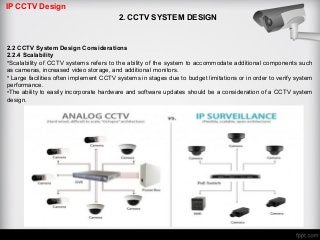
•Scalability of CCTV systems refers to the ability of the system to accommodate additional components such
as cameras, increased video storage, and additional monitors.
• Large facilities often implement CCTV systems in stages due to budget limitations or in order to verify system
performance.
•The ability to easily incorporate hardware and software updates should be a consideration of a CCTV system
design.
IP CCTV Design
2. CCTV SYSTEM DESIGN
2.1 Defining System Requirements
2.2.5 Cost
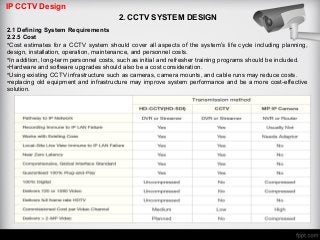
•Cost estimates for a CCTV system should cover all aspects of the system’s life cycle including planning,
design, installation, operation, maintenance, and personnel costs.
•In addition, long-term personnel costs, such as initial and refresher training programs should be included.
•Hardware and software upgrades should also be a cost consideration.
•Using existing CCTV infrastructure such as cameras, camera mounts, and cable runs may reduce costs.
•replacing old equipment and infrastructure may improve system performance and be a more cost-effective
solution.
IP CCTV Design
2. CCTV SYSTEM DESIGN
2.1 Defining System Requirements
2.2.6 Infrastructure
When planning a CCTV installation,
there are four important
considerations:
•To what extent can the system use
existing infrastructure?
•To what extent can the new CCTV
system integrate with existing
enterprise systems?
•To what extent can the new CCTV
system integrate with or complement
other existing or planned intrusion
detection and access control
systems?
•To what extent can the new system
operate in parallel with existing
systems and which system will
influence operational procedures and
response?
•For example, old coaxial cable
systems can be converted to IP
systems by running Ethernet over
coaxial cable with a converter
module. Analog video and Ethernet
can also be run over telephone
lines.
IP CCTV Design
2. CCTV SYSTEM DESIGN
2.1 Defining System Requirements
2.2.7 Reliability and Maintainability
perform the required functions over time and operate,
maintain, and upgrade the system.
techniques used to improve user confidence in a new
installation, including:
•Conferring with security and management personnel at
other facilities that have implemented similar systems or
used the same vendor;
•Requesting competing vendors to run trial programs on-
site or bench test equipment prior to installation;
•Installing new equipment on a small scale in order to verify
that performance meets the organization’s needs.
•Vendor warranty terms may require that all technicians
working on equipment be certified.
• Some vendors may require a maintenance contract to
ensure they have staff available to respond within a specific
period of time.
• The support requirements should be understood prior to
purchase and installation of equipment.
IP CCTV Design
2. CCTV SYSTEM DESIGN
2.1 Defining System Requirements
2.2.8 Annunciation, Assessment, and
Response
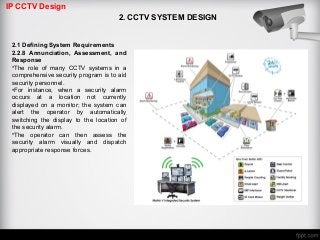
•The role of many CCTV systems in a
comprehensive security program is to aid
security personnel.
•For instance, when a security alarm
occurs at a location not currently
displayed on a monitor; the system can
alert the operator by automatically
switching the display to the location of
the security alarm.
•The operator can then assess the
security alarm visually and dispatch
appropriate response forces.
IP CCTV Design
2. CCTV SYSTEM DESIGN
2.1 Defining System Requirements
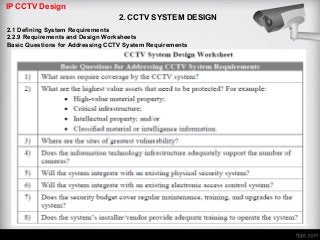
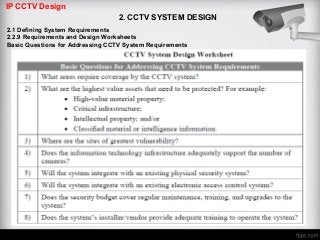
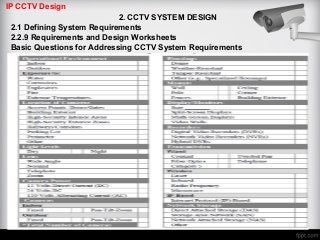
2.2.9 Requirements and Design Worksheets
Basic Questions for Addressing CCTV System Requirements
IP CCTV Design
2. CCTV SYSTEM DESIGN
2.1 Defining System Requirements
2.2.9 Requirements and Design Worksheets
Basic Questions for Addressing CCTV System Requirements
IP CCTV Design
2. CCTV SYSTEM DESIGN
2.1 Defining System Requirements
2.2.9 Requirements and Design Worksheets
Basic Questions for Addressing CCTV System Requirements

1.0 2.0 IP CCTV system

  • 1.
    IP CCTV Design EngNader Elmansi
  • 2.
    IP CCTV Design 1.INTRODUCTION • CCTV systems provide surveillance capabilities used in the protection of people, assets, and systems. • CCTV systems are often used to support comprehensive security systems by incorporating video coverage and security alarms for barriers, intrusion detection, and access control. • A CCTV system links a camera to a video monitor using a direct transmission system. This differs from broadcast television where the signal is transmitted over the air and viewed with a television. • CCTV systems have many components with a variety of functions, features, and specifications. Key components include cameras, lenses, data distribution, power, and lighting, among others. • CCTV technologies continuously undergo feature refinements to improve performance in areas such as digital equipment options, data storage, component miniaturization, wireless communications, and automated image analysis.
  • 3.
    IP CCTV Design 2.CCTV SYSTEM DESIGN • Following design process enables organizations to make purchasing decisions that result in the procurement and installation of a CCTV system that meets functional and operational requirements. • As CCTV is part of a multi-layered security approach, a system design should begin with a comprehensive needs assessment to ensure security risks and mitigation plans are identified. • Clear requirements, a comprehensive site survey, and proper equipment selection and installation must all be considered when designing a CCTV system.
  • 4.
    IP CCTV Design 2.CCTV SYSTEM DESIGN 2.1 Defining System Requirements •In order for an organization to properly implement a CCTV system, site-specific characteristics need to be assessed by a knowledgeable multidisciplinary team of personnel. •This team is critical to identifying key functional and operational requirements. •Functional requirements consist of determining the area of surveillance, such as a perimeter area or an access point. •Operational requirements define what information a CCTV system will be expected to provide given the existing operating conditions.
  • 5.
    IP CCTV Design 2.CCTV SYSTEM DESIGN 2.1 Defining System Requirements 2.1.1 Multidisciplinary System Design Team •Organizations should begin by establishing a team of people with relevant knowledge to help guide the CCTV system design process. •The system design team should be involved in all phases of the project to include: needs assessment, requirements development, system design and layout, procurement, installation, and final check-out of the system. • Personnel should be included from varied internal disciplines such as security, facility maintenance and management, and those who work directly with assets on-site or in controlled monitoring environments. • The team may opt to consult with external subject matter experts, such as electricians, systems engineers, and information technology (IT) professionals.
  • 6.
    IP CCTV Design 2.CCTV SYSTEM DESIGN 2.1 Defining System Requirements 2.1.2 Needs Assessment •Organizations can enhance the security of facilities and critical infrastructure most effectively by defining their overall goals and objectives for CCTV systems in terms of the requirements •A needs assessment gathers and analyzes four sets of requirements: functional, operational, infrastructure, and video retention. •Functional requirements–Define camera coverage needs such as surveillance of perimeters, parking lots, and storage areas; surveillance of approaches to, and spaces within, buildings or other structures; and surveillance of waterfronts; •Operational requirements–day and night operations, lighting, weather conditions, and temperature changes. Infrastructure requirements– Define needs for installing or accessing fiber or hard- wire cables, wireless networks, and power sources •Video retention requirements–Define the organization’s video retention and storage needs..
  • 7.
    IP CCTV Design 2.CCTV SYSTEM DESIGN 2.1 Defining System Requirements 2.1.3 CCTV Site Survey •A CCTV system’s effectiveness can be enhanced when integrated with access control, intrusion detection, or duress systems. • Successful integration requires a comprehensive site survey which supports the development of detailed equipment specifications, installation design, and ultimately a thorough system test. •A site survey should address all aspects of specifying and building a CCTV system and it is an integral part of defining the requirements for discrete tasks and the role of each piece of equipment. •Whenever possible, CCTV systems should be included in the planning and design stage of any new asset to ensure all necessary infrastructure requirements are adequately incorporated into the overall facility or asset design. •The result of a comprehensive survey of the area in which a CCTV system is to be installed or upgraded provides input to the requirements and design process. • Considerations inherent in a site survey include the number of operators, local and remote operator consoles, layout, light levels, camera and lens selection and location, and power and data transmission.
  • 8.
    IP CCTV Design 2.CCTV SYSTEM DESIGN 2.1 Defining System Requirements 2.1.4 System Layout Considerations •satellite photographs, local government files, privately contracted aerial photography services, and a host of free web-based mapping applications. •Aerial photographs can provide information regarding on-site distances and blind areas where outdoor video coverage may be needed. •Interior surveys are similar to exterior surveys. •Aerial photographs can be replaced with scaled computer aided drawings or blueprints of the facility being surveyed. •These can be used to mark potential camera site locations to identify the necessary coverage of access points, critical assets, and desired fields of view. •A camcorder is often used to determine camera positions and evaluate video images from proposed camera locations. •An important factor in the design and layout of a CCTV system is the location of its transmission hubs. •Transmission routes channeled through a primary transmission hub could lead to a single point of failure in which an outage of one transmitter could disable the transmission of data from other camera sites.
  • 9.
    IP CCTV Design 2.CCTV SYSTEM DESIGN 2.2 CCTV System Design Considerations •System design considerations include factors such as lighting, power, transmission, and cost. •These factors are important in the design and layout of a CCTV system. • In addition to these factors, camera types, lenses, monitors, multiplexers, •Selection of the CCTV components is an iterative process that takes place in conjunction with the design phase. •more details on common component features and specifications that should be considered when selecting equipment for a CCTV system.
  • 10.
    IP CCTV Design 2.CCTV SYSTEM DESIGN 2.2 CCTV System Design Considerations 2.2.1 Lighting •Lighting strategies, camera selection, and camera location should be considered together in the design of a CCTV system •Light (or illumination) levels, natural and artificial, affect system requirements at different times of the day for exterior systems. • Exterior cameras often require lenses with automatic apertures to compensate for changes in light levels. • Interior cameras may require internal software to compensate for backlight, which is the contrast between low interior light levels and high exterior daytime light levels. • For example, backlight compensation allows security personnel to see details of a person moving in front of a brightly lit window. • Artificial lighting can affect the appearance of the image as well as the operation of the CCTV system.
  • 11.
    IP CCTV Design 2.CCTV SYSTEM DESIGN 2.2 CCTV System Design Considerations 2.2.2 Power Distribution •it is advisable to locate power sources close to CCTV equipment •Placing low-voltage power components near high-voltage lines can induce currents in the low- voltage system, presenting a hazard to personnel and equipment of radiated heat. •placing a power source too far away can cause drive the installation costs up due to the larger conductor sizes needed to reduce voltage drop over long distances •uninterruptible power supplies (UPSs) are beneficial in protecting equipment and conditioning the power •Voltage spikes and lightning are common phenomena affecting CCTV systems. Lightning, a common cause of voltage spikes, may cause failures and disable major pieces of equipment in buildings. •all pieces of electronic equipment should have sufficient lightning suppression to help reduce damage and failures
  • 12.
    IP CCTV Design 2.CCTV SYSTEM DESIGN 2.2 CCTV System Design Considerations 2.2.3 Video Transmission •Selecting the appropriate video transmission media, such as coaxial cable , unshielded twisted pair (UTP) or Wireless is one of the most important aspects of designing a quality CCTV system. •if the video signal is not transmitted by the proper media, performance could be degraded. •Many common problems with video image quality can be avoided by selecting the appropriate transmission media . •As CCTV technology has evolved, video transmission has progressed from analog to digital transmission. •New cameras with Internet protocol (IP) capability transmit compressed video as digital data. • A drawback of IP transmissions is that video places a high demand on a network’s bandwidth, and the tradeoff may be image quality. •One potential solution for this issue is to separate the video stream from the primary network.
  • 13.
    IP CCTV Design 2.CCTV SYSTEM DESIGN 2.2 CCTV System Design Considerations 2.2.4 Scalability •Scalability of CCTV systems refers to the ability of the system to accommodate additional components such as cameras, increased video storage, and additional monitors. • Large facilities often implement CCTV systems in stages due to budget limitations or in order to verify system performance. •The ability to easily incorporate hardware and software updates should be a consideration of a CCTV system design.
  • 14.
    IP CCTV Design 2.CCTV SYSTEM DESIGN 2.1 Defining System Requirements 2.2.5 Cost •Cost estimates for a CCTV system should cover all aspects of the system’s life cycle including planning, design, installation, operation, maintenance, and personnel costs. •In addition, long-term personnel costs, such as initial and refresher training programs should be included. •Hardware and software upgrades should also be a cost consideration. •Using existing CCTV infrastructure such as cameras, camera mounts, and cable runs may reduce costs. •replacing old equipment and infrastructure may improve system performance and be a more cost-effective solution.
  • 15.
    IP CCTV Design 2.CCTV SYSTEM DESIGN 2.1 Defining System Requirements 2.2.6 Infrastructure When planning a CCTV installation, there are four important considerations: •To what extent can the system use existing infrastructure? •To what extent can the new CCTV system integrate with existing enterprise systems? •To what extent can the new CCTV system integrate with or complement other existing or planned intrusion detection and access control systems? •To what extent can the new system operate in parallel with existing systems and which system will influence operational procedures and response? •For example, old coaxial cable systems can be converted to IP systems by running Ethernet over coaxial cable with a converter module. Analog video and Ethernet can also be run over telephone lines.
  • 16.
    IP CCTV Design 2.CCTV SYSTEM DESIGN 2.1 Defining System Requirements 2.2.7 Reliability and Maintainability perform the required functions over time and operate, maintain, and upgrade the system. techniques used to improve user confidence in a new installation, including: •Conferring with security and management personnel at other facilities that have implemented similar systems or used the same vendor; •Requesting competing vendors to run trial programs on- site or bench test equipment prior to installation; •Installing new equipment on a small scale in order to verify that performance meets the organization’s needs. •Vendor warranty terms may require that all technicians working on equipment be certified. • Some vendors may require a maintenance contract to ensure they have staff available to respond within a specific period of time. • The support requirements should be understood prior to purchase and installation of equipment.
  • 17.
    IP CCTV Design 2.CCTV SYSTEM DESIGN 2.1 Defining System Requirements 2.2.8 Annunciation, Assessment, and Response •The role of many CCTV systems in a comprehensive security program is to aid security personnel. •For instance, when a security alarm occurs at a location not currently displayed on a monitor; the system can alert the operator by automatically switching the display to the location of the security alarm. •The operator can then assess the security alarm visually and dispatch appropriate response forces.
  • 18.
    IP CCTV Design 2.CCTV SYSTEM DESIGN 2.1 Defining System Requirements 2.2.9 Requirements and Design Worksheets Basic Questions for Addressing CCTV System Requirements
  • 19.
    IP CCTV Design 2.CCTV SYSTEM DESIGN 2.1 Defining System Requirements 2.2.9 Requirements and Design Worksheets Basic Questions for Addressing CCTV System Requirements
  • 20.
    IP CCTV Design 2.CCTV SYSTEM DESIGN 2.1 Defining System Requirements 2.2.9 Requirements and Design Worksheets Basic Questions for Addressing CCTV System Requirements