Presented By:
Y.Mamatha
156C1A0430
HISTORY:
1942 – First CCTV security camera surveillance system
installed. German engineer Walter Bruch was responsible
for the design and installation of the CCTV
security camera surveillance system.
1956 – First VCR produced by Ampex Corporation team
led by Charles Ginsburg. 19 year old engineer Ray Dolby
was also part of the team. Built for commercial business
use.
1960’s – First digital camera signals used in cameras over
analog by NASA.
1972 – First VCR for home use
produced by Philips.
1996 – The first IP camera was released in 1996 by Axis
Communications.
1998 – First consumer digital video recorders (DVR)
released to the public.
HOW DO SURVEILLANCE
CAMERAS WORK?
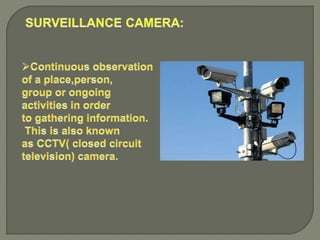
CCTV camera systems includes one or more
cameras which are used to send video images and
audio data to a monitor. Essentially, these camera
systems use cameras to transmit the signals to a main
hub which then records that data for later viewing or
live viewing if you have full time security personnel on
your premises.
TYPES
Surveillance cameras are being installed
everywhere for purpose of security and crime
prevention and detection. There are many
types of surveillance cameras are available for
this purpose.
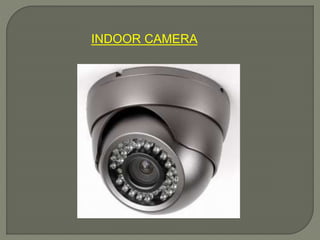
INDOOR CAMERA
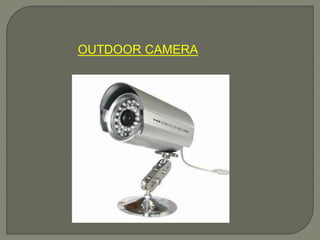
OUTDOOR CAMERA
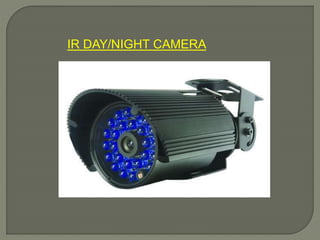
IR DAY/NIGHT CAMERA
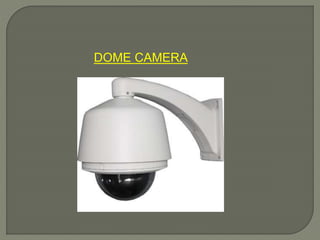
DOME CAMERA
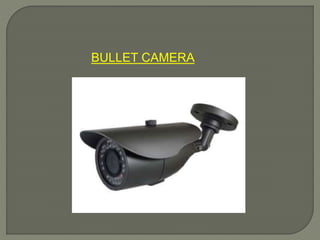
BULLET CAMERA
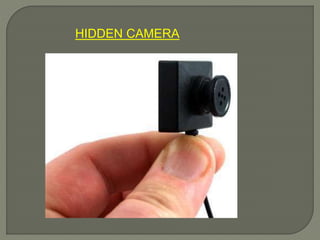
HIDDEN CAMERA
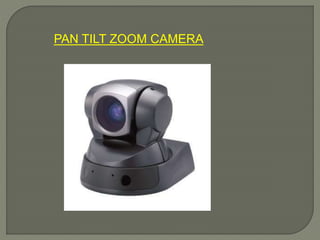
PAN TILT ZOOM CAMERA
TYPES OF CCTV SYSTEMS
CCTV Systems are broadly divided
into two types.
These are:
Wired CCTV System
Wireless CCTV System
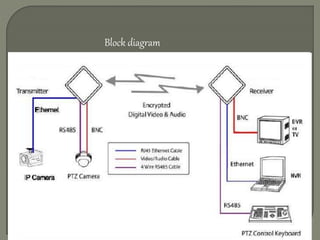
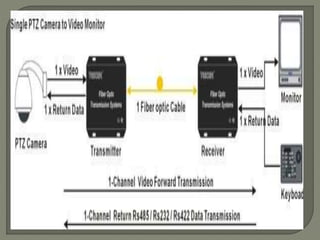
WIRED CCTV SYSTEM
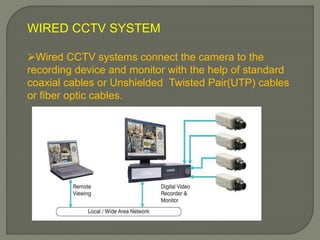
Wired CCTV systems connect the camera to the
recording device and monitor with the help of standard
coaxial cables or Unshielded Twisted Pair(UTP) cables
or fiber optic cables.
Block diagram
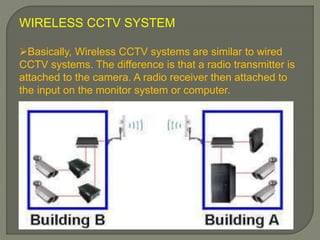
WIRELESS CCTV SYSTEM
Basically, Wireless CCTV systems are similar to wired
CCTV systems. The difference is that a radio transmitter is
attached to the camera. A radio receiver then attached to
the input on the monitor system or computer.
USES OF CCTV
CCTV is commonly used for a variety of purposes,
including:
Maintaining perimeter security in medium-to-high-
secure areas and installations.
Observing behavior of incarcerated inmates and
potentially dangerous patients in medical facilities.
Traffic Monitoring
Building and ground security.
Overseeing locations that would be hazardous to a
human. for example, highly radioactive environment.
Obtaining a visual record of activities where it is
necessary to maintain proper security. For example, in
banks, casinos, or airports.
ADVANTAGES
Deters Crime: The presence of CCTV camera system for
surveillance will reduce petty thefts and vandalism in shops,
malls and other public places.
Helps Maintain Records: The images and videos captured by
a CCTV camera system are often recorded and stored into a
database.
Protects Employees: This is particularly helpful in customer
service centers. The employees providing customer service may
sometimes be subjected to verbal abuse or physical attacks.
CCTV camera system helps to identify such instances and act
immediately. It is also helpful to keep a tab on the activities of
the employees.
For Evidence in Lawsuits: In legal cases of thefts and other
forms of crime, videos and images provided by the CCTV
camera system can serve as a valid proof and evidence against
the defaulter.
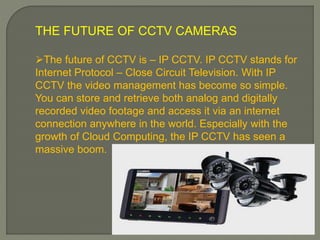
THE FUTURE OF CCTV CAMERAS
The future of CCTV is – IP CCTV. IP CCTV stands for
Internet Protocol – Close Circuit Television. With IP
CCTV the video management has become so simple.
You can store and retrieve both analog and digitally
recorded video footage and access it via an internet
connection anywhere in the world. Especially with the
growth of Cloud Computing, the IP CCTV has seen a
massive boom.
Conclusion:
Radiation safety control is requisites for lasting
nuclear industry
Our various efforts will help to improve radiation
safety control whether it is large or not
Actually, CCTV system is small effort but the such
effort will makes a good fruit
Surveillance camera control system

Surveillance camera control system

  • 1.
  • 4.
    HISTORY: 1942 – FirstCCTV security camera surveillance system installed. German engineer Walter Bruch was responsible for the design and installation of the CCTV security camera surveillance system. 1956 – First VCR produced by Ampex Corporation team led by Charles Ginsburg. 19 year old engineer Ray Dolby was also part of the team. Built for commercial business use. 1960’s – First digital camera signals used in cameras over analog by NASA. 1972 – First VCR for home use produced by Philips. 1996 – The first IP camera was released in 1996 by Axis Communications. 1998 – First consumer digital video recorders (DVR) released to the public.
  • 5.
    HOW DO SURVEILLANCE CAMERASWORK? CCTV camera systems includes one or more cameras which are used to send video images and audio data to a monitor. Essentially, these camera systems use cameras to transmit the signals to a main hub which then records that data for later viewing or live viewing if you have full time security personnel on your premises.
  • 6.
    TYPES Surveillance cameras arebeing installed everywhere for purpose of security and crime prevention and detection. There are many types of surveillance cameras are available for this purpose.
  • 7.
  • 8.
  • 9.
  • 10.
  • 11.
  • 12.
  • 13.
  • 14.
    TYPES OF CCTVSYSTEMS CCTV Systems are broadly divided into two types. These are: Wired CCTV System Wireless CCTV System
  • 15.
    WIRED CCTV SYSTEM WiredCCTV systems connect the camera to the recording device and monitor with the help of standard coaxial cables or Unshielded Twisted Pair(UTP) cables or fiber optic cables.
  • 16.
  • 18.
    WIRELESS CCTV SYSTEM Basically,Wireless CCTV systems are similar to wired CCTV systems. The difference is that a radio transmitter is attached to the camera. A radio receiver then attached to the input on the monitor system or computer.
  • 19.
    USES OF CCTV CCTVis commonly used for a variety of purposes, including: Maintaining perimeter security in medium-to-high- secure areas and installations. Observing behavior of incarcerated inmates and potentially dangerous patients in medical facilities. Traffic Monitoring Building and ground security. Overseeing locations that would be hazardous to a human. for example, highly radioactive environment. Obtaining a visual record of activities where it is necessary to maintain proper security. For example, in banks, casinos, or airports.
  • 20.
    ADVANTAGES Deters Crime: Thepresence of CCTV camera system for surveillance will reduce petty thefts and vandalism in shops, malls and other public places. Helps Maintain Records: The images and videos captured by a CCTV camera system are often recorded and stored into a database. Protects Employees: This is particularly helpful in customer service centers. The employees providing customer service may sometimes be subjected to verbal abuse or physical attacks. CCTV camera system helps to identify such instances and act immediately. It is also helpful to keep a tab on the activities of the employees. For Evidence in Lawsuits: In legal cases of thefts and other forms of crime, videos and images provided by the CCTV camera system can serve as a valid proof and evidence against the defaulter.
  • 21.
    THE FUTURE OFCCTV CAMERAS The future of CCTV is – IP CCTV. IP CCTV stands for Internet Protocol – Close Circuit Television. With IP CCTV the video management has become so simple. You can store and retrieve both analog and digitally recorded video footage and access it via an internet connection anywhere in the world. Especially with the growth of Cloud Computing, the IP CCTV has seen a massive boom.
  • 22.
    Conclusion: Radiation safety controlis requisites for lasting nuclear industry Our various efforts will help to improve radiation safety control whether it is large or not Actually, CCTV system is small effort but the such effort will makes a good fruit