CCTV	
(Closed	circuit	Television)
Closed-circuit	television (CCTV)	is	the	use	of video	
cameras to	transmit	a	signal	to	a	specific	place,	on	a	
limited	set	of	monitors.	It	differs	from	broadcast	
television in	that	the	signal	is	not	openly	transmitted,	
though	it	may	employ	point	to	point	(P2P),	point	to	
multipoint,	or	mesh	wireless	links.
Why	Use	CCTV	
• CCTV	should	not	be	perceived	as	a	magic	wand	for	preventing	crime	- it	is	just	another	 crime	
prevention	 tool	from	a	long	list	available	 to	a	business.	 There	are	many	reasons	 why	CCTV	is	the	most	cost	
effective	security	 solution.	 In	our	experience	 we	have	found	 that	most	businesses	 suffer	from	the	same	few	
security	 problems.	
-.
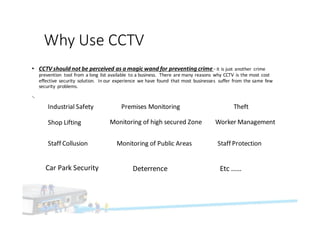
Industrial	Safety Premises	Monitoring Theft
Shop	Lifting Monitoring	of	high	secured	Zone
Monitoring	of	Public	Areas
Worker	Management
Staff	Collusion Staff	Protection
Car	Park	Security Deterrence Etc	……
Why	Use	CCTV	
• Statistics point to major reductions in the amount of crime being committed where there are
cameras installed. An article in 'New Scientist' magazine showed that simply installing a system can
reduce crime, in the areas covered, by over 95%.
• Generally, once a Camera system is installed, it will only be fools who attempt to perpetrate offences
within its field of view. These are often caught but for the majority it will provide a very high level of
deterrence.A professionally installed camera systemcan reduce shoplifting by up to 90%.
• Most people considering the installation of a CCTV system have the main objective of trying to
prevent crime
• A properly installed and managed CCTV system can dramatically reduce crime levels. Drops as high
as 90% have been recorded where a highly visible CCTV system has been installed in certain
locations, i.e. in shopping centers and car parks
• In small to medium-sized businesses, CCTV cameras acts as a deterrent. However, the initial cost and
complexity of good quality systems have been barriers for many businesses. The cost of equipment
has fallen steadily over the years. Today, good quality systems can be much cheaper and still provide
exceptional operational simplicity
Components	of	CCTV	System
• Analog	System
• Camera
• DVR
• Hard	Disk	for	recording
• Wiring	– for	Video	- Coaxial	or	CAT	5(with	video	balun)
• Wiring	– for	power	(not	required	iv	video	balun	is	used)
• Power	Supply	
• Connector	– BNC	or	RJ45	(in	case	of	video	balun)
Components	of	CCTV	System
• IP	System
• Camera
• NVR	with	video	analytics
• Hard	Disk	raid	enable.
• Wiring	– for	Video	– CAT	5/CAT	5E	/	CAT6
• Wiring	– for	power	
• Power	Supply		not	required	if	POE	switch	used
• Switch	/	POE	switch	in	case	of	POE	used
• Connector	– RJ45
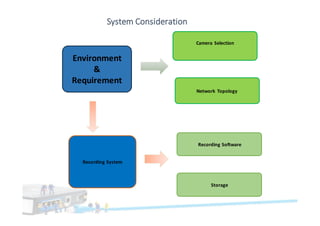
System	Consideration
Environment
&
Requirement
Recording	System
Camera	Selection
Network	Topology	
Recording	Software
Storage
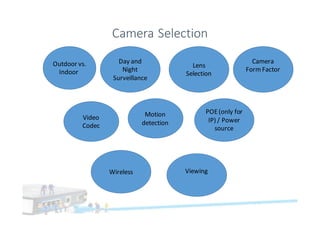
Camera	Selection
Outdoor	vs.	
Indoor
Day	and	
Night	
Surveillance
Lens	
Selection
Camera	
Form	Factor
Video	
Codec
Motion	
detection
POE	(only	for	
IP)	/	Power	
source
Wireless Viewing
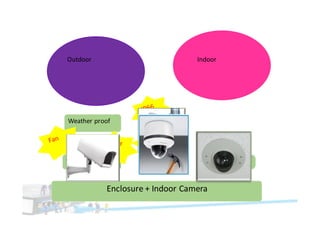
Outdoor Indoor
Enclosure +	Indoor	Camera
Weather	proof
Vandal proof
Heater
Vandal proof
Camera	Selection
Day	Surveillance	?
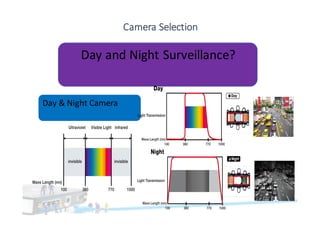
Day	and	Night	Surveillance?
Day	&	Night	Camera
Lens	Selection
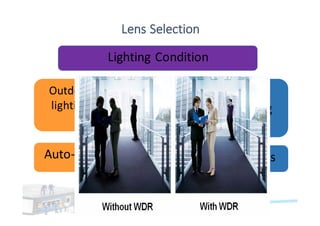
Lighting	Condition
Auto-Iris WDR Fixed	Iris
Outdoor	
lighting
Challenging	
lighting
Indoor	
lighting
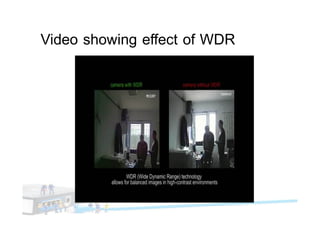
Video showing effect of WDR
Type	of	camera	and	their	Use
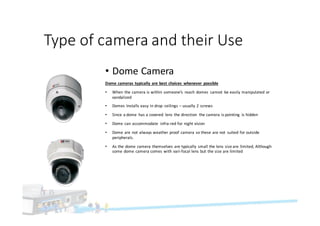
• Dome	Camera
Dome	cameras	typically	are	best	choices	 whenever	 possible
• When	the	camera	is	within	someone’s	 reach	domes	 cannot	 be	easily	manipulated	or	
vandalized
• Domes	Installs	easy	in	drop	 ceilings	– usually	2	screws
• Since	a	dome	 has	a	covered	 lens	the	direction	 the	camera	is	pointing	 is	hidden
• Dome	can	accommodate	 infra-red	for	night	vision
• Dome	are	not	always	weather	proof	camera	so	these	are	not	 suited	for	outside	
peripherals.
• As	the	dome	camera	themselves	are	typically	 small	the	lens	size	are	limited,	Although	
some	dome	camera	comes	with	vari-focal	lens	but	the	size	are	limited
Type	of	camera	and	their	Use
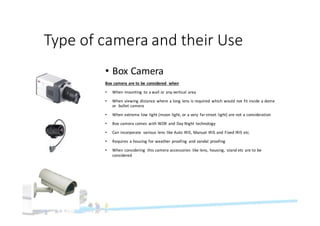
• Box	Camera
Box	camera	are	to	be	considered	 when
• When	mounting	 to	a	wall	or	any	vertical	area
• When	viewing	distance	where	a	long	lens	is	required	 which	would	not	fit	inside	a	dome	
or		bullet	camera
• When	extreme	low	light	(moon	light,	or	a	very	 far	street	light)	are	not	a	consideration
• Box	camera	comes	with	WDR	and	Day	Night	technology
• Can	incorporate	 various	lens	like	Auto	IRIS,	Manual	IRIS	and	Fixed	IRIS	etc.
• Requires	a	housing	for	weather	proofing	 and	vandal	proofing
• When	considering	 this	camera	accessories	 like	lens,	housing,	 stand	etc	are	to	be	
considered
Type	of	camera	and	their	Use
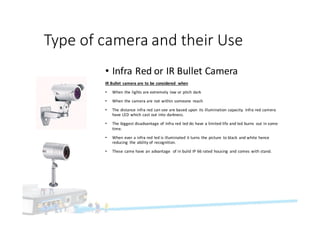
• Infra	Red	or	IR	Bullet	Camera
IR	Bullet	 camera	are	to	be	considered	 when
• When	the	lights	are	extremely	 low	or	pitch	dark
• When	the	camera	are	not	within	someone	 reach
• The	distance	infra	red	can	see	are	based	upon	 its	illumination	capacity.	 Infra	red	camera	
have	LED	which	cast	out	into	darkness.
• The	biggest	disadvantage	of	Infra	red	led	do	have	a	limited	life	and	led	burns	 out	in	some	
time.
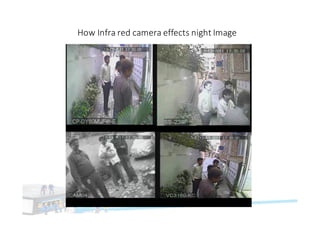
• When	ever	a	infra	red	led	is	illuminated	it	turns	the	picture	 to	black	 and	white	hence	
reducing	 the	ability	of	recognition.
• These	came	have	an	advantage		of	in	build	IP	66	rated	housing	 and	comes	with	stand.
How	Infra	red	camera	effects	night	Image
Type	of	camera	and	their	Use
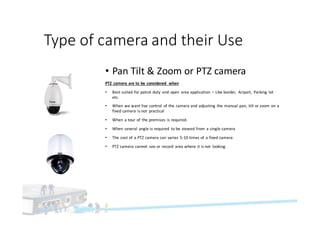
• Pan	Tilt	&	Zoom	or	PTZ	camera
PTZ	camera	are	to	be	considered	 when
• Best	suited	for	patrol	duty	 and	open	 area	application	 – Like	border,	 Airport,	 Parking	lot	
etc.
• When	we	want	live	control	 of	the	camera	and	adjusting	the	manual	pan,	tilt	or	zoom	on	a	
fixed	camera	is	not	 practical
• When	a	tour	of	the	premises	is	required.
• When	several	angle	is	required	 to	be	viewed	from	a	single	camera
• The	cost	of	a	PTZ	camera	can	varies	5-10	times	of	a	fixed	camera
• PTZ	camera	cannot	 see	or	record	 area	where	it	is	not	 looking.
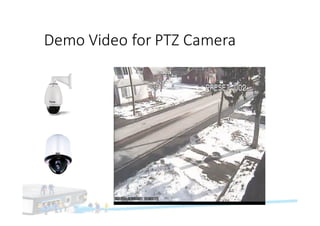
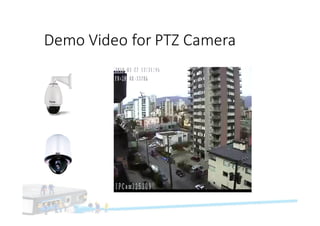
Demo	Video	for	PTZ	Camera
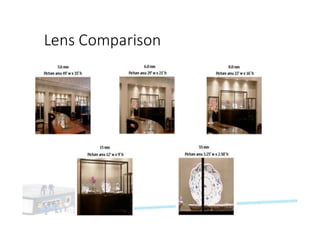
Lens	Comparison
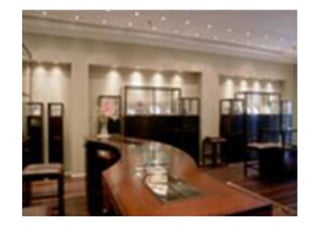
To	better	understand	let	us	first	look	at	this	photograph
Lens	Comparison
To	better	understand	let	us	first	look	at	this	photograph
Lens	Comparison
Type	of	Lens
There	are	2	types	of	lenses:
ü Fixed
ü Varifocal
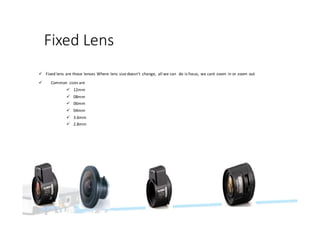
Fixed	Lens
ü Fixed	lens	are	those	lenses	Where	lens	size	doesn’t	 change,	 all	we	can		do	is	focus,	we	cant	zoom	in	or	zoom	out
ü Common	 sizes	are
ü 12mm
ü 08mm
ü 06mm
ü 04mm
ü 3.6mm
ü 2.8mm
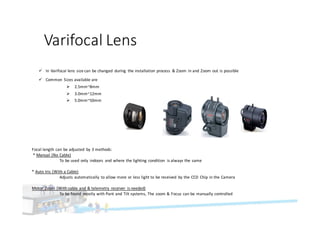
Varifocal	Lens
ü In	Varifocal	lens	size	can	be	changed	 during	 the	installation	process	 &	Zoom	in	and	Zoom	out	is	possible
ü Common	 Sizes	available	are
Ø 2.5mm~8mm
Ø 3.0mm~12mm
Ø 5.0mm~50mm
Focal	length	can	be	adjusted	 by	3	methods:	
*	Manual	(No	Cable)
To	be	used	only	 indoors	 and	where	the	lighting	condition	 is	always	the	same	
*	Auto	Iris	(With	a	Cable)
Adjusts	automatically	 to	allow	more	or	less	light	to	be	received	 by	the	CCD	 Chip	in	the	Camera
Motor	 Zoom	(With	cable	and	&	telemetry	 receiver	 is	needed)
To	be	found	 mostly	with	Pant	and	Tilt	systems,	The	zoom	&	Focus	can	be	manually	controlled
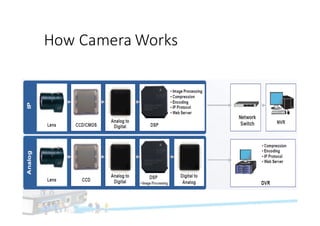
How	Camera	Works
IP	and	Analog	Pros	and	Cons
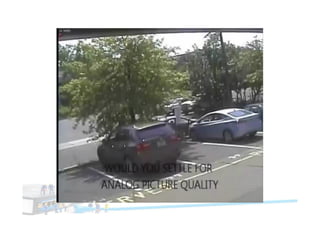
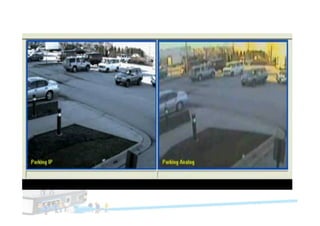
To	better	understand	let	us	view	some	video	which	can	
differentiate	between	IP	and	analog	video	technology
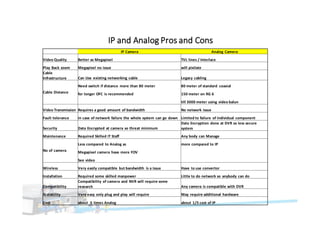
IP	and	Analog	Pros	and	Cons
IP	Camera Analog	Camera
Video	Quality Better	as	Megapixel TVL	lines	/	Interlace
Play	Back	zoom Megapixel	no	issue will	pixilate
Cable	
Infrastructure Can	Use	existing	networking	cable Legacy	cabling
Cable	Distance
Need	switch	if	distance	more	than	80	meter 80	meter	of	standard	 coaxial
for	longer	OFC	is	recommended 150	meter	on	RG	6
till	3000	meter	using	video	balun
Video	Transmission Requires	a	good	amount	of	bandwidth No	network	issue
Fault	tolerance in	case	of	network	failure	the	whole	system	can	go	down Limited	to	failure	of	individual	component
Security Data	Encrypted	at	camera	so	threat	minimum
Data	Encryption	done	at	DVR	so	less	secure	
system
Maintenance Required	Skilled	IT	Staff Any	body	can	Manage
No	of	camera
Less	compared	to	Analog	as more	compared	to	IP
Megapixel	camera	have	more	FOV
See	video
Wireless Very	easily	compatible	but	bandwidth	 is	a	issue Have	to	use	convertor
Installation Required	some	skilled	manpower Little	to	do	network	so	anybody	can	do
Compatibility
Compatibility	of	camera	and	NVR	will	require	some	
research Any	camera	is	compatible	with	DVR
Scalability Very	easy	only	plug	and	play	will	require May	require	additional	hardware
Cost about		5	times	Analog about	1/5	cost	of	IP
Why	no	of	camera	will	be	lesser	in	IP	as	compared	to	Analog
`
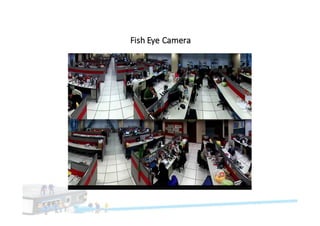
IP	cameras	are	megapixel	camera	and	hence	can	give	a	broader	and	panoramic	
view	which	3	analog	camera	combine	cannot	provide.		
Some	camera	manufacturer	have	manufacture	special	IP	camera	which	can	give	a	
360	degree	view
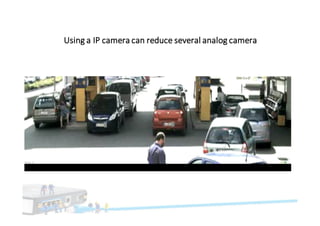
The	following	two	videos	will	be	self	explainable
Using	a	IP	camera	can	reduce	several	analog	camera
`
Fish	Eye	Camera
`
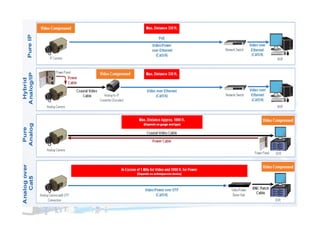
Wiring	Types
Given	below	are	the	various	type	of wiring	possible	in	IP	and	
Analog	Technology
Wiring	Types

Surveillance System, CCTV, BMS