TOPIC: CLOSEDCIRCUITSYSTEM
[cctv]
Name : OmerShaikh
Class: 12
What is Surveillance control camera
system
Purpose of Surveillance System
What is IP Camera
History of CCTV
 How Does Surveillance Camera Work
Types of Cameras
Types of CCTV System
Advantages and Disadvantages of
Camera
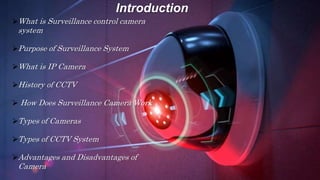
Introduction
What is Surveillance Control System
Surveillance cameras are video cameras
used for the purpose of observing an area.
They are often connected to a recording
device or IP network, and may be watched
by a security guard or law enforcement
officer.
Purpose of Surveillance System
 A surveillance camera is used in
surveillance to monitor public or private
areas that need to be monitored for
security reasons. Modern security cameras
use closed-circuit television [CCTV].
 Cameras can also be used to alert
security/protection officers to respond to
suspicious activities or individuals. Video
surveillance is commonly used for: Remote
video monitoring: to protect against theft,
burglaries, and dishonest employees.
What is IP Camera
.
 An IP Camera (Internet Protocol) is one
that sends and receives data via a
computer network and the Internet
(hence its name).
 These types of cameras are typically
used for surveillance monitoring and are
either “centralized” (meaning they
require a central network video recorder
to handle the recording, video and alarm
management) or “decentralized”
(meaning no NVR is necessary and the
footage can be recorded and managed
from any local or remote storage media).
 Though a webcam is essentially an
internet-based camera, the term “IP” is
typically reserved for surveillance
equipment.
History of CCTV
,
,
 First CCTV security camera surveillance
system installed. German engineer Walter
Bruch was responsible for the design and
installation of the CCTV security camera
surveillance system.
 1956 – First VCR produced by Ampex
Corporation team led by Charles Ginsburg. 19
year old engineer Ray Dolby was also part of
the team. Built for commercial business use.
 1960’s – First digital camera signals used in
cameras over analog by NASA.
 1972 – First VCR for home use produced by
Philips.
 1996 – The first IP camera was released in
1996 by Axis Communications.
 • 1998 – First consumer digital video recorders
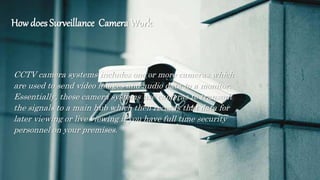
How does Surveillance Camera Work
CCTV camera systems includes one or more cameras which
are used to send video images and audio data to a monitor.
Essentially, these camera systems use cameras to transmit
the signals to a main hub which then records that data for
later viewing or live viewing if you have full time security
personnel on your premises.
Types of IP Camera
.
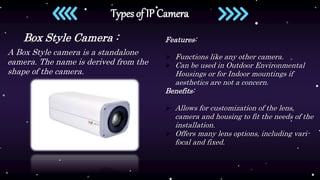
Box Style Camera :
A Box Style camera is a standalone
camera. The name is derived from the
shape of the camera.
Features:
 Functions like any other camera.
 Can be used in Outdoor Environmental
Housings or for Indoor mountings if
aesthetics are not a concern.
Benefits:
 Allows for customization of the lens,
camera and housing to fit the needs of the
installation.
 Offers many lens options, including vari-
focal and fixed.
DoomCamera:
A dome camera is a combination of
camera, lens, and ceiling mount
packaged in a discreet dome shape.
Features:
 Functions like any other camera but comes
in a dome-shaped housing.
 Is well-suited for environments that tend
to get dirty, like kitchens and warehouses.
 Typically available in indoor or outdoor
housings.
Benefits:
 Aesthetically pleasing / compact in
appearance.
 Available in vandal-resistant housings.
..
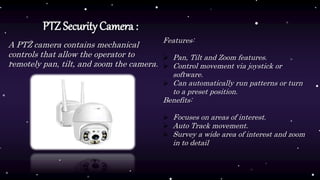
PTZ Security Camera :
.
,
.
A PTZ camera contains mechanical
controls that allow the operator to
remotely pan, tilt, and zoom the camera.
Features:
 Pan, Tilt and Zoom features.
 Control movement via joystick or
software.
 Can automatically run patterns or turn
to a preset position.
Benefits:
 Focuses on areas of interest.
 Auto Track movement.
 Survey a wide area of interest and zoom
in to detail
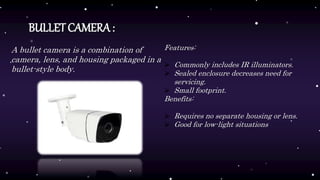
BULLETCAMERA:
.
.
A bullet camera is a combination of
camera, lens, and housing packaged in a
bullet-style body.
Features:
 Commonly includes IR illuminators.
 Sealed enclosure decreases need for
servicing.
 Small footprint.
Benefits:
 Requires no separate housing or lens.
 Good for low-light situations
THERMAL SECURITY CAMERA
/
.
A thermal camera uses thermal
imaging to produce surveillance footage
in dark or harsh environments. It uses
heat to differentiate objects.
Features:
Uses heat sensing to distinguish objects and
people.
Benefits:
Detect people and objects in smoke, haze,
dust, light fog.
Works in complete darkness.
WIRELESS CAMERA
J
;
Wireless IP security cameras offers
ease of installation and eliminates the
cost of network cabling when adding
this camera to your video surveillance
system.
Features:
 Wi-Fi enabled for easy installation and
setup.
 Tilting and swivel options to maximize
viewing.
Benefits:
 Motion detection for instant alerts of
intruders.
 Crystal clear images, even in low light
conditions.
TYPES OF CCTV SYSTEM
. WIRED CCTV SYSTEM : Wired CCTV systems
connect the camera to the recording device and
monitor with the help of standard coaxial cables or
Unshielded Twisted Pair(UTP) cables or fiber optic
cables.
 The image data is usually transmitted over a
coaxial cable. The signal transmitted over these
cables is then fed into a monitor or set of monitors
if the image needs to be visible indifferent
locations.
TYPES OF CCTV SYSTEMS :
CCTV Systems are broadly divided into two
types. They are:
• Wired CCTV System • Wireless CCTV
System
 WIRELESS CCTV SYSTEM:
Basically, Wireless CCTV
systems are similar to wired
CCTV systems. The difference
is that a radio transmitter is
attached to the camera. A radio
receiver then attached to the
input on the monitor system or
computer. Wireless systems are
useful when the distance
between the camera and the
monitor is too far to be
practical for a cable run.
CREDITS: This presentation template was created by Slidesgo,
including icons by Flaticon, and infographics & images by
Freepik
THANKYOU
,
]

Cctv

  • 1.
  • 2.
    What is Surveillancecontrol camera system Purpose of Surveillance System What is IP Camera History of CCTV  How Does Surveillance Camera Work Types of Cameras Types of CCTV System Advantages and Disadvantages of Camera Introduction
  • 3.
    What is SurveillanceControl System Surveillance cameras are video cameras used for the purpose of observing an area. They are often connected to a recording device or IP network, and may be watched by a security guard or law enforcement officer.
  • 4.
    Purpose of SurveillanceSystem  A surveillance camera is used in surveillance to monitor public or private areas that need to be monitored for security reasons. Modern security cameras use closed-circuit television [CCTV].  Cameras can also be used to alert security/protection officers to respond to suspicious activities or individuals. Video surveillance is commonly used for: Remote video monitoring: to protect against theft, burglaries, and dishonest employees.
  • 5.
    What is IPCamera .  An IP Camera (Internet Protocol) is one that sends and receives data via a computer network and the Internet (hence its name).  These types of cameras are typically used for surveillance monitoring and are either “centralized” (meaning they require a central network video recorder to handle the recording, video and alarm management) or “decentralized” (meaning no NVR is necessary and the footage can be recorded and managed from any local or remote storage media).  Though a webcam is essentially an internet-based camera, the term “IP” is typically reserved for surveillance equipment.
  • 6.
    History of CCTV , , First CCTV security camera surveillance system installed. German engineer Walter Bruch was responsible for the design and installation of the CCTV security camera surveillance system.  1956 – First VCR produced by Ampex Corporation team led by Charles Ginsburg. 19 year old engineer Ray Dolby was also part of the team. Built for commercial business use.  1960’s – First digital camera signals used in cameras over analog by NASA.  1972 – First VCR for home use produced by Philips.  1996 – The first IP camera was released in 1996 by Axis Communications.  • 1998 – First consumer digital video recorders
  • 7.
    How does SurveillanceCamera Work CCTV camera systems includes one or more cameras which are used to send video images and audio data to a monitor. Essentially, these camera systems use cameras to transmit the signals to a main hub which then records that data for later viewing or live viewing if you have full time security personnel on your premises.
  • 8.
    Types of IPCamera . Box Style Camera : A Box Style camera is a standalone camera. The name is derived from the shape of the camera. Features:  Functions like any other camera.  Can be used in Outdoor Environmental Housings or for Indoor mountings if aesthetics are not a concern. Benefits:  Allows for customization of the lens, camera and housing to fit the needs of the installation.  Offers many lens options, including vari- focal and fixed.
  • 9.
    DoomCamera: A dome camerais a combination of camera, lens, and ceiling mount packaged in a discreet dome shape. Features:  Functions like any other camera but comes in a dome-shaped housing.  Is well-suited for environments that tend to get dirty, like kitchens and warehouses.  Typically available in indoor or outdoor housings. Benefits:  Aesthetically pleasing / compact in appearance.  Available in vandal-resistant housings. ..
  • 10.
    PTZ Security Camera: . , . A PTZ camera contains mechanical controls that allow the operator to remotely pan, tilt, and zoom the camera. Features:  Pan, Tilt and Zoom features.  Control movement via joystick or software.  Can automatically run patterns or turn to a preset position. Benefits:  Focuses on areas of interest.  Auto Track movement.  Survey a wide area of interest and zoom in to detail
  • 11.
    BULLETCAMERA: . . A bullet camerais a combination of camera, lens, and housing packaged in a bullet-style body. Features:  Commonly includes IR illuminators.  Sealed enclosure decreases need for servicing.  Small footprint. Benefits:  Requires no separate housing or lens.  Good for low-light situations
  • 12.
    THERMAL SECURITY CAMERA / . Athermal camera uses thermal imaging to produce surveillance footage in dark or harsh environments. It uses heat to differentiate objects. Features: Uses heat sensing to distinguish objects and people. Benefits: Detect people and objects in smoke, haze, dust, light fog. Works in complete darkness.
  • 13.
    WIRELESS CAMERA J ; Wireless IPsecurity cameras offers ease of installation and eliminates the cost of network cabling when adding this camera to your video surveillance system. Features:  Wi-Fi enabled for easy installation and setup.  Tilting and swivel options to maximize viewing. Benefits:  Motion detection for instant alerts of intruders.  Crystal clear images, even in low light conditions.
  • 14.
    TYPES OF CCTVSYSTEM . WIRED CCTV SYSTEM : Wired CCTV systems connect the camera to the recording device and monitor with the help of standard coaxial cables or Unshielded Twisted Pair(UTP) cables or fiber optic cables.  The image data is usually transmitted over a coaxial cable. The signal transmitted over these cables is then fed into a monitor or set of monitors if the image needs to be visible indifferent locations. TYPES OF CCTV SYSTEMS : CCTV Systems are broadly divided into two types. They are: • Wired CCTV System • Wireless CCTV System  WIRELESS CCTV SYSTEM: Basically, Wireless CCTV systems are similar to wired CCTV systems. The difference is that a radio transmitter is attached to the camera. A radio receiver then attached to the input on the monitor system or computer. Wireless systems are useful when the distance between the camera and the monitor is too far to be practical for a cable run.
  • 15.
    CREDITS: This presentationtemplate was created by Slidesgo, including icons by Flaticon, and infographics & images by Freepik THANKYOU , ]