IP CCTV Design
Eng Nader Elmansi
IP CCTV Design
3. COMPONENTS OF CCTV SYSTEMS
3.4 Video Monitors
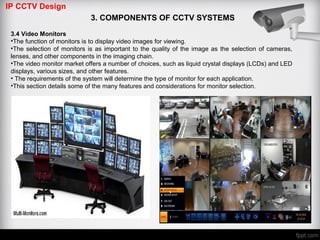
•The function of monitors is to display video images for viewing.
•The selection of monitors is as important to the quality of the image as the selection of cameras,
lenses, and other components in the imaging chain.
•The video monitor market offers a number of choices, such as liquid crystal displays (LCDs) and LED
displays, various sizes, and other features.
• The requirements of the system will determine the type of monitor for each application.
•This section details some of the many features and considerations for monitor selection.
IP CCTV Design
3. COMPONENTS OF CCTV SYSTEMS
3.4 Video Monitors
3.4.1 Pixels
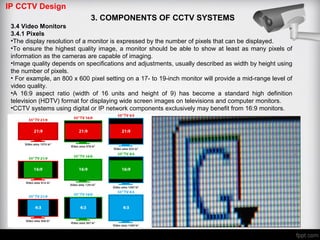
•The display resolution of a monitor is expressed by the number of pixels that can be displayed.
•To ensure the highest quality image, a monitor should be able to show at least as many pixels of
information as the cameras are capable of imaging.
•Image quality depends on specifications and adjustments, usually described as width by height using
the number of pixels.
• For example, an 800 x 600 pixel setting on a 17- to 19-inch monitor will provide a mid-range level of
video quality.
•A 16:9 aspect ratio (width of 16 units and height of 9) has become a standard high definition
television (HDTV) format for displaying wide screen images on televisions and computer monitors.
•CCTV systems using digital or IP network components exclusively may benefit from 16:9 monitors.
IP CCTV Design
3. COMPONENTS OF CCTV SYSTEMS
3.4 Video Monitors
3.4.2 Size
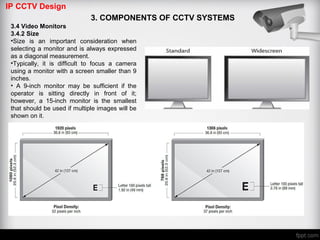
•Size is an important consideration when
selecting a monitor and is always expressed
as a diagonal measurement.
•Typically, it is difficult to focus a camera
using a monitor with a screen smaller than 9
inches.
• A 9-inch monitor may be sufficient if the
operator is sitting directly in front of it;
however, a 15-inch monitor is the smallest
that should be used if multiple images will be
shown on it.
IP CCTV Design
3. COMPONENTS OF CCTV SYSTEMS3.4 Video Monitors
IP CCTV Design
3. COMPONENTS OF CCTV SYSTEMS
3.4 Video Monitors
3.4.3 Monitors
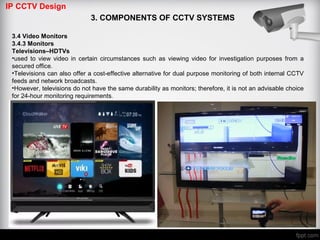
Televisions–HDTVs
•used to view video in certain circumstances such as viewing video for investigation purposes from a
secured office.
•Televisions can also offer a cost-effective alternative for dual purpose monitoring of both internal CCTV
feeds and network broadcasts.
•However, televisions do not have the same durability as monitors; therefore, it is not an advisable choice
for 24-hour monitoring requirements.
IP CCTV Design
3. COMPONENTS OF CCTV SYSTEMS
3.4 Video Monitors
3.4.3 Monitors
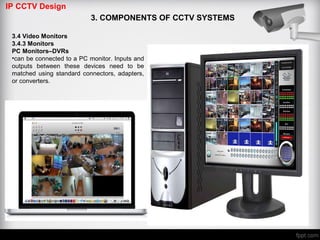
PC Monitors–DVRs
•can be connected to a PC monitor. Inputs and
outputs between these devices need to be
matched using standard connectors, adapters,
or converters.
IP CCTV Design
3. COMPONENTS OF CCTV SYSTEMS
3.4 Video Monitors
3.4.3 Monitors
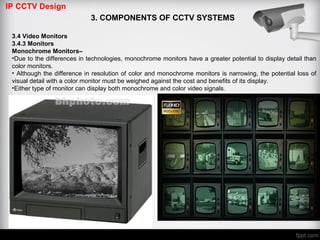
Monochrome Monitors–
•Due to the differences in technologies, monochrome monitors have a greater potential to display detail than
color monitors.
• Although the difference in resolution of color and monochrome monitors is narrowing, the potential loss of
visual detail with a color monitor must be weighed against the cost and benefits of its display.
•Either type of monitor can display both monochrome and color video signals.
IP CCTV Design
3. COMPONENTS OF CCTV SYSTEMS
3.4 Video Monitors
3.4.3 Monitors
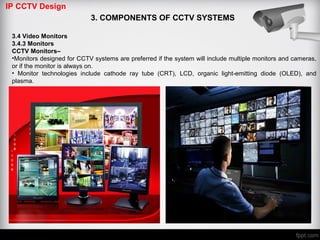
CCTV Monitors–
•Monitors designed for CCTV systems are preferred if the system will include multiple monitors and cameras,
or if the monitor is always on.
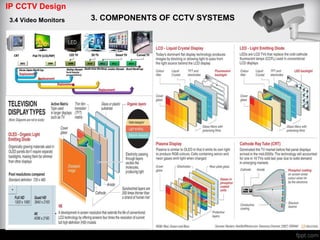
• Monitor technologies include cathode ray tube (CRT), LCD, organic light-emitting diode (OLED), and
plasma.
IP CCTV Design
3. COMPONENTS OF CCTV SYSTEMS
3.4 Video Monitors
3.4.3 Monitors
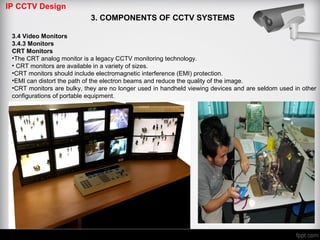
CRT Monitors
•The CRT analog monitor is a legacy CCTV monitoring technology.
• CRT monitors are available in a variety of sizes.
•CRT monitors should include electromagnetic interference (EMI) protection.
•EMI can distort the path of the electron beams and reduce the quality of the image.
•CRT monitors are bulky, they are no longer used in handheld viewing devices and are seldom used in other
configurations of portable equipment.
IP CCTV Design
3. COMPONENTS OF CCTV SYSTEMS
3.4 Video Monitors
3.4.3 Monitors
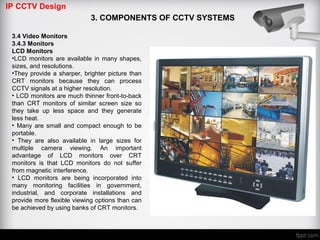
LCD Monitors
•LCD monitors are available in many shapes,
sizes, and resolutions.
•They provide a sharper, brighter picture than
CRT monitors because they can process
CCTV signals at a higher resolution.
• LCD monitors are much thinner front-to-back
than CRT monitors of similar screen size so
they take up less space and they generate
less heat.
• Many are small and compact enough to be
portable.
• They are also available in large sizes for
multiple camera viewing. An important
advantage of LCD monitors over CRT
monitors is that LCD monitors do not suffer
from magnetic interference.
• LCD monitors are being incorporated into
many monitoring facilities in government,
industrial, and corporate installations and
provide more flexible viewing options than can
be achieved by using banks of CRT monitors.
IP CCTV Design
3. COMPONENTS OF CCTV SYSTEMS
3.4 Video Monitors
3.4.3 Monitors
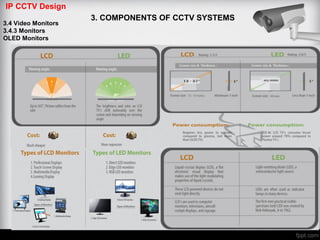
OLED Monitors
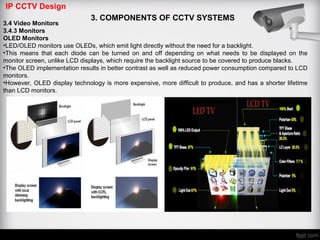
•LED/OLED monitors use OLEDs, which emit light directly without the need for a backlight.
•This means that each diode can be turned on and off depending on what needs to be displayed on the
monitor screen, unlike LCD displays, which require the backlight source to be covered to produce blacks.
•The OLED implementation results in better contrast as well as reduced power consumption compared to LCD
monitors.
•However, OLED display technology is more expensive, more difficult to produce, and has a shorter lifetime
than LCD monitors.
IP CCTV Design
3. COMPONENTS OF CCTV SYSTEMS
3.4 Video Monitors
3.4.3 Monitors
OLED Monitors
IP CCTV Design
3. COMPONENTS OF CCTV SYSTEMS
3.4 Video Monitors
3.4.3 Monitors
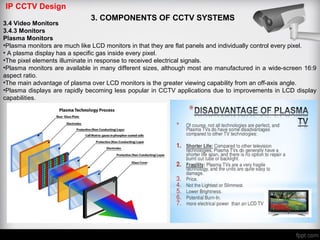
Plasma Monitors
•Plasma monitors are much like LCD monitors in that they are flat panels and individually control every pixel.
• A plasma display has a specific gas inside every pixel.
•The pixel elements illuminate in response to received electrical signals.
•Plasma monitors are available in many different sizes, although most are manufactured in a wide-screen 16:9
aspect ratio.
•The main advantage of plasma over LCD monitors is the greater viewing capability from an off-axis angle.
•Plasma displays are rapidly becoming less popular in CCTV applications due to improvements in LCD display
capabilities.
IP CCTV Design
3. COMPONENTS OF CCTV SYSTEMS
3.4 Video Monitors
3.4.4 Video Walls
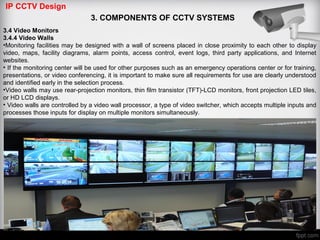
•Monitoring facilities may be designed with a wall of screens placed in close proximity to each other to display
video, maps, facility diagrams, alarm points, access control, event logs, third party applications, and Internet
websites.
• If the monitoring center will be used for other purposes such as an emergency operations center or for training,
presentations, or video conferencing, it is important to make sure all requirements for use are clearly understood
and identified early in the selection process.
•Video walls may use rear-projection monitors, thin film transistor (TFT)-LCD monitors, front projection LED tiles,
or HD LCD displays.
• Video walls are controlled by a video wall processor, a type of video switcher, which accepts multiple inputs and
processes those inputs for display on multiple monitors simultaneously.
IP CCTV Design
3. COMPONENTS OF CCTV SYSTEMS
3.4 Video Monitors
3.4.4 Video Walls
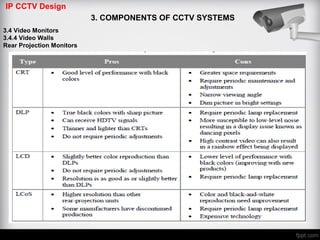
Rear Projection Monitors
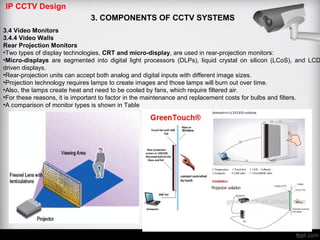
•Two types of display technologies, CRT and micro-display, are used in rear-projection monitors:
•Micro-displays are segmented into digital light processors (DLPs), liquid crystal on silicon (LCoS), and LCD
driven displays.
•Rear-projection units can accept both analog and digital inputs with different image sizes.
•Projection technology requires lamps to create images and those lamps will burn out over time.
•Also, the lamps create heat and need to be cooled by fans, which require filtered air.
•For these reasons, it is important to factor in the maintenance and replacement costs for bulbs and filters.
•A comparison of monitor types is shown in Table
IP CCTV Design
3. COMPONENTS OF CCTV SYSTEMS
3.4 Video Monitors
3.4.4 Video Walls
Rear Projection Monitors
IP CCTV Design
3. COMPONENTS OF CCTV SYSTEMS
3.4 Video Monitors
3.4.4 Video Walls
Rear Projection Monitors
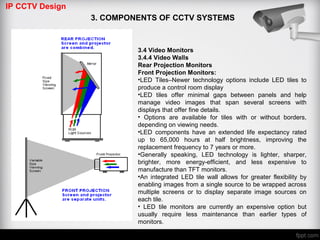
Front Projection Monitors:
•LED Tiles–Newer technology options include LED tiles to
produce a control room display
•LED tiles offer minimal gaps between panels and help
manage video images that span several screens with
displays that offer fine details.
• Options are available for tiles with or without borders,
depending on viewing needs.
•LED components have an extended life expectancy rated
up to 65,000 hours at half brightness, improving the
replacement frequency to 7 years or more.
•Generally speaking, LED technology is lighter, sharper,
brighter, more energy-efficient, and less expensive to
manufacture than TFT monitors.
•An integrated LED tile wall allows for greater flexibility by
enabling images from a single source to be wrapped across
multiple screens or to display separate image sources on
each tile.
• LED tile monitors are currently an expensive option but
usually require less maintenance than earlier types of
monitors.

3.4 IP CCTV video monitors

  • 1.
    IP CCTV Design EngNader Elmansi
  • 2.
    IP CCTV Design 3.COMPONENTS OF CCTV SYSTEMS 3.4 Video Monitors •The function of monitors is to display video images for viewing. •The selection of monitors is as important to the quality of the image as the selection of cameras, lenses, and other components in the imaging chain. •The video monitor market offers a number of choices, such as liquid crystal displays (LCDs) and LED displays, various sizes, and other features. • The requirements of the system will determine the type of monitor for each application. •This section details some of the many features and considerations for monitor selection.
  • 3.
    IP CCTV Design 3.COMPONENTS OF CCTV SYSTEMS 3.4 Video Monitors 3.4.1 Pixels •The display resolution of a monitor is expressed by the number of pixels that can be displayed. •To ensure the highest quality image, a monitor should be able to show at least as many pixels of information as the cameras are capable of imaging. •Image quality depends on specifications and adjustments, usually described as width by height using the number of pixels. • For example, an 800 x 600 pixel setting on a 17- to 19-inch monitor will provide a mid-range level of video quality. •A 16:9 aspect ratio (width of 16 units and height of 9) has become a standard high definition television (HDTV) format for displaying wide screen images on televisions and computer monitors. •CCTV systems using digital or IP network components exclusively may benefit from 16:9 monitors.
  • 4.
    IP CCTV Design 3.COMPONENTS OF CCTV SYSTEMS 3.4 Video Monitors 3.4.2 Size •Size is an important consideration when selecting a monitor and is always expressed as a diagonal measurement. •Typically, it is difficult to focus a camera using a monitor with a screen smaller than 9 inches. • A 9-inch monitor may be sufficient if the operator is sitting directly in front of it; however, a 15-inch monitor is the smallest that should be used if multiple images will be shown on it.
  • 5.
    IP CCTV Design 3.COMPONENTS OF CCTV SYSTEMS3.4 Video Monitors
  • 6.
    IP CCTV Design 3.COMPONENTS OF CCTV SYSTEMS 3.4 Video Monitors 3.4.3 Monitors Televisions–HDTVs •used to view video in certain circumstances such as viewing video for investigation purposes from a secured office. •Televisions can also offer a cost-effective alternative for dual purpose monitoring of both internal CCTV feeds and network broadcasts. •However, televisions do not have the same durability as monitors; therefore, it is not an advisable choice for 24-hour monitoring requirements.
  • 7.
    IP CCTV Design 3.COMPONENTS OF CCTV SYSTEMS 3.4 Video Monitors 3.4.3 Monitors PC Monitors–DVRs •can be connected to a PC monitor. Inputs and outputs between these devices need to be matched using standard connectors, adapters, or converters.
  • 8.
    IP CCTV Design 3.COMPONENTS OF CCTV SYSTEMS 3.4 Video Monitors 3.4.3 Monitors Monochrome Monitors– •Due to the differences in technologies, monochrome monitors have a greater potential to display detail than color monitors. • Although the difference in resolution of color and monochrome monitors is narrowing, the potential loss of visual detail with a color monitor must be weighed against the cost and benefits of its display. •Either type of monitor can display both monochrome and color video signals.
  • 9.
    IP CCTV Design 3.COMPONENTS OF CCTV SYSTEMS 3.4 Video Monitors 3.4.3 Monitors CCTV Monitors– •Monitors designed for CCTV systems are preferred if the system will include multiple monitors and cameras, or if the monitor is always on. • Monitor technologies include cathode ray tube (CRT), LCD, organic light-emitting diode (OLED), and plasma.
  • 10.
    IP CCTV Design 3.COMPONENTS OF CCTV SYSTEMS 3.4 Video Monitors 3.4.3 Monitors CRT Monitors •The CRT analog monitor is a legacy CCTV monitoring technology. • CRT monitors are available in a variety of sizes. •CRT monitors should include electromagnetic interference (EMI) protection. •EMI can distort the path of the electron beams and reduce the quality of the image. •CRT monitors are bulky, they are no longer used in handheld viewing devices and are seldom used in other configurations of portable equipment.
  • 11.
    IP CCTV Design 3.COMPONENTS OF CCTV SYSTEMS 3.4 Video Monitors 3.4.3 Monitors LCD Monitors •LCD monitors are available in many shapes, sizes, and resolutions. •They provide a sharper, brighter picture than CRT monitors because they can process CCTV signals at a higher resolution. • LCD monitors are much thinner front-to-back than CRT monitors of similar screen size so they take up less space and they generate less heat. • Many are small and compact enough to be portable. • They are also available in large sizes for multiple camera viewing. An important advantage of LCD monitors over CRT monitors is that LCD monitors do not suffer from magnetic interference. • LCD monitors are being incorporated into many monitoring facilities in government, industrial, and corporate installations and provide more flexible viewing options than can be achieved by using banks of CRT monitors.
  • 12.
    IP CCTV Design 3.COMPONENTS OF CCTV SYSTEMS 3.4 Video Monitors 3.4.3 Monitors OLED Monitors •LED/OLED monitors use OLEDs, which emit light directly without the need for a backlight. •This means that each diode can be turned on and off depending on what needs to be displayed on the monitor screen, unlike LCD displays, which require the backlight source to be covered to produce blacks. •The OLED implementation results in better contrast as well as reduced power consumption compared to LCD monitors. •However, OLED display technology is more expensive, more difficult to produce, and has a shorter lifetime than LCD monitors.
  • 13.
    IP CCTV Design 3.COMPONENTS OF CCTV SYSTEMS 3.4 Video Monitors 3.4.3 Monitors OLED Monitors
  • 14.
    IP CCTV Design 3.COMPONENTS OF CCTV SYSTEMS 3.4 Video Monitors 3.4.3 Monitors Plasma Monitors •Plasma monitors are much like LCD monitors in that they are flat panels and individually control every pixel. • A plasma display has a specific gas inside every pixel. •The pixel elements illuminate in response to received electrical signals. •Plasma monitors are available in many different sizes, although most are manufactured in a wide-screen 16:9 aspect ratio. •The main advantage of plasma over LCD monitors is the greater viewing capability from an off-axis angle. •Plasma displays are rapidly becoming less popular in CCTV applications due to improvements in LCD display capabilities.
  • 15.
    IP CCTV Design 3.COMPONENTS OF CCTV SYSTEMS 3.4 Video Monitors 3.4.4 Video Walls •Monitoring facilities may be designed with a wall of screens placed in close proximity to each other to display video, maps, facility diagrams, alarm points, access control, event logs, third party applications, and Internet websites. • If the monitoring center will be used for other purposes such as an emergency operations center or for training, presentations, or video conferencing, it is important to make sure all requirements for use are clearly understood and identified early in the selection process. •Video walls may use rear-projection monitors, thin film transistor (TFT)-LCD monitors, front projection LED tiles, or HD LCD displays. • Video walls are controlled by a video wall processor, a type of video switcher, which accepts multiple inputs and processes those inputs for display on multiple monitors simultaneously.
  • 16.
    IP CCTV Design 3.COMPONENTS OF CCTV SYSTEMS 3.4 Video Monitors 3.4.4 Video Walls Rear Projection Monitors •Two types of display technologies, CRT and micro-display, are used in rear-projection monitors: •Micro-displays are segmented into digital light processors (DLPs), liquid crystal on silicon (LCoS), and LCD driven displays. •Rear-projection units can accept both analog and digital inputs with different image sizes. •Projection technology requires lamps to create images and those lamps will burn out over time. •Also, the lamps create heat and need to be cooled by fans, which require filtered air. •For these reasons, it is important to factor in the maintenance and replacement costs for bulbs and filters. •A comparison of monitor types is shown in Table
  • 17.
    IP CCTV Design 3.COMPONENTS OF CCTV SYSTEMS 3.4 Video Monitors 3.4.4 Video Walls Rear Projection Monitors
  • 18.
    IP CCTV Design 3.COMPONENTS OF CCTV SYSTEMS 3.4 Video Monitors 3.4.4 Video Walls Rear Projection Monitors Front Projection Monitors: •LED Tiles–Newer technology options include LED tiles to produce a control room display •LED tiles offer minimal gaps between panels and help manage video images that span several screens with displays that offer fine details. • Options are available for tiles with or without borders, depending on viewing needs. •LED components have an extended life expectancy rated up to 65,000 hours at half brightness, improving the replacement frequency to 7 years or more. •Generally speaking, LED technology is lighter, sharper, brighter, more energy-efficient, and less expensive to manufacture than TFT monitors. •An integrated LED tile wall allows for greater flexibility by enabling images from a single source to be wrapped across multiple screens or to display separate image sources on each tile. • LED tile monitors are currently an expensive option but usually require less maintenance than earlier types of monitors.