1
PLANNING AND DESIGN OF
CCTV SECURITY SYSTEMS
BY
VIBHA V
CE10M200
2
What is cctv ?
 It is a self contained system, in that all of the
circuits contained within are closed and directly
connected.
 The first CCTV- by SIEMENS AG at Germany in
1942, for observing the launch of V-2 rockets.
 Engineer - Walter Bruch (Germany).
History
3
4
 Human observers are costly and valuable
 Observations of remote areas like parking lot
 Observation of hazardous areas – chemical,
radioactive material storage
 Discreet & concealed observations
 Sustained observations
 Simultaneous observation of multiple areas
Need for cctv system
5
 Finance and Banking
 Parking areas
 Educational Institutions
 Storage facilities and warehouses
 Construction sites
 Gas stations
 Commercial buildings
 Hospitals
 Marinas
 Shopping complexes
 Manufacturing plants
 Transporting companies
CCTV remote monitoring can be utilized to
track activities in such areas as:
6
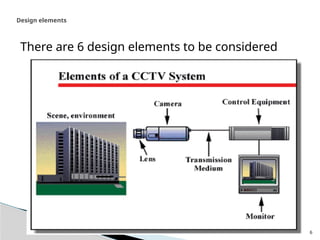
There are 6 design elements to be considered
Design elements
7
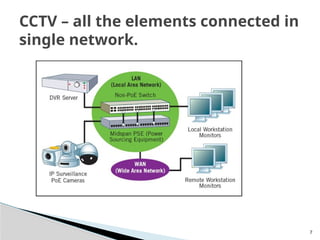
CCTV – all the elements connected in
single network.
8
Selection criteria for camera
 Purpose of monitoring
 The location of the camera
 Distance from the object
 Lighting condition
 Budget
Camera
9
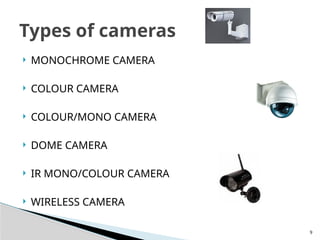
 MONOCHROME CAMERA
 COLOUR CAMERA
 COLOUR/MONO CAMERA
 DOME CAMERA
 IR MONO/COLOUR CAMERA
 WIRELESS CAMERA
Types of cameras
10
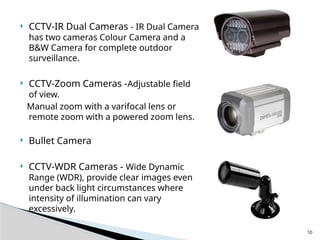
 CCTV-IR Dual Cameras - IR Dual Camera
has two cameras Colour Camera and a
B&W Camera for complete outdoor
surveillance.
 CCTV-Zoom Cameras -Adjustable field
of view.
Manual zoom with a varifocal lens or
remote zoom with a powered zoom lens.
 Bullet Camera
 CCTV-WDR Cameras - Wide Dynamic
Range (WDR), provide clear images even
under back light circumstances where
intensity of illumination can vary
excessively.
11
Camera installation
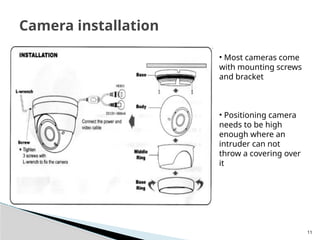
• Most cameras come
with mounting screws
and bracket
• Positioning camera
needs to be high
enough where an
intruder can not
throw a covering over
it
12
SELECTION CRITERIA
 The location of cable -runs either indoor or outdoor
 The maximum length of the individual cable runs.
Cabling is good practice –
 Extensibility: Leave couple of loops of cable
 Use of Concealed conduits.
Cabling / wiring
13
 Coaxial cable
 Optical fiber cable
 Microwave
 Twisted – pair cables etc
Types of cables
14
 Digital video recorder (DVR)
 Videocassette recorder(VCR)
 Compact Disc (CD)
Digital video recorder is preferred over all.
Data storage system
15
 Scene – is the area of surveillance
 Lens – optical component, defines the image by
shape, size, color etc
 Camera – device to convert optical image to
electronic signal
 Transmission medium – carries electronic
signal generated by camera
 Monitor – The monitor receives and displays
the transmitted image.
Design elements
16
 Light and level of illumination
 Type of camera used
 Type and properties of lenses
 Type of data transmission systems
 Monitor and monitoring factors
 Environmental factors
Factors affecting cctv performance
17
The performance of CCTV depends on
 Quantity
 Quality
 Distribution of available light.
Lighting requirements
18
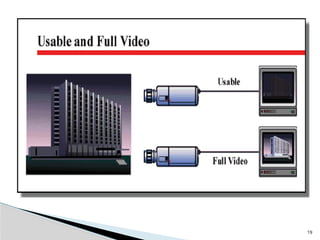
 Usable video – usable video refers to video
images which supply the minimum level of
information required for its application.
what is "usable" to one person, may not be to
another.
 Full video – it refers to the images which
reproduce the scene with high level of fidelity.
Usable video or full video is only possible
with proper illumination
19
20
If lighting levels are inadequate for a given
camera,
 Add light
 Select a camera with higher sensitivity
Choosing one of the option depends on cost of
changing camera Vs cost of supplementing
existing lighting
Options for producing proper image
21
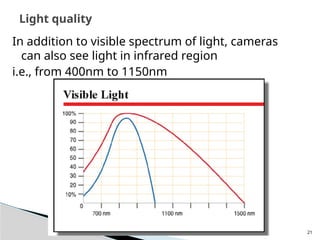
In addition to visible spectrum of light, cameras
can also see light in infrared region
i.e., from 400nm to 1150nm
Light quality
22
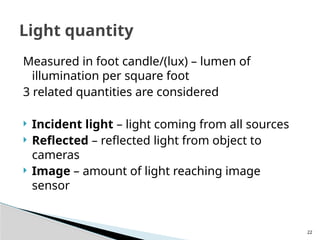
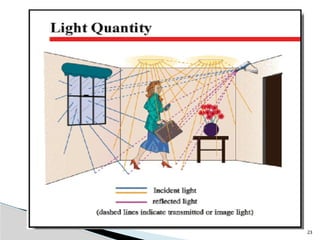
Measured in foot candle/(lux) – lumen of
illumination per square foot
3 related quantities are considered
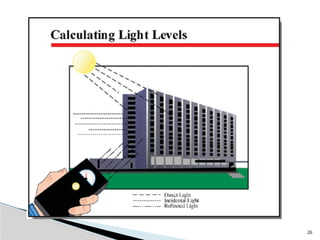
 Incident light – light coming from all sources
 Reflected – reflected light from object to
cameras
 Image – amount of light reaching image
sensor
Light quantity
23
24
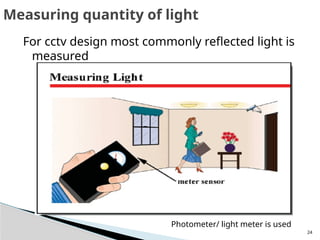
For cctv design most commonly reflected light is
measured
Measuring quantity of light
Photometer/ light meter is used
25
 Level of reflected light
 Lens transmissibility
 Lowest f-stop of lens iris (widest opening)
Factors affecting amount of light reaching
image sensor
26
27
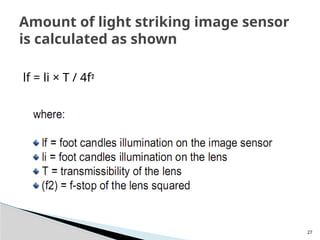
Amount of light striking image sensor
is calculated as shown
lf = li × T / 4f²
28
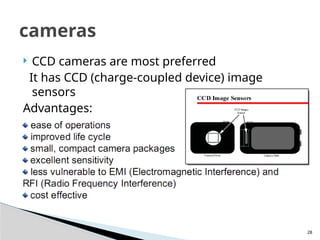
 CCD cameras are most preferred
It has CCD (charge-coupled device) image
sensors
Advantages:
cameras
29
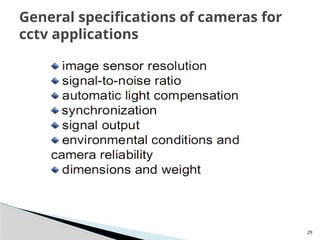
General specifications of cameras for
cctv applications
30
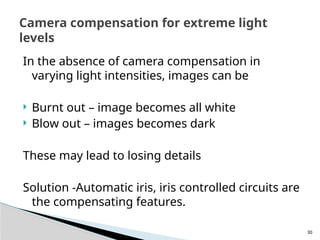
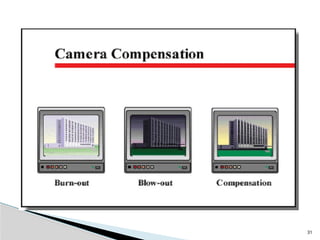
In the absence of camera compensation in
varying light intensities, images can be
 Burnt out – image becomes all white
 Blow out – images becomes dark
These may lead to losing details
Solution -Automatic iris, iris controlled circuits are
the compensating features.
Camera compensation for extreme light
levels
31
32
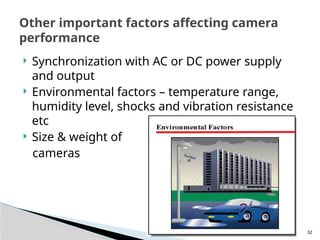
 Synchronization with AC or DC power supply
and output
 Environmental factors – temperature range,
humidity level, shocks and vibration resistance
etc
 Size & weight of
cameras
Other important factors affecting camera
performance
33
Factors affecting area to be covered & image quality
 Focal length
 Field of view
 Image size
Lenses define geometry of image striking image
sensor
 Size
 Shape
 Sharpness of image
lenses
34
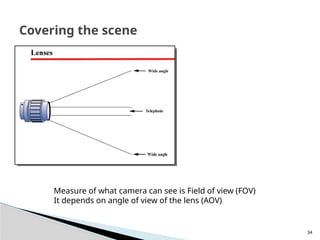
Covering the scene
Measure of what camera can see is Field of view (FOV)
It depends on angle of view of the lens (AOV)
35
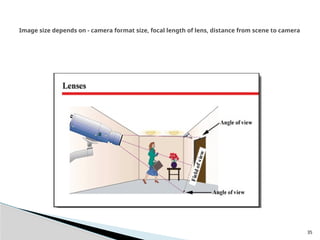
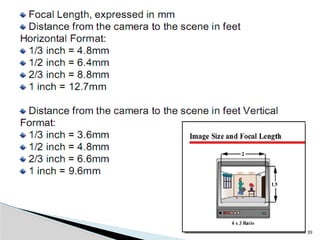
Image size depends on - camera format size, focal length of lens, distance from scene to camera
36
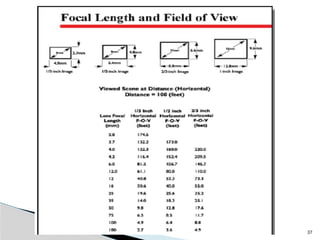
 Area to be observed is selected first
 Positioning of camera has to be assumed next
 Given the distance of object to camera, camera
format(1”,1/2”etc), and focal length of camera,
from the table field of view can be obtained.
Focal length & field of view
37
38
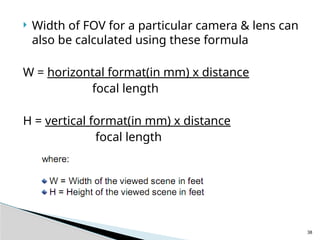
 Width of FOV for a particular camera & lens can
also be calculated using these formula
W = horizontal format(in mm) x distance
focal length
H = vertical format(in mm) x distance
focal length
39
40
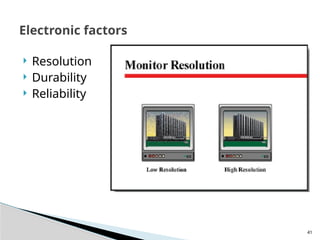
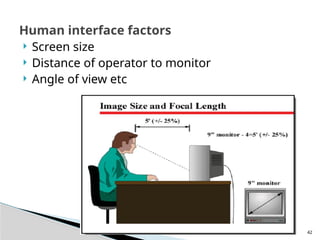
Factors affecting selection of monitor
 Electronic factor
 Human interface factor
And also
 Type of application
 Requirements
 Its placement and purpose etc
CCTV monitors
41
 Resolution
 Durability
 Reliability
Electronic factors
42
Human interface factors
 Screen size
 Distance of operator to monitor
 Angle of view etc
43
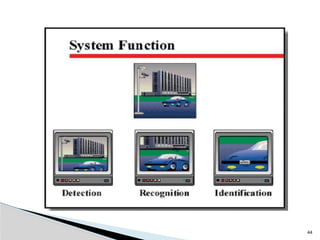
Designing is done based on
 What is the system’s function?
Example – detection, recognition, identification
 Who will be managing system & how?
 Is the system new or being upgraded?
Based on this low or high design criteria is set
Design requirements
44
45
Factors considered
 Level of security needed
 Number of critical areas to be observed
 Duration of observation
 Type of observation– continuous/ intermittent
 Area to be covered under observation
Considering all these criteria number of camera,
monitoring systems are determined
Planning cctv system
46
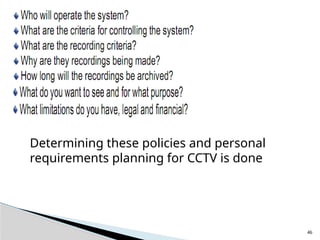
Determining these policies and personal
requirements planning for CCTV is done
47
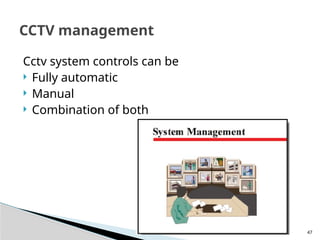
Cctv system controls can be
 Fully automatic
 Manual
 Combination of both
CCTV management
48
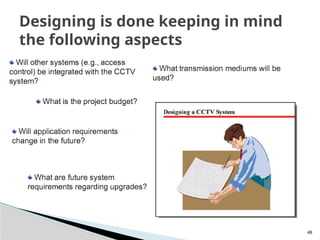
Designing is done keeping in mind
the following aspects
49
 Physical Damage to Camera assembly
 Spraying substances over the lens to blur the
image
 Laser pointers can temporarily blind cameras,
and higher powered lasers can damage them.
 Wireless broadcasting signal can be jammed
using network jammers
Hacking threats for CCTV
50
A carefully designed CCTV system provides
 Adequate coverage for security
 Extendibility for future additions and
enhancements
 Satisfied performance on the whole
 Customer satisfaction
conclusion
51
1) eBook - CCTV for security professionals
By Alan R Matchett.
2) Security PACE book 3 – cctv systems & control concepts.
3) www.hightechcctvmonitoring.com
4) en.wikipedia.org
5) http://www.securitycamerasandmore.com/
6)www.cctvcenter.com/guides/Raytec%20Lighting%20Guide.pdf
References
52

cctv_design_ppt for building services.pptx

  • 1.
    1 PLANNING AND DESIGNOF CCTV SECURITY SYSTEMS BY VIBHA V CE10M200
  • 2.
    2 What is cctv?  It is a self contained system, in that all of the circuits contained within are closed and directly connected.
  • 3.
     The firstCCTV- by SIEMENS AG at Germany in 1942, for observing the launch of V-2 rockets.  Engineer - Walter Bruch (Germany). History 3
  • 4.
    4  Human observersare costly and valuable  Observations of remote areas like parking lot  Observation of hazardous areas – chemical, radioactive material storage  Discreet & concealed observations  Sustained observations  Simultaneous observation of multiple areas Need for cctv system
  • 5.
    5  Finance andBanking  Parking areas  Educational Institutions  Storage facilities and warehouses  Construction sites  Gas stations  Commercial buildings  Hospitals  Marinas  Shopping complexes  Manufacturing plants  Transporting companies CCTV remote monitoring can be utilized to track activities in such areas as:
  • 6.
    6 There are 6design elements to be considered Design elements
  • 7.
    7 CCTV – allthe elements connected in single network.
  • 8.
    8 Selection criteria forcamera  Purpose of monitoring  The location of the camera  Distance from the object  Lighting condition  Budget Camera
  • 9.
    9  MONOCHROME CAMERA COLOUR CAMERA  COLOUR/MONO CAMERA  DOME CAMERA  IR MONO/COLOUR CAMERA  WIRELESS CAMERA Types of cameras
  • 10.
    10  CCTV-IR DualCameras - IR Dual Camera has two cameras Colour Camera and a B&W Camera for complete outdoor surveillance.  CCTV-Zoom Cameras -Adjustable field of view. Manual zoom with a varifocal lens or remote zoom with a powered zoom lens.  Bullet Camera  CCTV-WDR Cameras - Wide Dynamic Range (WDR), provide clear images even under back light circumstances where intensity of illumination can vary excessively.
  • 11.
    11 Camera installation • Mostcameras come with mounting screws and bracket • Positioning camera needs to be high enough where an intruder can not throw a covering over it
  • 12.
    12 SELECTION CRITERIA  Thelocation of cable -runs either indoor or outdoor  The maximum length of the individual cable runs. Cabling is good practice –  Extensibility: Leave couple of loops of cable  Use of Concealed conduits. Cabling / wiring
  • 13.
    13  Coaxial cable Optical fiber cable  Microwave  Twisted – pair cables etc Types of cables
  • 14.
    14  Digital videorecorder (DVR)  Videocassette recorder(VCR)  Compact Disc (CD) Digital video recorder is preferred over all. Data storage system
  • 15.
    15  Scene –is the area of surveillance  Lens – optical component, defines the image by shape, size, color etc  Camera – device to convert optical image to electronic signal  Transmission medium – carries electronic signal generated by camera  Monitor – The monitor receives and displays the transmitted image. Design elements
  • 16.
    16  Light andlevel of illumination  Type of camera used  Type and properties of lenses  Type of data transmission systems  Monitor and monitoring factors  Environmental factors Factors affecting cctv performance
  • 17.
    17 The performance ofCCTV depends on  Quantity  Quality  Distribution of available light. Lighting requirements
  • 18.
    18  Usable video– usable video refers to video images which supply the minimum level of information required for its application. what is "usable" to one person, may not be to another.  Full video – it refers to the images which reproduce the scene with high level of fidelity. Usable video or full video is only possible with proper illumination
  • 19.
  • 20.
    20 If lighting levelsare inadequate for a given camera,  Add light  Select a camera with higher sensitivity Choosing one of the option depends on cost of changing camera Vs cost of supplementing existing lighting Options for producing proper image
  • 21.
    21 In addition tovisible spectrum of light, cameras can also see light in infrared region i.e., from 400nm to 1150nm Light quality
  • 22.
    22 Measured in footcandle/(lux) – lumen of illumination per square foot 3 related quantities are considered  Incident light – light coming from all sources  Reflected – reflected light from object to cameras  Image – amount of light reaching image sensor Light quantity
  • 23.
  • 24.
    24 For cctv designmost commonly reflected light is measured Measuring quantity of light Photometer/ light meter is used
  • 25.
    25  Level ofreflected light  Lens transmissibility  Lowest f-stop of lens iris (widest opening) Factors affecting amount of light reaching image sensor
  • 26.
  • 27.
    27 Amount of lightstriking image sensor is calculated as shown lf = li × T / 4f²
  • 28.
    28  CCD camerasare most preferred It has CCD (charge-coupled device) image sensors Advantages: cameras
  • 29.
    29 General specifications ofcameras for cctv applications
  • 30.
    30 In the absenceof camera compensation in varying light intensities, images can be  Burnt out – image becomes all white  Blow out – images becomes dark These may lead to losing details Solution -Automatic iris, iris controlled circuits are the compensating features. Camera compensation for extreme light levels
  • 31.
  • 32.
    32  Synchronization withAC or DC power supply and output  Environmental factors – temperature range, humidity level, shocks and vibration resistance etc  Size & weight of cameras Other important factors affecting camera performance
  • 33.
    33 Factors affecting areato be covered & image quality  Focal length  Field of view  Image size Lenses define geometry of image striking image sensor  Size  Shape  Sharpness of image lenses
  • 34.
    34 Covering the scene Measureof what camera can see is Field of view (FOV) It depends on angle of view of the lens (AOV)
  • 35.
    35 Image size dependson - camera format size, focal length of lens, distance from scene to camera
  • 36.
    36  Area tobe observed is selected first  Positioning of camera has to be assumed next  Given the distance of object to camera, camera format(1”,1/2”etc), and focal length of camera, from the table field of view can be obtained. Focal length & field of view
  • 37.
  • 38.
    38  Width ofFOV for a particular camera & lens can also be calculated using these formula W = horizontal format(in mm) x distance focal length H = vertical format(in mm) x distance focal length
  • 39.
  • 40.
    40 Factors affecting selectionof monitor  Electronic factor  Human interface factor And also  Type of application  Requirements  Its placement and purpose etc CCTV monitors
  • 41.
    41  Resolution  Durability Reliability Electronic factors
  • 42.
    42 Human interface factors Screen size  Distance of operator to monitor  Angle of view etc
  • 43.
    43 Designing is donebased on  What is the system’s function? Example – detection, recognition, identification  Who will be managing system & how?  Is the system new or being upgraded? Based on this low or high design criteria is set Design requirements
  • 44.
  • 45.
    45 Factors considered  Levelof security needed  Number of critical areas to be observed  Duration of observation  Type of observation– continuous/ intermittent  Area to be covered under observation Considering all these criteria number of camera, monitoring systems are determined Planning cctv system
  • 46.
    46 Determining these policiesand personal requirements planning for CCTV is done
  • 47.
    47 Cctv system controlscan be  Fully automatic  Manual  Combination of both CCTV management
  • 48.
    48 Designing is donekeeping in mind the following aspects
  • 49.
    49  Physical Damageto Camera assembly  Spraying substances over the lens to blur the image  Laser pointers can temporarily blind cameras, and higher powered lasers can damage them.  Wireless broadcasting signal can be jammed using network jammers Hacking threats for CCTV
  • 50.
    50 A carefully designedCCTV system provides  Adequate coverage for security  Extendibility for future additions and enhancements  Satisfied performance on the whole  Customer satisfaction conclusion
  • 51.
    51 1) eBook -CCTV for security professionals By Alan R Matchett. 2) Security PACE book 3 – cctv systems & control concepts. 3) www.hightechcctvmonitoring.com 4) en.wikipedia.org 5) http://www.securitycamerasandmore.com/ 6)www.cctvcenter.com/guides/Raytec%20Lighting%20Guide.pdf References
  • 52.