IP CCTV
Eng Nader Elmansi
IP CCTV Surveillance
Overview
video surveillance has demonstrated its value and benefits countless times by:
•Providing real-time monitoring of a facility's environment, people, and assets
•Recording events for subsequent investigation, proof of compliance / audit
purposes
IP CCTV Surveillance
video surveillance architecture
The video surveillance architecture provides several benefits:
• Increased reliability
• Higher system availability
• Greater utility (any camera to any monitoring or recording device for any application,
anywhere)
• Increased accessibility and mobility
• Multivendor video surveillance system "best of breed" interoperability
• The ability to enhance other building management system capabilities through
improved interoperability
• Reduced capital and operational expenditures
IP CCTV Surveillance
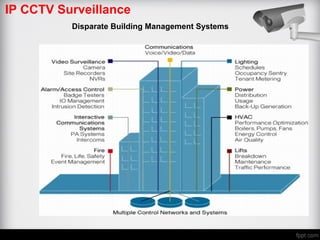
Disparate Building Management Systems
IP CCTV Surveillance
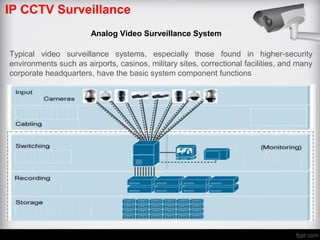
Analog Video Surveillance System
Typical video surveillance systems, especially those found in higher-security
environments such as airports, casinos, military sites, correctional facilities, and many
corporate headquarters, have the basic system component functions
IP CCTV Surveillance
Input devices
Cameras (fixed and/or
pan tilt and zoom [PTZ])
that are available in either
black and white or color
are covertly or openly
deployed
IP CCTV Surveillance
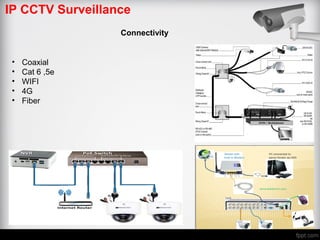
Connectivity
• Coaxial
• Cat 6 ,5e
• WIFI
• 4G
• Fiber
IP CCTV Surveillance
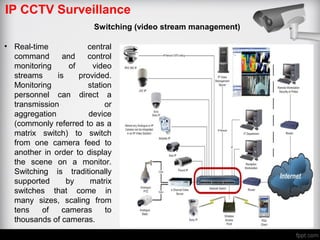
Switching (video stream management)
• Real-time central
command and control
monitoring of video
streams is provided.
Monitoring station
personnel can direct a
transmission or
aggregation device
(commonly referred to as a
matrix switch) to switch
from one camera feed to
another in order to display
the scene on a monitor.
Switching is traditionally
supported by matrix
switches that come in
many sizes, scaling from
tens of cameras to
thousands of cameras.
IP CCTV Surveillance
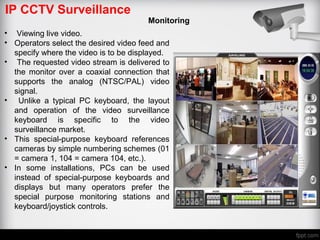
Monitoring
• Viewing live video.
• Operators select the desired video feed and
specify where the video is to be displayed.
• The requested video stream is delivered to
the monitor over a coaxial connection that
supports the analog (NTSC/PAL) video
signal.
• Unlike a typical PC keyboard, the layout
and operation of the video surveillance
keyboard is specific to the video
surveillance market.
• This special-purpose keyboard references
cameras by simple numbering schemes (01
= camera 1, 104 = camera 104, etc.).
• In some installations, PCs can be used
instead of special-purpose keyboards and
displays but many operators prefer the
special purpose monitoring stations and
keyboard/joystick controls.
IP CCTV Surveillance
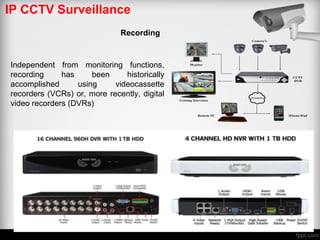
Recording
Independent from monitoring functions,
recording has been historically
accomplished using videocassette
recorders (VCRs) or, more recently, digital
video recorders (DVRs)
IP CCTV Surveillance
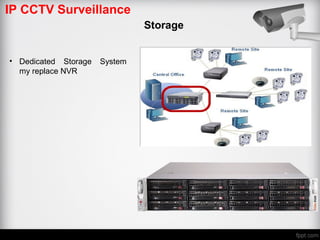
Storage
• Dedicated Storage System
my replace NVR
IP CCTV Surveillance
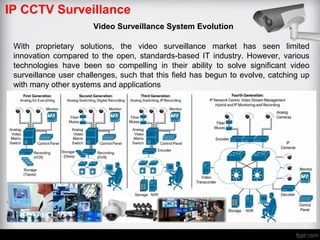
Video Surveillance System Evolution
With proprietary solutions, the video surveillance market has seen limited
innovation compared to the open, standards-based IT industry. However, various
technologies have been so compelling in their ability to solve significant video
surveillance user challenges, such that this field has begun to evolve, catching up
with many other systems and applications
IP CCTV Surveillance
First-Generation Video Surveillance
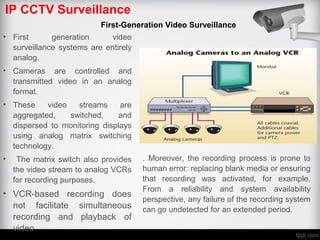
• First generation video
surveillance systems are entirely
analog.
• Cameras are controlled and
transmitted video in an analog
format.
• These video streams are
aggregated, switched, and
dispersed to monitoring displays
using analog matrix switching
technology.
• The matrix switch also provides
the video stream to analog VCRs
for recording purposes.
• VCR-based recording does
not facilitate simultaneous
recording and playback of
video
. Moreover, the recording process is prone to
human error: replacing blank media or ensuring
that recording was activated, for example.
From a reliability and system availability
perspective, any failure of the recording system
can go undetected for an extended period.
IP CCTV Surveillance
First-Generation Video Surveillance
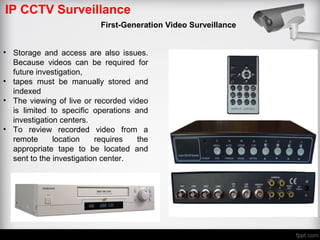
• Storage and access are also issues.
Because videos can be required for
future investigation,
• tapes must be manually stored and
indexed
• The viewing of live or recorded video
is limited to specific operations and
investigation centers.
• To review recorded video from a
remote location requires the
appropriate tape to be located and
sent to the investigation center.
IP CCTV Surveillance
Second-Generation Video Surveillance
• Second-generation systems are also
based on analog camera (input), fiber or
coaxial connectivity, with video switching
provided by an analog video matrix
switch..
• focus on addressing recording and
storage problems.
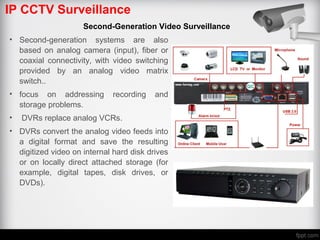
• DVRs replace analog VCRs.
• DVRs convert the analog video feeds into
a digital format and save the resulting
digitized video on internal hard disk drives
or on locally direct attached storage (for
example, digital tapes, disk drives, or
DVDs).
IP CCTV Surveillance
Second-Generation Video Surveillance
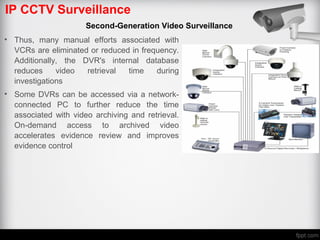
• Thus, many manual efforts associated with
VCRs are eliminated or reduced in frequency.
Additionally, the DVR's internal database
reduces video retrieval time during
investigations
• Some DVRs can be accessed via a network-
connected PC to further reduce the time
associated with video archiving and retrieval.
On-demand access to archived video
accelerates evidence review and improves
evidence control
IP CCTV Surveillance
Third-Generation Video Surveillance
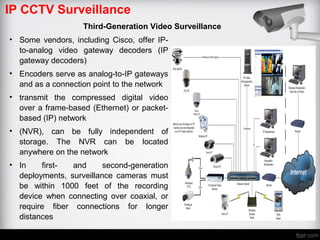
• Some vendors, including Cisco, offer IP-
to-analog video gateway decoders (IP
gateway decoders)
• Encoders serve as analog-to-IP gateways
and as a connection point to the network
• transmit the compressed digital video
over a frame-based (Ethernet) or packet-
based (IP) network
• (NVR), can be fully independent of
storage. The NVR can be located
anywhere on the network
• In first- and second-generation
deployments, surveillance cameras must
be within 1000 feet of the recording
device when connecting over coaxial, or
require fiber connections for longer
distances
IP CCTV Surveillance
Third-Generation Video Surveillance
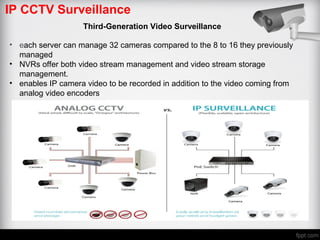
• each server can manage 32 cameras compared to the 8 to 16 they previously
managed
• NVRs offer both video stream management and video stream storage
management.
• enables IP camera video to be recorded in addition to the video coming from
analog video encoders
IP CCTV Surveillance
Third-Generation Video Surveillance
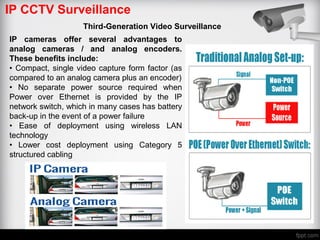
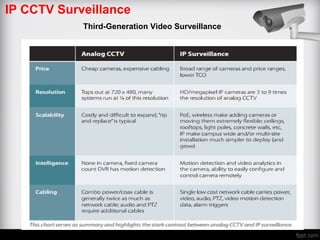
IP cameras offer several advantages to
analog cameras / and analog encoders.
These benefits include:
• Compact, single video capture form factor (as
compared to an analog camera plus an encoder)
• No separate power source required when
Power over Ethernet is provided by the IP
network switch, which in many cases has battery
back-up in the event of a power failure
• Ease of deployment using wireless LAN
technology
• Lower cost deployment using Category 5
structured cabling
IP CCTV Surveillance
Third-Generation Video Surveillance
IP CCTV Surveillance
Fourth-Generation Video Surveillance
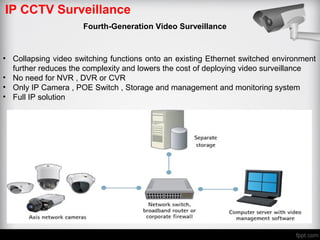
• Collapsing video switching functions onto an existing Ethernet switched environment
further reduces the complexity and lowers the cost of deploying video surveillance
• No need for NVR , DVR or CVR
• Only IP Camera , POE Switch , Storage and management and monitoring system
• Full IP solution

01 ip cctv suervilence overview

  • 1.
  • 2.
    IP CCTV Surveillance Overview videosurveillance has demonstrated its value and benefits countless times by: •Providing real-time monitoring of a facility's environment, people, and assets •Recording events for subsequent investigation, proof of compliance / audit purposes
  • 3.
    IP CCTV Surveillance videosurveillance architecture The video surveillance architecture provides several benefits: • Increased reliability • Higher system availability • Greater utility (any camera to any monitoring or recording device for any application, anywhere) • Increased accessibility and mobility • Multivendor video surveillance system "best of breed" interoperability • The ability to enhance other building management system capabilities through improved interoperability • Reduced capital and operational expenditures
  • 4.
    IP CCTV Surveillance DisparateBuilding Management Systems
  • 5.
    IP CCTV Surveillance AnalogVideo Surveillance System Typical video surveillance systems, especially those found in higher-security environments such as airports, casinos, military sites, correctional facilities, and many corporate headquarters, have the basic system component functions
  • 6.
    IP CCTV Surveillance Inputdevices Cameras (fixed and/or pan tilt and zoom [PTZ]) that are available in either black and white or color are covertly or openly deployed
  • 7.
    IP CCTV Surveillance Connectivity •Coaxial • Cat 6 ,5e • WIFI • 4G • Fiber
  • 8.
    IP CCTV Surveillance Switching(video stream management) • Real-time central command and control monitoring of video streams is provided. Monitoring station personnel can direct a transmission or aggregation device (commonly referred to as a matrix switch) to switch from one camera feed to another in order to display the scene on a monitor. Switching is traditionally supported by matrix switches that come in many sizes, scaling from tens of cameras to thousands of cameras.
  • 9.
    IP CCTV Surveillance Monitoring •Viewing live video. • Operators select the desired video feed and specify where the video is to be displayed. • The requested video stream is delivered to the monitor over a coaxial connection that supports the analog (NTSC/PAL) video signal. • Unlike a typical PC keyboard, the layout and operation of the video surveillance keyboard is specific to the video surveillance market. • This special-purpose keyboard references cameras by simple numbering schemes (01 = camera 1, 104 = camera 104, etc.). • In some installations, PCs can be used instead of special-purpose keyboards and displays but many operators prefer the special purpose monitoring stations and keyboard/joystick controls.
  • 10.
    IP CCTV Surveillance Recording Independentfrom monitoring functions, recording has been historically accomplished using videocassette recorders (VCRs) or, more recently, digital video recorders (DVRs)
  • 11.
    IP CCTV Surveillance Storage •Dedicated Storage System my replace NVR
  • 12.
    IP CCTV Surveillance VideoSurveillance System Evolution With proprietary solutions, the video surveillance market has seen limited innovation compared to the open, standards-based IT industry. However, various technologies have been so compelling in their ability to solve significant video surveillance user challenges, such that this field has begun to evolve, catching up with many other systems and applications
  • 13.
    IP CCTV Surveillance First-GenerationVideo Surveillance • First generation video surveillance systems are entirely analog. • Cameras are controlled and transmitted video in an analog format. • These video streams are aggregated, switched, and dispersed to monitoring displays using analog matrix switching technology. • The matrix switch also provides the video stream to analog VCRs for recording purposes. • VCR-based recording does not facilitate simultaneous recording and playback of video . Moreover, the recording process is prone to human error: replacing blank media or ensuring that recording was activated, for example. From a reliability and system availability perspective, any failure of the recording system can go undetected for an extended period.
  • 14.
    IP CCTV Surveillance First-GenerationVideo Surveillance • Storage and access are also issues. Because videos can be required for future investigation, • tapes must be manually stored and indexed • The viewing of live or recorded video is limited to specific operations and investigation centers. • To review recorded video from a remote location requires the appropriate tape to be located and sent to the investigation center.
  • 15.
    IP CCTV Surveillance Second-GenerationVideo Surveillance • Second-generation systems are also based on analog camera (input), fiber or coaxial connectivity, with video switching provided by an analog video matrix switch.. • focus on addressing recording and storage problems. • DVRs replace analog VCRs. • DVRs convert the analog video feeds into a digital format and save the resulting digitized video on internal hard disk drives or on locally direct attached storage (for example, digital tapes, disk drives, or DVDs).
  • 16.
    IP CCTV Surveillance Second-GenerationVideo Surveillance • Thus, many manual efforts associated with VCRs are eliminated or reduced in frequency. Additionally, the DVR's internal database reduces video retrieval time during investigations • Some DVRs can be accessed via a network- connected PC to further reduce the time associated with video archiving and retrieval. On-demand access to archived video accelerates evidence review and improves evidence control
  • 17.
    IP CCTV Surveillance Third-GenerationVideo Surveillance • Some vendors, including Cisco, offer IP- to-analog video gateway decoders (IP gateway decoders) • Encoders serve as analog-to-IP gateways and as a connection point to the network • transmit the compressed digital video over a frame-based (Ethernet) or packet- based (IP) network • (NVR), can be fully independent of storage. The NVR can be located anywhere on the network • In first- and second-generation deployments, surveillance cameras must be within 1000 feet of the recording device when connecting over coaxial, or require fiber connections for longer distances
  • 18.
    IP CCTV Surveillance Third-GenerationVideo Surveillance • each server can manage 32 cameras compared to the 8 to 16 they previously managed • NVRs offer both video stream management and video stream storage management. • enables IP camera video to be recorded in addition to the video coming from analog video encoders
  • 19.
    IP CCTV Surveillance Third-GenerationVideo Surveillance IP cameras offer several advantages to analog cameras / and analog encoders. These benefits include: • Compact, single video capture form factor (as compared to an analog camera plus an encoder) • No separate power source required when Power over Ethernet is provided by the IP network switch, which in many cases has battery back-up in the event of a power failure • Ease of deployment using wireless LAN technology • Lower cost deployment using Category 5 structured cabling
  • 20.
  • 21.
    IP CCTV Surveillance Fourth-GenerationVideo Surveillance • Collapsing video switching functions onto an existing Ethernet switched environment further reduces the complexity and lowers the cost of deploying video surveillance • No need for NVR , DVR or CVR • Only IP Camera , POE Switch , Storage and management and monitoring system • Full IP solution