By Simon Adcock, Managing Director,  ATEC Security & Communications Matching the Right IP Solution to Your Business / Organisation Requirements Presented to : Next generation CCTV Conference 2008 4 th  November 2008
Agenda What is an IP system ? Knowing what you want from your system (IP Operational requirements) Deciding whether IP is for you (IP benefits, disadvantages and Pitfalls) Analysing  alternative approaches to IP adoption Assessing what is on the market and making sense of what suppliers are offering
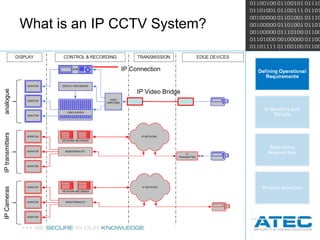
What is an IP CCTV System? analogue IP transmitters IP Cameras IP Video Bridge IP Connection
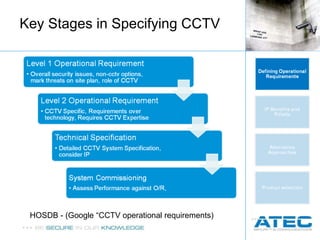
Key Stages in Specifying CCTV HOSDB - (Google “CCTV operational requirements)
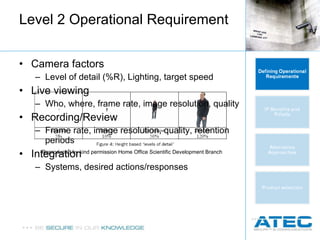
Level 2 Operational Requirement Camera factors Level of detail (%R), Lighting, target speed Live viewing Who, where, frame rate, image resolution, quality Recording/Review Frame rate, image resolution, quality, retention periods Integration Systems, desired actions/responses Reproduced by kind permission Home Office Scientific Development Branch
Design Considerations - Cameras Camera IP Cameras, Hybrid IP cameras or Analogue cameras with IP transmitters Encoder Frame rates Type of compression, performance WAN and recording streams No. of supported streams Latency (PTZ / voice comms) Environment, space, temperature TCP (error checking)/UDP (fire & forget) Multicast support
Design Considerations - Network Whose network ? Total bandwidth Available bandwidth Traffic cohabitation Prevent video hogging bandwidth Prevent other traffic causing video glitches Traffic prioritisation (QOS) Multicasting Network Security Secure network, secure CCTV overlay
Storage requirement Frame rate/resolution/compression = bandwidth Bandwidth (Kbps)/8 * retention period(s) = storage (KB) Compression MPEG4, H.264 benefits Recording Platform Redundancy (RAID, dual PSU, NIC) Resilience  Review Software Post event analytics (Google for CCTV) Design Considerations - Recording
A strong business case if…… Large Systems (>100 cameras) Mission Critical Multiple Monitoring and Review locations Wireless transmission Existing Network Regional (Telco Network) Integrated Systems
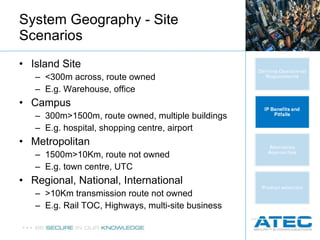
Island Site <300m across, route owned E.g. Warehouse, office Campus 300m>1500m, route owned, multiple buildings E.g. hospital, shopping centre, airport Metropolitan 1500m>10Km, route not owned E.g. town centre, UTC Regional, National, International >10Km transmission route not owned E.g. Rail TOC, Highways, multi-site business System Geography - Site Scenarios
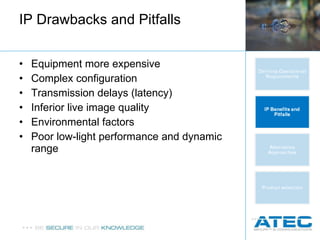
Equipment more expensive Complex configuration Transmission delays (latency) Inferior live image quality Environmental factors Poor low-light performance and dynamic range IP Drawbacks and Pitfalls
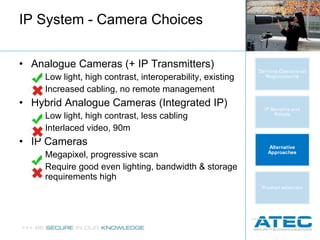
Analogue Cameras (+ IP Transmitters) Low light, high contrast, interoperability, existing Increased cabling, no remote management Hybrid Analogue Cameras (Integrated IP) Low light, high contrast, less cabling Interlaced video, 90m IP Cameras Megapixel, progressive scan Require good even lighting, bandwidth & storage requirements high IP System - Camera Choices
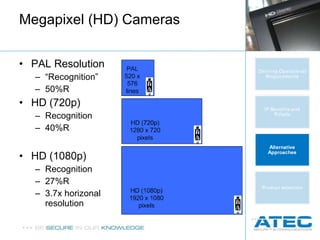
PAL Resolution “ Recognition” 50%R HD (720p) Recognition 40%R HD (1080p) Recognition 27%R 3.7x horizonal resolution Megapixel (HD) Cameras
Where to Start ? Manufacturer Will naturally push own product May not be the best for your application Generally don’t understand O/R Consultant Costly but Impartial Advice Few CCTV consultants have IP knowledge Integration partner Hands-on expertise in systems Should assist with O/R & technical spec. Advice not wholly impartial but free
Selecting equipment/Manufacturer Basic requirements Reliable equipment Useable intuitive software Financially stable Large installed base Desirable Features Efficient compression (quality/bandwidth) Bandwidth control Industry standard recording platform Evidence location tools Integration capability
Selecting an integrator partner Compliance NSI (NACOSS), BSIA Members/CoP Analogue CCTV Experience Informed choice, expertise still relevant Technology Competence Experience, Strategic Partnerships Understanding of Networks Bandwidth Control, Unicast/Multicast, TCP/UDP Managed/Unmanaged Infrastructure Successful IP CCTV Installations Ask for client references for similar projects
Operational Requirements should be the driver, not technology Get expert help with O/R and specification  (manufacturer, consultant, integrator) IP Business case Shared network, geography Technical Considerations Analogue or IP cameras Compression In a nutshell……………
Thank you for listening Simon Adcock – Managing Director ATEC Security Limited  Middlemore Lane Aldridge, Walsall West Midlands, WS9 8SP T : 01922 455 496 M: 07976 455521 F : 01922 743 186 E: simon.adcock@atec-security.co.uk W: www.atec-security.co.uk
HOSDB Operational Requirements manual 55-06 http://scienceandresearch.homeoffice.gov.uk/hosdb/publications/cctv-publications/ BSIA  www.bsia.co.uk  publications A guide for installation of cctv systems using IP technology (Form no: 235) A user guide to the use of Internet Protocol (IP) in the security industry (Form no: 211) An installer's guide to Internet Protocol (IP) in the security industry (Form no: 210) IP Benefits Guide (published soon) References and Further Reading

Matching the Right IP Solution to Your Business/Organisation Requirements

  • 1.
    By Simon Adcock,Managing Director, ATEC Security & Communications Matching the Right IP Solution to Your Business / Organisation Requirements Presented to : Next generation CCTV Conference 2008 4 th November 2008
  • 2.
    Agenda What isan IP system ? Knowing what you want from your system (IP Operational requirements) Deciding whether IP is for you (IP benefits, disadvantages and Pitfalls) Analysing alternative approaches to IP adoption Assessing what is on the market and making sense of what suppliers are offering
  • 3.
    What is anIP CCTV System? analogue IP transmitters IP Cameras IP Video Bridge IP Connection
  • 4.
    Key Stages inSpecifying CCTV HOSDB - (Google “CCTV operational requirements)
  • 5.
    Level 2 OperationalRequirement Camera factors Level of detail (%R), Lighting, target speed Live viewing Who, where, frame rate, image resolution, quality Recording/Review Frame rate, image resolution, quality, retention periods Integration Systems, desired actions/responses Reproduced by kind permission Home Office Scientific Development Branch
  • 6.
    Design Considerations -Cameras Camera IP Cameras, Hybrid IP cameras or Analogue cameras with IP transmitters Encoder Frame rates Type of compression, performance WAN and recording streams No. of supported streams Latency (PTZ / voice comms) Environment, space, temperature TCP (error checking)/UDP (fire & forget) Multicast support
  • 7.
    Design Considerations -Network Whose network ? Total bandwidth Available bandwidth Traffic cohabitation Prevent video hogging bandwidth Prevent other traffic causing video glitches Traffic prioritisation (QOS) Multicasting Network Security Secure network, secure CCTV overlay
  • 8.
    Storage requirement Framerate/resolution/compression = bandwidth Bandwidth (Kbps)/8 * retention period(s) = storage (KB) Compression MPEG4, H.264 benefits Recording Platform Redundancy (RAID, dual PSU, NIC) Resilience Review Software Post event analytics (Google for CCTV) Design Considerations - Recording
  • 9.
    A strong businesscase if…… Large Systems (>100 cameras) Mission Critical Multiple Monitoring and Review locations Wireless transmission Existing Network Regional (Telco Network) Integrated Systems
  • 10.
    Island Site <300macross, route owned E.g. Warehouse, office Campus 300m>1500m, route owned, multiple buildings E.g. hospital, shopping centre, airport Metropolitan 1500m>10Km, route not owned E.g. town centre, UTC Regional, National, International >10Km transmission route not owned E.g. Rail TOC, Highways, multi-site business System Geography - Site Scenarios
  • 11.
    Equipment more expensiveComplex configuration Transmission delays (latency) Inferior live image quality Environmental factors Poor low-light performance and dynamic range IP Drawbacks and Pitfalls
  • 12.
    Analogue Cameras (+IP Transmitters) Low light, high contrast, interoperability, existing Increased cabling, no remote management Hybrid Analogue Cameras (Integrated IP) Low light, high contrast, less cabling Interlaced video, 90m IP Cameras Megapixel, progressive scan Require good even lighting, bandwidth & storage requirements high IP System - Camera Choices
  • 13.
    PAL Resolution “Recognition” 50%R HD (720p) Recognition 40%R HD (1080p) Recognition 27%R 3.7x horizonal resolution Megapixel (HD) Cameras
  • 14.
    Where to Start? Manufacturer Will naturally push own product May not be the best for your application Generally don’t understand O/R Consultant Costly but Impartial Advice Few CCTV consultants have IP knowledge Integration partner Hands-on expertise in systems Should assist with O/R & technical spec. Advice not wholly impartial but free
  • 15.
    Selecting equipment/Manufacturer Basicrequirements Reliable equipment Useable intuitive software Financially stable Large installed base Desirable Features Efficient compression (quality/bandwidth) Bandwidth control Industry standard recording platform Evidence location tools Integration capability
  • 16.
    Selecting an integratorpartner Compliance NSI (NACOSS), BSIA Members/CoP Analogue CCTV Experience Informed choice, expertise still relevant Technology Competence Experience, Strategic Partnerships Understanding of Networks Bandwidth Control, Unicast/Multicast, TCP/UDP Managed/Unmanaged Infrastructure Successful IP CCTV Installations Ask for client references for similar projects
  • 17.
    Operational Requirements shouldbe the driver, not technology Get expert help with O/R and specification (manufacturer, consultant, integrator) IP Business case Shared network, geography Technical Considerations Analogue or IP cameras Compression In a nutshell……………
  • 18.
    Thank you forlistening Simon Adcock – Managing Director ATEC Security Limited Middlemore Lane Aldridge, Walsall West Midlands, WS9 8SP T : 01922 455 496 M: 07976 455521 F : 01922 743 186 E: simon.adcock@atec-security.co.uk W: www.atec-security.co.uk
  • 19.
    HOSDB Operational Requirementsmanual 55-06 http://scienceandresearch.homeoffice.gov.uk/hosdb/publications/cctv-publications/ BSIA www.bsia.co.uk publications A guide for installation of cctv systems using IP technology (Form no: 235) A user guide to the use of Internet Protocol (IP) in the security industry (Form no: 211) An installer's guide to Internet Protocol (IP) in the security industry (Form no: 210) IP Benefits Guide (published soon) References and Further Reading

Editor's Notes

  • #4 Transmission from Edge device to recording and review systems uses IP No analogue switching matrix DVR becomes NVR PCs used for display and review
  • #5 Reference from HOSDB Operational requirements manual System should be driven by requirements, not by technology. Documented Requirements need to be informed by what is possible O/R overview (from HOSDB) Deterrent Operational Alert Manage and Direct Operational response Evidence gathering ? Assist Police investigation Size of person within screen Positioning of camera Resolution of image Frame rate Who monitors
  • #6 Reference from HOSDB Operational requirements manual System should be driven by requirements, not by technology. Documented Requirements need to be informed by what is possible O/R overview (from HOSDB) Size of person within screen Positioning of camera Resolution of image Frame rate Who monitors
  • #7 Reference from HOSDB Operational requirements manual System should be driven by requirements, not by technology. Documented Requirements need to be informed by what is possible O/R overview (from HOSDB) Size of person within screen Positioning of camera Resolution of image Frame rate Who monitors
  • #8 Reference from HOSDB Operational requirements manual System should be driven by requirements, not by technology. Documented Requirements need to be informed by what is possible O/R overview (from HOSDB) Size of person within screen Positioning of camera Resolution of image Frame rate Who monitors
  • #9 Reference from HOSDB Operational requirements manual System should be driven by requirements, not by technology. Documented Requirements need to be informed by what is possible O/R overview (from HOSDB) Size of person within screen Positioning of camera Resolution of image Frame rate Who monitors
  • #10 Define IP. IP Benefits and Pitfalls. Reference from IP Benefits Guide.
  • #11 IP Benefits and Pitfalls. Reference from IP Benefits Guide.
  • #15 Success factors Reliability Image quality and frame rate Long term viability of manufacturer Integration with other systems
  • #16 Success factors Reliability Image quality and frame rate Long term viability of manufacturer Integration with other systems
  • #17 Success factors Reliability Image quality and frame rate Long term viability of manufacturer Integration with other systems
  • #20 For those of you that would like a copy of this presentation (and if that includes you, you need only to give your business card to one of my colleagues) I have listed some references.