Module PMR

CHAPTER 3 : LINEAR EQUATIONS

1.

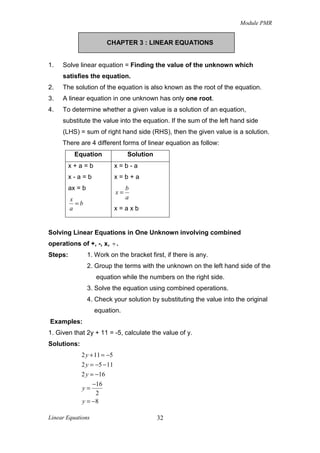
Solve linear equation = Finding the value of the unknown which
satisfies the equation.

2.

The solution of the equation is also known as the root of the equation.

3.

A linear equation in one unknown has only one root.

4.

To determine whether a given value is a solution of an equation,
substitute the value into the equation. If the sum of the left hand side
(LHS) = sum of right hand side (RHS), then the given value is a solution.
There are 4 different forms of linear equation as follow:
Equation

Solution

x+a=b

x=b-a

x-a=b

x=b+a

ax = b

x=

x
=b
a

b
a

x=axb

Solving Linear Equations in One Unknown involving combined
operations of +, -, x, ÷ .
Steps:

1. Work on the bracket first, if there is any.
2. Group the terms with the unknown on the left hand side of the
equation while the numbers on the right side.
3. Solve the equation using combined operations.
4. Check your solution by substituting the value into the original
equation.

Examples:
1. Given that 2y + 11 = -5, calculate the value of y.
Solutions:
2 y + 11 = −5
2 y = −5 − 11
2 y = −16
−16
y=
2
y = −8
Linear Equations

32
Module PMR

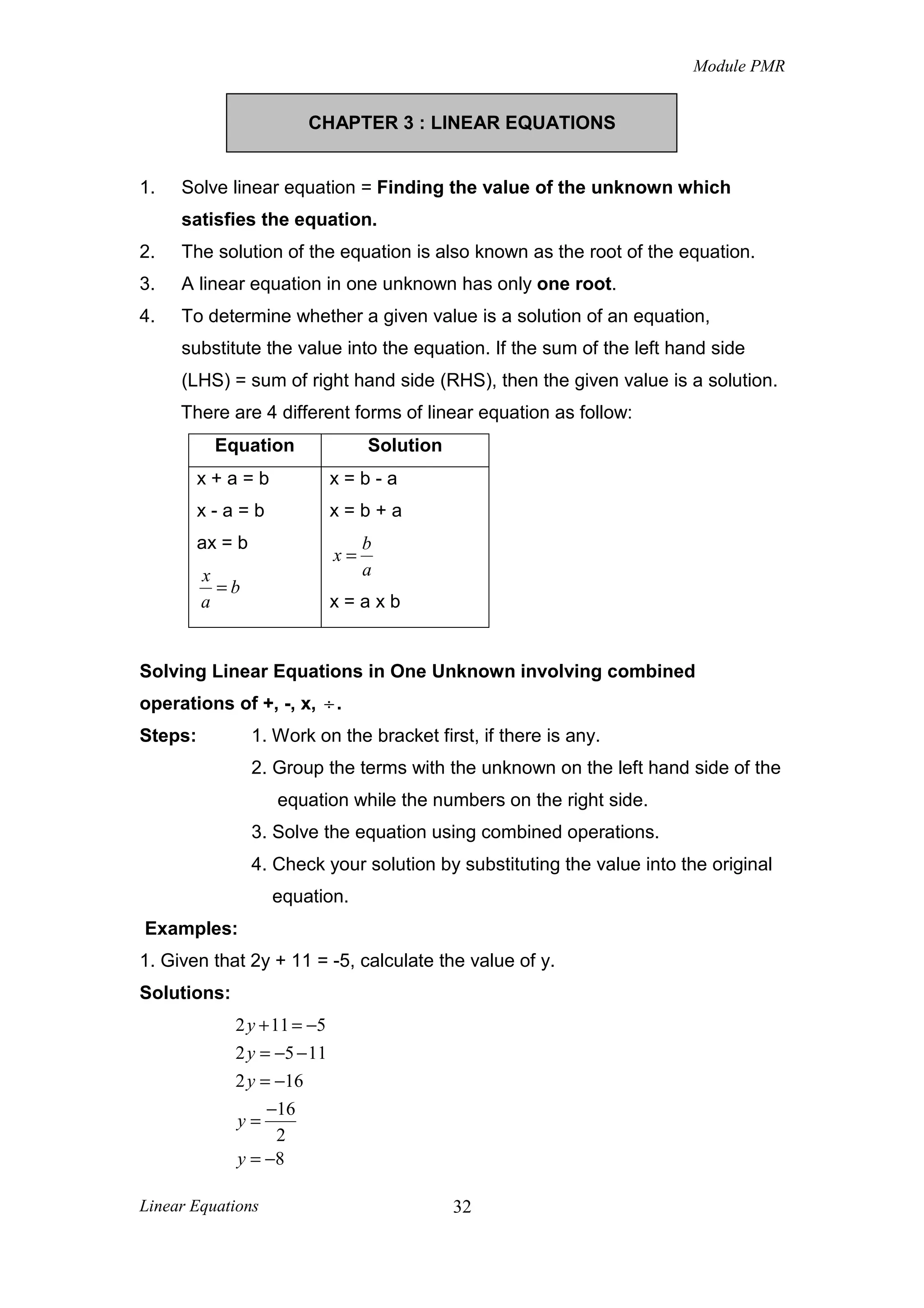
k +5
,find the value of k.
3

2. If k − 1 =

3. Find the value of q which
satisfies the equation
3(q − 4) = q + 2

Solution:

Solution:
k +5
3
3(k − 1) = k + 5

3(q − 4) = q + 2

3k − 3 = k + 5

3q − q = 2 + 12

3k − k = 5 + 3
2k = 8

2q = 14

k −1 =

3q − 12 = q + 2

14
2
q=7

q=

8
2
k =4
k=

4. If 7 - (x + 1) = -4x, then x = ?
Solution:
7 − ( x + 1) = −4 x
7 − x − 1 = −4 x
− x + 4 x = −7 + 1
3 x = −6
−6
3
x = −2

x=

Common Errors
No Errors

Correct Steps

m = −9

x+5 = 3
x = 3+5

x+5 = 3
x = 3−5

x=8

2.

m + 2 = −7
m = −7 − 2

m = −5

1.

m + 2 = −7
m = −7 + 2

x = −2

2y = 8

2y = 8

3.

8
2
y=4

y = 8× 2
y = 16

Linear Equations

y=

33
Module PMR

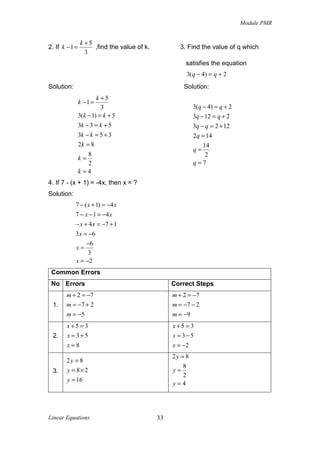
1
p =8
4
4.

p = 8×

1
p =8
4
p = 8× 4

1
4

p = 32

p=2

2x − 3 = 7

2x − 3 = 7
2x = 7 − 3

5.

2x = 7 + 3
2 x = 10
10
x=
2
x=5

2x = 4
x = 4× 2
x=8

Example
1.

Exercise

x + 5 = 11
x = 11 − 5

a) x + 2 = −10

x=6

b) x + 4 = 2

c) 4 + x = 7

d) 10 + x = −3

e) −6 = x + 3

f) −3 = 7 + x

Linear Equations

34
Module PMR

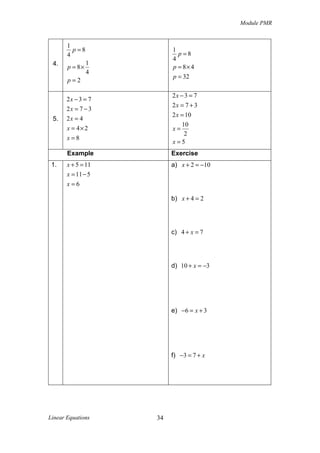
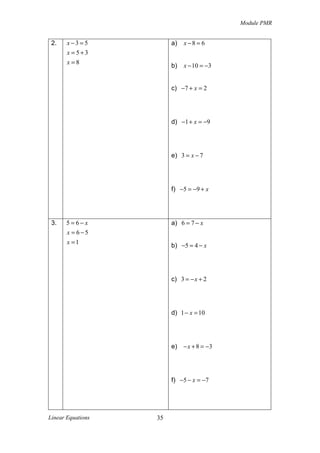
2.

x−3 = 5
x = 5+3

a)

b)

x=8

x −8 = 6
x − 10 = −3

c) −7 + x = 2

d) −1 + x = −9

e) 3 = x − 7

f) −5 = −9 + x

3.

5= 6− x
x = 6−5

a) 6 = 7 − x

x =1

b) −5 = 4 − x

c) 3 = − x + 2

d) 1 − x = 10

e) − x + 8 = −3

f) −5 − x = −7

Linear Equations

35
Module PMR

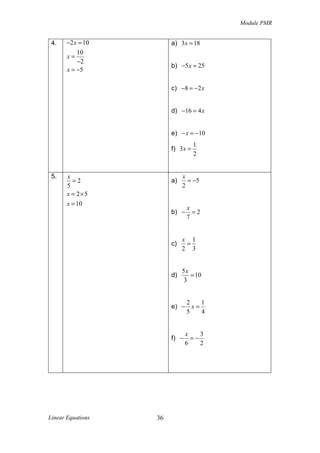
4.

−2 x = 10
10
x=
−2
x = −5

a) 3 x = 18
b) −5 x = 25
c) −8 = −2x
d) −16 = 4x
e) − x = −10
f) 3 x =

5.

x
=2
5
x = 2×5
x = 10

a)

1
2

x
= −5
2

b) −

x
=2
7

c)

x 1
=
2 3

d)

5x
= 10
3

2
1
e) − x =
5
4

f) −

Linear Equations

36

x
3
=−
6
2
Module PMR

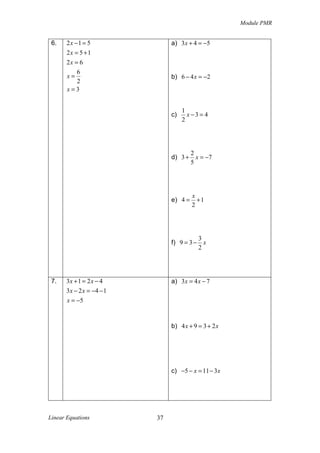
6.

2x −1 = 5

a) 3 x + 4 = −5

2x = 5 + 1
2x = 6
6
x=
2
x=3

b) 6 − 4 x = −2

c)

1
x −3 = 4
2

d) 3 +

2
x = −7
5

e) 4 =

x
+1
2

f) 9 = 3 −

7.

3x + 1 = 2 x − 4
3 x − 2 x = −4 − 1

3
x
2

a) 3 x = 4 x − 7

x = −5

b) 4 x + 9 = 3 + 2 x

c) −5 − x = 11 − 3 x

Linear Equations

37
Module PMR

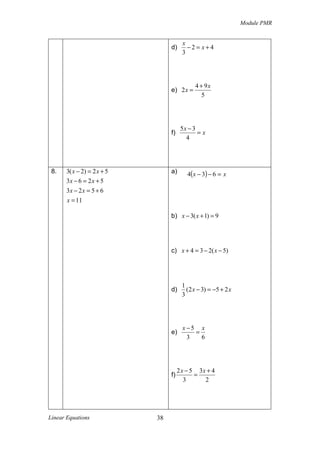
d)

x
−2= x+4
3

e) 2 x =

5x − 3
=x
4

f)

8.

3( x − 2) = 2 x + 5
3x − 6 = 2 x + 5

4 + 9x
5

a)

4( x − 3) − 6 = x

3x − 2 x = 5 + 6
x = 11

b) x − 3( x + 1) = 9

c) x + 4 = 3 − 2( x − 5)

d)

1
(2 x − 3) = −5 + 2 x
3

e)

x −5 x
=
3
6

f)

Linear Equations

38

2 x − 5 3x + 4
=
3
2
Module PMR

PMR past year questions
2004
1). Solve each of the following equations.
a) k = −14 − k
3
b) f + (6 − 4 f ) = −31
2

[3 marks]
2005
2). Solve each of the following equations.
a) 2n = 3n − 4
b) 2k =

3 − 7k
5

[3 marks]

2006
3). Solve each of the following equations.
a)

12
=3
n

b) 2(k − 1) = k + 3

[3 marks]
Linear Equations

39
Module PMR

2007
4). Solve each of the following equations.
a) x + 10 = 4
b)

5x − 4
=x
3

[3 marks]
2008
5). Solve each of the following equations.
a) p + 5 = −11
b) x − 1 =

x+3
2

[3 marks]

Linear Equations

40
Module PMR

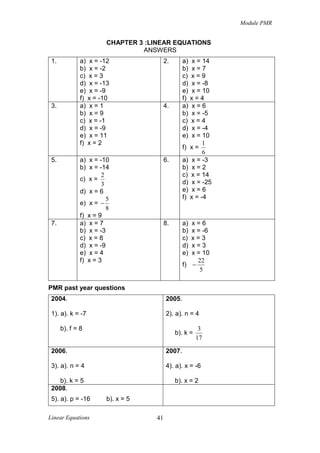
CHAPTER 3 :LINEAR EQUATIONS
ANSWERS
a) x = -12
b) x = -2
c) x = 3
d) x = -13
e) x = -9
f) x = -10
a) x = 1
b) x = 9
c) x = -1
d) x = -9
e) x = 11
f) x = 2

3.

5.

7.

2.

a) x = -10
b) x = -14
2
c) x =
3
d) x = 6
5
e) x = −
8
f) x = 9
a) x = 7
b) x = -3
c) x = 8
d) x = -9
e) x = 4
f) x = 3

1.

a) x = 14
b) x = 7
c) x = 9
d) x = -8
e) x = 10
f) x = 4
a) x = 6
b) x = -5
c) x = 4
d) x = -4
e) x = 10
1
f) x =
6
a) x = -3
b) x = 2
c) x = 14
d) x = -25
e) x = 6
f) x = -4

6.

4.

8.

a)
b)
c)
d)
e)

x=6
x = -6
x=3
x=3
x = 10
22
f) −
5

PMR past year questions
2004.

2005.

1). a). k = -7

2). a). n = 4

b). f = 8

b). k =

3
17

2006.

2007.

3). a). n = 4

4). a). x = -6

b). k = 5
2008.
5). a). p = -16
Linear Equations

b). x = 2
b). x = 5
41

Chapter 3 linear equations

  • 1.
    Module PMR CHAPTER 3: LINEAR EQUATIONS 1. Solve linear equation = Finding the value of the unknown which satisfies the equation. 2. The solution of the equation is also known as the root of the equation. 3. A linear equation in one unknown has only one root. 4. To determine whether a given value is a solution of an equation, substitute the value into the equation. If the sum of the left hand side (LHS) = sum of right hand side (RHS), then the given value is a solution. There are 4 different forms of linear equation as follow: Equation Solution x+a=b x=b-a x-a=b x=b+a ax = b x= x =b a b a x=axb Solving Linear Equations in One Unknown involving combined operations of +, -, x, ÷ . Steps: 1. Work on the bracket first, if there is any. 2. Group the terms with the unknown on the left hand side of the equation while the numbers on the right side. 3. Solve the equation using combined operations. 4. Check your solution by substituting the value into the original equation. Examples: 1. Given that 2y + 11 = -5, calculate the value of y. Solutions: 2 y + 11 = −5 2 y = −5 − 11 2 y = −16 −16 y= 2 y = −8 Linear Equations 32
  • 2.
    Module PMR k +5 ,findthe value of k. 3 2. If k − 1 = 3. Find the value of q which satisfies the equation 3(q − 4) = q + 2 Solution: Solution: k +5 3 3(k − 1) = k + 5 3(q − 4) = q + 2 3k − 3 = k + 5 3q − q = 2 + 12 3k − k = 5 + 3 2k = 8 2q = 14 k −1 = 3q − 12 = q + 2 14 2 q=7 q= 8 2 k =4 k= 4. If 7 - (x + 1) = -4x, then x = ? Solution: 7 − ( x + 1) = −4 x 7 − x − 1 = −4 x − x + 4 x = −7 + 1 3 x = −6 −6 3 x = −2 x= Common Errors No Errors Correct Steps m = −9 x+5 = 3 x = 3+5 x+5 = 3 x = 3−5 x=8 2. m + 2 = −7 m = −7 − 2 m = −5 1. m + 2 = −7 m = −7 + 2 x = −2 2y = 8 2y = 8 3. 8 2 y=4 y = 8× 2 y = 16 Linear Equations y= 33
  • 3.
    Module PMR 1 p =8 4 4. p= 8× 1 p =8 4 p = 8× 4 1 4 p = 32 p=2 2x − 3 = 7 2x − 3 = 7 2x = 7 − 3 5. 2x = 7 + 3 2 x = 10 10 x= 2 x=5 2x = 4 x = 4× 2 x=8 Example 1. Exercise x + 5 = 11 x = 11 − 5 a) x + 2 = −10 x=6 b) x + 4 = 2 c) 4 + x = 7 d) 10 + x = −3 e) −6 = x + 3 f) −3 = 7 + x Linear Equations 34
  • 4.
    Module PMR 2. x−3 =5 x = 5+3 a) b) x=8 x −8 = 6 x − 10 = −3 c) −7 + x = 2 d) −1 + x = −9 e) 3 = x − 7 f) −5 = −9 + x 3. 5= 6− x x = 6−5 a) 6 = 7 − x x =1 b) −5 = 4 − x c) 3 = − x + 2 d) 1 − x = 10 e) − x + 8 = −3 f) −5 − x = −7 Linear Equations 35
  • 5.
    Module PMR 4. −2 x= 10 10 x= −2 x = −5 a) 3 x = 18 b) −5 x = 25 c) −8 = −2x d) −16 = 4x e) − x = −10 f) 3 x = 5. x =2 5 x = 2×5 x = 10 a) 1 2 x = −5 2 b) − x =2 7 c) x 1 = 2 3 d) 5x = 10 3 2 1 e) − x = 5 4 f) − Linear Equations 36 x 3 =− 6 2
  • 6.
    Module PMR 6. 2x −1= 5 a) 3 x + 4 = −5 2x = 5 + 1 2x = 6 6 x= 2 x=3 b) 6 − 4 x = −2 c) 1 x −3 = 4 2 d) 3 + 2 x = −7 5 e) 4 = x +1 2 f) 9 = 3 − 7. 3x + 1 = 2 x − 4 3 x − 2 x = −4 − 1 3 x 2 a) 3 x = 4 x − 7 x = −5 b) 4 x + 9 = 3 + 2 x c) −5 − x = 11 − 3 x Linear Equations 37
  • 7.
    Module PMR d) x −2= x+4 3 e)2 x = 5x − 3 =x 4 f) 8. 3( x − 2) = 2 x + 5 3x − 6 = 2 x + 5 4 + 9x 5 a) 4( x − 3) − 6 = x 3x − 2 x = 5 + 6 x = 11 b) x − 3( x + 1) = 9 c) x + 4 = 3 − 2( x − 5) d) 1 (2 x − 3) = −5 + 2 x 3 e) x −5 x = 3 6 f) Linear Equations 38 2 x − 5 3x + 4 = 3 2
  • 8.
    Module PMR PMR pastyear questions 2004 1). Solve each of the following equations. a) k = −14 − k 3 b) f + (6 − 4 f ) = −31 2 [3 marks] 2005 2). Solve each of the following equations. a) 2n = 3n − 4 b) 2k = 3 − 7k 5 [3 marks] 2006 3). Solve each of the following equations. a) 12 =3 n b) 2(k − 1) = k + 3 [3 marks] Linear Equations 39
  • 9.
    Module PMR 2007 4). Solveeach of the following equations. a) x + 10 = 4 b) 5x − 4 =x 3 [3 marks] 2008 5). Solve each of the following equations. a) p + 5 = −11 b) x − 1 = x+3 2 [3 marks] Linear Equations 40
  • 10.
    Module PMR CHAPTER 3:LINEAR EQUATIONS ANSWERS a) x = -12 b) x = -2 c) x = 3 d) x = -13 e) x = -9 f) x = -10 a) x = 1 b) x = 9 c) x = -1 d) x = -9 e) x = 11 f) x = 2 3. 5. 7. 2. a) x = -10 b) x = -14 2 c) x = 3 d) x = 6 5 e) x = − 8 f) x = 9 a) x = 7 b) x = -3 c) x = 8 d) x = -9 e) x = 4 f) x = 3 1. a) x = 14 b) x = 7 c) x = 9 d) x = -8 e) x = 10 f) x = 4 a) x = 6 b) x = -5 c) x = 4 d) x = -4 e) x = 10 1 f) x = 6 a) x = -3 b) x = 2 c) x = 14 d) x = -25 e) x = 6 f) x = -4 6. 4. 8. a) b) c) d) e) x=6 x = -6 x=3 x=3 x = 10 22 f) − 5 PMR past year questions 2004. 2005. 1). a). k = -7 2). a). n = 4 b). f = 8 b). k = 3 17 2006. 2007. 3). a). n = 4 4). a). x = -6 b). k = 5 2008. 5). a). p = -16 Linear Equations b). x = 2 b). x = 5 41