Realist Theories
Lesson Objectives
• Look at how Realist theories differ from other
  explanations of crime
• Introduce Left and Right Realism
• Compare and Contrast LR and RR in terms of
  explanations and solutions to crime
• Evaluate Realist explanations
Last Lesson Recap
• What are Neo-Marxist principles based on?
• How do they further previous beliefs on
  crime?
• What is Voluntarism and how is it linked to
  crime?
• Explain a fully social theory of deviance?
Realist Theories
• Labelling theory and critical criminology regard crime
  as socially constructed
• Realists see crime as a real problem to be tackled, and
  not just a social construction created by the control
  agencies
• Argue there has been a significant rise in crime rate –
  especially street crime.
• Are concerned about the widespread fear of crime and
  impact of crime on its victims
• Other theories fail to offer realistic solutions to the
  problem of crime.
We can divide realist approaches along
           political lines…


Left Realists Right Realists
Right Realism
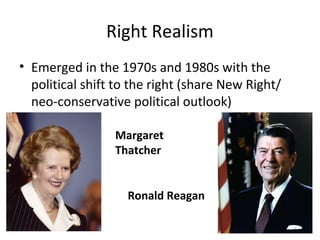
• Emerged in the 1970s and 1980s with the
  political shift to the right (share New Right/
  neo-conservative political outlook)

                 Margaret
                 Thatcher


                   Ronald Reagan
Right Realism
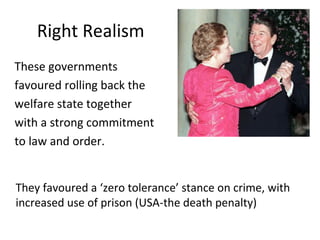
These governments
favoured rolling back the
welfare state together
with a strong commitment
to law and order.


They favoured a ‘zero tolerance’ stance on crime, with
increased use of prison (USA-the death penalty)
The causes of crime
• RRs reject the idea that structural and
  economic factors e.g. poverty and inequality
  cause crime (unlike which theorists?). They
  point out that the old tend to be poor yet
  have a very low crime rate.
• Crime is the product of 3 factors: biological
  differences, Socialisation and the underclass,
  and rational choice to offend
AO2:
                                         Lily et al (2002) found
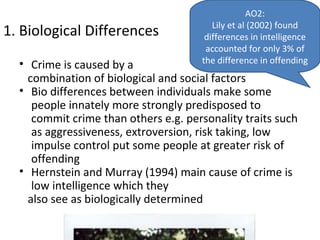
1. Biological Differences              differences in intelligence
                                       accounted for only 3% of
  • Crime is caused by a              the difference in offending
    combination of biological and social factors
  • Bio differences between individuals make some
     people innately more strongly predisposed to
     commit crime than others e.g. personality traits such
     as aggressiveness, extroversion, risk taking, low
     impulse control put some people at greater risk of
     offending
  • Hernstein and Murray (1994) main cause of crime is
     low intelligence which they
    also see as biologically determined
2. Socialisation and the Underclass
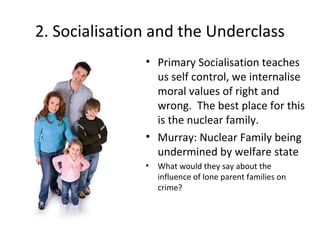
               • Primary Socialisation teaches
                 us self control, we internalise
                 moral values of right and
                 wrong. The best place for this
                 is the nuclear family.
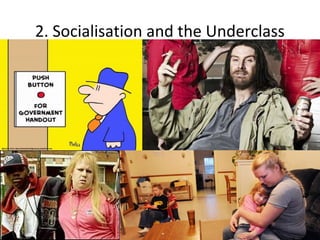
               • Murray: Nuclear Family being
                 undermined by welfare state
               •   What would they say about the
                   influence of lone parent families on
                   crime?
2. Socialisation and the Underclass
3. Rational Choice Theory (Clark, 1980)
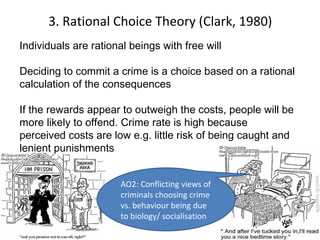
Individuals are rational beings with free will

Deciding to commit a crime is a choice based on a rational
calculation of the consequences

If the rewards appear to outweigh the costs, people will be
more likely to offend. Crime rate is high because
perceived costs are low e.g. little risk of being caught and
lenient punishments


                       AO2: Conflicting views of
                       criminals choosing crime
                       vs. behaviour being due
                       to biology/ socialisation
• A similar idea to Rational Choice Theory is
  Felson’s routine activity theory. This states
  that for crime to occur there must be:

1.A motivated offender, a suitable target (victim
  or property) and the absence of a ‘capable
  guardian’ (e.g. policeman/neighbour)
2.Offenders are assumed to act rationally, so
  the presence of a guardian is likely to deter
  them (informal guardians more effective)
Which factor do you find most
           logical?


       Which can you apply to:
             1.The London Riots
    2.A young man robbing a Securicor van
                3.Raoul Moat
So what methods do Right
   Realists advocate in
     tackling crime?


        Summarise Page 94
Criticisms
• Ignores wider structural causes such as
  poverty
• Overstates offenders rationality and how far
  they make cost-benefit calculations- may
  explain utilitarian crime but not violent crime
• Overemphasises biological factors
• Preoccupied with petty street crime and ignores
  corporate crime (more costly and harmful to
  public)
• Advocating a zero tolerance policy gives police
  free reign to discriminate against ethnic minority
  youth/homeless et. Crime becomes displaced in
  other areas
• Over emphasises control of disorder, rather than
  tackling underlying causes of neighbourhood
  decline e.g. lack of investment
RR

1. realist theories

  • 1.
  • 2.
    Lesson Objectives • Lookat how Realist theories differ from other explanations of crime • Introduce Left and Right Realism • Compare and Contrast LR and RR in terms of explanations and solutions to crime • Evaluate Realist explanations
  • 3.
    Last Lesson Recap •What are Neo-Marxist principles based on? • How do they further previous beliefs on crime? • What is Voluntarism and how is it linked to crime? • Explain a fully social theory of deviance?
  • 4.
    Realist Theories • Labellingtheory and critical criminology regard crime as socially constructed • Realists see crime as a real problem to be tackled, and not just a social construction created by the control agencies • Argue there has been a significant rise in crime rate – especially street crime. • Are concerned about the widespread fear of crime and impact of crime on its victims • Other theories fail to offer realistic solutions to the problem of crime.
  • 5.
    We can dividerealist approaches along political lines… Left Realists Right Realists
  • 6.
    Right Realism • Emergedin the 1970s and 1980s with the political shift to the right (share New Right/ neo-conservative political outlook) Margaret Thatcher Ronald Reagan
  • 7.
    Right Realism These governments favouredrolling back the welfare state together with a strong commitment to law and order. They favoured a ‘zero tolerance’ stance on crime, with increased use of prison (USA-the death penalty)
  • 8.
    The causes ofcrime • RRs reject the idea that structural and economic factors e.g. poverty and inequality cause crime (unlike which theorists?). They point out that the old tend to be poor yet have a very low crime rate. • Crime is the product of 3 factors: biological differences, Socialisation and the underclass, and rational choice to offend
  • 9.
    AO2: Lily et al (2002) found 1. Biological Differences differences in intelligence accounted for only 3% of • Crime is caused by a the difference in offending combination of biological and social factors • Bio differences between individuals make some people innately more strongly predisposed to commit crime than others e.g. personality traits such as aggressiveness, extroversion, risk taking, low impulse control put some people at greater risk of offending • Hernstein and Murray (1994) main cause of crime is low intelligence which they also see as biologically determined
  • 10.
    2. Socialisation andthe Underclass • Primary Socialisation teaches us self control, we internalise moral values of right and wrong. The best place for this is the nuclear family. • Murray: Nuclear Family being undermined by welfare state • What would they say about the influence of lone parent families on crime?
  • 11.
    2. Socialisation andthe Underclass
  • 12.
    3. Rational ChoiceTheory (Clark, 1980) Individuals are rational beings with free will Deciding to commit a crime is a choice based on a rational calculation of the consequences If the rewards appear to outweigh the costs, people will be more likely to offend. Crime rate is high because perceived costs are low e.g. little risk of being caught and lenient punishments AO2: Conflicting views of criminals choosing crime vs. behaviour being due to biology/ socialisation
  • 13.
    • A similaridea to Rational Choice Theory is Felson’s routine activity theory. This states that for crime to occur there must be: 1.A motivated offender, a suitable target (victim or property) and the absence of a ‘capable guardian’ (e.g. policeman/neighbour) 2.Offenders are assumed to act rationally, so the presence of a guardian is likely to deter them (informal guardians more effective)
  • 14.
    Which factor doyou find most logical? Which can you apply to: 1.The London Riots 2.A young man robbing a Securicor van 3.Raoul Moat
  • 15.
    So what methodsdo Right Realists advocate in tackling crime? Summarise Page 94
  • 16.
    Criticisms • Ignores widerstructural causes such as poverty • Overstates offenders rationality and how far they make cost-benefit calculations- may explain utilitarian crime but not violent crime • Overemphasises biological factors
  • 17.
    • Preoccupied withpetty street crime and ignores corporate crime (more costly and harmful to public) • Advocating a zero tolerance policy gives police free reign to discriminate against ethnic minority youth/homeless et. Crime becomes displaced in other areas • Over emphasises control of disorder, rather than tackling underlying causes of neighbourhood decline e.g. lack of investment
  • 18.

Editor's Notes

  • #2 http://www.youtube.com/watch?v=Xdyth8P3Fu4 RIGHT REALISM http://www.youtube.com/watch?v=r85FMhHWtNk&feature=related RR and LR
  • #5 Right realists regard theories such as labelling and critical criminology as too sympathetic to the criminal and too hostile to the forces of law and order. Right realists are less concerned to understand the causes of crime and more concerned to provide what they see as realistic solutions. However, although their main emphasis is on practical crime reduction strategies, they do in fact offer an explanation of the causes of crime. Critical Criminology is a theoretical perspective in criminology which sees crime as a product of oppression.
  • #6 http://www.podology.org.uk/#/crime-and-deviance/4538947634 CLIPS 2 AND 3 REALISM
  • #8 Concerned with practical solutions to reduce crime. In their views the best way to do is through crime and punishment, rather than rehabilitating offenders or tackling causes such as poverty
  • #9 Marxists
  • #12 A welfare state is creating welfare dependency and encouraging the growth of an underclass who fail to socialise their children properly Welfare provision has led to the growth of benefit dependent lone parent families, since men no longer need to take responsibility for supporting their families. Absent fathers mean boys lack discipline and an appropriate role model, so they turn to delinquent role models in street gangs and gain status through crime rather than supporting their families
  • #14 Informal Guardians- local community groups