IME
CR

&
EV
D

CE
AN
I
Interactionists
• Interactionists are interested in how people
interpret and socially construct the world
around them.
• They are interested in how criminality
develops in the social interactions between a
potential deviant and the agents of social
control.
Howard Becker (1973)
• Text: “Outsiders: Studies in the Sociology of
Deviance”
“...social groups create deviance by making the
rules whose infraction constitutes deviance,
and by applying those rules to particular
people and labelling them as outsiders – the
deviant is one to whom that label has been
successfully applied” pg. 9
Symbolic Interactionism / Labelling
Theory
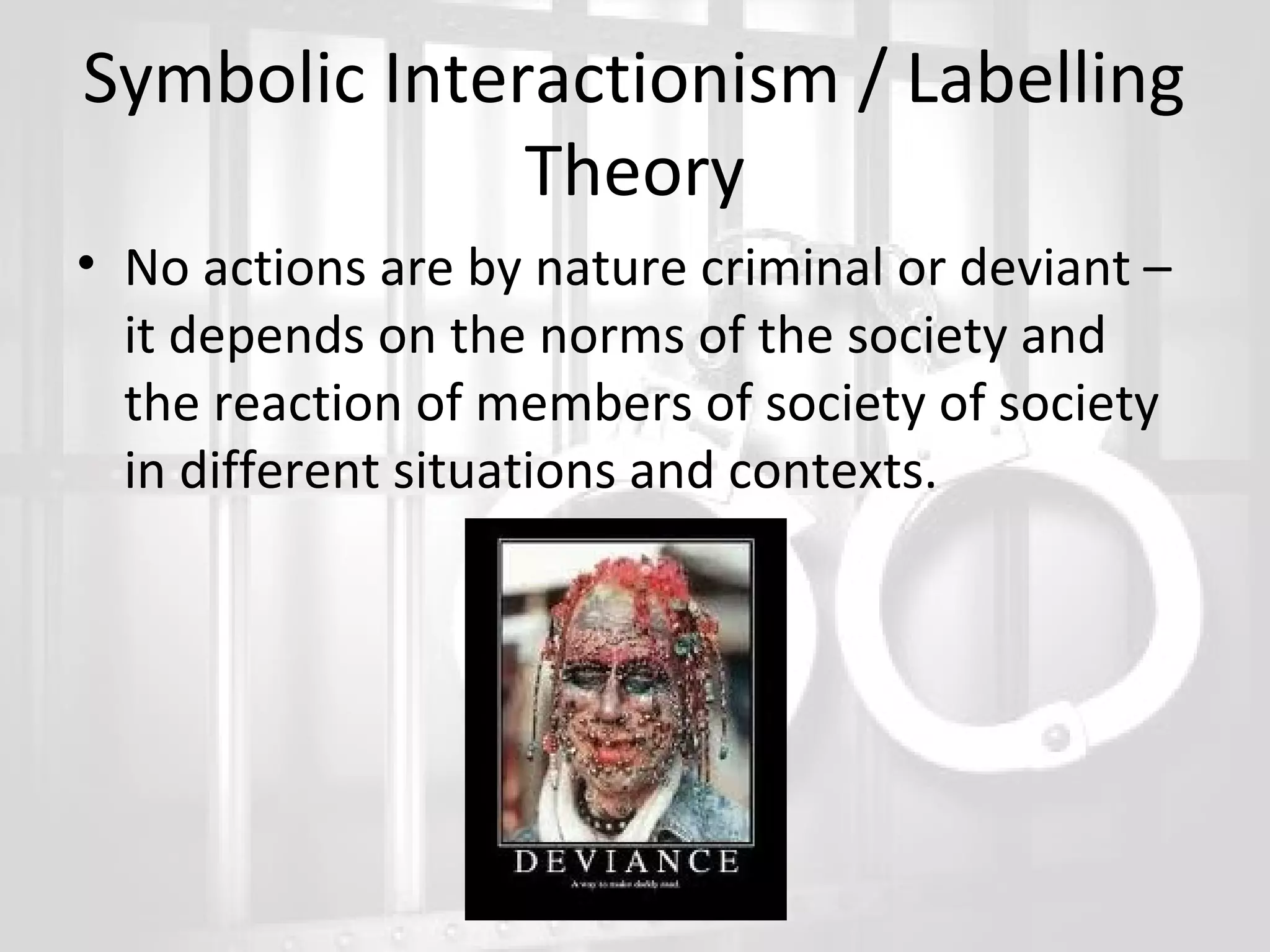
• No actions are by nature criminal or deviant –
it depends on the norms of the society and
the reaction of members of society of society
in different situations and contexts.
Deviance
• For example, consider the situations where
swearing at the top of your voice would and
wouldn’t be considered deviant:
– In the pub with your friends
– On the bus
– At home alone
– In class
– In the supermarket
– At a football match
Relativity
• Therefore ‘normality’ and ‘deviance’ is
relative
• It changes according to cultural context and
historical period
• Deviance is therefore a matter of
interpretation
• Provide some examples what is considered
deviance changing according to context and
period
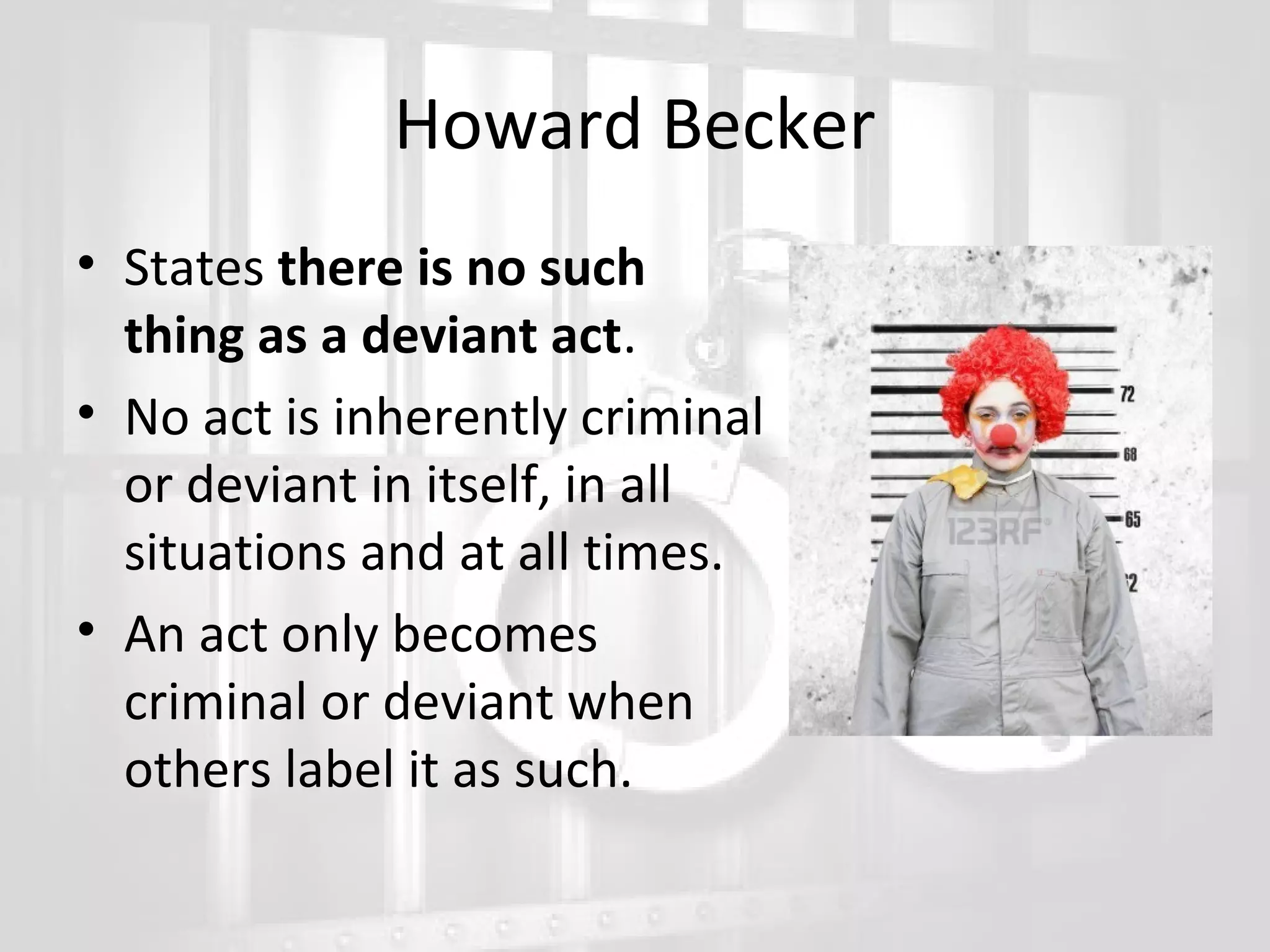
Howard Becker
• States there is no such
thing as a deviant act.
• No act is inherently criminal
or deviant in itself, in all
situations and at all times.
• An act only becomes
criminal or deviant when
others label it as such.
Labelling and Power
• The social construction of deviance requires
two activities:
1. One group which normally lacks power, behaves
in a particular way.
2. Another group with more power, responds
negatively to it and labels it as criminal.

• Becker claims a powerful groups create rules
or laws to define what counts as deviance and
labels those who fail to conform as criminals
or outlaws (outsiders)
Agents of Social Control
• Agents of social control are made up of group
such as the police, the judiciary, social
workers and probation workers.
• They work on behalf of the powerful groups to
label and define behaviour of less powerful.
• The behaviour of less powerful is subject to
greater surveillance and control by these
social agencies.
Edwin Lemert
• Distinguished between primary and
secondary deviance
• Primary deviance is insignificant deviant acts
that have not been publicly labelled.
• Secondary deviance is the result of societal
reaction – of labelling.
• Secondary deviance leads to stigmatization
where people are shunned and excluded from
normal society.
Secondary Deviance
• Lemert asserts that the criminal label can
become a master status where society
interprets all actions and motives within the
context of the label.
• Secondary deviance leads to prejudice,
discrimination and produce a self-fulfilling
prophecy and the labelled person may seek
refuge with other people branded with a
similar label.
• Think of the consequences for sex offenders
and ex-cons.
Video Clip to summarise

• https://www.youtube.com/watch?v=r-UBjL1zlgM
(Better)
• https://www.youtube.com/watch?v=830FBsmpTjg
(Good)
Evaluation
• Labelling theory shows us that defining
deviance is a complex process
• Definitions are relative and not fixed,
universal or unchangeable
• Labelling theory was the first to draw
attention to the consequences of being
labelled deviant
Criticisms
• Peter Ackers argues that the deviant act is
more important than the societal reaction to
it. Deviants don’t need a label to know they
are doing wrong.
• Labelling does not explain the origin of
deviance.
• Left Realists argue that it is wrong to blame
the agencies of social control for crime and
that labelling theory ignores the victims of
crime.

Crime and Deviance - Interactionist Approach

  • 1.
  • 2.
    Interactionists • Interactionists areinterested in how people interpret and socially construct the world around them. • They are interested in how criminality develops in the social interactions between a potential deviant and the agents of social control.
  • 3.
    Howard Becker (1973) •Text: “Outsiders: Studies in the Sociology of Deviance” “...social groups create deviance by making the rules whose infraction constitutes deviance, and by applying those rules to particular people and labelling them as outsiders – the deviant is one to whom that label has been successfully applied” pg. 9
  • 4.
    Symbolic Interactionism /Labelling Theory • No actions are by nature criminal or deviant – it depends on the norms of the society and the reaction of members of society of society in different situations and contexts.
  • 5.
    Deviance • For example,consider the situations where swearing at the top of your voice would and wouldn’t be considered deviant: – In the pub with your friends – On the bus – At home alone – In class – In the supermarket – At a football match
  • 6.
    Relativity • Therefore ‘normality’and ‘deviance’ is relative • It changes according to cultural context and historical period • Deviance is therefore a matter of interpretation • Provide some examples what is considered deviance changing according to context and period
  • 7.
    Howard Becker • Statesthere is no such thing as a deviant act. • No act is inherently criminal or deviant in itself, in all situations and at all times. • An act only becomes criminal or deviant when others label it as such.
  • 8.
    Labelling and Power •The social construction of deviance requires two activities: 1. One group which normally lacks power, behaves in a particular way. 2. Another group with more power, responds negatively to it and labels it as criminal. • Becker claims a powerful groups create rules or laws to define what counts as deviance and labels those who fail to conform as criminals or outlaws (outsiders)
  • 9.
    Agents of SocialControl • Agents of social control are made up of group such as the police, the judiciary, social workers and probation workers. • They work on behalf of the powerful groups to label and define behaviour of less powerful. • The behaviour of less powerful is subject to greater surveillance and control by these social agencies.
  • 10.
    Edwin Lemert • Distinguishedbetween primary and secondary deviance • Primary deviance is insignificant deviant acts that have not been publicly labelled. • Secondary deviance is the result of societal reaction – of labelling. • Secondary deviance leads to stigmatization where people are shunned and excluded from normal society.
  • 11.
    Secondary Deviance • Lemertasserts that the criminal label can become a master status where society interprets all actions and motives within the context of the label. • Secondary deviance leads to prejudice, discrimination and produce a self-fulfilling prophecy and the labelled person may seek refuge with other people branded with a similar label. • Think of the consequences for sex offenders and ex-cons.
  • 12.
    Video Clip tosummarise • https://www.youtube.com/watch?v=r-UBjL1zlgM (Better) • https://www.youtube.com/watch?v=830FBsmpTjg (Good)
  • 13.
    Evaluation • Labelling theoryshows us that defining deviance is a complex process • Definitions are relative and not fixed, universal or unchangeable • Labelling theory was the first to draw attention to the consequences of being labelled deviant
  • 14.
    Criticisms • Peter Ackersargues that the deviant act is more important than the societal reaction to it. Deviants don’t need a label to know they are doing wrong. • Labelling does not explain the origin of deviance. • Left Realists argue that it is wrong to blame the agencies of social control for crime and that labelling theory ignores the victims of crime.