Criminology and Crime Notes:A brief overviewCriminology
What is Criminology?I.  CriminologyA. The scientific approach to studying criminal behavior.  An interdisciplinary science that seeks to explain the causes, extent, and nature of crime in society.
   1. Individual and societal causes of    crime (sociological and psychological)    2. Incidence and forms of crime     (statistics)    3. The definition of crime in terms of         law (legal)    4. Reaction toward law breaking     (punishment and rehabilitation) 
What is Criminology?B. Closely related to the field of        criminal justice, which is the study        of agencies of social control that        handle criminal offenders.
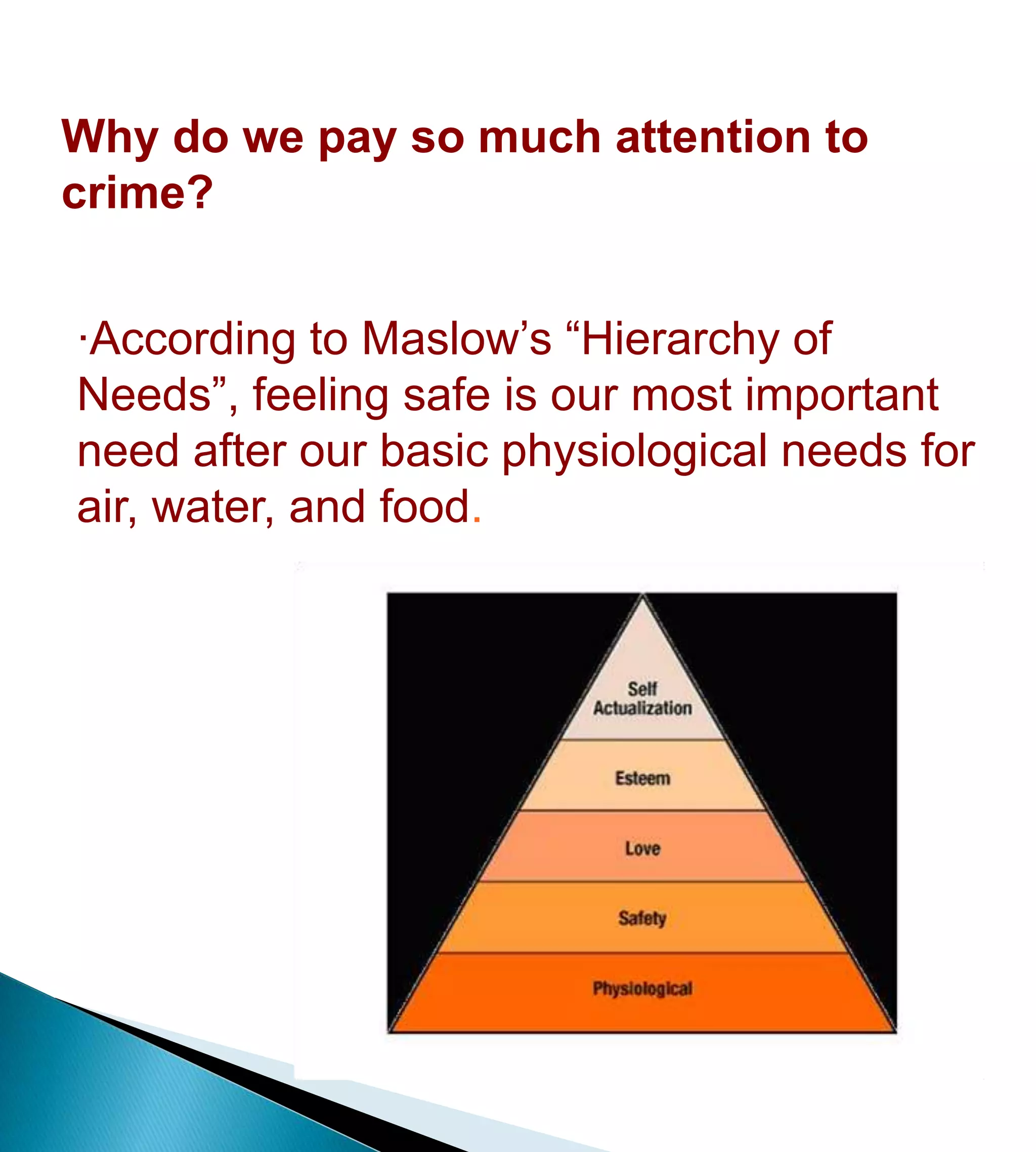
Why is crime so riveting?Why do we pay so much attention to crime?·According to Maslow’s “Hierarchy of Needs”, feeling safe is our most important need after our basic physiological needs for air, water, and food.
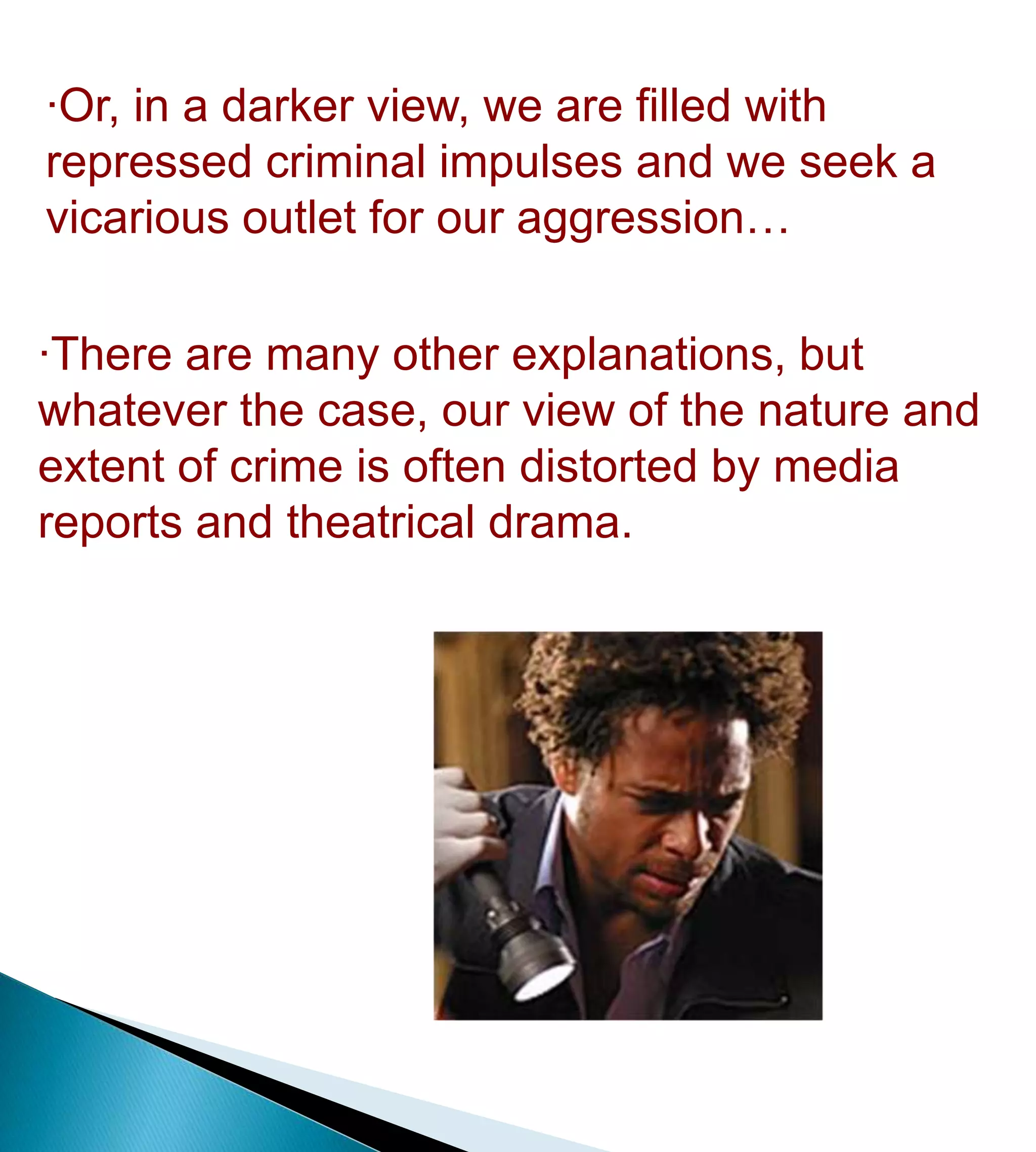
Why is crime so riveting?·Or, in a darker view, we are filled with    repressed criminal impulses and we seek a  vicarious outlet for our aggression…·There are many other explanations, but whatever the case, our view of the nature and extent of crime is often distorted by news reports, TV, and movies. It is everywhere in the media, and we can’t get enough!http://www.newsweek.com/2009/07/31/true-crime.html
How is crime portrayed in the media (TV/movies/news)?Criminals?Victims?Criminal justice system?
II.  CrimeA.  Definition: A wrong against society proclaimed by law and, if committed under certain circumstances, punishable by society.Remember:As society changes, what is defined as a crime changes.B.  Two Models of Crime1.  Consensus Model--People agree on            basic norms and values.  Those who break        them must be sanctioned. Laws set 	boundaries for acceptable behavior within         the society.
2. Conflict Model—There are different value systems and norms between groups. The most powerful group imposes its definition of crime on the rest, and the justice system primarily serves them and reinforces their power.
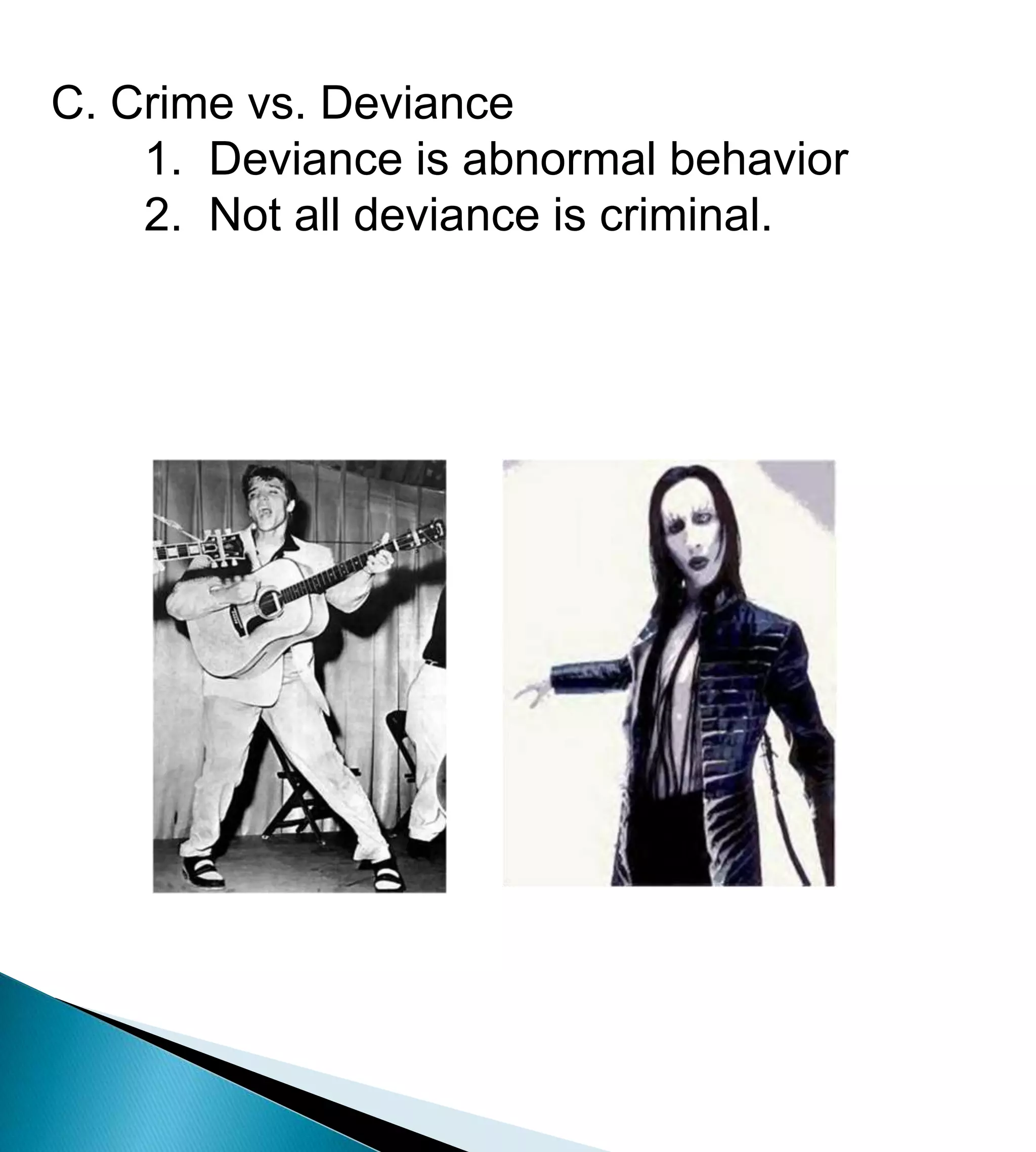
C. Crime vs. Deviance	1.  Deviance is abnormal behavior	2.  Not all deviance is criminal.
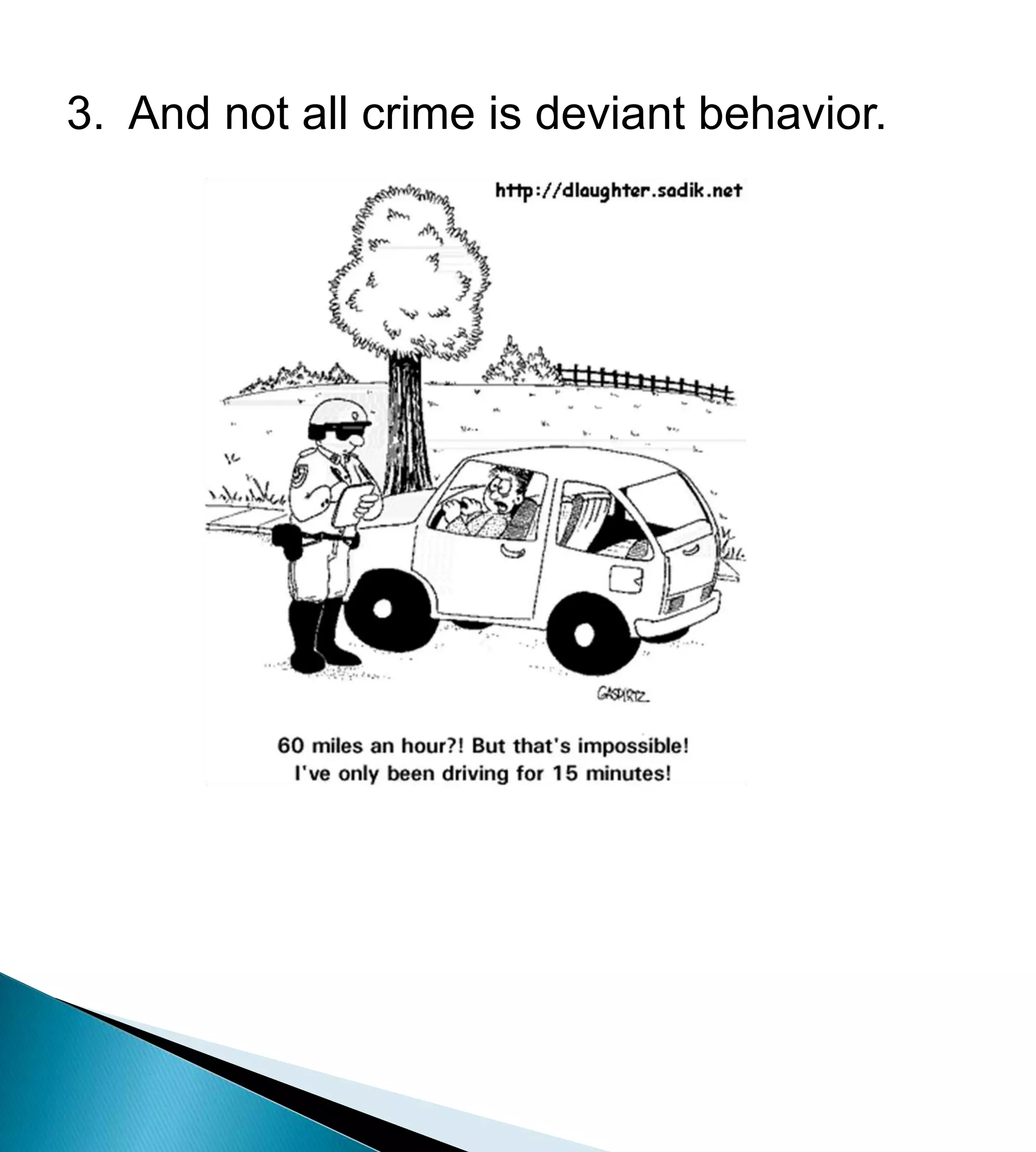
3.  And not all crime is deviant behavior.
D.  Types of Crime	1.  Violent Crime--crimes against persons	2.  Property Crime	3.  Public Order Crime--contrary to moral              values	4.  White Collar Crime--Business related	5.  Organized Crime--illegal acts by illegal              organizations	6.  High Tech CrimeWhat types of crimes are these?EmbezzlementGrand Theft AutoMurderProstitutionCredit Card FraudAssaultVandalismBank RobberyBriberyIllegal Gambling Operations (Bookmaking)ArsonPublic Drunkenness
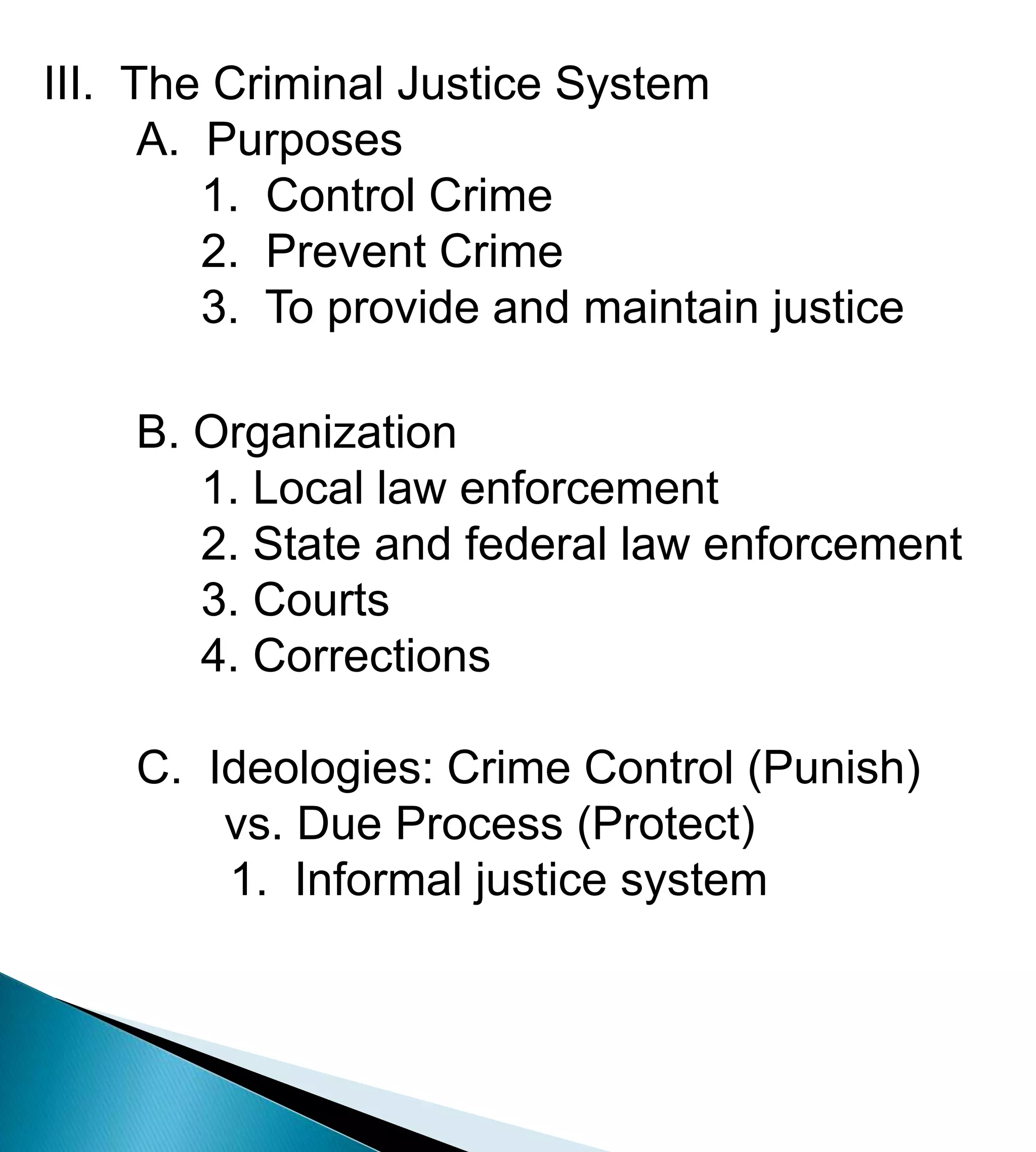
III.  The Criminal Justice System	A.  Purposes	     1.  Control Crime	     2.  Prevent Crime	     3.  To provide and maintain justice	B. Organization	     1. Local law enforcement 	     2. State and federal law enforcement  	     3. Courts  	     4. CorrectionsC.  Ideologies: Crime Control (Punish)                vs. Due Process (Protect)		1.  Informal justice system

Criminology and crime notes

  • 1.
    Criminology and CrimeNotes:A brief overviewCriminology
  • 2.
    What is Criminology?I. CriminologyA. The scientific approach to studying criminal behavior. An interdisciplinary science that seeks to explain the causes, extent, and nature of crime in society.
  • 3.
    1. Individual and societal causes of crime (sociological and psychological) 2. Incidence and forms of crime (statistics) 3. The definition of crime in terms of law (legal) 4. Reaction toward law breaking (punishment and rehabilitation) 
  • 4.
    What is Criminology?B.Closely related to the field of criminal justice, which is the study of agencies of social control that handle criminal offenders.
  • 5.
    Why is crimeso riveting?Why do we pay so much attention to crime?·According to Maslow’s “Hierarchy of Needs”, feeling safe is our most important need after our basic physiological needs for air, water, and food.
  • 6.
    Why is crimeso riveting?·Or, in a darker view, we are filled with repressed criminal impulses and we seek a vicarious outlet for our aggression…·There are many other explanations, but whatever the case, our view of the nature and extent of crime is often distorted by news reports, TV, and movies. It is everywhere in the media, and we can’t get enough!http://www.newsweek.com/2009/07/31/true-crime.html
  • 7.
    How is crimeportrayed in the media (TV/movies/news)?Criminals?Victims?Criminal justice system?
  • 8.
    II. CrimeA. Definition: A wrong against society proclaimed by law and, if committed under certain circumstances, punishable by society.Remember:As society changes, what is defined as a crime changes.B. Two Models of Crime1. Consensus Model--People agree on basic norms and values. Those who break them must be sanctioned. Laws set boundaries for acceptable behavior within the society.
  • 9.
    2. Conflict Model—Thereare different value systems and norms between groups. The most powerful group imposes its definition of crime on the rest, and the justice system primarily serves them and reinforces their power.
  • 10.
    C. Crime vs.Deviance 1. Deviance is abnormal behavior 2. Not all deviance is criminal.
  • 11.
    3. Andnot all crime is deviant behavior.
  • 12.
    D. Typesof Crime 1. Violent Crime--crimes against persons 2. Property Crime 3. Public Order Crime--contrary to moral values 4. White Collar Crime--Business related 5. Organized Crime--illegal acts by illegal organizations 6. High Tech CrimeWhat types of crimes are these?EmbezzlementGrand Theft AutoMurderProstitutionCredit Card FraudAssaultVandalismBank RobberyBriberyIllegal Gambling Operations (Bookmaking)ArsonPublic Drunkenness
  • 13.
    III. TheCriminal Justice System A. Purposes 1. Control Crime 2. Prevent Crime 3. To provide and maintain justice B. Organization 1. Local law enforcement 2. State and federal law enforcement 3. Courts 4. CorrectionsC. Ideologies: Crime Control (Punish) vs. Due Process (Protect) 1. Informal justice system