CRIMINOLOGY
AN INTRODUCTION AND OVERVIEW
Jojo P. Bautista, MS Crim.
WHAT IS CRIMINOLOGY?
Etymological Definition
CRIMINOLOGY - (from Latin crîmen, “accusation”, and Greek – logia,
“study”) – is the scientific study of crime, criminals, and criminal behavior.
The term was coined in 1885 by Italian law professor RAFFAELE
GAROFALO as criminologia.
WHAT IS CRIMINOLOGY?
Criminology (broadest sense) – is the body of knowledge regarding crimes,
criminals, and the effort of society to prevent and repress them.
Criminology (narrower sense) – is the scientific study of crimes and
criminal behavior.
WHAT IS CRIMINOLOGY?
Criminologists scientifically study the following:
1. The nature and extent of crime.
2. Patterns of criminality.
3. Explanations and causes of crime and criminal behavior.
4. Control of crime and criminal behavior.
WHAT IS CRIMINOLOGY?
Classic Definition
According to Edwin Sutherland and Donald Cressey:
Criminology is a body of knowledge regarding crime as a social
phenomenon. It includes within its scope the processes of making laws, of
breaking of laws, and of reaction toward the breaking of laws.
Making of laws
Law is passed because of the consensus of the will of the public. In
the Philippines, we have bicameral system of legislation. It is called
bicameral because it is composed of two houses; the Senate and the
House of Representatives. We have three major divisions or branches in
the government; the executive, vested on the office of the president, the
legislative, cited and explained above; and the judiciary, vested on the
Supreme Court. We are being represented by the legislative branch in
making laws.
Early laws worldwide setting:
1. Code of Hammurabi – Babylon (1700 B.C)
2. Mosaic Code – Israelites (1200 B.C)
3. Draconian Code – Greece (17th century)
4. Hindu Code of Manu – India
5. Koran – Islamic Society
6. Law of Twelve Tables – Romans (451-450 B.C)
7. Law of Moses (1500B.C-1900 B.C)
Early laws in the Philippines:
1. Maragtas Code (1215) –
- the oldest law of Panay Island
2. Kalantiaw Code (1433) –
- 2nd code of criminal justice
Breaking of laws
All violations of laws are violations of the will of the majority in the society.
Violation of the provisions of the criminal laws created by the public thru
representation is called CRIME.
CRIME – is an act or omission in violation of criminal law.
Act is outward movement tending to produce effect.
Reaction of the society towards the breaking of
laws:
Society either reacts positively or negatively when someone commits
crime.
However, seldom has the society reacted positively; it reacts negatively by
imposing punishments on the law-breaker.
Phenomenon – observable; something which can be observed; any fact,
circumstances., or experiences which can be explained scientifically.
Objectives of criminology:
The development of a body of general and verified principles and of other
types of knowledge regarding this process of law, crime, and its control
and prevention, and the treatment of youthful offenders.
THREE (3) Principal divisions of criminology:
1. Criminal etiology –it is an attempt at scientific analysis of the causes of
the crime.
2. Sociology of law – which is an attempt at scientific analysis of the
conditions which penal/criminal laws has developed as a process of
formal and social control.
3. Penology – which is concerned with the control and prevention of crime
and the treatment of offenders.
PURPOSE OF CRIMINOLOGY:
The purpose of criminology is to offer well-researched and objective
answers to four basic questions:
1. Why do crime rates vary?
2. Why do individuals differ as to criminality?
3. Why is there variation in reactions to crime?
4. What are the possible means of controlling criminality?
Goals of studying criminology:
1. To describe criminal behavior
2. To understand criminal behavior
3. To predict criminal behavior
4. To control criminal behavior
Various studies and sciences related to criminology:
1. Law
2. Sociology
3. Psychology
4. Medicine
5. Chemistry
6. Public Administration
7. Education
8. Theology
9. Economics
Agencies and sectors associated to criminology:
1. Legislative bodies and lawmakers
2. Law enforcement agencies
3. Courts and prosecution
4. Correctional institutions
5. Educational institutions/schools
6. Public charitable and social agencies
7. Public welfare agencies
8. Non-government organizations
Agencies and sectors associated to criminology:
9. Family and the Home
10.The church
11. private charitable and welfare institutions
12. Civic clubs and organizations
13. Print media, radio and television
Nature of criminology:
Criminology continues to bring together in a very amorphous manner
people who do the following kinds of work:
1. Academicians (often sociologists) who teach students a subject called
criminology, including those criminologists who also do research and
write on the subject;
2. Teachers who train other people for professional roles in crime control
and criminal work.
3. Those who are involved in policy research within the criminal justice
system; and
Nature of criminology:
4. Those who apply criminology that is all the people who are employed in
criminal justice agencies, ranging from policemen to lawyers to prison
wardens to correctional workers.
Even this list of broad groupings does not exhaust the possibilities as
criminology and criminal justice increasingly play prominent roles in the
further development of society.
Is criminology a science?
There is at present a continuing argument whether criminology is a
science or not. Edwin H. Sutherland and Donald Cressy both American
Criminologist argued that criminology is not a science but it has hopes of
becoming a science.
However, George L. Wilker said that criminology cannot possibly
become a science due to lack of universal proposition of crime and
scientific studies of criminal behavior is impossible.
Generally, criminology cannot be considered a science because it
has not yet acquired universal validity and acceptance. It is not stable, and
it varies from one time and place to another.
So how criminology become a science?
Criminology is a science in itself when applied to law
enforcement and prevention of crimes under the following:
1. It is an applied science – in the study of the causes of crimes,
anthropology, zoology, psychology, sociology and other natural
sciences may be applied. Natural science is concerned with the
physical nature or environment. While in crime detection, chemistry,
medicine, physics, mathematics, ballistics, photography, legal medicine,
question documents examination may be utilized. This is called
Instrumentation (applied Sciences). Applied science focuses on the
practical application of the principles discovered in basic science.
So how criminology become a science?
2. It is a social science – in as much as crime is a social creation
and that it exists in a society being a social phenomenon, its study
must be considered a part of social science.
This means the study of criminology includes not only the
study of crimes and criminal behavior but also the reaction of society
towards crime and criminal behavior.
Social science – refers to the intellectual and academic
disciplines designed to understand the social world objectively.
- It is the study of the various aspects of human
society.
So how criminology become a science?
3. It is dynamic – criminology changes as social conditions
changes. It is concomitant with the advancement of other
sciences that have been applied to it.
This further means that criminology is relative. The study of
crime varies from place to place, generation to generation, and from
culture to culture. Also, those acts defined as criminal today may no
longer be considered as criminal acts in the coming years. The study of
crime changes when criminal laws, values, beliefs, social structure,
and other social factors change. Remember that crime is a legal term.
A behavior can be labeled as crime only when it is defined by law as
such. Thus, the study of crime changes when its definition changes.
So how criminology become a science?
4. It is interdisciplinary – many disciplines are involved in the study
of crimes and criminal behavior. Among them are sociology,
psychology, psychiatry, economics, political science, and so on.
5. It is nationalistic – the study of crimes must be in relation with
existing criminal law within a territory or country. Finally, the question
as to whether an act is a crime is dependent on the criminal law of a
country.
The scope of criminology
1. Study of the causes of crimes and development of criminals.
2. Study of the origin and development of criminal laws.
3. Study of the different factors that enhances as :
a. Criminal psychology – study of human mind and behavior in relation
to criminality.
b. Criminal psychiatry – study of mental and behavioural disorders in
relation to criminality.
c. Criminal epidemiology – the study of criminality in relation to spatial
distribution on a community.
The scope of criminology
d. Criminal demography – study of the relationship between
criminology and population.
e. Criminal ecology – study of the relationship between environment
and criminality.
f. Criminal physical anthropology – study of criminality in relation to
physical constitution of men.
g. Victimology – study of the role of the victim in the commission of
crime.
The scope of criminology
4. Study of the various process and measures adopted by society violation
of criminal laws :
a. The detection and investigation of crimes.
b. The arrest and apprehension of criminals.
c. The prosecution and conviction of the criminal in a judicial
proceeding.
d. The imprisonment, correction, and rehabilitation of the criminal
convicted of a crime.
e. The enforcement of laws, decrees and regulations.
f. The administration of the police and other law enforcement
agencies.
g. Maintenance of recreational facilities and other auxiliary prevent the
development of crimes and criminal behavior.
Major areas of study in criminology
1. Criminal Sociology – includes the fundamentals of criminology, juvenile
delinquency, human behavior and crisis management, ethics and
community relations, and criminal justice system.
2. Criminal Law and Jurisprudence – covers the study of the Revised
Penal Code and its amendments, and other laws that are penal in
nature, criminal procedure, and the law on evidence.
3. Law Enforcement Administration – embraces police organization,
operational planning, patrol, industrial security management,
intelligence and secret service, police records, and personnel
management.
Major areas of study in criminology
4. Crime Detection, Investigation and Prevention – consist of Criminal,
special and arson investigation, vice control, traffic management and
accident invstigation, and police report writing.
5. Criminalistics – covers the following areas:
a. Dactyloscopy – the science of fingerprinting.
b. Police photography – study of the black and white and colored
photograph (both film-based photography and digital photography)
c. Polygraphy – the science of lie detection examination.
d. Ballistics – study of firearms and bullets.
e. Question document examination – study of disputed documents.
Major areas of study in criminology
f. Forensic medicine – application of medical science to elucidate
legal problems.
g. Forensic Chemistry – application of chemical principles in the
solution of problems that arise in connection with the
administration of justice.
6. Corrections – deals with the institution and non-institution correctional
system of approach.
The criminologist
Criminologists are interested as how criminal laws are created, who
has the power to create them, what are the purpose of such laws, how they
are enforced and violated.
The criminologists study the kinds of sanctions or incentives that can
best protect the environment. The criminologists study the relationship
between ideology and power in the making, enforcing, and breaking of
laws.
Criminologist, defined
A criminologist is a person who studies the causes of crimes, its
treatment and using scientific methods.
Criminologists use scientific principles
• Gather data
• Create theories
• Employ establish method of social science inquiry
• Experimental designs
• Sophisticated data analyses
Criminologist, defined
Criminologist is a professional who studies crime, criminals, criminal
behavior, and efforts to control crime (Reid, 1997).
Criminologist is one who is trained in the field of Criminology. Also,
he or she is one who studies crime and criminals, and criminal behavior
(Schmalleger, 1996).
What is then is a licensed criminologist?
A licensed criminologist is a degree holder of Criminology or
Criminology practitioner who passed the Licensure (Board) examination
for Criminologist and is registered with the Professional Regulation
Commission (PRC).
R.A 6506 – an Act Creating the Board of Criminology in the Philippines and
for other purposes.
Is a policeman considered a criminologist?
Generally speaking, a policeman is a criminology practitioner not a
criminologist, because he is focused only in the enforcement of the law,
which is only one aspect in the work of a criminologist.
What is a criminology practitioner?
A criminology practitioner is any person who is a consumer of the
knowledge and research of criminologists, applied in the prevention,
control and treatment of a crime.
Example: any member of any law enforcement agency of the government,
crime laboratory technicians, correctional officers, and other workers of the
criminal justice system.
What is a criminology practitioner?
A person is deemed to be engaged in the practice of Criminology if
he holds himself out to the public in any of the following capacities:
(Section 23, R.A. 6506)
a. As a professor, instructor or teacher in Criminology in any University,
College or school duly recognized by the government, and teaches any
of the following subjects:
1. Law Enforcement Administration
2. Criminalistics
3. Correctional Administration
4. Criminal Sociology and allied subjects
5. Other technical and specialized subjects in the Criminology
Curriculum provided by the Department of Education (now
Commission on Higher Education)
What is a criminology practitioner?
b. As a law enforcement administrator, executive, adviser, consultant or
agent in any government or private agency.
c. As a technician in dactyloscopy, ballistics, questioned documents,
police photography, lie detection, forensic chemistry, and other scientific
aspects of crime detection.
d. As correctional administrator, executive supervisor, worker or officer in
any correctional and penal institution.
e. As counsellor, expert, adviser, researcher in any government or private
agency, on any aspects of criminal research or project involving the
causes of crime, juvenile delinquency, treatment of offenders, police
operations, law enforcement administration, scientific criminal
investigation or public welfare administration.
Privileges given to certified criminologists
Pursuant to Section 24 of R.A. 6506, all certified criminologists shall
be exempt from taking any other entrance or qualifying government or civil
service examinations and shall be considered civil service eligible to the
following government positions:
a. Dactylographer i. security officer
b. Ballistician j. criminal investigator
c. Questioned document examiner k. police laboratory technician
d. Correctional officer
e. Law enforcement photographer
f. Lie detection examiner
g. probation officer
h. agents in any law enforcement agency
Career opportunities for criminology graduates
1. Law Enforcement Officers/Intelligence Officers/Investigators
a. PNP (Maritime, Hi-way Patrol, Aviation, or Airport) as personnel
and police officers.
b. Philippine Port Authority (PPA), as port police
c. Bureau of Customs (Custom Intelligence and Investigation
service)
d. NBI, as special investigators (SI)
e. PDEA, as agents
f. Department of Finance (Anti-Money Laundering and Lifestyle
Check)
Career opportunities for criminology graduates
g. NAPOLCOM, as investigators
h. BFP, as fire officers and investigators
i. Department of Transportation and Communications (DOTC), as
coastguards.
j. Department of the Interior and Local Government (DILG)
k. other government branches with Intelligence and Investigative
units.
2. Members and Officers of the Armed Forces of the Philippines (AFP)
Career opportunities for criminology graduates
a. Philippine Army
b. Philippine Navy
c. Philippine Marines
d. Philippine Airforce
3. Forensic Specialists or Experts
a. NBI
b. PNP – Crime Lab.
c. Higher Education Institutions (HEIs) – State Colleges and
Universities (SUCs) and Private Universities and Colleges (PUCs).
Career opportunities for criminology graduates
4. Personnel and Officers of Correctional Institutions
a. BuCor (DOJ), as prison officers or guards
b. BJMP, as jail officers or guards
c. Parole and Probation Administration, as Probation officers and
Parole officers (DOJ)
d. Provincial Jail under the Office of the Governor in every
province, as provincial jail officers or guards.
5. Judiciary
a. Supreme Court, as Sheriffs
Career opportunities for criminology graduates
6. State Colleges and Universities (SUCs) and Private Universities and
Colleges (PUCS) and Specialized Training Institutions (STIs) such as the
PMA, PNPA, and PPSC as:
a. Administrators
b. Instructors
c. Training Officers
d. Laboratory Technicians
7. Maritime Industry
a. Sea Marshall Officer in private vessels, both national and
international.
Pre-employment eligibilities
1. CRIMINOLOGY PRC LICENSE – REPUBLIC ACT NO. 6506
2. HONOR GRADUATE ELIGIBILITY – PRESIDENTIAL DECREE 907
3. CIVIL SERVICE ELIGIBILITY
4. NAPOLCOM ELIGIBILITY
5. AGENCY ELIGIBILITY
6. CERTIFIED SECURITY PROFESSIONAL LICENSE
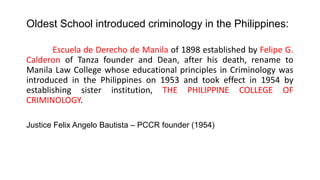
Oldest School introduced criminology in the Philippines:
Escuela de Derecho de Manila of 1898 established by Felipe G.
Calderon of Tanza founder and Dean, after his death, rename to
Manila Law College whose educational principles in Criminology was
introduced in the Philippines on 1953 and took effect in 1954 by
establishing sister institution, THE PHILIPPINE COLLEGE OF
CRIMINOLOGY.
Justice Felix Angelo Bautista – PCCR founder (1954)
Chapter 2
HISTORICAL DEVELOPMENT
THE DISCIPLINE OF CRIMINOLOGY HAS EVOLVED IN FIVE PHASES:
The first two phases were the early origins and the DARK AGES wherein
criminological theories have evolved and became more multidisciplinary. This
became the forerunner of independent criminology that seeks to understand crime
itself rather than study of crime as one aspect of overall, biological, sociological or
psychological theories of crime.
The third phase begins in the 18th century. This, in turn, allowed for

dispassionate, scientific study of why crime occurs. The development of this study
is now known as the era of CLASSICAL and NEO-CLASSICAL criminology.

The fourth phase began in 19th century (POSITIVIST criminology). During

this era, criminology distinguished itself as a subspecialty.
The fifth phase begins in the second half on 20th century (independent
criminology). In this period, criminology began to assert its independence from
traditional disciplines that spawned it. Criminological theories have been expanded
upon centuries.
CRIMINOLOGY DEFINED:
- is the scientific study of crimes, criminals, crime victims, and the theories
explaining illegal or deviant behavior, the social reaction to crime, the effectiveness
of anti-crime policies and the broader political terrain of social control.
EARLY ORIGINS OF CRIMINOLOGY
The concept of crime was recognized in the earliest surviving legal codes.
Code of Hammurabi (1750-1799 B.C.) Babylon – punishment was based on physical
retaliateons or lex talionis or eye for an eye, tooth for a tooth.
Mosaic Code (1200 B.C.) Israel – become the foundation of Judeo-Christian moral
teachings, and also became the basis for the U.S. legal system. Ex. Prohibition
against murder, theft, perjury, and adultery.
Code of Twelve Tables (451 B.C.) Rome – the foundation of the Romans Law. It was
formulated by a special commission of ten men in response to pressure from the
lower classes, the Plebeians.
DARK AGES
The early formal legal codes were lost during the DARK AGES, which last for
hundred of years after the fall of Rome. During the period, superstition and fear of
magic and satanic black arts dominated thinking. People who violated social norms
of religious practices were believed to be witches or possessed by demons. The
prescribed method for dealing with possessed was burning at stake.
Punishment included public flogging, branding, beheading, and burning.
Peasants who violated the rule of their asters were violently put down.
The system during the Dark Ages was harsh, less forgiving, and certainly
much less understanding. The system was ridiculous, such as trial by fire, drowning,
and combat were all extremely common, especially for those accused of witchery,
devil worshipping or sorcery.
18th CENTURY CRIMINOLOGY (Age of Enlightenment)
Despite the progress in human culture and knowledge during the Renaissance (1300-1500),
as the 18th century begun, Europian life was still extremely harsh for all but the few wealthy
members of society. Class and family position at birth determined the entire course of a person’s
life. Those who inherited lands and title flaunted their wealth through excessive behavior, such as
gorging themselves on food and drink.
Alcoholism became a problem. The overpopulated and underfed cities became breeding
grounds for crime. The penalty for was hanging. Unfair taxes on those least able to afford burden.
The poor often turned to theft for survival. Crime was viewed as a rebellious act against the political
structure.
In the mid-18th century, a dramatic change was occurring in the social thinking that had
dominated Europe. Religious orthodoxy was being challenged by science; rational thought began to
be valued over senseless traditions, a movement referred today as the “enlightenment.”
Criminologists believed that criminal behavior was the product of the offender’s rational
choice, and crime could be prevented through the speedy and certain application of penalties that
attached painful and unattractive consequences to such behavior.
Criminologist sought to develop theories to explain why crime occurred. They no longer
relied on the offender’s rational choice. Instead, they attributed criminal behavior to the motivation
to commit crime and the social context that allows people to pursue criminal inclination.
19th CENTURY CRIMINOLOGY
The positivist tradition began to develop on the mid-19th century as the
scientific method began to take hold in Europe. This movement was inspired by
new discoveries in biology, astronomy, and chemistry. If the scientific method could
be applied to the study of nature, then why not use it to study human behavior.
The positivist criminologists’ tradition has two (2) main elements:
1. The belief that human behavior is a function of external forces that are beyond
individual control. Some of these forces are SOCIAL: a) wealth and class b)
political c) famine; PERSONAL and PSYCHOLOGICAL: a) individual’s brain
structure b) biological make-up c) mental ability. Each of these forces operates
to influence human behavior.
2. Embrace of the scientific method to solve problems. Positivism relies on the
strict use of empirical methods to test hypotheses. That is, they believe in the
factual, first hand observation and measurement of conditions and events. A
positivist would agree that an abstract concept such as “intelligence” exist
because it can be measured by an IQ test.
20th CENTURY CRIMINOLOGY
For most of the 20th century, criminology’s primary orientation has been
SOCIOLOGICAL. In view of the globalization of the world brought about by recent
technological advances, computerization, and enormous increase in international
commerce, both legal and illegal, criminology have become a necessity.
Criminologists are called upon to assist governments in devising strategies to deal
with a wide variety of international and transnational crime.
There are number of requirements for successful criminological research:
1. Studying law
2. Understanding criminal justice system
3. Learning about culture
4. Collecting reliable data
5. Engaging in research
6. Doing cross-cultural empirical research and studies.
BIOLOGICAL CRIMINOLOGY
Biological explanations of behavior have been out of style for some time. A
glance through criminological texts of the past two decades will indicate less and
less attention being given to the subject, with major emphasis on sociological
theories of criminal behavior.
Earlier criminologist believe that personality is determined by the shape of
the skull, the relationship between criminal behavior and body type, and the study
of facial features and their relationships to crime.
in 1700s PHRENOLOGY emerged as a discipline. It was develop by Franz
Joseph Gall (1758-1828), who investigated the bumps and other irregularities of
the skulls of the inmates of penal institutions and asylums for the insane and
compared his findings to the head and head casts of person who were not
institutionalized. Phrenology is base on the proposition that the exterior of skull
corresponds to the interior of the brain’s conformation.
By measuring the shape of skull, we can measure behavior.
PSYCHOLOGICAL CRIMINOLOGY
SCHOOLS OF THOUGHT IN
CRIMINOLOGY
CLASSICAL CRIMINOLOGY
By the middle of the 18th century, social reformers studied, argued
and began to look for a more rational approach in imposing punishment.
Social reformers sought to eliminate the barbaric system of law,
punishment and justice. They stressed that the relationship between crime
and punishment should be balanced and fair.
Classical school theory - people are rational, intelligent beings who
exercise free will or the ability to make choices. People calculate the costs and
benefits of their behavior before they act. The classical school of thought focuses
on the offense committed rather than on the offender.
CLASSICAL CRIMINOLOGY
Cesare Beccaria – he pioneered the development of a systematic
understanding of why people committed crime. He believed that the
behavior of people with regard to their choice of action is based on
HEDONISM, the pleasure-pain principle: Human beings choose those
actions that give pleasure and avoid those that bring pain. “The
punishment should fit the crime.”
He believes that people were rational and intelligent human beings who
exercise free will. They commit crime because they imagine greater gains coming
from crime than conformity. For punishment to be effective, it must be certain,
severe and administered swiftly. His work, “ESSAY ON CRIMES AND
PUNISHMENT”, is considered to be one of the most influential papers he wrote.
• Free will – the ability to make a choice among various alternatives.
• Hedonistic – the attempt to maximize pleasure and minimize pain.
CLASSICAL CRIMINOLOGY
Jeremy Bentham – a contemporary of Beccaria. He devoted his life
to developing scientific approach to the making and breaking of laws. He
was concerned with achieving “the greatest happiness of the greatest
number.” He referred to his philosophy of social control as utilitarianism.
He based his ideas about crime on the belief that people sought out
pleasure and avoided pain. The punishment must “fit the crime.”
Utilitarianism – assumes that all human actions are calculated in
accordance with their likehood of bringing happiness (pleasure) or
unhappiness (pain). People weigh the probabilities of present and future
pleasures against those of present and future pain.
The Classical School of Criminology’s concept of human nature as
governed by the doctrine of “free will” and rational behavior.
Classical School focused on the criminal act (the crime) and not the
actor (why it was committed).
NEOCLASSICAL CRIMINOLOGY
The neoclassical school, which flourished in the 19th century, had
the same basis as the classical school – a belief in free will. Most of whom
were British. They believed the classical approach was too harsh and
unjust. This school of criminology is a modification of classical theory; it
believed that certain factors such as insanity will inhibit the exercise of
free will.
One changes of the neoclassical period was that children under 7
years of age were exempt from the law because they were presumed to
be unable to understand what is right or wrong. The exemption would cover
juveniles. Mental disease became a reason to exempt a suspect from
conviction too. It was seen as a sufficient cause of impaired responsibility,
and thus defense by reason of insanity crept into the law.
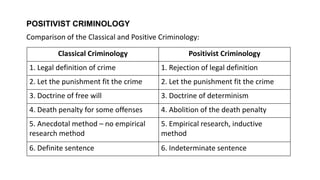
POSITIVIST CRIMINOLOGY
The positivist school originated in the 19th century in the context of
the “scientific revolution.” The positivists rejected the harsh legalism of
the classical school and substituted the concept of “free will” with the
doctrine of determinism. They focused on the constitutional approach to
crime, advocating that structure or physical characteristics of an individual
determine that person’s behavior. Since these characteristics are not
uniform, the positivists emphasized a philosophy of individualized, scientific
treatment of criminals, based on the findings of the physical and social
sciences.
Auguste Comte (1798-1857) – consider as the founder of positivist
school and sociology. He applied scientific methods in the study of society,
from where he adopted the word sociology.
POSITIVIST CRIMINOLOGY
The positivist school was composed of several Italians. Generally, it
is associated with:
1. Cesare Lombroso – who founded the Italian School of thought.
2. Enrico Ferri
3. Rafaelle Garofalo
They were called the “unholy three” by the religious leaders during
the time of positivism because of their belief in evolution as contrasted to
biblical interpretation of the origin of man and woman. Eventually, they
have been called the “holy three of criminology” because of their
emergence symbolized clearly that the era of faith was over and the
scientific age had begun.
POSITIVIST CRIMINOLOGY
The positivist school presumes that criminal behavior is caused by
internal and external factors outside of the individual’s control. The
scientific method was introduced and applied to the study of human
behavior.
Positivism can be broken up into three (3) segments:
1. Biological
2. psychological
3. Social positivism
POSITIVIST CRIMINOLOGY
Key assumptions of the positivist school of thought:
1. Human behavior is determined and not a matter of free will.
2. Criminals are fundamentally different from non-criminals.
3. Positivists search for such differences by scientific methods.
4. Social scientists (including criminologists) can be objective, or
values-neutral, in their work.
5. Crime is frequently caused by multiple factors.
6. Society is based on consensus, and not on social contract.
POSITIVIST CRIMINOLOGY
Cesare Lombroso (1835-1909) – an Italian criminologist, scientist,
university professor, prison doctor, and founder of criminal anthropology. He was
one of the largest contributors to biological positivism and founder of the Italian
School of Criminology. He is widely known as the father of modern criminology.
Lombroso’s work closely followed Charles Darwin’s theory of man’s
evolution. Lombroso contended that just as human beings developed from non-
human animal form, the criminal was a throwback or mutant to a primitive stage
of human evolution. The criminal was a product of biology, and not so much could
be done for this “born criminal.” Lombroso’s positivist approach was scientific,
anthropological and biological. With his research, the “legalistic concern for
crime” advance to a “scientific study of the criminal,” which in turn became the
field of criminology. This accounted for his title of being the father of criminology.
POSITIVIST CRIMINOLOGY
Lombroso’s theory of the “born criminal” states that criminals are a
lower form of life, nearer to their apelike ancestors than non-criminals in
traits and dispositions. They can be distinguished from non-criminals by
various atavistic stigmata, which refers to the physical features of creatures
at an earlier stage of development, before they became fully human beings
POSITIVIST CRIMINOLOGY
Lombroso’s major contributions to positivist criminology:
1. The theory of atavism – Lombroso had the opinion that criminals were
developed from primitive or subhuman individuals characterized by some
inferior mental and physical characteristics such as receding hairline, forehead
wrinkles, bumpy face, broad noses, fleshy lips, sloping shoulders, long arms,
and pointy fingers. He called this condition atavism.
2. The application of the experimental or scientific method to the study of
criminal – Lombroso spent endless hours measuring criminally insane persons
and epileptics’ skulls.
3. The development of a criminal typology.
POSITIVIST CRIMINOLOGY
4. The belief in the indeterminate sentence – penalties should be indeterminate
so that those other “born criminals” who are incorrigible could be worked with
and rehabilitated.
5. The application of statistical techniques to criminology – although crude and
with the use of questionable control groups, statistical techniques were used by
Lombroso to make criminological predictions.
POSITIVIST CRIMINOLOGY
Category of Criminals (Lombroso)
a. Born criminals – these refer to individuals who are born with a genetic
predilection toward criminality.
b. Epileptic criminals – these are criminals who commit crime because they are
affected by epilepsy.
c. Insane criminals – these are those who commit crimes due abnormalities or
psychological disorders. These criminals are not criminal from birth; they
become criminal as a result of some changes in their brains which interfere
with their ability to distinguished between right or wrong.
d. Occasional criminals – these are criminals who commit crime due to
insignificant reasons that push them to do at a given occasion.
POSITIVIST CRIMINOLOGY
Various types of occasional criminals (Lombroso)
a. Pseudo criminals – these individuals are not real criminals. They have neither any
inborn tendency towards crime nor are they under the influence of any bad crime-
inducing habit. They do something criminal on account of acute pressure of
circumstances that leave them with no choice. An example would be persons who kill
in self-defense.
b. Criminaloids (sometimes called criminoloid) means “like a criminal” or “having
resemblance with the criminal.” – criminaloids are not born criminals but non-
criminals who have adopted criminal activity due to pressure of circumstances and
less physical stamina or self-control. The nature of their crimes is not very grave.
c. Habitual criminals – they have no organic criminal tendency, but in the course of their
lives they have developed some foul habits that force them into criminality. Some
attributing factors are poor parenting and education, or contact with other criminals.
d. Passionate criminals – these are individuals who are easily influenced by great
emotions like fit of anger.
POSITIVIST CRIMINOLOGY
Enrico Ferri (1856-1929) – a student of Lombroso and best-known of
Lombroso’s associates. His interest in socialism led him to recognized the
importance of social, economic and political factors in the study of criminal
behavior. His greatest contribution was his attack on the classical doctrine of free
will. He believed that criminals could not be held morally responsible because
they did not choose to commit crimes but rather were driven to commit them
by conditions in their lives.
Raffaele Garofalo (1851-1934) – rejected the doctrine of free will and
supported the position that the only way to understand crime was to study it by
scientific methods. He found that Lombroso’s theory of atavism have many
shortcomings, he traced the roots of criminal behavior, not to physical features,
but to their psychological equivalents, which he called “moral anomalies.”
(Natural crimes are found in all human societies, regardless of the views of
lawmakers, and no civilized society can afford to disregard them). He emphasized
that society needed protection and that penal policy should be designed to
prevent criminals from inflicting harm.
POSITIVIST CRIMINOLOGY
Classification of Criminals (Garofalo)
1. Murderers – those who are satisfied from vengeance or revenge.
2. Violent criminals – those who commit very serious crimes.
3. Thieves – those who commit crimes against property.
4. Lascivious criminals – those who commit crimes against chastity.
POSITIVIST CRIMINOLOGY
Gabriel Tarde (1843-1904) – he rejected the Lombrosian theory of biological abnormality,
arguing that criminals were normal people who learned crime just as others learned legitimate
trades. He formulated his theory in terms of laws of imitation or principles that governed the
process by which people became criminals. According to his thesis, individuals emulate behavior
patterns in much the same way that they copy styles of dress.
Pattern of emulation:
1. Individuals imitate others in proportion to the intensity and frequency of their contacts.
2. Inferiors imitate superiors, and that is, trends flow from local to national and from upper to
lower classes.
3. When two behavior patterns clash, one may take the place of the other.
Tarde’s major contribution in the study of the cause of crime was his concept of the
criminal as a professional type. He believed that most criminals went through a process of
training before finally becoming criminal.
POSITIVIST CRIMINOLOGY
Emile Durkheim (1858-1917) – who is universally acknowledge as one of
the founders of sociology. He pointed out that all societies have not only crime
but sanctions. In a strongly cohesive society, punishment of members who deviate
is used to reinforce the value system to remind people of what is right and what is
wrong, thereby preserving the pool of common belief and the solidarity of the
society. Punishment must be harsh to serve these ends.
According to Durkheim, crime is an inevitable aspect of society. It could
disappear only if all members of society had the same values, and such
standardization is neither possible or desirable. He called this concept anomie
(Greek, anomos, without norms), a breakdown of social order as a result of a loss
of standards and values. In a society plagued by anomie, disintegration and chaos
replace social cohesion.
Perspectives on School of Thoughts:
The classical and the neo-classical school of thought which in the early
1800s proclaims that everyone has free will and will attempt to avoid punishment.
However, the positivist school of thought on the other hand presumes criminal
behavior can actually be brought about internal and external forces outside an
individual’s control.
BIOLOGICAL CRIMINOLOGY
The study on the relationship between biology and crimes leaves no doubt that
biological variables and their interactions are important to the understanding the
origins of the criminal behavior.
Origins of Biological Criminology:
The idea that crime is caused by biological defects or deficiencies in the offender was not
new when advanced b Lombroso. The most influential attack on Lombroso’s work was conducted
by British Criminologists Charles Buckman Goring (1817-1919), who recorded the facial and other
measurements of several thousand criminals and non-criminals. In his book “The English Convict”
in 1913, Goring concluded that Lombroso’s findings had no adequate scientific support and that
statistical evidence disproved the existence of a biological criminal type.
Categories of Biological Criminology:
1. Genetic factors – traits are transmitted from parents to offspring.
2. Neurological abnormalities – focus on abnormalities in brain functioning that reduce
inhibitions toward aggression.
Another type of dysfunction that may be related to aggression is chemical imbalances in
the brain. The gaps between cells in the nervous system are called synapses and the chemicals
that enable the flow of electrical impulses across the synapses are called neurotransmitter.
Criticisms on Biological Criminology:
1. They suggest that one can genetically inherit a trait or propensity that is socially defined and
culturally relative.
2. Any biological difference that is found is likely to explain only a minor proportion of criminal
behavior compared with social and cultural factors.
3. The bio-positivism seen to share a conservative consensus world view, an unquestioned
acceptance of official definition of criminality, and the social class bias that crime is primarily t
be found among “the dangerous class.”
4. Most of these studies reflect a “dualistic fallacy” notion, which assumes the mutual exclusivity
of criminals and non-criminals.
5. Most od their analyses are plagued by weak operationalization of key concepts such as
“feebleminded”, “inferior,” and crime.
Criticisms on Biological Criminology:
1. Not all biological difference is inherited; many may be due to pre-natal environment, injury,
and inadequate diet.
2. Modern genetics has simply bypassed many of these simplistic theories. Most modern
biologist speaks against notions of the inheritance of acquired characteristics, emphasizing
instead selective adaptation and mutation.
3. Many of these studies are based on small and/or inappropriate samples.
4. As a result of the dominance of this approach, criminological theory was very likely led down
the wrong path. The popularity of many of these theories related to their conservative and
individualistic emphasis and to their compatibility with authoritarian and simplistic solution to
the crime problem.
Bio-criminology – is the study of the physical aspects of psychological disorders.
PSYCHOLOGICAL
CRIMINOLOGY
Psychologists have considered a variety of possibilities to account for individual
differences, such as defective conscience, emotional immaturity, inadequate
childhood socialization, and maternal deprivation. They study how aggression is
learned, which situations promote violent or delinquent reactions. How crime is
related to personality factors and the association between various mental disorders
and criminality.
Origins of Psychological Criminology:
Psychological theories attempts to explain human intellectual and emotional
development:
Three (3) categories of psychological theories:
1. Moral development theory
2. Social learning theory
3. Personality theory
Moral Development Theory – describes a sequence of developmental stages that people
pass through when acquiring the capacity to make moral judgements. According to this theory,
this development process may or may not be completed, and people who remain unable to
recognize right from wrong will be more likely to engage in inappropriate, deviant, or even
criminal behavior.
Categories of Psychological Criminology:
• Moral Development Theory (by Jean Piaget, 1896-1980) – describes a sequence of
developmental stages that people pass through when acquiring the capacity to make moral
judgements. According to this theory, this development process may or may not be completed,
and people who remain unable to recognize right from wrong will be more likely to engage in
inappropriate, deviant, or even criminal behavior.
four (4) stages of cognitive development (Piaget):
1. From birth to age two (2) – children experience the world only their senses and motor
abilities and have a very immediate, experienced-based knowledge of the world.
2. Between two to seven – children learn to think about and understand objects using thoughts
that are independent of immediate experience. Children are egocentric, and that is, they
believe that others experience the same reality that they do.
3. Seven to adolescence – the child learns to think logically and to organize and classify objects.
Beginning in adolescence, the child develops the ability to think logically about the future and
understand theoretical concepts.
Categories of Psychological Criminology:
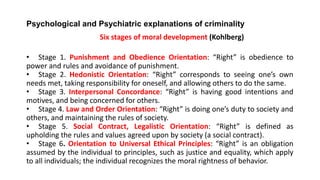
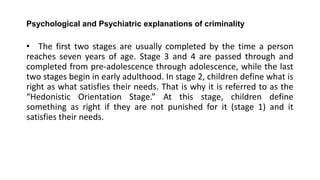
Lawrence Kohlberg (1927-1987) – a pioneer of moral development theory
proposed a multistage theory of moral evolution.
1. Early level of development, children strive to maximize pleasure and avoid
punishment.
2. Children consider the needs of others only to the extent that meeting those
needs will help the child fulfill his /her own needs.
3. The next period, which is characterized by conformity to social rules, the child
demonstrates respect for and duty to authority.
4. The child also seeks disapproval from the authority.
5. As the child matures, his /her moral judgment is motivated by respect for
legally determined rules and an understanding that these rules exist to benefit
all.
6. Universal principles are internalized such as liberty and justice.
Categories of Psychological Criminology:
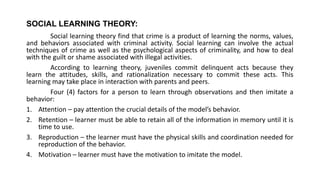
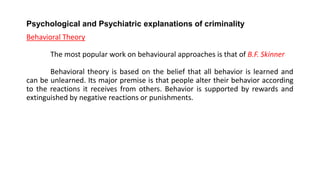
• Social Learning Theory - proposes that people internalize moral
codes more through the process of socialization or learning the
behavior through interaction with others, rather than through a
stage by stage development process. Social learning theories believe
that crime is a product of learning the norms, values and behaviors
associated with criminal activity.
Social learning theory maintains that young person learns how
to behave based on how elders or primarily parent figures, respond to
the person’s violations of and compliance with rules.
Categories of Psychological Criminology:
• Personality Theory – attempts to explain how people acquire predispositions
toward certin behavior. These predispositions are sometimes discussed in terms
of personality traits, such as impulsiveness and stubbornness, or personality
types, such as introvert and extrovert.
Personality – defined as the reasonably stable patterns of behavior,
including thoughts and emotions that distinguish one person from another.
Intelligence - refers to the general mental capability to reason, solve
problems, think abstractly, learn and understand new material, and profit from
past experience.
Henry Maudsley (1835-1918) - an English psychologist also believes that
criminals are morally insane. He argued that criminals as a group are defective on
physical and mental organization and thus lack any sense of morality.
Moral Insanity – is an inherent quality, and crime is a way in which the
deviant can express pathological urges.
Categories of Psychological Criminology:
Sigmund Freud (1856-1939) – the founder of psychoanalysis, suggested that
criminality may result from an overactive conscience that results to excessive guilt
feelings.
Psychoanalytic theory
- this theory blames criminal or delinquent behavior to a conscience that is
either so overbearing that is arouses feelings of guilt, or so weak that it cannot
control the individual’s impulses and leads to a need for immediate gratification.
Categories of Psychological Criminology:
Three parts of personality (Sigmund Freud):
1. Id – it present at birth. It is the impulsive part of the personality and
unconscious. It represents the unconscious biological drives for sex, food and
other life-sustaining necessities. The id impulses require instant gratification
without concern for the rights of others. It also is antisocial and knows no
boundaries, or limitations. It operates according to “pleasure principle.”
2. Ego – this is the objective, rational part of personality, the reality component.
It grows from id and represents the problem-solving dimension of the
personality. The ego compensate for the demands of the id by helping the
individual guide his actions to remain within the boundaries of righteousness
and fairness. It operates according to “reality principle.”
3. Superego – is the “conscience” of a person. It is the moral aspect of
personality. It allows a person to feel pride, shame, and guilt. It develops from
ego and is the moral code, norms, and values the child has acquired. Freud
believed that some people are criminal due to an overdeveloped superego
which leads to guilt, anxiety and a desire for punishment.
Concepts of Psychological Criminology;
Three (3) main psychological perspective:
1. Psychodynamic view – links aggressive behavior to personality conflicts
developed in childhood.
2. Cognitive theory – is concerned with human developments and how people
perceive the world.
3. Social Learning theory – sees criminality as learned behavior.
SOCIOLOGICAL CRIMINOLOGY
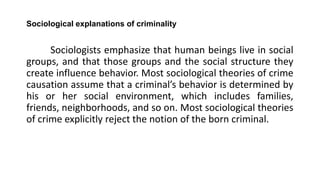
Sociological theories of crimes assume that the offender’s personality and action
are molded by contact with the social environment and such factor age, gender, social
class, and ethnic origins. People do not live as isolated individuals but as members of
social groups, and it is these social influence that shape behavior. Sociological
explanations of criminality emphasize that offenders are molded by societal forces. Among
the several theories that have arisen from this foundation, three deserves special mention.
A) social structure theory
B) social process theory
C) social conflict theory
Origins of Sociological Criminology:
The most common criminological theories attribute criminal motivation to
environmental or social factors than biological or psychological traits. These
theories may focus on social influences on crime or on economic factors:
1. Social cause – one of the first theories describing the influence of social
factors on crime came from French Sociologist Gabriel Tarde.
Gabriel Tarde - His basic theory on the causes of crime was founded on
laws of imitation. He believed that the persons predisposed to crime are
attracted to criminal activity by the example of other criminals. He felt that the
particular crimes committed and the methods committing those crimes are
products of imitation. Tarde was also one of the first to study the professional
criminal. He noted that certain offenders pursue careers of crime.
Emile Durkheim – he believed that the causes of crime are present in the
very nature of the society, crime is related to loss of social stability. Durkheim
used the term anomie to describe the feelings of alienation and confusion
associated with the breakdown of social bonds.
Origins of Sociological Criminology:
a.) Social-Structure theories
emphasizes the effects of an individual’s position in society and the
constraints that the person’s status puts on his or her perceptions and behavior.
All members of society subscribe to the same moral code but some people,
because of their position in society are more able than others to follow code.
Social-structural theories assert that crime is an adaptation to the limitations that
social position places on individual behavior.
Socio-structural theorists focus their attention on socio-economic status or
social class and the strain that lower class status brings. The principal goal of
these theories is to explain why poorer people engage in crime more frequently
than wealthy individuals.
Origins of Sociological Criminology:
Cloward and Ohlin’s Differential Opportunity Theory
• Richard Cloward and Lloyd Ohlin focused on serious delinquency
committed by urban, male gang members. They asserted that two goals
pursued by lower-class youth were a.) economic success and/or b.)middle-class
membership. Cloward and Ohlin believed that illegal opportunities, like
conventional opportunities, are stratified unequally. This means that there is an
illegitimate opportunity structure just as there is a legitimate opportunity
structure for success.
• Legitimate opportunity structure involves education, hard work, and a
good occupation, and not everyone has access to this opportunity structure to
obtain economic success.
• The illegitimate opportunity structure includes criminal enterprises in
neighborhoods where there are criminal mentors to assist youths in becoming
successful criminals.
Origins of Sociological Criminology:
Differential Association Theory – developed by Edwin Sutherland, it assumes that
persons who become criminal do so because of contacts’ with criminal patterns
and isolation from non-criminal patterns.
Principles of Differential Association:
• Criminal behavior is learned
• Learning is a by-product of interaction
• Learning occurs within intimate groups.
• Criminal techniques are learned.
• Perceptions of legal code influence motives and drives.
Origins of Sociological Criminology:
ECOLOGICAL THEORY – focuses on the criminal’s relationship to the social
environment. It seeks to explain delinquency based on where it occurs. The
environment of an area has an impact on delinquency. The most prominent
ecological theory is Clifford R. Shaw and Henry D. McKay’s social disorganization
theory.
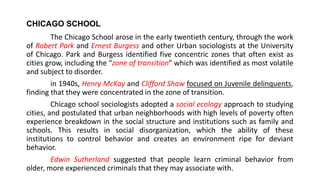
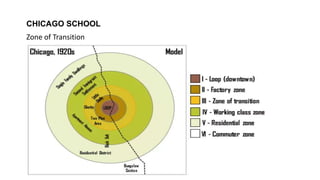
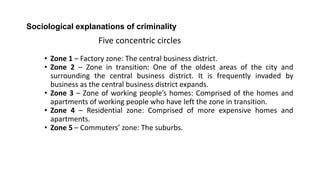
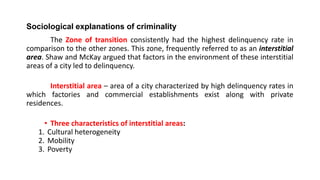
In 1940s, Henry McKay and Clifford Shaw focused on Juvenile
delinquents, finding that they were concentrated in the zone of transition.
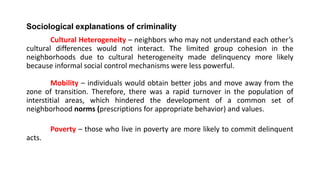
Chicago school sociologists adopted a social ecology approach to studying
cities, and postulated that urban neighborhoods with high levels of poverty often
experience breakdown in the social structure and institutions such as family and
schools. This results in social disorganization, which the ability of these
institutions to control behavior and creates an environment ripe for deviant
behavior.
Origins of Sociological Criminology:
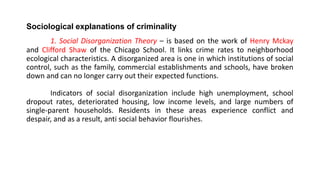
Social Disorganization Theory – is based on the work of Henry Mckay and Clifford
Shaw of the Chicago School. It links crime rates to neighborhood ecological
characteristics. A disorganized area is one in which institutions of social control,
such as the family, commercial establishments and schools, have broken down
and can no longer carry out their expected functions.
Indicators of social disorganization include high unemployment, school
dropout rates, deteriorated housing, low income levels, and large numbers of
single-parent households. Residents in these areas experience conflict and
despair, and as a result, anti social behavior flourishes.
Origins of Sociological Criminology:
b). Sub-Cultural Theories
Sub-cultural theories assume that certain groups have values quite distinct from those of
the rest of society. Members of these groups will be disproportionately involved in crime because
they acquire and follow the values of their group. According to the sub-cultural model, crime does
not occur because people have been imperfectly socialized; it occurs because they have been
socialized in a deviant group and acquired its values.
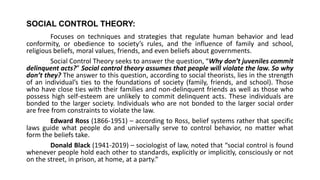
Social-Control Theory (Travis Hirschi, 1935-2017) – assumes that everyone has predisposition
toward criminal behavior.
Social Control Theory seeks to answer the question, “Why don’t juveniles commit
delinquent acts?” Social control theory assumes that people will violate the law. So why don’t
they? The answer to this question, according to social theorists, lies in the strength of an
individual’s ties to the foundations of society (family, friends, and school). Those who have close
ties with their families and non-delinquent friends as well as those who possess high self-esteem
are unlikely to commit delinquent acts. These individuals are bonded to the larger society.
Individuals who are not bonded to the larger social order are free from constraints to violate the
law.
Origins of Sociological Criminology:
Social Control/Social Bonding Theory (Travis Hirschi) – according to Hirschi, people usually do not
commit delinquent acts because they fear that this behavior will damage their relationships with
their parents, friends, families, teachers, and employers; thus, individuals do not commit
delinquents acts because they are bonded to the larger society. When these social bonds are
broken or diminished, delinquency is likely.
Four elements of the social bond:
• Attachment – describes the emotional and psychological ties a person has with others. It
includes sensitivity to and interest in others as well as sense of belonging. Hirschi believed that
attachment to parents is more important than attachment to peers and school. Attachment is
the most important element of the social bond.
• Commitment – involves the time, energy, and effort expended in conventional action. For
example, someone who has worked hard to get a good education is not likely to jeopardize
those efforts by committing crime. The more conventional assets people have—such as an
education, job, and home – the less likely they are to commit crime.
• Involvement – means significant time and attention spent in conventional activities, which
leaves little time for illegal behavior. People who are busy working, going to school, and raising
children are far less likely to commit crime. They do not have the spare time to indulge
temptations to commit crimes.
• Belief – describes the acceptance of moral legitimacy of law and authority, with an
understanding that the law should be obeyed.
Origins of Sociological Criminology:
• Self-Control Theory (Gottfredson and Hirschi) – Michael Gottfredson and Travis
Hirschi argued in later control theory that the tendency to commit crime can be
found in the level of self-control.
Self-Control – the ability to control one’s own behavior. Gottfredson and
Hirschi proposed that those who commit delinquent acts have low self-control;
they tend to be impulsive, insensitive, and need immediate gratification.
What causes people to have limited self-control? Lack of self-control is
caused by inadequate child-rearing practices. Self-control, according to
Gottfredson and Hirschi, is instilled in children by the age of eight and is relatively
constant thereafter. They suggested that parents must monitor their child’s
behavior, recognize inappropriate behavior when it occurs, and punish the
inappropriate behavior. If an individual has low self-control but there is no
criminal opportunity, then delinquency will not take place. If opportunity presents
itself to a juvenile with low self-control, delinquency is likely to occur.
Origins of Sociological Criminology:
2. Economic Cause
Studies concerning the influence of economic factors on criminal behavior
have attempted to link economic deprivation to increased motivation to commit
crimes, especially property crimes.
Other studies attempt to relate the disproportionate involvement of poor
people in crime to the distribution of power in society. The assumption in these
studies is that criminal law is a tool used by the social group with higher economic
status o advance its class interests.
Studies of the relationship between unemployment and crime have
yielded conflicting results. Some studies indicate a negative relationship between
unemployment and crime, and that is, when unemployment decreases, crime
increases, or vice versa.
Origins of Sociological Criminology:
Those who follow the teachings of German Philosopher Karl Marx (1818-
1883), known as Marxists, believe that capitalist societies generate surplus labor
as a means of limiting the demands of workers for higher wages and other
benefits.
During the period of economic expansion, fewer people are punished for
criminal activity. This reduces the amount of people in jail and increases the size
of surplus labor in the economy. On the other hand, during periods of economic
decline, more people are put in jail, which prevents too much surplus labor from
posing a threat to the social and economic order.
Sociological Theories of Criminality:
By the rapid growth of population, more particularly in urban places owing
to industrialization, sociologist reached the conclusions that growing up and living
in urban places, such as in squatters and slum areas, undoubtedly influenced the
outcome of people’s lives.
Auguste Comte (1798-1857) – the founder of sociology, argued that the
process whereby with the development of industrialize society people have
become increasingly separated into different places of residence and employment
has subverted the moral authority of a previously united society.
From these perspective, people are seen to commit criminal acts not
because it is in their material interest to do so, but because there is no strong
moral authority influencing them to do otherwise.
Sociological Explanation of crimes:
Five possible reactions or adaptations can occur when people are not in position
to legitimately attain internalized social goals.
Merton developed five (5) modes of adaptation:
1. Conformity – a conformist both accepts the cultural goal of economic success and
accepts the institutionalized means to obtain the success. A conformist is highly
unlikely to commit delinquent acts.
1. Ritualism – a ritualist rejects the cultural goal of economic success but accepts the
institutionalized means to obtain the cultural goal. Ritualist respond to strain by
lowering their aspiration for financial success, but they still accept the means to obtain
it, such as employment and education. It is unlikely that ritualist, who are heavily
represented in the lower middle class, will commit delinquent acts.
Sociological Explanation of crimes:
3. Innovation – an innovator accepts the goal of economic success but rejects the institutionalized
means to obtain it. In this adaptation, the individual invents new means to obtain economic
success other than education and employment. The innovator may commit offenses such as drug
dealing, robbery, fraud, bribery, and prostitution in an effort to obtain financial success. Innovators
want to be financially successful and will commit delinquent acts that move them forward to this
goal. Innovation is the mode of adaptation that is most likely to lead to delinquency.
4. Retreatism – a retreatist rejects both the cultural goal of economic success and any
institutionalized means to obtain it. Retreatist do not aspire to financial success nor are they
concerned with education and employment. They frequently escape into drug addiction and may
commit crimes to support their drug use. The retreatist’s strain is reduced by abandoning both the
goal and the means to obtain it.
5. Rebellion – a rebel rejects the cultural goal and the means to attain it but substitutes new goals
and new means to obtain them. This adaptation is likely to lead to delinquency and can be
represented by some gangs, militias, cults, and countercultures. Delinquency is likely to occur
among rebels, but it will not be as prevalent as delinquency among innovators.
RADICAL CRIMINOLOGY
The term Radical is defined as “favouring or effecting revolutionary changes”. In this
definition, criminological theories may be considered radical in at least two ways:
1. These theories represent a dramatic break with the pragmatic frameworks of the
varied theories.
2. These theories advocate fundamentals changes in the society’s social structure,
particularly in the mode of producing and distributing resources in order to
substantially reduce or eliminate crime.
Radical Criminology:
Radical Criminology – states that society functions in terms of the general
interests of the ruling class rather than “society as a whole” and that while the
potential for conflict is always present, it is continually neutralized by the power of
the ruling class. Radical criminology is related to critical and conflict criminology in
its focus on class struggle and its basis in Marxism. From this perspective, law, law
enforcement agencies, and government itself are instruments of the ruling class
to maintain their advantageous position in society, and to control those who pose
a threat to their position.
Radical Criminology considered crime to be a tool used by the ruling class.
Laws are put into place by the elite and are then used to serve their interests at
the peril of the lower class.
Radical Criminology:
Radical Theory – radical theories of crime causation are generally
based on Marx’s ideas. Among the first criminologists to employ
Marxist theory to explain crime and justice were Richard Quinney,
William Chambliss and Anthony Platt.
Radical criminologists argue that capitalism is an economic
system that requires people to compete against each other in the
individualistic pursuit of material wealth. The destructive effects of
capitalism, such as crime, are not caused by income or property
inequality or by poverty. Rather, crime is caused by class struggle- the
competition among wealthy people and among poor people,
between rich and poor people, and the practice of taking advantage
of other people.
Radical Criminology:
Radical criminology maintains that there is no such thing as an inherently
criminal act. In other words, in order for the behavior to be criminal, it must be
defined as crimes by some members of the society. It is a basic principle of
Labeling theory.
Social Reaction Theory
Commonly called Labeling theory, the focus of social reaction theory is
the criminalization process- the way people and actions are defined as criminal.
The distinguishing feature of all “criminals” is that they have been the object of a
negative social reaction. Negative labels include “troublemaker,” “mentally ill,”
and “ stupid.” These labels reduce the self-image of the individual.
Radical Criminology:
Labeling theory – this theory states that the reaction of other
people and the immediate effects of these reactions create deviance.
Once it became known that a person has engaged in a delinquent
behavior, said person is segregated from society, and a label such as
“thief,” “drug addict,” and “criminal,” is attached to the person.
Labeling serves as a process of segregation that creates outsiders or
outcasts from society, who begin to associate with others who also
have been cast out.
Origins of Radical theories:
Conflict Theory
Conflict theory assumes that society is based primarily on conflict between
competing interest groups – for instance, the rich against the poor, management
against labor, men against women, adults against children.
Conflict theorists state that delinquent behavior is due to conflict in
society that arises from an unfair distribution of wealth and power. Conflict
theorists are concerned with the role government plays in creating an
environment that is conducive to crime. They are also concerned with the role
that power has in controlling and shaping the law. One of the earliest theorists to
apply conflict theory to the study of crime was George Vold (1896-2018)
Early Radical Criminology Theory:
1. Crime and Privilege (Barry Krisberg, 1945-2019) - a radical criminologist
argued that crime must be studied within “the broader quest for social
justice,” which in turn requires that one must understand the relationship
between crime and privilege. In Krisberg analysis, the poor and indigenous
people, women, and other “underprivileged” or deprived groups of people do
not necessarily commit more crime than middle-class and upper-class , but
they are more likely to be subjected to the strict control and degradation of
the criminal justice system.
2. Crime and Oppression (Richard Quinney, 1934-2019) – he developed a
criminological theory that grew increasingly more Marxist and radical in
orientation. In his book, “The Social Reality of Crime,” he delineated his
propositions that today could best be characterized as continuing a conflict
approach. His perspective was more pluralist than materialist.
Major features of Radical Criminology:
1. Radical criminology rejects the individualistic approach to crime causation.
2. Radical criminology question the rightfulness of law.
3. Radical criminology instead of explaining the fact of deviance with reference
to the society, within which it occurs, gives importance to the social power.
4. Radical criminology do not believed in the accuracy of government figures
relating to crime because government officials either overstate or understate
figures.
5. Radical criminology hold that the law is used only against the poor, the
illiterate, the powerless, and the members of the minority groups.
The ruling class uses legal apparatus mainly with Three (3) objectives:
1. To impose its morality and standard on the society.
2. To protect their persons and property from the depredations of the poor.
3. To compose such definition of criminal behavior which may enable them to
maintain dominance over the poor and the middle classes.
Outlines of Radical Criminology:
1. Radical criminology must be anti-statist and anti-capitalist – it must not succumb to the
myth, as libertarians do, and that there is an opposition between capitalism and the state.
2. A Radical criminology must again recognize exploitation; the social exploitation of labor, as
the central organizing features of capitalist societies.
3. The criminal justice system is themselves a profit maximizing machines – the manner of
their profit-making is the processing and punishment of the poor.
4. The state is a protection racket – a protection racket is a scheme whereby a group provides
protection to businesses or other groups through violence outside the sanction of the law, in
other words, a racket that sells security such as traditionally, physical security but at present it
also involves computer security.
5. Radical criminology must be anti-colonial – it must confront the historic and ongoing assaults
on indigenous people communities globally by settler capitalist and their criminal justice
systems.
6. Radical criminology must be deep green – it must draw attention and oppose the integral
relationships between capitalist exploitation business practices, and the destruction of the
ecosystems.
7. Radical criminology is abolitionist – it must call for the abolition of all static criminal justice
system.
FEMINIST CRIMINOLOGY
It is primarily concerned with the victimization of women such as female
delinquency, prostitution, and gender inequality in the law and criminal justice system are
also receiving attention. Feminism is a set of theories about women’s oppression and set
of strategies to change it. It is related to, but not simply derived from, biological sex
differences, and reproductive capacities.
This seeks to address the limitation by enhancing the understanding of both male
and female offending as well as criminal justice system responses to their crimes.
Feminism:
Feminism is a school of thought that explains gender in terms of the social structure in
which it is constructed and emphasizes the importance of taking collective action to ends sexism.
Four types of feminist criminology:
1. Liberal feminist criminology – focuses on securing the same legal rights for women and men
enjoy. Liberal feminism believe that one cause of gender inequality is blocked opportunities,
so the goal of their social activism is the removal of any obstacles that women face in the paid
work force, education, government, and social institutions. The main strategy for
accomplishing this goal is legal changes, that is, abolishing gender discrimination by enacting
laws that prohibit gender discrimination.
2. Radical feminist criminology – it is a theoretical perspective that sees gender inequality of
sexism as the most fundamental form of oppression. Radical feminist criminology sees male
power and privilege as the root cause of all social relations inequality, and crime. The main
causes of gender inequality are: a.) the needs of men to control women’s sexuality and
reproductive potential; and b.) patriarchy. Radical feminist contends that men physically,
sexually, and psychologically victimize women mainly because of their need and desire to
control them.
Feminism:
3. Social Feminist Criminology – this school of thought argues that women deviancy is the by-
product of exploitation of capitalism and patriarchy. Fewer economic resources, opportunities and
low paying jobs availability are just left over of men who dominate capitalism. Women are
exploited by capitalism and patriarchy and as a result, they are left with only fewer opportunities.
These factor lead to deviancy. Social feminist argue that class inequality in capitalist society is
primary the oppression, with all other oppression growing largely out of unequal economic
conditions and class struggles.
4. Marxist Feminist Criminology – argues that the economic formation of a society is the primary
determinant of other social relations, such as gender relations. The gender division of labor is
viewed as the product of the class division of labor. Because women are seen as being primarily
dominated by capitalist society and secondarily by men, the main strategy for change is the
transformation from capitalist society to a democratic socialist society. To combat victimization
of women (rape, incest, battery, sexual harassment, etc.) an alternative system should undertake a
massive commitment to the female victim, enact legal reforms, and reinterpret the nuclear family.
A reformed society must offer equal access to jobs of all types, and at all levels within the criminal
justice system, particularly for working class women.
Feminism:
The feminist school of criminology is a school of criminology developed in the late 1960s
and into the 1970s as a reaction to the general disregard and discrimination of women in the
traditional study of crime. Feminist criminology notes that the field of criminology has historically
been dominated by men, leading to the development of criminological theories that focus on the
male experience. This patriarchal domination is not unique to criminological theory, as it is also
reflected in the criminal justice system which is cited as a gender institution itself.
Nicole Rafter Hahn (1939-2006) – argued that a woman was usually deemed “bad” if she has one
of the following characteristics:
1. She was indecisive and lacked “moral fortitude.”
2. She was promiscuous
3. She was irresponsible
Theories of female criminality:
1. Masculinization theory – masculinization is a term applied to the critique of traditional
academic discussions of the female offender and of popular depictions of female criminality.
Masculinization refers to the attribution of male characteristics to women in an attempt to
understand their attitude rather than locating women’s character in female experience or
structural location. Alfred Adler (1870-1937), argued that the women’s movement would lead
to an increase in female crime because liberation would make women more like men.
Masculinization is also the abnormal development of male sexual characteristics in a female
resulting from hormone therapies or adrenal malfunction.
2. Opportunity theory – suggests that offenders make rational choice; thus, they choose targets
that offer a high reward with little effort and risk. The occurrence of a crime depends on two
things; the presence of at least one motivated offender who is ready or willing to engage in a
crime, and the conditions of the environment in which that offender is situated, and which
provide opportunities for crime. All crimes require opportunity but not every opportunity is
followed by crime and criminal offenders.
Theories of female criminality:
3. Marginalization theory – marginalization comprises those processes by which individuals and
groups are ignored or relegated to the side-lines of political debate, social negotiation, and
economic bargaining; and that is being kept in the same situation. Homelessness, age, language,
employment status, skills, race, and religion are some criteria historically used to marginalize.
4. Chivalry or Paternalism theory – the paternalism argument posits that prosecutors, judges, and
other pillar of the criminal justice system try to protect women as the “weaker sex” from the
stigmata of a criminal record or the harshness of jail. According to this view, judges, and,
presumably, prosecutors and other pillars of the criminal justice system, treat women more
leniently than men because they do not want to subject the supposedly physically weaker sex to
the harsh conditions of prison. Because they see women as less violent; thus, less threat to the
society than men; or because they assume that many women are the sole caretakers of young
children, and that incarcerating them may leave children homeless or place a burden on the state
for their care.
Chivalry – is a type of protective attitude assumed by males toward females.
CONTEMPORARY THEORIES
OF CRIME
ANOMIE THEORY:
Anomie (Emile Durkheim, 1858-1917) – means the breakdown of social
order as a result of the loss of standards and values.
If the society is stable, its parts operating smoothly, the social
arrangements are functional. Such society is marked by cohesion, cooperation,
and consensus. But if the component parts are arranged in such a way as to
threaten the social order, the arrangements are said to be dysfunctional.
Emile Durkheim believed that the causes of crime are present in the very
nature of the society, crime is related to loss of social stability. Durkheim used the
term anomie to describe the feelings of alienation and confusion associated with
the breakdown of social bonds.
STRAIN THEORY:
Strain Theory (Robert Merton) - Strain theorists see delinquency as a
result of a lack of opportunity, in particular of economic opportunity. Those who
do not have equal opportunity are “strained” and consequently more likely to be
delinquent. Strained individuals are more prevalent when there is poverty.
This theory holds that crime is a function of the conflict between the goals
people have and the means they can use to legally obtain them. Although social
and economic goals are common to people in all economic strata, strain theories
argue that the ability to obtain these goals is class-dependent. People desire
wealth, material possessions, power, prestige, and other life comforts. Members
of the lower class are unable to achieve these symbols of success through
conventional means. Consequently, they feel anger, frustration and resentment,
which is referred to as strain. Lower-class citizens can either accept their
condition, or they can choose an alternative means of achieving success such as
theft, violence, or drug trafficking.
STRAIN THEORY:
Merton’s Strain Theory – according to Robert Merton, the cultural goal of U.S.
citizens is material wealth and that this goal is made widespread through the
media, cultural messages, as well as through other mechanisms.
In our society, institutionalized means of reaching the primary goal are:
education, occupation, and deferral of gratification.
However, not everyone has equal access to the institutionalized means to
obtain financial success. Poorer members of society have less access to education
and good jobs than do members of the middle and upper classes. Strain theory is
sometimes referred to as “blocked opportunity” theory. People are blocked in
their ability to access education and good jobs because they experience a
discrepancy between the desire to obtain economic success and the ability to do
so.
CULTURAL DEVIANCE THEORY:
Cultural Deviance Theory attribute crime to a set of values peculiar to the
lower class.
Cultural Deviance Theory – this theory combines elements of both strain
and social disorganization. According to this view, because of strain and social
isolation, a unique lower-class culture develops in disorganized neighborhoods.
These independent subcultures maintain a unique set of values and beliefs that
are in conflict with conventional social norms.
Middle –class culture stresses hard work, delayed gratification, formal
education, and being cautious.
The Lower-class subculture stresses excitement, toughness, risk-taking,
fearlessness, immediate gratification, and “street smarts.”
The lower-class subculture is an attractive alternative because the urban
poor find that it is impossible to meet the behavioral demands of middle-class
society.
THREE MAJOR CULTURAL DEVIANCES :
1. Social Disorganization Theory – is based on the work of Henry Mckay and
Clifford Shaw of the Chicago School. It links crime rates to neighborhood
ecological characteristics. A disorganized area is one in which institutions of social
control, such as the family, commercial establishments and schools, have broken
down and can no longer carry out their expected functions.
Indicators of social disorganization include high unemployment, school
dropout rates, deteriorated housing, low income levels, and large numbers of
single-parent households. Residents in these areas experience conflict and
despair, and as a result, anti social behavior flourishes.
This theory was developed by Shaw and McKay. It was one of the first
attempts to focus on the social conditions that lead to delinquency. They explain
why juvenile crime rates were so high in areas of a city characterized by urban
decay. They argued that the ecological condition of the city influenced
delinquency.
THREE MAJOR CULTURAL DEVIANCES :
2. Differential Association theory – this theory was proposed and developed by
Edwin Sutherland in the late 1930s and early 1940s. The theory states that crime
is learned through social interaction. People come into constant contact with
definitions favorable to violations of law and definitions unfavorable to violations
of law. This theory maintains that people learn to commit crime as a result of
contact with anti-social values, negative attitudes, and criminal behavior.
3. Culture Conflict theory – focuses on the source of the criminal norms and
attitudes. According to Thorsten Sellin (1896-1994), conduct and norms, are
norms that regulate the daily lives, and are rules that reflect the attitudes of the
groups to which each them belongs. Their purpose is to define what is considered
appropriate or normal behavior and what are inappropriate or abnormal
behaviors. The main difference between a criminal and non-criminal is that each
is responding to different sets of conduct norms.
SUB-CULTURAL THEORY:
Delinquent subculture is a subculture whose values are in opposition to
those of the dominant culture or those emerged to the slum areas in larger cities.
• Subculture – is a set of values, norms, and beliefs that differs from those within
the dominant culture.
According to subculture theory, delinquent youth hold values, norms, and
beliefs in opposition to those held in the dominant culture. Therefore, youths who
behave in a manner that is consistent with the values, norms, and beliefs of their
subculture will often be in conflict with the law.
The goal of lower-class youths is middle-class membership. However,
lower-class youth face developmental handicaps that place them at a
disadvantage in obtaining their goal of middle-class membership. These
developmental handicaps include the lack of educational preparation and
inability to delay gratification. Because lower-class members have norms and
values that differ from those of the middle class, lower-class families cannot teach
their children the proper socialization techniques necessary for middle-class
membership.
SUB-CULTURAL THEORY:
• How do young people of the lower class achieve middle-class membership?
The primary means of becoming a member of the middle-class is
EDUCATION. The standards and values used in school to evaluate youths, which
Cohen calls “middle-class measuring rods,” include ambition, responsibility,
deferred gratification, courtesy, ability to control aggression, constructive use of
time, and respect for property. Essentially, lower-class youths are being
evaluated by measures grounded in middle-class values and norms to which
they are not accustomed. These middle-class measuring rods make it difficult for
lower-class children to succeed in school.
Status Frustration – occurs due to a person’s inability to obtain the goal of
middle-class status.
DIFFERENTIAL OPPORTUNITY THEORY:
Richard Cloward and Lloyd Ohlin focused on serious delinquency committed by
urban, male gang members. They asserted that two goals pursued by lower-class youth
were a) economic success and/or b) middle-class membership. Cloward and Ohlin
believed that illegal opportunities, like conventional opportunities, are stratified
unequally. This means that there is an illegitimate opportunity structure just as there is a
legitimate opportunity structure for success.
• Legitimate opportunity structure involves education, hard work, and a good
occupation, and not everyone has access to this opportunity structure to obtain
economic success.
• The illegitimate opportunity structure includes criminal enterprises in
neighborhoods where there are criminal mentors to assist youths in becoming
successful criminals. Because having a mentor and other types of opportunities do not
exist in every neighborhood, not everyone has access to the means to be a criminal.
"Achieving success by new means is more than a matter of choosing to commit
crime.”
SOCIAL STRUCTURE THEORY:
Considering the deprivation suffered by the lower class, it is not surprising
that a disadvantage economic class position has been viewed by many
criminologists as a primary cause of crime. This view is referred to here as social
structure theory.
SOCIAL STRUCTURE THEORIES – examine only why lower-class youths are
more likely to commit crime than middle- and upper-class youths. Middle and
upper class youths do commit crime, but their crimes are usually less serious than
those committed by lower-class youths. Basically, social structure theories focus
on two major factors that influence delinquency:
1. socioeconomics condition
2. cultural values
Social structure theory suggests that forces operating in the lower-class
areas of the environment push many of their residents into criminal behavior
patterns. They consider the existence of unsupervised teenage gangs, high crime
rates, and social disorder in slum areas as major social problems.
SOCIAL PROCESS THEORY:
The elements of socialization are the chief determinants of criminal
behavior. People living in even the most deteriorated urban areas can successfully
survive inducements to crime, if they have good self-image, strong self-control,
and the support of their parents, peers, teachers, neighbors, and other important
institutions.
Social Process theory focus on the relationship between socialization and
delinquency. In particular, social process theories analyze the relationship to
delinquency of certain factors such as peer group relationships, family
relationships, and failure in school. Individuals who associate with delinquent
peers are themselves at significant risk of committing acts of delinquency.
Individuals who have been raised in a dysfunctional family or without proper
nurturing are at greater risk of delinquency. Individuals who drop out of school
are also at risk of for delinquency.
SOCIAL LEARNING THEORY:
Social learning theory find that crime is a product of learning the norms, values,
and behaviors associated with criminal activity. Social learning can involve the actual
techniques of crime as well as the psychological aspects of criminality, and how to deal
with the guilt or shame associated with illegal activities.
According to learning theory, juveniles commit delinquent acts because they
learn the attitudes, skills, and rationalization necessary to commit these acts. This
learning may take place in interaction with parents and peers.
Four (4) factors for a person to learn through observations and then imitate a
behavior:
1. Attention – pay attention the crucial details of the model’s behavior.
2. Retention – learner must be able to retain all of the information in memory until it is
time to use.
3. Reproduction – the learner must have the physical skills and coordination needed for
reproduction of the behavior.
4. Motivation – learner must have the motivation to imitate the model.
SOCIAL CONTROL THEORY:
Focuses on techniques and strategies that regulate human behavior and lead
conformity, or obedience to society’s rules, and the influence of family and school,
religious beliefs, moral values, friends, and even beliefs about governments.
Social Control Theory seeks to answer the question, “Why don’t juveniles commit
delinquent acts?” Social control theory assumes that people will violate the law. So why
don’t they? The answer to this question, according to social theorists, lies in the strength
of an individual’s ties to the foundations of society (family, friends, and school). Those
who have close ties with their families and non-delinquent friends as well as those who
possess high self-esteem are unlikely to commit delinquent acts. These individuals are
bonded to the larger society. Individuals who are not bonded to the larger social order
are free from constraints to violate the law.
Edward Ross (1866-1951) – according to Ross, belief systems rather that specific
laws guide what people do and universally serve to control behavior, no matter what
form the beliefs take.
Donald Black (1941-2019) – sociologist of law, noted that “social control is found
whenever people hold each other to standards, explicitly or implicitly, consciously or not
on the street, in prison, at home, at a party.”
CONTAINMENT THEORY:
Containment theory (Walter Reckless, 1899-1988) – assumes that for
every individual there exists a containing external structure and a protective
internal structure, both of which provide defense, protection, or insulation against
delinquency.
Walter Reckless believed that both internal and external forces operate
when juveniles make decisions to avoid or commit delinquent acts. Some internal
forces inhibit people from committing delinquent acts while others encourage
delinquent behavior. The same is true for external forces; some inhibit while
others encourage delinquent acts.
CONTAINMENT THEORY:
Four motivating and restraining forces for delinquency (Reckless):
• Inner pressures and pulls – lead juveniles toward committing delinquent acts. Inner
forces include an individual’s desires, needs, and wants such as money. These also
include feelings of restlessness, hostility, and the need for immediate gratification.
• Inner containments – inhibit delinquent behavior. Inner continments are internal
personal controls that lead someone to not commit delinquent acts. These include self-
esteem, strong sense of responsibility, internalized moral codes, tolerance of
frustration, and positive goal orientations. Some argue that inner containments are the
most powerful inhibitors to delinquency. If individuals are internally restrained from
committing delinquent acts because of their belief systems, they are highly unlikely to
commit delinquent acts.
• Outer pressures and pulls – lead to delinquent behavior. External pressures in the
environment that may lead to delinquency include the influence of one’s peer group,
unemployment, and living conditions. Associating with delinquent peers, not having a
job, and living in substandard conditions are external pressures on juveniles to commit
delinquent acts. External forces also include the rewards for committing delinquent acts
such as status and financial gain.
• Outer containments – inhibit delinquent behavior. These include forces that provide
discipline and supervision including parents, police, schools, and the juvenile justice
system.
INTEGRATED THEORY:
Delbert Elliot (1933—2019) and his colleagues proposed a theory that
integrates social control and strain theories. They suggest that limited or blocked
opportunities and a subsequent failure to achieve cultural goals would weaken or
even destroy a bonds in childhood, a series of bad experiences in school, in the
community, and at home, along with blocked access to opportunity, would be
likely to lead to a weakening of those social bonds. As strain weaken social bonds,
the chance of delinquency increases.
Another integrated theory combines control with learning theory. Terence
Thornberry (1945-2019) argues that the potential for delinquency begins with the
weakening of person’s bonds to the conventional world, such as parents, school,
and accepted values. But if the potential is to become a reality, one needs a social
setting in which to learn delinquent values. It is quite clear that social position is
also important. The poorest youngsters are typically the least bonded and the
most exposed to influence that can teach them criminal behavior.
RATIONAL-CHOICE THEORY:
The rational-choice theory, developed by Derek Cornish (1939-2019) and
Ronald Clarke (1941-2019), takes into account the entire criminal event, which
includes the criminal motivation, and the situation.
Rational – refers to the fact on how the criminals process information, and
how they evaluate alternatives.
Choice – suggests how the criminals make their decisions.
According to Cornish and Clarke, an individual commits a crime after he or
she had made a rational decision to do so, that is, has weighed the risks and
benefits of the act and selected a particular offense according to various criteria.
RATIONAL-CHOICE THEORY:
CHOICE THEORY – supports the idea that since the offender has made a
rational choice to commit the offense, the focus should be on the offense and not
on the offender. Choice theorists believe that the way to control delinquency is to
have offenders fear the punishment. Because people are hedonistic and seek
pleasure and the avoidance of pain, the role of punishment is to make the risks of
committing delinquent acts greater than any pleasure they experience in
committing the delinquent acts. Those who support the use of punishment to
control delinquency assume that juveniles are making a choice to commit criminal
acts and can be deterred if the risks outweigh the benefit.
ROUTINE-ACTIVITY THEORY:
ROUTINE ACTIVITY THEORY – is based on rational choice. Developed by
Lawrence Cohen and Marcus Felson, the theory contends that the motivation to
commit crime and the supply of offenders are constant. It is focused on the crime
target or anything an offender wants to take control. Before crime will occur,
however, three (3) elements must come together:
• Motivated offender (ex. a drug-abusing juvenile who needs money for drugs)
• Suitable target (ex. a home with easily transportable and valuable property)
• The absence of a capable guardian (ex. homeowners and neighbors are not
home)
ALTERNATIVE THEORIES OF
CRIME
LABELING THEORY:
Labeling theory – emphasizes explanations of why certain laws are passed
and enforced and why police and juvenile court personnel process some offenders
but not others. Labeling theorists argued that the law represents the values and
interests of individuals and organizations that are able to organize resources to
influence legislation. Not everyone who commits a delinquent act is processed
through the juvenile justice system and labeled a “delinquent.” Labeling theory
looks at the unanticipated and negative consequences of law and law
enforcement especially the label that is attached to certain offenders. It is not
concerned with what causes the initial delinquent act --- lack of opportunity, low
self-control, or biological abnormality --- but is concerned with what leads to
continued delinquency.
LABELING THEORY:
Frank Tannenbaum Labeling theory – Tannenbaum rejected the dualistic
fallacy- the idea that delinquents and non-delinquents are two fundamentally
different types of people. Tannenbaum sees delinquents as well-adjusted people.
Delinquent behavior is behavior so labeled by adults in a community. Adults, who
have more power than children, are able to have children labeled “delinquent”.
Once children are labeled delinquent, they become delinquent.
Lemert’s Labeling Theory – Edwin M. Lemert proposed that the reaction
to delinquency is what causes it in the future. Most juveniles commit acts of
delinquency and are never brought into juvenile justice system for processing. Not
all youths labeled “delinquent” accept these roles; how receptive they are to such
labels depends on their social class.
LABELING THEORY:
• Primary deviance – initial acts of delinquency that go undetected by
parents, family, friends, and the juvenile justice system. Individuals who commit
acts of primary deviance are not considered delinquents by their parents, family,
friends, or by the juvenile justice system because their behavior has gone
undetected. Most people who have only committed acts of primary deviance
do not see themselves as delinquents. However, those whose illegal actions
are detected and who are processed in the system are more likely to see
themselves as delinquent.
• Secondary deviance – continued delinquent behavior because the
individual is now acting according to the delinquent label. (involves continued
delinquent behavior because individuals are now acting according to the change
in their self-images).
• Status degradation ceremony – term coined by Harold Garfinkel to
describe the labeling process. This involves lowering a person’s status from non-
delinquent to delinquent.
CONFLICT THEORY:
The conflict theory originated from the perceptions of other criminologists
that the world is filled with conflict. Conflict is destructive when it leads to war,
violence, and health, but it can be functional when it results in positive social
change.
CONFLICT THEORY – conflict theorists state that delinquent behavior is
due to conflict in society that arises from an unfair distribution of wealth and
power. Conflict theorists are concerned with the role government plays in creating
an environment that is conducive to crime. They are also concerned with the role
that power has in controlling and shaping the law. Conflict theorists deal with bias
within the juvenile justice system.
Conflict theory does not attempt to explain crime, it simply identifies
social conflict as a basic fact of life and as a source of discriminatory treatment by
the criminal justice system to groups and classes that lack the power and status of
those who make and enforce the laws.
MARXIST THEORY:
Karl Marx focus his attention of the economic conditions perpetuated by the capitalist
system. He stated that its development had turned workers into dehumanized mass who lived in
an existence that was at the mercy of their capitalist employers. He wrote of the injustice of young
children being sent to work in mines and factories from dawn to dusk.
Marx identified the economic structures in society that control all human relations.
Production has two components: 1) productive forces, which include such thing as technology,
energy sources, and material sources; 2) productive relations, which are the relationship that exist
among the people producing goods and services.
In Marxist theory, the term “class” does not refer to an attribute or characteristics of a
person or a group; rather it denotes position in relation to others. Thus, it is not necessary to have
a particular amount of wealth or prestige to be a member of the capitalist class; it is more
important to have the power to exploit others economically, legally, and socially.
For Marxist criminologists, there is only one dominating segment, the capitalist ruling
class, which uses the criminal law to impose its will on the rest of the people in order to protect its
property and to define as criminal any variations of behavior that threatened the status quo.
DEVELOPMENTAL THEORY:
Concern over critical issues has prompted the development of some
contemporary visions of criminality referred to as “developmental theory.” They seek to
chart the natural history or development of criminal career. Why do some offenders
escalate their criminal activities while others decrease or limit their law violations? Why
do some offenders specialize in a particular crime while others become generalist? Why
do some criminal reduce criminal activity and resume it once their criminal careers at a
very early age, whereas others begin later? How can early and later-onset criminality be
explained?
Two (2) distinct group of Developmental Theory:
1. Latent trait theory – criminal behavior is controlled by a “master trait”, present at
birth or soon after, that remains stable and unchanging throughout a person’s
lifetime.
2. Life course theory – views criminality as dynamic process, influenced by individual
characteristics as well as social experiences.
Latent trait theory believes that people don’t change, opportunities do, and life
course theory expects personal change and growth.
DEVELOPMENTAL THEORY:
• Latent Trait Theory – latent traits include defective intelligence, impulsive
personality, genetic abnormalities, the physical chemical functioning of the
brain, and environmental influences on brain function such as drugs, chemicals,
and injuries. Those who carry one of these latent traits are in danger of
becoming career criminals; those persons who lack the traits have a much lower
risk.
• Life Course theory – according to life course theory, even as toddlers, people
begin relationship and behavior that will determine their adult life course. At
first they must learn to conform to social rules and function effectively in
society. Later they are expected to begin to think about careers, leave their
parental homes, find permanent relationships and eventually marry and begin
their own life.
CRIME CONTROL THEORIES
Crime control theories explain how societies persuade people to live within these rules.
CRIME CONTROL THEORY:
• Facilitating Criminality – some forms of criminal behavior involve particular and
necessary skills. Other crimes may require essential specialist tools. But for most
crimes neither of these constraints is absolute. A more general restriction might
result from the fact that some crimes may be possible only if the opportunity
results from the fact that some crime may be possible only if the opportunity
arises.
• Choosing Criminality – despite the factors which affect the ability of the
individual to commit a crime, the individual still needs to choose to turn to
criminal activity. In classical criminology this was not a problem, at all people
were naturally evil and therefore crime was inevitable unless it was controlled
by deterrence. In modern control theories, man is not naturally either evil or
moral, but needs a reason for choosing criminality.
INDIVIDUAL CRIME CONTROL THEORY:
There are two dependents aspects of individual crime control; a) the lack
of self-control of the individual; and b) the opportunity for committing crimes.
If the opportunity to commit crime arises then the person with low self-
esteem will commit it, whereas the person with high self-control will not. Low
self-control is the central aspect, but will operate to give rise to criminal acts only
if the opportunity arises.
SOCIOLOGICAL CRIME CONTROL THEORY:
Law abiding citizen are seen to have four elements:
1. Attachments – strong attachments make criminality less likely and the first
strongest attachments are seen to be with family.
2. Commitments – more social investments an individual makes to spouse,
children, education, job, financial commitments, property investments, etc.
3. Involvement – refers to the amount of person’s life has been given over to a
particular legitimate activity. Criminal acts are less likely if participation in
conventional or legitimates activity is important to the individual.
4. Belief – this is used as a sociological rather than a psychological term. Belief
are not seen as a set of deeply held conviction, but rather as something the
individual chooses to accept. Learning and understanding moral issues can
help to promote a situation where criminality is less likely.
EARLY CRIME CONTROL THEORY:
Control theories that have more sociological view would also add things such as race and
sex divisions, as well as giving more attention to the institutional control agents:
1. Family
2. School
3. Peer groups
4. Ethnic origins
EXISTING CRIME CONTROL AGENTS:
The Criminal Justice System is a composite of a number of the main institutions of means
of social control. The ones which will receive consideration here are the police and punishment,
but others such as prisons and other government control agencies could have been added.
1. Police
2. Punishment
3. Diversion
CRIME CONCEPTS
LACASSAGNE SCHOOL
Lombroso’s Italian school was rivalled, in France, by Alexandre Lacassagne
and his school of thought, based in Lyon and influential from 1885 to 1914. the
Lacassagne school rejected Lombroso’s theory of “criminal type” and of “born
criminals” and stressed the importance of social factors.
Lacassagne created an original synthesis of both tendencies, influenced by
positivism, phrenology and hygienism, which alleged a direct influence of the
social environment on the brain. He criticized the lack of efficiency of prison,
insisted on social responsibilities toward crime and on political voluntarism as a
solution to crime. And thus advocated harsh penalties for those criminals thought
to be unredeemable (recidivist), for example by supporting the 1895 law on penal
colonies or opposing the abolition of the death penalty in 1906.
POSITIVIST CRIMINOLOGY
Comparison of the Classical and Positive Criminology:
Classical Criminology Positivist Criminology
1. Legal definition of crime 1. Rejection of legal definition
2. Let the punishment fit the crime 2. Let the punishment fit the crime
3. Doctrine of free will 3. Doctrine of determinism
4. Death penalty for some offenses 4. Abolition of the death penalty
5. Anecdotal method – no empirical
research method
5. Empirical research, inductive
method
6. Definite sentence 6. Indeterminate sentence
LACASSAGNE SCHOOL
Hans Eysenck (1977) – a British psychologist, claimed that psychological
factors such as extraversion and neuroticism made a person more likely to commit
criminal acts. He also included a psychoticism dimension that includes traits
similar to the psychopathic profile, developed by Hervey Cleckley, and later Robert
Hare.
Eysenck also based his model on early parental socialization of the child.
His approach bridges the gap between biological explanations and environmental
or social learning-based approaches.
CHICAGO SCHOOL
The Chicago School arose in the early twentieth century, through the work
of Robert Park and Ernest Burgess and other Urban sociologists at the University
of Chicago. Park and Burgess identified five concentric zones that often exist as
cities grow, including the “zone of transition” which was identified as most volatile
and subject to disorder.
in 1940s, Henry McKay and Clifford Shaw focused on Juvenile delinquents,
finding that they were concentrated in the zone of transition.
Chicago school sociologists adopted a social ecology approach to studying
cities, and postulated that urban neighborhoods with high levels of poverty often
experience breakdown in the social structure and institutions such as family and
schools. This results in social disorganization, which the ability of these
institutions to control behavior and creates an environment ripe for deviant
behavior.
Edwin Sutherland suggested that people learn criminal behavior from
older, more experienced criminals that they may associate with.
CHICAGO SCHOOL
Zone of Transition
CHICAGO SCHOOL
Zone 1 – Factory zone: The central business district.
Zone 2 – Zone in transition: One of the oldest areas of the city and surrounding
the central business district. It is frequently invaded by business as the
central business district expands.
Zone 3 – Zone of working people’s homes: Comprised of the homes and
apartments of working people who have left the zone in transition.
Zone 4 – Residential zone: Comprised of more expensive homes and apartments.
Zone 5 – Commuters’ zone: The suburbs.
CHICAGO SCHOOL
The Zone of transition consistently had the highest delinquency rate in
comparison to the other zones. This zone, frequently referred to as an interstitial
area. Shaw and McKay argued that factors in the environment of these interstitial
areas of a city led to delinquency.
Interstitial area – area of a city characterized by high delinquency rates in
which factories and commercial establishments exist along with private
residences.
Three characteristics of interstitial areas:
1. Cultural heterogeneity
2. Mobility
3. Poverty
Chapter 3
CRIMINAL ETIOLOGY
Is a study of the causes of crimes
Earlier explanations of the existence of criminality
1. Crime is cause by demon (Paganism Era) – men violate social norms and
religious practices because they are possessed by demons or evil spirits.
2. Crime is caused by divine will – man manifest criminal behavior because they
are sinful. God is the offended party when they commit crimes, and the
punishment is in the form of plagues, earthquakes, or other forms of
desolation. This way, God’s anger is lessened.
3. Crime is a matter of personal offense and retribution (Ancient World, early
Greek Law) – the earliest form of punishment was private revenge, in which
the victim or victims kin retaliated for injury and the community did not
interfere. The earliest broad laws reflective of the retributive system are those
found in the Babylonian Code of Hammurabi (1790 B.C.). These laws were
based on “an eye for an eye, a tooth for a tooth” concept of retribution.
4. Crime is equal to sin (Middle Ages) – crimes and sins were treated as the
same substance and nature. In the Twelve Tables (450 B.C.) of the Roman law,
intentional homicide, setting fire to a dwelling or harvested crop, treason, and
parricide were all punished by death. Another cruel punishment method was
trial by ordeal or torture.
Biological explanations of criminality
The biological explanations of criminality assume that
individuals vary in behavior because of their biological structural
differences. These structural differences may be the result of
chromosomes, genes, chemistry, hormones, or even body type. The
biological theories suppose that something is happening inside the
person, often beyond his control to cause criminal behavior, and that
criminals may be born, not made.
Biological explanations of criminality
Heredity and Crimes
Early biological theorists believed that criminality was an
inherited trait passed on in the genes. Crime was blamed on a
substance called “germ-plasm” that caused people to have “bad
blood”. Once the person committed a crime, that fact was encoded in
her or his germ-plasm. When they were procreated, their “bad blood”
was transmitted to their children.
The methods employed to test the proposition that criminality
was inherited are the following:
A. Family studies
B. Twin behavior studies
C. Adoption studies
D. The XYY “supermale”studies
Biological explanations of criminality
A. Family Studies
In this method, the family known to have many criminals was
compared with a family free of criminals.
1. The study of the Juke Family (Richard Dugdale)
The Juke Family consisted of 6 girls, some of whom were
illegitimate. One of them, Ada Juke, was known as “The Mother of
Criminals.” Dugdale traced the 1,200 descendants for 75 years and
found 280 paupers, 60 thieves, 7 murderers, 40 other criminals, 40
with sexual diseases, 300 infants prematurely born, 50 prostitutes,
and 30 who were prosecuted for bastardy.
Biological explanations of criminality
2. The Study of the Kallikak Family (Henry Goddard)
Martin Kallikak was an American Revolutionary war
soldier. While stationed in a small village, he met a feeble-minded girl
and had illicit relations with her. About 489 descendants from this
lineage were traced which included 143 feeble-minded and 46
normal, 36 were illegitimate, 3 epileptics, 3 criminals, 8 kept brothels,
and 82 died in infancy.
3. The Study of Sir Jonathan Edwards’ Family
Sir Jonathan Edwards was a famous preacher during the
colonial period. When his family tree was traced, none of the
descendants was found to be criminal. Rather, many became
presidents of the United States, governors, members of the Supreme
Court, famous writers, preachers, and teachers.
Biological explanations of criminality
B. Twin Behavior Studies
The logic of this method is that if there is a greater similarity in
behavior between identical twins that between fraternal twins, the
behavior must be due to heredity.
In 1920, Lange studied 30 pairs of same-sex twins – 13 identical
and 17 fraternal twins. He found out that one member of each pair
was a known criminal. Moreover, both twins in 10 of the 13 pairs of
identical twins were criminals; 2 of the 17 pairs of fraternal twins were
both criminals. This showed a significant relationship between the
criminal activities of identical twins and a much lower association
between those of fraternal twins.
Biological explanations of criminality
• Monozygotic or identical twins – twins develop from one egg and
one sperm. Genetically identical.
• Dizygotic or fraternal twins – develop from two eggs and two sperm
and are no more genetically alike than other siblings (50% genetic
similarity)
If heredity plays a role in delinquency, one would expect that
identical twins have a higher concordance rate of delinquent behavior
than that of fraternal twins.
• Concordance Rate – is the similarity of delinquent behavior.
Biological explanations of criminality
C. Adoption Studies
This method compared the criminal records od adopted
children who were adopted at relatively early age with criminal
records of adopted parents. Adoptation studies focus on individuals
who were adopted soon after birth. Adaptation studies are better than
twin studies to isolate biological influences on delinquency because
the environmental influence of the biological parents is absent. The
only influence biological parents have on their children is GENETIC.
. In twin studies, the twins are usually raised by their biological
parents. Therefore, it is extremely difficult to determine if the
delinquency was influenced more by biological than by environmental
influences.
Biological explanations of criminality
In which combination does an adopted child have the greatest
chance of being delinquent? Sarnoff Mednick and his colleagues
conducted a study of adoptions in Denmark.
• When the biological and adoptive parents had no criminal record,
13.5% of the adopted children had a criminal record.
• When the biological parents had a criminal record but the
adoptive parents did not, about 20% of the adopted children had
a criminal record.
• When the biological parents did not have a criminal record but
the adoptive parents did, about 15% of the adopted children had
criminal record.
• When both biological and adoptive parents had a criminal record,
almost 25% of the adopted had criminal record.
Biological explanations of criminality
D. The “XYY Supermale” studies
The role of chromosome in crime causation has been analysed
in recent studies on human genetics. The first well-known study of this
type was undertaken by Patricia A. Jacobs, a British researcher who
examined 197 Scottish prisoners for chromosomal abnormalities
through a relatively simple blood test known as Karyotyping.
Twelve of the group displayed chromosomes which were
unusual, and 7 were found to have an XYY chromosome. Normal
males possess an XY chromosome while normal female are XX.
Biological explanations of criminality
Studies of XYY males tend to show that supermales:
• Are taller than the average male, often standing 6’1” or more.
• Suffer from acne or skin disorders.
• Are of less than average intelligence.
• Are overrepresented in prisons and mental hospitals.
• Come from families with less history of crime or mental illness.
Biological explanations of criminality
Physical appearance and Crime
Criminal Anthropometry
– Cesare Lombroso was the first to connect crime to human
evolution. Criminals were atavistic or throwbacks to an earlier, more
primitive stage of human development. They closely resembled their
apelike ancestors in traits, abilities, and dispositions. Because
criminals were not highly evolved, they possessed stigmata or
distinctive physical features such as asymmetrical face, an enormous
jaw, large or protruding ears, and receding chin but Lombroso’s finding
was contradicted by Charles Goring who physically measured 3000
English convicts and found no evidence of a physical type criminal.
Biological explanations of criminality
Physiognomy
- is the study of facial features of a person in relation to his
criminal behavior. This is done to determine whether the shape of the
ears, nose and eyes, and the distances between them were associated
with anti-social behavior.
- it was founded by J. Baptiste Della Porte.
The first to use this approach was Beccaria in his Crime and
Punishment. It was later revived by Swiss theologian Johann Kaspar
Lavater (1741-1801).
Biological explanations of criminality
Phrenology or Craniology
- it comes from the Greek word “mind”; and logos, “knowledge”
and this theory claims to be able to determine character, personality
traits and criminality on the basis of the shape of the head.
- is the study of the external formation of the skull indicating
the conformation of the brain and the development of its various
parts in relation to the behavior of the criminal. This is associated with
the work of Franz Joseph Gall.
Biological explanations of criminality
Body type and Crime
Physiology or Somatotype
- refers to the study of the body build of a person in relation to
his temperament and personality and the type of offense he is most
prone to commit.
This approach was originated by Ernst Kretschmer and
developed by William Seldon.
Biological explanations of criminality
Kretschmer studied the different body types and presented the
relationship between physique and mental illness.
He classified the body build into three distinct types:
1. Asthenic type –thin with long narrow arms, delicate bone structure and
appearance; could also be muscular and athletic. This body type is
associated with schizophrenia and tends to be idealistic, introverted,
withdrawn, and prone to commit larceny and fraud cases.
2. Athletic type – muscular individual with broad shoulders, well-developed
chest, robust and strong.
3. Pyknic type – round, fat and fleshy body; associated with manic-
depressiveness. This body type tend to be moody, extrovert, jolly and
realistic. They are prone to commit deception, fraud and violence.
4. Dysplastic type – partly asthenic and partly pyknic with no identifiable
mental illness. Their offenses are against decency and morality.
Biological explanations of criminality
In 1949 William Sheldon suggested that there was a relationship between
body build and temperament which was known as Somatotype Theory.
Sheldon defined three body types and their corresponding temperaments:
Body Type Physical Attributes Temperament
1. Ectomorph
(linearity and frailty)
Focused on the nervous system and
the brain (ectoderm).
Tall, thin, bony, droopy shoulders
Cerebrotonic – full of complaints, insomniac
with chronic fatigue and sensitive skin,
nervous and self-conscious, artistic, overly
sensitive, and love piracy, an introvert.
2. Endomorph
(soft temperament)
Focused on the digestive system,
particularly the stomach (endoderm)
Round, fat, short, tapering limbs, and
small bones.
Viscerotonic – relaxed, jolly, lazy, comfortable,
love of comfort and luxury, an extrovert.
3. Mesomorph
(Square Masculinity
and skeletal
massiveness)
Focused on musculature and the
circulatory system ( mesoderm).
Muscular with athletic built.
Somotonic – energetic, active, dynamic, walks,
talks and gestures assertively; behaves
aggressively; dominant; risk taker; more prone
to criminal activity than the ectomorphs and
endomorphs.
Biological explanations of criminality
Kretschmer’s
Body Types
Sheldon’s
Body Types
Characteristics
1. Asthenic Ectomorph Lean, slim, shallow chested, and
tall in proportion to their weight
2. Athletic Mesomorph Muscular individual with broad
shoulders, well developed chest,
robust and strong.
3. Pyknic Endomorph Broad, rounded figure, large
head, heavy neck, and rude face
4. Dysplastic ------------- Abnormal bodies
Abnormal builds
Biological explanations of criminality
Introvert comes from Latin intro-, "inward," and vertere,
"turning." It describes a person who tends to turn inward
mentally. Introverts sometimes avoid large groups of people,
feeling more energized by time alone. The opposite of
an introvert is an extrovert, who finds energy in interactions
with others.
Biological explanations of criminality
Physical defects and Crimes
Leaders of notorious criminal groups are usually nicknamed, in
accordance with their physical defects or handicaps, such funny
names as “Dorong Pilay,” “Densiong Unano,” and others. These
physical defects were the usual source of irritation during their
childhood days whenever they were the subject of mockery by others.
As a result, they develop inferiority complex. Consequently, they have
poor social relationship and serious emotional disturbances. They lack
competitiveness occupationally and socially. This makes them resort
to violent criminal behavior.
Psychological and Psychiatric explanations of criminality
Psychoanalytic theory
- this theory blames criminal or delinquent behavior to a
conscience that is either so overbearing that is arouses feelings of
guilt, or so weak that it cannot control the individual’s impulses and
leads to a need for immediate gratification.
Sigmund Freud – the founder of psychoanalysis, viewed
criminality as a result of too much guilt, feelings.
Psychological and Psychiatric explanations of criminality
Three parts of personality (Sigmund Freud):
1. Id – it present at birth. It is the impulsive part of the personality and
unconscious. It represents the unconscious biological drives for sex, food and
other life-sustaining necessities. The id impulses require instant gratification
without concern for the rights of others. It also is antisocial and knows no
boundaries, or limitations. It operates according to “pleasure principle.”
2. Ego – this is the objective, rational part of personality, the reality component.
It grows from id and represents the problem-solving dimension of the
personality. The ego compensate for the demands of the id by helping the
individual guide his actions to remain within the boundaries of righteousness
and fairness. It operates according to “reality principle.”
3. Superego – is the “conscience” of a person. It is the moral aspect of
personality. It allows a person to feel pride, shame, and guilt. It develops from
ego and is the moral code, norms, and values the child has acquired. Freud
believed that some people are criminal due to an overdeveloped superego
which leads to guilt, anxiety and a desire for punishment.
Psychological and Psychiatric explanations of criminality
Personality and Crime
Some psychological studies have examined the relation between
personality and criminality. In the investigation of the differences of personality
between criminals and non-criminals carried out in prisons, it showed that
inmates are typically more impulsive, hostile, self-centered, and immature than
non-criminals. In another study, psychiatrist-psychologists concluded that
criminals share abnormal thinking patterns that lead to decisions to commit
crimes. They argued that criminals are “angry” people who feel a sense of
superiority, expect not to be held accountable for their acts, and have a highly
inflated self-image. Any perceived attack on their glorified self-image elicits a
strong reaction, often a violent one.
Psychological and Psychiatric explanations of criminality
Mental disturbances and Crimes
Criminal behavior is also linked to some mental disturbances. These
disturbances or disorders come in many forms:
1. Mental Deficiency – this is a condition of arrested or incomplete development
of the mind existing before the age of eighteen, whether arising from inherent
causes or induced by disease or injury. Mentally deficient persons are prone to
commit malicious damage to property and unnatural sex offenses. They may
commit violent crimes but definitely not crimes involving the use of mentality.
Classes of Mental Deficiency:
A. Idiots – persons with a mental defect to a degree that they are unable to
guard themselves against common physical dangers. Their mentality is
comparable to that of a two-year old child.
Psychological and Psychiatric explanations of criminality
B. Imbeciles – persons with a mental defect, which though not amounting to
idiocy, is yet so pronounced that they are incapable of managing themselves or
their affairs.
C. Feeble-minded – persons with a mental defect, which though not amounting to
imbecility, is yet so pronounced that they require care, supervision and control for
their own or for protection of others, or in the case of children, they appear to be
permanently incapable of receiving proper benefit from instruction in ordinary
schools.
D. Morally defective – persons with strong vicious or criminal propensities. They
require care and supervision and control for their own or for the protection of
others.
Psychological and Psychiatric explanations of criminality
2. Psychosis – this is a common category of mental disorder among youthful
offenders and habitual criminals. Psychosis can be functional or organic. It is
characterized by infantile level of response, lack of conscience, lack of affection to
others, and aggression to environment and other people. Psychotic people lose
contact with reality and have difficulty distinguishing reality from fantasy. Most of
the time they have severe breakdowns in their ability to communicate and they
become isolated from others.
Common types of psychoses:
A. Schizophrenia – this is manifested by delusions or hallucinations or a
clear-cut thought disorder. This is also known as dementia praecox. Sometimes
schizophrenics are not logical in their thoughts, as shown by their languages. Their
personal appearance is dilapidated, and they are liable to impulsive acts and may
commit suicide.
Psychological and Psychiatric explanations of criminality
B. Paranoia – it is a psychotic delusion characterized by incorrect or
unreasonable ideas which can be seen as truth by people suffering from this
disorder. Paranoia is a Greek term which means “a mind beside itself.” paranoid
people are suspicious and have that feeling of being persecuted by others,
referred to as psychotic delusion.
3. Neurosis – neurotic behaviors are those that do not grossly violate social norms
or represent severely disorganized personalities. Most neurotics are aware of
their problems and may not seek professional help. They do not require
hospitalization but are guilty, unhappy, anxious people.
Psychological and Psychiatric explanations of criminality
Most common neuroses with their respective symptoms:
A. Neurasthenia – a condition of weakend nerves that manifests in fatigue and
nervousness and sometimes in physical symptoms such as pain.
B. Anxiety – it is also known as “anxiety state” or “anxiety reaction,” with the
person feeling anxious, fearful or apprehensive. The person may also be irritable
and restless and has chronic tension, poor concentration and overreaction to
noise.
C. Obsessive-compulsive neurosis – this is the uncontrollable or irresistible
impulse to do something. There may be an active desire to resist this irrational
behavior, but the person is prevented by his unconscious motives to act out his
difficulty or to suffer miserably in his fear. This neurosis may be any of the
following forms:
1. Kleptomania – the compulsive desire to steal.
Psychological and Psychiatric explanations of criminality
2. Dipsomania – the compulsive desire to drink alcohol.
3. Pyromania – the compulsive desire to set fire.
4. Homicidal compulsion – the irresistible urge to kill somebody.
D. Hysteria – this refers to an unhealthy or senseless emotional outburst coupled
with violent emotional outbreaks.
E. Phobia – it is generally called exaggerated fears of things that normal people
fear to some degree, and fears of things that ordinary people do not fear.
F. Depression – people who suffer from depressive neurosis generally have
feelings of pain, hurt, unpleasantness, sadness, rejection, self-pity, helplessness,
despair, boredom, pessimism, and rejection. When these feelings become
pervasive and affect all aspects of a person’s life, depression is said to occur.
Psychological and Psychiatric explanations of criminality
Some common phobias:
Name of Phobia Object of Fear
Agoraphobia Open, crowded places
Sociophobia People or social situations
Acrophobia Heights
Claustrophobia Enclosed spaces
Necrophobia death and/or the dead
Homophobia Blood
Autophobia Being alone
Scotophobia/Achluophobia Darkness
Pyrophobia Fire
Xenophobia Strangers, foreigners or aliens
Psychological and Psychiatric explanations of criminality
4. Epilepsy – this is a condition characterized by compulsive seizures and a
tendency to mental deterioration. The disease is characterized by reduced
emotional control, stubbornness, and irresistibility, impulsiveness, inconsistency
in feeling, irritability manifested either by sudden outburst of anger and vicious
conduct. Just before the convulsion, the epileptic may have mental confusion,
hallucination or delusion, and may commit violent crimes without provocation.
After the attack, he may be at the state of altered consciousness and may wonder
from one place to another and inflict bodily harm. In the course of mild attack, he
may unconsciously perform indecent acts, breach of the peace, and varying
degree of crime of violence.
Psychological and Psychiatric explanations of criminality
Intelligence and Crimes
The classic studies of the Juke and Kallikak families were among the first to
show that feeblemindedness or low intelligence was in inherited and transferred
from one generation to the next.
Travis Hirschi and Michael Hindelang also proposed the idea that lo IQ
increases the likehood of criminal behavior through its effect on school
performance, that is, youths with low IQs do poorly in school, and school failure
and academic incompetence are highly related to delinquency and later to adult
criminality.
Studies showed that forgery, bribery, security violation, and
embezzlements are crimes committed by offenders with higher IQ’s than those of
offenders in the general population; assault, rape, homicide, and sex offenses are
committed by offenders with lower IQ’s than those of offenders in the general
population.
Psychological and Psychiatric explanations of criminality
Charles Goring (1870-1919) – studied the mental characteristics of 3,000
English convicts. He found little difference in the physical characteristics of
criminals and non-criminals, but he uncovered a significant relationship between
crime and a condition he referred to as defective intelligence, which involves such
as traits as feeblemindedness, epilepsy, insanity and defective social instinct.
Cognitive Theory
This psychological theory of behavior is based on the belief that people
organize their thoughts into rules and laws, and that the way in which those
thoughts are organized results in either criminal or non-criminal behavior. This
organization of thoughts is called moral reasoning, and when applied to law, legal
reasoning.
- Assumes that individuals develop in a sequential manner, that is, a
person passes through one step in development, then another step, and so on.
Psychological and Psychiatric explanations of criminality
Moral Development Theory - pioneered by Lawrence Kohlberg.
Kohlberg contended that moral reasoning develops in three stages:
First stage – pre-conventional
Second stage - conventional
Third stage - post-conventional
He and his associates conducted studies in which criminals were found to
be significantly lower in their moral judgment development than non-criminals of
the same social background. Criminal offenders are more likely to be classified in
lowest levels of moral reasoning (stage 1 and 3), whereas non-criminals have
reached a higher stage of moral development (stage 3).
Psychological and Psychiatric explanations of criminality
Six stages of moral development (Kohlberg)
• Stage 1. Punishment and Obedience Orientation: “Right” is obedience to
power and rules and avoidance of punishment.
• Stage 2. Hedonistic Orientation: “Right” corresponds to seeing one’s own
needs met, taking responsibility for oneself, and allowing others to do the same.
• Stage 3. Interpersonal Concordance: “Right” is having good intentions and
motives, and being concerned for others.
• Stage 4. Law and Order Orientation: “Right” is doing one’s duty to society and
others, and maintaining the rules of society.
• Stage 5. Social Contract, Legalistic Orientation: “Right” is defined as
upholding the rules and values agreed upon by society (a social contract).
• Stage 6. Orientation to Universal Ethical Principles: “Right” is an obligation
assumed by the individual to principles, such as justice and equality, which apply
to all individuals; the individual recognizes the moral rightness of behavior.
Psychological and Psychiatric explanations of criminality
• The first two stages are usually completed by the time a person
reaches seven years of age. Stage 3 and 4 are passed through and
completed from pre-adolescence through adolescence, while the last
two stages begin in early adulthood. In stage 2, children define what is
right as what satisfies their needs. That is why it is referred to as the
“Hedonistic Orientation Stage.” At this stage, children define
something as right if they are not punished for it (stage 1) and it
satisfies their needs.
Psychological and Psychiatric explanations of criminality
Behavioral Theory
The most popular work on behavioural approaches is that of B.F. Skinner
Behavioral theory is based on the belief that all behavior is learned and
can be unlearned. Its major premise is that people alter their behavior according
to the reactions it receives from others. Behavior is supported by rewards and
extinguished by negative reactions or punishments.
Sociological explanations of criminality
Sociologists emphasize that human beings live in social
groups, and that those groups and the social structure they
create influence behavior. Most sociological theories of crime
causation assume that a criminal’s behavior is determined by
his or her social environment, which includes families,
friends, neighborhoods, and so on. Most sociological theories
of crime explicitly reject the notion of the born criminal.
Sociological explanations of criminality
A. Social Learning Theory
- Social learning theories believe that crime is a product of learning the
norms, values and behaviors associated with criminal activity.
1. Differential Association Theory – developed by Edwin Sutherland, it
assumes that persons who become criminal do so because of contacts’ with
criminal patterns and isolation from non-criminal patterns.
Principles of Differential Association:
• Criminal behavior is learned
• Learning is a by-product of interaction
• Learning occurs within intimate groups.
• Criminal techniques are learned.
• Perceptions of legal code influence motives and drives.
Sociological explanations of criminality
2. Differential Reinforcement Theory – proposed by Ronald Akers in
collaboration with Robert Burgess. Ronald Aker’s differential reinforcement
theory integrated differential association and the learning theory of operant
conditioning.
Operant Conditioning – learning theory that argues that behavior is
controlled by the consequences of that behavior. Everyone receives positive and
negative reinforcements of behavior.
Positive reinforcement – is a reward and is designed to increase the
behavior being rewarded. For example, if a girl is given money for cleaning up her
room, then the positive reinforcement of the reward is likely to lead her to
continue cleaning up her room. (rewarded behavior)
Sociological explanations of criminality
Negative reinforcement – is a punishment designed to decrease the
behavior. For example, if a teenage girl is caught skipping school and her parents
punish her, it is unlikely that she will skip school in the future. (punished
behavior).
• Therefore, behavior is controlled by the rewards and punishments people
receive for their behavior.
If a positive reinforcement is given after a person commits a delinquent
act, the person has received a reward for that behavior. It is to be expected that
the person will continue the behavior. For example, if a young male breaks into a
house and steals jewelry, he has received a positive reinforcement for that
behavior. If the juvenile then tells his friends, and they express support and award
prestige for the delinquent actions, then he is likely to continue.
Sociological explanations of criminality
3. Neutralization/Drift Theory – this theory is identified with the writings
of David Matza and Gresham Sykes.
They viewed the process of becoming a criminal as a learning experience.
They argued that most delinquents hold conventional values, norms, and beliefs
and must learn to neutralize the values before committing delinquent acts. Most
delinquents are not committed to a delinquent lifestyle and only commit
delinquent acts on rare occasions. Juvenile delinquents use techniques of
neutralization that shield them from any sense of guilt and allow them to drift into
delinquency and then back into conventional behavior. This theory is sometimes
called drift theory.
Sociological explanations of criminality
The five techniques of neutralization:
1. Denial responsibility – when juveniles state that their behavior was an accident
or resulted from forces beyond their control—unloving parents, bad
companions, or living in a criminogenic neighborhood—they deny the
responsibility. These juveniles saying, “I did not mean to do it” reflects denial of
responsibility.
2. Denial of injury – this technique of neutralization occurs when juveniles deny
the wrongfulness of their action or express their beliefs that the offense does
not really cause any harm. A statement such as, “ I did not really hurt anybody
because insurance will pay for it”.
3. Denial of victim – when juveniles believe that the victim deserved the injury or
the victim caused the offense to occur, they deny that there is a victim. Saying,
“They had it coming to them” reflects denial of victim.
Sociological explanations of criminality
4. Condemnation of the condemners – when juveniles shift the blame to others by
focusing attention on the motive and behavior of those who disapprove of their
actions, they are condemning the condemners. Using this neutralization
technique, juveniles challenge those who condemn the actions. These juveniles
argue that the police are corrupt and parents take out their frustration on their
children. A statement such as, ”Why is everybody picking on me?” reflects a
condemnation of the condemner.
5. Appeal to higher loyalties – when juveniles allow their peer group to take
precedence over the rules of society, they are practicing a neutralization
technique. A statement such as, “I did not do it for myself but for my friends”
reflects appeal to higher loyalties.
Sociological explanations of criminality
B. Social Control Theory
Social Control Theory seeks to answer the question, “Why don’t juveniles
commit delinquent acts?” Social control theory assumes that people will violate
the law. So why don’t they? The answer to this question, according to social
theorists, lies in the strength of an individual’s ties to the foundations of society
(family, friends, and school). Those who have close ties with their families and
non-delinquent friends as well as those who possess high self-esteem are unlikely
to commit delinquent acts. These individuals are bonded to the larger society.
Individuals who are not bonded to the larger social order are free from constraints
to violate the law.
Sociological explanations of criminality
1. Containment Theory (Walter Reckless) – Walter Reckless believed that
both internal and external forces operate when juveniles make decisions to avoid
or commit delinquent acts. Some internal forces inhibit people from committing
delinquent acts while others encourage delinquent behavior. The same is true for
external forces; some inhibit while others encourage delinquent acts.
Four motivating and restraining forces for delinquency (Reckless):
• Inner pressures and pulls – lead juveniles toward committing delinquent
acts. Inner forces include an individual’s desires, needs, and wants such as
money. These also include feelings of restlessness, hostility, and the need for
immediate gratification.
Sociological explanations of criminality
• Inner containments – inhibit delinquent behavior. Inner continments are
internal personal controls that lead someone to not commit delinquent acts.
These include self-esteem, strong sense of responsibility, internalized moral
codes, tolerance of frustration, and positive goal orientations. Some argue
that inner containments are the most powerful inhibitors to delinquency. If
individuals are internally restrained from committing delinquent acts
because of their belief systems, they are highly unlikely to commit
delinquent acts.
• Outer pressures and pulls – lead to delinquent behavior. External pressures
in the environment that may lead to delinquency include the influence of
one’s peer group, unemployment, and living conditions. Associating with
delinquent peers, not having a job, and living in substandard conditions are
external pressures on juveniles to commit delinquent acts. External forces
also include the rewards for committing delinquent acts such as status and
financial gain.
Sociological explanations of criminality
• Outer containments – inhibit delinquent behavior. These include forces that
provide discipline and supervision including parents, police, schools, and the
juvenile justice system.
Inner containments are more effective at inhibiting delinquent activity than are
outer containments. Outer containments are not always present prior to the
commission of delinquent acts, while inner containments such as internalized
moral codes are. An individual’s self-image and self-esteem are also major
predictors of which of these forces will dominate behavior. Therefore, if
individuals have a strong positive self-image, inner containments will dominate
their behavior.
Sociological explanations of criminality
2. Social Control/Social Bonding Theory (Travis Hirschi) – according to
Hirschi, people usually do not commit delinquent acts because they fear that this
behavior will damage their relationships with their parents, friends, families,
teachers, and employers; thus, individuals do not commit delinquents acts
because they are bonded to the larger society. When these social bonds are
broken or diminished, delinquency is likely.
Four elements of the social bond:
• Attachment – describes the emotional and psychological ties a person has
with others. It includes sensitivity to and interest in others as well as sense
of belonging. Hirschi believed that attachment to parents is more important
than attachment to peers and school. Attachment is the most important
element of the social bond.
Sociological explanations of criminality
• Commitment – involves the time, energy, and effort expended in
conventional action. For example, someone who has worked hard to get a
good education is not likely to jeopardize those efforts by committing crime.
The more conventional assets people have—such as an education, job, and
home – the less likely they are to commit crime.
• Involvement – means significant time and attention spent in conventional
activities, which leaves little time for illegal behavior. People who are busy
working, going to school, and raising children are far less likely to commit
crime. They do not have the spare time to indulge temptations to commit
crimes.
• Belief – describes the acceptance of moral legitimacy of law and authority,
with an understanding that the law should be obeyed.
Sociological explanations of criminality
3. Self-Control Theory (Gottfredson and Hirschi) – Michael Gottfredson and
Travis Hirschi argued in later control theory that the tendency to commit crime
can be found in the level of self-control.
Self-Control – the ability to control one’s own behavior. Gottfredson and
Hirschi proposed that those who commit delinquent acts have low self-control;
they tend to be impulsive, insensitive, and need immediate gratification.
What causes people to have limited self-control? Lack of self-control is caused by
inadequate child-rearing practices. Self-control, according to Gottfredson and
Hirschi, is instilled in children by the age of eight and is relatively constant
thereafter. They suggested that parents must monitor their child’s behavior,
recognize inappropriate behavior when it occurs, and punish the inappropriate
behavior. If an individual has low self-control but there is no criminal opportunity,
then delinquency will not take place. If opportunity presents itself to a juvenile
with low self-control, delinquency is likely to occur.
Sociological explanations of criminality
C. Conflict Theory
Conflict theory assumes that society is based primarily on conflict between
competing interest groups – for instance, the rich against the poor, management
against labor, men against women, adults against children.
Conflict theorists state that delinquent behavior is due to conflict in
society that arises from an unfair distribution of wealth and power. Conflict
theorists are concerned with the role government plays in creating an
environment that is conducive to crime. They are also concerned with the role
that power has in controlling and shaping the law. One of the earliest theorists to
apply conflict theory to the study of crime was George Vold.
Sociological explanations of criminality
• Radical Theory – radical theories of crime causation are generally based
on Marx’s ideas. Among the first criminologists to employ Marxist theory
to explain crime and justice were Richard Quinney, William Chambliss
and Anthony Platt.
Radical criminologists argue that capitalism is an economic system
that requires people to compete against each other in the individualistic
pursuit of material wealth. The destructive effects of capitalism, such as
crime, are not caused by income or property inequality or by poverty.
Rather, crime is caused by class struggle- the competition among wealthy
people and among poor people, between rich and poor people, and the
practice of taking advantage of other people.
Sociological explanations of criminality
D. Social Reaction Theory
Commonly called Labeling theory, the focus of social reaction theory is the
criminalization process- the way people and actions are defined as criminal. The
distinguishing feature of all “criminals” is that they have been the object of a
negative social reaction. Negative labels include “troublemaker,” “mentally ill,”
and “ stupid.” These labels reduce the self-image of the individual.
• Labeling theory – this theory states that the reaction of other people and
the immediate effects of these reactions create deviance. Once it became
known that a person has engaged in a delinquent behavior, said person is
segregated from society, and a label such as “thief,” “drug addict,” and
“criminal,” is attached to the person. Labeling serves as a process of
segregation that creates outsiders or outcasts from society, who begin to
associate with others who also have been cast out.
Sociological explanations of criminality
E. Social Structure Theories
Many criminologists view the disadvantaged economic class position as a
primary cause of crime. This is referred to as social structure theories. These
theories suggest that social and economic forces operating in deteriorated lower-
class areas push many of their residents into criminal behavior patterns. They
consider the existence of unsupervised teenage gangs, high crime rates, and social
disorder in slum areas as major social problems.
There are three independent, yet overlapping branches within the social
structure perspective – social disorganization, strain theory, and cultural deviance
theory.
Sociological explanations of criminality
1. Social Disorganization Theory – is based on the work of Henry Mckay
and Clifford Shaw of the Chicago School. It links crime rates to neighborhood
ecological characteristics. A disorganized area is one in which institutions of social
control, such as the family, commercial establishments and schools, have broken
down and can no longer carry out their expected functions.
Indicators of social disorganization include high unemployment, school
dropout rates, deteriorated housing, low income levels, and large numbers of
single-parent households. Residents in these areas experience conflict and
despair, and as a result, anti social behavior flourishes.
Sociological explanations of criminality
Five concentric circles
• Zone 1 – Factory zone: The central business district.
• Zone 2 – Zone in transition: One of the oldest areas of the city and
surrounding the central business district. It is frequently invaded by
business as the central business district expands.
• Zone 3 – Zone of working people’s homes: Comprised of the homes and
apartments of working people who have left the zone in transition.
• Zone 4 – Residential zone: Comprised of more expensive homes and
apartments.
• Zone 5 – Commuters’ zone: The suburbs.
Sociological explanations of criminality
The Zone of transition consistently had the highest delinquency rate in
comparison to the other zones. This zone, frequently referred to as an interstitial
area. Shaw and McKay argued that factors in the environment of these interstitial
areas of a city led to delinquency.
Interstitial area – area of a city characterized by high delinquency rates in
which factories and commercial establishments exist along with private
residences.
• Three characteristics of interstitial areas:
1. Cultural heterogeneity
2. Mobility
3. Poverty
Sociological explanations of criminality
Cultural Heterogeneity – neighbors who may not understand each other’s
cultural differences would not interact. The limited group cohesion in the
neighborhoods due to cultural heterogeneity made delinquency more likely
because informal social control mechanisms were less powerful.
Mobility – individuals would obtain better jobs and move away from the
zone of transition. Therefore, there was a rapid turnover in the population of
interstitial areas, which hindered the development of a common set of
neighborhood norms (prescriptions for appropriate behavior) and values.
Poverty – those who live in poverty are more likely to commit delinquent
acts.
Sociological explanations of criminality
2. Strain Theory - Strain theorists see delinquency as a result of a lack of
opportunity, in particular of economic opportunity. Those who do not have equal
opportunity are “strained” and consequently more likely to be delinquent.
Strained individuals are more prevalent when there is poverty.
This theory holds that crime is a function of the conflict between the goals
people have and the means they can use to legally obtain them. Although social
and economic goals are common to people in all economic strata, strain theories
argue that the ability to obtain these goals is class-dependent. People desire
wealth, material possessions, power, prestige, and other life comforts. Members
of the lower class are unable to achieve these symbols of success through
conventional means. Consequently, they feel anger, frustration and resentment,
which is referred to as strain. Lower-class citizens can either accept their
condition, or they can choose an alternative means of achieving success such as
theft, violence, or drug trafficking.
Sociological explanations of criminality
Merton’s Strain Theory – according to Robert Merton, the cultural goal of
U.S. citizens is material wealth and that this goal is made widespread through the
media, cultural messages, as well as through other mechanisms.
In our society, institutionalized means of reaching the primary goal are:
education, occupation, and deferral of gratification.
However, not everyone has equal access to the institutionalized means to
obtain financial success. Poorer members of society have less access to education
and good jobs than do members of the middle and upper classes. Strain theory is
sometimes referred to as “blocked opportunity” theory. People are blocked in
their ability to access education and good jobs because they experience a
discrepancy between the desire to obtain economic success and the ability to do
so.
Sociological explanations of criminality
Merton developed five (5) modes of adaptation:
1. Conformity – a conformist both accepts the cultural goal of economic success
and accepts the institutionalized means to obtain the success. A conformist is
highly unlikely to commit delinquent acts.
2. Ritualism – a ritualist rejects the cultural goal of economic success but accepts
the institutionalized means to obtain the cultural goal. Ritualist respond to
strain by lowering their aspiration for financial success, but they still accept the
means to obtain it, such as employment and education. It is unlikely that
ritualist, who are heavily represented in the lower middle class, will commit
delinquent acts.
3. Innovation – an innovator accepts the goal of economic success but rejects the
institutionalized means to obtain it. In this adaptation, the individual invents
new means to obtain economic success other than education and employment.
The innovator may commit offenses such as drug dealing, robbery, fraud,
bribery, and prostitution in an effort to obtain financial success. Innovators
want to be financially successful and will commit delinquent acts that move
them forward to this goal. Innovation is the mode of adaptation that is most
likely to lead to delinquency.
Sociological explanations of criminality
4. Retreatism – a retreatist rejects both the cultural goal of economic success and
any institutionalized means to obtain it. Retreatist do not aspire to financial
success nor are they concerned with education and employment. They frequently
escape into drug addiction and may commit crimes to support their drug use. The
retreatist’s strain is reduced by abandoning both the goal and the means to obtain
it.
5. Rebellion – a rebel rejects the cultural goal and the means to attain it but
substitutes new goals and new means to obtain them. This adaptation is likely to
lead to delinquency and can be represented by some gangs, militias, cults, and
countercultures. Delinquency is likely to occur among rebels, but it will not be as
prevalent as delinquency among innovators.
Sociological explanations of criminality
Robert Agnew’s General Strain Theory (GST) – helps identify the micro-
level or individual influences of strain. Whereas Merton tried to explain social
class differences in the crime rate, Agnew tried to explain why individuals who feel
stress are more likely to commit crime.
He suggested that criminality is the direct result of negative affective
states – the anger, frustration, and adverse emotions that emerge in the wake of
negative and destructive social relationships.
These negative affective states are produced by a variety of sources of
strain:
• Failure to achieve goals
• Disjunction of expectations and achievements
• Removal of positive stimuli
• Presentation of negative stimuli
Sociological explanations of criminality
3.
Sociological explanations of criminality
Cohen’s Delinquency and Frustration Theory - The goal of lower-class
youths is middle-class membership. However, lower-class youth face
developmental handicaps that place them at a disadvantage in obtaining their
goal of middle-class membership. These developmental handicaps include the
lack of educational preparation and inability to delay gratification. Because lower-
class members have norms and values that differ from those of the middle class,
lower-class families cannot teach their children the proper socialization
techniques necessary for middle-class membership.
His position was that delinquent behavior of lower class youths is actually
a protest against the norms and values of middle-class culture. Because social
conditions make them incapable of achieving success legitimately, lower-class
youths experience status frustration. As a result, they join in gangs and engage in
non-utilitarian, malicious and negativistic behavior.
• Status Frustration – occurs due to a person’s inability to obtain the goal of
middle-class status.
Sociological explanations of criminality
How do young people of the lower class achieve middle-class
membership?
The primary means of becoming a member of the middle-class is
EDUCATION. The standards and values used in school to evaluate youths, which
Cohen calls “middle-class measuring rods,” include ambition, responsibility,
deferred gratification, courtesy, ability to control aggression, constructive use of
time, and respect for property. Essentially, lower-class youths are being evaluated
by measures grounded in middle-class values and norms to which they are not
accustomed. These middle-class measuring rods make it difficult for lower-class
children to succeed in school.
Sociological explanations of criminality
Cloward and Ohlin’s Differential Opportunity Theory - Richard Cloward
and Lloyd Ohlin focused on serious delinquency committed by urban, male gang
members. They asserted that two goals pursued by lower-class youth:
1. economic success and/or
2. middle-class membership.
Cloward and Ohlin believed that illegal opportunities, like conventional
opportunities, are stratified unequally. This means that there is an illegitimate
opportunity structure just as there is a legitimate opportunity structure for
success.
Legitimate opportunity structure - involves education, hard work, and a good
occupation, and not everyone has access to this opportunity structure to obtain
economic success.
The illegitimate opportunity structure - includes criminal enterprises in
neighborhoods where there are criminal mentors to assist youths in becoming
successful criminals.
Geographical Factors
Earlier criminologists correlated climate, humidity, wind, velocity,
atmosphere pressure, rainfall, nature of soil, and other geographical factors to the
existence and development of crimes and criminality.
The following are some of the explanations formulated by criminologists
about the contribution of geography on crimes.
1. North and South Pole – According to Quetelet’s “thermic law of delinquency”,
crimes against persons predominate in South Pole during warm season while
crimes against property predominate in North Pole and cold countries.
2. Approach to the Equator -
THANK YOU
BY: JOJO P. BAUTISTA

CRIMINOLOGY.pptx

  • 1.
    CRIMINOLOGY AN INTRODUCTION ANDOVERVIEW Jojo P. Bautista, MS Crim.
  • 2.
    WHAT IS CRIMINOLOGY? EtymologicalDefinition CRIMINOLOGY - (from Latin crîmen, “accusation”, and Greek – logia, “study”) – is the scientific study of crime, criminals, and criminal behavior. The term was coined in 1885 by Italian law professor RAFFAELE GAROFALO as criminologia.
  • 3.
    WHAT IS CRIMINOLOGY? Criminology(broadest sense) – is the body of knowledge regarding crimes, criminals, and the effort of society to prevent and repress them. Criminology (narrower sense) – is the scientific study of crimes and criminal behavior.
  • 4.
    WHAT IS CRIMINOLOGY? Criminologistsscientifically study the following: 1. The nature and extent of crime. 2. Patterns of criminality. 3. Explanations and causes of crime and criminal behavior. 4. Control of crime and criminal behavior.
  • 5.
    WHAT IS CRIMINOLOGY? ClassicDefinition According to Edwin Sutherland and Donald Cressey: Criminology is a body of knowledge regarding crime as a social phenomenon. It includes within its scope the processes of making laws, of breaking of laws, and of reaction toward the breaking of laws.
  • 6.
    Making of laws Lawis passed because of the consensus of the will of the public. In the Philippines, we have bicameral system of legislation. It is called bicameral because it is composed of two houses; the Senate and the House of Representatives. We have three major divisions or branches in the government; the executive, vested on the office of the president, the legislative, cited and explained above; and the judiciary, vested on the Supreme Court. We are being represented by the legislative branch in making laws.
  • 7.
    Early laws worldwidesetting: 1. Code of Hammurabi – Babylon (1700 B.C) 2. Mosaic Code – Israelites (1200 B.C) 3. Draconian Code – Greece (17th century) 4. Hindu Code of Manu – India 5. Koran – Islamic Society 6. Law of Twelve Tables – Romans (451-450 B.C) 7. Law of Moses (1500B.C-1900 B.C)
  • 8.
    Early laws inthe Philippines: 1. Maragtas Code (1215) – - the oldest law of Panay Island 2. Kalantiaw Code (1433) – - 2nd code of criminal justice
  • 9.
    Breaking of laws Allviolations of laws are violations of the will of the majority in the society. Violation of the provisions of the criminal laws created by the public thru representation is called CRIME. CRIME – is an act or omission in violation of criminal law. Act is outward movement tending to produce effect.
  • 10.
    Reaction of thesociety towards the breaking of laws: Society either reacts positively or negatively when someone commits crime. However, seldom has the society reacted positively; it reacts negatively by imposing punishments on the law-breaker. Phenomenon – observable; something which can be observed; any fact, circumstances., or experiences which can be explained scientifically.
  • 11.
    Objectives of criminology: Thedevelopment of a body of general and verified principles and of other types of knowledge regarding this process of law, crime, and its control and prevention, and the treatment of youthful offenders.
  • 12.
    THREE (3) Principaldivisions of criminology: 1. Criminal etiology –it is an attempt at scientific analysis of the causes of the crime. 2. Sociology of law – which is an attempt at scientific analysis of the conditions which penal/criminal laws has developed as a process of formal and social control. 3. Penology – which is concerned with the control and prevention of crime and the treatment of offenders.
  • 13.
    PURPOSE OF CRIMINOLOGY: Thepurpose of criminology is to offer well-researched and objective answers to four basic questions: 1. Why do crime rates vary? 2. Why do individuals differ as to criminality? 3. Why is there variation in reactions to crime? 4. What are the possible means of controlling criminality?
  • 14.
    Goals of studyingcriminology: 1. To describe criminal behavior 2. To understand criminal behavior 3. To predict criminal behavior 4. To control criminal behavior
  • 15.
    Various studies andsciences related to criminology: 1. Law 2. Sociology 3. Psychology 4. Medicine 5. Chemistry 6. Public Administration 7. Education 8. Theology 9. Economics
  • 16.
    Agencies and sectorsassociated to criminology: 1. Legislative bodies and lawmakers 2. Law enforcement agencies 3. Courts and prosecution 4. Correctional institutions 5. Educational institutions/schools 6. Public charitable and social agencies 7. Public welfare agencies 8. Non-government organizations
  • 17.
    Agencies and sectorsassociated to criminology: 9. Family and the Home 10.The church 11. private charitable and welfare institutions 12. Civic clubs and organizations 13. Print media, radio and television
  • 18.
    Nature of criminology: Criminologycontinues to bring together in a very amorphous manner people who do the following kinds of work: 1. Academicians (often sociologists) who teach students a subject called criminology, including those criminologists who also do research and write on the subject; 2. Teachers who train other people for professional roles in crime control and criminal work. 3. Those who are involved in policy research within the criminal justice system; and
  • 19.
    Nature of criminology: 4.Those who apply criminology that is all the people who are employed in criminal justice agencies, ranging from policemen to lawyers to prison wardens to correctional workers. Even this list of broad groupings does not exhaust the possibilities as criminology and criminal justice increasingly play prominent roles in the further development of society.
  • 20.
    Is criminology ascience? There is at present a continuing argument whether criminology is a science or not. Edwin H. Sutherland and Donald Cressy both American Criminologist argued that criminology is not a science but it has hopes of becoming a science. However, George L. Wilker said that criminology cannot possibly become a science due to lack of universal proposition of crime and scientific studies of criminal behavior is impossible. Generally, criminology cannot be considered a science because it has not yet acquired universal validity and acceptance. It is not stable, and it varies from one time and place to another.
  • 21.
    So how criminologybecome a science? Criminology is a science in itself when applied to law enforcement and prevention of crimes under the following: 1. It is an applied science – in the study of the causes of crimes, anthropology, zoology, psychology, sociology and other natural sciences may be applied. Natural science is concerned with the physical nature or environment. While in crime detection, chemistry, medicine, physics, mathematics, ballistics, photography, legal medicine, question documents examination may be utilized. This is called Instrumentation (applied Sciences). Applied science focuses on the practical application of the principles discovered in basic science.
  • 22.
    So how criminologybecome a science? 2. It is a social science – in as much as crime is a social creation and that it exists in a society being a social phenomenon, its study must be considered a part of social science. This means the study of criminology includes not only the study of crimes and criminal behavior but also the reaction of society towards crime and criminal behavior. Social science – refers to the intellectual and academic disciplines designed to understand the social world objectively. - It is the study of the various aspects of human society.
  • 23.
    So how criminologybecome a science? 3. It is dynamic – criminology changes as social conditions changes. It is concomitant with the advancement of other sciences that have been applied to it. This further means that criminology is relative. The study of crime varies from place to place, generation to generation, and from culture to culture. Also, those acts defined as criminal today may no longer be considered as criminal acts in the coming years. The study of crime changes when criminal laws, values, beliefs, social structure, and other social factors change. Remember that crime is a legal term. A behavior can be labeled as crime only when it is defined by law as such. Thus, the study of crime changes when its definition changes.
  • 24.
    So how criminologybecome a science? 4. It is interdisciplinary – many disciplines are involved in the study of crimes and criminal behavior. Among them are sociology, psychology, psychiatry, economics, political science, and so on. 5. It is nationalistic – the study of crimes must be in relation with existing criminal law within a territory or country. Finally, the question as to whether an act is a crime is dependent on the criminal law of a country.
  • 25.
    The scope ofcriminology 1. Study of the causes of crimes and development of criminals. 2. Study of the origin and development of criminal laws. 3. Study of the different factors that enhances as : a. Criminal psychology – study of human mind and behavior in relation to criminality. b. Criminal psychiatry – study of mental and behavioural disorders in relation to criminality. c. Criminal epidemiology – the study of criminality in relation to spatial distribution on a community.
  • 26.
    The scope ofcriminology d. Criminal demography – study of the relationship between criminology and population. e. Criminal ecology – study of the relationship between environment and criminality. f. Criminal physical anthropology – study of criminality in relation to physical constitution of men. g. Victimology – study of the role of the victim in the commission of crime.
  • 27.
    The scope ofcriminology 4. Study of the various process and measures adopted by society violation of criminal laws : a. The detection and investigation of crimes. b. The arrest and apprehension of criminals. c. The prosecution and conviction of the criminal in a judicial proceeding. d. The imprisonment, correction, and rehabilitation of the criminal convicted of a crime. e. The enforcement of laws, decrees and regulations. f. The administration of the police and other law enforcement agencies. g. Maintenance of recreational facilities and other auxiliary prevent the development of crimes and criminal behavior.
  • 28.
    Major areas ofstudy in criminology 1. Criminal Sociology – includes the fundamentals of criminology, juvenile delinquency, human behavior and crisis management, ethics and community relations, and criminal justice system. 2. Criminal Law and Jurisprudence – covers the study of the Revised Penal Code and its amendments, and other laws that are penal in nature, criminal procedure, and the law on evidence. 3. Law Enforcement Administration – embraces police organization, operational planning, patrol, industrial security management, intelligence and secret service, police records, and personnel management.
  • 29.
    Major areas ofstudy in criminology 4. Crime Detection, Investigation and Prevention – consist of Criminal, special and arson investigation, vice control, traffic management and accident invstigation, and police report writing. 5. Criminalistics – covers the following areas: a. Dactyloscopy – the science of fingerprinting. b. Police photography – study of the black and white and colored photograph (both film-based photography and digital photography) c. Polygraphy – the science of lie detection examination. d. Ballistics – study of firearms and bullets. e. Question document examination – study of disputed documents.
  • 30.
    Major areas ofstudy in criminology f. Forensic medicine – application of medical science to elucidate legal problems. g. Forensic Chemistry – application of chemical principles in the solution of problems that arise in connection with the administration of justice. 6. Corrections – deals with the institution and non-institution correctional system of approach.
  • 31.
    The criminologist Criminologists areinterested as how criminal laws are created, who has the power to create them, what are the purpose of such laws, how they are enforced and violated. The criminologists study the kinds of sanctions or incentives that can best protect the environment. The criminologists study the relationship between ideology and power in the making, enforcing, and breaking of laws.
  • 32.
    Criminologist, defined A criminologistis a person who studies the causes of crimes, its treatment and using scientific methods. Criminologists use scientific principles • Gather data • Create theories • Employ establish method of social science inquiry • Experimental designs • Sophisticated data analyses
  • 33.
    Criminologist, defined Criminologist isa professional who studies crime, criminals, criminal behavior, and efforts to control crime (Reid, 1997). Criminologist is one who is trained in the field of Criminology. Also, he or she is one who studies crime and criminals, and criminal behavior (Schmalleger, 1996).
  • 34.
    What is thenis a licensed criminologist? A licensed criminologist is a degree holder of Criminology or Criminology practitioner who passed the Licensure (Board) examination for Criminologist and is registered with the Professional Regulation Commission (PRC). R.A 6506 – an Act Creating the Board of Criminology in the Philippines and for other purposes.
  • 35.
    Is a policemanconsidered a criminologist? Generally speaking, a policeman is a criminology practitioner not a criminologist, because he is focused only in the enforcement of the law, which is only one aspect in the work of a criminologist.
  • 36.
    What is acriminology practitioner? A criminology practitioner is any person who is a consumer of the knowledge and research of criminologists, applied in the prevention, control and treatment of a crime. Example: any member of any law enforcement agency of the government, crime laboratory technicians, correctional officers, and other workers of the criminal justice system.
  • 37.
    What is acriminology practitioner? A person is deemed to be engaged in the practice of Criminology if he holds himself out to the public in any of the following capacities: (Section 23, R.A. 6506) a. As a professor, instructor or teacher in Criminology in any University, College or school duly recognized by the government, and teaches any of the following subjects: 1. Law Enforcement Administration 2. Criminalistics 3. Correctional Administration 4. Criminal Sociology and allied subjects 5. Other technical and specialized subjects in the Criminology Curriculum provided by the Department of Education (now Commission on Higher Education)
  • 38.
    What is acriminology practitioner? b. As a law enforcement administrator, executive, adviser, consultant or agent in any government or private agency. c. As a technician in dactyloscopy, ballistics, questioned documents, police photography, lie detection, forensic chemistry, and other scientific aspects of crime detection. d. As correctional administrator, executive supervisor, worker or officer in any correctional and penal institution. e. As counsellor, expert, adviser, researcher in any government or private agency, on any aspects of criminal research or project involving the causes of crime, juvenile delinquency, treatment of offenders, police operations, law enforcement administration, scientific criminal investigation or public welfare administration.
  • 39.
    Privileges given tocertified criminologists Pursuant to Section 24 of R.A. 6506, all certified criminologists shall be exempt from taking any other entrance or qualifying government or civil service examinations and shall be considered civil service eligible to the following government positions: a. Dactylographer i. security officer b. Ballistician j. criminal investigator c. Questioned document examiner k. police laboratory technician d. Correctional officer e. Law enforcement photographer f. Lie detection examiner g. probation officer h. agents in any law enforcement agency
  • 40.
    Career opportunities forcriminology graduates 1. Law Enforcement Officers/Intelligence Officers/Investigators a. PNP (Maritime, Hi-way Patrol, Aviation, or Airport) as personnel and police officers. b. Philippine Port Authority (PPA), as port police c. Bureau of Customs (Custom Intelligence and Investigation service) d. NBI, as special investigators (SI) e. PDEA, as agents f. Department of Finance (Anti-Money Laundering and Lifestyle Check)
  • 41.
    Career opportunities forcriminology graduates g. NAPOLCOM, as investigators h. BFP, as fire officers and investigators i. Department of Transportation and Communications (DOTC), as coastguards. j. Department of the Interior and Local Government (DILG) k. other government branches with Intelligence and Investigative units. 2. Members and Officers of the Armed Forces of the Philippines (AFP)
  • 42.
    Career opportunities forcriminology graduates a. Philippine Army b. Philippine Navy c. Philippine Marines d. Philippine Airforce 3. Forensic Specialists or Experts a. NBI b. PNP – Crime Lab. c. Higher Education Institutions (HEIs) – State Colleges and Universities (SUCs) and Private Universities and Colleges (PUCs).
  • 43.
    Career opportunities forcriminology graduates 4. Personnel and Officers of Correctional Institutions a. BuCor (DOJ), as prison officers or guards b. BJMP, as jail officers or guards c. Parole and Probation Administration, as Probation officers and Parole officers (DOJ) d. Provincial Jail under the Office of the Governor in every province, as provincial jail officers or guards. 5. Judiciary a. Supreme Court, as Sheriffs
  • 44.
    Career opportunities forcriminology graduates 6. State Colleges and Universities (SUCs) and Private Universities and Colleges (PUCS) and Specialized Training Institutions (STIs) such as the PMA, PNPA, and PPSC as: a. Administrators b. Instructors c. Training Officers d. Laboratory Technicians 7. Maritime Industry a. Sea Marshall Officer in private vessels, both national and international.
  • 45.
    Pre-employment eligibilities 1. CRIMINOLOGYPRC LICENSE – REPUBLIC ACT NO. 6506 2. HONOR GRADUATE ELIGIBILITY – PRESIDENTIAL DECREE 907 3. CIVIL SERVICE ELIGIBILITY 4. NAPOLCOM ELIGIBILITY 5. AGENCY ELIGIBILITY 6. CERTIFIED SECURITY PROFESSIONAL LICENSE
  • 46.
    Oldest School introducedcriminology in the Philippines: Escuela de Derecho de Manila of 1898 established by Felipe G. Calderon of Tanza founder and Dean, after his death, rename to Manila Law College whose educational principles in Criminology was introduced in the Philippines on 1953 and took effect in 1954 by establishing sister institution, THE PHILIPPINE COLLEGE OF CRIMINOLOGY. Justice Felix Angelo Bautista – PCCR founder (1954)
  • 48.
  • 49.
    THE DISCIPLINE OFCRIMINOLOGY HAS EVOLVED IN FIVE PHASES: The first two phases were the early origins and the DARK AGES wherein criminological theories have evolved and became more multidisciplinary. This became the forerunner of independent criminology that seeks to understand crime itself rather than study of crime as one aspect of overall, biological, sociological or psychological theories of crime. The third phase begins in the 18th century. This, in turn, allowed for dispassionate, scientific study of why crime occurs. The development of this study is now known as the era of CLASSICAL and NEO-CLASSICAL criminology. The fourth phase began in 19th century (POSITIVIST criminology). During this era, criminology distinguished itself as a subspecialty. The fifth phase begins in the second half on 20th century (independent criminology). In this period, criminology began to assert its independence from traditional disciplines that spawned it. Criminological theories have been expanded upon centuries.
  • 50.
    CRIMINOLOGY DEFINED: - isthe scientific study of crimes, criminals, crime victims, and the theories explaining illegal or deviant behavior, the social reaction to crime, the effectiveness of anti-crime policies and the broader political terrain of social control.
  • 51.
    EARLY ORIGINS OFCRIMINOLOGY The concept of crime was recognized in the earliest surviving legal codes. Code of Hammurabi (1750-1799 B.C.) Babylon – punishment was based on physical retaliateons or lex talionis or eye for an eye, tooth for a tooth. Mosaic Code (1200 B.C.) Israel – become the foundation of Judeo-Christian moral teachings, and also became the basis for the U.S. legal system. Ex. Prohibition against murder, theft, perjury, and adultery. Code of Twelve Tables (451 B.C.) Rome – the foundation of the Romans Law. It was formulated by a special commission of ten men in response to pressure from the lower classes, the Plebeians.
  • 52.
    DARK AGES The earlyformal legal codes were lost during the DARK AGES, which last for hundred of years after the fall of Rome. During the period, superstition and fear of magic and satanic black arts dominated thinking. People who violated social norms of religious practices were believed to be witches or possessed by demons. The prescribed method for dealing with possessed was burning at stake. Punishment included public flogging, branding, beheading, and burning. Peasants who violated the rule of their asters were violently put down. The system during the Dark Ages was harsh, less forgiving, and certainly much less understanding. The system was ridiculous, such as trial by fire, drowning, and combat were all extremely common, especially for those accused of witchery, devil worshipping or sorcery.
  • 53.
    18th CENTURY CRIMINOLOGY(Age of Enlightenment) Despite the progress in human culture and knowledge during the Renaissance (1300-1500), as the 18th century begun, Europian life was still extremely harsh for all but the few wealthy members of society. Class and family position at birth determined the entire course of a person’s life. Those who inherited lands and title flaunted their wealth through excessive behavior, such as gorging themselves on food and drink. Alcoholism became a problem. The overpopulated and underfed cities became breeding grounds for crime. The penalty for was hanging. Unfair taxes on those least able to afford burden. The poor often turned to theft for survival. Crime was viewed as a rebellious act against the political structure. In the mid-18th century, a dramatic change was occurring in the social thinking that had dominated Europe. Religious orthodoxy was being challenged by science; rational thought began to be valued over senseless traditions, a movement referred today as the “enlightenment.” Criminologists believed that criminal behavior was the product of the offender’s rational choice, and crime could be prevented through the speedy and certain application of penalties that attached painful and unattractive consequences to such behavior. Criminologist sought to develop theories to explain why crime occurred. They no longer relied on the offender’s rational choice. Instead, they attributed criminal behavior to the motivation to commit crime and the social context that allows people to pursue criminal inclination.
  • 54.
    19th CENTURY CRIMINOLOGY Thepositivist tradition began to develop on the mid-19th century as the scientific method began to take hold in Europe. This movement was inspired by new discoveries in biology, astronomy, and chemistry. If the scientific method could be applied to the study of nature, then why not use it to study human behavior. The positivist criminologists’ tradition has two (2) main elements: 1. The belief that human behavior is a function of external forces that are beyond individual control. Some of these forces are SOCIAL: a) wealth and class b) political c) famine; PERSONAL and PSYCHOLOGICAL: a) individual’s brain structure b) biological make-up c) mental ability. Each of these forces operates to influence human behavior. 2. Embrace of the scientific method to solve problems. Positivism relies on the strict use of empirical methods to test hypotheses. That is, they believe in the factual, first hand observation and measurement of conditions and events. A positivist would agree that an abstract concept such as “intelligence” exist because it can be measured by an IQ test.
  • 55.
    20th CENTURY CRIMINOLOGY Formost of the 20th century, criminology’s primary orientation has been SOCIOLOGICAL. In view of the globalization of the world brought about by recent technological advances, computerization, and enormous increase in international commerce, both legal and illegal, criminology have become a necessity. Criminologists are called upon to assist governments in devising strategies to deal with a wide variety of international and transnational crime. There are number of requirements for successful criminological research: 1. Studying law 2. Understanding criminal justice system 3. Learning about culture 4. Collecting reliable data 5. Engaging in research 6. Doing cross-cultural empirical research and studies.
  • 56.
    BIOLOGICAL CRIMINOLOGY Biological explanationsof behavior have been out of style for some time. A glance through criminological texts of the past two decades will indicate less and less attention being given to the subject, with major emphasis on sociological theories of criminal behavior. Earlier criminologist believe that personality is determined by the shape of the skull, the relationship between criminal behavior and body type, and the study of facial features and their relationships to crime. in 1700s PHRENOLOGY emerged as a discipline. It was develop by Franz Joseph Gall (1758-1828), who investigated the bumps and other irregularities of the skulls of the inmates of penal institutions and asylums for the insane and compared his findings to the head and head casts of person who were not institutionalized. Phrenology is base on the proposition that the exterior of skull corresponds to the interior of the brain’s conformation. By measuring the shape of skull, we can measure behavior.
  • 57.
  • 58.
    SCHOOLS OF THOUGHTIN CRIMINOLOGY
  • 59.
    CLASSICAL CRIMINOLOGY By themiddle of the 18th century, social reformers studied, argued and began to look for a more rational approach in imposing punishment. Social reformers sought to eliminate the barbaric system of law, punishment and justice. They stressed that the relationship between crime and punishment should be balanced and fair. Classical school theory - people are rational, intelligent beings who exercise free will or the ability to make choices. People calculate the costs and benefits of their behavior before they act. The classical school of thought focuses on the offense committed rather than on the offender.
  • 60.
    CLASSICAL CRIMINOLOGY Cesare Beccaria– he pioneered the development of a systematic understanding of why people committed crime. He believed that the behavior of people with regard to their choice of action is based on HEDONISM, the pleasure-pain principle: Human beings choose those actions that give pleasure and avoid those that bring pain. “The punishment should fit the crime.” He believes that people were rational and intelligent human beings who exercise free will. They commit crime because they imagine greater gains coming from crime than conformity. For punishment to be effective, it must be certain, severe and administered swiftly. His work, “ESSAY ON CRIMES AND PUNISHMENT”, is considered to be one of the most influential papers he wrote. • Free will – the ability to make a choice among various alternatives. • Hedonistic – the attempt to maximize pleasure and minimize pain.
  • 61.
    CLASSICAL CRIMINOLOGY Jeremy Bentham– a contemporary of Beccaria. He devoted his life to developing scientific approach to the making and breaking of laws. He was concerned with achieving “the greatest happiness of the greatest number.” He referred to his philosophy of social control as utilitarianism. He based his ideas about crime on the belief that people sought out pleasure and avoided pain. The punishment must “fit the crime.” Utilitarianism – assumes that all human actions are calculated in accordance with their likehood of bringing happiness (pleasure) or unhappiness (pain). People weigh the probabilities of present and future pleasures against those of present and future pain. The Classical School of Criminology’s concept of human nature as governed by the doctrine of “free will” and rational behavior. Classical School focused on the criminal act (the crime) and not the actor (why it was committed).
  • 62.
    NEOCLASSICAL CRIMINOLOGY The neoclassicalschool, which flourished in the 19th century, had the same basis as the classical school – a belief in free will. Most of whom were British. They believed the classical approach was too harsh and unjust. This school of criminology is a modification of classical theory; it believed that certain factors such as insanity will inhibit the exercise of free will. One changes of the neoclassical period was that children under 7 years of age were exempt from the law because they were presumed to be unable to understand what is right or wrong. The exemption would cover juveniles. Mental disease became a reason to exempt a suspect from conviction too. It was seen as a sufficient cause of impaired responsibility, and thus defense by reason of insanity crept into the law.
  • 63.
    POSITIVIST CRIMINOLOGY The positivistschool originated in the 19th century in the context of the “scientific revolution.” The positivists rejected the harsh legalism of the classical school and substituted the concept of “free will” with the doctrine of determinism. They focused on the constitutional approach to crime, advocating that structure or physical characteristics of an individual determine that person’s behavior. Since these characteristics are not uniform, the positivists emphasized a philosophy of individualized, scientific treatment of criminals, based on the findings of the physical and social sciences. Auguste Comte (1798-1857) – consider as the founder of positivist school and sociology. He applied scientific methods in the study of society, from where he adopted the word sociology.
  • 64.
    POSITIVIST CRIMINOLOGY The positivistschool was composed of several Italians. Generally, it is associated with: 1. Cesare Lombroso – who founded the Italian School of thought. 2. Enrico Ferri 3. Rafaelle Garofalo They were called the “unholy three” by the religious leaders during the time of positivism because of their belief in evolution as contrasted to biblical interpretation of the origin of man and woman. Eventually, they have been called the “holy three of criminology” because of their emergence symbolized clearly that the era of faith was over and the scientific age had begun.
  • 65.
    POSITIVIST CRIMINOLOGY The positivistschool presumes that criminal behavior is caused by internal and external factors outside of the individual’s control. The scientific method was introduced and applied to the study of human behavior. Positivism can be broken up into three (3) segments: 1. Biological 2. psychological 3. Social positivism
  • 66.
    POSITIVIST CRIMINOLOGY Key assumptionsof the positivist school of thought: 1. Human behavior is determined and not a matter of free will. 2. Criminals are fundamentally different from non-criminals. 3. Positivists search for such differences by scientific methods. 4. Social scientists (including criminologists) can be objective, or values-neutral, in their work. 5. Crime is frequently caused by multiple factors. 6. Society is based on consensus, and not on social contract.
  • 67.
    POSITIVIST CRIMINOLOGY Cesare Lombroso(1835-1909) – an Italian criminologist, scientist, university professor, prison doctor, and founder of criminal anthropology. He was one of the largest contributors to biological positivism and founder of the Italian School of Criminology. He is widely known as the father of modern criminology. Lombroso’s work closely followed Charles Darwin’s theory of man’s evolution. Lombroso contended that just as human beings developed from non- human animal form, the criminal was a throwback or mutant to a primitive stage of human evolution. The criminal was a product of biology, and not so much could be done for this “born criminal.” Lombroso’s positivist approach was scientific, anthropological and biological. With his research, the “legalistic concern for crime” advance to a “scientific study of the criminal,” which in turn became the field of criminology. This accounted for his title of being the father of criminology.
  • 68.
    POSITIVIST CRIMINOLOGY Lombroso’s theoryof the “born criminal” states that criminals are a lower form of life, nearer to their apelike ancestors than non-criminals in traits and dispositions. They can be distinguished from non-criminals by various atavistic stigmata, which refers to the physical features of creatures at an earlier stage of development, before they became fully human beings
  • 69.
    POSITIVIST CRIMINOLOGY Lombroso’s majorcontributions to positivist criminology: 1. The theory of atavism – Lombroso had the opinion that criminals were developed from primitive or subhuman individuals characterized by some inferior mental and physical characteristics such as receding hairline, forehead wrinkles, bumpy face, broad noses, fleshy lips, sloping shoulders, long arms, and pointy fingers. He called this condition atavism. 2. The application of the experimental or scientific method to the study of criminal – Lombroso spent endless hours measuring criminally insane persons and epileptics’ skulls. 3. The development of a criminal typology.
  • 70.
    POSITIVIST CRIMINOLOGY 4. Thebelief in the indeterminate sentence – penalties should be indeterminate so that those other “born criminals” who are incorrigible could be worked with and rehabilitated. 5. The application of statistical techniques to criminology – although crude and with the use of questionable control groups, statistical techniques were used by Lombroso to make criminological predictions.
  • 71.
    POSITIVIST CRIMINOLOGY Category ofCriminals (Lombroso) a. Born criminals – these refer to individuals who are born with a genetic predilection toward criminality. b. Epileptic criminals – these are criminals who commit crime because they are affected by epilepsy. c. Insane criminals – these are those who commit crimes due abnormalities or psychological disorders. These criminals are not criminal from birth; they become criminal as a result of some changes in their brains which interfere with their ability to distinguished between right or wrong. d. Occasional criminals – these are criminals who commit crime due to insignificant reasons that push them to do at a given occasion.
  • 72.
    POSITIVIST CRIMINOLOGY Various typesof occasional criminals (Lombroso) a. Pseudo criminals – these individuals are not real criminals. They have neither any inborn tendency towards crime nor are they under the influence of any bad crime- inducing habit. They do something criminal on account of acute pressure of circumstances that leave them with no choice. An example would be persons who kill in self-defense. b. Criminaloids (sometimes called criminoloid) means “like a criminal” or “having resemblance with the criminal.” – criminaloids are not born criminals but non- criminals who have adopted criminal activity due to pressure of circumstances and less physical stamina or self-control. The nature of their crimes is not very grave. c. Habitual criminals – they have no organic criminal tendency, but in the course of their lives they have developed some foul habits that force them into criminality. Some attributing factors are poor parenting and education, or contact with other criminals. d. Passionate criminals – these are individuals who are easily influenced by great emotions like fit of anger.
  • 73.
    POSITIVIST CRIMINOLOGY Enrico Ferri(1856-1929) – a student of Lombroso and best-known of Lombroso’s associates. His interest in socialism led him to recognized the importance of social, economic and political factors in the study of criminal behavior. His greatest contribution was his attack on the classical doctrine of free will. He believed that criminals could not be held morally responsible because they did not choose to commit crimes but rather were driven to commit them by conditions in their lives. Raffaele Garofalo (1851-1934) – rejected the doctrine of free will and supported the position that the only way to understand crime was to study it by scientific methods. He found that Lombroso’s theory of atavism have many shortcomings, he traced the roots of criminal behavior, not to physical features, but to their psychological equivalents, which he called “moral anomalies.” (Natural crimes are found in all human societies, regardless of the views of lawmakers, and no civilized society can afford to disregard them). He emphasized that society needed protection and that penal policy should be designed to prevent criminals from inflicting harm.
  • 74.
    POSITIVIST CRIMINOLOGY Classification ofCriminals (Garofalo) 1. Murderers – those who are satisfied from vengeance or revenge. 2. Violent criminals – those who commit very serious crimes. 3. Thieves – those who commit crimes against property. 4. Lascivious criminals – those who commit crimes against chastity.
  • 75.
    POSITIVIST CRIMINOLOGY Gabriel Tarde(1843-1904) – he rejected the Lombrosian theory of biological abnormality, arguing that criminals were normal people who learned crime just as others learned legitimate trades. He formulated his theory in terms of laws of imitation or principles that governed the process by which people became criminals. According to his thesis, individuals emulate behavior patterns in much the same way that they copy styles of dress. Pattern of emulation: 1. Individuals imitate others in proportion to the intensity and frequency of their contacts. 2. Inferiors imitate superiors, and that is, trends flow from local to national and from upper to lower classes. 3. When two behavior patterns clash, one may take the place of the other. Tarde’s major contribution in the study of the cause of crime was his concept of the criminal as a professional type. He believed that most criminals went through a process of training before finally becoming criminal.
  • 76.
    POSITIVIST CRIMINOLOGY Emile Durkheim(1858-1917) – who is universally acknowledge as one of the founders of sociology. He pointed out that all societies have not only crime but sanctions. In a strongly cohesive society, punishment of members who deviate is used to reinforce the value system to remind people of what is right and what is wrong, thereby preserving the pool of common belief and the solidarity of the society. Punishment must be harsh to serve these ends. According to Durkheim, crime is an inevitable aspect of society. It could disappear only if all members of society had the same values, and such standardization is neither possible or desirable. He called this concept anomie (Greek, anomos, without norms), a breakdown of social order as a result of a loss of standards and values. In a society plagued by anomie, disintegration and chaos replace social cohesion.
  • 77.
    Perspectives on Schoolof Thoughts: The classical and the neo-classical school of thought which in the early 1800s proclaims that everyone has free will and will attempt to avoid punishment. However, the positivist school of thought on the other hand presumes criminal behavior can actually be brought about internal and external forces outside an individual’s control.
  • 78.
    BIOLOGICAL CRIMINOLOGY The studyon the relationship between biology and crimes leaves no doubt that biological variables and their interactions are important to the understanding the origins of the criminal behavior.
  • 79.
    Origins of BiologicalCriminology: The idea that crime is caused by biological defects or deficiencies in the offender was not new when advanced b Lombroso. The most influential attack on Lombroso’s work was conducted by British Criminologists Charles Buckman Goring (1817-1919), who recorded the facial and other measurements of several thousand criminals and non-criminals. In his book “The English Convict” in 1913, Goring concluded that Lombroso’s findings had no adequate scientific support and that statistical evidence disproved the existence of a biological criminal type. Categories of Biological Criminology: 1. Genetic factors – traits are transmitted from parents to offspring. 2. Neurological abnormalities – focus on abnormalities in brain functioning that reduce inhibitions toward aggression. Another type of dysfunction that may be related to aggression is chemical imbalances in the brain. The gaps between cells in the nervous system are called synapses and the chemicals that enable the flow of electrical impulses across the synapses are called neurotransmitter.
  • 80.
    Criticisms on BiologicalCriminology: 1. They suggest that one can genetically inherit a trait or propensity that is socially defined and culturally relative. 2. Any biological difference that is found is likely to explain only a minor proportion of criminal behavior compared with social and cultural factors. 3. The bio-positivism seen to share a conservative consensus world view, an unquestioned acceptance of official definition of criminality, and the social class bias that crime is primarily t be found among “the dangerous class.” 4. Most of these studies reflect a “dualistic fallacy” notion, which assumes the mutual exclusivity of criminals and non-criminals. 5. Most od their analyses are plagued by weak operationalization of key concepts such as “feebleminded”, “inferior,” and crime.
  • 81.
    Criticisms on BiologicalCriminology: 1. Not all biological difference is inherited; many may be due to pre-natal environment, injury, and inadequate diet. 2. Modern genetics has simply bypassed many of these simplistic theories. Most modern biologist speaks against notions of the inheritance of acquired characteristics, emphasizing instead selective adaptation and mutation. 3. Many of these studies are based on small and/or inappropriate samples. 4. As a result of the dominance of this approach, criminological theory was very likely led down the wrong path. The popularity of many of these theories related to their conservative and individualistic emphasis and to their compatibility with authoritarian and simplistic solution to the crime problem. Bio-criminology – is the study of the physical aspects of psychological disorders.
  • 82.
    PSYCHOLOGICAL CRIMINOLOGY Psychologists have considereda variety of possibilities to account for individual differences, such as defective conscience, emotional immaturity, inadequate childhood socialization, and maternal deprivation. They study how aggression is learned, which situations promote violent or delinquent reactions. How crime is related to personality factors and the association between various mental disorders and criminality.
  • 83.
    Origins of PsychologicalCriminology: Psychological theories attempts to explain human intellectual and emotional development: Three (3) categories of psychological theories: 1. Moral development theory 2. Social learning theory 3. Personality theory Moral Development Theory – describes a sequence of developmental stages that people pass through when acquiring the capacity to make moral judgements. According to this theory, this development process may or may not be completed, and people who remain unable to recognize right from wrong will be more likely to engage in inappropriate, deviant, or even criminal behavior.
  • 84.
    Categories of PsychologicalCriminology: • Moral Development Theory (by Jean Piaget, 1896-1980) – describes a sequence of developmental stages that people pass through when acquiring the capacity to make moral judgements. According to this theory, this development process may or may not be completed, and people who remain unable to recognize right from wrong will be more likely to engage in inappropriate, deviant, or even criminal behavior. four (4) stages of cognitive development (Piaget): 1. From birth to age two (2) – children experience the world only their senses and motor abilities and have a very immediate, experienced-based knowledge of the world. 2. Between two to seven – children learn to think about and understand objects using thoughts that are independent of immediate experience. Children are egocentric, and that is, they believe that others experience the same reality that they do. 3. Seven to adolescence – the child learns to think logically and to organize and classify objects. Beginning in adolescence, the child develops the ability to think logically about the future and understand theoretical concepts.
  • 85.
    Categories of PsychologicalCriminology: Lawrence Kohlberg (1927-1987) – a pioneer of moral development theory proposed a multistage theory of moral evolution. 1. Early level of development, children strive to maximize pleasure and avoid punishment. 2. Children consider the needs of others only to the extent that meeting those needs will help the child fulfill his /her own needs. 3. The next period, which is characterized by conformity to social rules, the child demonstrates respect for and duty to authority. 4. The child also seeks disapproval from the authority. 5. As the child matures, his /her moral judgment is motivated by respect for legally determined rules and an understanding that these rules exist to benefit all. 6. Universal principles are internalized such as liberty and justice.
  • 86.
    Categories of PsychologicalCriminology: • Social Learning Theory - proposes that people internalize moral codes more through the process of socialization or learning the behavior through interaction with others, rather than through a stage by stage development process. Social learning theories believe that crime is a product of learning the norms, values and behaviors associated with criminal activity. Social learning theory maintains that young person learns how to behave based on how elders or primarily parent figures, respond to the person’s violations of and compliance with rules.
  • 87.
    Categories of PsychologicalCriminology: • Personality Theory – attempts to explain how people acquire predispositions toward certin behavior. These predispositions are sometimes discussed in terms of personality traits, such as impulsiveness and stubbornness, or personality types, such as introvert and extrovert. Personality – defined as the reasonably stable patterns of behavior, including thoughts and emotions that distinguish one person from another. Intelligence - refers to the general mental capability to reason, solve problems, think abstractly, learn and understand new material, and profit from past experience. Henry Maudsley (1835-1918) - an English psychologist also believes that criminals are morally insane. He argued that criminals as a group are defective on physical and mental organization and thus lack any sense of morality. Moral Insanity – is an inherent quality, and crime is a way in which the deviant can express pathological urges.
  • 88.
    Categories of PsychologicalCriminology: Sigmund Freud (1856-1939) – the founder of psychoanalysis, suggested that criminality may result from an overactive conscience that results to excessive guilt feelings. Psychoanalytic theory - this theory blames criminal or delinquent behavior to a conscience that is either so overbearing that is arouses feelings of guilt, or so weak that it cannot control the individual’s impulses and leads to a need for immediate gratification.
  • 89.
    Categories of PsychologicalCriminology: Three parts of personality (Sigmund Freud): 1. Id – it present at birth. It is the impulsive part of the personality and unconscious. It represents the unconscious biological drives for sex, food and other life-sustaining necessities. The id impulses require instant gratification without concern for the rights of others. It also is antisocial and knows no boundaries, or limitations. It operates according to “pleasure principle.” 2. Ego – this is the objective, rational part of personality, the reality component. It grows from id and represents the problem-solving dimension of the personality. The ego compensate for the demands of the id by helping the individual guide his actions to remain within the boundaries of righteousness and fairness. It operates according to “reality principle.” 3. Superego – is the “conscience” of a person. It is the moral aspect of personality. It allows a person to feel pride, shame, and guilt. It develops from ego and is the moral code, norms, and values the child has acquired. Freud believed that some people are criminal due to an overdeveloped superego which leads to guilt, anxiety and a desire for punishment.
  • 90.
    Concepts of PsychologicalCriminology; Three (3) main psychological perspective: 1. Psychodynamic view – links aggressive behavior to personality conflicts developed in childhood. 2. Cognitive theory – is concerned with human developments and how people perceive the world. 3. Social Learning theory – sees criminality as learned behavior.
  • 91.
    SOCIOLOGICAL CRIMINOLOGY Sociological theoriesof crimes assume that the offender’s personality and action are molded by contact with the social environment and such factor age, gender, social class, and ethnic origins. People do not live as isolated individuals but as members of social groups, and it is these social influence that shape behavior. Sociological explanations of criminality emphasize that offenders are molded by societal forces. Among the several theories that have arisen from this foundation, three deserves special mention. A) social structure theory B) social process theory C) social conflict theory
  • 92.
    Origins of SociologicalCriminology: The most common criminological theories attribute criminal motivation to environmental or social factors than biological or psychological traits. These theories may focus on social influences on crime or on economic factors: 1. Social cause – one of the first theories describing the influence of social factors on crime came from French Sociologist Gabriel Tarde. Gabriel Tarde - His basic theory on the causes of crime was founded on laws of imitation. He believed that the persons predisposed to crime are attracted to criminal activity by the example of other criminals. He felt that the particular crimes committed and the methods committing those crimes are products of imitation. Tarde was also one of the first to study the professional criminal. He noted that certain offenders pursue careers of crime. Emile Durkheim – he believed that the causes of crime are present in the very nature of the society, crime is related to loss of social stability. Durkheim used the term anomie to describe the feelings of alienation and confusion associated with the breakdown of social bonds.
  • 93.
    Origins of SociologicalCriminology: a.) Social-Structure theories emphasizes the effects of an individual’s position in society and the constraints that the person’s status puts on his or her perceptions and behavior. All members of society subscribe to the same moral code but some people, because of their position in society are more able than others to follow code. Social-structural theories assert that crime is an adaptation to the limitations that social position places on individual behavior. Socio-structural theorists focus their attention on socio-economic status or social class and the strain that lower class status brings. The principal goal of these theories is to explain why poorer people engage in crime more frequently than wealthy individuals.
  • 94.
    Origins of SociologicalCriminology: Cloward and Ohlin’s Differential Opportunity Theory • Richard Cloward and Lloyd Ohlin focused on serious delinquency committed by urban, male gang members. They asserted that two goals pursued by lower-class youth were a.) economic success and/or b.)middle-class membership. Cloward and Ohlin believed that illegal opportunities, like conventional opportunities, are stratified unequally. This means that there is an illegitimate opportunity structure just as there is a legitimate opportunity structure for success. • Legitimate opportunity structure involves education, hard work, and a good occupation, and not everyone has access to this opportunity structure to obtain economic success. • The illegitimate opportunity structure includes criminal enterprises in neighborhoods where there are criminal mentors to assist youths in becoming successful criminals.
  • 95.
    Origins of SociologicalCriminology: Differential Association Theory – developed by Edwin Sutherland, it assumes that persons who become criminal do so because of contacts’ with criminal patterns and isolation from non-criminal patterns. Principles of Differential Association: • Criminal behavior is learned • Learning is a by-product of interaction • Learning occurs within intimate groups. • Criminal techniques are learned. • Perceptions of legal code influence motives and drives.
  • 96.
    Origins of SociologicalCriminology: ECOLOGICAL THEORY – focuses on the criminal’s relationship to the social environment. It seeks to explain delinquency based on where it occurs. The environment of an area has an impact on delinquency. The most prominent ecological theory is Clifford R. Shaw and Henry D. McKay’s social disorganization theory. In 1940s, Henry McKay and Clifford Shaw focused on Juvenile delinquents, finding that they were concentrated in the zone of transition. Chicago school sociologists adopted a social ecology approach to studying cities, and postulated that urban neighborhoods with high levels of poverty often experience breakdown in the social structure and institutions such as family and schools. This results in social disorganization, which the ability of these institutions to control behavior and creates an environment ripe for deviant behavior.
  • 97.
    Origins of SociologicalCriminology: Social Disorganization Theory – is based on the work of Henry Mckay and Clifford Shaw of the Chicago School. It links crime rates to neighborhood ecological characteristics. A disorganized area is one in which institutions of social control, such as the family, commercial establishments and schools, have broken down and can no longer carry out their expected functions. Indicators of social disorganization include high unemployment, school dropout rates, deteriorated housing, low income levels, and large numbers of single-parent households. Residents in these areas experience conflict and despair, and as a result, anti social behavior flourishes.
  • 98.
    Origins of SociologicalCriminology: b). Sub-Cultural Theories Sub-cultural theories assume that certain groups have values quite distinct from those of the rest of society. Members of these groups will be disproportionately involved in crime because they acquire and follow the values of their group. According to the sub-cultural model, crime does not occur because people have been imperfectly socialized; it occurs because they have been socialized in a deviant group and acquired its values. Social-Control Theory (Travis Hirschi, 1935-2017) – assumes that everyone has predisposition toward criminal behavior. Social Control Theory seeks to answer the question, “Why don’t juveniles commit delinquent acts?” Social control theory assumes that people will violate the law. So why don’t they? The answer to this question, according to social theorists, lies in the strength of an individual’s ties to the foundations of society (family, friends, and school). Those who have close ties with their families and non-delinquent friends as well as those who possess high self-esteem are unlikely to commit delinquent acts. These individuals are bonded to the larger society. Individuals who are not bonded to the larger social order are free from constraints to violate the law.
  • 99.
    Origins of SociologicalCriminology: Social Control/Social Bonding Theory (Travis Hirschi) – according to Hirschi, people usually do not commit delinquent acts because they fear that this behavior will damage their relationships with their parents, friends, families, teachers, and employers; thus, individuals do not commit delinquents acts because they are bonded to the larger society. When these social bonds are broken or diminished, delinquency is likely. Four elements of the social bond: • Attachment – describes the emotional and psychological ties a person has with others. It includes sensitivity to and interest in others as well as sense of belonging. Hirschi believed that attachment to parents is more important than attachment to peers and school. Attachment is the most important element of the social bond. • Commitment – involves the time, energy, and effort expended in conventional action. For example, someone who has worked hard to get a good education is not likely to jeopardize those efforts by committing crime. The more conventional assets people have—such as an education, job, and home – the less likely they are to commit crime. • Involvement – means significant time and attention spent in conventional activities, which leaves little time for illegal behavior. People who are busy working, going to school, and raising children are far less likely to commit crime. They do not have the spare time to indulge temptations to commit crimes. • Belief – describes the acceptance of moral legitimacy of law and authority, with an understanding that the law should be obeyed.
  • 100.
    Origins of SociologicalCriminology: • Self-Control Theory (Gottfredson and Hirschi) – Michael Gottfredson and Travis Hirschi argued in later control theory that the tendency to commit crime can be found in the level of self-control. Self-Control – the ability to control one’s own behavior. Gottfredson and Hirschi proposed that those who commit delinquent acts have low self-control; they tend to be impulsive, insensitive, and need immediate gratification. What causes people to have limited self-control? Lack of self-control is caused by inadequate child-rearing practices. Self-control, according to Gottfredson and Hirschi, is instilled in children by the age of eight and is relatively constant thereafter. They suggested that parents must monitor their child’s behavior, recognize inappropriate behavior when it occurs, and punish the inappropriate behavior. If an individual has low self-control but there is no criminal opportunity, then delinquency will not take place. If opportunity presents itself to a juvenile with low self-control, delinquency is likely to occur.
  • 101.
    Origins of SociologicalCriminology: 2. Economic Cause Studies concerning the influence of economic factors on criminal behavior have attempted to link economic deprivation to increased motivation to commit crimes, especially property crimes. Other studies attempt to relate the disproportionate involvement of poor people in crime to the distribution of power in society. The assumption in these studies is that criminal law is a tool used by the social group with higher economic status o advance its class interests. Studies of the relationship between unemployment and crime have yielded conflicting results. Some studies indicate a negative relationship between unemployment and crime, and that is, when unemployment decreases, crime increases, or vice versa.
  • 102.
    Origins of SociologicalCriminology: Those who follow the teachings of German Philosopher Karl Marx (1818- 1883), known as Marxists, believe that capitalist societies generate surplus labor as a means of limiting the demands of workers for higher wages and other benefits. During the period of economic expansion, fewer people are punished for criminal activity. This reduces the amount of people in jail and increases the size of surplus labor in the economy. On the other hand, during periods of economic decline, more people are put in jail, which prevents too much surplus labor from posing a threat to the social and economic order.
  • 103.
    Sociological Theories ofCriminality: By the rapid growth of population, more particularly in urban places owing to industrialization, sociologist reached the conclusions that growing up and living in urban places, such as in squatters and slum areas, undoubtedly influenced the outcome of people’s lives. Auguste Comte (1798-1857) – the founder of sociology, argued that the process whereby with the development of industrialize society people have become increasingly separated into different places of residence and employment has subverted the moral authority of a previously united society. From these perspective, people are seen to commit criminal acts not because it is in their material interest to do so, but because there is no strong moral authority influencing them to do otherwise.
  • 104.
    Sociological Explanation ofcrimes: Five possible reactions or adaptations can occur when people are not in position to legitimately attain internalized social goals. Merton developed five (5) modes of adaptation: 1. Conformity – a conformist both accepts the cultural goal of economic success and accepts the institutionalized means to obtain the success. A conformist is highly unlikely to commit delinquent acts. 1. Ritualism – a ritualist rejects the cultural goal of economic success but accepts the institutionalized means to obtain the cultural goal. Ritualist respond to strain by lowering their aspiration for financial success, but they still accept the means to obtain it, such as employment and education. It is unlikely that ritualist, who are heavily represented in the lower middle class, will commit delinquent acts.
  • 105.
    Sociological Explanation ofcrimes: 3. Innovation – an innovator accepts the goal of economic success but rejects the institutionalized means to obtain it. In this adaptation, the individual invents new means to obtain economic success other than education and employment. The innovator may commit offenses such as drug dealing, robbery, fraud, bribery, and prostitution in an effort to obtain financial success. Innovators want to be financially successful and will commit delinquent acts that move them forward to this goal. Innovation is the mode of adaptation that is most likely to lead to delinquency. 4. Retreatism – a retreatist rejects both the cultural goal of economic success and any institutionalized means to obtain it. Retreatist do not aspire to financial success nor are they concerned with education and employment. They frequently escape into drug addiction and may commit crimes to support their drug use. The retreatist’s strain is reduced by abandoning both the goal and the means to obtain it. 5. Rebellion – a rebel rejects the cultural goal and the means to attain it but substitutes new goals and new means to obtain them. This adaptation is likely to lead to delinquency and can be represented by some gangs, militias, cults, and countercultures. Delinquency is likely to occur among rebels, but it will not be as prevalent as delinquency among innovators.
  • 106.
    RADICAL CRIMINOLOGY The termRadical is defined as “favouring or effecting revolutionary changes”. In this definition, criminological theories may be considered radical in at least two ways: 1. These theories represent a dramatic break with the pragmatic frameworks of the varied theories. 2. These theories advocate fundamentals changes in the society’s social structure, particularly in the mode of producing and distributing resources in order to substantially reduce or eliminate crime.
  • 107.
    Radical Criminology: Radical Criminology– states that society functions in terms of the general interests of the ruling class rather than “society as a whole” and that while the potential for conflict is always present, it is continually neutralized by the power of the ruling class. Radical criminology is related to critical and conflict criminology in its focus on class struggle and its basis in Marxism. From this perspective, law, law enforcement agencies, and government itself are instruments of the ruling class to maintain their advantageous position in society, and to control those who pose a threat to their position. Radical Criminology considered crime to be a tool used by the ruling class. Laws are put into place by the elite and are then used to serve their interests at the peril of the lower class.
  • 108.
    Radical Criminology: Radical Theory– radical theories of crime causation are generally based on Marx’s ideas. Among the first criminologists to employ Marxist theory to explain crime and justice were Richard Quinney, William Chambliss and Anthony Platt. Radical criminologists argue that capitalism is an economic system that requires people to compete against each other in the individualistic pursuit of material wealth. The destructive effects of capitalism, such as crime, are not caused by income or property inequality or by poverty. Rather, crime is caused by class struggle- the competition among wealthy people and among poor people, between rich and poor people, and the practice of taking advantage of other people.
  • 109.
    Radical Criminology: Radical criminologymaintains that there is no such thing as an inherently criminal act. In other words, in order for the behavior to be criminal, it must be defined as crimes by some members of the society. It is a basic principle of Labeling theory. Social Reaction Theory Commonly called Labeling theory, the focus of social reaction theory is the criminalization process- the way people and actions are defined as criminal. The distinguishing feature of all “criminals” is that they have been the object of a negative social reaction. Negative labels include “troublemaker,” “mentally ill,” and “ stupid.” These labels reduce the self-image of the individual.
  • 110.
    Radical Criminology: Labeling theory– this theory states that the reaction of other people and the immediate effects of these reactions create deviance. Once it became known that a person has engaged in a delinquent behavior, said person is segregated from society, and a label such as “thief,” “drug addict,” and “criminal,” is attached to the person. Labeling serves as a process of segregation that creates outsiders or outcasts from society, who begin to associate with others who also have been cast out.
  • 111.
    Origins of Radicaltheories: Conflict Theory Conflict theory assumes that society is based primarily on conflict between competing interest groups – for instance, the rich against the poor, management against labor, men against women, adults against children. Conflict theorists state that delinquent behavior is due to conflict in society that arises from an unfair distribution of wealth and power. Conflict theorists are concerned with the role government plays in creating an environment that is conducive to crime. They are also concerned with the role that power has in controlling and shaping the law. One of the earliest theorists to apply conflict theory to the study of crime was George Vold (1896-2018)
  • 112.
    Early Radical CriminologyTheory: 1. Crime and Privilege (Barry Krisberg, 1945-2019) - a radical criminologist argued that crime must be studied within “the broader quest for social justice,” which in turn requires that one must understand the relationship between crime and privilege. In Krisberg analysis, the poor and indigenous people, women, and other “underprivileged” or deprived groups of people do not necessarily commit more crime than middle-class and upper-class , but they are more likely to be subjected to the strict control and degradation of the criminal justice system. 2. Crime and Oppression (Richard Quinney, 1934-2019) – he developed a criminological theory that grew increasingly more Marxist and radical in orientation. In his book, “The Social Reality of Crime,” he delineated his propositions that today could best be characterized as continuing a conflict approach. His perspective was more pluralist than materialist.
  • 113.
    Major features ofRadical Criminology: 1. Radical criminology rejects the individualistic approach to crime causation. 2. Radical criminology question the rightfulness of law. 3. Radical criminology instead of explaining the fact of deviance with reference to the society, within which it occurs, gives importance to the social power. 4. Radical criminology do not believed in the accuracy of government figures relating to crime because government officials either overstate or understate figures. 5. Radical criminology hold that the law is used only against the poor, the illiterate, the powerless, and the members of the minority groups. The ruling class uses legal apparatus mainly with Three (3) objectives: 1. To impose its morality and standard on the society. 2. To protect their persons and property from the depredations of the poor. 3. To compose such definition of criminal behavior which may enable them to maintain dominance over the poor and the middle classes.
  • 114.
    Outlines of RadicalCriminology: 1. Radical criminology must be anti-statist and anti-capitalist – it must not succumb to the myth, as libertarians do, and that there is an opposition between capitalism and the state. 2. A Radical criminology must again recognize exploitation; the social exploitation of labor, as the central organizing features of capitalist societies. 3. The criminal justice system is themselves a profit maximizing machines – the manner of their profit-making is the processing and punishment of the poor. 4. The state is a protection racket – a protection racket is a scheme whereby a group provides protection to businesses or other groups through violence outside the sanction of the law, in other words, a racket that sells security such as traditionally, physical security but at present it also involves computer security. 5. Radical criminology must be anti-colonial – it must confront the historic and ongoing assaults on indigenous people communities globally by settler capitalist and their criminal justice systems. 6. Radical criminology must be deep green – it must draw attention and oppose the integral relationships between capitalist exploitation business practices, and the destruction of the ecosystems. 7. Radical criminology is abolitionist – it must call for the abolition of all static criminal justice system.
  • 115.
    FEMINIST CRIMINOLOGY It isprimarily concerned with the victimization of women such as female delinquency, prostitution, and gender inequality in the law and criminal justice system are also receiving attention. Feminism is a set of theories about women’s oppression and set of strategies to change it. It is related to, but not simply derived from, biological sex differences, and reproductive capacities. This seeks to address the limitation by enhancing the understanding of both male and female offending as well as criminal justice system responses to their crimes.
  • 116.
    Feminism: Feminism is aschool of thought that explains gender in terms of the social structure in which it is constructed and emphasizes the importance of taking collective action to ends sexism. Four types of feminist criminology: 1. Liberal feminist criminology – focuses on securing the same legal rights for women and men enjoy. Liberal feminism believe that one cause of gender inequality is blocked opportunities, so the goal of their social activism is the removal of any obstacles that women face in the paid work force, education, government, and social institutions. The main strategy for accomplishing this goal is legal changes, that is, abolishing gender discrimination by enacting laws that prohibit gender discrimination. 2. Radical feminist criminology – it is a theoretical perspective that sees gender inequality of sexism as the most fundamental form of oppression. Radical feminist criminology sees male power and privilege as the root cause of all social relations inequality, and crime. The main causes of gender inequality are: a.) the needs of men to control women’s sexuality and reproductive potential; and b.) patriarchy. Radical feminist contends that men physically, sexually, and psychologically victimize women mainly because of their need and desire to control them.
  • 117.
    Feminism: 3. Social FeministCriminology – this school of thought argues that women deviancy is the by- product of exploitation of capitalism and patriarchy. Fewer economic resources, opportunities and low paying jobs availability are just left over of men who dominate capitalism. Women are exploited by capitalism and patriarchy and as a result, they are left with only fewer opportunities. These factor lead to deviancy. Social feminist argue that class inequality in capitalist society is primary the oppression, with all other oppression growing largely out of unequal economic conditions and class struggles. 4. Marxist Feminist Criminology – argues that the economic formation of a society is the primary determinant of other social relations, such as gender relations. The gender division of labor is viewed as the product of the class division of labor. Because women are seen as being primarily dominated by capitalist society and secondarily by men, the main strategy for change is the transformation from capitalist society to a democratic socialist society. To combat victimization of women (rape, incest, battery, sexual harassment, etc.) an alternative system should undertake a massive commitment to the female victim, enact legal reforms, and reinterpret the nuclear family. A reformed society must offer equal access to jobs of all types, and at all levels within the criminal justice system, particularly for working class women.
  • 118.
    Feminism: The feminist schoolof criminology is a school of criminology developed in the late 1960s and into the 1970s as a reaction to the general disregard and discrimination of women in the traditional study of crime. Feminist criminology notes that the field of criminology has historically been dominated by men, leading to the development of criminological theories that focus on the male experience. This patriarchal domination is not unique to criminological theory, as it is also reflected in the criminal justice system which is cited as a gender institution itself. Nicole Rafter Hahn (1939-2006) – argued that a woman was usually deemed “bad” if she has one of the following characteristics: 1. She was indecisive and lacked “moral fortitude.” 2. She was promiscuous 3. She was irresponsible
  • 119.
    Theories of femalecriminality: 1. Masculinization theory – masculinization is a term applied to the critique of traditional academic discussions of the female offender and of popular depictions of female criminality. Masculinization refers to the attribution of male characteristics to women in an attempt to understand their attitude rather than locating women’s character in female experience or structural location. Alfred Adler (1870-1937), argued that the women’s movement would lead to an increase in female crime because liberation would make women more like men. Masculinization is also the abnormal development of male sexual characteristics in a female resulting from hormone therapies or adrenal malfunction. 2. Opportunity theory – suggests that offenders make rational choice; thus, they choose targets that offer a high reward with little effort and risk. The occurrence of a crime depends on two things; the presence of at least one motivated offender who is ready or willing to engage in a crime, and the conditions of the environment in which that offender is situated, and which provide opportunities for crime. All crimes require opportunity but not every opportunity is followed by crime and criminal offenders.
  • 120.
    Theories of femalecriminality: 3. Marginalization theory – marginalization comprises those processes by which individuals and groups are ignored or relegated to the side-lines of political debate, social negotiation, and economic bargaining; and that is being kept in the same situation. Homelessness, age, language, employment status, skills, race, and religion are some criteria historically used to marginalize. 4. Chivalry or Paternalism theory – the paternalism argument posits that prosecutors, judges, and other pillar of the criminal justice system try to protect women as the “weaker sex” from the stigmata of a criminal record or the harshness of jail. According to this view, judges, and, presumably, prosecutors and other pillars of the criminal justice system, treat women more leniently than men because they do not want to subject the supposedly physically weaker sex to the harsh conditions of prison. Because they see women as less violent; thus, less threat to the society than men; or because they assume that many women are the sole caretakers of young children, and that incarcerating them may leave children homeless or place a burden on the state for their care. Chivalry – is a type of protective attitude assumed by males toward females.
  • 121.
  • 122.
    ANOMIE THEORY: Anomie (EmileDurkheim, 1858-1917) – means the breakdown of social order as a result of the loss of standards and values. If the society is stable, its parts operating smoothly, the social arrangements are functional. Such society is marked by cohesion, cooperation, and consensus. But if the component parts are arranged in such a way as to threaten the social order, the arrangements are said to be dysfunctional. Emile Durkheim believed that the causes of crime are present in the very nature of the society, crime is related to loss of social stability. Durkheim used the term anomie to describe the feelings of alienation and confusion associated with the breakdown of social bonds.
  • 123.
    STRAIN THEORY: Strain Theory(Robert Merton) - Strain theorists see delinquency as a result of a lack of opportunity, in particular of economic opportunity. Those who do not have equal opportunity are “strained” and consequently more likely to be delinquent. Strained individuals are more prevalent when there is poverty. This theory holds that crime is a function of the conflict between the goals people have and the means they can use to legally obtain them. Although social and economic goals are common to people in all economic strata, strain theories argue that the ability to obtain these goals is class-dependent. People desire wealth, material possessions, power, prestige, and other life comforts. Members of the lower class are unable to achieve these symbols of success through conventional means. Consequently, they feel anger, frustration and resentment, which is referred to as strain. Lower-class citizens can either accept their condition, or they can choose an alternative means of achieving success such as theft, violence, or drug trafficking.
  • 124.
    STRAIN THEORY: Merton’s StrainTheory – according to Robert Merton, the cultural goal of U.S. citizens is material wealth and that this goal is made widespread through the media, cultural messages, as well as through other mechanisms. In our society, institutionalized means of reaching the primary goal are: education, occupation, and deferral of gratification. However, not everyone has equal access to the institutionalized means to obtain financial success. Poorer members of society have less access to education and good jobs than do members of the middle and upper classes. Strain theory is sometimes referred to as “blocked opportunity” theory. People are blocked in their ability to access education and good jobs because they experience a discrepancy between the desire to obtain economic success and the ability to do so.
  • 125.
    CULTURAL DEVIANCE THEORY: CulturalDeviance Theory attribute crime to a set of values peculiar to the lower class. Cultural Deviance Theory – this theory combines elements of both strain and social disorganization. According to this view, because of strain and social isolation, a unique lower-class culture develops in disorganized neighborhoods. These independent subcultures maintain a unique set of values and beliefs that are in conflict with conventional social norms. Middle –class culture stresses hard work, delayed gratification, formal education, and being cautious. The Lower-class subculture stresses excitement, toughness, risk-taking, fearlessness, immediate gratification, and “street smarts.” The lower-class subculture is an attractive alternative because the urban poor find that it is impossible to meet the behavioral demands of middle-class society.
  • 126.
    THREE MAJOR CULTURALDEVIANCES : 1. Social Disorganization Theory – is based on the work of Henry Mckay and Clifford Shaw of the Chicago School. It links crime rates to neighborhood ecological characteristics. A disorganized area is one in which institutions of social control, such as the family, commercial establishments and schools, have broken down and can no longer carry out their expected functions. Indicators of social disorganization include high unemployment, school dropout rates, deteriorated housing, low income levels, and large numbers of single-parent households. Residents in these areas experience conflict and despair, and as a result, anti social behavior flourishes. This theory was developed by Shaw and McKay. It was one of the first attempts to focus on the social conditions that lead to delinquency. They explain why juvenile crime rates were so high in areas of a city characterized by urban decay. They argued that the ecological condition of the city influenced delinquency.
  • 127.
    THREE MAJOR CULTURALDEVIANCES : 2. Differential Association theory – this theory was proposed and developed by Edwin Sutherland in the late 1930s and early 1940s. The theory states that crime is learned through social interaction. People come into constant contact with definitions favorable to violations of law and definitions unfavorable to violations of law. This theory maintains that people learn to commit crime as a result of contact with anti-social values, negative attitudes, and criminal behavior. 3. Culture Conflict theory – focuses on the source of the criminal norms and attitudes. According to Thorsten Sellin (1896-1994), conduct and norms, are norms that regulate the daily lives, and are rules that reflect the attitudes of the groups to which each them belongs. Their purpose is to define what is considered appropriate or normal behavior and what are inappropriate or abnormal behaviors. The main difference between a criminal and non-criminal is that each is responding to different sets of conduct norms.
  • 128.
    SUB-CULTURAL THEORY: Delinquent subcultureis a subculture whose values are in opposition to those of the dominant culture or those emerged to the slum areas in larger cities. • Subculture – is a set of values, norms, and beliefs that differs from those within the dominant culture. According to subculture theory, delinquent youth hold values, norms, and beliefs in opposition to those held in the dominant culture. Therefore, youths who behave in a manner that is consistent with the values, norms, and beliefs of their subculture will often be in conflict with the law. The goal of lower-class youths is middle-class membership. However, lower-class youth face developmental handicaps that place them at a disadvantage in obtaining their goal of middle-class membership. These developmental handicaps include the lack of educational preparation and inability to delay gratification. Because lower-class members have norms and values that differ from those of the middle class, lower-class families cannot teach their children the proper socialization techniques necessary for middle-class membership.
  • 129.
    SUB-CULTURAL THEORY: • Howdo young people of the lower class achieve middle-class membership? The primary means of becoming a member of the middle-class is EDUCATION. The standards and values used in school to evaluate youths, which Cohen calls “middle-class measuring rods,” include ambition, responsibility, deferred gratification, courtesy, ability to control aggression, constructive use of time, and respect for property. Essentially, lower-class youths are being evaluated by measures grounded in middle-class values and norms to which they are not accustomed. These middle-class measuring rods make it difficult for lower-class children to succeed in school. Status Frustration – occurs due to a person’s inability to obtain the goal of middle-class status.
  • 130.
    DIFFERENTIAL OPPORTUNITY THEORY: RichardCloward and Lloyd Ohlin focused on serious delinquency committed by urban, male gang members. They asserted that two goals pursued by lower-class youth were a) economic success and/or b) middle-class membership. Cloward and Ohlin believed that illegal opportunities, like conventional opportunities, are stratified unequally. This means that there is an illegitimate opportunity structure just as there is a legitimate opportunity structure for success. • Legitimate opportunity structure involves education, hard work, and a good occupation, and not everyone has access to this opportunity structure to obtain economic success. • The illegitimate opportunity structure includes criminal enterprises in neighborhoods where there are criminal mentors to assist youths in becoming successful criminals. Because having a mentor and other types of opportunities do not exist in every neighborhood, not everyone has access to the means to be a criminal. "Achieving success by new means is more than a matter of choosing to commit crime.”
  • 131.
    SOCIAL STRUCTURE THEORY: Consideringthe deprivation suffered by the lower class, it is not surprising that a disadvantage economic class position has been viewed by many criminologists as a primary cause of crime. This view is referred to here as social structure theory. SOCIAL STRUCTURE THEORIES – examine only why lower-class youths are more likely to commit crime than middle- and upper-class youths. Middle and upper class youths do commit crime, but their crimes are usually less serious than those committed by lower-class youths. Basically, social structure theories focus on two major factors that influence delinquency: 1. socioeconomics condition 2. cultural values Social structure theory suggests that forces operating in the lower-class areas of the environment push many of their residents into criminal behavior patterns. They consider the existence of unsupervised teenage gangs, high crime rates, and social disorder in slum areas as major social problems.
  • 132.
    SOCIAL PROCESS THEORY: Theelements of socialization are the chief determinants of criminal behavior. People living in even the most deteriorated urban areas can successfully survive inducements to crime, if they have good self-image, strong self-control, and the support of their parents, peers, teachers, neighbors, and other important institutions. Social Process theory focus on the relationship between socialization and delinquency. In particular, social process theories analyze the relationship to delinquency of certain factors such as peer group relationships, family relationships, and failure in school. Individuals who associate with delinquent peers are themselves at significant risk of committing acts of delinquency. Individuals who have been raised in a dysfunctional family or without proper nurturing are at greater risk of delinquency. Individuals who drop out of school are also at risk of for delinquency.
  • 133.
    SOCIAL LEARNING THEORY: Sociallearning theory find that crime is a product of learning the norms, values, and behaviors associated with criminal activity. Social learning can involve the actual techniques of crime as well as the psychological aspects of criminality, and how to deal with the guilt or shame associated with illegal activities. According to learning theory, juveniles commit delinquent acts because they learn the attitudes, skills, and rationalization necessary to commit these acts. This learning may take place in interaction with parents and peers. Four (4) factors for a person to learn through observations and then imitate a behavior: 1. Attention – pay attention the crucial details of the model’s behavior. 2. Retention – learner must be able to retain all of the information in memory until it is time to use. 3. Reproduction – the learner must have the physical skills and coordination needed for reproduction of the behavior. 4. Motivation – learner must have the motivation to imitate the model.
  • 134.
    SOCIAL CONTROL THEORY: Focuseson techniques and strategies that regulate human behavior and lead conformity, or obedience to society’s rules, and the influence of family and school, religious beliefs, moral values, friends, and even beliefs about governments. Social Control Theory seeks to answer the question, “Why don’t juveniles commit delinquent acts?” Social control theory assumes that people will violate the law. So why don’t they? The answer to this question, according to social theorists, lies in the strength of an individual’s ties to the foundations of society (family, friends, and school). Those who have close ties with their families and non-delinquent friends as well as those who possess high self-esteem are unlikely to commit delinquent acts. These individuals are bonded to the larger society. Individuals who are not bonded to the larger social order are free from constraints to violate the law. Edward Ross (1866-1951) – according to Ross, belief systems rather that specific laws guide what people do and universally serve to control behavior, no matter what form the beliefs take. Donald Black (1941-2019) – sociologist of law, noted that “social control is found whenever people hold each other to standards, explicitly or implicitly, consciously or not on the street, in prison, at home, at a party.”
  • 135.
    CONTAINMENT THEORY: Containment theory(Walter Reckless, 1899-1988) – assumes that for every individual there exists a containing external structure and a protective internal structure, both of which provide defense, protection, or insulation against delinquency. Walter Reckless believed that both internal and external forces operate when juveniles make decisions to avoid or commit delinquent acts. Some internal forces inhibit people from committing delinquent acts while others encourage delinquent behavior. The same is true for external forces; some inhibit while others encourage delinquent acts.
  • 136.
    CONTAINMENT THEORY: Four motivatingand restraining forces for delinquency (Reckless): • Inner pressures and pulls – lead juveniles toward committing delinquent acts. Inner forces include an individual’s desires, needs, and wants such as money. These also include feelings of restlessness, hostility, and the need for immediate gratification. • Inner containments – inhibit delinquent behavior. Inner continments are internal personal controls that lead someone to not commit delinquent acts. These include self- esteem, strong sense of responsibility, internalized moral codes, tolerance of frustration, and positive goal orientations. Some argue that inner containments are the most powerful inhibitors to delinquency. If individuals are internally restrained from committing delinquent acts because of their belief systems, they are highly unlikely to commit delinquent acts. • Outer pressures and pulls – lead to delinquent behavior. External pressures in the environment that may lead to delinquency include the influence of one’s peer group, unemployment, and living conditions. Associating with delinquent peers, not having a job, and living in substandard conditions are external pressures on juveniles to commit delinquent acts. External forces also include the rewards for committing delinquent acts such as status and financial gain. • Outer containments – inhibit delinquent behavior. These include forces that provide discipline and supervision including parents, police, schools, and the juvenile justice system.
  • 137.
    INTEGRATED THEORY: Delbert Elliot(1933—2019) and his colleagues proposed a theory that integrates social control and strain theories. They suggest that limited or blocked opportunities and a subsequent failure to achieve cultural goals would weaken or even destroy a bonds in childhood, a series of bad experiences in school, in the community, and at home, along with blocked access to opportunity, would be likely to lead to a weakening of those social bonds. As strain weaken social bonds, the chance of delinquency increases. Another integrated theory combines control with learning theory. Terence Thornberry (1945-2019) argues that the potential for delinquency begins with the weakening of person’s bonds to the conventional world, such as parents, school, and accepted values. But if the potential is to become a reality, one needs a social setting in which to learn delinquent values. It is quite clear that social position is also important. The poorest youngsters are typically the least bonded and the most exposed to influence that can teach them criminal behavior.
  • 138.
    RATIONAL-CHOICE THEORY: The rational-choicetheory, developed by Derek Cornish (1939-2019) and Ronald Clarke (1941-2019), takes into account the entire criminal event, which includes the criminal motivation, and the situation. Rational – refers to the fact on how the criminals process information, and how they evaluate alternatives. Choice – suggests how the criminals make their decisions. According to Cornish and Clarke, an individual commits a crime after he or she had made a rational decision to do so, that is, has weighed the risks and benefits of the act and selected a particular offense according to various criteria.
  • 139.
    RATIONAL-CHOICE THEORY: CHOICE THEORY– supports the idea that since the offender has made a rational choice to commit the offense, the focus should be on the offense and not on the offender. Choice theorists believe that the way to control delinquency is to have offenders fear the punishment. Because people are hedonistic and seek pleasure and the avoidance of pain, the role of punishment is to make the risks of committing delinquent acts greater than any pleasure they experience in committing the delinquent acts. Those who support the use of punishment to control delinquency assume that juveniles are making a choice to commit criminal acts and can be deterred if the risks outweigh the benefit.
  • 140.
    ROUTINE-ACTIVITY THEORY: ROUTINE ACTIVITYTHEORY – is based on rational choice. Developed by Lawrence Cohen and Marcus Felson, the theory contends that the motivation to commit crime and the supply of offenders are constant. It is focused on the crime target or anything an offender wants to take control. Before crime will occur, however, three (3) elements must come together: • Motivated offender (ex. a drug-abusing juvenile who needs money for drugs) • Suitable target (ex. a home with easily transportable and valuable property) • The absence of a capable guardian (ex. homeowners and neighbors are not home)
  • 141.
  • 142.
    LABELING THEORY: Labeling theory– emphasizes explanations of why certain laws are passed and enforced and why police and juvenile court personnel process some offenders but not others. Labeling theorists argued that the law represents the values and interests of individuals and organizations that are able to organize resources to influence legislation. Not everyone who commits a delinquent act is processed through the juvenile justice system and labeled a “delinquent.” Labeling theory looks at the unanticipated and negative consequences of law and law enforcement especially the label that is attached to certain offenders. It is not concerned with what causes the initial delinquent act --- lack of opportunity, low self-control, or biological abnormality --- but is concerned with what leads to continued delinquency.
  • 143.
    LABELING THEORY: Frank TannenbaumLabeling theory – Tannenbaum rejected the dualistic fallacy- the idea that delinquents and non-delinquents are two fundamentally different types of people. Tannenbaum sees delinquents as well-adjusted people. Delinquent behavior is behavior so labeled by adults in a community. Adults, who have more power than children, are able to have children labeled “delinquent”. Once children are labeled delinquent, they become delinquent. Lemert’s Labeling Theory – Edwin M. Lemert proposed that the reaction to delinquency is what causes it in the future. Most juveniles commit acts of delinquency and are never brought into juvenile justice system for processing. Not all youths labeled “delinquent” accept these roles; how receptive they are to such labels depends on their social class.
  • 144.
    LABELING THEORY: • Primarydeviance – initial acts of delinquency that go undetected by parents, family, friends, and the juvenile justice system. Individuals who commit acts of primary deviance are not considered delinquents by their parents, family, friends, or by the juvenile justice system because their behavior has gone undetected. Most people who have only committed acts of primary deviance do not see themselves as delinquents. However, those whose illegal actions are detected and who are processed in the system are more likely to see themselves as delinquent. • Secondary deviance – continued delinquent behavior because the individual is now acting according to the delinquent label. (involves continued delinquent behavior because individuals are now acting according to the change in their self-images). • Status degradation ceremony – term coined by Harold Garfinkel to describe the labeling process. This involves lowering a person’s status from non- delinquent to delinquent.
  • 145.
    CONFLICT THEORY: The conflicttheory originated from the perceptions of other criminologists that the world is filled with conflict. Conflict is destructive when it leads to war, violence, and health, but it can be functional when it results in positive social change. CONFLICT THEORY – conflict theorists state that delinquent behavior is due to conflict in society that arises from an unfair distribution of wealth and power. Conflict theorists are concerned with the role government plays in creating an environment that is conducive to crime. They are also concerned with the role that power has in controlling and shaping the law. Conflict theorists deal with bias within the juvenile justice system. Conflict theory does not attempt to explain crime, it simply identifies social conflict as a basic fact of life and as a source of discriminatory treatment by the criminal justice system to groups and classes that lack the power and status of those who make and enforce the laws.
  • 146.
    MARXIST THEORY: Karl Marxfocus his attention of the economic conditions perpetuated by the capitalist system. He stated that its development had turned workers into dehumanized mass who lived in an existence that was at the mercy of their capitalist employers. He wrote of the injustice of young children being sent to work in mines and factories from dawn to dusk. Marx identified the economic structures in society that control all human relations. Production has two components: 1) productive forces, which include such thing as technology, energy sources, and material sources; 2) productive relations, which are the relationship that exist among the people producing goods and services. In Marxist theory, the term “class” does not refer to an attribute or characteristics of a person or a group; rather it denotes position in relation to others. Thus, it is not necessary to have a particular amount of wealth or prestige to be a member of the capitalist class; it is more important to have the power to exploit others economically, legally, and socially. For Marxist criminologists, there is only one dominating segment, the capitalist ruling class, which uses the criminal law to impose its will on the rest of the people in order to protect its property and to define as criminal any variations of behavior that threatened the status quo.
  • 147.
    DEVELOPMENTAL THEORY: Concern overcritical issues has prompted the development of some contemporary visions of criminality referred to as “developmental theory.” They seek to chart the natural history or development of criminal career. Why do some offenders escalate their criminal activities while others decrease or limit their law violations? Why do some offenders specialize in a particular crime while others become generalist? Why do some criminal reduce criminal activity and resume it once their criminal careers at a very early age, whereas others begin later? How can early and later-onset criminality be explained? Two (2) distinct group of Developmental Theory: 1. Latent trait theory – criminal behavior is controlled by a “master trait”, present at birth or soon after, that remains stable and unchanging throughout a person’s lifetime. 2. Life course theory – views criminality as dynamic process, influenced by individual characteristics as well as social experiences. Latent trait theory believes that people don’t change, opportunities do, and life course theory expects personal change and growth.
  • 148.
    DEVELOPMENTAL THEORY: • LatentTrait Theory – latent traits include defective intelligence, impulsive personality, genetic abnormalities, the physical chemical functioning of the brain, and environmental influences on brain function such as drugs, chemicals, and injuries. Those who carry one of these latent traits are in danger of becoming career criminals; those persons who lack the traits have a much lower risk. • Life Course theory – according to life course theory, even as toddlers, people begin relationship and behavior that will determine their adult life course. At first they must learn to conform to social rules and function effectively in society. Later they are expected to begin to think about careers, leave their parental homes, find permanent relationships and eventually marry and begin their own life.
  • 149.
    CRIME CONTROL THEORIES Crimecontrol theories explain how societies persuade people to live within these rules.
  • 150.
    CRIME CONTROL THEORY: •Facilitating Criminality – some forms of criminal behavior involve particular and necessary skills. Other crimes may require essential specialist tools. But for most crimes neither of these constraints is absolute. A more general restriction might result from the fact that some crimes may be possible only if the opportunity results from the fact that some crime may be possible only if the opportunity arises. • Choosing Criminality – despite the factors which affect the ability of the individual to commit a crime, the individual still needs to choose to turn to criminal activity. In classical criminology this was not a problem, at all people were naturally evil and therefore crime was inevitable unless it was controlled by deterrence. In modern control theories, man is not naturally either evil or moral, but needs a reason for choosing criminality.
  • 151.
    INDIVIDUAL CRIME CONTROLTHEORY: There are two dependents aspects of individual crime control; a) the lack of self-control of the individual; and b) the opportunity for committing crimes. If the opportunity to commit crime arises then the person with low self- esteem will commit it, whereas the person with high self-control will not. Low self-control is the central aspect, but will operate to give rise to criminal acts only if the opportunity arises.
  • 152.
    SOCIOLOGICAL CRIME CONTROLTHEORY: Law abiding citizen are seen to have four elements: 1. Attachments – strong attachments make criminality less likely and the first strongest attachments are seen to be with family. 2. Commitments – more social investments an individual makes to spouse, children, education, job, financial commitments, property investments, etc. 3. Involvement – refers to the amount of person’s life has been given over to a particular legitimate activity. Criminal acts are less likely if participation in conventional or legitimates activity is important to the individual. 4. Belief – this is used as a sociological rather than a psychological term. Belief are not seen as a set of deeply held conviction, but rather as something the individual chooses to accept. Learning and understanding moral issues can help to promote a situation where criminality is less likely.
  • 153.
    EARLY CRIME CONTROLTHEORY: Control theories that have more sociological view would also add things such as race and sex divisions, as well as giving more attention to the institutional control agents: 1. Family 2. School 3. Peer groups 4. Ethnic origins EXISTING CRIME CONTROL AGENTS: The Criminal Justice System is a composite of a number of the main institutions of means of social control. The ones which will receive consideration here are the police and punishment, but others such as prisons and other government control agencies could have been added. 1. Police 2. Punishment 3. Diversion
  • 154.
  • 156.
    LACASSAGNE SCHOOL Lombroso’s Italianschool was rivalled, in France, by Alexandre Lacassagne and his school of thought, based in Lyon and influential from 1885 to 1914. the Lacassagne school rejected Lombroso’s theory of “criminal type” and of “born criminals” and stressed the importance of social factors. Lacassagne created an original synthesis of both tendencies, influenced by positivism, phrenology and hygienism, which alleged a direct influence of the social environment on the brain. He criticized the lack of efficiency of prison, insisted on social responsibilities toward crime and on political voluntarism as a solution to crime. And thus advocated harsh penalties for those criminals thought to be unredeemable (recidivist), for example by supporting the 1895 law on penal colonies or opposing the abolition of the death penalty in 1906.
  • 157.
    POSITIVIST CRIMINOLOGY Comparison ofthe Classical and Positive Criminology: Classical Criminology Positivist Criminology 1. Legal definition of crime 1. Rejection of legal definition 2. Let the punishment fit the crime 2. Let the punishment fit the crime 3. Doctrine of free will 3. Doctrine of determinism 4. Death penalty for some offenses 4. Abolition of the death penalty 5. Anecdotal method – no empirical research method 5. Empirical research, inductive method 6. Definite sentence 6. Indeterminate sentence
  • 158.
    LACASSAGNE SCHOOL Hans Eysenck(1977) – a British psychologist, claimed that psychological factors such as extraversion and neuroticism made a person more likely to commit criminal acts. He also included a psychoticism dimension that includes traits similar to the psychopathic profile, developed by Hervey Cleckley, and later Robert Hare. Eysenck also based his model on early parental socialization of the child. His approach bridges the gap between biological explanations and environmental or social learning-based approaches.
  • 159.
    CHICAGO SCHOOL The ChicagoSchool arose in the early twentieth century, through the work of Robert Park and Ernest Burgess and other Urban sociologists at the University of Chicago. Park and Burgess identified five concentric zones that often exist as cities grow, including the “zone of transition” which was identified as most volatile and subject to disorder. in 1940s, Henry McKay and Clifford Shaw focused on Juvenile delinquents, finding that they were concentrated in the zone of transition. Chicago school sociologists adopted a social ecology approach to studying cities, and postulated that urban neighborhoods with high levels of poverty often experience breakdown in the social structure and institutions such as family and schools. This results in social disorganization, which the ability of these institutions to control behavior and creates an environment ripe for deviant behavior. Edwin Sutherland suggested that people learn criminal behavior from older, more experienced criminals that they may associate with.
  • 160.
  • 161.
    CHICAGO SCHOOL Zone 1– Factory zone: The central business district. Zone 2 – Zone in transition: One of the oldest areas of the city and surrounding the central business district. It is frequently invaded by business as the central business district expands. Zone 3 – Zone of working people’s homes: Comprised of the homes and apartments of working people who have left the zone in transition. Zone 4 – Residential zone: Comprised of more expensive homes and apartments. Zone 5 – Commuters’ zone: The suburbs.
  • 162.
    CHICAGO SCHOOL The Zoneof transition consistently had the highest delinquency rate in comparison to the other zones. This zone, frequently referred to as an interstitial area. Shaw and McKay argued that factors in the environment of these interstitial areas of a city led to delinquency. Interstitial area – area of a city characterized by high delinquency rates in which factories and commercial establishments exist along with private residences. Three characteristics of interstitial areas: 1. Cultural heterogeneity 2. Mobility 3. Poverty
  • 163.
    Chapter 3 CRIMINAL ETIOLOGY Isa study of the causes of crimes
  • 164.
    Earlier explanations ofthe existence of criminality 1. Crime is cause by demon (Paganism Era) – men violate social norms and religious practices because they are possessed by demons or evil spirits. 2. Crime is caused by divine will – man manifest criminal behavior because they are sinful. God is the offended party when they commit crimes, and the punishment is in the form of plagues, earthquakes, or other forms of desolation. This way, God’s anger is lessened. 3. Crime is a matter of personal offense and retribution (Ancient World, early Greek Law) – the earliest form of punishment was private revenge, in which the victim or victims kin retaliated for injury and the community did not interfere. The earliest broad laws reflective of the retributive system are those found in the Babylonian Code of Hammurabi (1790 B.C.). These laws were based on “an eye for an eye, a tooth for a tooth” concept of retribution. 4. Crime is equal to sin (Middle Ages) – crimes and sins were treated as the same substance and nature. In the Twelve Tables (450 B.C.) of the Roman law, intentional homicide, setting fire to a dwelling or harvested crop, treason, and parricide were all punished by death. Another cruel punishment method was trial by ordeal or torture.
  • 165.
    Biological explanations ofcriminality The biological explanations of criminality assume that individuals vary in behavior because of their biological structural differences. These structural differences may be the result of chromosomes, genes, chemistry, hormones, or even body type. The biological theories suppose that something is happening inside the person, often beyond his control to cause criminal behavior, and that criminals may be born, not made.
  • 166.
    Biological explanations ofcriminality Heredity and Crimes Early biological theorists believed that criminality was an inherited trait passed on in the genes. Crime was blamed on a substance called “germ-plasm” that caused people to have “bad blood”. Once the person committed a crime, that fact was encoded in her or his germ-plasm. When they were procreated, their “bad blood” was transmitted to their children. The methods employed to test the proposition that criminality was inherited are the following: A. Family studies B. Twin behavior studies C. Adoption studies D. The XYY “supermale”studies
  • 167.
    Biological explanations ofcriminality A. Family Studies In this method, the family known to have many criminals was compared with a family free of criminals. 1. The study of the Juke Family (Richard Dugdale) The Juke Family consisted of 6 girls, some of whom were illegitimate. One of them, Ada Juke, was known as “The Mother of Criminals.” Dugdale traced the 1,200 descendants for 75 years and found 280 paupers, 60 thieves, 7 murderers, 40 other criminals, 40 with sexual diseases, 300 infants prematurely born, 50 prostitutes, and 30 who were prosecuted for bastardy.
  • 168.
    Biological explanations ofcriminality 2. The Study of the Kallikak Family (Henry Goddard) Martin Kallikak was an American Revolutionary war soldier. While stationed in a small village, he met a feeble-minded girl and had illicit relations with her. About 489 descendants from this lineage were traced which included 143 feeble-minded and 46 normal, 36 were illegitimate, 3 epileptics, 3 criminals, 8 kept brothels, and 82 died in infancy. 3. The Study of Sir Jonathan Edwards’ Family Sir Jonathan Edwards was a famous preacher during the colonial period. When his family tree was traced, none of the descendants was found to be criminal. Rather, many became presidents of the United States, governors, members of the Supreme Court, famous writers, preachers, and teachers.
  • 169.
    Biological explanations ofcriminality B. Twin Behavior Studies The logic of this method is that if there is a greater similarity in behavior between identical twins that between fraternal twins, the behavior must be due to heredity. In 1920, Lange studied 30 pairs of same-sex twins – 13 identical and 17 fraternal twins. He found out that one member of each pair was a known criminal. Moreover, both twins in 10 of the 13 pairs of identical twins were criminals; 2 of the 17 pairs of fraternal twins were both criminals. This showed a significant relationship between the criminal activities of identical twins and a much lower association between those of fraternal twins.
  • 170.
    Biological explanations ofcriminality • Monozygotic or identical twins – twins develop from one egg and one sperm. Genetically identical. • Dizygotic or fraternal twins – develop from two eggs and two sperm and are no more genetically alike than other siblings (50% genetic similarity) If heredity plays a role in delinquency, one would expect that identical twins have a higher concordance rate of delinquent behavior than that of fraternal twins. • Concordance Rate – is the similarity of delinquent behavior.
  • 171.
    Biological explanations ofcriminality C. Adoption Studies This method compared the criminal records od adopted children who were adopted at relatively early age with criminal records of adopted parents. Adoptation studies focus on individuals who were adopted soon after birth. Adaptation studies are better than twin studies to isolate biological influences on delinquency because the environmental influence of the biological parents is absent. The only influence biological parents have on their children is GENETIC. . In twin studies, the twins are usually raised by their biological parents. Therefore, it is extremely difficult to determine if the delinquency was influenced more by biological than by environmental influences.
  • 172.
    Biological explanations ofcriminality In which combination does an adopted child have the greatest chance of being delinquent? Sarnoff Mednick and his colleagues conducted a study of adoptions in Denmark. • When the biological and adoptive parents had no criminal record, 13.5% of the adopted children had a criminal record. • When the biological parents had a criminal record but the adoptive parents did not, about 20% of the adopted children had a criminal record. • When the biological parents did not have a criminal record but the adoptive parents did, about 15% of the adopted children had criminal record. • When both biological and adoptive parents had a criminal record, almost 25% of the adopted had criminal record.
  • 173.
    Biological explanations ofcriminality D. The “XYY Supermale” studies The role of chromosome in crime causation has been analysed in recent studies on human genetics. The first well-known study of this type was undertaken by Patricia A. Jacobs, a British researcher who examined 197 Scottish prisoners for chromosomal abnormalities through a relatively simple blood test known as Karyotyping. Twelve of the group displayed chromosomes which were unusual, and 7 were found to have an XYY chromosome. Normal males possess an XY chromosome while normal female are XX.
  • 174.
    Biological explanations ofcriminality Studies of XYY males tend to show that supermales: • Are taller than the average male, often standing 6’1” or more. • Suffer from acne or skin disorders. • Are of less than average intelligence. • Are overrepresented in prisons and mental hospitals. • Come from families with less history of crime or mental illness.
  • 175.
    Biological explanations ofcriminality Physical appearance and Crime Criminal Anthropometry – Cesare Lombroso was the first to connect crime to human evolution. Criminals were atavistic or throwbacks to an earlier, more primitive stage of human development. They closely resembled their apelike ancestors in traits, abilities, and dispositions. Because criminals were not highly evolved, they possessed stigmata or distinctive physical features such as asymmetrical face, an enormous jaw, large or protruding ears, and receding chin but Lombroso’s finding was contradicted by Charles Goring who physically measured 3000 English convicts and found no evidence of a physical type criminal.
  • 176.
    Biological explanations ofcriminality Physiognomy - is the study of facial features of a person in relation to his criminal behavior. This is done to determine whether the shape of the ears, nose and eyes, and the distances between them were associated with anti-social behavior. - it was founded by J. Baptiste Della Porte. The first to use this approach was Beccaria in his Crime and Punishment. It was later revived by Swiss theologian Johann Kaspar Lavater (1741-1801).
  • 177.
    Biological explanations ofcriminality Phrenology or Craniology - it comes from the Greek word “mind”; and logos, “knowledge” and this theory claims to be able to determine character, personality traits and criminality on the basis of the shape of the head. - is the study of the external formation of the skull indicating the conformation of the brain and the development of its various parts in relation to the behavior of the criminal. This is associated with the work of Franz Joseph Gall.
  • 178.
    Biological explanations ofcriminality Body type and Crime Physiology or Somatotype - refers to the study of the body build of a person in relation to his temperament and personality and the type of offense he is most prone to commit. This approach was originated by Ernst Kretschmer and developed by William Seldon.
  • 179.
    Biological explanations ofcriminality Kretschmer studied the different body types and presented the relationship between physique and mental illness. He classified the body build into three distinct types: 1. Asthenic type –thin with long narrow arms, delicate bone structure and appearance; could also be muscular and athletic. This body type is associated with schizophrenia and tends to be idealistic, introverted, withdrawn, and prone to commit larceny and fraud cases. 2. Athletic type – muscular individual with broad shoulders, well-developed chest, robust and strong. 3. Pyknic type – round, fat and fleshy body; associated with manic- depressiveness. This body type tend to be moody, extrovert, jolly and realistic. They are prone to commit deception, fraud and violence. 4. Dysplastic type – partly asthenic and partly pyknic with no identifiable mental illness. Their offenses are against decency and morality.
  • 180.
    Biological explanations ofcriminality In 1949 William Sheldon suggested that there was a relationship between body build and temperament which was known as Somatotype Theory. Sheldon defined three body types and their corresponding temperaments: Body Type Physical Attributes Temperament 1. Ectomorph (linearity and frailty) Focused on the nervous system and the brain (ectoderm). Tall, thin, bony, droopy shoulders Cerebrotonic – full of complaints, insomniac with chronic fatigue and sensitive skin, nervous and self-conscious, artistic, overly sensitive, and love piracy, an introvert. 2. Endomorph (soft temperament) Focused on the digestive system, particularly the stomach (endoderm) Round, fat, short, tapering limbs, and small bones. Viscerotonic – relaxed, jolly, lazy, comfortable, love of comfort and luxury, an extrovert. 3. Mesomorph (Square Masculinity and skeletal massiveness) Focused on musculature and the circulatory system ( mesoderm). Muscular with athletic built. Somotonic – energetic, active, dynamic, walks, talks and gestures assertively; behaves aggressively; dominant; risk taker; more prone to criminal activity than the ectomorphs and endomorphs.
  • 181.
  • 182.
    Biological explanations ofcriminality Kretschmer’s Body Types Sheldon’s Body Types Characteristics 1. Asthenic Ectomorph Lean, slim, shallow chested, and tall in proportion to their weight 2. Athletic Mesomorph Muscular individual with broad shoulders, well developed chest, robust and strong. 3. Pyknic Endomorph Broad, rounded figure, large head, heavy neck, and rude face 4. Dysplastic ------------- Abnormal bodies Abnormal builds
  • 183.
    Biological explanations ofcriminality Introvert comes from Latin intro-, "inward," and vertere, "turning." It describes a person who tends to turn inward mentally. Introverts sometimes avoid large groups of people, feeling more energized by time alone. The opposite of an introvert is an extrovert, who finds energy in interactions with others.
  • 184.
    Biological explanations ofcriminality Physical defects and Crimes Leaders of notorious criminal groups are usually nicknamed, in accordance with their physical defects or handicaps, such funny names as “Dorong Pilay,” “Densiong Unano,” and others. These physical defects were the usual source of irritation during their childhood days whenever they were the subject of mockery by others. As a result, they develop inferiority complex. Consequently, they have poor social relationship and serious emotional disturbances. They lack competitiveness occupationally and socially. This makes them resort to violent criminal behavior.
  • 185.
    Psychological and Psychiatricexplanations of criminality Psychoanalytic theory - this theory blames criminal or delinquent behavior to a conscience that is either so overbearing that is arouses feelings of guilt, or so weak that it cannot control the individual’s impulses and leads to a need for immediate gratification. Sigmund Freud – the founder of psychoanalysis, viewed criminality as a result of too much guilt, feelings.
  • 186.
    Psychological and Psychiatricexplanations of criminality Three parts of personality (Sigmund Freud): 1. Id – it present at birth. It is the impulsive part of the personality and unconscious. It represents the unconscious biological drives for sex, food and other life-sustaining necessities. The id impulses require instant gratification without concern for the rights of others. It also is antisocial and knows no boundaries, or limitations. It operates according to “pleasure principle.” 2. Ego – this is the objective, rational part of personality, the reality component. It grows from id and represents the problem-solving dimension of the personality. The ego compensate for the demands of the id by helping the individual guide his actions to remain within the boundaries of righteousness and fairness. It operates according to “reality principle.” 3. Superego – is the “conscience” of a person. It is the moral aspect of personality. It allows a person to feel pride, shame, and guilt. It develops from ego and is the moral code, norms, and values the child has acquired. Freud believed that some people are criminal due to an overdeveloped superego which leads to guilt, anxiety and a desire for punishment.
  • 187.
    Psychological and Psychiatricexplanations of criminality Personality and Crime Some psychological studies have examined the relation between personality and criminality. In the investigation of the differences of personality between criminals and non-criminals carried out in prisons, it showed that inmates are typically more impulsive, hostile, self-centered, and immature than non-criminals. In another study, psychiatrist-psychologists concluded that criminals share abnormal thinking patterns that lead to decisions to commit crimes. They argued that criminals are “angry” people who feel a sense of superiority, expect not to be held accountable for their acts, and have a highly inflated self-image. Any perceived attack on their glorified self-image elicits a strong reaction, often a violent one.
  • 188.
    Psychological and Psychiatricexplanations of criminality Mental disturbances and Crimes Criminal behavior is also linked to some mental disturbances. These disturbances or disorders come in many forms: 1. Mental Deficiency – this is a condition of arrested or incomplete development of the mind existing before the age of eighteen, whether arising from inherent causes or induced by disease or injury. Mentally deficient persons are prone to commit malicious damage to property and unnatural sex offenses. They may commit violent crimes but definitely not crimes involving the use of mentality. Classes of Mental Deficiency: A. Idiots – persons with a mental defect to a degree that they are unable to guard themselves against common physical dangers. Their mentality is comparable to that of a two-year old child.
  • 189.
    Psychological and Psychiatricexplanations of criminality B. Imbeciles – persons with a mental defect, which though not amounting to idiocy, is yet so pronounced that they are incapable of managing themselves or their affairs. C. Feeble-minded – persons with a mental defect, which though not amounting to imbecility, is yet so pronounced that they require care, supervision and control for their own or for protection of others, or in the case of children, they appear to be permanently incapable of receiving proper benefit from instruction in ordinary schools. D. Morally defective – persons with strong vicious or criminal propensities. They require care and supervision and control for their own or for the protection of others.
  • 190.
    Psychological and Psychiatricexplanations of criminality 2. Psychosis – this is a common category of mental disorder among youthful offenders and habitual criminals. Psychosis can be functional or organic. It is characterized by infantile level of response, lack of conscience, lack of affection to others, and aggression to environment and other people. Psychotic people lose contact with reality and have difficulty distinguishing reality from fantasy. Most of the time they have severe breakdowns in their ability to communicate and they become isolated from others. Common types of psychoses: A. Schizophrenia – this is manifested by delusions or hallucinations or a clear-cut thought disorder. This is also known as dementia praecox. Sometimes schizophrenics are not logical in their thoughts, as shown by their languages. Their personal appearance is dilapidated, and they are liable to impulsive acts and may commit suicide.
  • 191.
    Psychological and Psychiatricexplanations of criminality B. Paranoia – it is a psychotic delusion characterized by incorrect or unreasonable ideas which can be seen as truth by people suffering from this disorder. Paranoia is a Greek term which means “a mind beside itself.” paranoid people are suspicious and have that feeling of being persecuted by others, referred to as psychotic delusion. 3. Neurosis – neurotic behaviors are those that do not grossly violate social norms or represent severely disorganized personalities. Most neurotics are aware of their problems and may not seek professional help. They do not require hospitalization but are guilty, unhappy, anxious people.
  • 192.
    Psychological and Psychiatricexplanations of criminality Most common neuroses with their respective symptoms: A. Neurasthenia – a condition of weakend nerves that manifests in fatigue and nervousness and sometimes in physical symptoms such as pain. B. Anxiety – it is also known as “anxiety state” or “anxiety reaction,” with the person feeling anxious, fearful or apprehensive. The person may also be irritable and restless and has chronic tension, poor concentration and overreaction to noise. C. Obsessive-compulsive neurosis – this is the uncontrollable or irresistible impulse to do something. There may be an active desire to resist this irrational behavior, but the person is prevented by his unconscious motives to act out his difficulty or to suffer miserably in his fear. This neurosis may be any of the following forms: 1. Kleptomania – the compulsive desire to steal.
  • 193.
    Psychological and Psychiatricexplanations of criminality 2. Dipsomania – the compulsive desire to drink alcohol. 3. Pyromania – the compulsive desire to set fire. 4. Homicidal compulsion – the irresistible urge to kill somebody. D. Hysteria – this refers to an unhealthy or senseless emotional outburst coupled with violent emotional outbreaks. E. Phobia – it is generally called exaggerated fears of things that normal people fear to some degree, and fears of things that ordinary people do not fear. F. Depression – people who suffer from depressive neurosis generally have feelings of pain, hurt, unpleasantness, sadness, rejection, self-pity, helplessness, despair, boredom, pessimism, and rejection. When these feelings become pervasive and affect all aspects of a person’s life, depression is said to occur.
  • 194.
    Psychological and Psychiatricexplanations of criminality Some common phobias: Name of Phobia Object of Fear Agoraphobia Open, crowded places Sociophobia People or social situations Acrophobia Heights Claustrophobia Enclosed spaces Necrophobia death and/or the dead Homophobia Blood Autophobia Being alone Scotophobia/Achluophobia Darkness Pyrophobia Fire Xenophobia Strangers, foreigners or aliens
  • 195.
    Psychological and Psychiatricexplanations of criminality 4. Epilepsy – this is a condition characterized by compulsive seizures and a tendency to mental deterioration. The disease is characterized by reduced emotional control, stubbornness, and irresistibility, impulsiveness, inconsistency in feeling, irritability manifested either by sudden outburst of anger and vicious conduct. Just before the convulsion, the epileptic may have mental confusion, hallucination or delusion, and may commit violent crimes without provocation. After the attack, he may be at the state of altered consciousness and may wonder from one place to another and inflict bodily harm. In the course of mild attack, he may unconsciously perform indecent acts, breach of the peace, and varying degree of crime of violence.
  • 196.
    Psychological and Psychiatricexplanations of criminality Intelligence and Crimes The classic studies of the Juke and Kallikak families were among the first to show that feeblemindedness or low intelligence was in inherited and transferred from one generation to the next. Travis Hirschi and Michael Hindelang also proposed the idea that lo IQ increases the likehood of criminal behavior through its effect on school performance, that is, youths with low IQs do poorly in school, and school failure and academic incompetence are highly related to delinquency and later to adult criminality. Studies showed that forgery, bribery, security violation, and embezzlements are crimes committed by offenders with higher IQ’s than those of offenders in the general population; assault, rape, homicide, and sex offenses are committed by offenders with lower IQ’s than those of offenders in the general population.
  • 197.
    Psychological and Psychiatricexplanations of criminality Charles Goring (1870-1919) – studied the mental characteristics of 3,000 English convicts. He found little difference in the physical characteristics of criminals and non-criminals, but he uncovered a significant relationship between crime and a condition he referred to as defective intelligence, which involves such as traits as feeblemindedness, epilepsy, insanity and defective social instinct. Cognitive Theory This psychological theory of behavior is based on the belief that people organize their thoughts into rules and laws, and that the way in which those thoughts are organized results in either criminal or non-criminal behavior. This organization of thoughts is called moral reasoning, and when applied to law, legal reasoning. - Assumes that individuals develop in a sequential manner, that is, a person passes through one step in development, then another step, and so on.
  • 198.
    Psychological and Psychiatricexplanations of criminality Moral Development Theory - pioneered by Lawrence Kohlberg. Kohlberg contended that moral reasoning develops in three stages: First stage – pre-conventional Second stage - conventional Third stage - post-conventional He and his associates conducted studies in which criminals were found to be significantly lower in their moral judgment development than non-criminals of the same social background. Criminal offenders are more likely to be classified in lowest levels of moral reasoning (stage 1 and 3), whereas non-criminals have reached a higher stage of moral development (stage 3).
  • 199.
    Psychological and Psychiatricexplanations of criminality Six stages of moral development (Kohlberg) • Stage 1. Punishment and Obedience Orientation: “Right” is obedience to power and rules and avoidance of punishment. • Stage 2. Hedonistic Orientation: “Right” corresponds to seeing one’s own needs met, taking responsibility for oneself, and allowing others to do the same. • Stage 3. Interpersonal Concordance: “Right” is having good intentions and motives, and being concerned for others. • Stage 4. Law and Order Orientation: “Right” is doing one’s duty to society and others, and maintaining the rules of society. • Stage 5. Social Contract, Legalistic Orientation: “Right” is defined as upholding the rules and values agreed upon by society (a social contract). • Stage 6. Orientation to Universal Ethical Principles: “Right” is an obligation assumed by the individual to principles, such as justice and equality, which apply to all individuals; the individual recognizes the moral rightness of behavior.
  • 200.
    Psychological and Psychiatricexplanations of criminality • The first two stages are usually completed by the time a person reaches seven years of age. Stage 3 and 4 are passed through and completed from pre-adolescence through adolescence, while the last two stages begin in early adulthood. In stage 2, children define what is right as what satisfies their needs. That is why it is referred to as the “Hedonistic Orientation Stage.” At this stage, children define something as right if they are not punished for it (stage 1) and it satisfies their needs.
  • 201.
    Psychological and Psychiatricexplanations of criminality Behavioral Theory The most popular work on behavioural approaches is that of B.F. Skinner Behavioral theory is based on the belief that all behavior is learned and can be unlearned. Its major premise is that people alter their behavior according to the reactions it receives from others. Behavior is supported by rewards and extinguished by negative reactions or punishments.
  • 202.
    Sociological explanations ofcriminality Sociologists emphasize that human beings live in social groups, and that those groups and the social structure they create influence behavior. Most sociological theories of crime causation assume that a criminal’s behavior is determined by his or her social environment, which includes families, friends, neighborhoods, and so on. Most sociological theories of crime explicitly reject the notion of the born criminal.
  • 203.
    Sociological explanations ofcriminality A. Social Learning Theory - Social learning theories believe that crime is a product of learning the norms, values and behaviors associated with criminal activity. 1. Differential Association Theory – developed by Edwin Sutherland, it assumes that persons who become criminal do so because of contacts’ with criminal patterns and isolation from non-criminal patterns. Principles of Differential Association: • Criminal behavior is learned • Learning is a by-product of interaction • Learning occurs within intimate groups. • Criminal techniques are learned. • Perceptions of legal code influence motives and drives.
  • 204.
    Sociological explanations ofcriminality 2. Differential Reinforcement Theory – proposed by Ronald Akers in collaboration with Robert Burgess. Ronald Aker’s differential reinforcement theory integrated differential association and the learning theory of operant conditioning. Operant Conditioning – learning theory that argues that behavior is controlled by the consequences of that behavior. Everyone receives positive and negative reinforcements of behavior. Positive reinforcement – is a reward and is designed to increase the behavior being rewarded. For example, if a girl is given money for cleaning up her room, then the positive reinforcement of the reward is likely to lead her to continue cleaning up her room. (rewarded behavior)
  • 205.
    Sociological explanations ofcriminality Negative reinforcement – is a punishment designed to decrease the behavior. For example, if a teenage girl is caught skipping school and her parents punish her, it is unlikely that she will skip school in the future. (punished behavior). • Therefore, behavior is controlled by the rewards and punishments people receive for their behavior. If a positive reinforcement is given after a person commits a delinquent act, the person has received a reward for that behavior. It is to be expected that the person will continue the behavior. For example, if a young male breaks into a house and steals jewelry, he has received a positive reinforcement for that behavior. If the juvenile then tells his friends, and they express support and award prestige for the delinquent actions, then he is likely to continue.
  • 206.
    Sociological explanations ofcriminality 3. Neutralization/Drift Theory – this theory is identified with the writings of David Matza and Gresham Sykes. They viewed the process of becoming a criminal as a learning experience. They argued that most delinquents hold conventional values, norms, and beliefs and must learn to neutralize the values before committing delinquent acts. Most delinquents are not committed to a delinquent lifestyle and only commit delinquent acts on rare occasions. Juvenile delinquents use techniques of neutralization that shield them from any sense of guilt and allow them to drift into delinquency and then back into conventional behavior. This theory is sometimes called drift theory.
  • 207.
    Sociological explanations ofcriminality The five techniques of neutralization: 1. Denial responsibility – when juveniles state that their behavior was an accident or resulted from forces beyond their control—unloving parents, bad companions, or living in a criminogenic neighborhood—they deny the responsibility. These juveniles saying, “I did not mean to do it” reflects denial of responsibility. 2. Denial of injury – this technique of neutralization occurs when juveniles deny the wrongfulness of their action or express their beliefs that the offense does not really cause any harm. A statement such as, “ I did not really hurt anybody because insurance will pay for it”. 3. Denial of victim – when juveniles believe that the victim deserved the injury or the victim caused the offense to occur, they deny that there is a victim. Saying, “They had it coming to them” reflects denial of victim.
  • 208.
    Sociological explanations ofcriminality 4. Condemnation of the condemners – when juveniles shift the blame to others by focusing attention on the motive and behavior of those who disapprove of their actions, they are condemning the condemners. Using this neutralization technique, juveniles challenge those who condemn the actions. These juveniles argue that the police are corrupt and parents take out their frustration on their children. A statement such as, ”Why is everybody picking on me?” reflects a condemnation of the condemner. 5. Appeal to higher loyalties – when juveniles allow their peer group to take precedence over the rules of society, they are practicing a neutralization technique. A statement such as, “I did not do it for myself but for my friends” reflects appeal to higher loyalties.
  • 209.
    Sociological explanations ofcriminality B. Social Control Theory Social Control Theory seeks to answer the question, “Why don’t juveniles commit delinquent acts?” Social control theory assumes that people will violate the law. So why don’t they? The answer to this question, according to social theorists, lies in the strength of an individual’s ties to the foundations of society (family, friends, and school). Those who have close ties with their families and non-delinquent friends as well as those who possess high self-esteem are unlikely to commit delinquent acts. These individuals are bonded to the larger society. Individuals who are not bonded to the larger social order are free from constraints to violate the law.
  • 210.
    Sociological explanations ofcriminality 1. Containment Theory (Walter Reckless) – Walter Reckless believed that both internal and external forces operate when juveniles make decisions to avoid or commit delinquent acts. Some internal forces inhibit people from committing delinquent acts while others encourage delinquent behavior. The same is true for external forces; some inhibit while others encourage delinquent acts. Four motivating and restraining forces for delinquency (Reckless): • Inner pressures and pulls – lead juveniles toward committing delinquent acts. Inner forces include an individual’s desires, needs, and wants such as money. These also include feelings of restlessness, hostility, and the need for immediate gratification.
  • 211.
    Sociological explanations ofcriminality • Inner containments – inhibit delinquent behavior. Inner continments are internal personal controls that lead someone to not commit delinquent acts. These include self-esteem, strong sense of responsibility, internalized moral codes, tolerance of frustration, and positive goal orientations. Some argue that inner containments are the most powerful inhibitors to delinquency. If individuals are internally restrained from committing delinquent acts because of their belief systems, they are highly unlikely to commit delinquent acts. • Outer pressures and pulls – lead to delinquent behavior. External pressures in the environment that may lead to delinquency include the influence of one’s peer group, unemployment, and living conditions. Associating with delinquent peers, not having a job, and living in substandard conditions are external pressures on juveniles to commit delinquent acts. External forces also include the rewards for committing delinquent acts such as status and financial gain.
  • 212.
    Sociological explanations ofcriminality • Outer containments – inhibit delinquent behavior. These include forces that provide discipline and supervision including parents, police, schools, and the juvenile justice system. Inner containments are more effective at inhibiting delinquent activity than are outer containments. Outer containments are not always present prior to the commission of delinquent acts, while inner containments such as internalized moral codes are. An individual’s self-image and self-esteem are also major predictors of which of these forces will dominate behavior. Therefore, if individuals have a strong positive self-image, inner containments will dominate their behavior.
  • 213.
    Sociological explanations ofcriminality 2. Social Control/Social Bonding Theory (Travis Hirschi) – according to Hirschi, people usually do not commit delinquent acts because they fear that this behavior will damage their relationships with their parents, friends, families, teachers, and employers; thus, individuals do not commit delinquents acts because they are bonded to the larger society. When these social bonds are broken or diminished, delinquency is likely. Four elements of the social bond: • Attachment – describes the emotional and psychological ties a person has with others. It includes sensitivity to and interest in others as well as sense of belonging. Hirschi believed that attachment to parents is more important than attachment to peers and school. Attachment is the most important element of the social bond.
  • 214.
    Sociological explanations ofcriminality • Commitment – involves the time, energy, and effort expended in conventional action. For example, someone who has worked hard to get a good education is not likely to jeopardize those efforts by committing crime. The more conventional assets people have—such as an education, job, and home – the less likely they are to commit crime. • Involvement – means significant time and attention spent in conventional activities, which leaves little time for illegal behavior. People who are busy working, going to school, and raising children are far less likely to commit crime. They do not have the spare time to indulge temptations to commit crimes. • Belief – describes the acceptance of moral legitimacy of law and authority, with an understanding that the law should be obeyed.
  • 215.
    Sociological explanations ofcriminality 3. Self-Control Theory (Gottfredson and Hirschi) – Michael Gottfredson and Travis Hirschi argued in later control theory that the tendency to commit crime can be found in the level of self-control. Self-Control – the ability to control one’s own behavior. Gottfredson and Hirschi proposed that those who commit delinquent acts have low self-control; they tend to be impulsive, insensitive, and need immediate gratification. What causes people to have limited self-control? Lack of self-control is caused by inadequate child-rearing practices. Self-control, according to Gottfredson and Hirschi, is instilled in children by the age of eight and is relatively constant thereafter. They suggested that parents must monitor their child’s behavior, recognize inappropriate behavior when it occurs, and punish the inappropriate behavior. If an individual has low self-control but there is no criminal opportunity, then delinquency will not take place. If opportunity presents itself to a juvenile with low self-control, delinquency is likely to occur.
  • 216.
    Sociological explanations ofcriminality C. Conflict Theory Conflict theory assumes that society is based primarily on conflict between competing interest groups – for instance, the rich against the poor, management against labor, men against women, adults against children. Conflict theorists state that delinquent behavior is due to conflict in society that arises from an unfair distribution of wealth and power. Conflict theorists are concerned with the role government plays in creating an environment that is conducive to crime. They are also concerned with the role that power has in controlling and shaping the law. One of the earliest theorists to apply conflict theory to the study of crime was George Vold.
  • 217.
    Sociological explanations ofcriminality • Radical Theory – radical theories of crime causation are generally based on Marx’s ideas. Among the first criminologists to employ Marxist theory to explain crime and justice were Richard Quinney, William Chambliss and Anthony Platt. Radical criminologists argue that capitalism is an economic system that requires people to compete against each other in the individualistic pursuit of material wealth. The destructive effects of capitalism, such as crime, are not caused by income or property inequality or by poverty. Rather, crime is caused by class struggle- the competition among wealthy people and among poor people, between rich and poor people, and the practice of taking advantage of other people.
  • 218.
    Sociological explanations ofcriminality D. Social Reaction Theory Commonly called Labeling theory, the focus of social reaction theory is the criminalization process- the way people and actions are defined as criminal. The distinguishing feature of all “criminals” is that they have been the object of a negative social reaction. Negative labels include “troublemaker,” “mentally ill,” and “ stupid.” These labels reduce the self-image of the individual. • Labeling theory – this theory states that the reaction of other people and the immediate effects of these reactions create deviance. Once it became known that a person has engaged in a delinquent behavior, said person is segregated from society, and a label such as “thief,” “drug addict,” and “criminal,” is attached to the person. Labeling serves as a process of segregation that creates outsiders or outcasts from society, who begin to associate with others who also have been cast out.
  • 219.
    Sociological explanations ofcriminality E. Social Structure Theories Many criminologists view the disadvantaged economic class position as a primary cause of crime. This is referred to as social structure theories. These theories suggest that social and economic forces operating in deteriorated lower- class areas push many of their residents into criminal behavior patterns. They consider the existence of unsupervised teenage gangs, high crime rates, and social disorder in slum areas as major social problems. There are three independent, yet overlapping branches within the social structure perspective – social disorganization, strain theory, and cultural deviance theory.
  • 220.
    Sociological explanations ofcriminality 1. Social Disorganization Theory – is based on the work of Henry Mckay and Clifford Shaw of the Chicago School. It links crime rates to neighborhood ecological characteristics. A disorganized area is one in which institutions of social control, such as the family, commercial establishments and schools, have broken down and can no longer carry out their expected functions. Indicators of social disorganization include high unemployment, school dropout rates, deteriorated housing, low income levels, and large numbers of single-parent households. Residents in these areas experience conflict and despair, and as a result, anti social behavior flourishes.
  • 221.
    Sociological explanations ofcriminality Five concentric circles • Zone 1 – Factory zone: The central business district. • Zone 2 – Zone in transition: One of the oldest areas of the city and surrounding the central business district. It is frequently invaded by business as the central business district expands. • Zone 3 – Zone of working people’s homes: Comprised of the homes and apartments of working people who have left the zone in transition. • Zone 4 – Residential zone: Comprised of more expensive homes and apartments. • Zone 5 – Commuters’ zone: The suburbs.
  • 222.
    Sociological explanations ofcriminality The Zone of transition consistently had the highest delinquency rate in comparison to the other zones. This zone, frequently referred to as an interstitial area. Shaw and McKay argued that factors in the environment of these interstitial areas of a city led to delinquency. Interstitial area – area of a city characterized by high delinquency rates in which factories and commercial establishments exist along with private residences. • Three characteristics of interstitial areas: 1. Cultural heterogeneity 2. Mobility 3. Poverty
  • 223.
    Sociological explanations ofcriminality Cultural Heterogeneity – neighbors who may not understand each other’s cultural differences would not interact. The limited group cohesion in the neighborhoods due to cultural heterogeneity made delinquency more likely because informal social control mechanisms were less powerful. Mobility – individuals would obtain better jobs and move away from the zone of transition. Therefore, there was a rapid turnover in the population of interstitial areas, which hindered the development of a common set of neighborhood norms (prescriptions for appropriate behavior) and values. Poverty – those who live in poverty are more likely to commit delinquent acts.
  • 224.
    Sociological explanations ofcriminality 2. Strain Theory - Strain theorists see delinquency as a result of a lack of opportunity, in particular of economic opportunity. Those who do not have equal opportunity are “strained” and consequently more likely to be delinquent. Strained individuals are more prevalent when there is poverty. This theory holds that crime is a function of the conflict between the goals people have and the means they can use to legally obtain them. Although social and economic goals are common to people in all economic strata, strain theories argue that the ability to obtain these goals is class-dependent. People desire wealth, material possessions, power, prestige, and other life comforts. Members of the lower class are unable to achieve these symbols of success through conventional means. Consequently, they feel anger, frustration and resentment, which is referred to as strain. Lower-class citizens can either accept their condition, or they can choose an alternative means of achieving success such as theft, violence, or drug trafficking.
  • 225.
    Sociological explanations ofcriminality Merton’s Strain Theory – according to Robert Merton, the cultural goal of U.S. citizens is material wealth and that this goal is made widespread through the media, cultural messages, as well as through other mechanisms. In our society, institutionalized means of reaching the primary goal are: education, occupation, and deferral of gratification. However, not everyone has equal access to the institutionalized means to obtain financial success. Poorer members of society have less access to education and good jobs than do members of the middle and upper classes. Strain theory is sometimes referred to as “blocked opportunity” theory. People are blocked in their ability to access education and good jobs because they experience a discrepancy between the desire to obtain economic success and the ability to do so.
  • 226.
    Sociological explanations ofcriminality Merton developed five (5) modes of adaptation: 1. Conformity – a conformist both accepts the cultural goal of economic success and accepts the institutionalized means to obtain the success. A conformist is highly unlikely to commit delinquent acts. 2. Ritualism – a ritualist rejects the cultural goal of economic success but accepts the institutionalized means to obtain the cultural goal. Ritualist respond to strain by lowering their aspiration for financial success, but they still accept the means to obtain it, such as employment and education. It is unlikely that ritualist, who are heavily represented in the lower middle class, will commit delinquent acts. 3. Innovation – an innovator accepts the goal of economic success but rejects the institutionalized means to obtain it. In this adaptation, the individual invents new means to obtain economic success other than education and employment. The innovator may commit offenses such as drug dealing, robbery, fraud, bribery, and prostitution in an effort to obtain financial success. Innovators want to be financially successful and will commit delinquent acts that move them forward to this goal. Innovation is the mode of adaptation that is most likely to lead to delinquency.
  • 227.
    Sociological explanations ofcriminality 4. Retreatism – a retreatist rejects both the cultural goal of economic success and any institutionalized means to obtain it. Retreatist do not aspire to financial success nor are they concerned with education and employment. They frequently escape into drug addiction and may commit crimes to support their drug use. The retreatist’s strain is reduced by abandoning both the goal and the means to obtain it. 5. Rebellion – a rebel rejects the cultural goal and the means to attain it but substitutes new goals and new means to obtain them. This adaptation is likely to lead to delinquency and can be represented by some gangs, militias, cults, and countercultures. Delinquency is likely to occur among rebels, but it will not be as prevalent as delinquency among innovators.
  • 228.
    Sociological explanations ofcriminality Robert Agnew’s General Strain Theory (GST) – helps identify the micro- level or individual influences of strain. Whereas Merton tried to explain social class differences in the crime rate, Agnew tried to explain why individuals who feel stress are more likely to commit crime. He suggested that criminality is the direct result of negative affective states – the anger, frustration, and adverse emotions that emerge in the wake of negative and destructive social relationships. These negative affective states are produced by a variety of sources of strain: • Failure to achieve goals • Disjunction of expectations and achievements • Removal of positive stimuli • Presentation of negative stimuli
  • 229.
  • 230.
    Sociological explanations ofcriminality Cohen’s Delinquency and Frustration Theory - The goal of lower-class youths is middle-class membership. However, lower-class youth face developmental handicaps that place them at a disadvantage in obtaining their goal of middle-class membership. These developmental handicaps include the lack of educational preparation and inability to delay gratification. Because lower- class members have norms and values that differ from those of the middle class, lower-class families cannot teach their children the proper socialization techniques necessary for middle-class membership. His position was that delinquent behavior of lower class youths is actually a protest against the norms and values of middle-class culture. Because social conditions make them incapable of achieving success legitimately, lower-class youths experience status frustration. As a result, they join in gangs and engage in non-utilitarian, malicious and negativistic behavior. • Status Frustration – occurs due to a person’s inability to obtain the goal of middle-class status.
  • 231.
    Sociological explanations ofcriminality How do young people of the lower class achieve middle-class membership? The primary means of becoming a member of the middle-class is EDUCATION. The standards and values used in school to evaluate youths, which Cohen calls “middle-class measuring rods,” include ambition, responsibility, deferred gratification, courtesy, ability to control aggression, constructive use of time, and respect for property. Essentially, lower-class youths are being evaluated by measures grounded in middle-class values and norms to which they are not accustomed. These middle-class measuring rods make it difficult for lower-class children to succeed in school.
  • 232.
    Sociological explanations ofcriminality Cloward and Ohlin’s Differential Opportunity Theory - Richard Cloward and Lloyd Ohlin focused on serious delinquency committed by urban, male gang members. They asserted that two goals pursued by lower-class youth: 1. economic success and/or 2. middle-class membership. Cloward and Ohlin believed that illegal opportunities, like conventional opportunities, are stratified unequally. This means that there is an illegitimate opportunity structure just as there is a legitimate opportunity structure for success. Legitimate opportunity structure - involves education, hard work, and a good occupation, and not everyone has access to this opportunity structure to obtain economic success. The illegitimate opportunity structure - includes criminal enterprises in neighborhoods where there are criminal mentors to assist youths in becoming successful criminals.
  • 233.
    Geographical Factors Earlier criminologistscorrelated climate, humidity, wind, velocity, atmosphere pressure, rainfall, nature of soil, and other geographical factors to the existence and development of crimes and criminality. The following are some of the explanations formulated by criminologists about the contribution of geography on crimes. 1. North and South Pole – According to Quetelet’s “thermic law of delinquency”, crimes against persons predominate in South Pole during warm season while crimes against property predominate in North Pole and cold countries. 2. Approach to the Equator -
  • 234.
    THANK YOU BY: JOJOP. BAUTISTA