CONTAINMENT THEORY
Walter Reckless
Presented by: Rovie Danielle A. Oregas
BSSW III
Walter Reckless
• American criminologist
• Born in Philadelphia,
Pennsylvenia on
January 19, 1899.
• wrote a book called Juvenile
Delinquency in which he
explained how young offenders
become criminals
• Who became known because
of his Containment Theory.
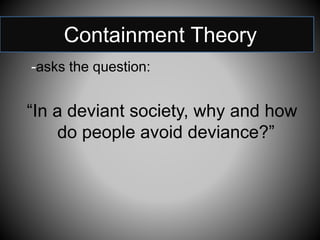
Containment Theory
-asks the question:
“In a deviant society, why and how
do people avoid deviance?”
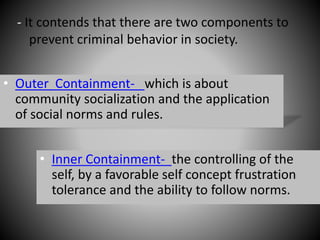
- It contends that there are two components to
prevent criminal behavior in society.
• Outer Containment- which is about
community socialization and the application
of social norms and rules.
• Inner Containment- the controlling of the
self, by a favorable self concept frustration
tolerance and the ability to follow norms.
PUSH-PULL Forces
• Forces that causes deviant behavior.
• Reckless said that we are all put through pushes and
pulls that push or pull an individual into deviant behavior.
-We can see such pushes when children are threatened by other
children to join a gang.
- An example of a pull is when a child sees that, in order to get
money to buy things, he or she can join a gang and reach their
objective. They are pulled into the gang by its attraction as a
way of earning status and making money”
• Some examples of pushes are unhappiness with
living conditions and family issues or conflicts,
overt aggressiveness, anger, and hostility,
socioeconomic problems, frustration, boredom
and racism.
• Some pulls can be delinquent peers, family
members, subcultures, and groups
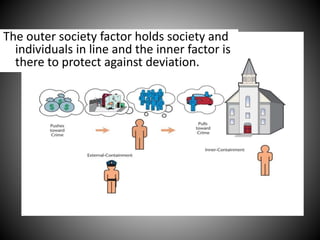
The outer society factor holds society and
individuals in line and the inner factor is
there to protect against deviation.
• The external factor is provided by groups in society, the
state, tribes and villages, family and other nuclear
groups of that manner. There has to be certain
responsibilities and guidelines for the individual, and
these are provided by the external containment.
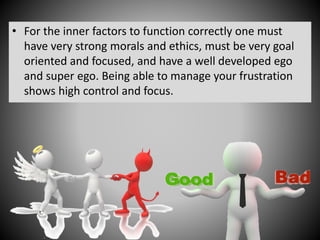
• For the inner factors to function correctly one must
have very strong morals and ethics, must be very goal
oriented and focused, and have a well developed ego
and super ego. Being able to manage your frustration
shows high control and focus.
Containment theory

Containment theory

  • 1.
    CONTAINMENT THEORY Walter Reckless Presentedby: Rovie Danielle A. Oregas BSSW III
  • 2.
    Walter Reckless • Americancriminologist • Born in Philadelphia, Pennsylvenia on January 19, 1899. • wrote a book called Juvenile Delinquency in which he explained how young offenders become criminals • Who became known because of his Containment Theory.
  • 3.
    Containment Theory -asks thequestion: “In a deviant society, why and how do people avoid deviance?”
  • 4.
    - It contendsthat there are two components to prevent criminal behavior in society. • Outer Containment- which is about community socialization and the application of social norms and rules. • Inner Containment- the controlling of the self, by a favorable self concept frustration tolerance and the ability to follow norms.
  • 5.
    PUSH-PULL Forces • Forcesthat causes deviant behavior. • Reckless said that we are all put through pushes and pulls that push or pull an individual into deviant behavior. -We can see such pushes when children are threatened by other children to join a gang. - An example of a pull is when a child sees that, in order to get money to buy things, he or she can join a gang and reach their objective. They are pulled into the gang by its attraction as a way of earning status and making money”
  • 6.
    • Some examplesof pushes are unhappiness with living conditions and family issues or conflicts, overt aggressiveness, anger, and hostility, socioeconomic problems, frustration, boredom and racism. • Some pulls can be delinquent peers, family members, subcultures, and groups
  • 7.
    The outer societyfactor holds society and individuals in line and the inner factor is there to protect against deviation.
  • 8.
    • The externalfactor is provided by groups in society, the state, tribes and villages, family and other nuclear groups of that manner. There has to be certain responsibilities and guidelines for the individual, and these are provided by the external containment.
  • 9.
    • For theinner factors to function correctly one must have very strong morals and ethics, must be very goal oriented and focused, and have a well developed ego and super ego. Being able to manage your frustration shows high control and focus.