Left realism 
On Crime and Deviance
The key figure is Jock Young. 
Left realism developed because… 
• There was a strong need to find a practical solution 
for crime 
• The influence of right realism on government policy 
was strong 
They believe society is an unequal, capitalist one. But, 
they are reformist socialists, and so believe in a 
gradual change, rather than a violent overthrow.
Taking crime seriously 
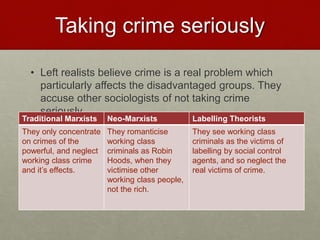
• Left realists believe crime is a real problem which 
particularly affects the disadvantaged groups. They 
accuse other sociologists of not taking crime 
seriously. 
Traditional Marxists Neo-Marxists Labelling Theorists 
They only concentrate 
on crimes of the 
powerful, and neglect 
working class crime 
and it’s effects. 
They romanticise 
working class 
criminals as Robin 
Hoods, when they 
victimise other 
working class people, 
not the rich. 
They see working class 
criminals as the victims of 
labelling by social control 
agents, and so neglect the 
real victims of crime.
• Young says the increase in crime rates has led to 
an aetiological crisis (a crisis in explanation of 
crime). Other theorists deny the increase in crime is 
real; they believe it is due to an increase in the 
report of crime or labelling of the poor. 
• Left realists say more people are reporting crime 
because more people are falling victim to it.
evidence 
• They use surveys as evidence. Local surveys 
indicated more crime than official statistics. They 
also showed that disadvantaged groups are more 
likely to be victims, so they have a greater fear of 
crime. However, they are less likely to report crime 
which could be due to the fact that they are less 
likely to have their problems dealt with by the police.
The causes of crime 
Lea and Young identify three related causes of 
crime… 
• Relative deprivation 
• Subculture 
• Marginalisation
Relative deprivation 
• They believe deprivation isn’t the direct cause – living 
standards have risen since the 1950s, but so have 
crime rates. Lea and Young explain this paradox that 
society is more prosperous but more crime ridden. 
They say the media and advertisements raise the 
expectations of those who can’t afford material goods 
and to obtain them, have to resort to crime. 
• Runciman refers to how deprived someone feels in 
relation to others or their own expectations. This leads 
to crime in order to obtain what they feel they are 
entitled to.
Relative deprivation 
• Young says: “the lethal combination is relative 
deprivation and individualism” 
• This causes crime by encouraging the pursuit of self 
interest at the expense of others. An increase in 
individualism causes the disintegration of families 
and communities by undermining the values of 
mutual support and selflessness. This weakens the 
informal controls that such groups exercise over 
individuals, creating a spiral of increasing crime and 
aggression.
subculture 
• (Left realists owe much to Merton, Cloward and Ohlin and Cohen for 
identifying this as a cause) 
• For left realists, a subculture is a group’s collective 
solution to the problem of relative deprivation. 
Different groups produce different subcultural 
responses to this problem. For example, some turn 
to crime to close the ‘deprivation gap’, whilst others 
find religion offers spiritual comfort and ‘theodicy of 
disprivilege’ (Weber). 
• They think subcultures still subscribe to the values 
and goals of mainstream society but can’t achieve 
them legitimately.
marginalisation 
• Unlike workers, unemployed youths lack clear goals 
and organisations to represent their interests. They 
are marginalised and so have a sense of resentment 
and frustration which they express through criminal 
acts. Due to being powerless, they can’t improve 
their position.
Late modernity, exclusion 
and crime 
• Young says we are now living in the stage of society where 
instability, insecurity and exclusion make the problem of crime 
worse. This contrasts to the 1950s/60s ‘Golden Age’ society 
which had a general consensus. 
• De-industrialisation has increased; many jobs were short-term, 
low paid and insecure. These changes destabilised families 
and community life which led to an increase in divorce rates 
(as have New Right policies). This in turn led to an increase in 
marginalisation and exclusion of those ‘at the bottom’.
Late modernity, exclusion 
and crime 
Meanwhile, greater inequality between rich and poor and the 
spread of free market values encouraging individualism have 
increased since the sense of relative deprivation. Young also 
notes the growing contrast between cultural inclusion and 
economic inclusion as a source of relative deprivation… 
• Media-saturated late modern society promotes cultural 
inclusion: even the poor have access to the media’s materialistic 
, consumerist messages. 
• There is greater emphasis on leisure, which stresses personal 
consumption and immediate gratification. 
• The poor are systematically excluded from opportunities to gain 
the ‘glittering prizes of a wealthy society’ despite the 
meritocracy ideology.
Late modernity, exclusion 
and crime 
• Young’s contrast is similair to Merton’s ‘notion of anomie’ that 
society creates crime by setting cultural goals but denying 
people the opportunity to achieve them legitimately. 
• Another trend is the relative deprivation is generalised 
throughout society. There is widespread resentment at the 
undeservedly high rewards that some receive. Also, there is 
‘relative deprivation downwards’ where the middle class were 
disciplined and had to work hard to succeed in their competitive 
work environment and so resent the stereotypical underclass as 
idle, irresponsible and hedonistic and see them as living off 
undeserved state handouts.
Late modernity, exclusion 
and crime 
The result of this trend towards exclusion is that the amount and types 
of crime are changing in late modern society. 
• Firstly, crime is more widespread and is found increasingly throughout 
the social structure. 
• Crime is nastier; there has been an increase in ‘hate crime’ and it is 
often the result of relative deprivation downwards (e.g. racist attacks 
against asylum seekers) 
• Reactions to crime by the public and the state are changing. Society 
is more diverse and there is less public consensus on right and wrong 
(blurred boundaries) 
• Informal controls become less effective as families and communities 
disintegrate. 
These factors make the public more intolerant and leads to demands for 
harsher formal controls.
Tackling crime 
• Left realists also aim to devise solutions to the 
problem of crime. They believe we must… 
• Improve Policing and Control 
• Deal with the Deeper Structural Cases of Crime
Policing and control 
Kinsey, Lea and Young argue that police clear-up rates are too 
low to act as a deterrent to crime. They also argue police spend 
too little time investigating crime. They believe the public must 
become more involved in determining the police’s priorities and 
style of policing. 
(AO2 marks: Nottingham police have become the first to use an online rate system – 
you can rate the police out of 5 stars). 
The police depend on the public to provide them with crime 
information, but they are losing public support, especially in inner 
cities and amongst ethnic minorities and youth. So, the flow of 
information dries up which means the police have resorted to 
‘military policing’ (‘swamping’ areas and random stop and 
searches). This results in a vicious circle… The public lose faith in 
the police  they don’t report crime  the police swamp areas, 
so certain people/communities feel victimised  people don’t
Policing and control 
So, policing needs to be made more accountable to 
local communities and deal with local concerns. Their 
relationship with local communities needs to improve 
by spending more time investigating crime and 
changing their priorities. 
However, left realists believe a ‘multi-agency’ 
approach is needed.
Tackling the structural 
cases 
Left realists thing the causes of crime lie in the 
unequal structure of society and major structural 
changes are needed. 
Young says we must deal with the unequal 
opportunities available to locals, the unfairness of 
rewards and discrimination. To do this, we should 
provide decent jobs for everyone, improve housing 
and community facilities, be tolerant of diversity and 
cease stereotyping.
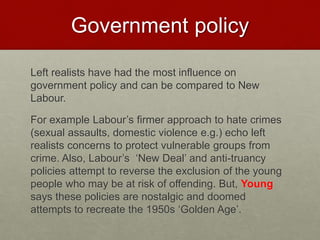
Government policy 
Left realists have had the most influence on 
government policy and can be compared to New 
Labour. 
For example Labour’s firmer approach to hate crimes 
(sexual assaults, domestic violence e.g.) echo left 
realists concerns to protect vulnerable groups from 
crime. Also, Labour’s ‘New Deal’ and anti-truancy 
policies attempt to reverse the exclusion of the young 
people who may be at risk of offending. But, Young 
says these policies are nostalgic and doomed 
attempts to recreate the 1950s ‘Golden Age’.
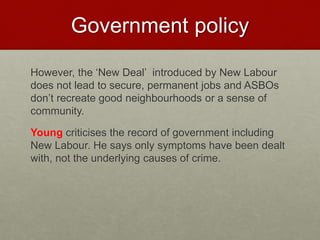
Government policy 
However, the ‘New Deal’ introduced by New Labour 
does not lead to secure, permanent jobs and ASBOs 
don’t recreate good neighbourhoods or a sense of 
community. 
Young criticises the record of government including 
New Labour. He says only symptoms have been dealt 
with, not the underlying causes of crime.
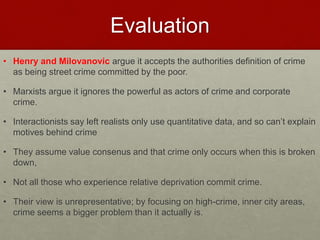
Evaluation 
• Henry and Milovanovic argue it accepts the authorities definition of crime 
as being street crime committed by the poor. 
• Marxists argue it ignores the powerful as actors of crime and corporate 
crime. 
• Interactionists say left realists only use quantitative data, and so can’t explain 
motives behind crime 
• They assume value consenus and that crime only occurs when this is broken 
down, 
• Not all those who experience relative deprivation commit crime. 
• Their view is unrepresentative; by focusing on high-crime, inner city areas, 
crime seems a bigger problem than it actually is.
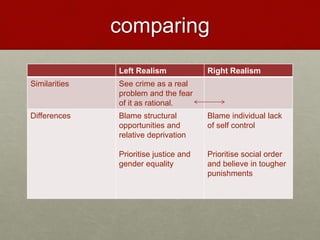
comparing 
Left Realism Right Realism 
Similarities See crime as a real 
problem and the fear 
of it as rational. 
Differences Blame structural 
opportunities and 
relative deprivation 
Prioritise justice and 
gender equality 
Blame individual lack 
of self control 
Prioritise social order 
and believe in tougher 
punishments

Left Realism

  • 1.
    Left realism OnCrime and Deviance
  • 2.
    The key figureis Jock Young. Left realism developed because… • There was a strong need to find a practical solution for crime • The influence of right realism on government policy was strong They believe society is an unequal, capitalist one. But, they are reformist socialists, and so believe in a gradual change, rather than a violent overthrow.
  • 3.
    Taking crime seriously • Left realists believe crime is a real problem which particularly affects the disadvantaged groups. They accuse other sociologists of not taking crime seriously. Traditional Marxists Neo-Marxists Labelling Theorists They only concentrate on crimes of the powerful, and neglect working class crime and it’s effects. They romanticise working class criminals as Robin Hoods, when they victimise other working class people, not the rich. They see working class criminals as the victims of labelling by social control agents, and so neglect the real victims of crime.
  • 4.
    • Young saysthe increase in crime rates has led to an aetiological crisis (a crisis in explanation of crime). Other theorists deny the increase in crime is real; they believe it is due to an increase in the report of crime or labelling of the poor. • Left realists say more people are reporting crime because more people are falling victim to it.
  • 5.
    evidence • Theyuse surveys as evidence. Local surveys indicated more crime than official statistics. They also showed that disadvantaged groups are more likely to be victims, so they have a greater fear of crime. However, they are less likely to report crime which could be due to the fact that they are less likely to have their problems dealt with by the police.
  • 6.
    The causes ofcrime Lea and Young identify three related causes of crime… • Relative deprivation • Subculture • Marginalisation
  • 7.
    Relative deprivation •They believe deprivation isn’t the direct cause – living standards have risen since the 1950s, but so have crime rates. Lea and Young explain this paradox that society is more prosperous but more crime ridden. They say the media and advertisements raise the expectations of those who can’t afford material goods and to obtain them, have to resort to crime. • Runciman refers to how deprived someone feels in relation to others or their own expectations. This leads to crime in order to obtain what they feel they are entitled to.
  • 8.
    Relative deprivation •Young says: “the lethal combination is relative deprivation and individualism” • This causes crime by encouraging the pursuit of self interest at the expense of others. An increase in individualism causes the disintegration of families and communities by undermining the values of mutual support and selflessness. This weakens the informal controls that such groups exercise over individuals, creating a spiral of increasing crime and aggression.
  • 9.
    subculture • (Leftrealists owe much to Merton, Cloward and Ohlin and Cohen for identifying this as a cause) • For left realists, a subculture is a group’s collective solution to the problem of relative deprivation. Different groups produce different subcultural responses to this problem. For example, some turn to crime to close the ‘deprivation gap’, whilst others find religion offers spiritual comfort and ‘theodicy of disprivilege’ (Weber). • They think subcultures still subscribe to the values and goals of mainstream society but can’t achieve them legitimately.
  • 10.
    marginalisation • Unlikeworkers, unemployed youths lack clear goals and organisations to represent their interests. They are marginalised and so have a sense of resentment and frustration which they express through criminal acts. Due to being powerless, they can’t improve their position.
  • 11.
    Late modernity, exclusion and crime • Young says we are now living in the stage of society where instability, insecurity and exclusion make the problem of crime worse. This contrasts to the 1950s/60s ‘Golden Age’ society which had a general consensus. • De-industrialisation has increased; many jobs were short-term, low paid and insecure. These changes destabilised families and community life which led to an increase in divorce rates (as have New Right policies). This in turn led to an increase in marginalisation and exclusion of those ‘at the bottom’.
  • 12.
    Late modernity, exclusion and crime Meanwhile, greater inequality between rich and poor and the spread of free market values encouraging individualism have increased since the sense of relative deprivation. Young also notes the growing contrast between cultural inclusion and economic inclusion as a source of relative deprivation… • Media-saturated late modern society promotes cultural inclusion: even the poor have access to the media’s materialistic , consumerist messages. • There is greater emphasis on leisure, which stresses personal consumption and immediate gratification. • The poor are systematically excluded from opportunities to gain the ‘glittering prizes of a wealthy society’ despite the meritocracy ideology.
  • 13.
    Late modernity, exclusion and crime • Young’s contrast is similair to Merton’s ‘notion of anomie’ that society creates crime by setting cultural goals but denying people the opportunity to achieve them legitimately. • Another trend is the relative deprivation is generalised throughout society. There is widespread resentment at the undeservedly high rewards that some receive. Also, there is ‘relative deprivation downwards’ where the middle class were disciplined and had to work hard to succeed in their competitive work environment and so resent the stereotypical underclass as idle, irresponsible and hedonistic and see them as living off undeserved state handouts.
  • 14.
    Late modernity, exclusion and crime The result of this trend towards exclusion is that the amount and types of crime are changing in late modern society. • Firstly, crime is more widespread and is found increasingly throughout the social structure. • Crime is nastier; there has been an increase in ‘hate crime’ and it is often the result of relative deprivation downwards (e.g. racist attacks against asylum seekers) • Reactions to crime by the public and the state are changing. Society is more diverse and there is less public consensus on right and wrong (blurred boundaries) • Informal controls become less effective as families and communities disintegrate. These factors make the public more intolerant and leads to demands for harsher formal controls.
  • 15.
    Tackling crime •Left realists also aim to devise solutions to the problem of crime. They believe we must… • Improve Policing and Control • Deal with the Deeper Structural Cases of Crime
  • 16.
    Policing and control Kinsey, Lea and Young argue that police clear-up rates are too low to act as a deterrent to crime. They also argue police spend too little time investigating crime. They believe the public must become more involved in determining the police’s priorities and style of policing. (AO2 marks: Nottingham police have become the first to use an online rate system – you can rate the police out of 5 stars). The police depend on the public to provide them with crime information, but they are losing public support, especially in inner cities and amongst ethnic minorities and youth. So, the flow of information dries up which means the police have resorted to ‘military policing’ (‘swamping’ areas and random stop and searches). This results in a vicious circle… The public lose faith in the police  they don’t report crime  the police swamp areas, so certain people/communities feel victimised  people don’t
  • 17.
    Policing and control So, policing needs to be made more accountable to local communities and deal with local concerns. Their relationship with local communities needs to improve by spending more time investigating crime and changing their priorities. However, left realists believe a ‘multi-agency’ approach is needed.
  • 18.
    Tackling the structural cases Left realists thing the causes of crime lie in the unequal structure of society and major structural changes are needed. Young says we must deal with the unequal opportunities available to locals, the unfairness of rewards and discrimination. To do this, we should provide decent jobs for everyone, improve housing and community facilities, be tolerant of diversity and cease stereotyping.
  • 19.
    Government policy Leftrealists have had the most influence on government policy and can be compared to New Labour. For example Labour’s firmer approach to hate crimes (sexual assaults, domestic violence e.g.) echo left realists concerns to protect vulnerable groups from crime. Also, Labour’s ‘New Deal’ and anti-truancy policies attempt to reverse the exclusion of the young people who may be at risk of offending. But, Young says these policies are nostalgic and doomed attempts to recreate the 1950s ‘Golden Age’.
  • 20.
    Government policy However,the ‘New Deal’ introduced by New Labour does not lead to secure, permanent jobs and ASBOs don’t recreate good neighbourhoods or a sense of community. Young criticises the record of government including New Labour. He says only symptoms have been dealt with, not the underlying causes of crime.
  • 21.
    Evaluation • Henryand Milovanovic argue it accepts the authorities definition of crime as being street crime committed by the poor. • Marxists argue it ignores the powerful as actors of crime and corporate crime. • Interactionists say left realists only use quantitative data, and so can’t explain motives behind crime • They assume value consenus and that crime only occurs when this is broken down, • Not all those who experience relative deprivation commit crime. • Their view is unrepresentative; by focusing on high-crime, inner city areas, crime seems a bigger problem than it actually is.
  • 22.
    comparing Left RealismRight Realism Similarities See crime as a real problem and the fear of it as rational. Differences Blame structural opportunities and relative deprivation Prioritise justice and gender equality Blame individual lack of self control Prioritise social order and believe in tougher punishments