Right Realism
(opposite to Left Realism)
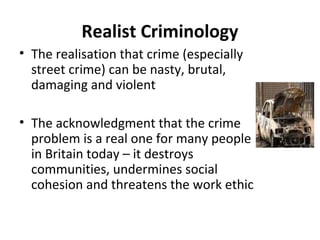
Realist Criminology
• The realisation that crime (especially
street crime) can be nasty, brutal,
damaging and violent
• The acknowledgment that the crime
problem is a real one for many people
in Britain today – it destroys
communities, undermines social
cohesion and threatens the work ethic
RIGHT REALISM
Sought practical crime CONTROL measures –
worry less about finding the causes of crime
but concentrate on CONTROLLING IT – this is
a CONTROL theory:
- “GET TOUGH”
- Labelling and Critical criminologists are far too
sympathetic to criminals and excuse criminal
behaviour with reference to police labelling and
poverty/inequality/capitalism
RIGHT REALISM – crime does not result
from poverty:
• James Q. Wilson (1975) – in the 1960s in the US anti-
poverty programmes were accompanied by
enormous crime increases
• Ron Clarke - since the end of World War II (1945)
there have been steadily rising incomes in the UK –
but this has been accompanied by rising not falling
crime rates
• If the Marxists are right and crime is caused by
poverty why is it that the old tend to be poor yet
they have a very low crime rate
THE CAUSES OF CRIME
• Although Right Realists say they are not as
interested in finding the causes of crime as
controlling it they argue that there are THREE
FACTORS which cause crime.
• We can remember these three by using the
acronym memory jogger BUS R
• BIOLOGICAL differences
• UNDERCLASS/ (faulty) SOCIALISATION
• RATIONAL Choice Theory
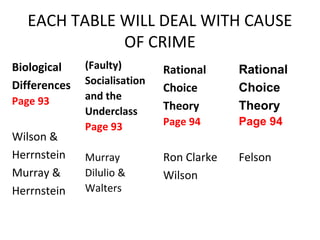
EACH TABLE WILL DEAL WITH CAUSE
OF CRIME
Biological
Differences
Page 93
Wilson &
Herrnstein
Murray &
Herrnstein
Rational
Choice
Theory
Page 94
Ron Clarke
Wilson
(Faulty)
Socialisation
and the
Underclass
Page 93
Murray
Dilulio &
Walters
Rational
Choice
Theory
Page 94
Felson
RIGHT REALISM CAUSES OF CRIME
1 BIOLOGICAL DIFFERENCES
• Herrnstein & Murray (1994) argue that the main
cause of crime is low intelligence (this they argue
is biologically determined)
• Wilson & Herrnstein (1985) use a biosocial
theory (crime is caused by a combination of
biological and social factors) – some people are
innately more strongly predisposed to commit
crime – get this from personality traits like
extroversion and aggressiveness which makes
them risk-takers without self-control who act on
impulse
RIGHT REALISM CAUSES OF CRIME
2 SOCIALISATION AND THE UNDERCLASS
• Faulty socialisation means that kids do not learn self-
control and do not internalise moral values of right
and wrong (they remain feral children)
• Charles Murray (1994) of New Right – argument that
misguided generous welfare benefits have created a
‘new rabble’ or underclass and a mass of single
parent families which spawn delinquents. The
Underclass live in different world to respectable
people, their lifestyles characterised by deplorable
and reckless and feckless behaviour.
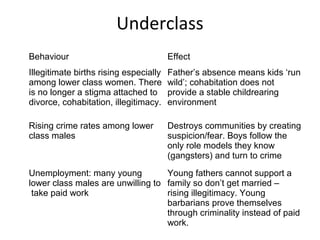
Underclass
Behaviour Effect
Illegitimate births rising especially
among lower class women. There
is no longer a stigma attached to
divorce, cohabitation, illegitimacy.
Father’s absence means kids ‘run
wild’; cohabitation does not
provide a stable childrearing
environment
Rising crime rates among lower
class males
Destroys communities by creating
suspicion/fear. Boys follow the
only role models they know
(gangsters) and turn to crime
Unemployment: many young
lower class males are unwilling to
take paid work
Young fathers cannot support a
family so don’t get married –
rising illegitimacy. Young
barbarians prove themselves
through criminality instead of paid
work.
Bennett, Dilulio & Walters (1996)
Crime is the result of
‘growing up surrounded by deviant, delinquent
and criminal adults in a practically perfect
criminogenic environment – that is, [one] that
seems almost consciously designed to produce
vicious, predatory unrepentant street
criminals’.
RIGHT REALISM CAUSES OF CRIME
3 RATIONAL CHOICE THEORY
• In this idea the criminal is seen as essentially rational
• Crime is committed when the chances are highest of
getting the maximum reward with the minimum risk
• If you can get away with it crime will rise
• If crime is more profitable than taking a job then
crime will rise
• It’s a form of "cost / benefit" analysis i.e. constantly
weighing up the costs and benefits of any action
RATIONAL CHOICE THEORY
• Right realists argue that the perceived costs
crime are low – that is why the crime rate has
increased. There is too little chance of being
caught, and when they are caught they are
treated leniently
• Marcus Felson (1998) argues that the presence
of ‘capable guardians’ like policemen or
neighbours deter crime because they tip the
cost-benefit analysis of crime in favour of not
offending
Jeremy Bentham (1748-1832)
English philosopher
Utilitarianism:Utilitarian Principle
• Humans are concerned with the search for pleasure
and the avoidance of pain
• The individual constantly takes stock of or reflects on
his or her actions, situation and choices
• The individual is seen as a calculating being who
assesses the sum total of pleasure and pain in every
action before acting
• If a given action will lead to a surplus of profit or
pleasure, then this path will be chosen
Right Realism – TACKLING CRIME
Given the view that crime is caused by biological
differences, faulty socialisation and rational
choice the wisest course of action is thus for
society to BOTH:
• Lessen the risks of the innocent being victimised
i.e. PREVENT
• Increase the costs of crime to those who
perpetrate it by swift and severe penalties i.e.
PUNISH - Certainty, swiftness and severity of
punishment of penalty can deter and reduce
crime
PREVENT and PUNISH
RIGHT REALISM: Practical Solutions
1. Pro-active policing – Regulation/Zero-Tolerance
2. Broken Windows Policy
3. Strong Communities – naming and shaming
4. Target hardening
5. Situation management/Defensible space
6. Crime Deterrence
7. Swift and lengthy imprisonment for those who
won’t obey the laws
1 Pro-active Policing / Zero Tolerance
• In this sense, the role of the police is
seen to be "pro-active" involving such
things as:
• Maintaining a strong presence "on the
ground / on the beat".
• Keeping in close touch / working with
"local people" to prevent crime.
• Keeping the streets clear of "potential
criminals" (youths, drug abusers,
beggars, prostitutes and so forth).
Zero Tolerance of this?
2 ‘Broken Windows’ policy
Wilson & Kelling (1982)
• Essential to maintain the character of
neighbourhoods, so all signs of deterioration
must be dealt with immediately
• Repair broken windows
• Remove graffiti
3 Strong Communities and ‘Naming and
Shaming’
• If the community is strong, involvement in
crime should result in disgrace and loss of
standing in the community through ‘naming
and shaming’
• Based in Etzioni’s theory of Communitarianism
which argues that only by their own efforts
can communities solve social problems
4 Target Hardening
• Control approach to crime
• Attempts to limit the frequency of crime by a
policy of target-hardening i.e. moving
potential law-breakers on towards harder
targets in the hope that the effort involved
will deter them altogether
Target Hardening
5 Situation management
• involves the management, design or
manipulation of the immediate environment
to prevent crime or reduce the opportunity
• E.g. more street lighting, blocking off back
access to houses, making public spaces visible,
CCTV
6 Crime Deterrence
• Highly visible car locks
• Burglar alarms on houses
• Bars on windows
• All these things will deter the
rational criminal who will look for a
softer target
• nothing deters more than the
certainty of detection
7 PUNISHMENT
Prison -
put criminals out of circulation
Control Theory
• New Right Realism is often linked to so-called
Control Theory
• i.e. its more about controlling and managing crime
than actually trying to find the causes or solving it
• If we accept that humans are selfish, rational
calculating individuals then crime will always be with
us and keeping the levels of crime down is perhaps
the best we can hope for!

Right realism powerpoint def

  • 1.
  • 2.
    Realist Criminology • Therealisation that crime (especially street crime) can be nasty, brutal, damaging and violent • The acknowledgment that the crime problem is a real one for many people in Britain today – it destroys communities, undermines social cohesion and threatens the work ethic
  • 3.
    RIGHT REALISM Sought practicalcrime CONTROL measures – worry less about finding the causes of crime but concentrate on CONTROLLING IT – this is a CONTROL theory: - “GET TOUGH” - Labelling and Critical criminologists are far too sympathetic to criminals and excuse criminal behaviour with reference to police labelling and poverty/inequality/capitalism
  • 4.
    RIGHT REALISM –crime does not result from poverty: • James Q. Wilson (1975) – in the 1960s in the US anti- poverty programmes were accompanied by enormous crime increases • Ron Clarke - since the end of World War II (1945) there have been steadily rising incomes in the UK – but this has been accompanied by rising not falling crime rates • If the Marxists are right and crime is caused by poverty why is it that the old tend to be poor yet they have a very low crime rate
  • 5.
    THE CAUSES OFCRIME • Although Right Realists say they are not as interested in finding the causes of crime as controlling it they argue that there are THREE FACTORS which cause crime. • We can remember these three by using the acronym memory jogger BUS R • BIOLOGICAL differences • UNDERCLASS/ (faulty) SOCIALISATION • RATIONAL Choice Theory
  • 6.
    EACH TABLE WILLDEAL WITH CAUSE OF CRIME Biological Differences Page 93 Wilson & Herrnstein Murray & Herrnstein Rational Choice Theory Page 94 Ron Clarke Wilson (Faulty) Socialisation and the Underclass Page 93 Murray Dilulio & Walters Rational Choice Theory Page 94 Felson
  • 7.
    RIGHT REALISM CAUSESOF CRIME 1 BIOLOGICAL DIFFERENCES • Herrnstein & Murray (1994) argue that the main cause of crime is low intelligence (this they argue is biologically determined) • Wilson & Herrnstein (1985) use a biosocial theory (crime is caused by a combination of biological and social factors) – some people are innately more strongly predisposed to commit crime – get this from personality traits like extroversion and aggressiveness which makes them risk-takers without self-control who act on impulse
  • 8.
    RIGHT REALISM CAUSESOF CRIME 2 SOCIALISATION AND THE UNDERCLASS • Faulty socialisation means that kids do not learn self- control and do not internalise moral values of right and wrong (they remain feral children) • Charles Murray (1994) of New Right – argument that misguided generous welfare benefits have created a ‘new rabble’ or underclass and a mass of single parent families which spawn delinquents. The Underclass live in different world to respectable people, their lifestyles characterised by deplorable and reckless and feckless behaviour.
  • 9.
    Underclass Behaviour Effect Illegitimate birthsrising especially among lower class women. There is no longer a stigma attached to divorce, cohabitation, illegitimacy. Father’s absence means kids ‘run wild’; cohabitation does not provide a stable childrearing environment Rising crime rates among lower class males Destroys communities by creating suspicion/fear. Boys follow the only role models they know (gangsters) and turn to crime Unemployment: many young lower class males are unwilling to take paid work Young fathers cannot support a family so don’t get married – rising illegitimacy. Young barbarians prove themselves through criminality instead of paid work.
  • 10.
    Bennett, Dilulio &Walters (1996) Crime is the result of ‘growing up surrounded by deviant, delinquent and criminal adults in a practically perfect criminogenic environment – that is, [one] that seems almost consciously designed to produce vicious, predatory unrepentant street criminals’.
  • 11.
    RIGHT REALISM CAUSESOF CRIME 3 RATIONAL CHOICE THEORY • In this idea the criminal is seen as essentially rational • Crime is committed when the chances are highest of getting the maximum reward with the minimum risk • If you can get away with it crime will rise • If crime is more profitable than taking a job then crime will rise • It’s a form of "cost / benefit" analysis i.e. constantly weighing up the costs and benefits of any action
  • 12.
    RATIONAL CHOICE THEORY •Right realists argue that the perceived costs crime are low – that is why the crime rate has increased. There is too little chance of being caught, and when they are caught they are treated leniently • Marcus Felson (1998) argues that the presence of ‘capable guardians’ like policemen or neighbours deter crime because they tip the cost-benefit analysis of crime in favour of not offending
  • 13.
    Jeremy Bentham (1748-1832) Englishphilosopher Utilitarianism:Utilitarian Principle • Humans are concerned with the search for pleasure and the avoidance of pain • The individual constantly takes stock of or reflects on his or her actions, situation and choices • The individual is seen as a calculating being who assesses the sum total of pleasure and pain in every action before acting • If a given action will lead to a surplus of profit or pleasure, then this path will be chosen
  • 14.
    Right Realism –TACKLING CRIME Given the view that crime is caused by biological differences, faulty socialisation and rational choice the wisest course of action is thus for society to BOTH: • Lessen the risks of the innocent being victimised i.e. PREVENT • Increase the costs of crime to those who perpetrate it by swift and severe penalties i.e. PUNISH - Certainty, swiftness and severity of punishment of penalty can deter and reduce crime
  • 15.
    PREVENT and PUNISH RIGHTREALISM: Practical Solutions 1. Pro-active policing – Regulation/Zero-Tolerance 2. Broken Windows Policy 3. Strong Communities – naming and shaming 4. Target hardening 5. Situation management/Defensible space 6. Crime Deterrence 7. Swift and lengthy imprisonment for those who won’t obey the laws
  • 16.
    1 Pro-active Policing/ Zero Tolerance • In this sense, the role of the police is seen to be "pro-active" involving such things as: • Maintaining a strong presence "on the ground / on the beat". • Keeping in close touch / working with "local people" to prevent crime. • Keeping the streets clear of "potential criminals" (youths, drug abusers, beggars, prostitutes and so forth).
  • 17.
  • 18.
    2 ‘Broken Windows’policy Wilson & Kelling (1982) • Essential to maintain the character of neighbourhoods, so all signs of deterioration must be dealt with immediately • Repair broken windows • Remove graffiti
  • 19.
    3 Strong Communitiesand ‘Naming and Shaming’ • If the community is strong, involvement in crime should result in disgrace and loss of standing in the community through ‘naming and shaming’ • Based in Etzioni’s theory of Communitarianism which argues that only by their own efforts can communities solve social problems
  • 20.
    4 Target Hardening •Control approach to crime • Attempts to limit the frequency of crime by a policy of target-hardening i.e. moving potential law-breakers on towards harder targets in the hope that the effort involved will deter them altogether
  • 21.
  • 22.
    5 Situation management •involves the management, design or manipulation of the immediate environment to prevent crime or reduce the opportunity • E.g. more street lighting, blocking off back access to houses, making public spaces visible, CCTV
  • 23.
    6 Crime Deterrence •Highly visible car locks • Burglar alarms on houses • Bars on windows • All these things will deter the rational criminal who will look for a softer target • nothing deters more than the certainty of detection
  • 24.
    7 PUNISHMENT Prison - putcriminals out of circulation
  • 25.
    Control Theory • NewRight Realism is often linked to so-called Control Theory • i.e. its more about controlling and managing crime than actually trying to find the causes or solving it • If we accept that humans are selfish, rational calculating individuals then crime will always be with us and keeping the levels of crime down is perhaps the best we can hope for!