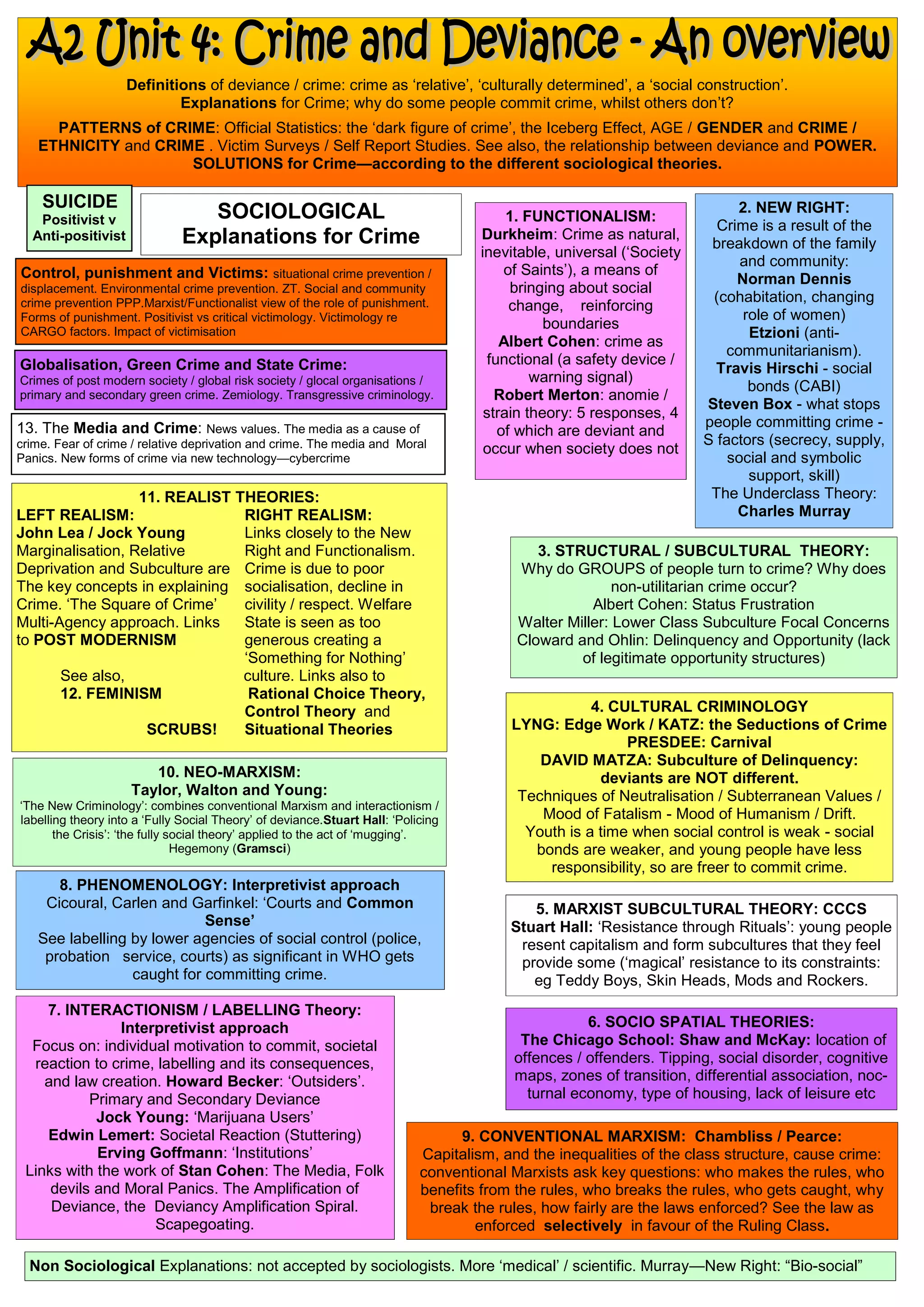
Definitions of deviance / crime: crime as ‘relative’, ‘culturally determined’, a ‘social construction’.
                            Explanations for Crime; why do some people commit crime, whilst others don’t?
     PATTERNS of CRIME: Official Statistics: the ‘dark figure of crime’, the Iceberg Effect, AGE / GENDER and CRIME /
   ETHNICITY and CRIME . Victim Surveys / Self Report Studies. See also, the relationship between deviance and POWER.
                     SOLUTIONS for Crime—according to the different sociological theories.

    SUICIDE                                                                                                                 2. NEW RIGHT:
   Positivist v                  SOCIOLOGICAL                                             1. FUNCTIONALISM:
                                                                                                                         Crime is a result of the
  Anti-positivist             Explanations for Crime                                 Durkheim: Crime as natural,
                                                                                                                        breakdown of the family
                                                                                     inevitable, universal (‘Society
                                                                                                                             and community:
Control, punishment and Victims: situational crime prevention /                           of Saints’), a means of
                                                                                                                            Norman Dennis
displacement. Environmental crime prevention. ZT. Social and community                     bringing about social
crime prevention PPP.Marxist/Functionalist view of the role of punishment.                                              (cohabitation, changing
                                                                                           change, reinforcing
Forms of punishment. Positivist vs critical victimology. Victimology re                                                      role of women)
                                                                                                boundaries
CARGO factors. Impact of victimisation                                                                                        Etzioni (anti-
                                                                                         Albert Cohen: crime as
                                                                                                                          communitarianism).
Globalisation, Green Crime and State Crime:                                            functional (a safety device /
                                                                                                                         Travis Hirschi - social
Crimes of post modern society / global risk society / glocal organisations /                  warning signal)
                                                                                                                              bonds (CABI)
primary and secondary green crime. Zemiology. Transgressive criminology.                Robert Merton: anomie /
                                                                                                                       Steven Box - what stops
                                                                                      strain theory: 5 responses, 4
13. The Media and Crime: News values. The media as a cause of                                                          people committing crime -
                                                                                         of which are deviant and
crime. Fear of crime / relative deprivation and crime. The media and Moral                                             S factors (secrecy, supply,
                                                                                      occur when society does not
Panics. New forms of crime via new technology—cybercrime                                                                   social and symbolic
                                                                                                                              support, skill)
                  11. REALIST THEORIES:                                                                                 The Underclass Theory:
LEFT REALISM:                  RIGHT REALISM:                                                                               Charles Murray
John Lea / Jock Young          Links closely to the New
Marginalisation, Relative      Right and Functionalism.                                      3. STRUCTURAL / SUBCULTURAL THEORY:
Deprivation and Subculture are Crime is due to poor                                       Why do GROUPS of people turn to crime? Why does
The key concepts in explaining socialisation, decline in                                                 non-utilitarian crime occur?
Crime. ‘The Square of Crime’   civility / respect. Welfare                                           Albert Cohen: Status Frustration
Multi-Agency approach. Links   State is seen as too                                       Walter Miller: Lower Class Subculture Focal Concerns
to POST MODERNISM              generous creating a                                        Cloward and Ohlin: Delinquency and Opportunity (lack
                               ‘Something for Nothing’                                             of legitimate opportunity structures)
       See also,               culture. Links also to
       12. FEMINISM             Rational Choice Theory,
                               Control Theory and                                                    4. CULTURAL CRIMINOLOGY
                   SCRUBS!     Situational Theories                                      LYNG: Edge Work / KATZ: the Seductions of Crime
                                                                                                          PRESDEE: Carnival
                                                                                             DAVID MATZA: Subculture of Delinquency:
                        10. NEO-MARXISM:                                                              deviants are NOT different.
                     Taylor, Walton and Young:                                            Techniques of Neutralisation / Subterranean Values /
‘The New Criminology’: combines conventional Marxism and interactionism /
labelling theory into a ‘Fully Social Theory’ of deviance.Stuart Hall: ‘Policing             Mood of Fatalism - Mood of Humanism / Drift.
       the Crisis’: ‘the fully social theory’ applied to the act of ‘mugging’.             Youth is a time when social control is weak - social
                                Hegemony (Gramsci)                                          bonds are weaker, and young people have less
                                                                                              responsibility, so are freer to commit crime.
      8. PHENOMENOLOGY: Interpretivist approach
    Cicoural, Carlen and Garfinkel: ‘Courts and Common                                      5. MARXIST SUBCULTURAL THEORY: CCCS
                            Sense’                                                       Stuart Hall: ‘Resistance through Rituals’: young people
   See labelling by lower agencies of social control (police,                             resent capitalism and form subcultures that they feel
    probation service, courts) as significant in WHO gets                                 provide some (‘magical’ resistance to its constraints:
                 caught for committing crime.                                               eg Teddy Boys, Skin Heads, Mods and Rockers.
    7. INTERACTIONISM / LABELLING Theory:
               Interpretivist approach                                                               6. SOCIO SPATIAL THEORIES:
  Focus on: individual motivation to commit, societal                                      The Chicago School: Shaw and McKay: location of
  reaction to crime, labelling and its consequences,                                      offences / offenders. Tipping, social disorder, cognitive
    and law creation. Howard Becker: ‘Outsiders’.                                         maps, zones of transition, differential association, noc-
           Primary and Secondary Deviance                                                   turnal economy, type of housing, lack of leisure etc
            Jock Young: ‘Marijuana Users’
    Edwin Lemert: Societal Reaction (Stuttering)                                  9. CONVENTIONAL MARXISM: Chambliss / Pearce:
            Erving Goffmann: ‘Institutions’                                 Capitalism, and the inequalities of the class structure, cause crime:
 Links with the work of Stan Cohen: The Media, Folk                         conventional Marxists ask key questions: who makes the rules, who
     devils and Moral Panics. The Amplification of                          benefits from the rules, who breaks the rules, who gets caught, why
     Deviance, the Deviancy Amplification Spiral.                            break the rules, how fairly are the laws enforced? See the law as
                    Scapegoating.                                                   enforced selectively in favour of the Ruling Class.

  Non Sociological Explanations: not accepted by sociologists. More ‘medical’ / scientific. Murray—New Right: “Bio-social”

SociologyExchange.co.uk Shared Resource

  • 1.
    Definitions of deviance/ crime: crime as ‘relative’, ‘culturally determined’, a ‘social construction’. Explanations for Crime; why do some people commit crime, whilst others don’t? PATTERNS of CRIME: Official Statistics: the ‘dark figure of crime’, the Iceberg Effect, AGE / GENDER and CRIME / ETHNICITY and CRIME . Victim Surveys / Self Report Studies. See also, the relationship between deviance and POWER. SOLUTIONS for Crime—according to the different sociological theories. SUICIDE 2. NEW RIGHT: Positivist v SOCIOLOGICAL 1. FUNCTIONALISM: Crime is a result of the Anti-positivist Explanations for Crime Durkheim: Crime as natural, breakdown of the family inevitable, universal (‘Society and community: Control, punishment and Victims: situational crime prevention / of Saints’), a means of Norman Dennis displacement. Environmental crime prevention. ZT. Social and community bringing about social crime prevention PPP.Marxist/Functionalist view of the role of punishment. (cohabitation, changing change, reinforcing Forms of punishment. Positivist vs critical victimology. Victimology re role of women) boundaries CARGO factors. Impact of victimisation Etzioni (anti- Albert Cohen: crime as communitarianism). Globalisation, Green Crime and State Crime: functional (a safety device / Travis Hirschi - social Crimes of post modern society / global risk society / glocal organisations / warning signal) bonds (CABI) primary and secondary green crime. Zemiology. Transgressive criminology. Robert Merton: anomie / Steven Box - what stops strain theory: 5 responses, 4 13. The Media and Crime: News values. The media as a cause of people committing crime - of which are deviant and crime. Fear of crime / relative deprivation and crime. The media and Moral S factors (secrecy, supply, occur when society does not Panics. New forms of crime via new technology—cybercrime social and symbolic support, skill) 11. REALIST THEORIES: The Underclass Theory: LEFT REALISM: RIGHT REALISM: Charles Murray John Lea / Jock Young Links closely to the New Marginalisation, Relative Right and Functionalism. 3. STRUCTURAL / SUBCULTURAL THEORY: Deprivation and Subculture are Crime is due to poor Why do GROUPS of people turn to crime? Why does The key concepts in explaining socialisation, decline in non-utilitarian crime occur? Crime. ‘The Square of Crime’ civility / respect. Welfare Albert Cohen: Status Frustration Multi-Agency approach. Links State is seen as too Walter Miller: Lower Class Subculture Focal Concerns to POST MODERNISM generous creating a Cloward and Ohlin: Delinquency and Opportunity (lack ‘Something for Nothing’ of legitimate opportunity structures) See also, culture. Links also to 12. FEMINISM Rational Choice Theory, Control Theory and 4. CULTURAL CRIMINOLOGY SCRUBS! Situational Theories LYNG: Edge Work / KATZ: the Seductions of Crime PRESDEE: Carnival DAVID MATZA: Subculture of Delinquency: 10. NEO-MARXISM: deviants are NOT different. Taylor, Walton and Young: Techniques of Neutralisation / Subterranean Values / ‘The New Criminology’: combines conventional Marxism and interactionism / labelling theory into a ‘Fully Social Theory’ of deviance.Stuart Hall: ‘Policing Mood of Fatalism - Mood of Humanism / Drift. the Crisis’: ‘the fully social theory’ applied to the act of ‘mugging’. Youth is a time when social control is weak - social Hegemony (Gramsci) bonds are weaker, and young people have less responsibility, so are freer to commit crime. 8. PHENOMENOLOGY: Interpretivist approach Cicoural, Carlen and Garfinkel: ‘Courts and Common 5. MARXIST SUBCULTURAL THEORY: CCCS Sense’ Stuart Hall: ‘Resistance through Rituals’: young people See labelling by lower agencies of social control (police, resent capitalism and form subcultures that they feel probation service, courts) as significant in WHO gets provide some (‘magical’ resistance to its constraints: caught for committing crime. eg Teddy Boys, Skin Heads, Mods and Rockers. 7. INTERACTIONISM / LABELLING Theory: Interpretivist approach 6. SOCIO SPATIAL THEORIES: Focus on: individual motivation to commit, societal The Chicago School: Shaw and McKay: location of reaction to crime, labelling and its consequences, offences / offenders. Tipping, social disorder, cognitive and law creation. Howard Becker: ‘Outsiders’. maps, zones of transition, differential association, noc- Primary and Secondary Deviance turnal economy, type of housing, lack of leisure etc Jock Young: ‘Marijuana Users’ Edwin Lemert: Societal Reaction (Stuttering) 9. CONVENTIONAL MARXISM: Chambliss / Pearce: Erving Goffmann: ‘Institutions’ Capitalism, and the inequalities of the class structure, cause crime: Links with the work of Stan Cohen: The Media, Folk conventional Marxists ask key questions: who makes the rules, who devils and Moral Panics. The Amplification of benefits from the rules, who breaks the rules, who gets caught, why Deviance, the Deviancy Amplification Spiral. break the rules, how fairly are the laws enforced? See the law as Scapegoating. enforced selectively in favour of the Ruling Class. Non Sociological Explanations: not accepted by sociologists. More ‘medical’ / scientific. Murray—New Right: “Bio-social”