Realist Criminology
Two distinct strands: Right Realism and Left Realism.
Both aspire to take crime seriously
Each have their own distinctive explanations for crime and how to
tackle it.
Right Realists favour a ‘get tough’ stance and use both biological and
social explanations
Left Realists on the other hand couch their explanations firmly in the
inequalities created by capitalist society, but unlike their Neo-Marxist
predecessors are more guarded about the possibilities of fundamental
social change in the short term.
Left Realists advocate a DUAL APPROACH
a)practical measures to reduce crime
b)pushing for long term change to a more equal caring society which
can ultimately eliminate the root causes of crime.
1
LEFT REALISM
• TAKING CRIME SERIOUSLY – we hereby accuse
the other theories of not taking crime
seriously and charge each of you with the
following criminological offences:
2
Traditional Marxists
• We emphasise the crimes of the
powerful such as white collar and
corporate crime, and look at how this
penalises the working class
• LEFT REALISTS THEY SAY – yes this is
important but it neglects working class
crime and its effects which neglect or
play-down the very real problems
working class crime causes
• IN OTHER WORDS YOU TRAD
MARXISTS HAVEN’T TAKEN CRIME
SERIOUSLY!
3
Neo Marxism
• We say that crime by the working classes is
understandable and is a political act – revenge
and redistribution of wealth
• NO! You just romanticise working class
criminals as latter day Robin Hoods, stealing
from the rich as an act of political resistance to
capitalism. This is fanciful and unrealistic –
most working class burglary or theft is stealing
from other members of the working class not
the rich
• IN OTHER WORDS YOU NEO-MARXISTS
HAVEN’T TAKEN CRIME SERIOUSLY!
4
I’m
Robbin’
Hood - I
rob from
the rich
and give
to the
poor!
I don’t
think so
Hoodo!
Labelling Theorists
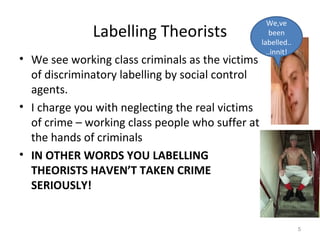
• We see working class criminals as the victims
of discriminatory labelling by social control
agents.
• I charge you with neglecting the real victims
of crime – working class people who suffer at
the hands of criminals
• IN OTHER WORDS YOU LABELLING
THEORISTS HAVEN’T TAKEN CRIME
SERIOUSLY!
5
We,ve
been
labelled..
..innit!
What is Realism?
• The realisation that crime can be nasty, brutal,
damaging and violent, and it has increased
significantly since the 1950s. These increases can’t
be explained away simply by increases in reporting
of crime and more labelling which creates more
crime
• The acknowledgment that the crime problem is a
real one for many people in Britain today
6
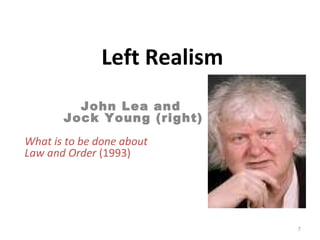
Left Realism
John Lea and
Jock Young (right)
What is to be done about
Law and Order (1993)
7
Left Realism
• Idea to tackle the inadequacies of other perspectives
in explaining crime and to counter the influence of
Right Realism on government policy
• Linked theory to hands-on practical measures to
actually improve the lives of people in relation to
crime. Famously promised to ‘take crime seriously’
especially those that affect women, ethnic minorities
and the working class
8
Similarities to Marxism/Neo-Marxism
(no wonder really because it’s Young again)
• Capitalism encourages levels of consumption
it is unable to deliver to all.
• It is no wonder then that some people
motivated by consumerism/materialism make
up the shortfall by turning to crime.
• However revolution and the overthrow of
capitalism is unlikely
• Instead gradual social change is required
along with practical solutions to the crime
problem
9
Left Realism: KEY IDEA 1
REAL INCREASE IN CRIME!
• There has been a REAL and SUBSTANTIAL
INCREASE in crime rates since the 1950s, and
this crime most effects disadvantaged
groups.
10
Left Realism: KEY IDEA 2
AETIOLOGICAL CRISIS
• The increase in the crime rate has led to an
AETIOLOGICAL CRISIS for theories of crime – a
crisis in explanation
• Neo Marxists and labelling theorists deny that
the increase is real – they argue that it is just an
increase in the reporting of crime (e.g. more
telephones) or an increased tendency to label the
poor. Crime statistics show more crime but to
them this is just an illusion – a social construction
• LEFT REALISTS - they say NO – there just is loads
more crime, get real! The Victim Surveys they
carry out show twice as much crime as official
stats.
11
Left Realism: KEY IDEA 3 VICTIMOLOGY
• Name given to the study of the victims of
crime - tries to understand real-life problems
as experienced by real people
• They show that disadvantaged groups
(women, the poor, inner city residents) have a
greater risk of becoming victims – e.g.
Unskilled workers are twice as likely to be
burgled
12
Left Realism: KEY IDEA 4
• FEAR OF CRIME
• Disadvantaged groups have a greater fear of
crime and this has a big effect on their lives
• Fear of attack stops women from going out at
night; the poor suffer more because they are less
likely to insure themselves
• Disadvantaged groups are less likely to report
crimes against them and the police are often
reluctant to deal with crimes like domestic
violence, rape or racist attacks
13
Left Realism
• Three CAUSES OF CRIME Key concepts explain
the causes of crime
14
Left Realism: Causes of crime
• Crime is the result of the interweaving of
factors which differ according to the type of
crime
• This is known as MULTIPLE AETIOLOGY
• AETIOLOGY is the word for the search for the
causes of crime
15
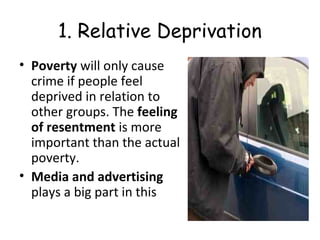
1. Relative Deprivation
• Poverty will only cause
crime if people feel
deprived in relation to
other groups. The feeling
of resentment is more
important than the actual
poverty.
• Media and advertising
plays a big part in this
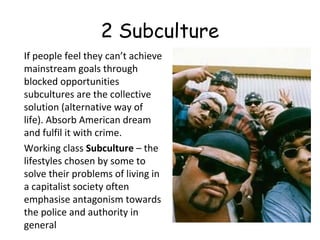
2 Subculture
If people feel they can’t achieve
mainstream goals through
blocked opportunities
subcultures are the collective
solution (alternative way of
life). Absorb American dream
and fulfil it with crime.
Working class Subculture – the
lifestyles chosen by some to
solve their problems of living in
a capitalist society often
emphasise antagonism towards
the police and authority in
general
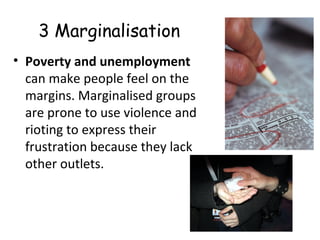
3 Marginalisation
• Poverty and unemployment
can make people feel on the
margins. Marginalised groups
are prone to use violence and
rioting to express their
frustration because they lack
other outlets.

Left realism: INTRODUCTION TO LEFT REALISM POWERPOINT

  • 1.
    Realist Criminology Two distinctstrands: Right Realism and Left Realism. Both aspire to take crime seriously Each have their own distinctive explanations for crime and how to tackle it. Right Realists favour a ‘get tough’ stance and use both biological and social explanations Left Realists on the other hand couch their explanations firmly in the inequalities created by capitalist society, but unlike their Neo-Marxist predecessors are more guarded about the possibilities of fundamental social change in the short term. Left Realists advocate a DUAL APPROACH a)practical measures to reduce crime b)pushing for long term change to a more equal caring society which can ultimately eliminate the root causes of crime. 1
  • 2.
    LEFT REALISM • TAKINGCRIME SERIOUSLY – we hereby accuse the other theories of not taking crime seriously and charge each of you with the following criminological offences: 2
  • 3.
    Traditional Marxists • Weemphasise the crimes of the powerful such as white collar and corporate crime, and look at how this penalises the working class • LEFT REALISTS THEY SAY – yes this is important but it neglects working class crime and its effects which neglect or play-down the very real problems working class crime causes • IN OTHER WORDS YOU TRAD MARXISTS HAVEN’T TAKEN CRIME SERIOUSLY! 3
  • 4.
    Neo Marxism • Wesay that crime by the working classes is understandable and is a political act – revenge and redistribution of wealth • NO! You just romanticise working class criminals as latter day Robin Hoods, stealing from the rich as an act of political resistance to capitalism. This is fanciful and unrealistic – most working class burglary or theft is stealing from other members of the working class not the rich • IN OTHER WORDS YOU NEO-MARXISTS HAVEN’T TAKEN CRIME SERIOUSLY! 4 I’m Robbin’ Hood - I rob from the rich and give to the poor! I don’t think so Hoodo!
  • 5.
    Labelling Theorists • Wesee working class criminals as the victims of discriminatory labelling by social control agents. • I charge you with neglecting the real victims of crime – working class people who suffer at the hands of criminals • IN OTHER WORDS YOU LABELLING THEORISTS HAVEN’T TAKEN CRIME SERIOUSLY! 5 We,ve been labelled.. ..innit!
  • 6.
    What is Realism? •The realisation that crime can be nasty, brutal, damaging and violent, and it has increased significantly since the 1950s. These increases can’t be explained away simply by increases in reporting of crime and more labelling which creates more crime • The acknowledgment that the crime problem is a real one for many people in Britain today 6
  • 7.
    Left Realism John Leaand Jock Young (right) What is to be done about Law and Order (1993) 7
  • 8.
    Left Realism • Ideato tackle the inadequacies of other perspectives in explaining crime and to counter the influence of Right Realism on government policy • Linked theory to hands-on practical measures to actually improve the lives of people in relation to crime. Famously promised to ‘take crime seriously’ especially those that affect women, ethnic minorities and the working class 8
  • 9.
    Similarities to Marxism/Neo-Marxism (nowonder really because it’s Young again) • Capitalism encourages levels of consumption it is unable to deliver to all. • It is no wonder then that some people motivated by consumerism/materialism make up the shortfall by turning to crime. • However revolution and the overthrow of capitalism is unlikely • Instead gradual social change is required along with practical solutions to the crime problem 9
  • 10.
    Left Realism: KEYIDEA 1 REAL INCREASE IN CRIME! • There has been a REAL and SUBSTANTIAL INCREASE in crime rates since the 1950s, and this crime most effects disadvantaged groups. 10
  • 11.
    Left Realism: KEYIDEA 2 AETIOLOGICAL CRISIS • The increase in the crime rate has led to an AETIOLOGICAL CRISIS for theories of crime – a crisis in explanation • Neo Marxists and labelling theorists deny that the increase is real – they argue that it is just an increase in the reporting of crime (e.g. more telephones) or an increased tendency to label the poor. Crime statistics show more crime but to them this is just an illusion – a social construction • LEFT REALISTS - they say NO – there just is loads more crime, get real! The Victim Surveys they carry out show twice as much crime as official stats. 11
  • 12.
    Left Realism: KEYIDEA 3 VICTIMOLOGY • Name given to the study of the victims of crime - tries to understand real-life problems as experienced by real people • They show that disadvantaged groups (women, the poor, inner city residents) have a greater risk of becoming victims – e.g. Unskilled workers are twice as likely to be burgled 12
  • 13.
    Left Realism: KEYIDEA 4 • FEAR OF CRIME • Disadvantaged groups have a greater fear of crime and this has a big effect on their lives • Fear of attack stops women from going out at night; the poor suffer more because they are less likely to insure themselves • Disadvantaged groups are less likely to report crimes against them and the police are often reluctant to deal with crimes like domestic violence, rape or racist attacks 13
  • 14.
    Left Realism • ThreeCAUSES OF CRIME Key concepts explain the causes of crime 14
  • 15.
    Left Realism: Causesof crime • Crime is the result of the interweaving of factors which differ according to the type of crime • This is known as MULTIPLE AETIOLOGY • AETIOLOGY is the word for the search for the causes of crime 15
  • 16.
    1. Relative Deprivation •Poverty will only cause crime if people feel deprived in relation to other groups. The feeling of resentment is more important than the actual poverty. • Media and advertising plays a big part in this
  • 17.
    2 Subculture If peoplefeel they can’t achieve mainstream goals through blocked opportunities subcultures are the collective solution (alternative way of life). Absorb American dream and fulfil it with crime. Working class Subculture – the lifestyles chosen by some to solve their problems of living in a capitalist society often emphasise antagonism towards the police and authority in general
  • 18.
    3 Marginalisation • Povertyand unemployment can make people feel on the margins. Marginalised groups are prone to use violence and rioting to express their frustration because they lack other outlets.