CHAPTER 17


    Understanding
    Principles of Accounting


1
Chapter Outline

     What Is Accounting and Who Uses
      Accounting Information?
     Who Are Accountants and What Do
      They Do?
     Tools of the Accounting Trade
     Financial Statements
     Analyzing Financial Statements
     International Accounting


2
What Is Accounting and Who
     Uses Accounting Information?
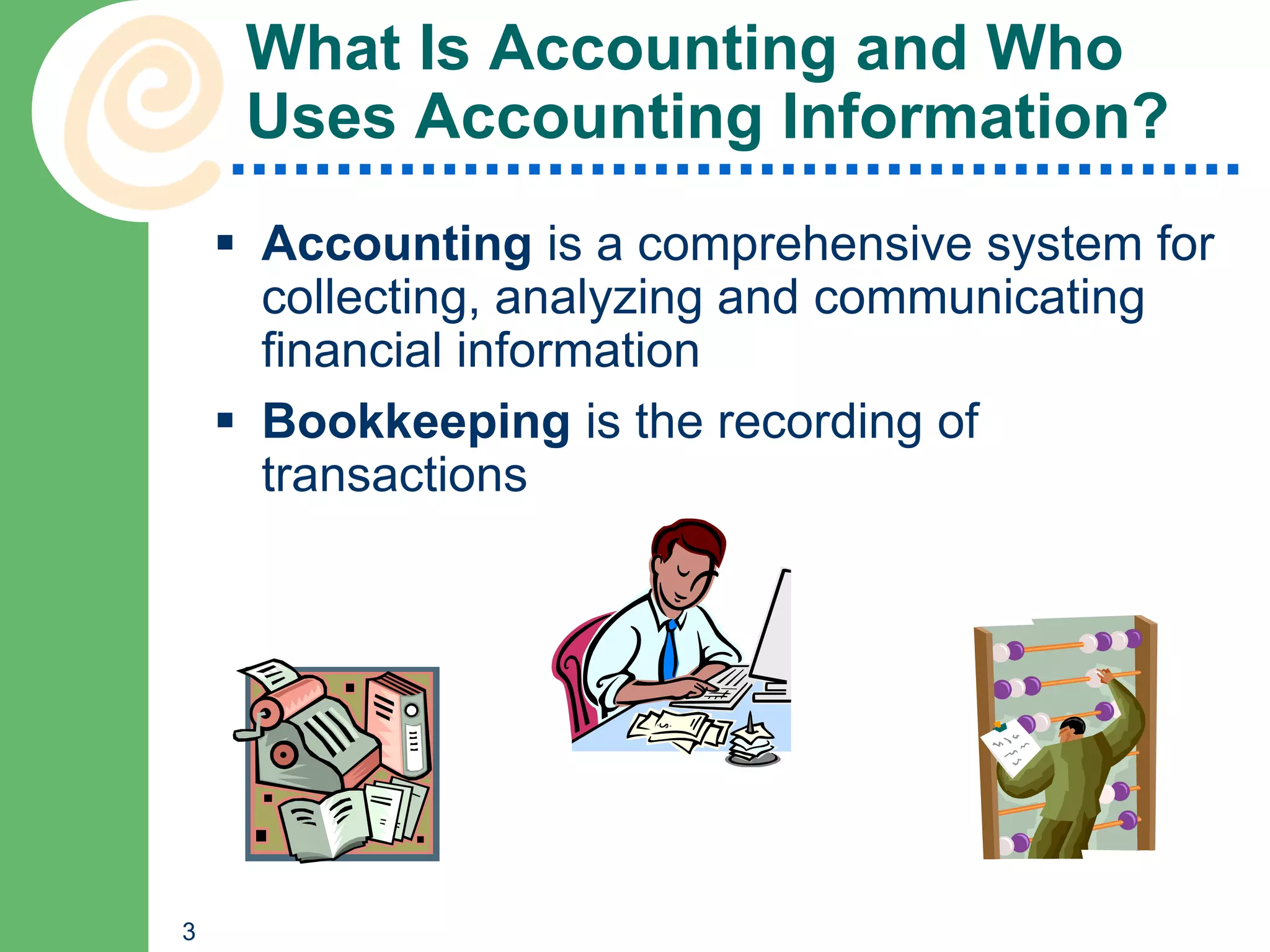
     Accounting is a comprehensive system for
      collecting, analyzing and communicating
      financial information
     Bookkeeping is the recording of
      transactions


3
What Is Accounting and Who
     Uses Accounting Information?

     Accounting
      information system
      (AIS) is an organized
      means by which
      financial information is
      identified, measured,
      recorded and retained
      for use in accounting
      statements and
      management reports


4
Users of Accounting
     Information

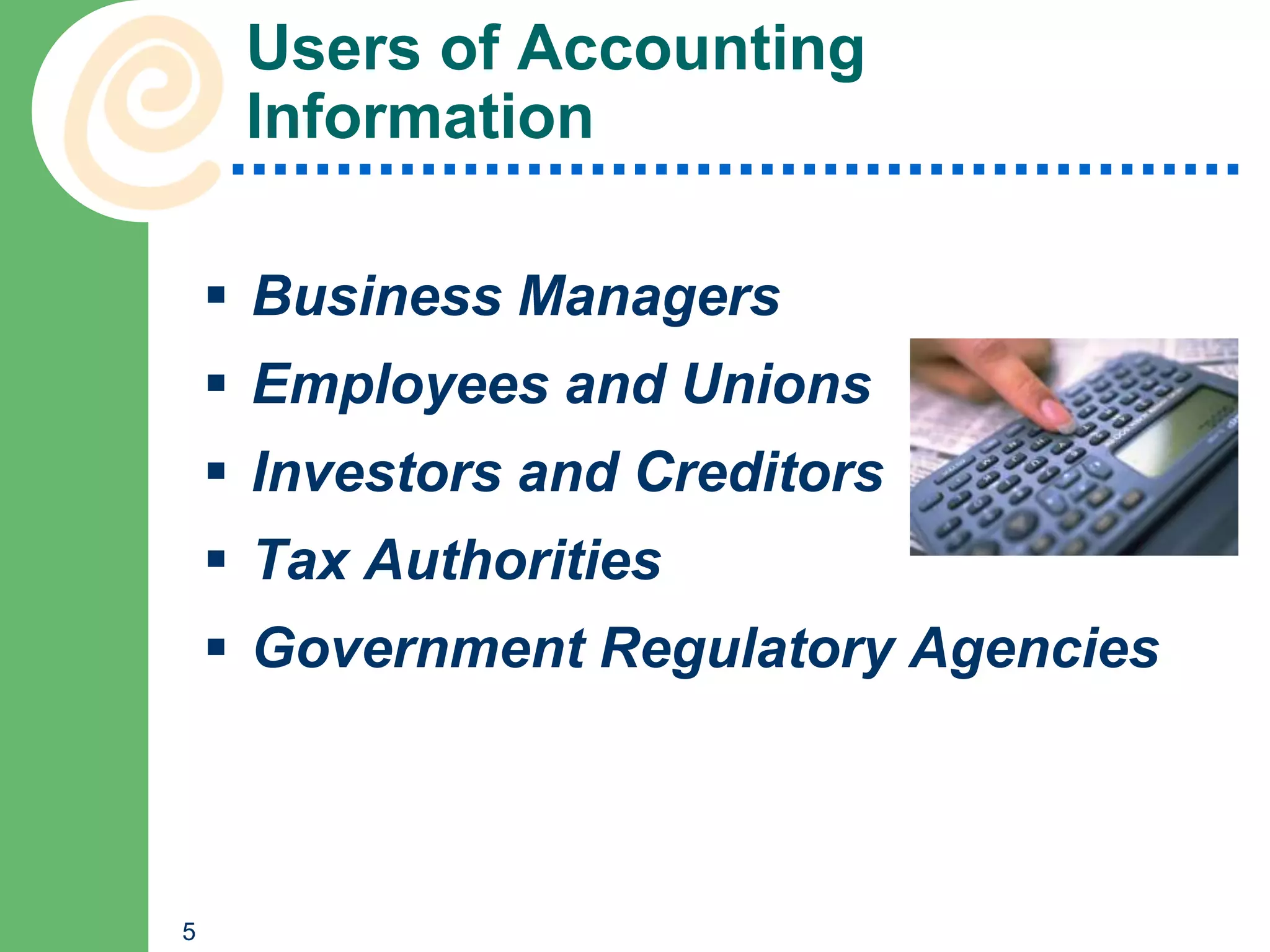
     Business Managers
     Employees and Unions
     Investors and Creditors
     Tax Authorities
     Government Regulatory Agencies


5
What is a Controller?

    Person who manages all
     of a firm’s accounting
        activities (chief
       accounting officer


6
Who Are Accountants and What
     Do They Do?

     Financial Versus Managerial
      Accounting
       Financial accounting system is
        concerned with external information
        users
       Managerial (or Management) accounting
        system serves internal users


7
What is an Audit?

    Systematic examination
         of a company’s
      accounting system to
     determine whether its
     financial reports fairly
    represent its operations


8
What is GAAP (or Generally
    Accepted Accounting Principles)?


    Accepted rules and
    procedures governing
    the content and form
    of financial reports


9
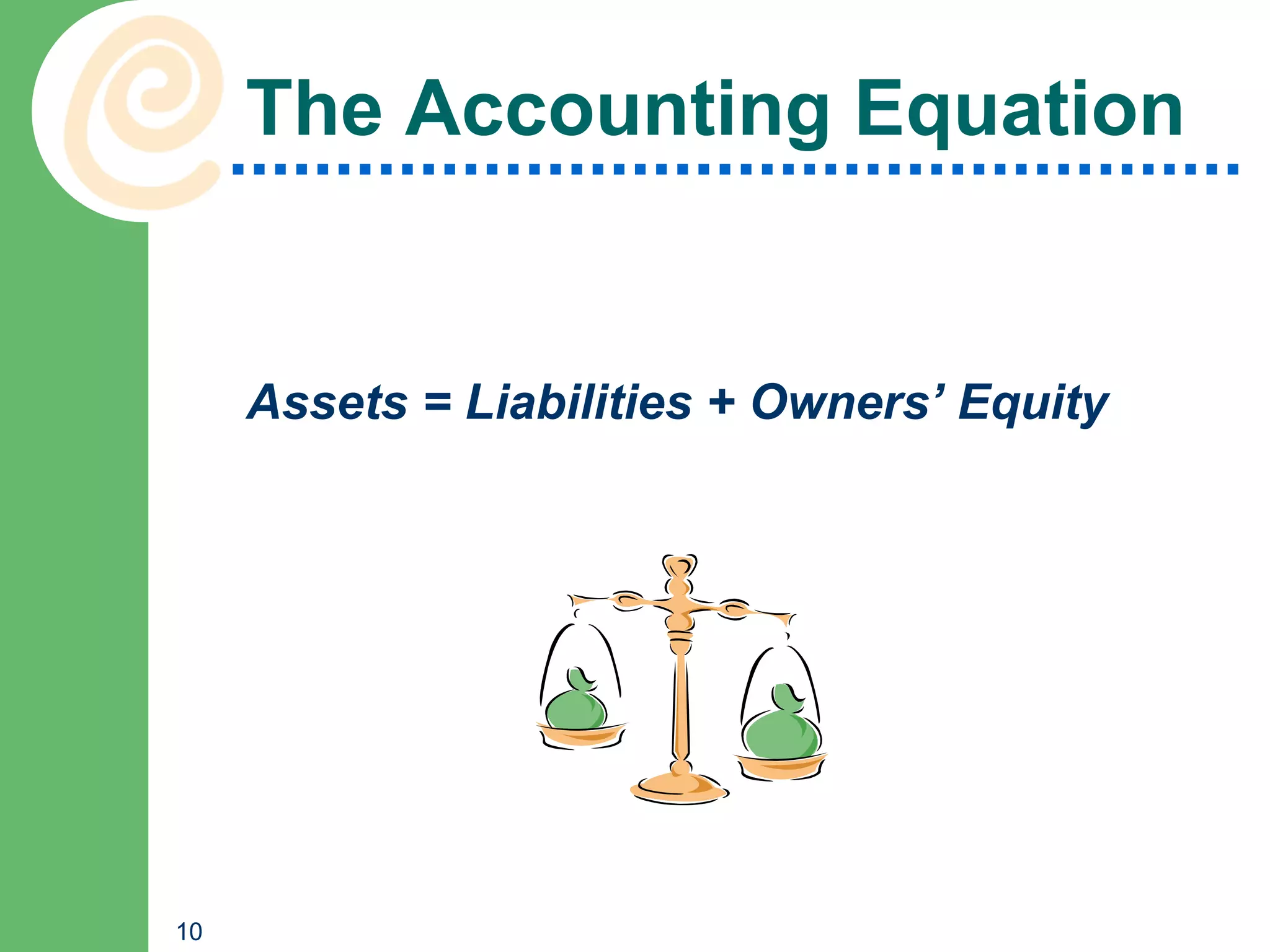
The Accounting Equation


     Assets = Liabilities + Owners’ Equity


10
The Accounting Equation

      Asset is any economic resource expected
       to benefit a firm or an individual who owns it
      Liability is a debt owned by a firm to an
       outside organization or individual
      Owners’ equity is the amount of money
       that owners would receive if they sold all of
       a firm’s assets and paid all of its liabilities


11
What is Double-Entry
     Accounting?


     Bookkeeping system
     that balances the
     accounting equation by
     recording the dual
     effects of every financial
     transaction


12
Financial Statements
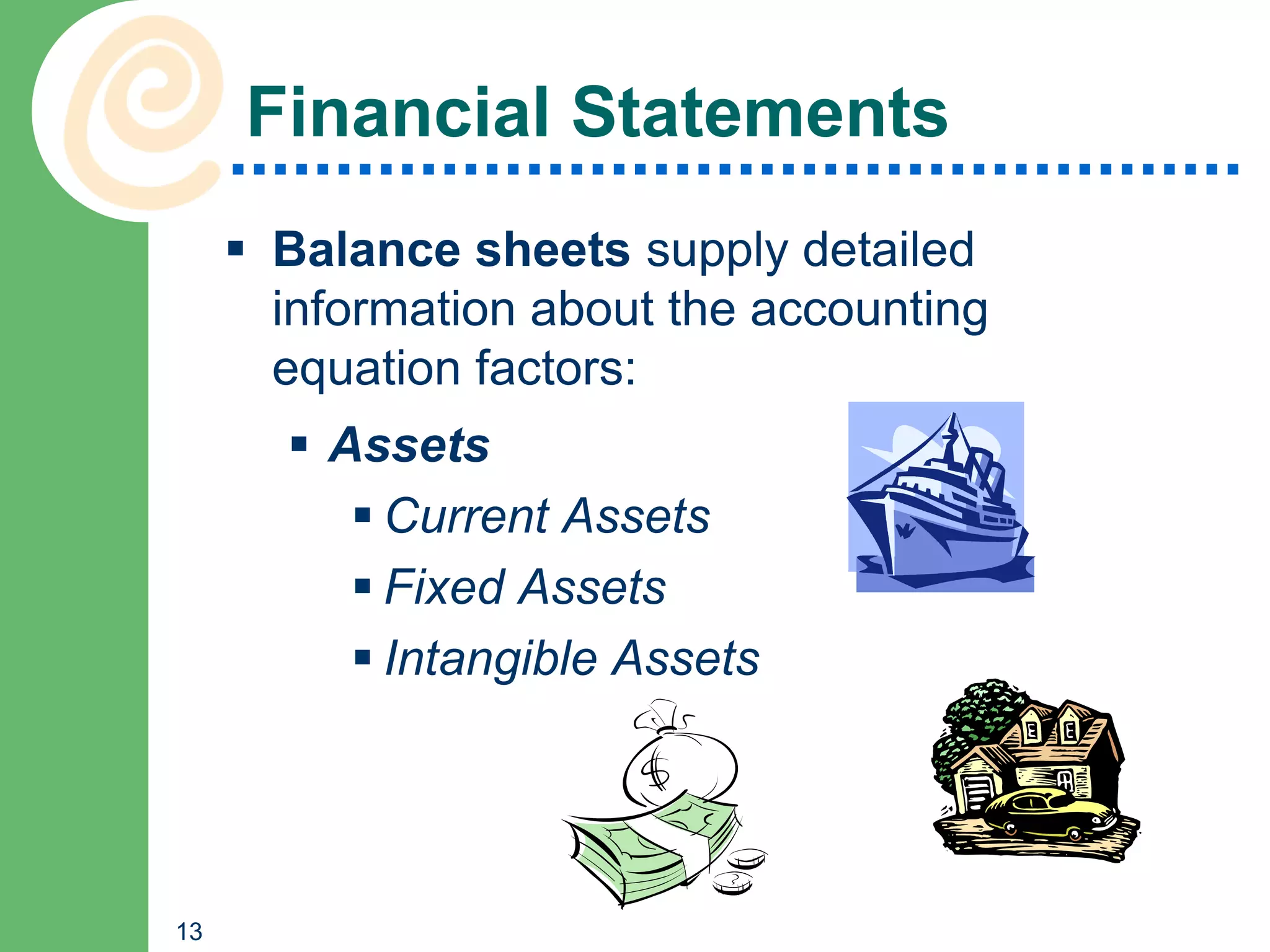
      Balance sheets supply detailed
       information about the accounting
       equation factors:
        Assets
           Current Assets
           Fixed Assets
           Intangible Assets


13
Financial Statements

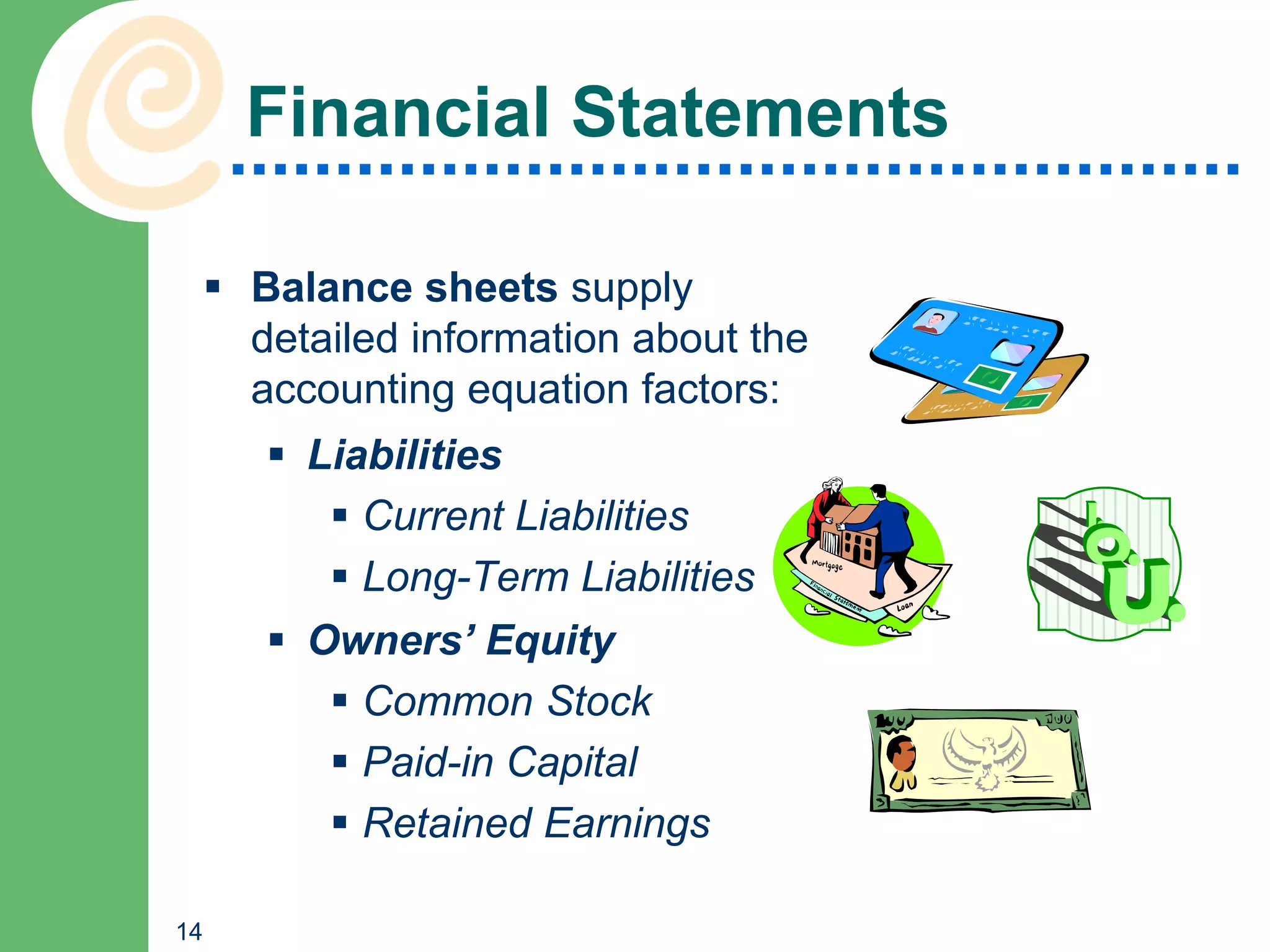
      Balance sheets supply
       detailed information about the
       accounting equation factors:
         Liabilities
            Current Liabilities
            Long-Term Liabilities
         Owners’ Equity
            Common Stock
            Paid-in Capital
            Retained Earnings

14
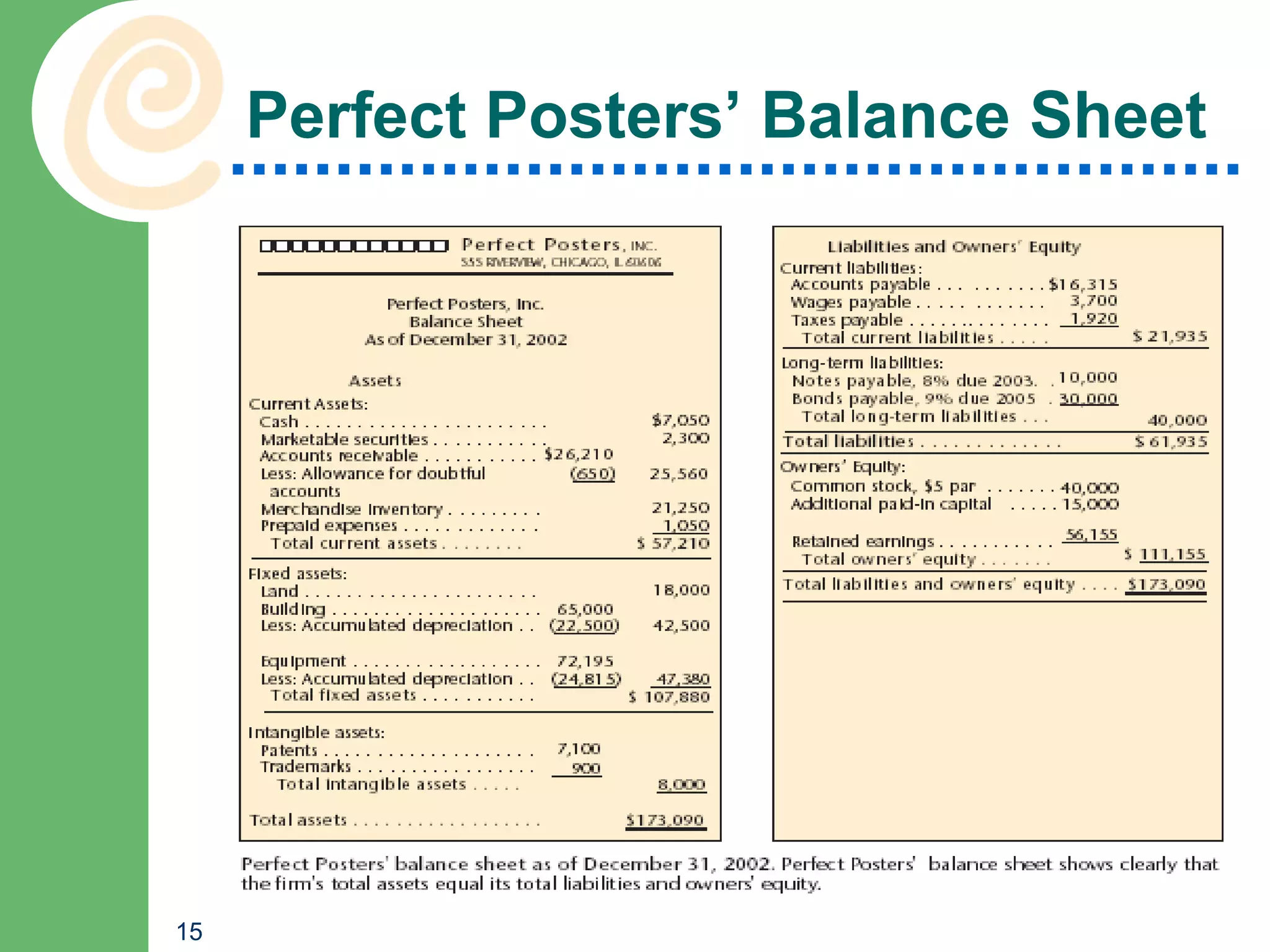
Perfect Posters’ Balance Sheet


15
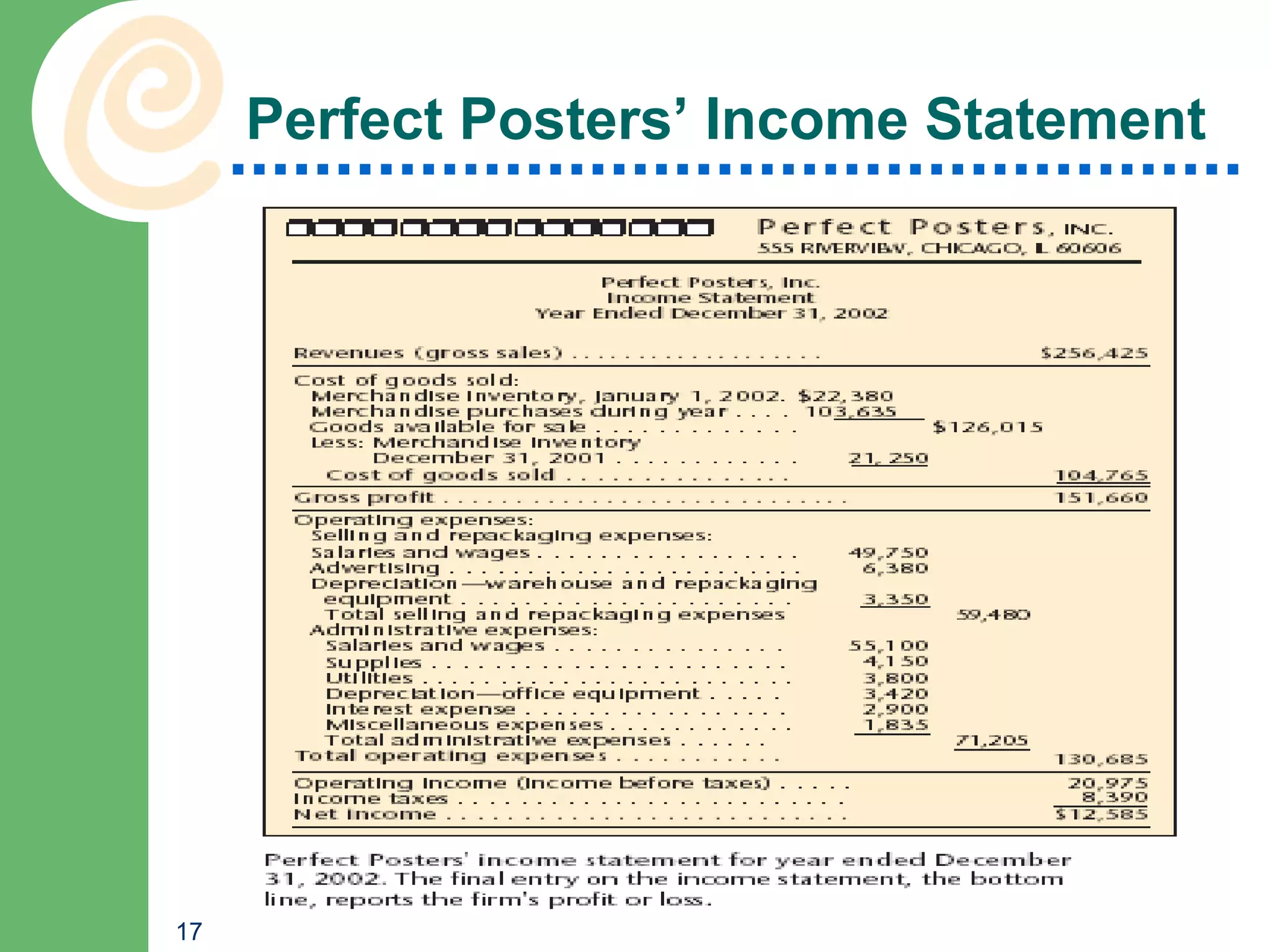
Financial Statements

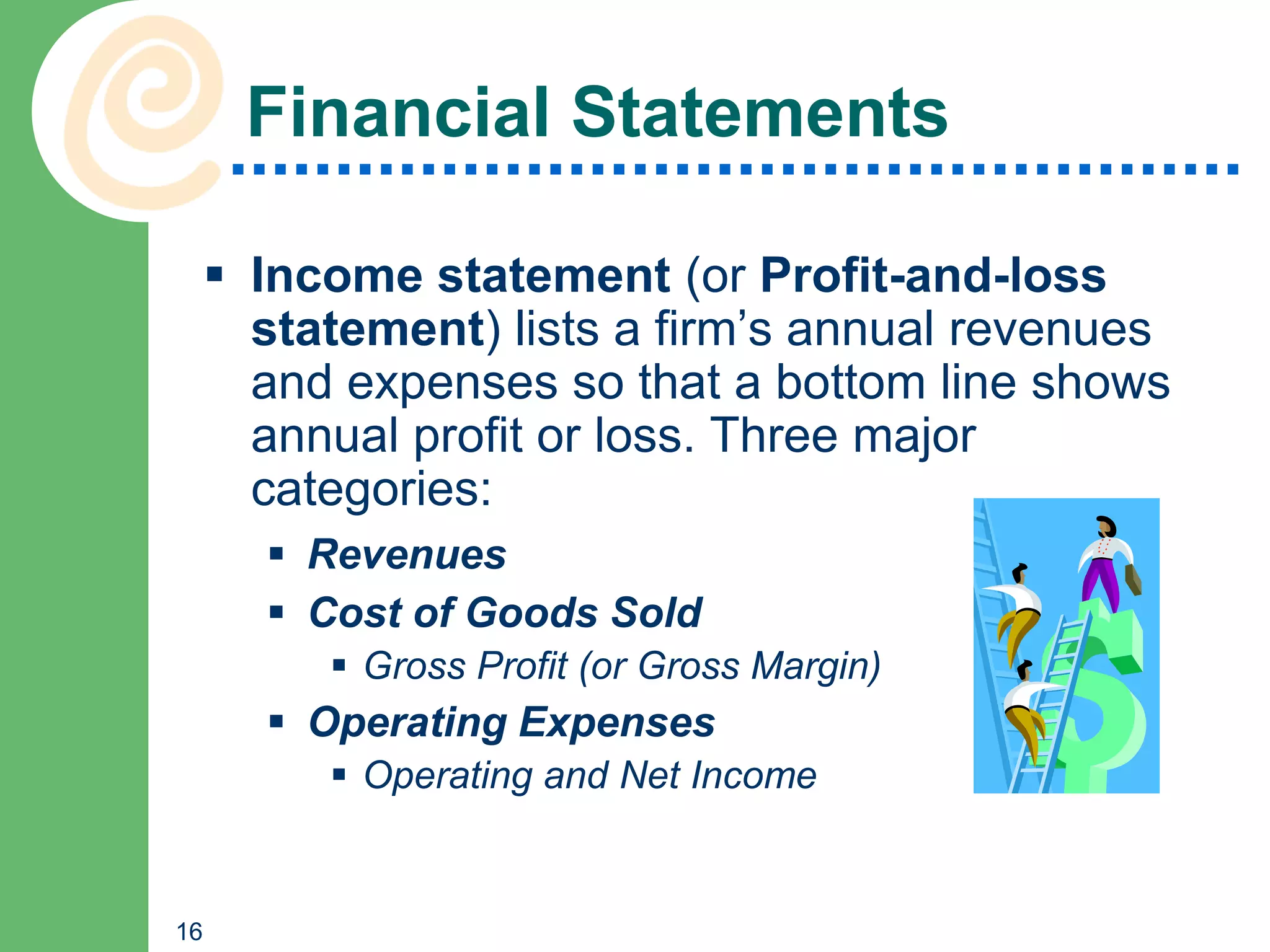
      Income statement (or Profit-and-loss
       statement) lists a firm’s annual revenues
       and expenses so that a bottom line shows
       annual profit or loss. Three major
       categories:
        Revenues
        Cost of Goods Sold
           Gross Profit (or Gross Margin)
        Operating Expenses
           Operating and Net Income


16
Perfect Posters’ Income Statement


17
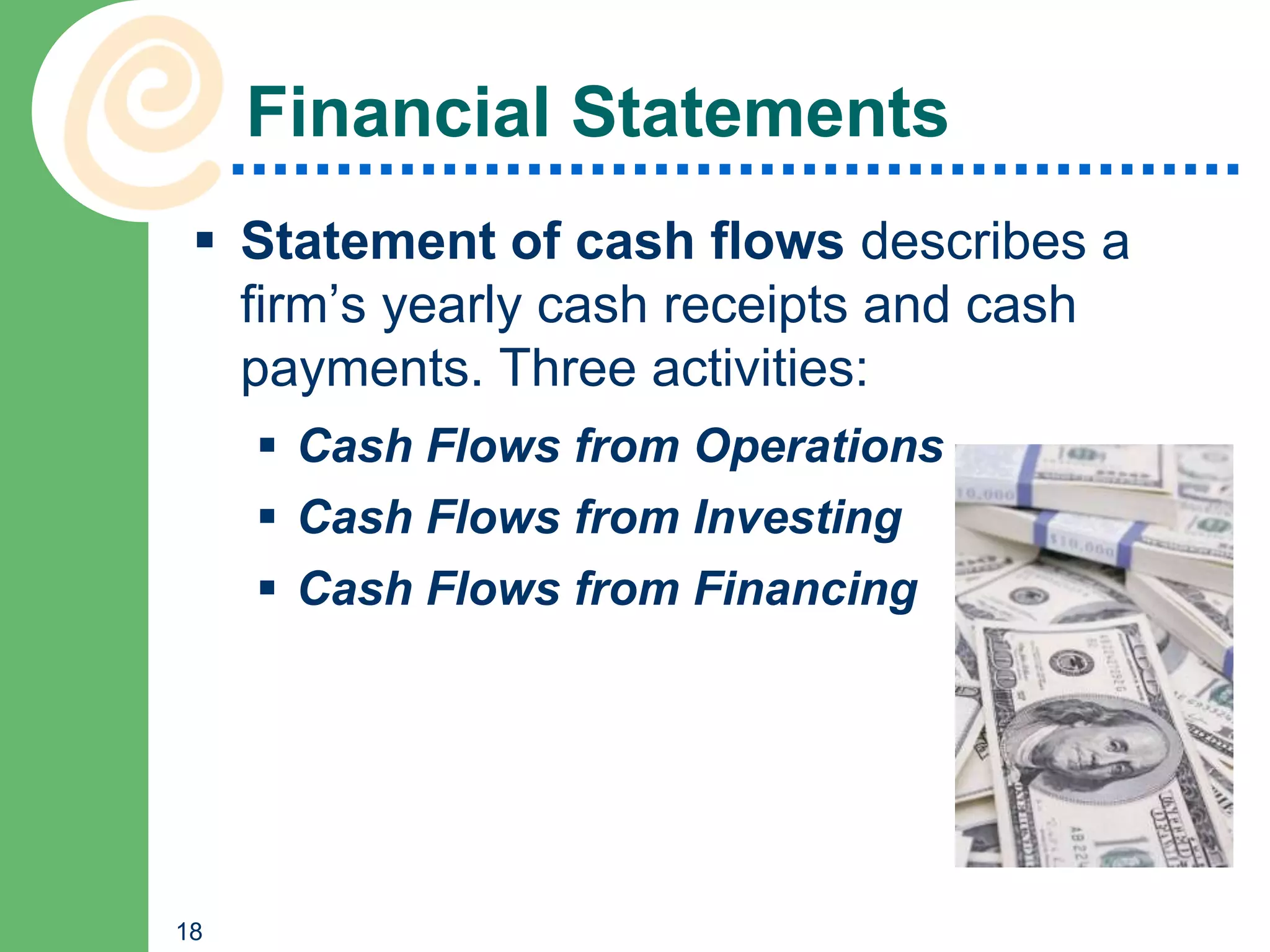
Financial Statements
  Statement of cash flows describes a
   firm’s yearly cash receipts and cash
   payments. Three activities:
      Cash Flows from Operations
      Cash Flows from Investing
      Cash Flows from Financing


18
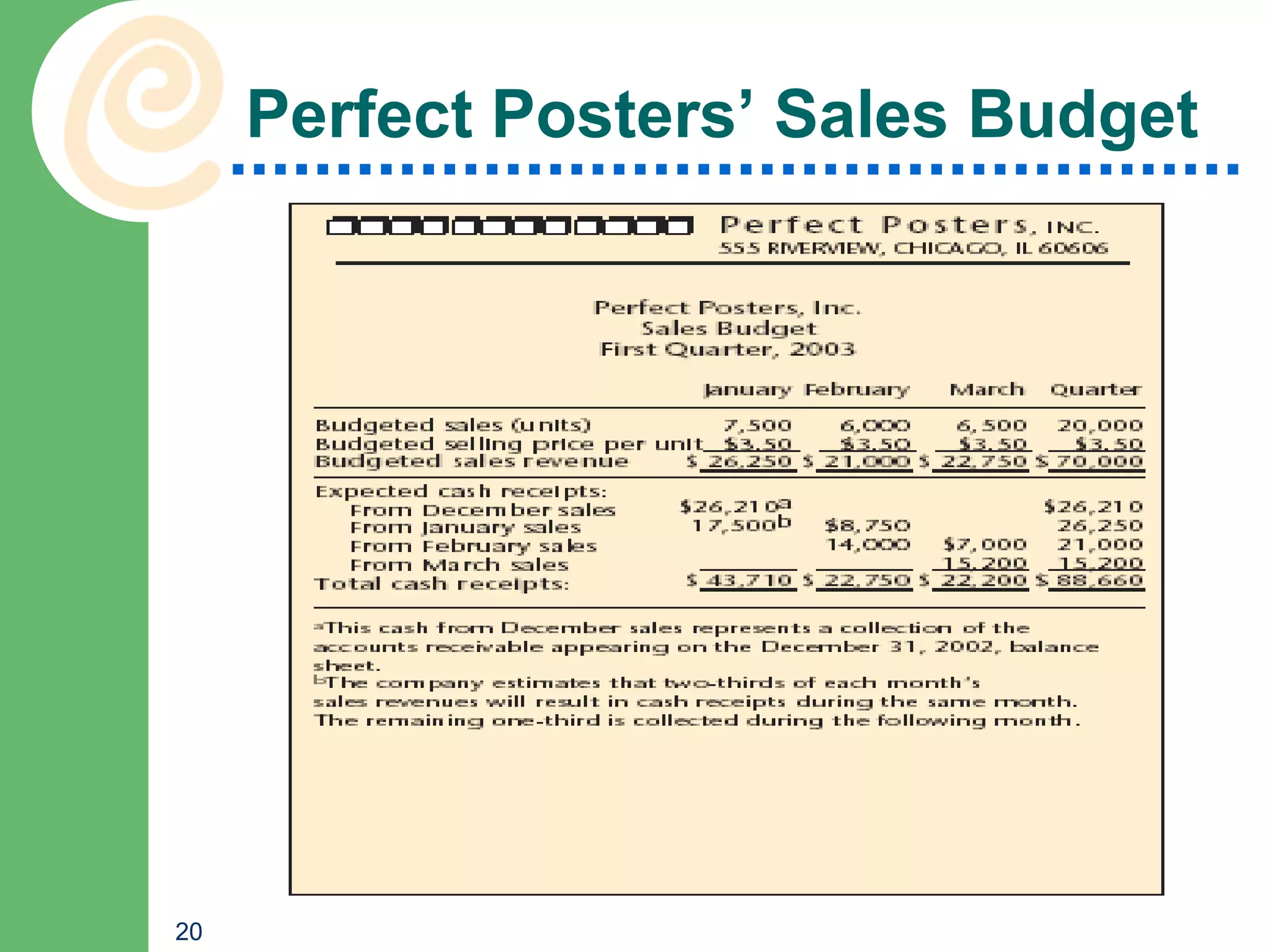
An Internal Financial Statement:
     What is the Budget?


     Detailed statement of
     estimated receipts and
     expenditures for a
     future period of time


19
Perfect Posters’ Sales Budget


20
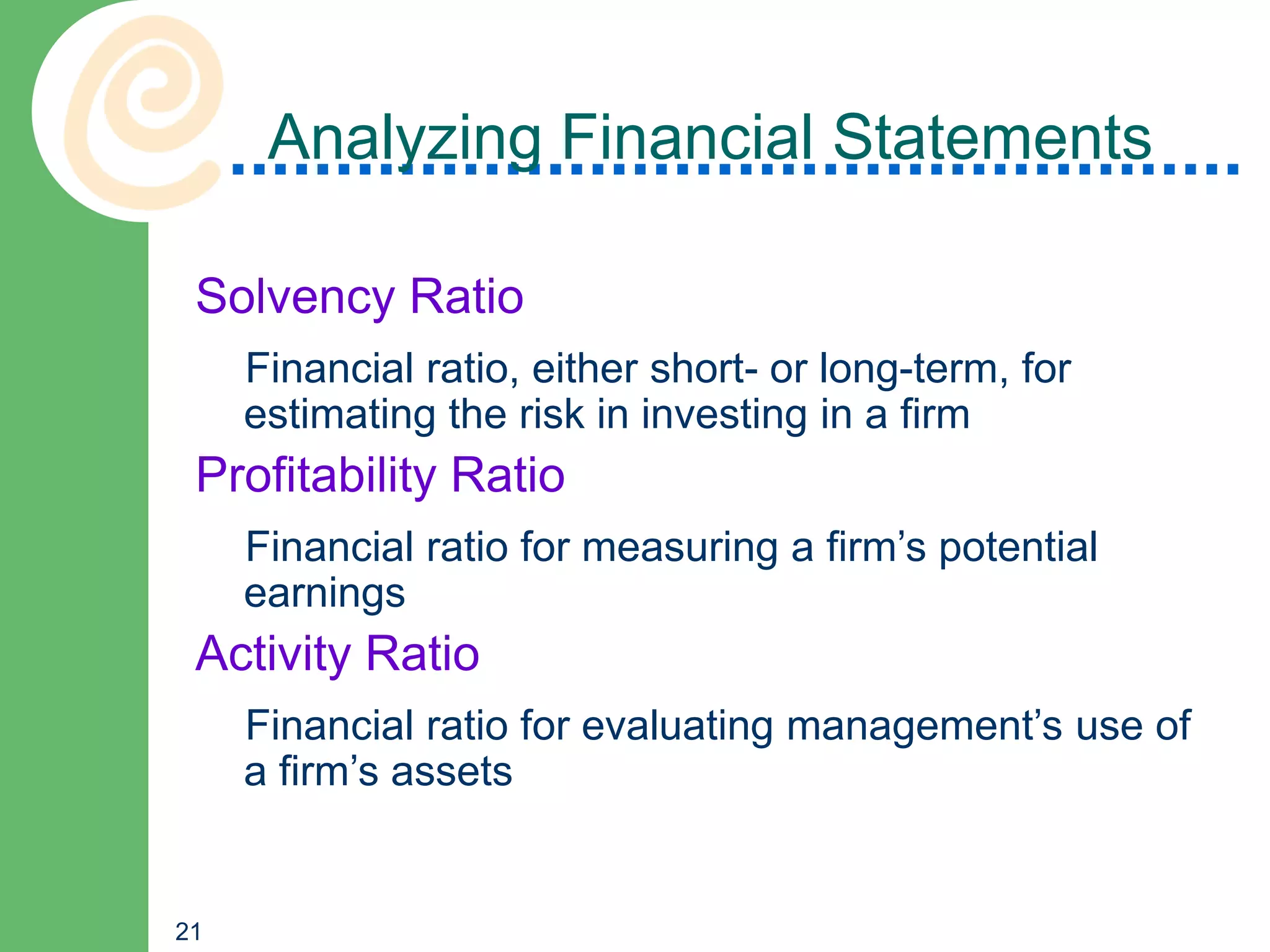
Analyzing Financial Statements

 Solvency Ratio
     Financial ratio, either short- or long-term, for
     estimating the risk in investing in a firm
 Profitability Ratio
     Financial ratio for measuring a firm’s potential
     earnings
 Activity Ratio
     Financial ratio for evaluating management’s use of
     a firm’s assets


21
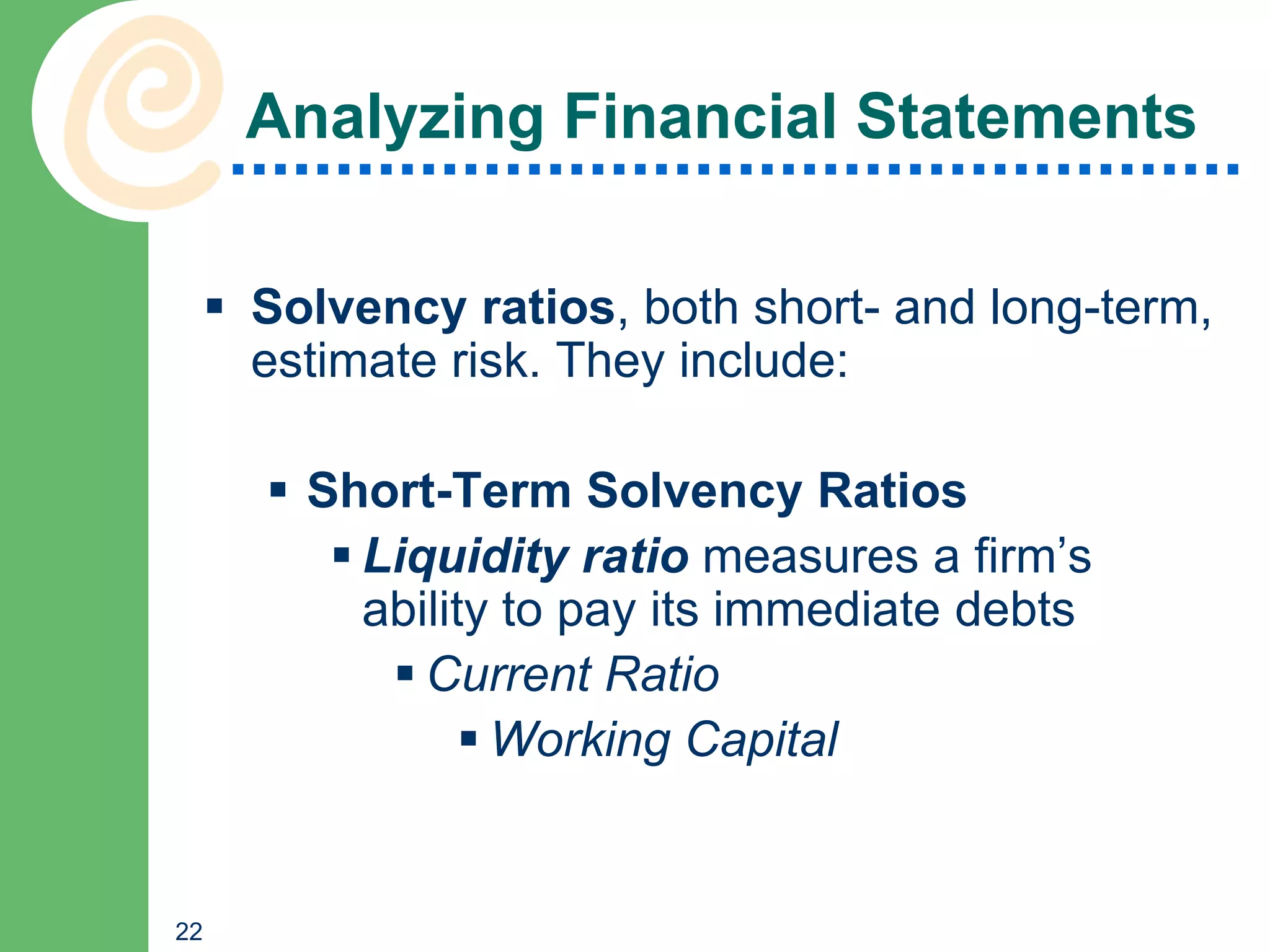
Analyzing Financial Statements

      Solvency ratios, both short- and long-term,
       estimate risk. They include:

        Short-Term Solvency Ratios
           Liquidity ratio measures a firm’s
            ability to pay its immediate debts
              Current Ratio
                   Working Capital


22
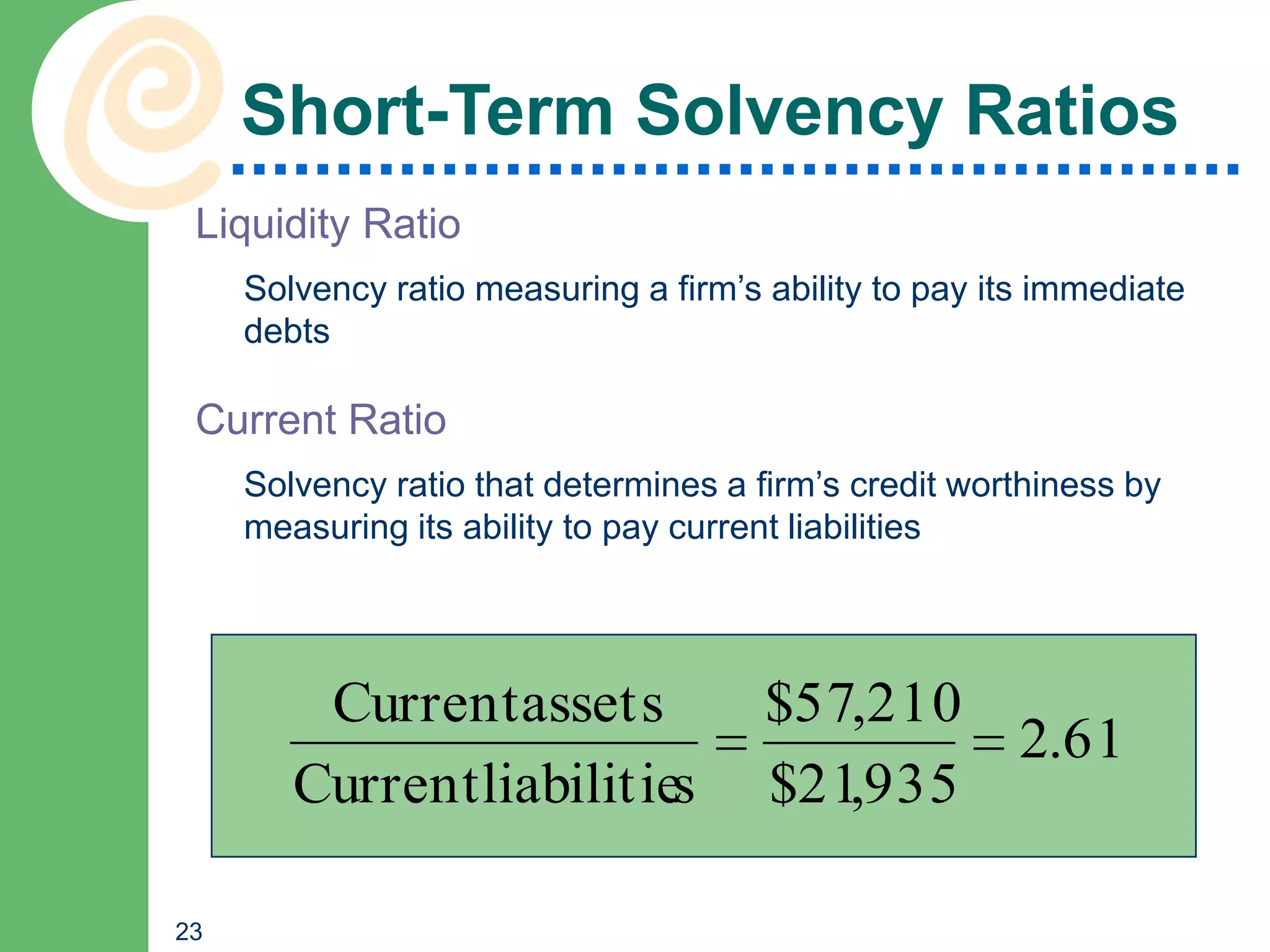
Short-Term Solvency Ratios
 Liquidity Ratio
     Solvency ratio measuring a firm’s ability to pay its immediate
     debts

 Current Ratio
     Solvency ratio that determines a firm’s credit worthiness by
     measuring its ability to pay current liabilities


         Current assets                $57,210
                                                        2.61
        Current liabilities            $21,935

23
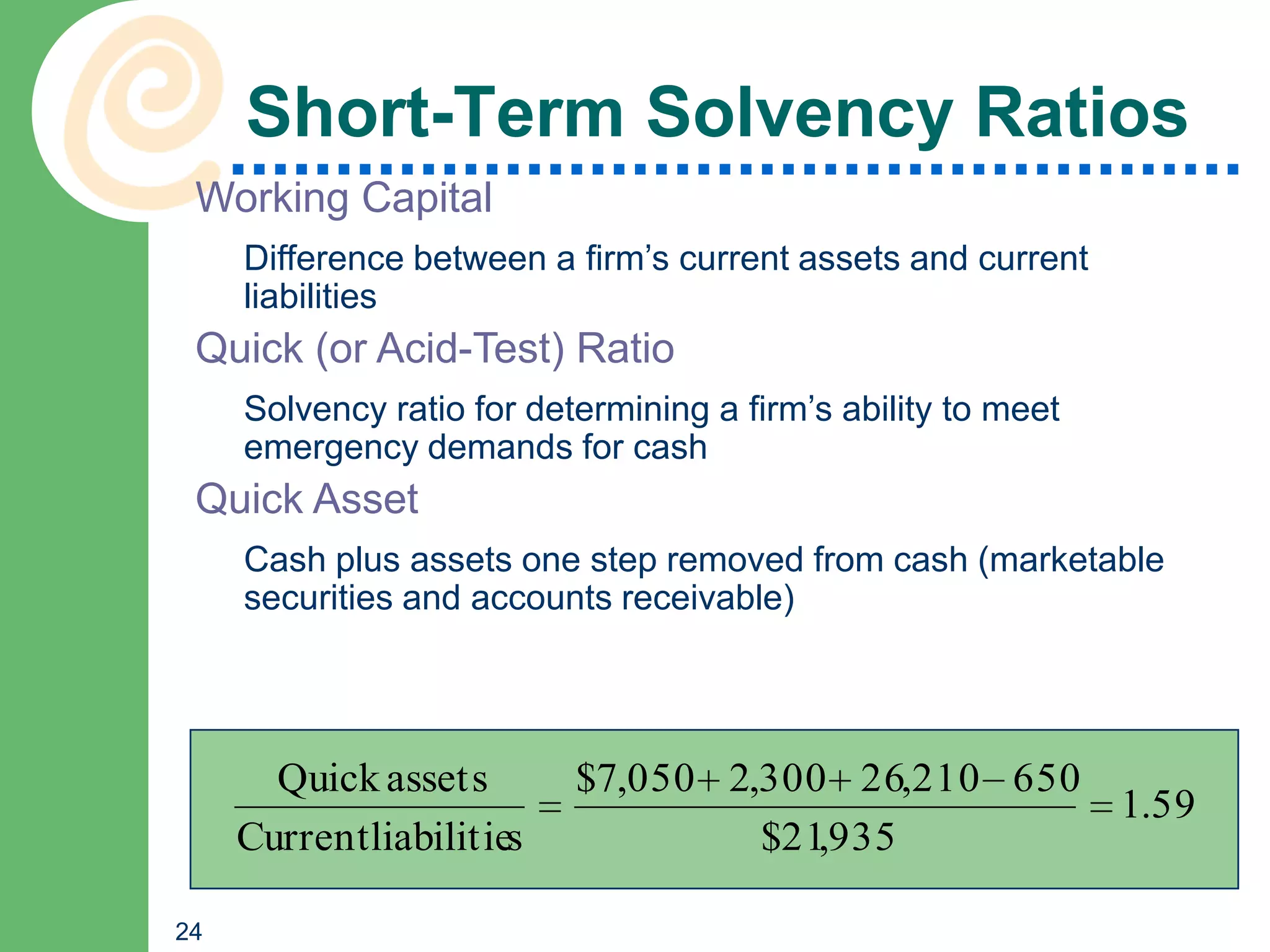
Short-Term Solvency Ratios
 Working Capital
     Difference between a firm’s current assets and current
     liabilities
 Quick (or Acid-Test) Ratio
     Solvency ratio for determining a firm’s ability to meet
     emergency demands for cash
 Quick Asset
     Cash plus assets one step removed from cash (marketable
     securities and accounts receivable)


       Quick assets        $7,050 2,300 26,210 650
                                                   1.59
     Current liabilities            $21,935

24
Long-Term Solvency Ratios
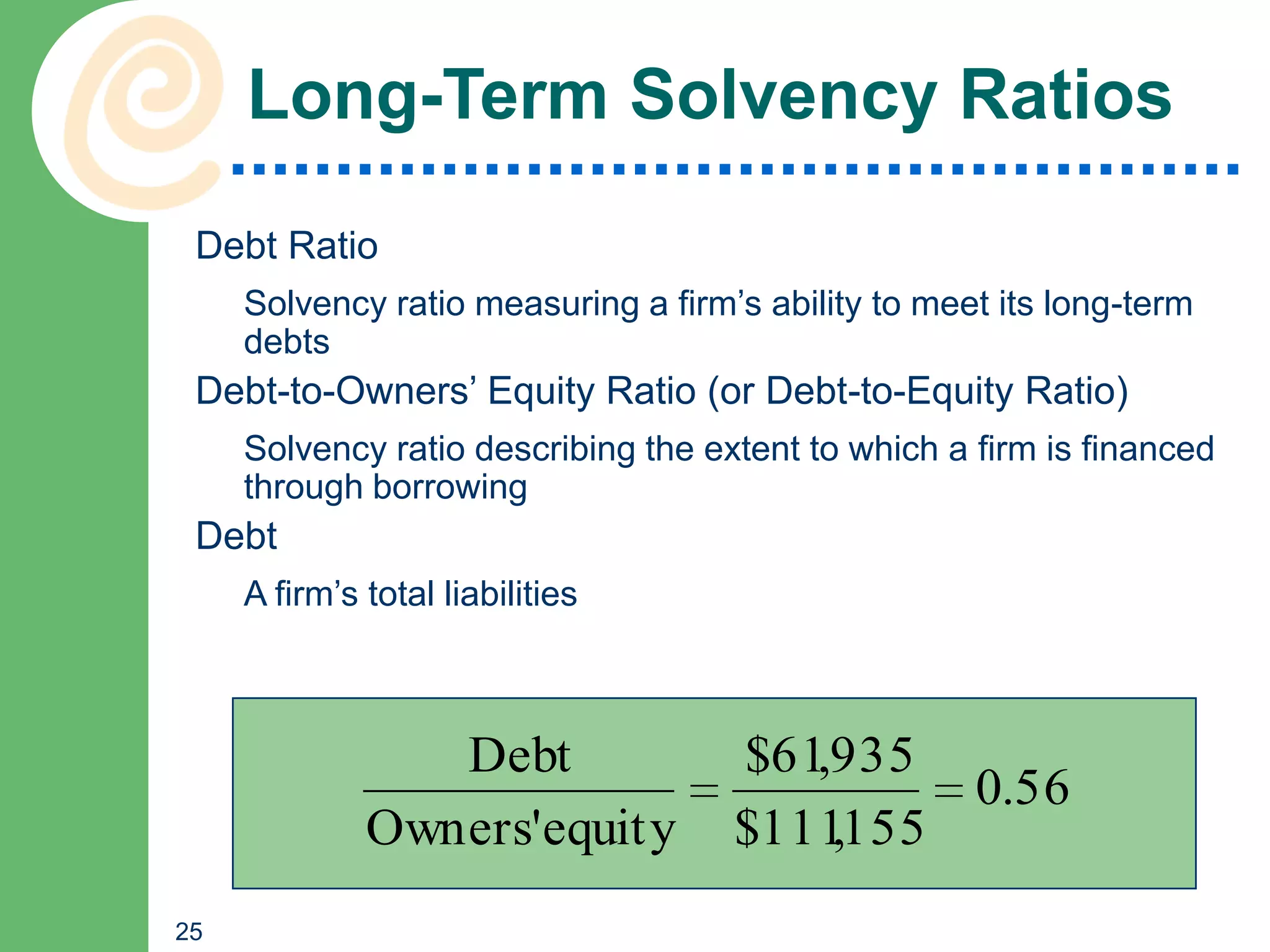
 Debt Ratio
     Solvency ratio measuring a firm’s ability to meet its long-term
     debts
 Debt-to-Owners’ Equity Ratio (or Debt-to-Equity Ratio)
     Solvency ratio describing the extent to which a firm is financed
     through borrowing
 Debt
     A firm’s total liabilities


                 Debt                $61,935
                                             0.56
              Owners'equity          $111155
                                         ,
25
Profitability Ratios
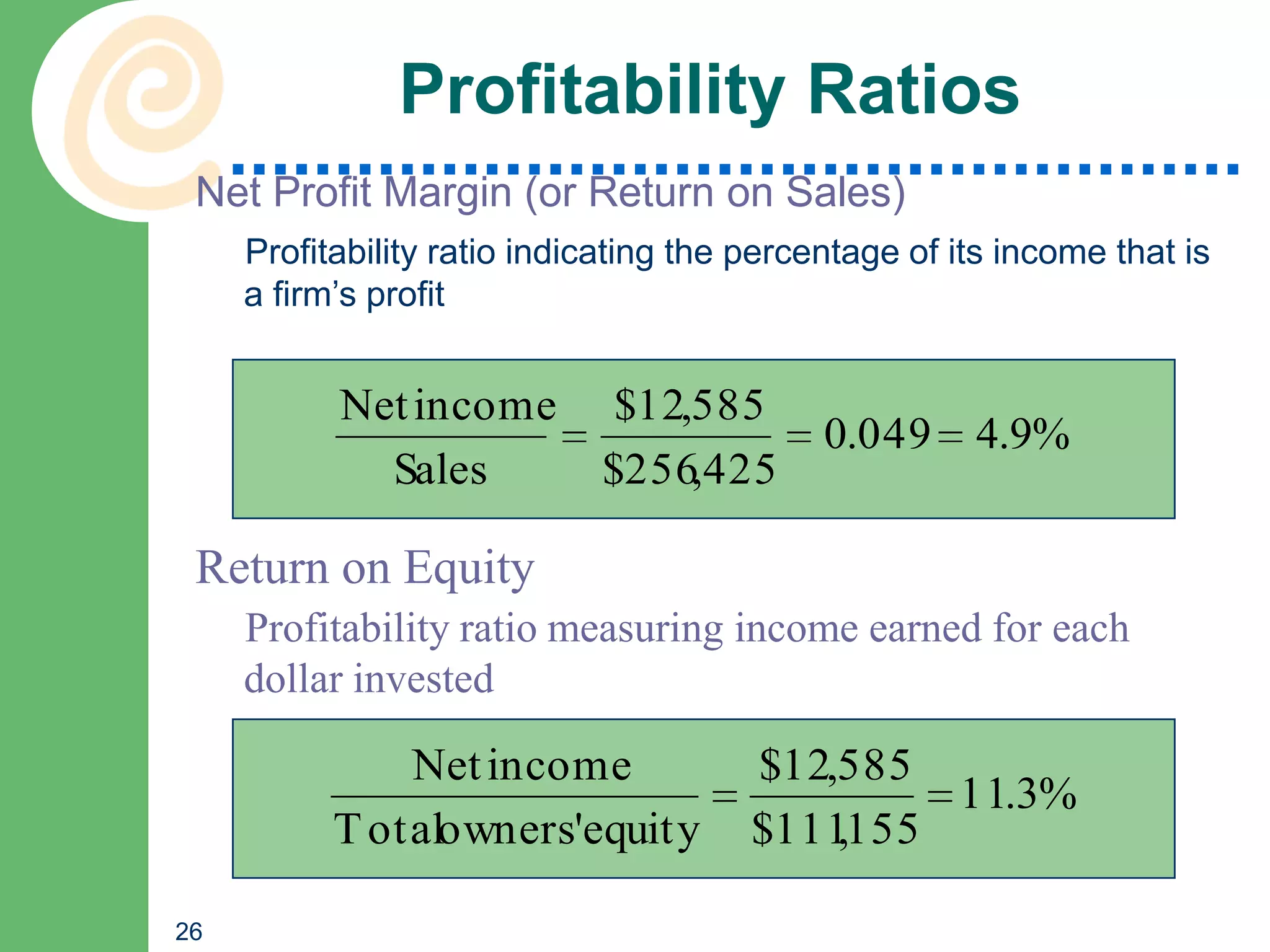
 Net Profit Margin (or Return on Sales)
     Profitability ratio indicating the percentage of its income that is
     a firm’s profit


           Net income         $12,585
                                             0.049 4.9%
             Sales           $256,425

 Return on Equity
     Profitability ratio measuring income earned for each
     dollar invested

               Net income               $12,585
                                                11.3%
           T otalowners'equity          $111155
                                            ,

26
Profitability Ratios
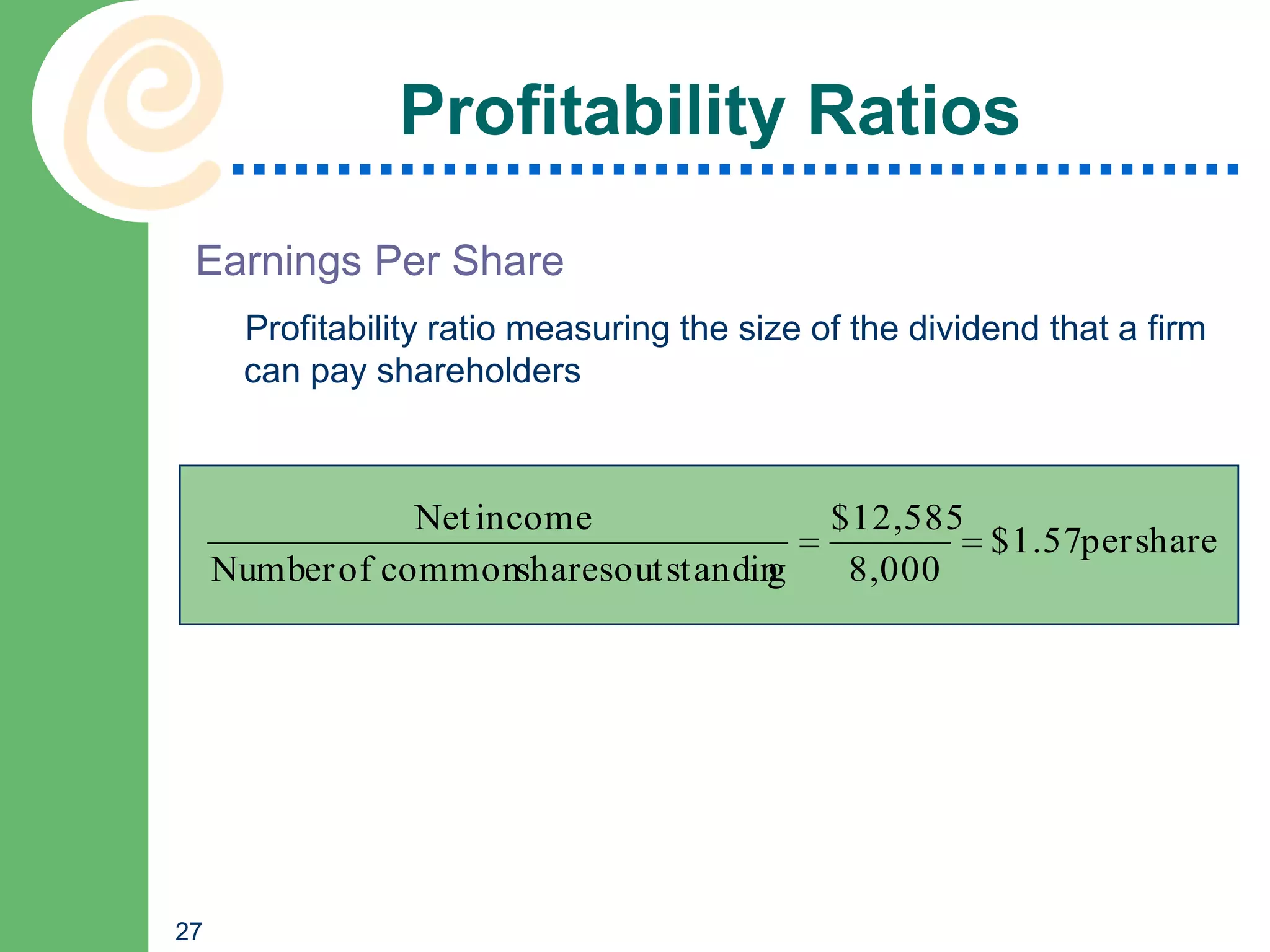
 Earnings Per Share
      Profitability ratio measuring the size of the dividend that a firm
      can pay shareholders


                 Net income                   $12,585
                                                      $1.57per share
     Number of commonsharesoutstandin
                                    g          8,000


27
Activity Ratios
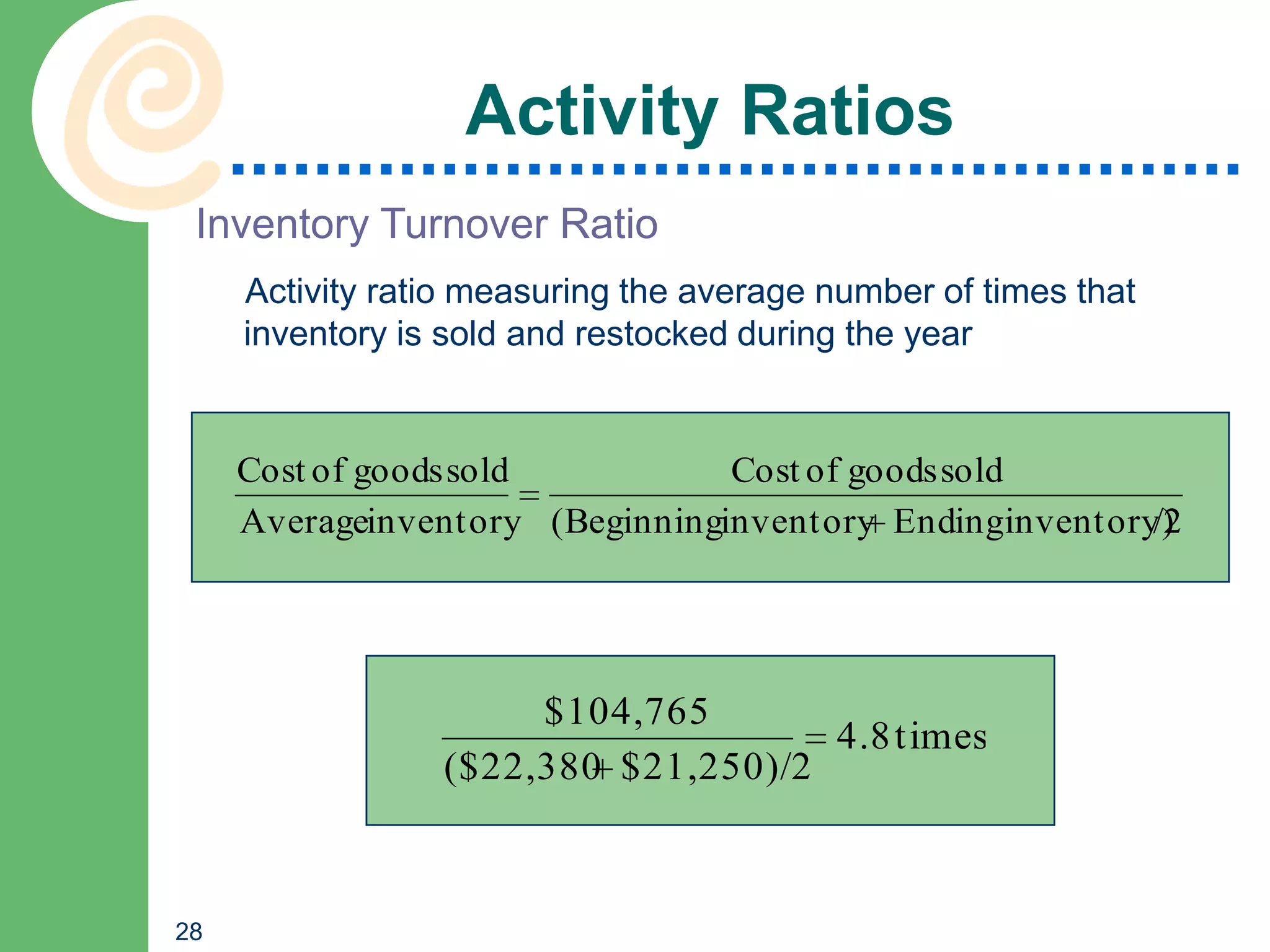
 Inventory Turnover Ratio
     Activity ratio measuring the average number of times that
     inventory is sold and restocked during the year


     Cost of goods sold          Cost of goods sold
     Averageinventory (Beginninginventory Endinginventory)
                                                         /2


                      $104,765
                                     4.8 times
                 ($22,380 $21,250)/2


28

1. principles of accounting

  • 1.
    CHAPTER 17 Understanding Principles of Accounting 1
  • 2.
    Chapter Outline  What Is Accounting and Who Uses Accounting Information?  Who Are Accountants and What Do They Do?  Tools of the Accounting Trade  Financial Statements  Analyzing Financial Statements  International Accounting 2
  • 3.
    What Is Accountingand Who Uses Accounting Information?  Accounting is a comprehensive system for collecting, analyzing and communicating financial information  Bookkeeping is the recording of transactions 3
  • 4.
    What Is Accountingand Who Uses Accounting Information?  Accounting information system (AIS) is an organized means by which financial information is identified, measured, recorded and retained for use in accounting statements and management reports 4
  • 5.
    Users of Accounting Information  Business Managers  Employees and Unions  Investors and Creditors  Tax Authorities  Government Regulatory Agencies 5
  • 6.
    What is aController? Person who manages all of a firm’s accounting activities (chief accounting officer 6
  • 7.
    Who Are Accountantsand What Do They Do?  Financial Versus Managerial Accounting  Financial accounting system is concerned with external information users  Managerial (or Management) accounting system serves internal users 7
  • 8.
    What is anAudit? Systematic examination of a company’s accounting system to determine whether its financial reports fairly represent its operations 8
  • 9.
    What is GAAP(or Generally Accepted Accounting Principles)? Accepted rules and procedures governing the content and form of financial reports 9
  • 10.
    The Accounting Equation Assets = Liabilities + Owners’ Equity 10
  • 11.
    The Accounting Equation  Asset is any economic resource expected to benefit a firm or an individual who owns it  Liability is a debt owned by a firm to an outside organization or individual  Owners’ equity is the amount of money that owners would receive if they sold all of a firm’s assets and paid all of its liabilities 11
  • 12.
    What is Double-Entry Accounting? Bookkeeping system that balances the accounting equation by recording the dual effects of every financial transaction 12
  • 13.
    Financial Statements  Balance sheets supply detailed information about the accounting equation factors:  Assets  Current Assets  Fixed Assets  Intangible Assets 13
  • 14.
    Financial Statements  Balance sheets supply detailed information about the accounting equation factors:  Liabilities  Current Liabilities  Long-Term Liabilities  Owners’ Equity  Common Stock  Paid-in Capital  Retained Earnings 14
  • 15.
  • 16.
    Financial Statements  Income statement (or Profit-and-loss statement) lists a firm’s annual revenues and expenses so that a bottom line shows annual profit or loss. Three major categories:  Revenues  Cost of Goods Sold  Gross Profit (or Gross Margin)  Operating Expenses  Operating and Net Income 16
  • 17.
  • 18.
    Financial Statements Statement of cash flows describes a firm’s yearly cash receipts and cash payments. Three activities:  Cash Flows from Operations  Cash Flows from Investing  Cash Flows from Financing 18
  • 19.
    An Internal FinancialStatement: What is the Budget? Detailed statement of estimated receipts and expenditures for a future period of time 19
  • 20.
  • 21.
    Analyzing Financial Statements Solvency Ratio Financial ratio, either short- or long-term, for estimating the risk in investing in a firm Profitability Ratio Financial ratio for measuring a firm’s potential earnings Activity Ratio Financial ratio for evaluating management’s use of a firm’s assets 21
  • 22.
    Analyzing Financial Statements  Solvency ratios, both short- and long-term, estimate risk. They include:  Short-Term Solvency Ratios  Liquidity ratio measures a firm’s ability to pay its immediate debts  Current Ratio  Working Capital 22
  • 23.
    Short-Term Solvency Ratios Liquidity Ratio Solvency ratio measuring a firm’s ability to pay its immediate debts Current Ratio Solvency ratio that determines a firm’s credit worthiness by measuring its ability to pay current liabilities Current assets $57,210 2.61 Current liabilities $21,935 23
  • 24.
    Short-Term Solvency Ratios Working Capital Difference between a firm’s current assets and current liabilities Quick (or Acid-Test) Ratio Solvency ratio for determining a firm’s ability to meet emergency demands for cash Quick Asset Cash plus assets one step removed from cash (marketable securities and accounts receivable) Quick assets $7,050 2,300 26,210 650 1.59 Current liabilities $21,935 24
  • 25.
    Long-Term Solvency Ratios Debt Ratio Solvency ratio measuring a firm’s ability to meet its long-term debts Debt-to-Owners’ Equity Ratio (or Debt-to-Equity Ratio) Solvency ratio describing the extent to which a firm is financed through borrowing Debt A firm’s total liabilities Debt $61,935 0.56 Owners'equity $111155 , 25
  • 26.
    Profitability Ratios NetProfit Margin (or Return on Sales) Profitability ratio indicating the percentage of its income that is a firm’s profit Net income $12,585 0.049 4.9% Sales $256,425 Return on Equity Profitability ratio measuring income earned for each dollar invested Net income $12,585 11.3% T otalowners'equity $111155 , 26
  • 27.
    Profitability Ratios EarningsPer Share Profitability ratio measuring the size of the dividend that a firm can pay shareholders Net income $12,585 $1.57per share Number of commonsharesoutstandin g 8,000 27
  • 28.
    Activity Ratios InventoryTurnover Ratio Activity ratio measuring the average number of times that inventory is sold and restocked during the year Cost of goods sold Cost of goods sold Averageinventory (Beginninginventory Endinginventory) /2 $104,765 4.8 times ($22,380 $21,250)/2 28