> > > > > > > > Chapter 16

       Understanding
       Accounting and
    Financial Statements
Learni ng Go al s
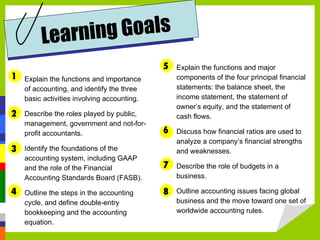
                                             5 Explain the functions and major
1 Explain the functions and importance           components of the four principal financial
    of accounting, and identify the three        statements: the balance sheet, the
    basic activities involving accounting.       income statement, the statement of
                                                 owner’s equity, and the statement of
2 Describe the roles played by public,           cash flows.
    management, government and not-for-
    profit accountants.                      6 Discuss how financial ratios are used to
                                                 analyze a company’s financial strengths
3 Identify the foundations of the                and weaknesses.
    accounting system, including GAAP
    and the role of the Financial            7 Describe the role of budgets in a
    Accounting Standards Board (FASB).           business.

4 Outline the steps in the accounting        8 Outline accounting issues facing global
    cycle, and define double-entry               business and the move toward one set of
    bookkeeping and the accounting               worldwide accounting rules.
    equation.
Ac co un ti ng
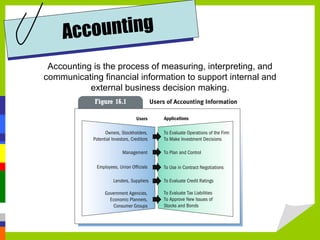
 Accounting is the process of measuring, interpreting, and
communicating financial information to support internal and
           external business decision making.
O pen Book
       Man  agement

• Open book management - sharing sensitive financial
  information with employees and teaching them how to
  understand and use financial statements.
• Viewing financial information may help them better
  understand how their work contributes to the
  company’s success.
• Outsiders use financial data to evaluate investment
  opportunities.
Business  Activities
    Involving Accounting
• Financing activities provide necessary funds to
  start a business and expand it after it begins
  operating.
• Investing activities provide valuable assets
  required to run a business.
• Operating activities focus on selling goods and
  services, but they also consider expenses as
  important elements of sound financial
  management.
Accounting
         Profe ssionals
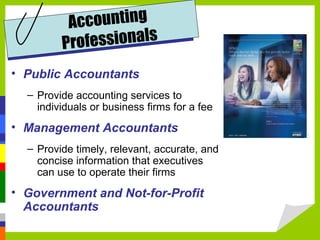
• Public Accountants
  – Provide accounting services to
    individuals or business firms for a fee
• Management Accountants
  – Provide timely, relevant, accurate, and
    concise information that executives
    can use to operate their firms
• Government and Not-for-Profit
  Accountants
T he F oundation of
            Accoun   ting Systems

•   Generally accepted accounting principles (GAAP) encompass the
    conventions, rules, and procedures for determining acceptable
    accounting practices at a particular time.

•   Financial Accounting Standards Board (FASB) is primarily
    responsible for evaluating, setting, or modifying GAAP in the U.S.

•   Sarbanes-Oxley Act responded to cases of accounting fraud.
     – Created the Public Accounting Oversight Board, which sets audit
       standards and investigates and sanctions accounting firms that certify the
       books of publicly traded firms.
     – Senior executives must personally certify that the financial information
       reported by the company is correct.
     – Resulted in increase in demand for accountants.
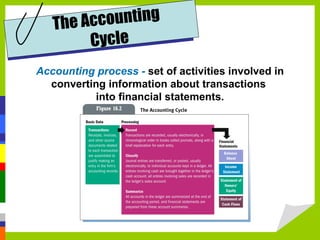
The A ccounting
         Cycle
Accounting process - set of activities involved in
  converting information about transactions
          into financial statements.
The Accoun ting Equation

• Assets - anything of value owned or leased by a business.
• Liability - claim against a firm’s assets by a creditor.
• Owner’s equity - all claims of the proprietor, partners, or
  stockholders against the assets of a firm, equal to the excess of
  assets over liabilities.
• Basic accounting equation - relationship that states that
  assets equal liabilities plus owners’ equity.


• Double-entry bookkeeping - process by which accounting
  transactions are entered; each individual transaction always has
  an offsetting transaction.
uters & The
    Im pact of Comp
                    ccounting
      Internet on A
• Simplifies the accounting process by automating data entry and
  calculations.

• Available products are customized for businesses of different sizes.
    – Entrepreneurs and small businesses use: QuickBooks, Peachtree,
      and BusinessWorks.

    – Larger firms use larger scale software packages like:
      Computer Associates, Oracle, and SAP.

• Software that handles accounting information for international
  businesses is another option. Offers different country
  information/language.

• Some systems offer web-based packages for small
  and medium businesses.
B alan c e Sheet

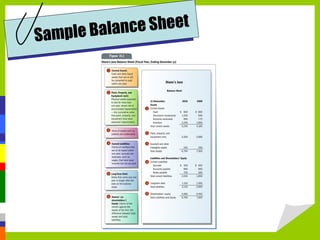
 Balance sheet - statement of a firm’s financial
  position—what it owns and the claims against its
  assets—at a particular point in time.

 Photograph of firm’s assets together with its liabilities
  and owner’s equity

 Follows the accounting equation
S a mp le Ba la nce Sheet
om e Sta t ement
  In c
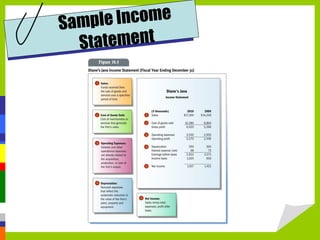
 Income Statement - financial record of a company’s
  revenues and expenses, and profits over a period of
  time.

 Firm’s financial performance in terms of revenues,
  expenses, and profits over a given time period.

 Reports profit or loss.

 Focus on revenues and costs associated with
  revenues.
Samp le Income
  Statement
St atement of
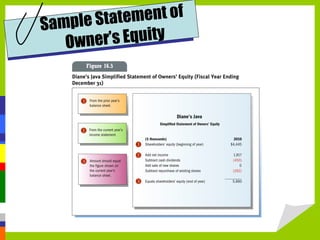
       Own  er’s Equity

 Statement of Owner’s Equity - is designed to show
  the components of the change in equity from the end
  of one fiscal year to the end of the next.

 Begins with the amount of equity shown on the
  balance sheet.

 Net income is added, and cash dividends paid to
  owners are subtracted.
Sample Sta tement of
   Own er’s Equity
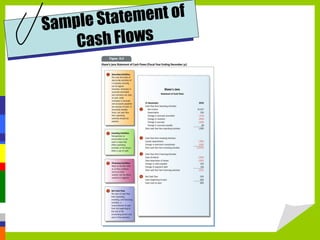
Th e Sta tement of
         Ca sh Flows

 Statement of cash flows - a firm’s cash receipts and
  cash payments that presents information on its
  sources and uses of cash.

 Accrual accounting - method that records revenue
  and expenses when they occur, not necessarily when
  cash actually changes hands.
S ample Sta tement of
     Ca sh Flows
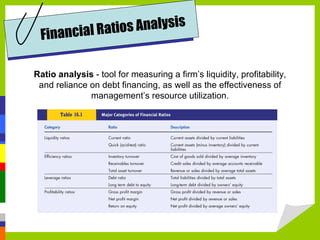
s Analysis
 F i nancial Ratio

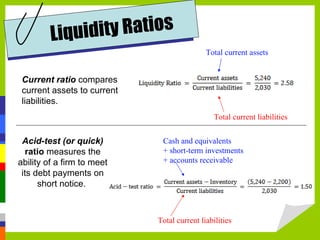
Ratio analysis - tool for measuring a firm’s liquidity, profitability,
 and reliance on debt financing, as well as the effectiveness of
              management’s resource utilization.
Liquidit y Ra t i o s
                                             Total current assets


 Current ratio compares
 current assets to current
 liabilities.
                                                Total current liabilities


 Acid-test (or quick)         Cash and equivalents
   ratio measures the         + short-term investments
ability of a firm to meet     + accounts receivable
 its debt payments on
      short notice.


                             Total current liabilities
Activity Ratios
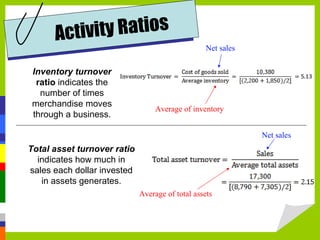
                                                  Net sales

 Inventory turnover
  ratio indicates the
   number of times
 merchandise moves
                                  Average of inventory
 through a business.

                                                              Net sales
Total asset turnover ratio
  indicates how much in
sales each dollar invested
   in assets generates.
                             Average of total assets
Profitabil i t y Ra t i o s

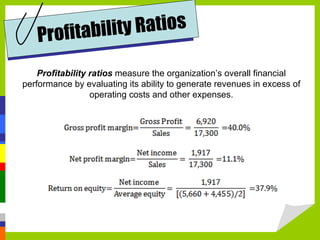
    Profitability ratios measure the organization’s overall financial
performance by evaluating its ability to generate revenues in excess of
                  operating costs and other expenses.
Leverag e R a ti o s
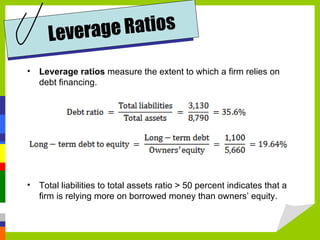
• Leverage ratios measure the extent to which a firm relies on
  debt financing.


• Total liabilities to total assets ratio > 50 percent indicates that a
  firm is relying more on borrowed money than owners’ equity.
Budgets

•   Budget - planning and control tool that reflects a
    firm’s expected sales revenues, operating
    expenses, and cash receipts and outlays.

•   Management estimates of expected sales, cash
    inflows and outflows, and costs.

•   Budgets are a financial blueprint that serves as a
    financial plan.

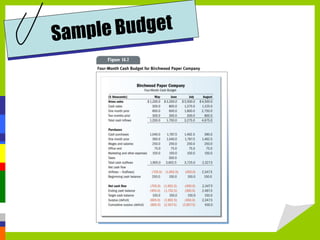
•   Cash budget - tracks the firm’s cash inflows and
    outflows.
Sample Budget
Int ernational
              Accounting
• International Accounting Standards Committee (IASC)
  promotes worldwide consistency in financial reporting practices.
  In 2001, became the International Accounting Standards
  Board (IASB). International Financial Reporting Standards
  (IFRS) are the standards.

• Exchange Rates - ratio at which a country’s currency can be
  exchanged for other currencies.
• Consolidated financial statements must reflect gains and losses
  due to changes in exchange rates.
• Can have significant impact on financial statement.

Ch16 introto business

  • 1.
    > > >> > > > > Chapter 16 Understanding Accounting and Financial Statements
  • 2.
    Learni ng Goal s 5 Explain the functions and major 1 Explain the functions and importance components of the four principal financial of accounting, and identify the three statements: the balance sheet, the basic activities involving accounting. income statement, the statement of owner’s equity, and the statement of 2 Describe the roles played by public, cash flows. management, government and not-for- profit accountants. 6 Discuss how financial ratios are used to analyze a company’s financial strengths 3 Identify the foundations of the and weaknesses. accounting system, including GAAP and the role of the Financial 7 Describe the role of budgets in a Accounting Standards Board (FASB). business. 4 Outline the steps in the accounting 8 Outline accounting issues facing global cycle, and define double-entry business and the move toward one set of bookkeeping and the accounting worldwide accounting rules. equation.
  • 3.
    Ac co unti ng Accounting is the process of measuring, interpreting, and communicating financial information to support internal and external business decision making.
  • 4.
    O pen Book Man agement • Open book management - sharing sensitive financial information with employees and teaching them how to understand and use financial statements. • Viewing financial information may help them better understand how their work contributes to the company’s success. • Outsiders use financial data to evaluate investment opportunities.
  • 5.
    Business Activities Involving Accounting • Financing activities provide necessary funds to start a business and expand it after it begins operating. • Investing activities provide valuable assets required to run a business. • Operating activities focus on selling goods and services, but they also consider expenses as important elements of sound financial management.
  • 6.
    Accounting Profe ssionals • Public Accountants – Provide accounting services to individuals or business firms for a fee • Management Accountants – Provide timely, relevant, accurate, and concise information that executives can use to operate their firms • Government and Not-for-Profit Accountants
  • 7.
    T he Foundation of Accoun ting Systems • Generally accepted accounting principles (GAAP) encompass the conventions, rules, and procedures for determining acceptable accounting practices at a particular time. • Financial Accounting Standards Board (FASB) is primarily responsible for evaluating, setting, or modifying GAAP in the U.S. • Sarbanes-Oxley Act responded to cases of accounting fraud. – Created the Public Accounting Oversight Board, which sets audit standards and investigates and sanctions accounting firms that certify the books of publicly traded firms. – Senior executives must personally certify that the financial information reported by the company is correct. – Resulted in increase in demand for accountants.
  • 8.
    The A ccounting Cycle Accounting process - set of activities involved in converting information about transactions into financial statements.
  • 9.
    The Accoun tingEquation • Assets - anything of value owned or leased by a business. • Liability - claim against a firm’s assets by a creditor. • Owner’s equity - all claims of the proprietor, partners, or stockholders against the assets of a firm, equal to the excess of assets over liabilities. • Basic accounting equation - relationship that states that assets equal liabilities plus owners’ equity. • Double-entry bookkeeping - process by which accounting transactions are entered; each individual transaction always has an offsetting transaction.
  • 10.
    uters & The Im pact of Comp ccounting Internet on A • Simplifies the accounting process by automating data entry and calculations. • Available products are customized for businesses of different sizes. – Entrepreneurs and small businesses use: QuickBooks, Peachtree, and BusinessWorks. – Larger firms use larger scale software packages like: Computer Associates, Oracle, and SAP. • Software that handles accounting information for international businesses is another option. Offers different country information/language. • Some systems offer web-based packages for small and medium businesses.
  • 11.
    B alan ce Sheet  Balance sheet - statement of a firm’s financial position—what it owns and the claims against its assets—at a particular point in time.  Photograph of firm’s assets together with its liabilities and owner’s equity  Follows the accounting equation
  • 12.
    S a mple Ba la nce Sheet
  • 13.
    om e Stat ement In c  Income Statement - financial record of a company’s revenues and expenses, and profits over a period of time.  Firm’s financial performance in terms of revenues, expenses, and profits over a given time period.  Reports profit or loss.  Focus on revenues and costs associated with revenues.
  • 14.
    Samp le Income Statement
  • 15.
    St atement of Own er’s Equity  Statement of Owner’s Equity - is designed to show the components of the change in equity from the end of one fiscal year to the end of the next.  Begins with the amount of equity shown on the balance sheet.  Net income is added, and cash dividends paid to owners are subtracted.
  • 16.
    Sample Sta tementof Own er’s Equity
  • 17.
    Th e Statement of Ca sh Flows  Statement of cash flows - a firm’s cash receipts and cash payments that presents information on its sources and uses of cash.  Accrual accounting - method that records revenue and expenses when they occur, not necessarily when cash actually changes hands.
  • 18.
    S ample Statement of Ca sh Flows
  • 19.
    s Analysis Fi nancial Ratio Ratio analysis - tool for measuring a firm’s liquidity, profitability, and reliance on debt financing, as well as the effectiveness of management’s resource utilization.
  • 20.
    Liquidit y Rat i o s Total current assets Current ratio compares current assets to current liabilities. Total current liabilities Acid-test (or quick) Cash and equivalents ratio measures the + short-term investments ability of a firm to meet + accounts receivable its debt payments on short notice. Total current liabilities
  • 21.
    Activity Ratios Net sales Inventory turnover ratio indicates the number of times merchandise moves Average of inventory through a business. Net sales Total asset turnover ratio indicates how much in sales each dollar invested in assets generates. Average of total assets
  • 22.
    Profitabil i ty Ra t i o s Profitability ratios measure the organization’s overall financial performance by evaluating its ability to generate revenues in excess of operating costs and other expenses.
  • 23.
    Leverag e Ra ti o s • Leverage ratios measure the extent to which a firm relies on debt financing. • Total liabilities to total assets ratio > 50 percent indicates that a firm is relying more on borrowed money than owners’ equity.
  • 24.
    Budgets • Budget - planning and control tool that reflects a firm’s expected sales revenues, operating expenses, and cash receipts and outlays. • Management estimates of expected sales, cash inflows and outflows, and costs. • Budgets are a financial blueprint that serves as a financial plan. • Cash budget - tracks the firm’s cash inflows and outflows.
  • 25.
  • 26.
    Int ernational Accounting • International Accounting Standards Committee (IASC) promotes worldwide consistency in financial reporting practices. In 2001, became the International Accounting Standards Board (IASB). International Financial Reporting Standards (IFRS) are the standards. • Exchange Rates - ratio at which a country’s currency can be exchanged for other currencies. • Consolidated financial statements must reflect gains and losses due to changes in exchange rates. • Can have significant impact on financial statement.