Malposition and Malpresentation
1
Definition of Terms
•
•
•
Presentation- the part of the fetus which occupies the lower
uterine segment.
Lie – the relationship between the long axis of the fetus and the
mother (longitudinal ,Transverse and Oblique)
Attitude- position of the fetal head in relation to the neck
2
Definition of Terms…

Denominator- It is an arbitrary f i
xed bony point at the presenting part which
come in relation with the various quadrants of the maternal pelvis. Occiput,
Sacrum, Mentum, Frontal and Acromion
Position- It is the relation of the denominator to the different quadrants of
the maternal pelvis.
Cardinal movement:
Engagement,Descent,Flexion,Internalrotation,Extensition,External
rotation ( Restitution ) and Expulsion
Engagement- means maximum transverse diameter of the presenting part
passes through the pelvic brim. • For head bi-parietal diameter. • For breech
bi-trochanteric diameter 3


Malposition
Malposition is abnormal position of the vertex (other than
occipito-anterior position (DOA,ROA and LOA)) of the fetal
head relative to the maternal pelvis.
Malpresentation
Any fetal presentation other than a vertex presentation
4
Etiologies of Malpresentation/Malposition
Fetal Maternal
Multiple pregnancy
Congenital anomalies- anencephaly, hydrocephalus,
fetal tumors, fetal hydrops
Fetal macrosomia
Conjoined twins
Polyhydramnios
Oligohydramnios
Placenta previa
•
•
•
•
•
•
•
Preterm labor/prematurity
Uterine congenital anomalies- arcuate,
septate, didelphys, unicornuate uteri
Contracted pelvis
Grand multiparity
Uterine myoma
Genetic predispositions- family history
of malpresentations
•
•
•
•
•
•
Most known causes of mal-presentations act by preventing the natural rotation of the fetal head
to the lower segment around the 34th week or above and also by preventing the stabilization and
fixation of the fetal head in the pelvic inlet around term.
5
Malposition


Classification of Malposition
Occiput posterior (DOP,LOP, ROP)
Persistent occiput transverse position (ROT, LOT)
Occiput posterior
Occiput posterior position is when the fetal occiput is
posterior in relation to the maternal pelvis.
6
1. Occiput posterior position




Most, 90%, occiput posterior positions undergo
spontaneous anterior rotation.
Transverse narrowing of the midpelvis is a risk factor.
Is associated with partial def l
ection of the head and hence
the occipito frontal diameter (11.5 cm) is presenting.
ROP is more common than LOP
- Large bowel on the left side
7
Diagnosis

Suggestive abdominal findings:-
Flattened lower part of the abdomen.
Anteriorly palpable fetal limbs.
Fetal heart heard in the flank.
More marked fetal movement
On vaginal examination:-
Posterior fontanelle towards the sacrum.
Anterior fontanelle felt anteriorly if neck is flexed.
8
•
•
Mechanism of labor
Two types of OP:
- Flexed OP: suboccipito bregmatic( 9.5 cm) and biparietal diameters (9.5
cm) are the presenting diameters.
- Deflexed OP: occipitofrontal( 11.5 cm) and biparietal diameters engage.
Progress depend on flexion!!
9
Management

Labor and delivery need not differ remarkably from that with the occiput
anterior.
The possibilities for vaginal delivery:
1 -Spontaneous delivery.
2 -Forceps delivery with the occiput directly posterior.
3 -Manual rotation to the anterior position followed by spontaneous or
forceps delivery.
4 -Forceps rotation of the occiput to the anterior position and delivery
10
•
•
Spontaneous delivery
-Roomy outlet with relaxed perineum.
-Generous episiotomy is usually needed.
Forceps delivery as an occiput Posterior
-Forceps put midway between the occiput and sinciput.
-Initial traction directed posteriorly and as the glabella is at the apex of pubic arch the
traction should be anterior.
11
•
•
•
•
•
•
•
•
Manual Rotation.
The effective method is to rotate the sinciput
posteriorly.
Determine the exact position.
For ROP use the right hand to grasp the sinciput,
displacing upward to increase flexion.
Middle finger in the frontal suture as a marker.
The thumb and other f i
ngers around the bitemporal
region.
For the LOP, we use the left hand
The free hand applied over the maternal f l
ank to
promote rotation.
12
Persistent occiput transverse position (ROT, LOT)




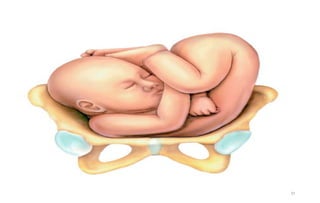
Persistent occiput transverse position is an occiput
transverse position that is maintained for an hour or more in
the second stage of labor
Classification
High transverse arrest (arrest above station +2 )
Deep transverse arrest (arrest below station +2)
13
Causes and risk factors

Inadequate power (contraction and poor pushing)
Platypelloid and android pelvis.
Fetal head in long occipito-frontal diameter.
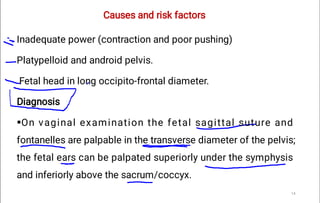
Diagnosis
On vaginal examination the fetal sagittal suture and
fontanelles are palpable in the transverse diameter of the pelvis;
the fetal ears can be palpated superiorly under the symphysis
and inferiorly above the sacrum/coccyx.
14
Management

Expectant management:
If there is any progress in descent and the fetal heart rate is reassuring,
expectant management is the preferred option.
Partial or complete rotation may still occur spontaneously.
Augmentation.
Caesarean delivery if there is high transverse arrest despite adequate
uterine contraction and maternal expulsive effort
15
Abnormal Axial Lie





Diagnosed in approximately 1 in 300 cases, at term.
Occurs if the fetal spine or long axis crosses that of the mother.
Diagnosis made by palpation or vaginal examination and
verified by ultrasound.
An arm, foot, or a shoulder be the presenting part.
Prematurity
Prematurity is often a factor, with abnormal lie reported to
occur in about 2 percent of pregnancies at 32 weeks, or six
times the rate found at term.
16
Abnormal Axial Lie…




•
Multiparty parity, contraction or deformity of the maternal pelvis, and
abnormal placentation are also the most commonly reported clinical
factors associated with abnormal lie.
Could be – oblique or transverse or unstable.
Unstable if the fetal membranes are intact and there is great fetal
mobility resulting in frequent changes of lie or presentation.
Perinatal mortality for unstable or transverse lie varies from 5 percent
to 25 percent, with maternal mortality as high as 10 percent
Cord prolapse occurs 20 times as it does with a cephalic presentation.
17
18
•
•
•
•
Management:
Exclude a major fetal malformation and abnormal placentation.
Expectant management before term.
Active intervention at or beyond 37weeks or after confirmation of
fetal lung maturity.
External cephalic version with subsequent induction of
labor(Stabilization induction).
19
•
•
•
•
Cesarean delivery is indicated if:
External version is unsuccessful or unavailable
Spontaneous rupture of membranes occurs
Active labor has begun with an abnormal lie
20
Deflection Attitudes


•
•
Attitude refers to the position of the fetal head in relation to the neck.
The normal attitude is full f l
exion on the neck, with the fetal chin against the upper
chest.
Def l
exed attitudes include various degrees of def l
ection or even extension of the fetal
head on the neck.
Management
Spontaneous conversion to a more normal f l
exed attitude or further extension of an
intermediate def lection to a fully extended position commonly occurs as labor
progresses.
Cesarean delivery is the only appropriate alternative when arrest of progress is
observed.
21
Malpresentation
•
•
•
•
•
Any fetal presentation other than a vertex presentation
Normal presentation is vertex presentation with flexed attitude.
The fetus normally assumes a vertical orientation or lie and a cephalic
presentation, with the fetal vertex flexed on the neck(95%).
fetal malpresentation
Deviation occurs from the normal lie, presentation, or f l
exion
attitude , fetal malpresentation.(5%)
Are associated with maternal and perinatal morbidity and
mortality much higher than the vertex presentation.
22
Presentation may be 

Cephalic 95%
Vertex 99%
Face 1:500
Brow 1:1500
Breech 3 - 4% at term
Shoulder 1:200
Compound
Cord presentation
23
Vertex 99%
Face 1:500
Brow 1:1500
24
Face presentation
•
•
•
•
Is characterized by a longitudinal lie and full extension of the
fetal head on the neck, with the occiput against the upper back.
The fetal chin (mentum) is chosen as the point of designation
during vaginal examination.
Incidence is 1 in 500 deliveries.
Many infants with a face presentation have malformations.
25
Etiologies
•
–
–
–
–
–
–
–
Conditions that favor extension or prevent head flexion
Fetal neck soft tissue masses or goiter
Preterm fetuses
coils of cord around the neck
Hydramnios
Anencephaly found in one third of the cases
Contracted pelvic (specially inlet)
High parity
26
•
•
•
•
In face presentation:
The presenting diameter in Mentoanterior is Sub-mento-bregmatic(9.5cm)
The presenting diameter in Mentoposterior is bregmotrachelar( 18cm)
Denominator in face presentation – Mentum
The prognosis for labor with a face presentation depends on the orientation
of the fetal chin.
At diagnosis: - Mentoanterior 60 to 80%
- Mentoposterior 20 to 25 %
- Mentotransverse 10 to 15 %
27
Attempts to convert a face presentation manually into a vertex presentation, manual or
forceps rotation of a persistently posterior chin to a mentum anterior position, and internal
podalic version and extraction are dangerous and not attempted. In the case of an average
or small fetus, adequate pelvis, and hypotonic labor, oxytocin may be considered.
28
•
•
•
Most m entotransv erse and 2 5 to 3 3 p erc ent of
mentoposterior infants will rotate .
In mentoanterior vaginal delivery is possible as the vertex f i
t
into the hollow of the sacrum and the chin f i
ts under the
symphysis.
The birth of the head in mentoposterior position is
impossible as the fetal brow pressing over the symphysis
precludes flexion.
29
Fig. Face with LMA
30
Fig. Face with RMA
31
Diagnosis




•
Suggestive abdominal finding:
Deep depression between the back and the head…’S’ shape of the fetal spine
Groove may be felt between the occiput and the back
On vaginal examination
Fetal chin, mouth and nose palpated.
The mouth with the two malar bone prominences make a triangle (unlike in breech
where the anal orifice with two trochanteric eminences are in a line)
Radiography
Demonstration of the hyperextended head with the facial bones at or below
the pelvic inlet
32
1.
2.
3.
To differentiate face from breech
Face – sucking ref l
ex, palpate gum, mentum + two maxillae makes
a triangle
Breech – meconium may be obtained, anus is on midline b/n the
ischial tubrosities, anal sphincter tone is more than the tone of the
mouth.
X-ray
Hyper extended head
Facial bones at or below pelvic inlet
33
34
Management of Face Presentation
•
•
•
Overall, 70% to 80% of infants with face presentation can be
delivered vaginally, either spontaneously or by low forceps,
whereas 12% to 30% require cesarean delivery.
Assess fetal size, pelvic adequacy and the presence of
anomalies at initial diagnosis.
In the absence of a contracted pelvis and with effective labor,
successful vaginal delivery usually will follow
35
•
•
•
Fetal heart rate monitoring is probably better done with
external devices to avoid damage to the face and eyes
Follow labor progress and ascertain internal rotation to mento
anterior position
Manual rotation to mento anterior position, internal podalic
version and extraction are an outdated management
36
•
•
•
Persistent mento-posterior presentation:
Mento-posterior in the later part of the f i
rst stage(after 6 cm of
cervical dilatation) and second stages of labor.
If fetus is alive → Cesarean delivery
If the fetus is dead → Craniotomy if all the prerequisites are
met
37
•
•
•
•
Complications
Prolonged labor: oxytocin may be considered in hypotonic
labor?
Worsening of the fetal condition is 10 fold higher.
- Continuous intrapartum electronic fetal heart rate
monitoring.
- Care must be taken in the placement of an electrode
to avoid cosmetic injury to the face.
Nerve damage to the neonate with forced f l
exion during
C/S.
Laryngeal and tracheal edema resulting from pressures of
the birth process.
38
Brow presentation
Brow presentation
•
•
•
•
Occupies a longitudinal axis, with a partially def l
exed cephalic attitude,
midway between full flexion and full extension.
The portion of the head between the orbital ridge and the anterior fontanel
presents at the pelvic inlet.
The frontal bones are the point of designation.
The engaging diameters are the mentovertical (13.5cm) and biparietal
(9.5cm).
-the largest pelvic diameter is 13 cm.
-labor is impossible with normal baby and fetus.
39
•
•
•
•
•
Frontum anterior is reportedly the most common position at diagnosis,
occurring about twice as often as either transverse or posterior positions.
Incidence is 1 in 10,000 ( Williams), 1 in 1,500( Gabbe).
On abdominal palpation both the occiput and chin can be palpated easily.
Brow presentation is commonly unstable and often converts to a face or vertex
presentation , about 91% in adequate pelvimetry.
Risk factors: -Cephalopelvic disproportion
-Prematurity
-Great parity
-An open fetal mouth pressed against the vaginal wall.
40
One unexpected cause of persistent
brow presentation may be an open fetal
mouth pressed against the vaginal wall,
splinting the head and preventing either
flexion or extension
41





Diagnosis
Suggestive abdominal finding:
Occiput felt above Sinciput.
Free head with ROM
Unengaged head in primigravida at term
Prolonged labor
Leopold’s palpation- “ military” attitude
42





Perivaginal
Diagnosis is rare before labor
Frontal suture
Large anterior fontanel  4 lines felt unlike 3 of posterior
fontanel
Orbital ridges, eyes, roots of nose
In brow presentation extensive moulding  caput occurs
43



•
•
•
Management
Antenatal
Antenatal
Expectant since 50% undergo spontaneous conversion to face(20%) or vertex(30%).
The patient should come to hospital immediately if labor starts or membrane ruptures.
In labor
In labor
If labor progresses with no distress  no interference, chance of change to face or
vertex in 2-3 hours.
If brow presentation diagnosed in early labor with no maternal OR fetal compromise,
we may wait and review the condition after 2 to 3 hours.
If still brow … emergency cesarean section!
If brow presentation diagnosed in established labor with signs of obstructed labor
emergency cesarean section!
44
•
•
•



•
•
Management…
Mechanism of labor – varies with size of the fetus.
Very small fetus  large pelvis – engagement and delivery is possible.
Large fetus – engagement is impossible unless:
extensive moulding,
flexion to vertex,
extension to face.
Forced conversion of the brow to a more favorable position with forceps or manual is
contraindicated.
Trial of labor with careful monitoring of maternal and fetal condition may be appropriate.
45
Management…



Persistent brow presentation is brow presentation in the
later part of the f i
rst stage (after 6 cm of cervical dilatation)
and second stages of labor.
If the fetus is alive deliver by cesarean section.
If the fetus is dead: Perform craniotomy if the cervix is fully
dilated and the head is accessible and other prerequisite for
craniotomy are met:
46
Management…


Deliver by caesarean section if:-
The cervix is not fully dilated or station is high.
The operator is not proficient in craniotomy.
Do not use an obstetric vacuum or forceps with brow presentation.
Augmentation of labor is also not generally recommended in brow
presentation.
47
Complications
Rupture of fetal membranes
Cord prolapse → fetal distress →fetal death
Marked molding
Rupture of fetal membranes
Prolonged and complicated labour
Maternal distress, dehydration, ketoacidosisInfection
No engagement of presenting part
Obstructed labour → uterine rupture →maternal death
Maternal complication
Fetal complication
48
Shoulder presentation
49
Shoulder presentation…
•
•
•
•
•
The shoulder is usually over the pelvic inlet, shoulder presentation.
The head lies in one iliac fossa, and the breech in the other.
The acromion and the back are important for designation.
The dorsum can be directed anteriorly or posteriorly, superiorly or
inferiorly.
Incidence is 1 in 335 singleton fetuses.
50
51
Risk factors







High parity Relaxed and pendulous abdomen The
uterus falls forward, and deflecting the long axis of the fetus away
from the axis of the birth canal
Preterm fetus
Placenta previa
Abnormal uterine anatomy
Hydramnios
Contracted pelvis
Multiple pregnancy.
52
•
•
•
•
•
Diagnosis
Abdominal Examination finding
The abdomen is unusually wide.
Fundal height is less than gestation age.
The uterine fundus extends to only slightly above the umbilicus.
No fetal pole is detected in the fundus.
Ballot table head is found in one iliac fossa and the breech in the other.
53
•
•
•
•
•
Vaginal examination
In delayed and neglected cases the hand and arm may prolapse.
Cord prolapse rate is the highest among the malpresentations (20%).
Depending on the position of dorsum, the shoulder, hands or parts of
the ribs may be felt on vaginal exam.
Clinical pelvimetry should be performed
Sonography
In addition to conf irming the diagnosis, presence of congenital
anomalies, placenta previa, uterine anomalies and fetal size
assessment should be made.
54
55
Management
•
•
•
•
Vaginal delivery of a fully developed newborn is impossible with a
persistent transverse lie.
After rupture of the membranes the fetal shoulder is forced into the
pelvis, and the corresponding arm frequently prolapses.
The onset of active labor in a woman with a transverse lie is an
indication for emergency cesarean delivery.
ECV should be tried if the membrane is intact and no
contraindications.
56
•
o
o
o
o
Management…
If the pelvis is large and the fetus is small, spontaneous evolution could take
place:
Arm and shoulder descend behind the symphysis.
The chest descend into the pelvis.
The breech follows.
Delivery follows as with breech with one arm extended.
57
Spontaneous
evolution
58
Spontaneous
evolution
59
If the fetus is small, less than 800 g, and dead it may double upon itself
and get expelled, conduplicato corpore.
S
p
o
n
t
a
n
e
o
u
s
e
x
p
u
l
s
i
o
n
60
Compound Presentation
•
•
•
•
Compound presentation is when a fetal extremity prolapses alongside the main
presenting part.
It usually is the hand alongside the fetal head.
Incidence of 1 in 700 deliveries.
Although maternal age, race, parity, and pelvic size have been associated with compound
presentation, prematurity is the most consistent clinical finding.
Diagnosis
Antepartum obstetrical ultrasound examination.
vaginal examination: Irregular mobile fetal part adjacent to the larger presenting part
61
•
•
•
•
Intrapartum management
Observation in normally progressing labor because 75% of
vertex/upper extremity combinations deliver spontaneously.
Closely monitor labor. The prolapsed extremity should not be
manipulated as it may retract with the descent of the main presenting
part.
Spontaneous vaginal birth can occur only when the fetus is very small
or dead and macerated.
Cesarean delivery is indicated if there is protraction or arrest of labor.
62
•
•
•
Augmentation of labor and instrument use is not recommended
Occult or undetected cord prolapse is possible, and, therefore,
continuous electronic FHR monitoring is recommended.
Cord prolapse occurs in 10% to 20% of cases.
Outcomes:
- Most cases result in uncomplicated vaginal delivery( up to 75%).
- I sc he mic ne c ro sis o f the arm (bo th ne uro lo gic and
musculoskeletal injury).
63
Asynclitism/Lateral flexion
Parietal presentation/Asynclitism/Lateral flexion



Synclitism: The posture in which the 2 parietal bones are at the
same level.
Asynclitism: The posture in which one parietal bone is at a lower
level than the other due to lateral inclination of the head.
Asynclitism is benef i
cial in bringing the shorter subparietal or
supraparietal diameter (9 cm) to enter the pelvis instead of the
longer biparietal (9.5 cm).
Slight degree of asynclitism may occur in normal labour
64
65
Thank you

MALPRESENTATION AND MALPOSITION.pdf

  • 1.
  • 2.
    Definition of Terms • • • Presentation-the part of the fetus which occupies the lower uterine segment. Lie – the relationship between the long axis of the fetus and the mother (longitudinal ,Transverse and Oblique) Attitude- position of the fetal head in relation to the neck 2
  • 3.
    Definition of Terms…  Denominator-It is an arbitrary f i xed bony point at the presenting part which come in relation with the various quadrants of the maternal pelvis. Occiput, Sacrum, Mentum, Frontal and Acromion Position- It is the relation of the denominator to the different quadrants of the maternal pelvis. Cardinal movement: Engagement,Descent,Flexion,Internalrotation,Extensition,External rotation ( Restitution ) and Expulsion Engagement- means maximum transverse diameter of the presenting part passes through the pelvic brim. • For head bi-parietal diameter. • For breech bi-trochanteric diameter 3
  • 4.
      Malposition Malposition is abnormalposition of the vertex (other than occipito-anterior position (DOA,ROA and LOA)) of the fetal head relative to the maternal pelvis. Malpresentation Any fetal presentation other than a vertex presentation 4
  • 5.
    Etiologies of Malpresentation/Malposition FetalMaternal Multiple pregnancy Congenital anomalies- anencephaly, hydrocephalus, fetal tumors, fetal hydrops Fetal macrosomia Conjoined twins Polyhydramnios Oligohydramnios Placenta previa • • • • • • • Preterm labor/prematurity Uterine congenital anomalies- arcuate, septate, didelphys, unicornuate uteri Contracted pelvis Grand multiparity Uterine myoma Genetic predispositions- family history of malpresentations • • • • • • Most known causes of mal-presentations act by preventing the natural rotation of the fetal head to the lower segment around the 34th week or above and also by preventing the stabilization and fixation of the fetal head in the pelvic inlet around term. 5
  • 6.
    Malposition   Classification of Malposition Occiputposterior (DOP,LOP, ROP) Persistent occiput transverse position (ROT, LOT) Occiput posterior Occiput posterior position is when the fetal occiput is posterior in relation to the maternal pelvis. 6
  • 7.
    1. Occiput posteriorposition     Most, 90%, occiput posterior positions undergo spontaneous anterior rotation. Transverse narrowing of the midpelvis is a risk factor. Is associated with partial def l ection of the head and hence the occipito frontal diameter (11.5 cm) is presenting. ROP is more common than LOP - Large bowel on the left side 7
  • 8.
    Diagnosis Suggestive abdominal findings:- Flattenedlower part of the abdomen. Anteriorly palpable fetal limbs. Fetal heart heard in the flank. More marked fetal movement On vaginal examination:- Posterior fontanelle towards the sacrum. Anterior fontanelle felt anteriorly if neck is flexed. 8
  • 9.
    • • Mechanism of labor Twotypes of OP: - Flexed OP: suboccipito bregmatic( 9.5 cm) and biparietal diameters (9.5 cm) are the presenting diameters. - Deflexed OP: occipitofrontal( 11.5 cm) and biparietal diameters engage. Progress depend on flexion!! Progress depend on flexion!! 9
  • 10.
    Management Labor and deliveryneed not differ remarkably from that with the occiput anterior. The possibilities for vaginal delivery: 1 -Spontaneous delivery. 2 -Forceps delivery with the occiput directly posterior. 3 -Manual rotation to the anterior position followed by spontaneous or forceps delivery. 4 -Forceps rotation of the occiput to the anterior position and delivery 10
  • 11.
    • • Spontaneous delivery -Roomy outletwith relaxed perineum. -Generous episiotomy is usually needed. Forceps delivery as an occiput Posterior -Forceps put midway between the occiput and sinciput. -Initial traction directed posteriorly and as the glabella is at the apex of pubic arch the traction should be anterior. 11
  • 12.
    • • • • • • • • Manual Rotation. The effectivemethod is to rotate the sinciput posteriorly. Determine the exact position. For ROP use the right hand to grasp the sinciput, displacing upward to increase flexion. Middle finger in the frontal suture as a marker. The thumb and other f i ngers around the bitemporal region. For the LOP, we use the left hand The free hand applied over the maternal f l ank to promote rotation. 12
  • 13.
    Persistent occiput transverseposition (ROT, LOT)    Persistent occiput transverse position is an occiput transverse position that is maintained for an hour or more in the second stage of labor Classification High transverse arrest (arrest above station +2 ) Deep transverse arrest (arrest below station +2) 13
  • 14.
    Causes and riskfactors  Inadequate power (contraction and poor pushing) Platypelloid and android pelvis. Fetal head in long occipito-frontal diameter. Diagnosis On vaginal examination the fetal sagittal suture and fontanelles are palpable in the transverse diameter of the pelvis; the fetal ears can be palpated superiorly under the symphysis and inferiorly above the sacrum/coccyx. 14
  • 15.
    Management Expectant management: If thereis any progress in descent and the fetal heart rate is reassuring, expectant management is the preferred option. Partial or complete rotation may still occur spontaneously. Augmentation. Caesarean delivery if there is high transverse arrest despite adequate uterine contraction and maternal expulsive effort 15
  • 16.
    Abnormal Axial Lie      Diagnosedin approximately 1 in 300 cases, at term. Occurs if the fetal spine or long axis crosses that of the mother. Diagnosis made by palpation or vaginal examination and verified by ultrasound. An arm, foot, or a shoulder be the presenting part. Prematurity Prematurity is often a factor, with abnormal lie reported to occur in about 2 percent of pregnancies at 32 weeks, or six times the rate found at term. 16
  • 17.
    Abnormal Axial Lie…     • Multipartyparity, contraction or deformity of the maternal pelvis, and abnormal placentation are also the most commonly reported clinical factors associated with abnormal lie. Could be – oblique or transverse or unstable. Unstable if the fetal membranes are intact and there is great fetal mobility resulting in frequent changes of lie or presentation. Perinatal mortality for unstable or transverse lie varies from 5 percent to 25 percent, with maternal mortality as high as 10 percent Cord prolapse occurs 20 times as it does with a cephalic presentation. 17
  • 18.
  • 19.
    • • • • Management: Exclude a majorfetal malformation and abnormal placentation. Expectant management before term. Active intervention at or beyond 37weeks or after confirmation of fetal lung maturity. External cephalic version with subsequent induction of labor(Stabilization induction). 19
  • 20.
    • • • • Cesarean delivery isindicated if: External version is unsuccessful or unavailable Spontaneous rupture of membranes occurs Active labor has begun with an abnormal lie 20
  • 21.
    Deflection Attitudes   • • Attitude refersto the position of the fetal head in relation to the neck. The normal attitude is full f l exion on the neck, with the fetal chin against the upper chest. Def l exed attitudes include various degrees of def l ection or even extension of the fetal head on the neck. Management Spontaneous conversion to a more normal f l exed attitude or further extension of an intermediate def lection to a fully extended position commonly occurs as labor progresses. Cesarean delivery is the only appropriate alternative when arrest of progress is observed. 21
  • 22.
    Malpresentation • • • • • Any fetal presentationother than a vertex presentation Normal presentation is vertex presentation with flexed attitude. The fetus normally assumes a vertical orientation or lie and a cephalic presentation, with the fetal vertex flexed on the neck(95%). fetal malpresentation Deviation occurs from the normal lie, presentation, or f l exion attitude , fetal malpresentation.(5%) Are associated with maternal and perinatal morbidity and mortality much higher than the vertex presentation. 22
  • 23.
    Presentation may be Cephalic 95% Vertex 99% Face 1:500 Brow 1:1500 Breech 3 - 4% at term Shoulder 1:200 Compound Cord presentation 23
  • 24.
  • 25.
    Face presentation • • • • Is characterizedby a longitudinal lie and full extension of the fetal head on the neck, with the occiput against the upper back. The fetal chin (mentum) is chosen as the point of designation during vaginal examination. Incidence is 1 in 500 deliveries. Many infants with a face presentation have malformations. 25
  • 26.
    Etiologies • – – – – – – – Conditions that favorextension or prevent head flexion Fetal neck soft tissue masses or goiter Preterm fetuses coils of cord around the neck Hydramnios Anencephaly found in one third of the cases Contracted pelvic (specially inlet) High parity 26
  • 27.
    • • • • In face presentation: Thepresenting diameter in Mentoanterior is Sub-mento-bregmatic(9.5cm) The presenting diameter in Mentoposterior is bregmotrachelar( 18cm) Denominator in face presentation – Mentum The prognosis for labor with a face presentation depends on the orientation of the fetal chin. At diagnosis: - Mentoanterior 60 to 80% - Mentoposterior 20 to 25 % - Mentotransverse 10 to 15 % 27
  • 28.
    Attempts to converta face presentation manually into a vertex presentation, manual or forceps rotation of a persistently posterior chin to a mentum anterior position, and internal podalic version and extraction are dangerous and not attempted. In the case of an average or small fetus, adequate pelvis, and hypotonic labor, oxytocin may be considered. 28
  • 29.
    • • • Most m entotransverse and 2 5 to 3 3 p erc ent of mentoposterior infants will rotate . In mentoanterior vaginal delivery is possible as the vertex f i t into the hollow of the sacrum and the chin f i ts under the symphysis. The birth of the head in mentoposterior position is impossible as the fetal brow pressing over the symphysis precludes flexion. 29
  • 30.
  • 31.
  • 32.
    Diagnosis     • Suggestive abdominal finding: Deepdepression between the back and the head…’S’ shape of the fetal spine Groove may be felt between the occiput and the back On vaginal examination Fetal chin, mouth and nose palpated. The mouth with the two malar bone prominences make a triangle (unlike in breech where the anal orifice with two trochanteric eminences are in a line) Radiography Demonstration of the hyperextended head with the facial bones at or below the pelvic inlet 32
  • 33.
    1. 2. 3. To differentiate facefrom breech To differentiate face from breech Face – sucking ref l ex, palpate gum, mentum + two maxillae makes a triangle Breech – meconium may be obtained, anus is on midline b/n the ischial tubrosities, anal sphincter tone is more than the tone of the mouth. X-ray Hyper extended head Facial bones at or below pelvic inlet 33
  • 34.
  • 35.
    Management of FacePresentation • • • Overall, 70% to 80% of infants with face presentation can be delivered vaginally, either spontaneously or by low forceps, whereas 12% to 30% require cesarean delivery. Assess fetal size, pelvic adequacy and the presence of anomalies at initial diagnosis. In the absence of a contracted pelvis and with effective labor, successful vaginal delivery usually will follow 35
  • 36.
    • • • Fetal heart ratemonitoring is probably better done with external devices to avoid damage to the face and eyes Follow labor progress and ascertain internal rotation to mento anterior position Manual rotation to mento anterior position, internal podalic version and extraction are an outdated management 36
  • 37.
    • • • Persistent mento-posterior presentation: Mento-posteriorin the later part of the f i rst stage(after 6 cm of cervical dilatation) and second stages of labor. If fetus is alive → Cesarean delivery If the fetus is dead → Craniotomy if all the prerequisites are met 37
  • 38.
    • • • • Complications Prolonged labor: oxytocinmay be considered in hypotonic labor? Worsening of the fetal condition is 10 fold higher. - Continuous intrapartum electronic fetal heart rate monitoring. - Care must be taken in the placement of an electrode to avoid cosmetic injury to the face. Nerve damage to the neonate with forced f l exion during C/S. Laryngeal and tracheal edema resulting from pressures of the birth process. 38
  • 39.
    Brow presentation Brow presentation • • • • Occupiesa longitudinal axis, with a partially def l exed cephalic attitude, midway between full flexion and full extension. The portion of the head between the orbital ridge and the anterior fontanel presents at the pelvic inlet. The frontal bones are the point of designation. The engaging diameters are the mentovertical (13.5cm) and biparietal (9.5cm). -the largest pelvic diameter is 13 cm. -labor is impossible with normal baby and fetus. 39
  • 40.
    • • • • • Frontum anterior isreportedly the most common position at diagnosis, occurring about twice as often as either transverse or posterior positions. Incidence is 1 in 10,000 ( Williams), 1 in 1,500( Gabbe). On abdominal palpation both the occiput and chin can be palpated easily. Brow presentation is commonly unstable and often converts to a face or vertex presentation , about 91% in adequate pelvimetry. Risk factors: -Cephalopelvic disproportion -Prematurity -Great parity -An open fetal mouth pressed against the vaginal wall. 40
  • 41.
    One unexpected causeof persistent brow presentation may be an open fetal mouth pressed against the vaginal wall, splinting the head and preventing either flexion or extension 41
  • 42.
         Diagnosis Suggestive abdominal finding: Occiputfelt above Sinciput. Free head with ROM Unengaged head in primigravida at term Prolonged labor Leopold’s palpation- “ military” attitude 42
  • 43.
         Perivaginal Diagnosis is rarebefore labor Frontal suture Large anterior fontanel  4 lines felt unlike 3 of posterior fontanel Orbital ridges, eyes, roots of nose In brow presentation extensive moulding caput occurs 43
  • 44.
       • • • Management Antenatal Antenatal Expectant since 50%undergo spontaneous conversion to face(20%) or vertex(30%). The patient should come to hospital immediately if labor starts or membrane ruptures. In labor In labor If labor progresses with no distress  no interference, chance of change to face or vertex in 2-3 hours. If brow presentation diagnosed in early labor with no maternal OR fetal compromise, we may wait and review the condition after 2 to 3 hours. If still brow … emergency cesarean section! If brow presentation diagnosed in established labor with signs of obstructed labor emergency cesarean section! 44
  • 45.
    • • •    • • Management… Mechanism of labor– varies with size of the fetus. Very small fetus large pelvis – engagement and delivery is possible. Large fetus – engagement is impossible unless: extensive moulding, flexion to vertex, extension to face. Forced conversion of the brow to a more favorable position with forceps or manual is contraindicated. Trial of labor with careful monitoring of maternal and fetal condition may be appropriate. 45
  • 46.
    Management…    Persistent brow presentationis brow presentation in the later part of the f i rst stage (after 6 cm of cervical dilatation) and second stages of labor. If the fetus is alive deliver by cesarean section. If the fetus is dead: Perform craniotomy if the cervix is fully dilated and the head is accessible and other prerequisite for craniotomy are met: 46
  • 47.
    Management…   Deliver by caesareansection if:- The cervix is not fully dilated or station is high. The operator is not proficient in craniotomy. Do not use an obstetric vacuum or forceps with brow presentation. Augmentation of labor is also not generally recommended in brow presentation. 47
  • 48.
    Complications Rupture of fetalmembranes Cord prolapse → fetal distress →fetal death Marked molding Rupture of fetal membranes Prolonged and complicated labour Maternal distress, dehydration, ketoacidosisInfection No engagement of presenting part Obstructed labour → uterine rupture →maternal death Maternal complication Fetal complication 48
  • 49.
  • 50.
    Shoulder presentation… • • • • • The shoulderis usually over the pelvic inlet, shoulder presentation. The head lies in one iliac fossa, and the breech in the other. The acromion and the back are important for designation. The dorsum can be directed anteriorly or posteriorly, superiorly or inferiorly. Incidence is 1 in 335 singleton fetuses. 50
  • 51.
  • 52.
    Risk factors        High parityRelaxed and pendulous abdomen The uterus falls forward, and deflecting the long axis of the fetus away from the axis of the birth canal Preterm fetus Placenta previa Abnormal uterine anatomy Hydramnios Contracted pelvis Multiple pregnancy. 52
  • 53.
    • • • • • Diagnosis Abdominal Examination finding Theabdomen is unusually wide. Fundal height is less than gestation age. The uterine fundus extends to only slightly above the umbilicus. No fetal pole is detected in the fundus. Ballot table head is found in one iliac fossa and the breech in the other. 53
  • 54.
    • • • • • Vaginal examination In delayedand neglected cases the hand and arm may prolapse. Cord prolapse rate is the highest among the malpresentations (20%). Depending on the position of dorsum, the shoulder, hands or parts of the ribs may be felt on vaginal exam. Clinical pelvimetry should be performed Sonography In addition to conf irming the diagnosis, presence of congenital anomalies, placenta previa, uterine anomalies and fetal size assessment should be made. 54
  • 55.
  • 56.
    Management • • • • Vaginal delivery ofa fully developed newborn is impossible with a persistent transverse lie. After rupture of the membranes the fetal shoulder is forced into the pelvis, and the corresponding arm frequently prolapses. The onset of active labor in a woman with a transverse lie is an indication for emergency cesarean delivery. ECV should be tried if the membrane is intact and no contraindications. 56
  • 57.
    • o o o o Management… If the pelvisis large and the fetus is small, spontaneous evolution could take place: Arm and shoulder descend behind the symphysis. The chest descend into the pelvis. The breech follows. Delivery follows as with breech with one arm extended. 57
  • 58.
  • 59.
  • 60.
    If the fetusis small, less than 800 g, and dead it may double upon itself and get expelled, conduplicato corpore. S p o n t a n e o u s e x p u l s i o n 60
  • 61.
    Compound Presentation • • • • Compound presentationis when a fetal extremity prolapses alongside the main presenting part. It usually is the hand alongside the fetal head. Incidence of 1 in 700 deliveries. Although maternal age, race, parity, and pelvic size have been associated with compound presentation, prematurity is the most consistent clinical finding. Diagnosis Antepartum obstetrical ultrasound examination. vaginal examination: Irregular mobile fetal part adjacent to the larger presenting part 61
  • 62.
    • • • • Intrapartum management Observation innormally progressing labor because 75% of vertex/upper extremity combinations deliver spontaneously. Closely monitor labor. The prolapsed extremity should not be manipulated as it may retract with the descent of the main presenting part. Spontaneous vaginal birth can occur only when the fetus is very small or dead and macerated. Cesarean delivery is indicated if there is protraction or arrest of labor. 62
  • 63.
    • • • Augmentation of laborand instrument use is not recommended Occult or undetected cord prolapse is possible, and, therefore, continuous electronic FHR monitoring is recommended. Cord prolapse occurs in 10% to 20% of cases. Outcomes: - Most cases result in uncomplicated vaginal delivery( up to 75%). - I sc he mic ne c ro sis o f the arm (bo th ne uro lo gic and musculoskeletal injury). 63
  • 64.
    Asynclitism/Lateral flexion Parietal presentation/Asynclitism/Lateralflexion    Synclitism: The posture in which the 2 parietal bones are at the same level. Asynclitism: The posture in which one parietal bone is at a lower level than the other due to lateral inclination of the head. Asynclitism is benef i cial in bringing the shorter subparietal or supraparietal diameter (9 cm) to enter the pelvis instead of the longer biparietal (9.5 cm). Slight degree of asynclitism may occur in normal labour 64
  • 65.