3rd year Nursing student
5/23/2024
1
Eshetu T, UoG.
Abnormal labor
5/23/2024
Eshetu T, UoG.
2
 Is any labor in which the pattern of labor progress is
significantly different from accepted and recognized
patterns of labor progress in terms of
Profile of uterine contractions
Decent of fetal presenting part
Cervical changes
5/23/2024
Eshetu T, UoG.
3
Labor Pattern
Diagnostic Criteria
Preferred
Rx
Exceptional Rx
Nullipara Multiparas
1. First stage disorder 1. Prolongation disorder
Prolonged Latent Phase >20hrs >14hrs Bed rest
 Oxytocin
 C/s delivery for
urgent problems
1. Protraction disorders
Active phase dilatation <1.2cm/hrs. <1.5cm/hrs. Expectant/
Support
C/s for CPD
Descent <1cm/hrs. <2cm/hrs.
1. Arrest disorders
Prolonged deceleration phase >3hr >1hr
CPD - C/s
No CPD –
Oxytocin
Rest if exhausted
C/ s delivery
Secondary arrest of dilatation >2hr >2hr
Arrest of descent >1hr >1hr
Failure of Descent No descent in deceleration phase
1. Second stage disorders
Prolonged 2nd SOL
Without epidural > 2 hrs.
Without epidural >
1 hr.
depends on identified cause and
presence of complications
With epidural
> 3 hrs.
With epidural
> 2 hrs.
Failure of descent No descent in second stage
Causes of Abnormal labor
5/23/2024
Eshetu T, UoG.
4
The „„3 Ps‟‟- act singly or in combination
1. Power: Dysfunctional ux contraction & poor maternal
effort
Types of utérine dysfunction
1. Hypotonic uterine dysfunction
• More common
• Uterine contractions have a normal gradient pattern
• But Pressure is insufficient to dilate the cervix
Causes of Abnormal labor
5/23/2024
Eshetu T, UoG.
5
2. Hypertonic or in-coordinate uterine dysfunction
• Either basal tone is elevated appreciably or
• The pressure gradient is distorted → may result from;
 More forceful contraction of the uterine mid segment than
the fundus
 From complete asynchrony of the impulses originating in
each cornu
 From a combination of these two
Causes of Abnormal labor
5/23/2024
Eshetu T, UoG.
6
Various factors are implicated in uterine dysfunction
 Analgesia
 Chorioamnionitis
 A higher station
 Maternal age & obesity
Causes of Abnormal labor
5/23/2024
Eshetu T, UoG.
7
2. Passage:
The contracted pelvis & lower reproductive tract
3. Passenger: Macrosomia, malpresentation,
malposition
 NB: Labor abnormality can be as a consequence of
combination of the three Ps. For example,
abnormality of passage and passenger can result
in Cephalo-Pelvic-Disproportion (CPD) or Feto-
Pelvic-Disproportion (FPD)
Sign & symptom of abnormal labour
5/23/2024
Eshetu T, UoG.
8
 Failure or poor progress of labour
NB: Clinical Pelvimetry is used intrapartum to
check for adequacy of the pelvis in case of
prolonged second stage in prim gravid.
Diagnosis of labour abnormality is
 Mainly clinical by
Close observation of progress of labour
Appropriate use of Partograph.
Complications of abnormal labour
5/23/2024
Eshetu T, UoG.
9
 If not managed timely, abnormal Labor will
contribute to bad outcome of the
 Maternal, Fetal and Neonate.
 Obstructed labor, obstetric fistula, Uterine
rupture, hemorrhage, sepsis and maternal death
 Fetal distress, asphyxia, and death
Management of abnormal labor
5/23/2024
Eshetu T, UoG.
10
 Rule out false labor
 False labor is characterized by change in cervical
effacement and dilatation after 4 to 8 hrs. of
revaluation.
 Once false labor is ascertained explain to the
woman (and accompanying relatives) about
 False or true labor & danger symptoms of pregnancy & labor.
 Discharge the woman if she has no other problem
requiring inpatient management.
 Rehydrate if there is sign of dehydration and give
psychological support for the mother
Management of abnormal labor
5/23/2024
Eshetu T, UoG.
11
1. Latent phase abnormalities
 Dysfunctional uterine contraction is treated by
 Augmentation of labor if there is no
contraindication.
 Scarred cervix due to operations such as
 Conization or cautery may lead to prolonged first
stage of labor. in such scenario C/S, delivery
should be considered.
Management of latent phase abnormality in the
presence of
 Malpresentation and
 Malposition depends on the specific abnormality.
Management….
5/23/2024
Eshetu T, UoG.
12
2. Active phase abnormalities
 If the alert line is crossed, thorough assessment of the:-
 Mother,
Fetes and
Progress of labor should be done to identify the cause.
 In the absence of adequate uterine contractions:
Provide labor support:
 Sometimes rehydration,
 Emptying the bladder & encouraging the woman to be
more active and
 Move around or adopt an upright position.
Management….
5/23/2024
Eshetu T, UoG.
13
 Consider ARM & augmentation if no contraindication
Re-evaluation 2-4 hours later
 Presence of adequate labor progress with above
interventions (Cervicogram remains to the left of
the action line):
 Expect vaginal delivery
 Inadequate labor progress despite intervention
(Cervicogram crosses the action line):
Cesarean delivery.
Management….
5/23/2024
Eshetu T, UoG.
14
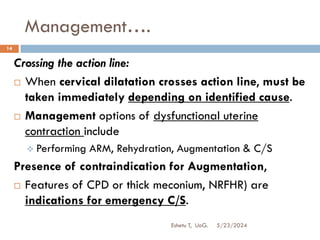
Crossing the action line:
 When cervical dilatation crosses action line, must be
taken immediately depending on identified cause.
 Management options of dysfunctional uterine
contraction include
 Performing ARM, Rehydration, Augmentation & C/S
Presence of contraindication for Augmentation,
 Features of CPD or thick meconium, NRFHR) are
indications for emergency C/S.
Management
5/23/2024
Eshetu T, UoG.
15
3. 2nd SOL abnormality
 Abnormal progress in the second stage is entertained
if there is not progressive descent (or head rotation to
a favorable position) with uterine contraction.
Management depends on
 Identified cause & presence of complications.
The management options are
 Augmentation of labor (particularly in primigravid),
 Caesarean delivery,
 Instrumental vaginal delivery (in the absence of CI)
 Destructive vaginal delivery (if prerequisites are
fulfilled).
Malposition and Malpresentation
5/23/2024
Eshetu T, UoG.
16
• Malposition – any positions of the vertex other than OA
of the fetal head relative to the maternal pelvis
 Occiput posterior
 Persistent occiput transverse position
• Malpresentation - all fetal presentations other than
vertex
 Face
 Brow
 Breech
 Shoulder
 Compound
Occipito-posterior position
5/23/2024
Eshetu T, UoG.
17
 Where the occiput is placed posteriorly either over
 The sacroiliac joint (ROP/LOP) or
 Directly over the sacrum (DOP)
• It is the most common fetal malposition
incidence
• At the onset of labor10%
• term fetuses before labor, 15 – 20%
• Only 5% are OP at vaginal delivery because
• Most(90%) spontaneously rotate to an OA during
labor
Occipito-posterior position
5/23/2024
Eshetu T, UoG.
18
Risk factors
5/23/2024
Eshetu T, UoG.
19
• Nulliparity
• Maternal age greater than 35 years
• Obesity
• Previous OP delivery
• Shape of pelvic inlet (Anthropoid & android pelvis)
• GA ≥41 weeks, Birth weight ≥4000 grams
• Anterior placenta – leads the fetus to remains in
dorso-posterior position
Diagnosis
5/23/2024
Eshetu T, UoG.
20
 History
 Physical examination
 Abdominal findings
 Vaginal examination
 Ultra sound
Diagnosis
5/23/2024
Eshetu T, UoG.
21
2.1. Abdominal findings:-
• Flattened lower part of the abdomen
• Anteriorly palpable fetal limbs, difficult to outline
the back clearly
• Fetal heart heard in the flank
2.2. On vaginal examination:-
5/23/2024
Eshetu T, UoG.
22
 Elongated bag of membrane which is likely to
rupture during examination
 Posterior fontanelle towards the sacrum
 Anterior fontanelle felt anteriorly if neck is extended
Diagnosis
5/23/2024
Eshetu T, UoG.
23
3. Ultrasound
Management
5/23/2024
Eshetu T, UoG.
24
• If the pelvis is grossly adequate follow labor closely
with anticipation of spontaneous rotation to OAP
1. If there is rotation to occiput anterior, expect
vaginal delivery as occiput anterior
2. Incomplete rotation→ occipito-transverse position
Management
5/23/2024
Eshetu T, UoG.
25
Expect vaginal delivery
 If there is good progress of labor
 Vacuum delivery can be tried
 If there is arrest of fetal descent at low station
(station at or below +2), women with adequate
pelvis.
 Deliver by c/s if there is:-
 Arrest of fetal descent at high station (station above
+2)
B. Malpresentation
5/23/2024
Eshetu T, UoG.
26
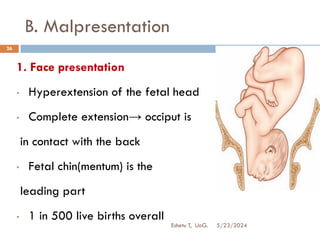
1. Face presentation
• Hyperextension of the fetal head
• Complete extension→ occiput is
in contact with the back
• Fetal chin(mentum) is the
leading part
• 1 in 500 live births overall
Risk factors
5/23/2024
Eshetu T, UoG.
27
• Anencephaly
• Anterior neck mass
• Multiple nuchal cords
• CPD
• Prematurity
• Severe hydrocephalus
• Multiparity
• Polyhydramnios
Diagnosis
5/23/2024
Eshetu T, UoG.
28
 Suggestive abdominal finding:
 On abdominal examination
 Groove may be felt between the occiput and the
back
 Fetal limbs are felt anteriorly in MA presentation
 Head seems big and is not engaged
Diagnosis
5/23/2024
Eshetu T, UoG.
29
• More often discovered by vaginal examination
 Fetal chin, mouth and nose are palpated
Management
5/23/2024
Eshetu T, UoG.
30
• Identify position of the mentum
1. Mento-anterior: Chin anterior- 60% to 80%
 Adequate pelvis → follow the progress of labor
 Forceps delivery- when indicated and prerequisites
for out let forceps are met
 70% to 80% of infants can be delivered vaginally,
either spontaneously or by low forceps
 12% to 30% require cesarean delivery
Management
5/23/2024
Eshetu T, UoG.
31
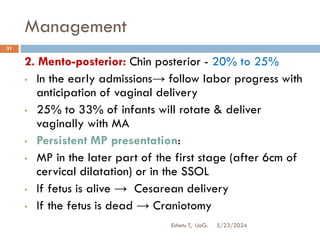
2. Mento-posterior: Chin posterior - 20% to 25%
• In the early admissions→ follow labor progress with
anticipation of vaginal delivery
• 25% to 33% of infants will rotate & deliver
vaginally with MA
• Persistent MP presentation:
• MP in the later part of the first stage (after 6cm of
cervical dilatation) or in the SSOL
• If fetus is alive → Cesarean delivery
• If the fetus is dead → Craniotomy
Impacting of an
Open fetal mouth
against
The sacrum
5/23/2024 32
Management
MATERNAL AND FETAL COMPLICATION
FACE PRESENTATION
Delay of labor
Chance of perineal
damage is more
Postpartum
hemorrhage
Increased morbidity
Obstructed labor
 Utrine rupture
 Increased risk of
operative delivery
 Neonatal infection
 Fetal facial bruising
5/23/2024
33
Eshetu T, UoG.
Brow presentation
5/23/2024
Eshetu T, UoG.
34
• The rarest variety of cephalic presentation
• 1/500 to 1/4000 deliveries, averagely 1 in 1500
• Midway between full flexion and full extension
• Presenting part→ brow (the part of the head
between orbital ridges and anterior fontanel)
• The position is commonly unstable and converts to
either vertex or face presentation
Risk factors
5/23/2024
Eshetu T, UoG.
35
• CPD
• Prematurity
• Multiparity
• Hydrocephalus
• Anterior neck mass
• Multiple nuchal cords
• Macrosomia
• Polyhydramnios
Diagnosis
5/23/2024
Eshetu T, UoG.
36
 History
 Physical examination
 Abdominal
 Vaginal
Diagnosis
5/23/2024
Eshetu T, UoG.
37
 Suggestive abdominal finding:
• More or less like those of face presentation, However,
• The cephalic prominence and
• The groove b/n it and the back are less prominent
• The head feels very big and is none-egaged
 On vaginal examination: More often detected
• Anterior fontanelle and orbits are felt
Management
5/23/2024
Eshetu T, UoG.
38
• Women with a clinically adequate or proven pelvis
can undergo a trial of labor if brow is diagnosed in
the early stag.
• Since many will convert to a more favorable
presentation
• In women with a narrow or contracted pelvis
 C/s early
Management of persistent brow
5/23/2024
Eshetu T, UoG.
39
• Persistent brow presentation is brow presentation in;
 The later part of the first stage- after 6cm of cx
dilatation,
 The second stages of labor
• Engagement of the fetal head and subsequent delivery
can not take place in persistent brow
• Except in small fetal head or the pelvis is unusually
large
Management
5/23/2024
Eshetu T, UoG.
40
• If the fetus is alive deliver by cesarean section
• If the fetus is dead;
 Perform craniotomy if prerequisite are met
 Deliver by cesarean section if:-
 The cervix is not fully dilated or station is high
 The operator is not proficient in craniotomy
3. Breech presentation
5/23/2024
Eshetu T, UoG.
41
• The fetal buttock and/or feet are the presenting
part occupying the lower pole of the uterus
• Overall occurs in 3% to 4% of labor
• More common in remote from term
• At term, breech presentation persists in
approximately 2–5%
Incidence of breech presentation
5/23/2024
Eshetu T, UoG.
42
Types of breach presentation
• Frank breech- 50– 70%
• Complete or
flexed breech- 5 -10%
• Footling/ incomplete
breech- 10- 40%
5/23/2024 43
Type of breech prese…..
5/23/2024
Eshetu T, UoG.
44
• Frank breech (50-70%) - lower extremities are flexed at
the hips and extended at the knees
• Complete breech (5-10%) - both hips & knees are
flexed
• Footling or incomplete (10- 40% - one or both hips are
extended. As a result, one or both feet or knees lie
below the breech
Risk factors
 Prematurity
 High parity
 Multiple pregnancy
 Uterine abnormality
(eg, bicornuate or
septate uterus, fibroid,
tumor previa)
 Pelvic masses
 Fetal anomalies
 Absolute CPD
 Previous breech
 Unknown
5/23/2024
45
Eshetu T, UoG.
Diagnosis
5/23/2024
Eshetu T, UoG.
46
1. History
2. Physical examination
2.1. On abdominal palpation
2.2. Per-vaginal examination (Pv)
 Soft & irregular parts are felt through the Cx
opening
 Palpation of ischial tuberosities, sacrum and the
feet by the sides of the buttock
Diagnosis
5/23/2024
Eshetu T, UoG.
47
 In frank breech, no feet are appreciated, but;
 Ischial tuberosities, anal opening and sacrum will be
felt and are in a straight line
 Complete breech, the feet may be felt alongside
the buttocks
 Perform clinical pelvimetry and look for cord
presentation or prolapse
Diagnosis
5/23/2024
Eshetu T, UoG.
48
3. Ultrasound
 To confirm clinical diagnosis
 To assess fetal attitude
 To assess amniotic fluid volume to consider ECV
 To estimate fetal weight, and
 To investigate for fetal anomalies and other
predisposing factors
Management
5/23/2024
Eshetu T, UoG.
49
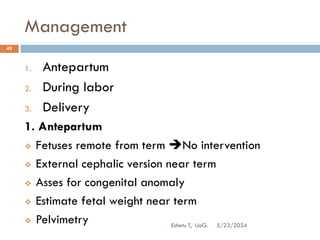
1. Antepartum
2. During labor
3. Delivery
1. Antepartum
 Fetuses remote from term No intervention
 External cephalic version near term
 Asses for congenital anomaly
 Estimate fetal weight near term
 Pelvimetry
Management
5/23/2024
Eshetu T, UoG.
50
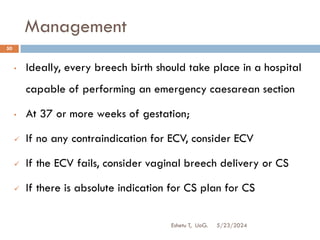
• Ideally, every breech birth should take place in a hospital
capable of performing an emergency caesarean section
• At 37 or more weeks of gestation;
 If no any contraindication for ECV, consider ECV
 If the ECV fails, consider vaginal breech delivery or CS
 If there is absolute indication for CS plan for CS
Mode of delivery in breech presentation
5/23/2024
Eshetu T, UoG.
51
1-Cesarean delivery
A- absolute indications for C/S are:-
o Estimated fetal weight >3500 grams.
o Any degree of pelvic contracture.
o Footling presentations.
o Breech presentation with hyper extended
head.
o Breech with other poor obstetric performance.
o Old primigravida
Mode of delivery in breech presentation
5/23/2024
Eshetu T, UoG.
52
2. VAGINAL BREECH DELIVERY.
 Cases with no absolute maternal or fetal indications
for direct C/S.
 EFW<3500 grams.
 Frank or complete breech.
 Flexed head and adequate pelvis.
 Gross fetal malformations judged to be
incompatible with extra uterine life
Types of vaginal breech delivery
5/23/2024
Eshetu T, UoG.
53
1. Spontaneous breech delivery
2. Assisted breech delivery.
3.Total breech extraction
Labor management in breech delivery
5/23/2024
Eshetu T, UoG.
54
 Admission evaluation . Hx, PE, US exam
1-first stage of labor-
 Securing IV line.
 Progress of labor is not remarkably different,
 Avoid ARM
 Augmentation is contra-indicated in breech.
 Experienced obstetrician
 Anesthesiologist
 Pediatrician
Second stage of labor
5/23/2024
Eshetu T, UoG.
55
Delivery of the buttocks and legs:
• If tight perineum perform an episiotomy
 Pinard‘s maneuver
• Pushing behind the knee so that it bends; then grasp
the ankle and deliver the foot and leg
2. Lovset‟s maneuver
5/23/2024
Eshetu T, UoG.
56
Delivery of the arms and shoulders
• Delivery is more difficult and can be aided by
rotating the fetus through a half circle draw the
elbow toward the face
• Hold the fetus around the bony pelvis with thumbs
across the sacrum
• The fetus is turned 180 degree while downward
traction is applied at the same time,
• So that the posterior arm emerges under pubic
arch & then hooked
• The position is restored & anterior arm is
delivered in the same manner
Delivery of the arms and shoulders
5/23/2024
Eshetu T, UoG.
57
Delivery of the head
5/23/2024
Eshetu T, UoG.
58
• When the nape of the neck is visible, Apply fundal
pressure to maintain flexion and deliver the upcoming
head
• Mauriceau Smellie Veit Maneuver (MSV):
• Index and middle finger of one hand are applied over
the maxilla, to flex the head, while the fetal body rests on
the palm of the same hand and forearm
• Two fingers of the other hand are hooked over the fetal
neck and grasp the fetal shoulders
• Apply gentle downward traction to deliver the head
• Forceps delivery: Specialized type of obstetric forceps
(Piper) can be used when the MSV cannot be
accomplished easily
Delivery of the after coming Head
5/23/2024
Eshetu T, UoG.
59
Complications of breech delivery
5/23/2024
Eshetu T, UoG.
60
 Increased perinatal & maternal mortality & morbidity.
 Cord prolaps 15% in footling and 5% in complete
breech presentation.
 Increased operative interventions especially C/S
delivery.
5.Transverse lie/ Shoulder presentation
5/23/2024
Eshetu T, UoG.
61
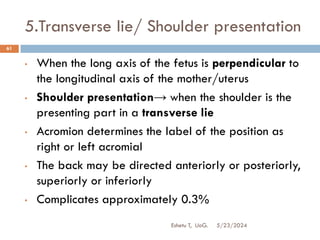
• When the long axis of the fetus is perpendicular to
the longitudinal axis of the mother/uterus
• Shoulder presentation→ when the shoulder is the
presenting part in a transverse lie
• Acromion determines the label of the position as
right or left acromial
• The back may be directed anteriorly or posteriorly,
superiorly or inferiorly
• Complicates approximately 0.3%
Dorsoanterior position
5/23/2024
Eshetu T, UoG.
62
Causes
5/23/2024
Eshetu T, UoG.
63
• Abdominal wall relaxation from high parity,
Hydramnios
• Preterm fetus
• Placenta previa
• Abnormal uterine anatomy
• Contracted maternal pelvis
Diagnosis
5/23/2024
Eshetu T, UoG.
64
1. History
2. Physical examination
2.1. Abdominal findings:
2.2. Vaginal finding
3. U/s- Confirmatory
Diagnosis
5/23/2024
Eshetu T, UoG.
65
 Abdominal findings:
• Neither the fetal head nor the breech is felt in the
upper and lower part of the uterus
• The abdomen is transversely elongated than
longitudinally
• Fundal height is less than gestation age
 Vaginal finding:
• The shoulder or the prolapsed arm is felt
 U/s- Confirmatory
Management
5/23/2024
Eshetu T, UoG.
66
• Spontaneous delivery of a fully developed
newborn is impossible.
• CS delivery if in active labor
• Consider ECV during pregnancy after 36 weeks
of gestation until early in labor with intact fetal
membranes, if operator is experienced
• If ECV fails deliver by CS
Note: Neglected shoulder presentation leads to
obstructed labor and associated complications
Asynclytism
5/23/2024
Eshetu T, UoG.
67
 Asynclytism refers to abnormalities in descent and
engagement of the vertex through the pelvic brim in
which the sagittal suture is pushed laterally to the
anterior or posterior pelvic segments rather than its
normal central location
 As a result, the vertex attempts to engage into the pelvis
with one of the parietal bones predominantly presenting
Asynclitism
5/23/2024
Eshetu T, UoG.
68
 Asynclytism results in difficulty of the vertex
engagement and descent and may result in
obstructed labor if not spontaneously resolved
 Anterior Asynclytism has a more likely chance of
spontaneous resolution and vaginal delivery
compared to a posterior asynclitism
Types & possible causes of asynclitism
5/23/2024
Eshetu T, UoG.
69
Management
5/23/2024
Eshetu T, UoG.
70
 In anterior Asynclytism, if pelvis is adequate and
the mother is in early labor one can await for
spontaneous reversion and vaginal delivery.
 Posterior asynclitism is considered an indication for
caesarean delivery.
Compound Presentation
5/23/2024
Eshetu T, UoG.
71
 Compound presentation is a vertex presentation with a
single or double hand or feet felt alongside the fetal
head on vaginal exam Or
 A breech presentation with a single or double hand felt
alongside the breech presentation
 If the hand is felt anterior or lower to the vertex and not
alongside it then it is a “ hand prolapse” rather than a
compound presentation
Diagnosis of Compound Presentation
5/23/2024
Eshetu T, UoG.
72
 The tips of the fingers of the hand or feet are felt
alongside the fetal head on vaginal exam
 The tips of the fingers of the hand are felt
alongside the breech
 Always assess the pelvic capacity as well as the
presence of cord in compound presentations
diagnosed in labor
Management of Compound Presentations
5/23/2024
Eshetu T, UoG.
73
Cephalo pelvic disproportion/CPD/
5/23/2024
Eshetu T, UoG.
74
• Is disparity b/n the fetal head & maternal pelvis
• Which leads to inability of the fetal head to pass
through the maternal pelvis for mechanical reasons
• Fetopelvic disproportion arises from
 Diminished pelvic capacity/ alteration in shape,
 Abnormal fetal size or presentation, or
 More usually from both
CPD
5/23/2024
Eshetu T, UoG.
75
Cephalo pelvic disproportion/CPD
 It occurs At
 The may be contracted only or in combination
1. Pelvic inlet,
2. Cavity /midpelvis, or
3. Pelvic outlet
CPD
5/23/2024
Eshetu T, UoG.
76
1. Contracted Inlet
• Anteroposterior diameter of the inlet, called
obstetrical conjugate,
• Is commonly approximated by manually measuring
the diagonal conjugate,
• Is approximately 1.5 cm less than the diagonal
conjugate
CPD
5/23/2024
Eshetu T, UoG.
77
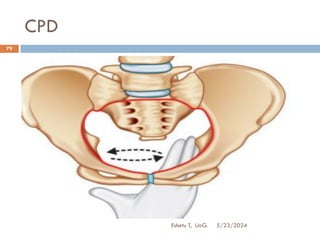
• To measure the diagonal conjugate, a hand with the
palm oriented laterally extends its index finger to the
promontory
• The distance from the finger tip to the point at which
the lowest margin of the symphysis strikes the same
finger ‟s base is the diagonal conjugate
• Inlet contraction usually is defined as a diagonal
conjugate <11.5 cm
2. Contracted Midpelvis
5/23/2024
Eshetu T, UoG.
78
• More common than inlet contraction
• It frequently causes transverse arrest of the head
• Inter-spinous diameter <10cm→Suspected Midpelvic
contraction
• When it measures <8 cm, the midpelvis is contracted
• If the spines are prominent,
• The pelvic sidewalls converge
CPD
5/23/2024
Eshetu T, UoG.
79
Outlet contracture
5/23/2024
Eshetu T, UoG.
80
• Inter-ischial tuberous diameter of 8 cm or less
• Often-associated mid-pelvic contraction
• Isolated outlet contraction is a infrequency
Diagnosis
5/23/2024
Eshetu T, UoG.
81
• Properly taken history, P/E and appropriate use of
labor graph allow easy and early identification
1. History
• Primigravid (especially teenage pregnancy)
• Prolonged labor or Previous history
• Previous history of perinatal death
• Previous history of obstetric trauma
• Properly documented obstetric record (e.g.
intraoperative direct measurement of the obstetric
conjugate)
Diagnosis
5/23/2024
Eshetu T, UoG.
82
2. P/E; Intrapartum evaluation
• Generally CPD, with very few exceptions, is
diagnosed after a properly conducted trial of
labor
• Findings that may indicate CPD are:-
 Abnormal progress of labor:
 Arrest and protraction disorders of cervical
dilatation, or crossing an alert or action line on a
partograph
 Failure of head descent especially in the presence
of arrested or protracted cervical dilatation
Diagnosis
5/23/2024
Eshetu T, UoG.
83
 High station of the head in late AFSOL or SSOL
may suggest CPD, particularly in primigravid
woman
 Failure of progress of labor after correction
of inadequate uterine activity (by amniotomy or
oxytocin infusion or both)
Diagnosis
5/23/2024
Eshetu T, UoG.
84
• Abnormal clinical pelvimetry:
 Obstatrical conjugate is less than 10 cm
 Inter-tuberous diameter of less than 8 cm (a fist
size) indicates a grossly contracted pelvis
 Abnormal measurements of clinical pelvimetry
also include
• Easily reachable sacral promontory,
• Prominent ischial spines,
• Convergent pelvic side walls,
• Flat sacrum, narrow sub pubic angle
Diagnosis
5/23/2024
Eshetu T, UoG.
85
 Molding
• Severe moldings (+2/+3) at a higher station
• Hallmark feature of CPD
 Caput Succedaneum
• A severe degree of caput has been associated with
prolonged labor and CPD
• Scalp edema hampers identification and assessment
of the suture lines
Diagnosis
5/23/2024
Eshetu T, UoG.
86
 Fetal Macrosomia
• Clinical, maternal or u/s estimation of fetal
size have the potential for identifying
macrosomic pregnancies at risk for CPD
 Fetal distress
• In the presence of marked CPD, the fetus
responds with fetal heart rate abnormalities,
falling PH and passage of meconium
 Imaging
• Ultrasound examination may reveal macrosomia
or congenital anomalies e.g. hydrocephalus
Management of CPD
5/23/2024
Eshetu T, UoG.
87
 Trial of labor
• In a woman with suspected CPD
• It is done in an equipped and staffed hospital for
operative procedures in case vaginal delivery fails
 CPD is suspected;
• If there is previous history of prolonged labor
with bad obstetric history or operative delivery,
• If the parturient is teenage,
• In the presence of borderline pelvis or if the
cervicogram is crossing the alert line without signs of
CPD
Management of CPD
5/23/2024
Eshetu T, UoG.
88
 Borderline pelvis is entertained;
 If the obstetric conjugate is 8 to 10 cm
• If there is no other risk factor (such as previous CS),
trial of labor is the best diagnostic approach
• The trial continues as long as labor progresses well
and as long as there is reassuring fetal and
maternal status
Route of delivery
5/23/2024
Eshetu T, UoG.
89
• Generally, presence of CPD during labor is an
indication for caesarean delivery
• In permanent absolute disparities
 Severe pelvic contracture (OC of 6-8 cm) or
 Extreme pelvic contracture (OC < 6 cm)), there is
no possibility of vaginal delivery and elective
cesarean section should be done
Route of delivery
5/23/2024
Eshetu T, UoG.
90
• Induction & augmentation of labor is CI in fetal
macrosomia
• Cesarean delivery is recommended for macrosomic
fetus with estimated fetal weight of greater than
4.5kg regardless of the status of labor
• Fetal hydrocephalus may be managed by
cephalocenthesis
• Craniotomy is indicated if the fetus is dead and
prerequisites for destructive delivery are fulfilled
Discharge counseling and education
5/23/2024
Eshetu T, UoG.
91
• A woman who delivered by CS should be explained
about the indication (CPD) and the need for repeat CS in
future pregnancy
• Besides verbal explanation, a written note should be
given
• Previous CS for CPD can be followed at a nearby health
center and referred after 36 -37 weeks of gestation
Complications
5/23/2024
Eshetu T, UoG.
92
 Maternal: -
• Prolonged/obstructed labor: the end result is
obstructed labor and its associated complications
• PPH
• Maternal sepsis
 Fetal / neonatal
 Fetal distress
 Perinatal asphyxia
 Neonatal infections
 Perinatal death
OBSTRUCTED LABOR/ OL
5/23/2024
Eshetu T, UoG.
93
• OL is failure of descent of the fetus in the
birth canal for mechanical reasons in spite of
good uterine contraction
• An outcome of neglected and mismanaged labor
CAUSES
 Maternal:
 Contracted pelvis / cephalopelvic disproportion
(commonest)
 Soft tissue abnormalities (e.g. tumor previa, vaginal
septum, tight perineum, uterine congenital anomalies)
CAUSES …
5/23/2024
Eshetu T, UoG.
94
 Fetal:
 Macrosomia
 Malpresentations/Malposition
 Locked twins, conjoined twins
 Fetal anomalies e.g. hydrocephalus
DX
5/23/2024
Eshetu T, UoG.
95
 History
• Abnormally prolonged labor
• Early ROM or PROM -Fever
• Most do not have ANC
• Painful contractions
• Previous pregnancy complicated by prolonged labor,
stillbirth or early neonatal death
• Previous instrumental deliveries & CS
• Medical history; particularly rickets, osteomalacia, or
pelvic injury
Clinical findings
5/23/2024
Eshetu T, UoG.
96
General condition of the patient:-
• Exhausted due to severe pain and lack of sleep
• Anxious, terrified and uncontrollable
• Dehydration is nearly always present
• Deep and rapid respiration as a result of ketoacidosis
Clinical signs of infection:-
 Pyrexia and tachycardia
 Purulent vaginal discharge
• Severe intrapartum infection results in septic shock
with circulatory collapse, hypotension, and a rapid pulse
with subnormal temperature
Abdominal findings
5/23/2024
Eshetu T, UoG.
97
• Distention of the bowel as a result of acidosis and
hypokalemia
• Three tumor abdomen; Due to:-
 Grossly thickened and retracted upper uterine
segment above Bandl‘s ring
 Thinly distended lower uterine segment below the ring;
 Fully distended and/or edematous bladder further
distending the lower abdomen
Abdominal findings
5/23/2024
Eshetu T, UoG.
98
• Retraction ring of Bandl marks the junction
between thickened and retracted upper
segment and thinned lower uterine segment
• The three tumor abdomen‖ and retraction ring
of Bandl are warning signs of an impending
uterine rupture
 Fetal Status
 Abnormal fetal heart rate
 IUFD
Three tumors Abdo
5/23/2024 99
Vaginal examination findings
5/23/2024
Eshetu T, UoG.
100
• Edema of lower vagina and vulva (canula sign)
• Meconium- stained and foul-smelling discharge
• Bleeding may be seen
• Edema of the cervix & poorly applied to the head.
• Little or no descent of the presenting part
• Increasing molding
• Excessive caput
• Malpresentation/position
• Shoulder with or without prolapsed arm in
transverse lie,
MANAGEMENT
5/23/2024
Eshetu T, UoG.
101
• Initial management of OL involves resuscitation
and monitoring of the life endangering
conditions
• Identification and treatment of the causes
• Secure good venous access; preferably with two
large-bore cannulae and give crystalloids
• Send an urgent blood sample:
 Blood group and Rh, cross-match, complete blood
count
Management cont‟d…
5/23/2024
Eshetu T, UoG.
102
 Give broad spectrum antibiotics:
 Ampicillin 2gm Q 6hrs or
 Ceftriaxone 1g IV BID, PLUS
 Gentamicin 80mg IV Q 8hrs, PLUS
 Metronidazole 500 mg IV TID
OR
 Gentamicin 80mg IV Q 8hrs PLUS
 Clindamycin 900 mg IV Q 8hrs
Management
5/23/2024
Eshetu T, UoG.
103
• Empty the bladder
Catheterization may be difficult or impossible
• Empty the stomach:
insert NG tube, particularly in the
presence of distended abdomen
Management
5/23/2024
Eshetu T, UoG.
104
 Delivery:
• Alive fetus: do emergency cesarean delivery
• Dead fetus
 With presence of imminent signs of uterine rupture:
 Perform C/S or destructive delivery under direct vision
 Without imminent signs of uterine rupture:
 Perform destructive delivery if prerequisites are fulfilled
Postoperative care and follow up
5/23/2024
Eshetu T, UoG.
105
• Intensive resuscitation & close monitoring until her
condition improves
• IV antibiotics should be continued until the patient
is fever free for 48 hours and Shift the medications
to PO antibiotics to complete 7-10 days treatment
• Give analgesics
• Breast care for those with SB or neonatal deaths
• Explain the condition & counsel on future pregnancy
• After prolonged obstructed labor, keep the catheter
for at least 10 days
COMPLICATIONS
5/23/2024
Eshetu T, UoG.
106
• Atonic PPH,
• Uterine rupture,
• Peripartum infection leading to various organ failures
• Maternal death,
• Fetal distress,
• Fetal & neonatal infections, and death
COMPLICATIONS
5/23/2024
Eshetu T, UoG.
107
 Late complications:
• Fistula (vesico-vaginal, rectovaginal) & its aftermath,
• Foot drop (sciatic, common peroneal nerve),
• Infertility following postpartum PID or hysterectomy,
• Psychological trauma due to the painful labor
experience, loss of the baby and social isolation
Cord presentation and prolapse
5/23/2024
Eshetu T, UoG.
108
1. Cord presentation:
 Presentation of UC below the level of the
presenting part with intact fetal membranes
2. Cord prolapse
 Descends alongside or beyond the fetal presenting
part in the presence of ruptured membranes.
Types of Cord prolapse
5/23/2024
Eshetu T, UoG.
109
1. Overt UC prolapse: Protrusion of the UC in
advance of the fetal presenting part with ruptured
fetal membranes.
2. Occult UC prolapse: Cord descends alongside, but
not past, the presenting part with intact / ruptured
fetal membranes.
RISK FACTORS
 Malpresentation
 Unengaged presenting
part
 Prematurity
 Multifetal gestation
 PROM
 Abnormal placentation
 Multiparity
 Polyhydramnios
 Long UC
 Pelvic deformities
 Uterine
tumors/malformations
 Congenital anomalies
 Low birth weight less
than 2.5 kg.
5/23/2024
110
Eshetu T, UoG.
DIAGNOSIS
5/23/2024
Eshetu T, UoG.
111
1. Occult UCP: Presence of severe prolonged fetal
bradycardia or moderate to severe variable
decelerations after a previous normal tracing on
CTG/ Pinnard stethoscope or fetal death
2. Overt UCP: Presence of palpable cord (pulsatile or
non-pulsatile) on pelvic examination or visible cord
outside the introitus.
2. Cord presentation: Loops of cord are palpated
through the fetal membranes on digital vaginal
examination or seen in front of the presenting part on
ultrasound examination.
General Management
5/23/2024
Eshetu T, UoG.
112
 Call for assistance.
 Secure IV fluid.
 Check for cord pulsation. If absent, confirm fetal heart
beat with fetoscope or U/S
 Discontinue oxytocin if being given.
 Careful pelvic examination immediately after
spontaneous rupture of fetal membranes.
 Prepare for resuscitation of the newborn.
 In cord presentation, do not rupture fetal membranes at
any stage of labor; deliver the fetus by CS.
General Management
5/23/2024
Eshetu T, UoG.
113
 Monitor FHB while preparing for delivery
 If the woman is in the first stage of labor, perform
the following in all cases:
 Push the presenting part up to decrease pressure on
the cord and dislodge the presenting part from the
pelvis.
 Place the other hand on the abdomen in the
suprapubic region to keep the presenting part out
of the pelvis.
General Management
5/23/2024
Eshetu T, UoG.
114
 Once the presenting part is firmly held above the pelvic
brim, remove the other hand from the vagina.
 Keep the hand on the abdomen until a caesarean section can be
performed.
 If available, give tocolytics.
 Perform immediate caesarean delivery.
 Choice of anesthesia should be the quickest and safest for both
the mother and the fetus preferably – GA.
General Management
5/23/2024
Eshetu T, UoG.
115
Manuevers to reduce presenting part pressure on the cord:
 Examiner„s hand is maintained in the vagina to elevate the
presenting part off of the umbilical cord while preparations
for an emergency C/S are being made.
 Client be placed in steep Trendelenberg or knee-chest
position.
 Do not manipulate the cord.
 Avoid exposure of the cord to cold environment to avoid
cord spasm (keep in vagina).
 Bladder filling: Insert Foley catheter into maternal bladder
then fill bladder with 500- 700 ml of normal saline with the
patient in Trendelenberg position (used during referral).
General Management
5/23/2024
Eshetu T, UoG.
116
 If the woman is in the second stage of labor:
 Expedite vaginal birth if deemed quicker than
cesarean section.
 Obstetric vacuum is preferable over forceps, if
prerequisites are met.
 If there is malpresentation or if prerequisites for
instrumental delivery are not fulfilled, deliver
immediately by CS.
NOTE: Delivery should be accomplished within 30
minutes from the time of diagnosis.
PREVENTION
5/23/2024
Eshetu T, UoG.
117
 Avoid ARM if the presenting part is not well
applied/ engaged or perform ARM with
simultaneous downward fundal pressure.
 Avoid disengaging fetal presenting part when
performing procedures.
 Incidental finding of cord presentation on U/S
should be followed to decide mode of delivery.
Premature Rupture of Membrane
5/23/2024
118
Eshetu T, UoG.
Premature Rupture of Membrane
5/23/2024
Eshetu T, UoG.
119
• Is rupture of membranes (ROM) before the onset of
labor
• Can be term or preterm – Complicates 8 vs 3% of
pxs
• The single most common identifiable factor
associated with preterm delivery
• It is responsible for approximately one-third of
preterm births
• Prolonged PROM - for > 12 hours
Risk factors
5/23/2024
Eshetu T, UoG.
120
• The pathogenesis of spontaneous membrane rupture is
not completely understood
• Mechanical factors: Multifetal gestation,
polyhydramnios…
• Urogenital infections: UTI, cervicitis, bacterial vaginosis
• Previous history of preterm PROM, preterm labor
• Second and third trimester bleeding (e.g. abruptio
placenta).
• Other risk factors: Low socioeconomic status,
nutritional deficiencies, low BMI, smoking and connective
tissue disorders
Diagnosis
5/23/2024
Eshetu T, UoG.
121
• Is clinical, and is generally based on visualization
of amniotic fluid in the vagina
1. History;
• A sudden "gush“ of clear or pale-yellow fluid from
the vagina→ The classic clinical presentation
• Intermittent or constant leaking of small amounts of
fluid
Diagnosis
5/23/2024
Eshetu T, UoG.
122
 Physical examination
 Sterile speculum examination
• Direct observation of amniotic fluid coming out of the
cervical canal or
• Pooling
• The woman can be asked to push on her fundus or
cough to provoke leakage of AF from the cervical os
• For patients who are not in labor, examination of the
cervix and vagina should be performed using a
sterile speculum
Diagnosis
5/23/2024
Eshetu T, UoG.
123
• Sterile speculum examination can also help;
 To check for the presence of cord prolapse
 To assess cervical status or cervicitis
 To sent amniotic fluid for maturity tests (if available)
• Digital examination should be avoided b/s;
 It may decrease the latency period
 Increase the risk of intrauterine infection
Diagnosis
5/23/2024
Eshetu T, UoG.
124
 Laboratory tests
• Ferning test
 Swab the posterior fornix
 Spread some fluid on a slide & let it dry for at least
10‟
 Examine it with a microscope and look for a fern-leaf
pattern (arborization)
 The test is not affected by meconium, vaginal PH &
blood
Diagnosis
5/23/2024
Eshetu T, UoG.
125
 Nitrazine paper test:
• Amniotic fluid usually has a pH range of 7.0 - 7.3
compared with the vaginal pH of 3.8 - 4.2 and pH of
urine of 5.0 - 6.0
• Hold a piece of nitrazine paper in a hemostat (artery
forceps)
• Touch it against the fluid pooled on the speculum
blade
• A change from yellow to blue indicates presence
of amniotic fluid (a PH >6 - 6.5)
Diagnosis
5/23/2024
Eshetu T, UoG.
126
 Pad test
• Can be helpful when there is no pooling & no leakage
from cervix
 Place a vaginal pad over the vulva & examine it one
hour later visually & by odorous
 Wetting with no urine and no vaginal discharge
(vaginitis) may suggest PROM
 If the diagnosis remains in question, repeat the test
Diagnosis
5/23/2024
Eshetu T, UoG.
127
 U/s examination
• Performed to look for reduction of amniotic fluid
volume
• If the patient has a normal amniotic fluid volume, it
is very unlikely
• 50 – 70% of women with PPROM have low
amniotic fluid volume on initial sonography
DDX
5/23/2024
Eshetu T, UoG.
128
• Other causes of vaginal/perineal wetness such
 Urinary incontinence,
 Vaginal discharge (normal or related to infection),
 Perspiration
• These causes should be considered in women with
negative clinical & laboratory findings for PPROM
Complications of PPROM
5/23/2024
Eshetu T, UoG.
129
 Maternal Risks
• Chorioamnionitis- 15–25%
- Increases as the duration is more prolonged
• APH(2-5%), Retained placenta, PPH, postpartal sepsis
(15–20%)
• Cesarean delivery and its complications
 Fetal Risks
• Infection and fetal distress
- Due to umbilical cord compression/ placental abruption
• Oligohydramnios and its complications
• Prematurity, preterm birth and its complications
Management of PROM
5/23/2024
Eshetu T, UoG.
130
 At term,
• Half of expectantly managed deliver within 5 hours
• 95% deliver within 28 hours of membrane
rupture
• Of all women with PROM before 34 weeks, 93%
deliver in <1 week
Management of PROM
5/23/2024
Eshetu T, UoG.
131
 Depends on the ff. factors;
• Gestational age
• Presence or absence of maternal/fetal infection
• Presence or absence of labor
• Fetal lung maturity, well-being & presentation
• Cervical status (by visual inspection)
• Availability of neonatal intensive care
Management of PROM
5/23/2024
Eshetu T, UoG.
132
 Confirm the GA of the fetus (using LMP, early U/S)
 Perform ultrasound to determine fetal presentation & lie
 Electronic fetal monitoring to identify occult umbilical cord
compression
 Do biophysical profile or NST
 Do CBC
 Maternal leukocytosis or the presence of a left shift
supports the diagnosis of chorioamnionitis
 Isolated leukocytosis in the absence of other s/s is
of limited value
Management of PROM
5/23/2024
Eshetu T, UoG.
133
 Delivery vs Expectant
• Indications for expedite delivery
 Onset of labor,
 GA ≥ 37wks,
 Evidence for non reassuring fetal status,
 Evidence for chorioamnionitis,
 Lethal congenital anomalies, IUFD,
 If there is high risk of cord prolapse (e.g.,
transverse lie) and abruptio placenta
Management of PROM
5/23/2024
Eshetu T, UoG.
134
 Note;
• If the gestational is below 34 weeks and both the
fetal and maternal conditions are stable, expectant
management can be considered for abruption
placenta in a setting where close follow up is
possible
Management of PROM
5/23/2024
Eshetu T, UoG.
135
 Expectant management
 Admit to the ward (Transfer patients with early
preterm PROM to a higher health facility with NICU,
if possible)
 Avoid digital cervical (pelvic) examination
 Advise bed-rest
 Corticosteroids
• Betamethasone 12 mg IM 24 hours apart for two
doses or,
• Dexamethasone 6 mg IM 12 hours apart for four doses)
for lung maturity
Management of PROM
5/23/2024
Eshetu T, UoG.
136
 Prophylactic Antibiotics
• Ampicillin 2gm IV QID PLUS
• Erythromycin 250mg P.O QID for 48 hours followed by
• Amoxicillin 500mg P.O TID & Erythromycin 250mg. P.O QID
for 5 days
• Azithromycin may be substituted for Erythromycin with
regimen of 500mg PO on day 1 followed by 250mg PO
daily for 6 days
• If there is onset of labor and in the absence of signs
of uterine infection, discontinue antibiotics after delivery
 Neuroprotection (MGSO4)
 If GA <32 weeks and preterm birth is likely within the next
24 hours
Management of PROM
5/23/2024
Eshetu T, UoG.
137
 Rationale
• Prophylactic antibiotics are indicated to
 Prolong latency and to reduce the risk of both
neonatal and maternal infection
 Infection appears to be both a cause and
consequence of PPROM
Management of PROM
5/23/2024
Eshetu T, UoG.
138
 Monitoring and Follow up
 Monitor the following clinical features during
expectant management
• Maternal pulse & temperature - every 4-6 hours
• FHR - every 4-6hrs (& if possible CTG 2x daily)
• Uterine tenderness or irritability (or pain) – daily
• WBC count & differential - changes, every 2-3
days
• Amniotic fluid appearance & odor - daily
Management of PROM
5/23/2024
Eshetu T, UoG.
139
 Labor and delivery for term PROM without infection:
• If cervix is favorable, labor is induced, unless there
are contraindications to vaginal delivery
• If cervix is unfavorable, ripen the cervix (preferably with
PO misoprostol)
• Institute Ampicillin 2gm IV QID for prolonged PROM
(>12hrs)
• Follow for features of chorioamnionitis (maternal
fever, tachycardia, leukocytosis, uterine tenderness,
offensive vaginal discharge and fetal tachycardia) and
start triple antibiotics if so
• The antibiotic should continue throughout labor and for at
least one dose after delivery

ABNORMAL LABOUR[]{}#%^*+=_\|~<>€£¥•.,?!’-/:(($$&@“.,?!’pdf

  • 1.
    3rd year Nursingstudent 5/23/2024 1 Eshetu T, UoG.
  • 2.
    Abnormal labor 5/23/2024 Eshetu T,UoG. 2  Is any labor in which the pattern of labor progress is significantly different from accepted and recognized patterns of labor progress in terms of Profile of uterine contractions Decent of fetal presenting part Cervical changes
  • 3.
    5/23/2024 Eshetu T, UoG. 3 LaborPattern Diagnostic Criteria Preferred Rx Exceptional Rx Nullipara Multiparas 1. First stage disorder 1. Prolongation disorder Prolonged Latent Phase >20hrs >14hrs Bed rest  Oxytocin  C/s delivery for urgent problems 1. Protraction disorders Active phase dilatation <1.2cm/hrs. <1.5cm/hrs. Expectant/ Support C/s for CPD Descent <1cm/hrs. <2cm/hrs. 1. Arrest disorders Prolonged deceleration phase >3hr >1hr CPD - C/s No CPD – Oxytocin Rest if exhausted C/ s delivery Secondary arrest of dilatation >2hr >2hr Arrest of descent >1hr >1hr Failure of Descent No descent in deceleration phase 1. Second stage disorders Prolonged 2nd SOL Without epidural > 2 hrs. Without epidural > 1 hr. depends on identified cause and presence of complications With epidural > 3 hrs. With epidural > 2 hrs. Failure of descent No descent in second stage
  • 4.
    Causes of Abnormallabor 5/23/2024 Eshetu T, UoG. 4 The „„3 Ps‟‟- act singly or in combination 1. Power: Dysfunctional ux contraction & poor maternal effort Types of utérine dysfunction 1. Hypotonic uterine dysfunction • More common • Uterine contractions have a normal gradient pattern • But Pressure is insufficient to dilate the cervix
  • 5.
    Causes of Abnormallabor 5/23/2024 Eshetu T, UoG. 5 2. Hypertonic or in-coordinate uterine dysfunction • Either basal tone is elevated appreciably or • The pressure gradient is distorted → may result from;  More forceful contraction of the uterine mid segment than the fundus  From complete asynchrony of the impulses originating in each cornu  From a combination of these two
  • 6.
    Causes of Abnormallabor 5/23/2024 Eshetu T, UoG. 6 Various factors are implicated in uterine dysfunction  Analgesia  Chorioamnionitis  A higher station  Maternal age & obesity
  • 7.
    Causes of Abnormallabor 5/23/2024 Eshetu T, UoG. 7 2. Passage: The contracted pelvis & lower reproductive tract 3. Passenger: Macrosomia, malpresentation, malposition  NB: Labor abnormality can be as a consequence of combination of the three Ps. For example, abnormality of passage and passenger can result in Cephalo-Pelvic-Disproportion (CPD) or Feto- Pelvic-Disproportion (FPD)
  • 8.
    Sign & symptomof abnormal labour 5/23/2024 Eshetu T, UoG. 8  Failure or poor progress of labour NB: Clinical Pelvimetry is used intrapartum to check for adequacy of the pelvis in case of prolonged second stage in prim gravid. Diagnosis of labour abnormality is  Mainly clinical by Close observation of progress of labour Appropriate use of Partograph.
  • 9.
    Complications of abnormallabour 5/23/2024 Eshetu T, UoG. 9  If not managed timely, abnormal Labor will contribute to bad outcome of the  Maternal, Fetal and Neonate.  Obstructed labor, obstetric fistula, Uterine rupture, hemorrhage, sepsis and maternal death  Fetal distress, asphyxia, and death
  • 10.
    Management of abnormallabor 5/23/2024 Eshetu T, UoG. 10  Rule out false labor  False labor is characterized by change in cervical effacement and dilatation after 4 to 8 hrs. of revaluation.  Once false labor is ascertained explain to the woman (and accompanying relatives) about  False or true labor & danger symptoms of pregnancy & labor.  Discharge the woman if she has no other problem requiring inpatient management.  Rehydrate if there is sign of dehydration and give psychological support for the mother
  • 11.
    Management of abnormallabor 5/23/2024 Eshetu T, UoG. 11 1. Latent phase abnormalities  Dysfunctional uterine contraction is treated by  Augmentation of labor if there is no contraindication.  Scarred cervix due to operations such as  Conization or cautery may lead to prolonged first stage of labor. in such scenario C/S, delivery should be considered. Management of latent phase abnormality in the presence of  Malpresentation and  Malposition depends on the specific abnormality.
  • 12.
    Management…. 5/23/2024 Eshetu T, UoG. 12 2.Active phase abnormalities  If the alert line is crossed, thorough assessment of the:-  Mother, Fetes and Progress of labor should be done to identify the cause.  In the absence of adequate uterine contractions: Provide labor support:  Sometimes rehydration,  Emptying the bladder & encouraging the woman to be more active and  Move around or adopt an upright position.
  • 13.
    Management…. 5/23/2024 Eshetu T, UoG. 13 Consider ARM & augmentation if no contraindication Re-evaluation 2-4 hours later  Presence of adequate labor progress with above interventions (Cervicogram remains to the left of the action line):  Expect vaginal delivery  Inadequate labor progress despite intervention (Cervicogram crosses the action line): Cesarean delivery.
  • 14.
    Management…. 5/23/2024 Eshetu T, UoG. 14 Crossingthe action line:  When cervical dilatation crosses action line, must be taken immediately depending on identified cause.  Management options of dysfunctional uterine contraction include  Performing ARM, Rehydration, Augmentation & C/S Presence of contraindication for Augmentation,  Features of CPD or thick meconium, NRFHR) are indications for emergency C/S.
  • 15.
    Management 5/23/2024 Eshetu T, UoG. 15 3.2nd SOL abnormality  Abnormal progress in the second stage is entertained if there is not progressive descent (or head rotation to a favorable position) with uterine contraction. Management depends on  Identified cause & presence of complications. The management options are  Augmentation of labor (particularly in primigravid),  Caesarean delivery,  Instrumental vaginal delivery (in the absence of CI)  Destructive vaginal delivery (if prerequisites are fulfilled).
  • 16.
    Malposition and Malpresentation 5/23/2024 EshetuT, UoG. 16 • Malposition – any positions of the vertex other than OA of the fetal head relative to the maternal pelvis  Occiput posterior  Persistent occiput transverse position • Malpresentation - all fetal presentations other than vertex  Face  Brow  Breech  Shoulder  Compound
  • 17.
    Occipito-posterior position 5/23/2024 Eshetu T,UoG. 17  Where the occiput is placed posteriorly either over  The sacroiliac joint (ROP/LOP) or  Directly over the sacrum (DOP) • It is the most common fetal malposition incidence • At the onset of labor10% • term fetuses before labor, 15 – 20% • Only 5% are OP at vaginal delivery because • Most(90%) spontaneously rotate to an OA during labor
  • 18.
  • 19.
    Risk factors 5/23/2024 Eshetu T,UoG. 19 • Nulliparity • Maternal age greater than 35 years • Obesity • Previous OP delivery • Shape of pelvic inlet (Anthropoid & android pelvis) • GA ≥41 weeks, Birth weight ≥4000 grams • Anterior placenta – leads the fetus to remains in dorso-posterior position
  • 20.
    Diagnosis 5/23/2024 Eshetu T, UoG. 20 History  Physical examination  Abdominal findings  Vaginal examination  Ultra sound
  • 21.
    Diagnosis 5/23/2024 Eshetu T, UoG. 21 2.1.Abdominal findings:- • Flattened lower part of the abdomen • Anteriorly palpable fetal limbs, difficult to outline the back clearly • Fetal heart heard in the flank
  • 22.
    2.2. On vaginalexamination:- 5/23/2024 Eshetu T, UoG. 22  Elongated bag of membrane which is likely to rupture during examination  Posterior fontanelle towards the sacrum  Anterior fontanelle felt anteriorly if neck is extended
  • 23.
  • 24.
    Management 5/23/2024 Eshetu T, UoG. 24 •If the pelvis is grossly adequate follow labor closely with anticipation of spontaneous rotation to OAP 1. If there is rotation to occiput anterior, expect vaginal delivery as occiput anterior 2. Incomplete rotation→ occipito-transverse position
  • 25.
    Management 5/23/2024 Eshetu T, UoG. 25 Expectvaginal delivery  If there is good progress of labor  Vacuum delivery can be tried  If there is arrest of fetal descent at low station (station at or below +2), women with adequate pelvis.  Deliver by c/s if there is:-  Arrest of fetal descent at high station (station above +2)
  • 26.
    B. Malpresentation 5/23/2024 Eshetu T,UoG. 26 1. Face presentation • Hyperextension of the fetal head • Complete extension→ occiput is in contact with the back • Fetal chin(mentum) is the leading part • 1 in 500 live births overall
  • 27.
    Risk factors 5/23/2024 Eshetu T,UoG. 27 • Anencephaly • Anterior neck mass • Multiple nuchal cords • CPD • Prematurity • Severe hydrocephalus • Multiparity • Polyhydramnios
  • 28.
    Diagnosis 5/23/2024 Eshetu T, UoG. 28 Suggestive abdominal finding:  On abdominal examination  Groove may be felt between the occiput and the back  Fetal limbs are felt anteriorly in MA presentation  Head seems big and is not engaged
  • 29.
    Diagnosis 5/23/2024 Eshetu T, UoG. 29 •More often discovered by vaginal examination  Fetal chin, mouth and nose are palpated
  • 30.
    Management 5/23/2024 Eshetu T, UoG. 30 •Identify position of the mentum 1. Mento-anterior: Chin anterior- 60% to 80%  Adequate pelvis → follow the progress of labor  Forceps delivery- when indicated and prerequisites for out let forceps are met  70% to 80% of infants can be delivered vaginally, either spontaneously or by low forceps  12% to 30% require cesarean delivery
  • 31.
    Management 5/23/2024 Eshetu T, UoG. 31 2.Mento-posterior: Chin posterior - 20% to 25% • In the early admissions→ follow labor progress with anticipation of vaginal delivery • 25% to 33% of infants will rotate & deliver vaginally with MA • Persistent MP presentation: • MP in the later part of the first stage (after 6cm of cervical dilatation) or in the SSOL • If fetus is alive → Cesarean delivery • If the fetus is dead → Craniotomy
  • 32.
    Impacting of an Openfetal mouth against The sacrum 5/23/2024 32 Management
  • 33.
    MATERNAL AND FETALCOMPLICATION FACE PRESENTATION Delay of labor Chance of perineal damage is more Postpartum hemorrhage Increased morbidity Obstructed labor  Utrine rupture  Increased risk of operative delivery  Neonatal infection  Fetal facial bruising 5/23/2024 33 Eshetu T, UoG.
  • 34.
    Brow presentation 5/23/2024 Eshetu T,UoG. 34 • The rarest variety of cephalic presentation • 1/500 to 1/4000 deliveries, averagely 1 in 1500 • Midway between full flexion and full extension • Presenting part→ brow (the part of the head between orbital ridges and anterior fontanel) • The position is commonly unstable and converts to either vertex or face presentation
  • 35.
    Risk factors 5/23/2024 Eshetu T,UoG. 35 • CPD • Prematurity • Multiparity • Hydrocephalus • Anterior neck mass • Multiple nuchal cords • Macrosomia • Polyhydramnios
  • 36.
    Diagnosis 5/23/2024 Eshetu T, UoG. 36 History  Physical examination  Abdominal  Vaginal
  • 37.
    Diagnosis 5/23/2024 Eshetu T, UoG. 37 Suggestive abdominal finding: • More or less like those of face presentation, However, • The cephalic prominence and • The groove b/n it and the back are less prominent • The head feels very big and is none-egaged  On vaginal examination: More often detected • Anterior fontanelle and orbits are felt
  • 38.
    Management 5/23/2024 Eshetu T, UoG. 38 •Women with a clinically adequate or proven pelvis can undergo a trial of labor if brow is diagnosed in the early stag. • Since many will convert to a more favorable presentation • In women with a narrow or contracted pelvis  C/s early
  • 39.
    Management of persistentbrow 5/23/2024 Eshetu T, UoG. 39 • Persistent brow presentation is brow presentation in;  The later part of the first stage- after 6cm of cx dilatation,  The second stages of labor • Engagement of the fetal head and subsequent delivery can not take place in persistent brow • Except in small fetal head or the pelvis is unusually large
  • 40.
    Management 5/23/2024 Eshetu T, UoG. 40 •If the fetus is alive deliver by cesarean section • If the fetus is dead;  Perform craniotomy if prerequisite are met  Deliver by cesarean section if:-  The cervix is not fully dilated or station is high  The operator is not proficient in craniotomy
  • 41.
    3. Breech presentation 5/23/2024 EshetuT, UoG. 41 • The fetal buttock and/or feet are the presenting part occupying the lower pole of the uterus • Overall occurs in 3% to 4% of labor • More common in remote from term • At term, breech presentation persists in approximately 2–5%
  • 42.
    Incidence of breechpresentation 5/23/2024 Eshetu T, UoG. 42
  • 43.
    Types of breachpresentation • Frank breech- 50– 70% • Complete or flexed breech- 5 -10% • Footling/ incomplete breech- 10- 40% 5/23/2024 43
  • 44.
    Type of breechprese….. 5/23/2024 Eshetu T, UoG. 44 • Frank breech (50-70%) - lower extremities are flexed at the hips and extended at the knees • Complete breech (5-10%) - both hips & knees are flexed • Footling or incomplete (10- 40% - one or both hips are extended. As a result, one or both feet or knees lie below the breech
  • 45.
    Risk factors  Prematurity High parity  Multiple pregnancy  Uterine abnormality (eg, bicornuate or septate uterus, fibroid, tumor previa)  Pelvic masses  Fetal anomalies  Absolute CPD  Previous breech  Unknown 5/23/2024 45 Eshetu T, UoG.
  • 46.
    Diagnosis 5/23/2024 Eshetu T, UoG. 46 1.History 2. Physical examination 2.1. On abdominal palpation 2.2. Per-vaginal examination (Pv)  Soft & irregular parts are felt through the Cx opening  Palpation of ischial tuberosities, sacrum and the feet by the sides of the buttock
  • 47.
    Diagnosis 5/23/2024 Eshetu T, UoG. 47 In frank breech, no feet are appreciated, but;  Ischial tuberosities, anal opening and sacrum will be felt and are in a straight line  Complete breech, the feet may be felt alongside the buttocks  Perform clinical pelvimetry and look for cord presentation or prolapse
  • 48.
    Diagnosis 5/23/2024 Eshetu T, UoG. 48 3.Ultrasound  To confirm clinical diagnosis  To assess fetal attitude  To assess amniotic fluid volume to consider ECV  To estimate fetal weight, and  To investigate for fetal anomalies and other predisposing factors
  • 49.
    Management 5/23/2024 Eshetu T, UoG. 49 1.Antepartum 2. During labor 3. Delivery 1. Antepartum  Fetuses remote from term No intervention  External cephalic version near term  Asses for congenital anomaly  Estimate fetal weight near term  Pelvimetry
  • 50.
    Management 5/23/2024 Eshetu T, UoG. 50 •Ideally, every breech birth should take place in a hospital capable of performing an emergency caesarean section • At 37 or more weeks of gestation;  If no any contraindication for ECV, consider ECV  If the ECV fails, consider vaginal breech delivery or CS  If there is absolute indication for CS plan for CS
  • 51.
    Mode of deliveryin breech presentation 5/23/2024 Eshetu T, UoG. 51 1-Cesarean delivery A- absolute indications for C/S are:- o Estimated fetal weight >3500 grams. o Any degree of pelvic contracture. o Footling presentations. o Breech presentation with hyper extended head. o Breech with other poor obstetric performance. o Old primigravida
  • 52.
    Mode of deliveryin breech presentation 5/23/2024 Eshetu T, UoG. 52 2. VAGINAL BREECH DELIVERY.  Cases with no absolute maternal or fetal indications for direct C/S.  EFW<3500 grams.  Frank or complete breech.  Flexed head and adequate pelvis.  Gross fetal malformations judged to be incompatible with extra uterine life
  • 53.
    Types of vaginalbreech delivery 5/23/2024 Eshetu T, UoG. 53 1. Spontaneous breech delivery 2. Assisted breech delivery. 3.Total breech extraction
  • 54.
    Labor management inbreech delivery 5/23/2024 Eshetu T, UoG. 54  Admission evaluation . Hx, PE, US exam 1-first stage of labor-  Securing IV line.  Progress of labor is not remarkably different,  Avoid ARM  Augmentation is contra-indicated in breech.  Experienced obstetrician  Anesthesiologist  Pediatrician
  • 55.
    Second stage oflabor 5/23/2024 Eshetu T, UoG. 55 Delivery of the buttocks and legs: • If tight perineum perform an episiotomy  Pinard‘s maneuver • Pushing behind the knee so that it bends; then grasp the ankle and deliver the foot and leg
  • 56.
    2. Lovset‟s maneuver 5/23/2024 EshetuT, UoG. 56 Delivery of the arms and shoulders • Delivery is more difficult and can be aided by rotating the fetus through a half circle draw the elbow toward the face • Hold the fetus around the bony pelvis with thumbs across the sacrum • The fetus is turned 180 degree while downward traction is applied at the same time, • So that the posterior arm emerges under pubic arch & then hooked • The position is restored & anterior arm is delivered in the same manner
  • 57.
    Delivery of thearms and shoulders 5/23/2024 Eshetu T, UoG. 57
  • 58.
    Delivery of thehead 5/23/2024 Eshetu T, UoG. 58 • When the nape of the neck is visible, Apply fundal pressure to maintain flexion and deliver the upcoming head • Mauriceau Smellie Veit Maneuver (MSV): • Index and middle finger of one hand are applied over the maxilla, to flex the head, while the fetal body rests on the palm of the same hand and forearm • Two fingers of the other hand are hooked over the fetal neck and grasp the fetal shoulders • Apply gentle downward traction to deliver the head • Forceps delivery: Specialized type of obstetric forceps (Piper) can be used when the MSV cannot be accomplished easily
  • 59.
    Delivery of theafter coming Head 5/23/2024 Eshetu T, UoG. 59
  • 60.
    Complications of breechdelivery 5/23/2024 Eshetu T, UoG. 60  Increased perinatal & maternal mortality & morbidity.  Cord prolaps 15% in footling and 5% in complete breech presentation.  Increased operative interventions especially C/S delivery.
  • 61.
    5.Transverse lie/ Shoulderpresentation 5/23/2024 Eshetu T, UoG. 61 • When the long axis of the fetus is perpendicular to the longitudinal axis of the mother/uterus • Shoulder presentation→ when the shoulder is the presenting part in a transverse lie • Acromion determines the label of the position as right or left acromial • The back may be directed anteriorly or posteriorly, superiorly or inferiorly • Complicates approximately 0.3%
  • 62.
  • 63.
    Causes 5/23/2024 Eshetu T, UoG. 63 •Abdominal wall relaxation from high parity, Hydramnios • Preterm fetus • Placenta previa • Abnormal uterine anatomy • Contracted maternal pelvis
  • 64.
    Diagnosis 5/23/2024 Eshetu T, UoG. 64 1.History 2. Physical examination 2.1. Abdominal findings: 2.2. Vaginal finding 3. U/s- Confirmatory
  • 65.
    Diagnosis 5/23/2024 Eshetu T, UoG. 65 Abdominal findings: • Neither the fetal head nor the breech is felt in the upper and lower part of the uterus • The abdomen is transversely elongated than longitudinally • Fundal height is less than gestation age  Vaginal finding: • The shoulder or the prolapsed arm is felt  U/s- Confirmatory
  • 66.
    Management 5/23/2024 Eshetu T, UoG. 66 •Spontaneous delivery of a fully developed newborn is impossible. • CS delivery if in active labor • Consider ECV during pregnancy after 36 weeks of gestation until early in labor with intact fetal membranes, if operator is experienced • If ECV fails deliver by CS Note: Neglected shoulder presentation leads to obstructed labor and associated complications
  • 67.
    Asynclytism 5/23/2024 Eshetu T, UoG. 67 Asynclytism refers to abnormalities in descent and engagement of the vertex through the pelvic brim in which the sagittal suture is pushed laterally to the anterior or posterior pelvic segments rather than its normal central location  As a result, the vertex attempts to engage into the pelvis with one of the parietal bones predominantly presenting
  • 68.
    Asynclitism 5/23/2024 Eshetu T, UoG. 68 Asynclytism results in difficulty of the vertex engagement and descent and may result in obstructed labor if not spontaneously resolved  Anterior Asynclytism has a more likely chance of spontaneous resolution and vaginal delivery compared to a posterior asynclitism
  • 69.
    Types & possiblecauses of asynclitism 5/23/2024 Eshetu T, UoG. 69
  • 70.
    Management 5/23/2024 Eshetu T, UoG. 70 In anterior Asynclytism, if pelvis is adequate and the mother is in early labor one can await for spontaneous reversion and vaginal delivery.  Posterior asynclitism is considered an indication for caesarean delivery.
  • 71.
    Compound Presentation 5/23/2024 Eshetu T,UoG. 71  Compound presentation is a vertex presentation with a single or double hand or feet felt alongside the fetal head on vaginal exam Or  A breech presentation with a single or double hand felt alongside the breech presentation  If the hand is felt anterior or lower to the vertex and not alongside it then it is a “ hand prolapse” rather than a compound presentation
  • 72.
    Diagnosis of CompoundPresentation 5/23/2024 Eshetu T, UoG. 72  The tips of the fingers of the hand or feet are felt alongside the fetal head on vaginal exam  The tips of the fingers of the hand are felt alongside the breech  Always assess the pelvic capacity as well as the presence of cord in compound presentations diagnosed in labor
  • 73.
    Management of CompoundPresentations 5/23/2024 Eshetu T, UoG. 73
  • 74.
    Cephalo pelvic disproportion/CPD/ 5/23/2024 EshetuT, UoG. 74 • Is disparity b/n the fetal head & maternal pelvis • Which leads to inability of the fetal head to pass through the maternal pelvis for mechanical reasons • Fetopelvic disproportion arises from  Diminished pelvic capacity/ alteration in shape,  Abnormal fetal size or presentation, or  More usually from both
  • 75.
    CPD 5/23/2024 Eshetu T, UoG. 75 Cephalopelvic disproportion/CPD  It occurs At  The may be contracted only or in combination 1. Pelvic inlet, 2. Cavity /midpelvis, or 3. Pelvic outlet
  • 76.
    CPD 5/23/2024 Eshetu T, UoG. 76 1.Contracted Inlet • Anteroposterior diameter of the inlet, called obstetrical conjugate, • Is commonly approximated by manually measuring the diagonal conjugate, • Is approximately 1.5 cm less than the diagonal conjugate
  • 77.
    CPD 5/23/2024 Eshetu T, UoG. 77 •To measure the diagonal conjugate, a hand with the palm oriented laterally extends its index finger to the promontory • The distance from the finger tip to the point at which the lowest margin of the symphysis strikes the same finger ‟s base is the diagonal conjugate • Inlet contraction usually is defined as a diagonal conjugate <11.5 cm
  • 78.
    2. Contracted Midpelvis 5/23/2024 EshetuT, UoG. 78 • More common than inlet contraction • It frequently causes transverse arrest of the head • Inter-spinous diameter <10cm→Suspected Midpelvic contraction • When it measures <8 cm, the midpelvis is contracted • If the spines are prominent, • The pelvic sidewalls converge
  • 79.
  • 80.
    Outlet contracture 5/23/2024 Eshetu T,UoG. 80 • Inter-ischial tuberous diameter of 8 cm or less • Often-associated mid-pelvic contraction • Isolated outlet contraction is a infrequency
  • 81.
    Diagnosis 5/23/2024 Eshetu T, UoG. 81 •Properly taken history, P/E and appropriate use of labor graph allow easy and early identification 1. History • Primigravid (especially teenage pregnancy) • Prolonged labor or Previous history • Previous history of perinatal death • Previous history of obstetric trauma • Properly documented obstetric record (e.g. intraoperative direct measurement of the obstetric conjugate)
  • 82.
    Diagnosis 5/23/2024 Eshetu T, UoG. 82 2.P/E; Intrapartum evaluation • Generally CPD, with very few exceptions, is diagnosed after a properly conducted trial of labor • Findings that may indicate CPD are:-  Abnormal progress of labor:  Arrest and protraction disorders of cervical dilatation, or crossing an alert or action line on a partograph  Failure of head descent especially in the presence of arrested or protracted cervical dilatation
  • 83.
    Diagnosis 5/23/2024 Eshetu T, UoG. 83 High station of the head in late AFSOL or SSOL may suggest CPD, particularly in primigravid woman  Failure of progress of labor after correction of inadequate uterine activity (by amniotomy or oxytocin infusion or both)
  • 84.
    Diagnosis 5/23/2024 Eshetu T, UoG. 84 •Abnormal clinical pelvimetry:  Obstatrical conjugate is less than 10 cm  Inter-tuberous diameter of less than 8 cm (a fist size) indicates a grossly contracted pelvis  Abnormal measurements of clinical pelvimetry also include • Easily reachable sacral promontory, • Prominent ischial spines, • Convergent pelvic side walls, • Flat sacrum, narrow sub pubic angle
  • 85.
    Diagnosis 5/23/2024 Eshetu T, UoG. 85 Molding • Severe moldings (+2/+3) at a higher station • Hallmark feature of CPD  Caput Succedaneum • A severe degree of caput has been associated with prolonged labor and CPD • Scalp edema hampers identification and assessment of the suture lines
  • 86.
    Diagnosis 5/23/2024 Eshetu T, UoG. 86 Fetal Macrosomia • Clinical, maternal or u/s estimation of fetal size have the potential for identifying macrosomic pregnancies at risk for CPD  Fetal distress • In the presence of marked CPD, the fetus responds with fetal heart rate abnormalities, falling PH and passage of meconium  Imaging • Ultrasound examination may reveal macrosomia or congenital anomalies e.g. hydrocephalus
  • 87.
    Management of CPD 5/23/2024 EshetuT, UoG. 87  Trial of labor • In a woman with suspected CPD • It is done in an equipped and staffed hospital for operative procedures in case vaginal delivery fails  CPD is suspected; • If there is previous history of prolonged labor with bad obstetric history or operative delivery, • If the parturient is teenage, • In the presence of borderline pelvis or if the cervicogram is crossing the alert line without signs of CPD
  • 88.
    Management of CPD 5/23/2024 EshetuT, UoG. 88  Borderline pelvis is entertained;  If the obstetric conjugate is 8 to 10 cm • If there is no other risk factor (such as previous CS), trial of labor is the best diagnostic approach • The trial continues as long as labor progresses well and as long as there is reassuring fetal and maternal status
  • 89.
    Route of delivery 5/23/2024 EshetuT, UoG. 89 • Generally, presence of CPD during labor is an indication for caesarean delivery • In permanent absolute disparities  Severe pelvic contracture (OC of 6-8 cm) or  Extreme pelvic contracture (OC < 6 cm)), there is no possibility of vaginal delivery and elective cesarean section should be done
  • 90.
    Route of delivery 5/23/2024 EshetuT, UoG. 90 • Induction & augmentation of labor is CI in fetal macrosomia • Cesarean delivery is recommended for macrosomic fetus with estimated fetal weight of greater than 4.5kg regardless of the status of labor • Fetal hydrocephalus may be managed by cephalocenthesis • Craniotomy is indicated if the fetus is dead and prerequisites for destructive delivery are fulfilled
  • 91.
    Discharge counseling andeducation 5/23/2024 Eshetu T, UoG. 91 • A woman who delivered by CS should be explained about the indication (CPD) and the need for repeat CS in future pregnancy • Besides verbal explanation, a written note should be given • Previous CS for CPD can be followed at a nearby health center and referred after 36 -37 weeks of gestation
  • 92.
    Complications 5/23/2024 Eshetu T, UoG. 92 Maternal: - • Prolonged/obstructed labor: the end result is obstructed labor and its associated complications • PPH • Maternal sepsis  Fetal / neonatal  Fetal distress  Perinatal asphyxia  Neonatal infections  Perinatal death
  • 93.
    OBSTRUCTED LABOR/ OL 5/23/2024 EshetuT, UoG. 93 • OL is failure of descent of the fetus in the birth canal for mechanical reasons in spite of good uterine contraction • An outcome of neglected and mismanaged labor CAUSES  Maternal:  Contracted pelvis / cephalopelvic disproportion (commonest)  Soft tissue abnormalities (e.g. tumor previa, vaginal septum, tight perineum, uterine congenital anomalies)
  • 94.
    CAUSES … 5/23/2024 Eshetu T,UoG. 94  Fetal:  Macrosomia  Malpresentations/Malposition  Locked twins, conjoined twins  Fetal anomalies e.g. hydrocephalus
  • 95.
    DX 5/23/2024 Eshetu T, UoG. 95 History • Abnormally prolonged labor • Early ROM or PROM -Fever • Most do not have ANC • Painful contractions • Previous pregnancy complicated by prolonged labor, stillbirth or early neonatal death • Previous instrumental deliveries & CS • Medical history; particularly rickets, osteomalacia, or pelvic injury
  • 96.
    Clinical findings 5/23/2024 Eshetu T,UoG. 96 General condition of the patient:- • Exhausted due to severe pain and lack of sleep • Anxious, terrified and uncontrollable • Dehydration is nearly always present • Deep and rapid respiration as a result of ketoacidosis Clinical signs of infection:-  Pyrexia and tachycardia  Purulent vaginal discharge • Severe intrapartum infection results in septic shock with circulatory collapse, hypotension, and a rapid pulse with subnormal temperature
  • 97.
    Abdominal findings 5/23/2024 Eshetu T,UoG. 97 • Distention of the bowel as a result of acidosis and hypokalemia • Three tumor abdomen; Due to:-  Grossly thickened and retracted upper uterine segment above Bandl‘s ring  Thinly distended lower uterine segment below the ring;  Fully distended and/or edematous bladder further distending the lower abdomen
  • 98.
    Abdominal findings 5/23/2024 Eshetu T,UoG. 98 • Retraction ring of Bandl marks the junction between thickened and retracted upper segment and thinned lower uterine segment • The three tumor abdomen‖ and retraction ring of Bandl are warning signs of an impending uterine rupture  Fetal Status  Abnormal fetal heart rate  IUFD
  • 99.
  • 100.
    Vaginal examination findings 5/23/2024 EshetuT, UoG. 100 • Edema of lower vagina and vulva (canula sign) • Meconium- stained and foul-smelling discharge • Bleeding may be seen • Edema of the cervix & poorly applied to the head. • Little or no descent of the presenting part • Increasing molding • Excessive caput • Malpresentation/position • Shoulder with or without prolapsed arm in transverse lie,
  • 101.
    MANAGEMENT 5/23/2024 Eshetu T, UoG. 101 •Initial management of OL involves resuscitation and monitoring of the life endangering conditions • Identification and treatment of the causes • Secure good venous access; preferably with two large-bore cannulae and give crystalloids • Send an urgent blood sample:  Blood group and Rh, cross-match, complete blood count
  • 102.
    Management cont‟d… 5/23/2024 Eshetu T,UoG. 102  Give broad spectrum antibiotics:  Ampicillin 2gm Q 6hrs or  Ceftriaxone 1g IV BID, PLUS  Gentamicin 80mg IV Q 8hrs, PLUS  Metronidazole 500 mg IV TID OR  Gentamicin 80mg IV Q 8hrs PLUS  Clindamycin 900 mg IV Q 8hrs
  • 103.
    Management 5/23/2024 Eshetu T, UoG. 103 •Empty the bladder Catheterization may be difficult or impossible • Empty the stomach: insert NG tube, particularly in the presence of distended abdomen
  • 104.
    Management 5/23/2024 Eshetu T, UoG. 104 Delivery: • Alive fetus: do emergency cesarean delivery • Dead fetus  With presence of imminent signs of uterine rupture:  Perform C/S or destructive delivery under direct vision  Without imminent signs of uterine rupture:  Perform destructive delivery if prerequisites are fulfilled
  • 105.
    Postoperative care andfollow up 5/23/2024 Eshetu T, UoG. 105 • Intensive resuscitation & close monitoring until her condition improves • IV antibiotics should be continued until the patient is fever free for 48 hours and Shift the medications to PO antibiotics to complete 7-10 days treatment • Give analgesics • Breast care for those with SB or neonatal deaths • Explain the condition & counsel on future pregnancy • After prolonged obstructed labor, keep the catheter for at least 10 days
  • 106.
    COMPLICATIONS 5/23/2024 Eshetu T, UoG. 106 •Atonic PPH, • Uterine rupture, • Peripartum infection leading to various organ failures • Maternal death, • Fetal distress, • Fetal & neonatal infections, and death
  • 107.
    COMPLICATIONS 5/23/2024 Eshetu T, UoG. 107 Late complications: • Fistula (vesico-vaginal, rectovaginal) & its aftermath, • Foot drop (sciatic, common peroneal nerve), • Infertility following postpartum PID or hysterectomy, • Psychological trauma due to the painful labor experience, loss of the baby and social isolation
  • 108.
    Cord presentation andprolapse 5/23/2024 Eshetu T, UoG. 108 1. Cord presentation:  Presentation of UC below the level of the presenting part with intact fetal membranes 2. Cord prolapse  Descends alongside or beyond the fetal presenting part in the presence of ruptured membranes.
  • 109.
    Types of Cordprolapse 5/23/2024 Eshetu T, UoG. 109 1. Overt UC prolapse: Protrusion of the UC in advance of the fetal presenting part with ruptured fetal membranes. 2. Occult UC prolapse: Cord descends alongside, but not past, the presenting part with intact / ruptured fetal membranes.
  • 110.
    RISK FACTORS  Malpresentation Unengaged presenting part  Prematurity  Multifetal gestation  PROM  Abnormal placentation  Multiparity  Polyhydramnios  Long UC  Pelvic deformities  Uterine tumors/malformations  Congenital anomalies  Low birth weight less than 2.5 kg. 5/23/2024 110 Eshetu T, UoG.
  • 111.
    DIAGNOSIS 5/23/2024 Eshetu T, UoG. 111 1.Occult UCP: Presence of severe prolonged fetal bradycardia or moderate to severe variable decelerations after a previous normal tracing on CTG/ Pinnard stethoscope or fetal death 2. Overt UCP: Presence of palpable cord (pulsatile or non-pulsatile) on pelvic examination or visible cord outside the introitus. 2. Cord presentation: Loops of cord are palpated through the fetal membranes on digital vaginal examination or seen in front of the presenting part on ultrasound examination.
  • 112.
    General Management 5/23/2024 Eshetu T,UoG. 112  Call for assistance.  Secure IV fluid.  Check for cord pulsation. If absent, confirm fetal heart beat with fetoscope or U/S  Discontinue oxytocin if being given.  Careful pelvic examination immediately after spontaneous rupture of fetal membranes.  Prepare for resuscitation of the newborn.  In cord presentation, do not rupture fetal membranes at any stage of labor; deliver the fetus by CS.
  • 113.
    General Management 5/23/2024 Eshetu T,UoG. 113  Monitor FHB while preparing for delivery  If the woman is in the first stage of labor, perform the following in all cases:  Push the presenting part up to decrease pressure on the cord and dislodge the presenting part from the pelvis.  Place the other hand on the abdomen in the suprapubic region to keep the presenting part out of the pelvis.
  • 114.
    General Management 5/23/2024 Eshetu T,UoG. 114  Once the presenting part is firmly held above the pelvic brim, remove the other hand from the vagina.  Keep the hand on the abdomen until a caesarean section can be performed.  If available, give tocolytics.  Perform immediate caesarean delivery.  Choice of anesthesia should be the quickest and safest for both the mother and the fetus preferably – GA.
  • 115.
    General Management 5/23/2024 Eshetu T,UoG. 115 Manuevers to reduce presenting part pressure on the cord:  Examiner„s hand is maintained in the vagina to elevate the presenting part off of the umbilical cord while preparations for an emergency C/S are being made.  Client be placed in steep Trendelenberg or knee-chest position.  Do not manipulate the cord.  Avoid exposure of the cord to cold environment to avoid cord spasm (keep in vagina).  Bladder filling: Insert Foley catheter into maternal bladder then fill bladder with 500- 700 ml of normal saline with the patient in Trendelenberg position (used during referral).
  • 116.
    General Management 5/23/2024 Eshetu T,UoG. 116  If the woman is in the second stage of labor:  Expedite vaginal birth if deemed quicker than cesarean section.  Obstetric vacuum is preferable over forceps, if prerequisites are met.  If there is malpresentation or if prerequisites for instrumental delivery are not fulfilled, deliver immediately by CS. NOTE: Delivery should be accomplished within 30 minutes from the time of diagnosis.
  • 117.
    PREVENTION 5/23/2024 Eshetu T, UoG. 117 Avoid ARM if the presenting part is not well applied/ engaged or perform ARM with simultaneous downward fundal pressure.  Avoid disengaging fetal presenting part when performing procedures.  Incidental finding of cord presentation on U/S should be followed to decide mode of delivery.
  • 118.
    Premature Rupture ofMembrane 5/23/2024 118 Eshetu T, UoG.
  • 119.
    Premature Rupture ofMembrane 5/23/2024 Eshetu T, UoG. 119 • Is rupture of membranes (ROM) before the onset of labor • Can be term or preterm – Complicates 8 vs 3% of pxs • The single most common identifiable factor associated with preterm delivery • It is responsible for approximately one-third of preterm births • Prolonged PROM - for > 12 hours
  • 120.
    Risk factors 5/23/2024 Eshetu T,UoG. 120 • The pathogenesis of spontaneous membrane rupture is not completely understood • Mechanical factors: Multifetal gestation, polyhydramnios… • Urogenital infections: UTI, cervicitis, bacterial vaginosis • Previous history of preterm PROM, preterm labor • Second and third trimester bleeding (e.g. abruptio placenta). • Other risk factors: Low socioeconomic status, nutritional deficiencies, low BMI, smoking and connective tissue disorders
  • 121.
    Diagnosis 5/23/2024 Eshetu T, UoG. 121 •Is clinical, and is generally based on visualization of amniotic fluid in the vagina 1. History; • A sudden "gush“ of clear or pale-yellow fluid from the vagina→ The classic clinical presentation • Intermittent or constant leaking of small amounts of fluid
  • 122.
    Diagnosis 5/23/2024 Eshetu T, UoG. 122 Physical examination  Sterile speculum examination • Direct observation of amniotic fluid coming out of the cervical canal or • Pooling • The woman can be asked to push on her fundus or cough to provoke leakage of AF from the cervical os • For patients who are not in labor, examination of the cervix and vagina should be performed using a sterile speculum
  • 123.
    Diagnosis 5/23/2024 Eshetu T, UoG. 123 •Sterile speculum examination can also help;  To check for the presence of cord prolapse  To assess cervical status or cervicitis  To sent amniotic fluid for maturity tests (if available) • Digital examination should be avoided b/s;  It may decrease the latency period  Increase the risk of intrauterine infection
  • 124.
    Diagnosis 5/23/2024 Eshetu T, UoG. 124 Laboratory tests • Ferning test  Swab the posterior fornix  Spread some fluid on a slide & let it dry for at least 10‟  Examine it with a microscope and look for a fern-leaf pattern (arborization)  The test is not affected by meconium, vaginal PH & blood
  • 125.
    Diagnosis 5/23/2024 Eshetu T, UoG. 125 Nitrazine paper test: • Amniotic fluid usually has a pH range of 7.0 - 7.3 compared with the vaginal pH of 3.8 - 4.2 and pH of urine of 5.0 - 6.0 • Hold a piece of nitrazine paper in a hemostat (artery forceps) • Touch it against the fluid pooled on the speculum blade • A change from yellow to blue indicates presence of amniotic fluid (a PH >6 - 6.5)
  • 126.
    Diagnosis 5/23/2024 Eshetu T, UoG. 126 Pad test • Can be helpful when there is no pooling & no leakage from cervix  Place a vaginal pad over the vulva & examine it one hour later visually & by odorous  Wetting with no urine and no vaginal discharge (vaginitis) may suggest PROM  If the diagnosis remains in question, repeat the test
  • 127.
    Diagnosis 5/23/2024 Eshetu T, UoG. 127 U/s examination • Performed to look for reduction of amniotic fluid volume • If the patient has a normal amniotic fluid volume, it is very unlikely • 50 – 70% of women with PPROM have low amniotic fluid volume on initial sonography
  • 128.
    DDX 5/23/2024 Eshetu T, UoG. 128 •Other causes of vaginal/perineal wetness such  Urinary incontinence,  Vaginal discharge (normal or related to infection),  Perspiration • These causes should be considered in women with negative clinical & laboratory findings for PPROM
  • 129.
    Complications of PPROM 5/23/2024 EshetuT, UoG. 129  Maternal Risks • Chorioamnionitis- 15–25% - Increases as the duration is more prolonged • APH(2-5%), Retained placenta, PPH, postpartal sepsis (15–20%) • Cesarean delivery and its complications  Fetal Risks • Infection and fetal distress - Due to umbilical cord compression/ placental abruption • Oligohydramnios and its complications • Prematurity, preterm birth and its complications
  • 130.
    Management of PROM 5/23/2024 EshetuT, UoG. 130  At term, • Half of expectantly managed deliver within 5 hours • 95% deliver within 28 hours of membrane rupture • Of all women with PROM before 34 weeks, 93% deliver in <1 week
  • 131.
    Management of PROM 5/23/2024 EshetuT, UoG. 131  Depends on the ff. factors; • Gestational age • Presence or absence of maternal/fetal infection • Presence or absence of labor • Fetal lung maturity, well-being & presentation • Cervical status (by visual inspection) • Availability of neonatal intensive care
  • 132.
    Management of PROM 5/23/2024 EshetuT, UoG. 132  Confirm the GA of the fetus (using LMP, early U/S)  Perform ultrasound to determine fetal presentation & lie  Electronic fetal monitoring to identify occult umbilical cord compression  Do biophysical profile or NST  Do CBC  Maternal leukocytosis or the presence of a left shift supports the diagnosis of chorioamnionitis  Isolated leukocytosis in the absence of other s/s is of limited value
  • 133.
    Management of PROM 5/23/2024 EshetuT, UoG. 133  Delivery vs Expectant • Indications for expedite delivery  Onset of labor,  GA ≥ 37wks,  Evidence for non reassuring fetal status,  Evidence for chorioamnionitis,  Lethal congenital anomalies, IUFD,  If there is high risk of cord prolapse (e.g., transverse lie) and abruptio placenta
  • 134.
    Management of PROM 5/23/2024 EshetuT, UoG. 134  Note; • If the gestational is below 34 weeks and both the fetal and maternal conditions are stable, expectant management can be considered for abruption placenta in a setting where close follow up is possible
  • 135.
    Management of PROM 5/23/2024 EshetuT, UoG. 135  Expectant management  Admit to the ward (Transfer patients with early preterm PROM to a higher health facility with NICU, if possible)  Avoid digital cervical (pelvic) examination  Advise bed-rest  Corticosteroids • Betamethasone 12 mg IM 24 hours apart for two doses or, • Dexamethasone 6 mg IM 12 hours apart for four doses) for lung maturity
  • 136.
    Management of PROM 5/23/2024 EshetuT, UoG. 136  Prophylactic Antibiotics • Ampicillin 2gm IV QID PLUS • Erythromycin 250mg P.O QID for 48 hours followed by • Amoxicillin 500mg P.O TID & Erythromycin 250mg. P.O QID for 5 days • Azithromycin may be substituted for Erythromycin with regimen of 500mg PO on day 1 followed by 250mg PO daily for 6 days • If there is onset of labor and in the absence of signs of uterine infection, discontinue antibiotics after delivery  Neuroprotection (MGSO4)  If GA <32 weeks and preterm birth is likely within the next 24 hours
  • 137.
    Management of PROM 5/23/2024 EshetuT, UoG. 137  Rationale • Prophylactic antibiotics are indicated to  Prolong latency and to reduce the risk of both neonatal and maternal infection  Infection appears to be both a cause and consequence of PPROM
  • 138.
    Management of PROM 5/23/2024 EshetuT, UoG. 138  Monitoring and Follow up  Monitor the following clinical features during expectant management • Maternal pulse & temperature - every 4-6 hours • FHR - every 4-6hrs (& if possible CTG 2x daily) • Uterine tenderness or irritability (or pain) – daily • WBC count & differential - changes, every 2-3 days • Amniotic fluid appearance & odor - daily
  • 139.
    Management of PROM 5/23/2024 EshetuT, UoG. 139  Labor and delivery for term PROM without infection: • If cervix is favorable, labor is induced, unless there are contraindications to vaginal delivery • If cervix is unfavorable, ripen the cervix (preferably with PO misoprostol) • Institute Ampicillin 2gm IV QID for prolonged PROM (>12hrs) • Follow for features of chorioamnionitis (maternal fever, tachycardia, leukocytosis, uterine tenderness, offensive vaginal discharge and fetal tachycardia) and start triple antibiotics if so • The antibiotic should continue throughout labor and for at least one dose after delivery