Welcome to Chemistry!
What is chemistry? 
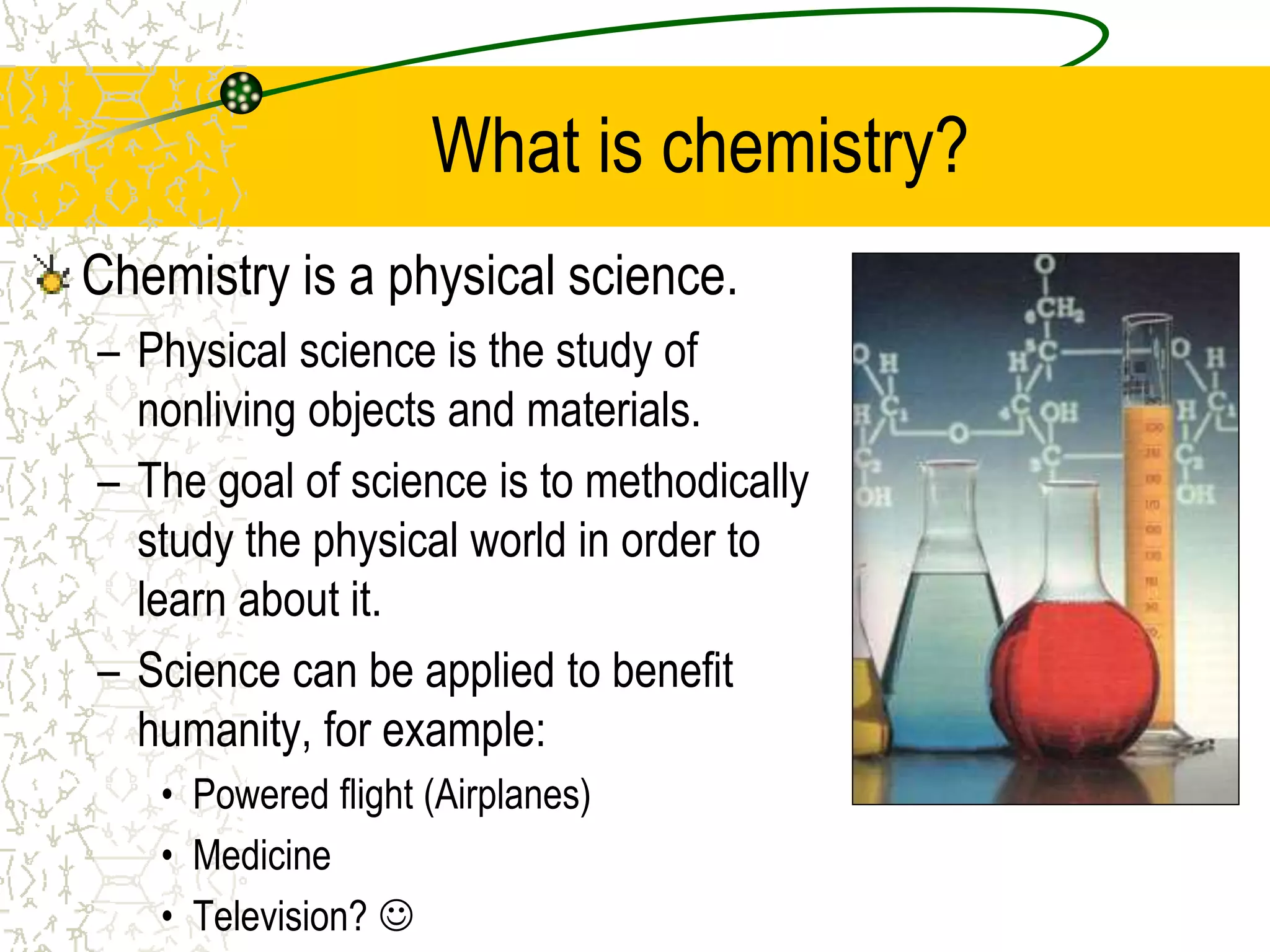
Chemistry is a physical science. 
– Physical science is the study of 
nonliving objects and materials. 
– The goal of science is to methodically 
study the physical world in order to 
learn about it. 
– Science can be applied to benefit 
humanity, for example: 
• Powered flight (Airplanes) 
• Medicine 
• Television? 
What is chemistry? 
Chemistry is a science concerned with the 
structure, composition, and properties of matter, 
as well as the changes it undergoes during 
chemical reactions.
What is matter? 
Matter is anything that: 
– Has mass (weight) 
– Occupies space (volume) 
Mass is: 
– a measure of the amount of matter in an object. 
– measured in kilograms (kg)
There are 5 branches of chemistry 
Inorganic 
Organic 
Analytic 
Physical 
Biochemistry
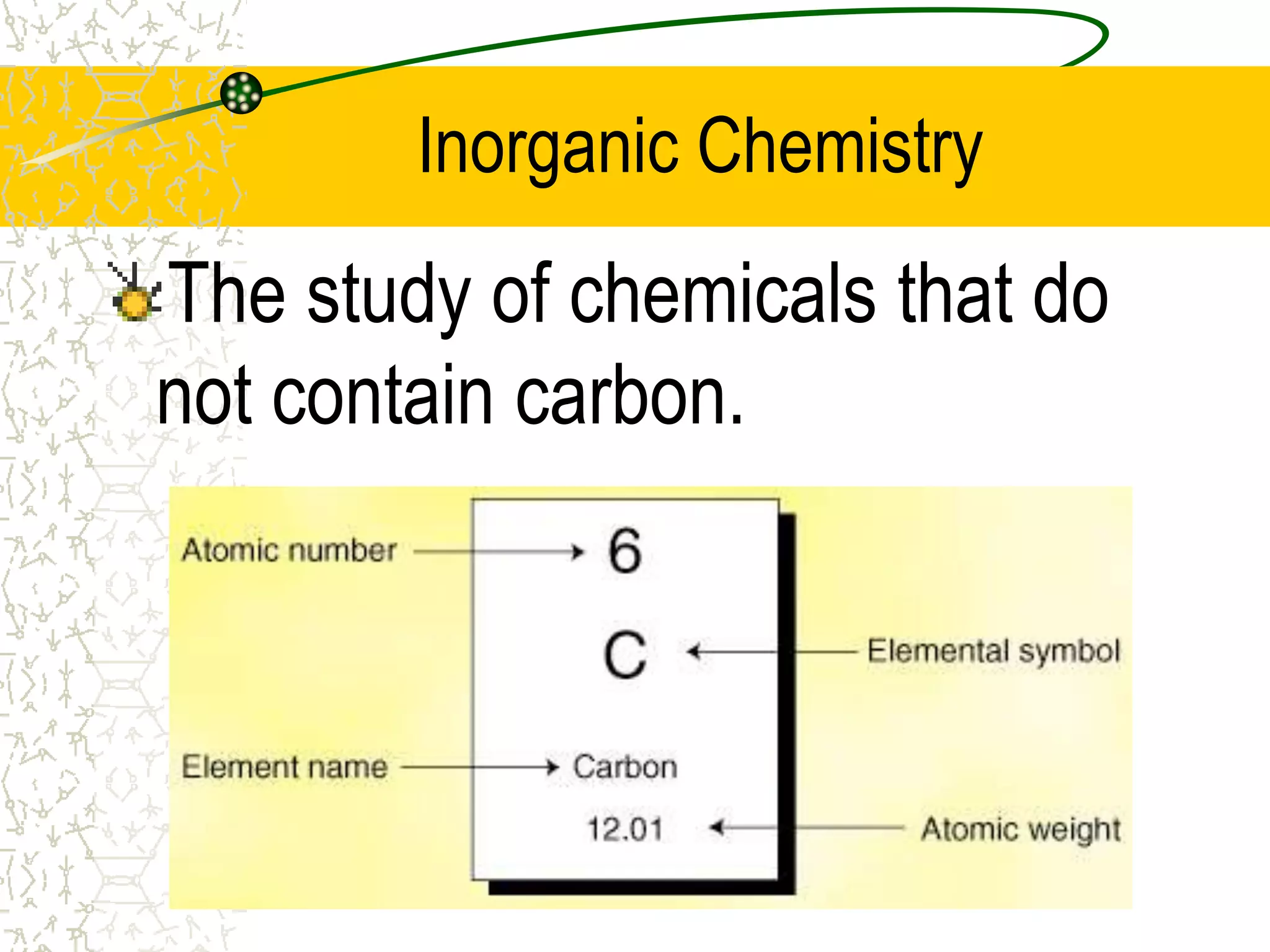
Inorganic Chemistry 
The study of chemicals that do 
not contain carbon.
Organic Chemistry 
The study of chemicals that 
contain carbon. 
Organic chemistry is the study 
of chemicals in living organisms.
Analytical Chemistry 
Analytical chemistry studies the 
composition of matter; in other words, 
it is the study of what elements and 
compounds make up matter. 
Analytical chemistry relies heavily on 
laboratory research.
Physical Chemistry 
Physical chemistry is the study of how 
matter behaves and how chemical 
reactions occur. 
Physical chemistry heavily relies on 
math and physics. 
Like analytical chemists, physical 
chemists conduct a lot of research.
Biochemistry 
Biochemistry is the study of processes 
that take place inside living organisms. 
Biochemistry is used very often in 
medical fields, by doctors, 
veterinarians, dentists, and 
pharmacists.
Quiz time! 
Take out a piece of paper and number 1-10 
Write your name at the top! 
Answer the following questions:
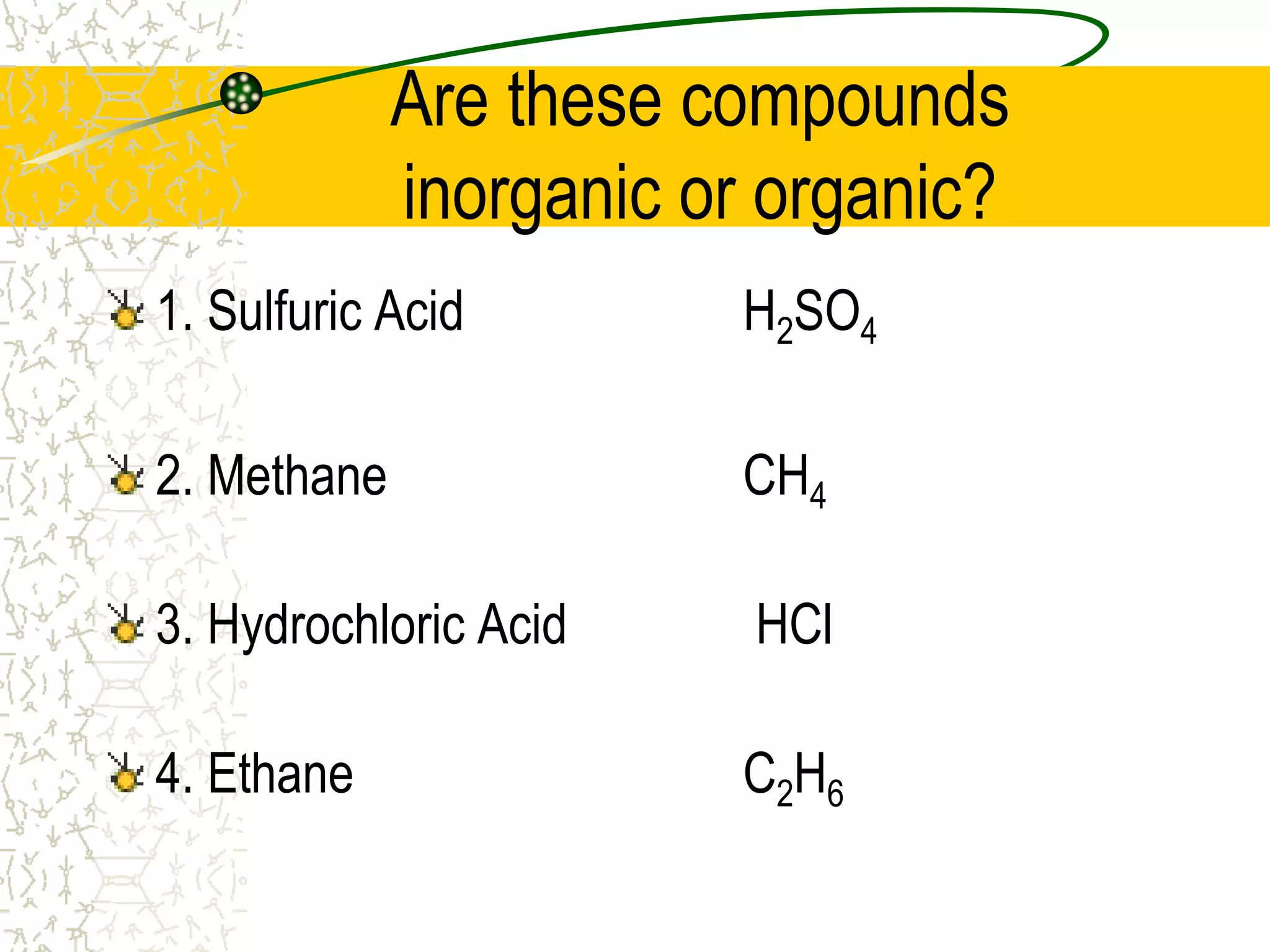
Are these compounds 
inorganic or organic? 
1. Sulfuric Acid H2SO4 
2. Methane CH4 
3. Hydrochloric Acid HCl 
4. Ethane C2H6
Which branch of chemistry… 
5. is used by people in the medical field? 
6. relies on math and physics? 
7. studies compounds of living organisms? 
8. relies on lab research and experiments? 
9. studies chemicals that do not contain carbon? 
10. is considered a science?
Time’s Up! 
Switch papers with the person sitting next to you. 
Mark any incorrect answers with an X next to the 
number. 
Write the total number correct on the top right of 
the paper, and CIRCLE the number. 
Pass back the paper to its owner, then pass 
them forward to be collected by your teacher.
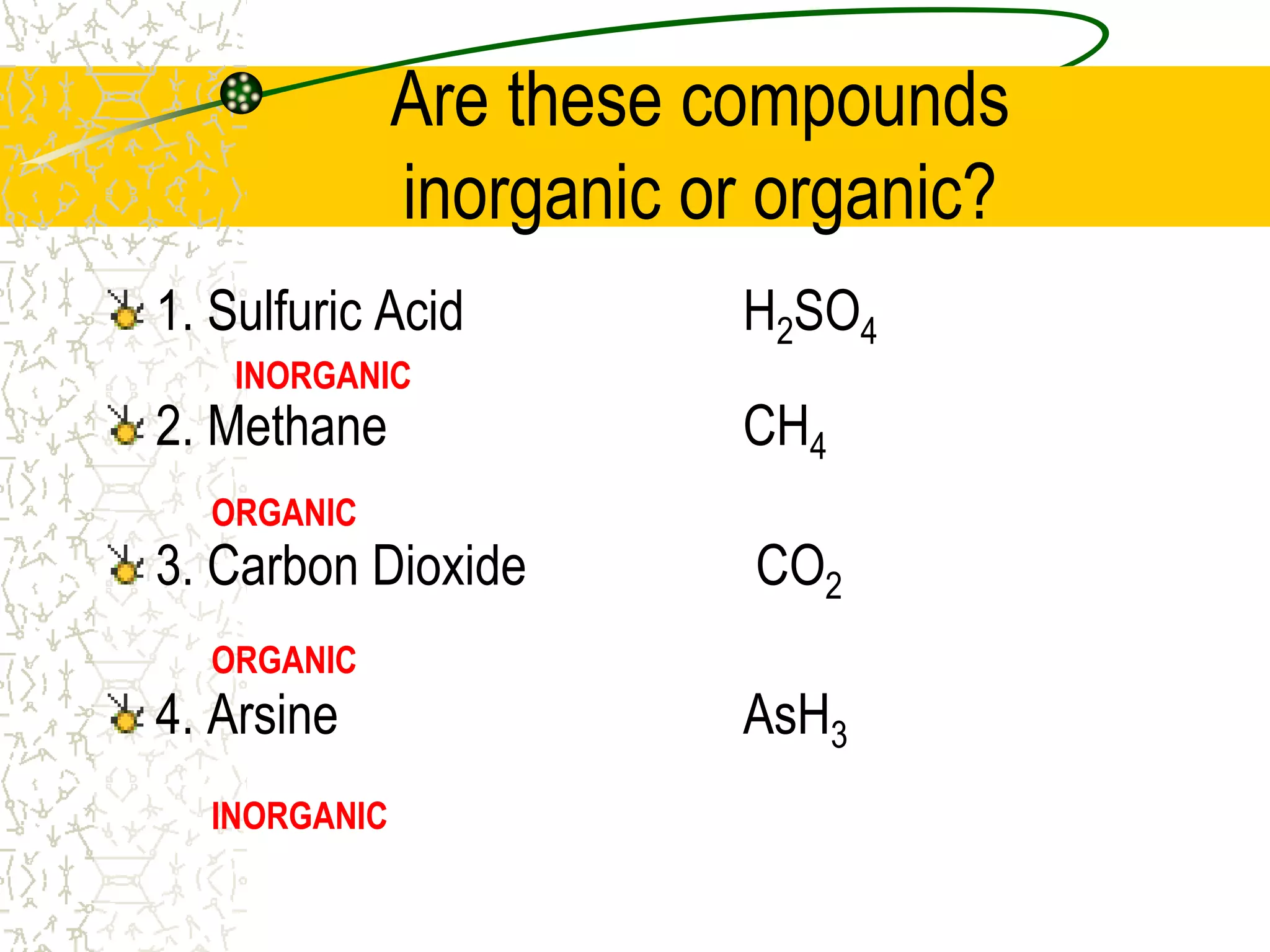
Are these compounds 
inorganic or organic? 
1. Sulfuric Acid H2SO4 
INORGANIC 
2. Methane CH4 
ORGANIC 
3. Carbon Dioxide CO2 
ORGANIC 
4. Arsine AsH3 
INORGANIC
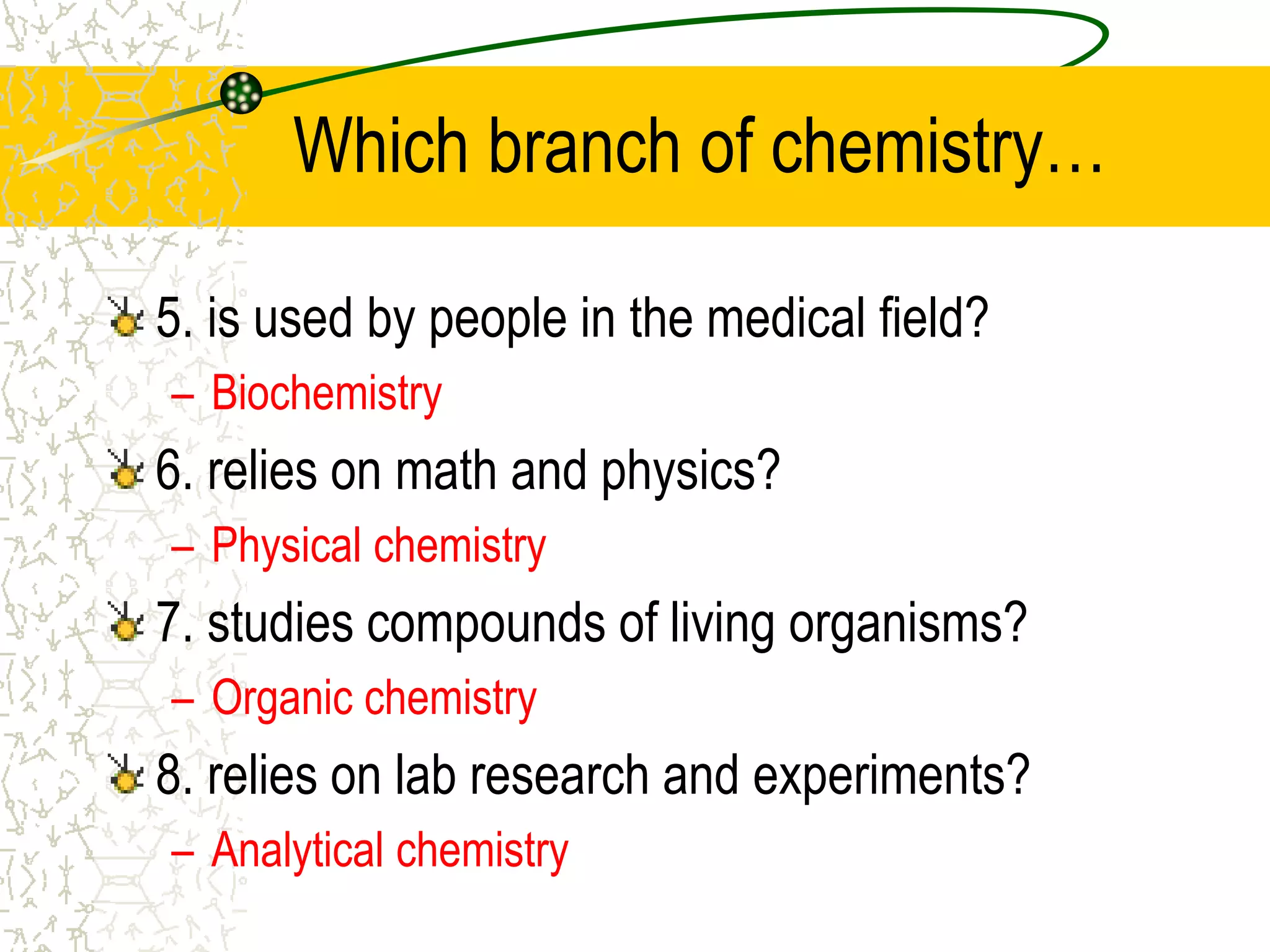
Which branch of chemistry… 
5. is used by people in the medical field? 
– Biochemistry 
6. relies on math and physics? 
– Physical chemistry 
7. studies compounds of living organisms? 
– Organic chemistry 
8. relies on lab research and experiments? 
– Analytical chemistry
Which branch of chemistry… 
9. studies chemicals that do not contain carbon? 
– Inorganic chemistry 
10. is considered a science? 
– ALL OF THEM!!! 
Matter & Its Properties
Quick Review 
What is chemistry? 
– Study of the properties of matter, and the changes 
they undergo 
How many branches of chemistry are there? 
– 5 
What is matter? 
– Anything that has mass and takes up space
What is Matter Made Of? 
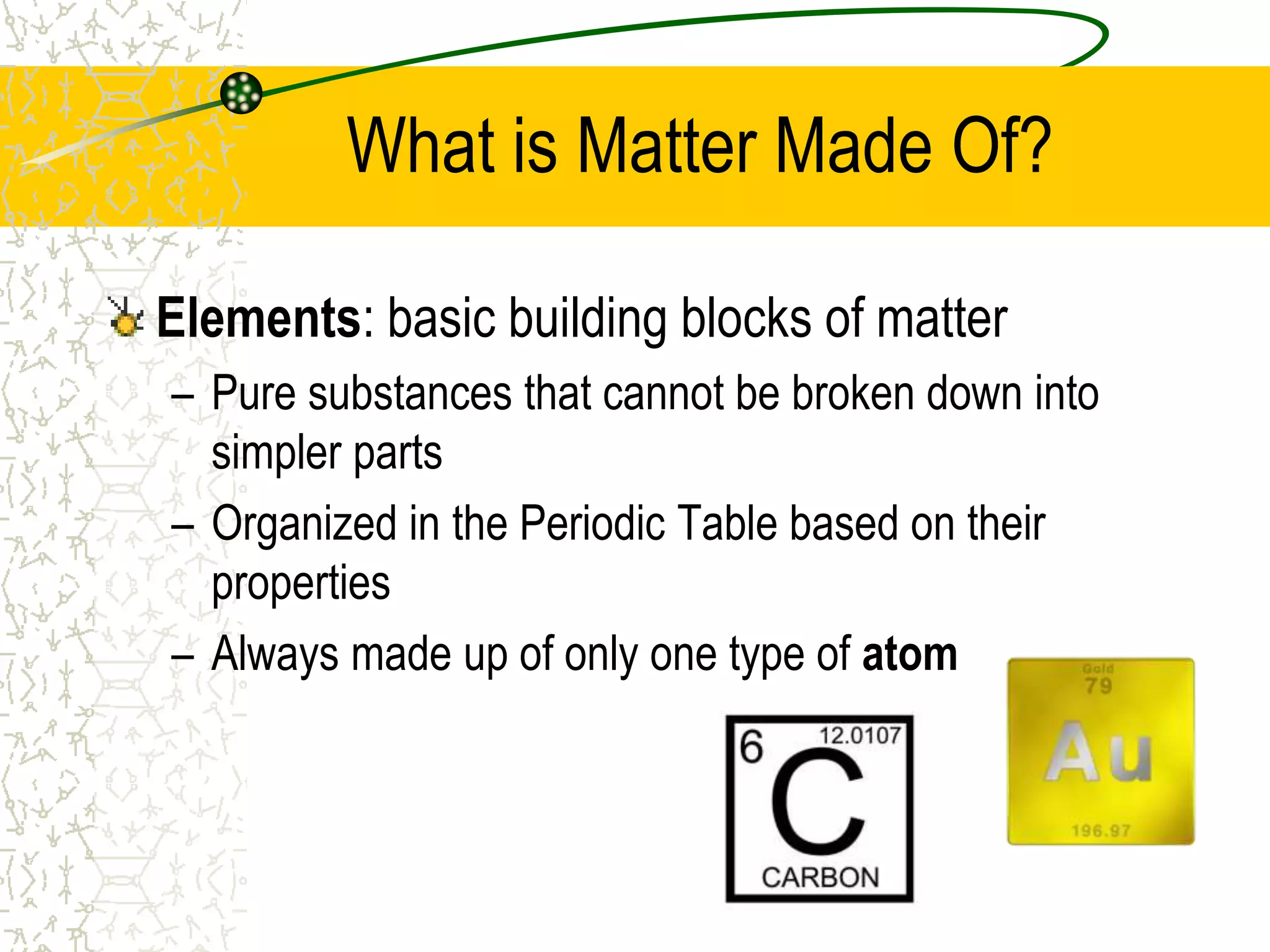
Elements: basic building blocks of matter 
– Pure substances that cannot be broken down into 
simpler parts 
– Organized in the Periodic Table based on their 
properties 
– Always made up of only one type of atom
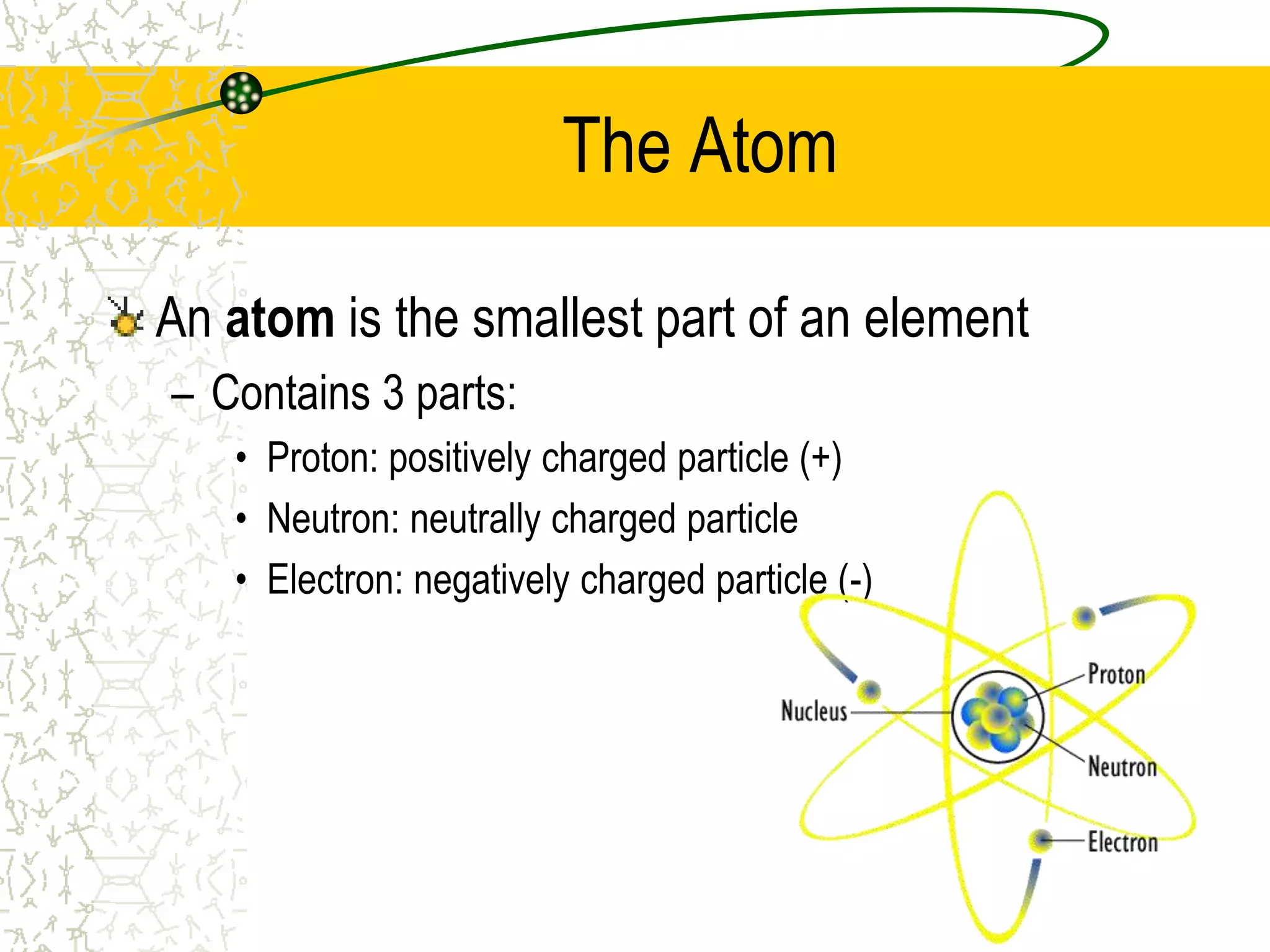
The Atom 
An atom is the smallest part of an element 
– Contains 3 parts: 
• Proton: positively charged particle (+) 
• Neutron: neutrally charged particle 
• Electron: negatively charged particle (-)
Combining Atoms 
Atoms can combine with one another to form 
molecules and compounds 
Molecules = two or more atoms that are 
chemically bonded 
Compounds = molecules that contain two or 
more different atoms 
All compounds are molecules, but not all 
molecules are compounds!
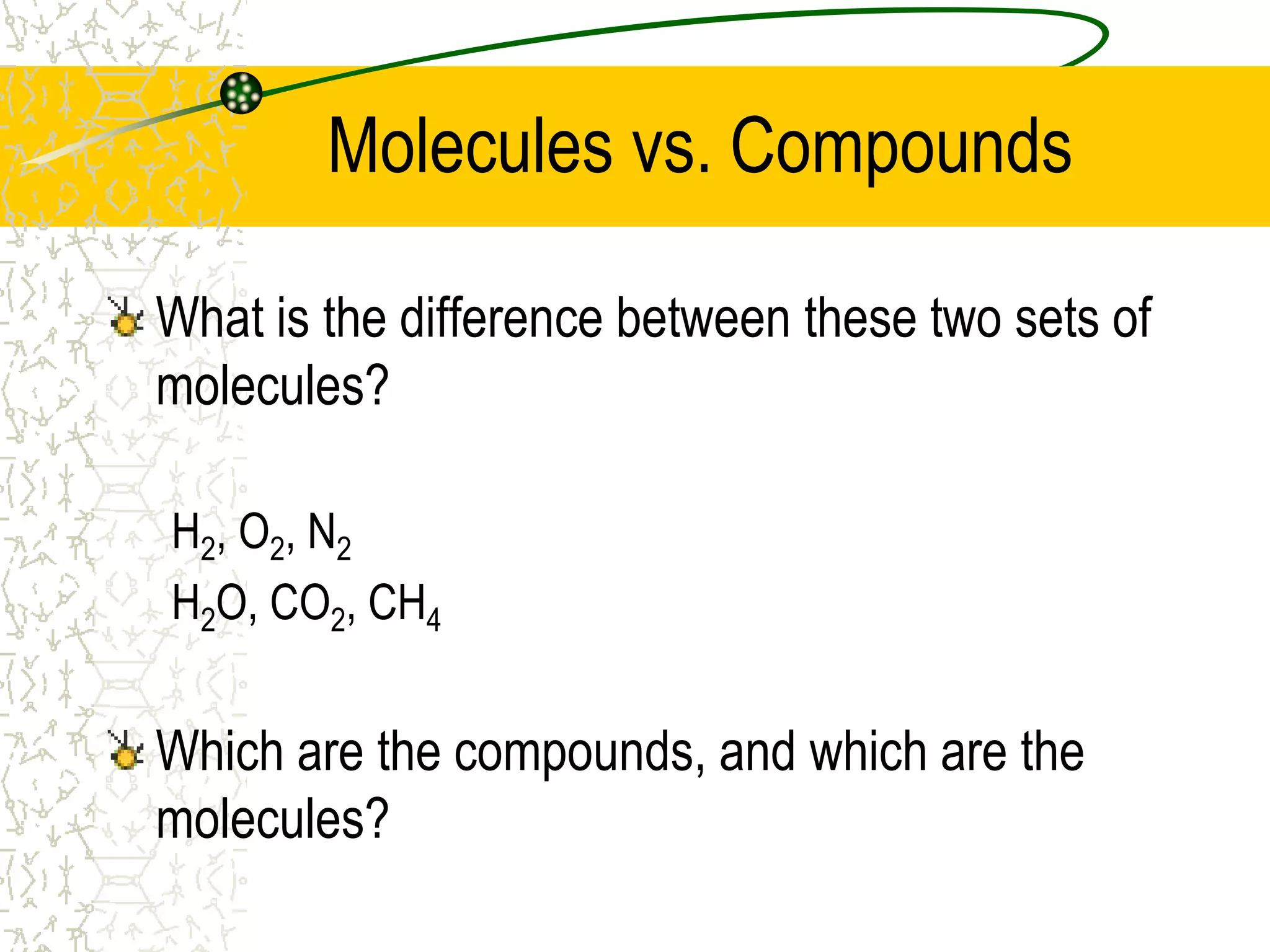
Molecules vs. Compounds 
What is the difference between these two sets of 
molecules? 
H2, O2, N2 
H2O, CO2, CH4 
Which are the compounds, and which are the 
molecules?
Properties of Matter 
Properties help chemists identify unknown 
substances 
Two basic types of properties: 
– Physical properties 
– Chemical properties
Physical Properties 
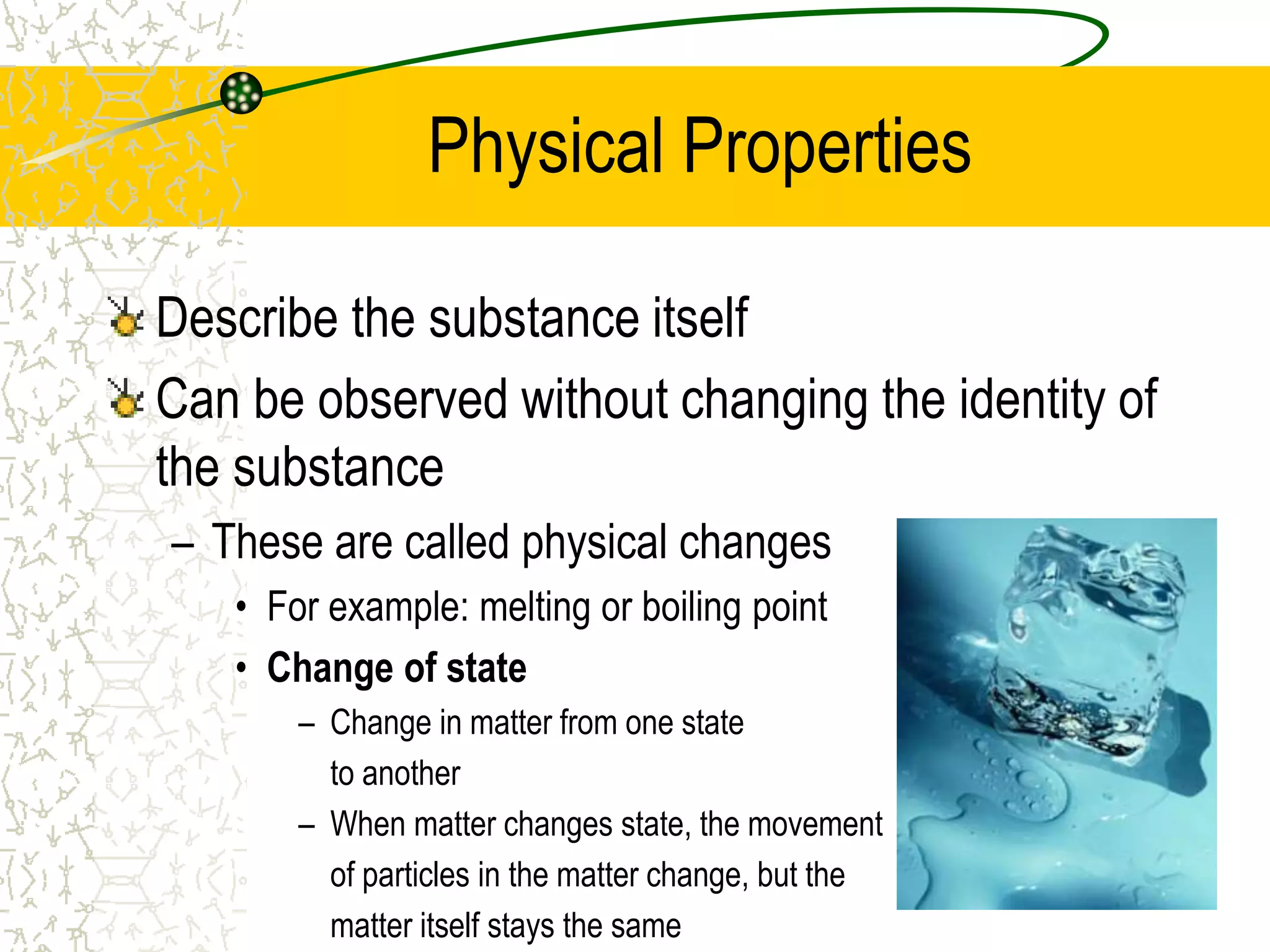
Describe the substance itself 
Can be observed without changing the identity of 
the substance 
– These are called physical changes 
• For example: melting or boiling point 
• Change of state 
– Change in matter from one state 
to another 
– When matter changes state, the movement 
of particles in the matter change, but the 
matter itself stays the same
States of Matter 
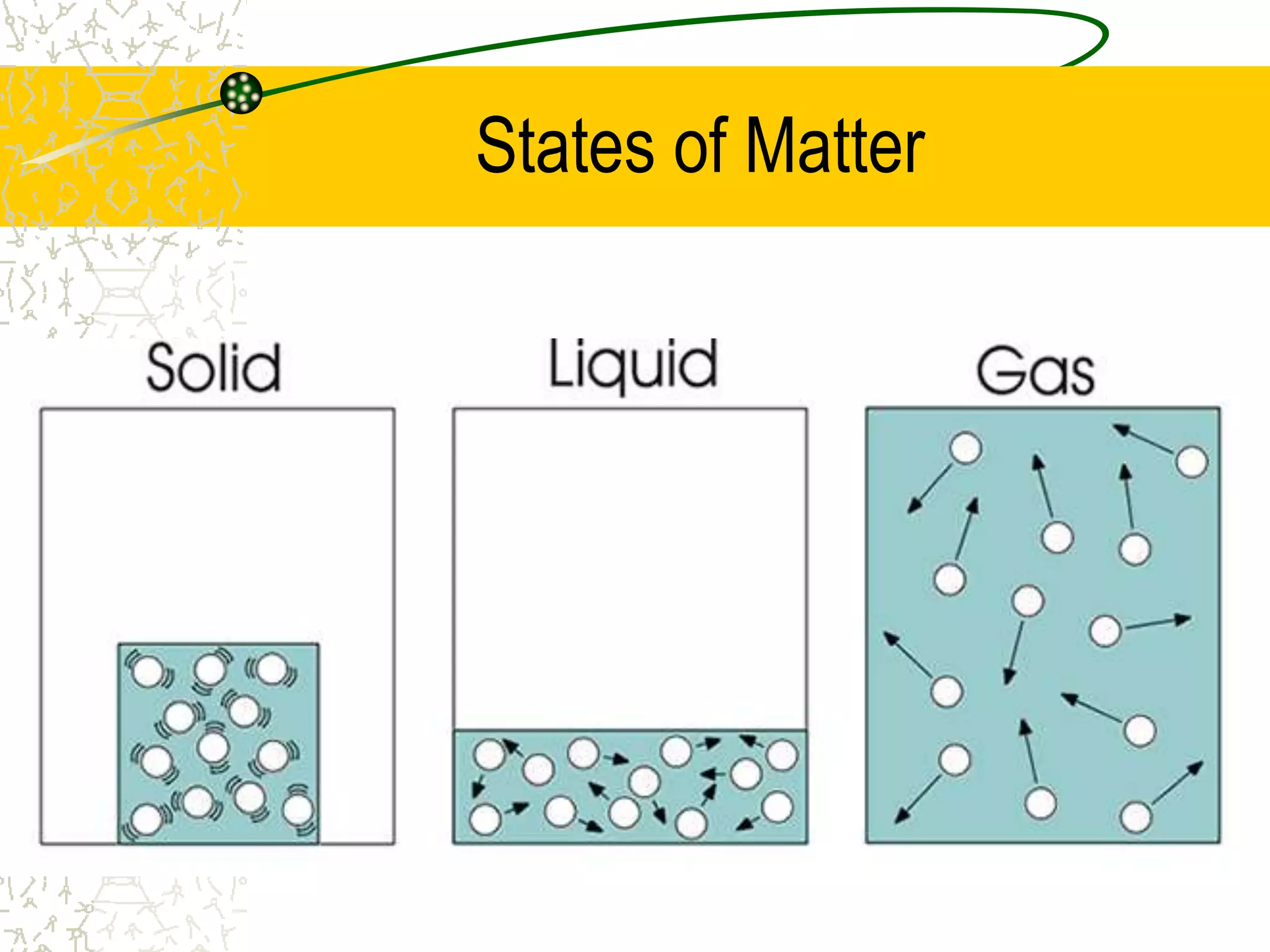
Three main states of matter 
– Solid 
• Has a definite volume, & definite shape 
• Particles are packed tightly together (high attraction) 
– Liquid 
• Has a definite volume, but not a definite shape 
• Particles are closely packed but can slide around 
– Gas 
• No definite volume or shape 
• Particles move quickly and bounce around each other
States of Matter
A Fourth State of Matter?! 
Plasma 
– State of matter with a very high temperature, and 
made up of charged particles 
– Gas is heated until its electrons are no longer bound 
to any nucleus 
– Can be influenced by electricity 
– Video
Chemical Properties 
Cannot be observed without changing the 
makeup of the substance 
Relates to a substance’s ability to undergo a 
chemical change 
– Change in which one or more substances is turned 
into another substance 
– Also known as a chemical reaction
Chemical Reactions 
Chemical reactions are easy to see 
– Like these 
There are always two types of substances in a 
chemical reaction 
– Reactants 
– Products 
Reactant + reactant  product
Energy in Changes of Matter 
All changes require energy 
In every change, the total amount of energy 
always stays the same; energy that is present 
before the reaction will still be there after the 
reaction, but may be present in a different form 
– Law of Conservation of Energy
Classification of Matter 
Matter can be one of two things: 
– Pure substance 
• Composition is the same throughout 
– Mixture 
• Contains more than one substance 
• Blend of two or more kinds of substances, with each of 
them keeping their original properties
Mixtures 
Two types of mixtures: 
– Homogenous 
– Heterogenous 
Homogenous 
– Looks the same throughout 
– Also called solutions 
Heterogenous 
– Looks different throughout

Intro to Chemistry Powerpoint- Minerva School

  • 1.
  • 2.
    What is chemistry? Chemistry is a physical science. – Physical science is the study of nonliving objects and materials. – The goal of science is to methodically study the physical world in order to learn about it. – Science can be applied to benefit humanity, for example: • Powered flight (Airplanes) • Medicine • Television? 
  • 3.
    What is chemistry? Chemistry is a science concerned with the structure, composition, and properties of matter, as well as the changes it undergoes during chemical reactions.
  • 4.
    What is matter? Matter is anything that: – Has mass (weight) – Occupies space (volume) Mass is: – a measure of the amount of matter in an object. – measured in kilograms (kg)
  • 5.
    There are 5branches of chemistry Inorganic Organic Analytic Physical Biochemistry
  • 6.
    Inorganic Chemistry Thestudy of chemicals that do not contain carbon.
  • 7.
    Organic Chemistry Thestudy of chemicals that contain carbon. Organic chemistry is the study of chemicals in living organisms.
  • 8.
    Analytical Chemistry Analyticalchemistry studies the composition of matter; in other words, it is the study of what elements and compounds make up matter. Analytical chemistry relies heavily on laboratory research.
  • 9.
    Physical Chemistry Physicalchemistry is the study of how matter behaves and how chemical reactions occur. Physical chemistry heavily relies on math and physics. Like analytical chemists, physical chemists conduct a lot of research.
  • 10.
    Biochemistry Biochemistry isthe study of processes that take place inside living organisms. Biochemistry is used very often in medical fields, by doctors, veterinarians, dentists, and pharmacists.
  • 11.
    Quiz time! Takeout a piece of paper and number 1-10 Write your name at the top! Answer the following questions:
  • 12.
    Are these compounds inorganic or organic? 1. Sulfuric Acid H2SO4 2. Methane CH4 3. Hydrochloric Acid HCl 4. Ethane C2H6
  • 13.
    Which branch ofchemistry… 5. is used by people in the medical field? 6. relies on math and physics? 7. studies compounds of living organisms? 8. relies on lab research and experiments? 9. studies chemicals that do not contain carbon? 10. is considered a science?
  • 14.
    Time’s Up! Switchpapers with the person sitting next to you. Mark any incorrect answers with an X next to the number. Write the total number correct on the top right of the paper, and CIRCLE the number. Pass back the paper to its owner, then pass them forward to be collected by your teacher.
  • 15.
    Are these compounds inorganic or organic? 1. Sulfuric Acid H2SO4 INORGANIC 2. Methane CH4 ORGANIC 3. Carbon Dioxide CO2 ORGANIC 4. Arsine AsH3 INORGANIC
  • 16.
    Which branch ofchemistry… 5. is used by people in the medical field? – Biochemistry 6. relies on math and physics? – Physical chemistry 7. studies compounds of living organisms? – Organic chemistry 8. relies on lab research and experiments? – Analytical chemistry
  • 17.
    Which branch ofchemistry… 9. studies chemicals that do not contain carbon? – Inorganic chemistry 10. is considered a science? – ALL OF THEM!!! 
  • 18.
    Matter & ItsProperties
  • 19.
    Quick Review Whatis chemistry? – Study of the properties of matter, and the changes they undergo How many branches of chemistry are there? – 5 What is matter? – Anything that has mass and takes up space
  • 20.
    What is MatterMade Of? Elements: basic building blocks of matter – Pure substances that cannot be broken down into simpler parts – Organized in the Periodic Table based on their properties – Always made up of only one type of atom
  • 21.
    The Atom Anatom is the smallest part of an element – Contains 3 parts: • Proton: positively charged particle (+) • Neutron: neutrally charged particle • Electron: negatively charged particle (-)
  • 22.
    Combining Atoms Atomscan combine with one another to form molecules and compounds Molecules = two or more atoms that are chemically bonded Compounds = molecules that contain two or more different atoms All compounds are molecules, but not all molecules are compounds!
  • 23.
    Molecules vs. Compounds What is the difference between these two sets of molecules? H2, O2, N2 H2O, CO2, CH4 Which are the compounds, and which are the molecules?
  • 24.
    Properties of Matter Properties help chemists identify unknown substances Two basic types of properties: – Physical properties – Chemical properties
  • 25.
    Physical Properties Describethe substance itself Can be observed without changing the identity of the substance – These are called physical changes • For example: melting or boiling point • Change of state – Change in matter from one state to another – When matter changes state, the movement of particles in the matter change, but the matter itself stays the same
  • 26.
    States of Matter Three main states of matter – Solid • Has a definite volume, & definite shape • Particles are packed tightly together (high attraction) – Liquid • Has a definite volume, but not a definite shape • Particles are closely packed but can slide around – Gas • No definite volume or shape • Particles move quickly and bounce around each other
  • 27.
  • 28.
    A Fourth Stateof Matter?! Plasma – State of matter with a very high temperature, and made up of charged particles – Gas is heated until its electrons are no longer bound to any nucleus – Can be influenced by electricity – Video
  • 29.
    Chemical Properties Cannotbe observed without changing the makeup of the substance Relates to a substance’s ability to undergo a chemical change – Change in which one or more substances is turned into another substance – Also known as a chemical reaction
  • 30.
    Chemical Reactions Chemicalreactions are easy to see – Like these There are always two types of substances in a chemical reaction – Reactants – Products Reactant + reactant  product
  • 31.
    Energy in Changesof Matter All changes require energy In every change, the total amount of energy always stays the same; energy that is present before the reaction will still be there after the reaction, but may be present in a different form – Law of Conservation of Energy
  • 32.
    Classification of Matter Matter can be one of two things: – Pure substance • Composition is the same throughout – Mixture • Contains more than one substance • Blend of two or more kinds of substances, with each of them keeping their original properties
  • 33.
    Mixtures Two typesof mixtures: – Homogenous – Heterogenous Homogenous – Looks the same throughout – Also called solutions Heterogenous – Looks different throughout