FORCES
- ENERGY AND CHANGE -
GRADE 9
TERM 3
Mr L. de Boer-Smit
KEY QUESTIONS:
• What is a force?
• What effect can a force have on an object?
• Do forces have to be between objects which are touching?
Mr L. de Boer-Smit
1.1 – TYPES OF FORCES:
• WHAT ARE FORCES?
• EFFECTS OF FORCES
• PAIRS OF FORCES
• REPRESENTING FORCES
• TYPES OF FORCES
Mr L. de Boer-Smit
WHAT ARE FORCES?
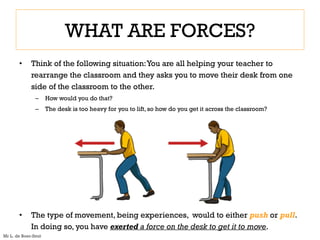
• Think of the following situation:You are all helping your teacher to
rearrange the classroom and they asks you to move their desk from one
side of the classroom to the other.
– How would you do that?
– The desk is too heavy for you to lift, so how do you get it across the classroom?
• The type of movement, being experiences, would to either push or pull.
In doing so, you have exerted a force on the desk to get it to move.
Mr L. de Boer-Smit
• A force is a push or a pull on an object.
• The unit in which we measure force is a newton (N).
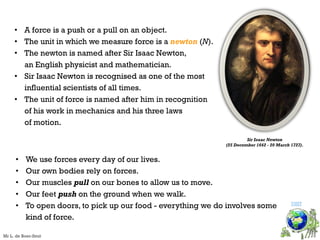
• The newton is named after Sir Isaac Newton,
an English physicist and mathematician.
• Sir Isaac Newton is recognised as one of the most
influential scientists of all times.
• The unit of force is named after him in recognition
of his work in mechanics and his three laws
of motion.
Sir Isaac Newton
(25 December 1642 - 20 March 1727).
• We use forces every day of our lives.
• Our own bodies rely on forces.
• Our muscles pull on our bones to allow us to move.
• Our feet push on the ground when we walk.
• To open doors, to pick up our food - everything we do involves some
kind of force.
VISIT
Mr L. de Boer-Smit
ACTIVITY:What can forces do?
INSTRUCTIONS:
1. Complete the activity on pg. 5-6 (Siyavula Book 9B)
This activity is all about experimenting with different objects and
seeing what happens to them when we push and pull them. Learners
should see that pushing on solid objects accelerates them. Pushing
or pulling on sponges, balloons and play dough distorts their shape
and the ball can be made to move..
Mr L. de Boer-Smit
EFFECTS OF FORCES
From the activity, you should have seen that forces can have the following
effects:
• Forces can change the shape of an object.This is called deformation.
• Forces can change the motion of an object. If an object is stationary, a
force can cause the object to start moving. Or, if an object is already
moving, a force can cause an object to speed up or slow down.
• Forces can change the direction in which an object is moving.
• How do we describe the motion of an object?
• When an object is moving, we say it has a velocity.
Velocity:Velocity is the rate of change of the position of an object.
• Velocity is the speed of an object and the direction in which it is moving.
• Speed describes only how fast an object is moving, whereas velocity
gives both how fast and in what direction the object is moving.
Mr L. de Boer-Smit
• An object can move at constant velocity.
• This means it travels at the same speed in the same direction.
• For example a car travelling along the highway at 100 km/h in a straight
line has a constant velocity. However,what happens when the car moves
faster or slows down?
• We saw in the activity that we could change the motion of an object by
applying a force to make it speed up or slow down.
• The velocity of the object is changing over time due to a force acting on it.
• This is called acceleration.
Acceleration: Acceleration is the rate of change of a body's velocity with
time. In other words, it is a measure of how an object's speed changes every
second.
Mr L. de Boer-Smit
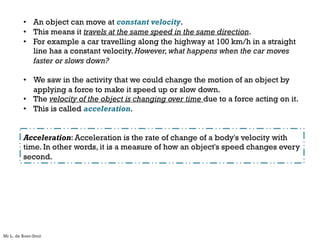
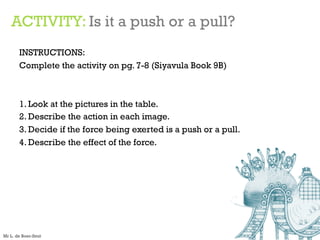
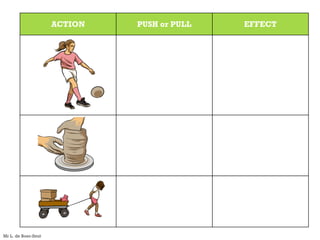
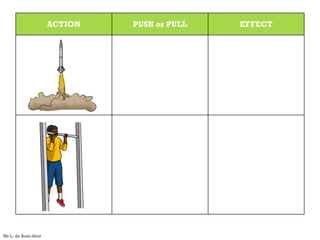
ACTIVITY: Is it a push or a pull?
INSTRUCTIONS:
Complete the activity on pg. 7-8 (Siyavula Book 9B)
1. Look at the pictures in the table.
2. Describe the action in each image.
3. Decide if the force being exerted is a push or a pull.
4. Describe the effect of the force.
Mr L. de Boer-Smit
ACTION PUSH or PULL EFFECT
Mr L. de Boer-Smit
ACTION PUSH or PULL EFFECT
Mr L. de Boer-Smit
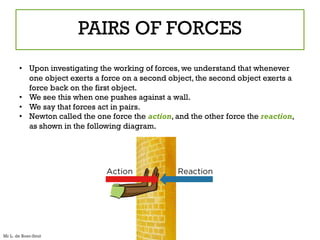
PAIRS OF FORCES
• Upon investigating the working of forces, we understand that whenever
one object exerts a force on a second object, the second object exerts a
force back on the first object.
• We see this when one pushes against a wall.
• We say that forces act in pairs.
• Newton called the one force the action, and the other force the reaction,
as shown in the following diagram.
Mr L. de Boer-Smit
• We also see that when you exerted a force on the wall, you experience
the wall exerting a force back on you.
• Forces act in pairs on different objects.
• The force exerted by the second object is equal in strength and
opposite in direction to the first force.
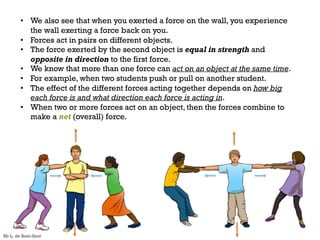
• We know that more than one force can act on an object at the same time.
• For example, when two students push or pull on another student.
• The effect of the different forces acting together depends on how big
each force is and what direction each force is acting in.
• When two or more forces act on an object, then the forces combine to
make a net (overall) force.
Mr L. de Boer-Smit
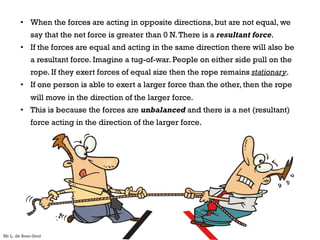
• When the forces are acting in opposite directions, but are not equal, we
say that the net force is greater than 0 N.There is a resultant force.
• If the forces are equal and acting in the same direction there will also be
a resultant force. Imagine a tug-of-war. People on either side pull on the
rope. If they exert forces of equal size then the rope remains stationary.
• If one person is able to exert a larger force than the other, then the rope
will move in the direction of the larger force.
• This is because the forces are unbalanced and there is a net (resultant)
force acting in the direction of the larger force.
Mr L. de Boer-Smit
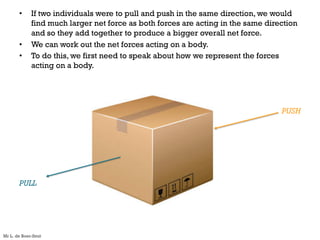
• If two individuals were to pull and push in the same direction, we would
find much larger net force as both forces are acting in the same direction
and so they add together to produce a bigger overall net force.
• We can work out the net forces acting on a body.
• To do this, we first need to speak about how we represent the forces
acting on a body.
PULL
PUSH
Mr L. de Boer-Smit
ACTIVITY: Pairs of forces.
INSTRUCTIONS:
Complete the activity on pg. 9-10 (Siyavula Book 9B)
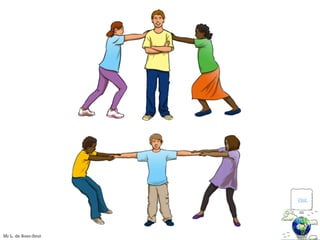
1. Work in groups of three for this activity.
2. First, go up to your classroom wall and push against it. Describe what you feel
below.
3. When you push on the wall, do you think the wall is pushing back on your hands?
How does this force compare to the force you are exerting on the wall?
4. Stand in a triangle with your two partners and hold hands. Pull on each others'
hands. Do you feel your partners' hands pulling back as you pull?
5. Still standing in a triangle, place your palms up against each other and push
against each others' hands. Do you feel your partners' hands pushing back as you
push?
6. Next, stand shoulder-to-shoulder with your two partners.The two learners on the
outside must push against the shoulders of the learner in the middle.
7. What happens when you both push with the same force?
8. What happens when one of you pushes with a harder force than the other?
9. Next, the learner in the middle must stretch out his or her arms.The learners on
the outside must pull on the middle learner's hands in opposite directions.
10. What happens when you both pull with equal force?
11. What happens when one of you pulls with a stronger force than the other?
12. What happens when one of you pulls and the other pushes?
Mr L. de Boer-Smit
Visit
Mr L. de Boer-Smit
REPRESENTING FORCES
How do we show a force?
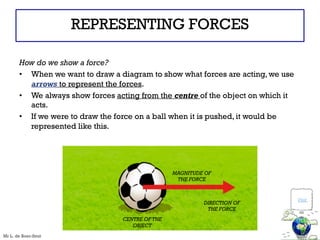
• When we want to draw a diagram to show what forces are acting, we use
arrows to represent the forces.
• We always show forces acting from the centre of the object on which it
acts.
• If we were to draw the force on a ball when it is pushed, it would be
represented like this.
CENTRE OF THE
OBJECT
DIRECTION OF
THE FORCE
MAGNITUDE OF
THE FORCE
Visit
Mr L. de Boer-Smit
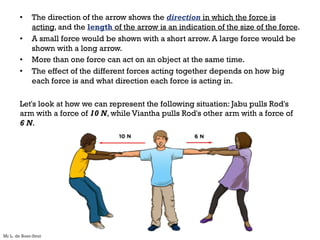
• The direction of the arrow shows the direction in which the force is
acting, and the length of the arrow is an indication of the size of the force.
• A small force would be shown with a short arrow. A large force would be
shown with a long arrow.
• More than one force can act on an object at the same time.
• The effect of the different forces acting together depends on how big
each force is and what direction each force is acting in.
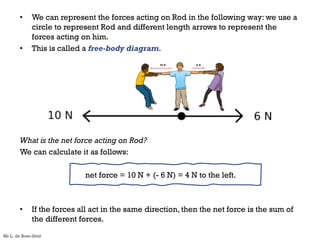
Let's look at how we can represent the following situation: Jabu pulls Rod's
arm with a force of 10 N, while Viantha pulls Rod's other arm with a force of
6 N.
Mr L. de Boer-Smit
• We can represent the forces acting on Rod in the following way: we use a
circle to represent Rod and different length arrows to represent the
forces acting on him.
• This is called a free-body diagram.
What is the net force acting on Rod?
We can calculate it as follows:
net force = 10 N + (- 6 N) = 4 N to the left.
• If the forces all act in the same direction, then the net force is the sum of
the different forces.
Mr L. de Boer-Smit
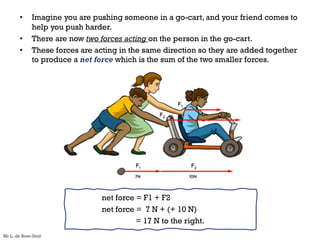
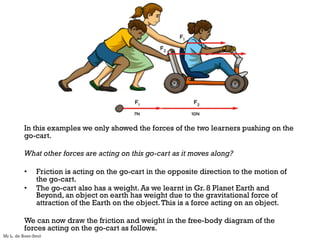
• Imagine you are pushing someone in a go-cart, and your friend comes to
help you push harder.
• There are now two forces acting on the person in the go-cart.
• These forces are acting in the same direction so they are added together
to produce a net force which is the sum of the two smaller forces.
net force = F1 + F2
net force = 7 N + (+ 10 N)
= 17 N to the right.
Mr L. de Boer-Smit
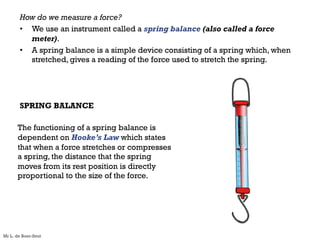
How do we measure a force?
• We use an instrument called a spring balance (also called a force
meter).
• A spring balance is a simple device consisting of a spring which, when
stretched, gives a reading of the force used to stretch the spring.
SPRING BALANCE
The functioning of a spring balance is
dependent on Hooke’s Law which states
that when a force stretches or compresses
a spring, the distance that the spring
moves from its rest position is directly
proportional to the size of the force.
Mr L. de Boer-Smit
TYPES OF FORCES
• So far, we have looked at forces acting on an object when the object causing
the force is in contact with object experiencing the force.
Do we always have to be in contact with an object in order to exert a force?
• There are forces exerted by a magnets but they did not have to touch each
other.That means that you do not have to be in contact with something in
order to exert a force on it.
• There are two types of forces:
– Contact forces: objects are in contact with each other and exert forces on each
other.
– Non-contact (field) forces: objects are not in contact with each other
and exert forces on each other.
Mr L. de Boer-Smit
ACTIVITY: Forces can act over a distance.
INSTRUCTIONS:
Complete the activity on pg. 13-14 (Siyavula Book 9B)
MATERIALS:
• bar magnets
• metal paper clips
INSTRUCTIONS:
1. Place one of the bar magnets on the table.
2. Bring the north end of another bar magnet close to the south end
of the first bar magnet.What happens?
3. Bring the north end of one bar magnet close to the
north end of the other bar magnet.What happens?
4. Place the paper clips on the table.
5. Bring a bar magnet over the paper clips.
What do you observe?
Mr L. de Boer-Smit
1.2 – CONTACT FORCES
• FRICTION
• TENSION AND COMPRESSION
Mr L. de Boer-Smit
• Contact forces are forces between objects which are touching each other.
• Most of the forces that we looked at in the previous section were contact
forces, for example, when you push a desk, or pull a go-cart.You are
touching the object.
What happens when you kick a ball across the grass?
• The ball moves quickly at first but then slows down again.
• Something has caused the ball to slow and stop moving. If the motion of
the ball has changed then a force must have been exerted on it.
• The force which opposes motion is called friction.
• Friction forces always act in the opposite direction to the motion of the
object.
• Friction resists movement when the object and surface are in contact.
What does that mean?
• It means that if the ball is moving forward then friction acts backwards on
the ball.
FRICTION
Mr L. de Boer-Smit
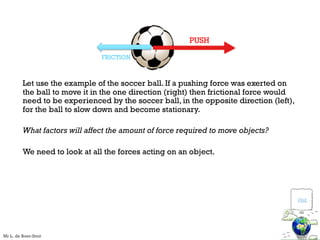
Let use the example of the soccer ball. If a pushing force was exerted on
the ball to move it in the one direction (right) then frictional force would
need to be experienced by the soccer ball, in the opposite direction (left),
for the ball to slow down and become stationary.
What factors will affect the amount of force required to move objects?
We need to look at all the forces acting on an object.
FRICTION
PUSH
Visit
Mr L. de Boer-Smit
In this examples we only showed the forces of the two learners pushing on the
go-cart.
What other forces are acting on this go-cart as it moves along?
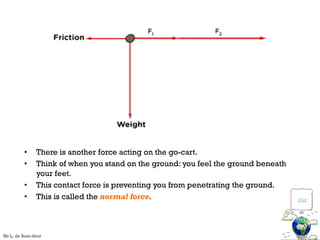
• Friction is acting on the go-cart in the opposite direction to the motion of
the go-cart.
• The go-cart also has a weight. As we learnt in Gr. 8 Planet Earth and
Beyond, an object on earth has weight due to the gravitational force of
attraction of the Earth on the object.This is a force acting on an object.
We can now draw the friction and weight in the free-body diagram of the
forces acting on the go-cart as follows.
Mr L. de Boer-Smit
• There is another force acting on the go-cart.
• Think of when you stand on the ground: you feel the ground beneath
your feet.
• This contact force is preventing you from penetrating the ground.
• This is called the normal force. Visit
Mr L. de Boer-Smit
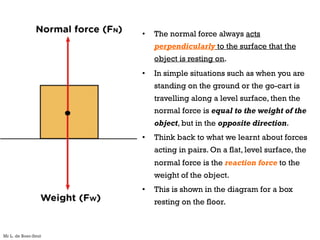
• The normal force always acts
perpendicularly to the surface that the
object is resting on.
• In simple situations such as when you are
standing on the ground or the go-cart is
travelling along a level surface, then the
normal force is equal to the weight of the
object, but in the opposite direction.
• Think back to what we learnt about forces
acting in pairs. On a flat, level surface, the
normal force is the reaction force to the
weight of the object.
• This is shown in the diagram for a box
resting on the floor.
Mr L. de Boer-Smit
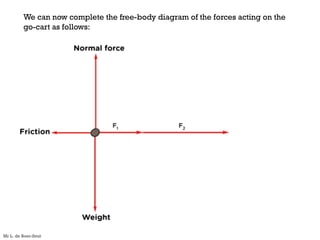
We can now complete the free-body diagram of the forces acting on the
go-cart as follows:
Mr L. de Boer-Smit
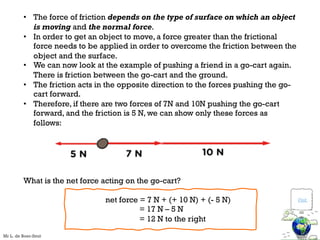
• The force of friction depends on the type of surface on which an object
is moving and the normal force.
• In order to get an object to move, a force greater than the frictional
force needs to be applied in order to overcome the friction between the
object and the surface.
• We can now look at the example of pushing a friend in a go-cart again.
There is friction between the go-cart and the ground.
• The friction acts in the opposite direction to the forces pushing the go-
cart forward.
• Therefore, if there are two forces of 7N and 10N pushing the go-cart
forward, and the friction is 5 N, we can show only these forces as
follows:
What is the net force acting on the go-cart?
net force = 7 N + (+ 10 N) + (- 5 N)
= 17 N – 5 N
= 12 N to the right
Visit
Mr L. de Boer-Smit
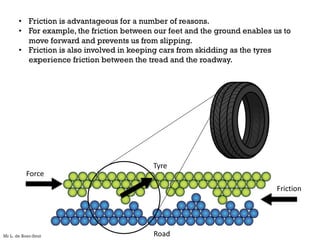
• Friction is advantageous for a number of reasons.
• For example, the friction between our feet and the ground enables us to
move forward and prevents us from slipping.
• Friction is also involved in keeping cars from skidding as the tyres
experience friction between the tread and the roadway.
Tyre
Road
Friction
Force
Mr L. de Boer-Smit
INVESTIGATION:
What is the relationship between normal force
and friction?
Complete the investigation on pg. 16-20 (Siyavula Book 9B)
INVESTIGATIVE QUESTION: What is the relationship between the normal
force and friction?
AIM: To determine the relationship between the normal force and the size of
the frictional force.
In the situations that we are going to investigate, the object will be pulled
along on a flat, level surface.We will increase its mass and measure the
resulting frictional force.
But how does this relate to the normal force?
Mr L. de Boer-Smit
TENSION AND COMPRESSION
• There are other forces which are contact forces.
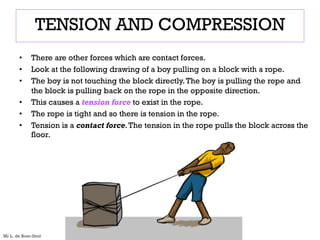
• Look at the following drawing of a boy pulling on a block with a rope.
• The boy is not touching the block directly.The boy is pulling the rope and
the block is pulling back on the rope in the opposite direction.
• This causes a tension force to exist in the rope.
• The rope is tight and so there is tension in the rope.
• Tension is a contact force.The tension in the rope pulls the block across the
floor.
Mr L. de Boer-Smit
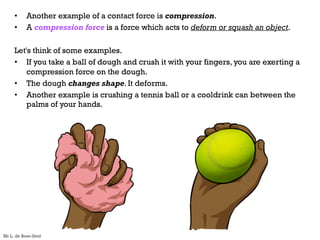
• Another example of a contact force is compression.
• A compression force is a force which acts to deform or squash an object.
Let's think of some examples.
• If you take a ball of dough and crush it with your fingers, you are exerting a
compression force on the dough.
• The dough changes shape. It deforms.
• Another example is crushing a tennis ball or a cooldrink can between the
palms of your hands.
Mr L. de Boer-Smit
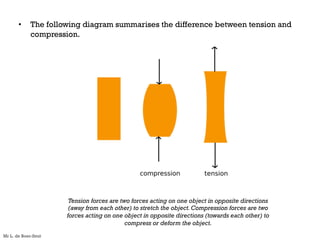
• The following diagram summarises the difference between tension and
compression.
Tension forces are two forces acting on one object in opposite directions
(away from each other) to stretch the object.Compression forces are two
forces acting on one object in opposite directions (towards each other) to
compress or deform the object.
Mr L. de Boer-Smit
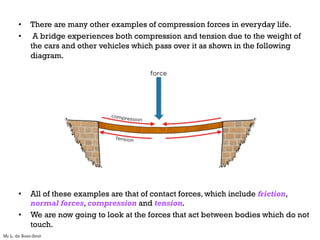
• There are many other examples of compression forces in everyday life.
• A bridge experiences both compression and tension due to the weight of
the cars and other vehicles which pass over it as shown in the following
diagram.
• All of these examples are that of contact forces, which include friction,
normal forces, compression and tension.
• We are now going to look at the forces that act between bodies which do not
touch.
Mr L. de Boer-Smit
1.3 – FIELD (NON-CONTACT)
FORCES
• GRAVITATIONAL FORCES
• MAGNETIC FORCES
• ELECTROSTATIC FORCE
Mr L. de Boer-Smit
GRAVIATIONAL FORCES
• A field is a region in space where an object (with certain properties) will
experience a force.
• Field forces are non-contact forces.
• Non-contact forces are forces which act over a distance.They do not have to
be touching.
The most common examples of fields are:
– gravitational field
– magnetic field
– electric field
• When we discussed contact forces, we spoke about pushes and pulls.
However, with field forces, it is better to talk about repulsion and attraction.
Have you ever wondered why things fall down and not up?
Visit
Mr L. de Boer-Smit
GRAVIATIONAL FORCES
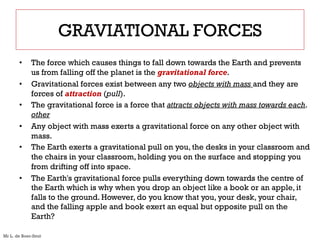
• The force which causes things to fall down towards the Earth and prevents
us from falling off the planet is the gravitational force.
• Gravitational forces exist between any two objects with mass and they are
forces of attraction (pull).
• The gravitational force is a force that attracts objects with mass towards each.
other
• Any object with mass exerts a gravitational force on any other object with
mass.
• The Earth exerts a gravitational pull on you, the desks in your classroom and
the chairs in your classroom, holding you on the surface and stopping you
from drifting off into space.
• The Earth's gravitational force pulls everything down towards the centre of
the Earth which is why when you drop an object like a book or an apple, it
falls to the ground. However, do you know that you, your desk, your chair,
and the falling apple and book exert an equal but opposite pull on the
Earth?
Mr L. de Boer-Smit
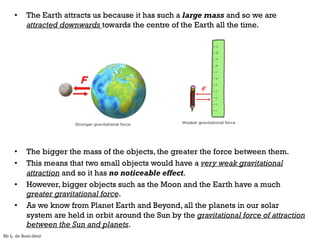
• The Earth attracts us because it has such a large mass and so we are
attracted downwards towards the centre of the Earth all the time.
• The bigger the mass of the objects, the greater the force between them.
• This means that two small objects would have a very weak gravitational
attraction and so it has no noticeable effect.
• However, bigger objects such as the Moon and the Earth have a much
greater gravitational force.
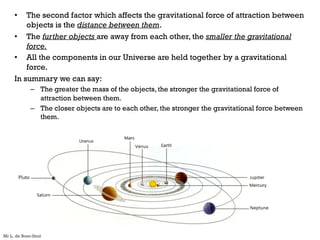
• As we know from Planet Earth and Beyond, all the planets in our solar
system are held in orbit around the Sun by the gravitational force of attraction
between the Sun and planets.
Mr L. de Boer-Smit
• The second factor which affects the gravitational force of attraction between
objects is the distance between them.
• The further objects are away from each other, the smaller the gravitational
force.
• All the components in our Universe are held together by a gravitational
force.
In summary we can say:
– The greater the mass of the objects, the stronger the gravitational force of
attraction between them.
– The closer objects are to each other, the stronger the gravitational force between
them.
Mr L. de Boer-Smit
INVESTIGATION: Dropping Objects
Complete the investigation on pg. 25-27 (Siyavula Book 9B)
INVESTIGATIVE QUESTION:
Do different objects fall at the same rate?
HYPOTHESIS:
What do you think will happen?
Mr L. de Boer-Smit
Mass vs Weight
• The mass of an object is the amount of matter in the object.
• It tells you how many particles you have. eg. the mass of a wooden block
tells us how many atoms there are.
• Mass is measured in kilograms (kg) and is independent of where you
measure it.
• A wooden block with a mass of 10 kg on Earth also has a mass of 10 kg on
the Moon.
• However, an object's weight can change as it depends on the mass of the
object and also the strength of the gravitational force acting on it.
• Weight is measured in newtons (N) as it is the gravitational force of
attraction exerted on an object by the Earth (or Moon or any other planet).
• Therefore, the weight of an object will change when weighed in different
places.
The weight of a 10 kg block on Earth will be different to that on the Moon.Why
do you think this is?Will the weight be more or less than on the Moon?
Mr L. de Boer-Smit
INVESTIGATION:
What is the relationship between mass of an
object and its weight.
Complete the investigation on pg. 28-30 (Siyavula Book 9B)
INVESTIGATIVE QUESTION:
What is the relationship between the mass of an object and it's weight?
HYPOTHESIS:
Write a hypothesis for this investigation.
Mr L. de Boer-Smit
MEASURING WEIGHT
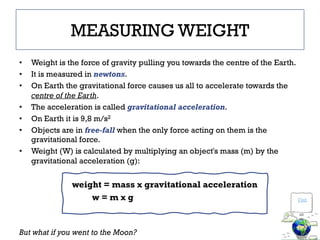
• Weight is the force of gravity pulling you towards the centre of the Earth.
• It is measured in newtons.
• On Earth the gravitational force causes us all to accelerate towards the
centre of the Earth.
• The acceleration is called gravitational acceleration.
• On Earth it is 9,8 m/s2
• Objects are in free-fall when the only force acting on them is the
gravitational force.
• Weight (W) is calculated by multiplying an object's mass (m) by the
gravitational acceleration (g):
weight = mass x gravitational acceleration
w = m x g
But what if you went to the Moon?
Visit
GRAVITY AND THE MOON
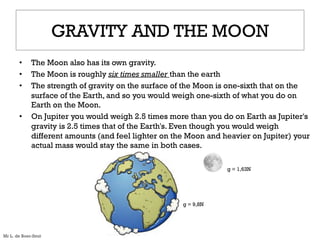
• The Moon also has its own gravity.
• The Moon is roughly six times smaller than the earth
• The strength of gravity on the surface of the Moon is one-sixth that on the
surface of the Earth, and so you would weigh one-sixth of what you do on
Earth on the Moon.
• On Jupiter you would weigh 2.5 times more than you do on Earth as Jupiter's
gravity is 2.5 times that of the Earth's. Even though you would weigh
different amounts (and feel lighter on the Moon and heavier on Jupiter) your
actual mass would stay the same in both cases.
g = 1,63N
• fdf g = 9,8N
Mr L. de Boer-Smit
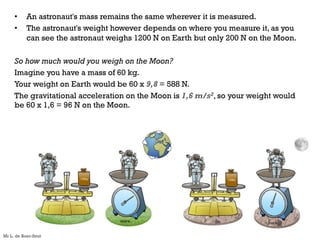
• An astronaut's mass remains the same wherever it is measured.
• The astronaut's weight however depends on where you measure it, as you
can see the astronaut weighs 1200 N on Earth but only 200 N on the Moon.
So how much would you weigh on the Moon?
Imagine you have a mass of 60 kg.
Your weight on Earth would be 60 x 9,8 = 588 N.
The gravitational acceleration on the Moon is 1,6 m/s2, so your weight would
be 60 x 1,6 = 96 N on the Moon.
Mr L. de Boer-Smit
ACTIVITY:Weight and mass calculations.
INSTRUCTIONS:
Complete the activity on pg. 31-33 (Siyavula Book 9B)
1. A Ferrari has a mass of 1485 kg.What is its weight on Earth?
w = m x g
Mr L. de Boer-Smit
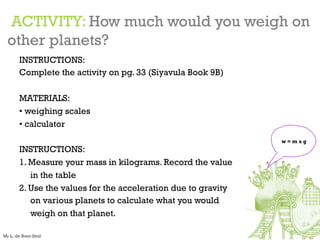
ACTIVITY: How much would you weigh on
other planets?
INSTRUCTIONS:
Complete the activity on pg. 33 (Siyavula Book 9B)
MATERIALS:
• weighing scales
• calculator
INSTRUCTIONS:
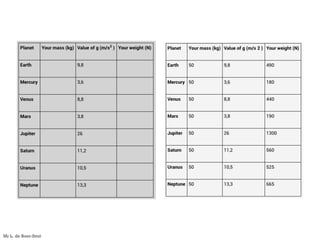
1. Measure your mass in kilograms. Record the value
in the table
2. Use the values for the acceleration due to gravity
on various planets to calculate what you would
weigh on that planet.
w = m x g
Mr L. de Boer-Smit
Mr L. de Boer-Smit
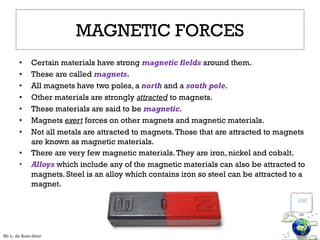
MAGNETIC FORCES
• Certain materials have strong magnetic fields around them.
• These are called magnets.
• All magnets have two poles, a north and a south pole.
• Other materials are strongly attracted to magnets.
• These materials are said to be magnetic.
• Magnets exert forces on other magnets and magnetic materials.
• Not all metals are attracted to magnets.Those that are attracted to magnets
are known as magnetic materials.
• There are very few magnetic materials.They are iron, nickel and cobalt.
• Alloys which include any of the magnetic materials can also be attracted to
magnets. Steel is an alloy which contains iron so steel can be attracted to a
magnet.
Visit
Mr L. de Boer-Smit
INVESTIGATION:
Magnetic or non-magnetic.
Complete the investigation on pg. 34-35 (Siyavula Book 9B)
INVESTIGATIVE QUESTION:
Which materials are magnetic and which are not?
HYPOTHESIS:
Write a hypothesis for this investigation.
Mr L. de Boer-Smit
ACTIVITY: Can magnetic forces act
through substance?
INSTRUCTIONS:
Complete the activity on pg. 36 (Siyavula Book 9B)
MATERIALS:
• bar magnets
• paper
• thin piece of wood
• thick piece of wood
• foil
• paperclips
INSTRUCTIONS:
1. Hold two north poles close together.What do you notice?
2. Hold two south poles close together.What do you notice?
3. Hold a north pole and a south pole close together.What do you notice?
4. Put the paper clips on the desk.
5.Try to pick up the paperclips with the magnet but put one of the other
materials between the magnet and the paper clips. Are the paperclips still
attracted to the magnet?
6.Try each of the different materials between the magnet and the paper clip.
We already know
that the force can
attract at a distance.
Mr L. de Boer-Smit
MAGNETIC FORCES
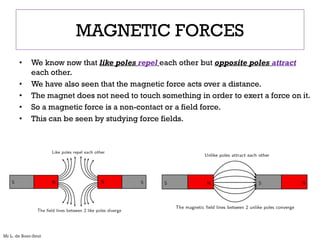
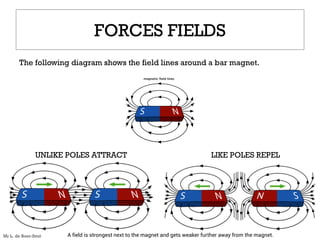
• We know now that like poles repel each other but opposite poles attract
each other.
• We have also seen that the magnetic force acts over a distance.
• The magnet does not need to touch something in order to exert a force on it.
• So a magnetic force is a non-contact or a field force.
• This can be seen by studying force fields.
Mr L. de Boer-Smit
ACTIVITY:Visualizing magnetic force
fields
INSTRUCTIONS:
Complete the activity on pg. 37-38 (Siyavula Book 9B)
MATERIALS:
• iron filings
• two bar magnets
• paper
INSTRUCTIONS:
1. Put the bar magnet on the table.
2. Put the paper over the magnet.
3. Shake the iron filings onto the paper.
4. Use your finger to slowly push the filings around the magnet.
5.Take note of the pattern and draw it below.
Mr L. de Boer-Smit
FORCES FIELDS
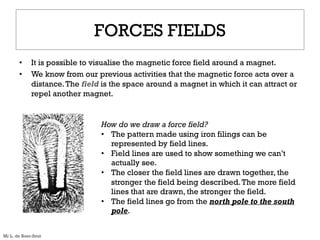
• It is possible to visualise the magnetic force field around a magnet.
• We know from our previous activities that the magnetic force acts over a
distance.The field is the space around a magnet in which it can attract or
repel another magnet.
How do we draw a force field?
• The pattern made using iron filings can be
represented by field lines.
• Field lines are used to show something we can’t
actually see.
• The closer the field lines are drawn together, the
stronger the field being described.The more field
lines that are drawn, the stronger the field.
• The field lines go from the north pole to the south
pole.
Mr L. de Boer-Smit
FORCES FIELDS
The following diagram shows the field lines around a bar magnet.
UNLIKE POLES ATTRACT LIKE POLES REPEL
A field is strongest next to the magnet and gets weaker further away from the magnet.
Mr L. de Boer-Smit
EARTH’S MAGENTIC FIELD
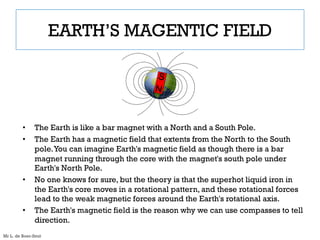
• The Earth is like a bar magnet with a North and a South Pole.
• The Earth has a magnetic field that extents from the North to the South
pole.You can imagine Earth's magnetic field as though there is a bar
magnet running through the core with the magnet's south pole under
Earth's North Pole.
• No one knows for sure, but the theory is that the superhot liquid iron in
the Earth's core moves in a rotational pattern, and these rotational forces
lead to the weak magnetic forces around the Earth's rotational axis.
• The Earth's magnetic field is the reason why we can use compasses to tell
direction.
Mr L. de Boer-Smit
MAGENTIC POLES
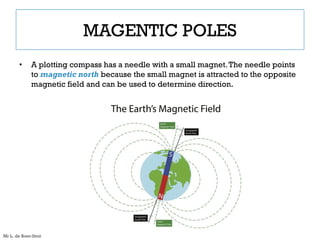
• A plotting compass has a needle with a small magnet.The needle points
to magnetic north because the small magnet is attracted to the opposite
magnetic field and can be used to determine direction.
Mr L. de Boer-Smit
AURORA
BOREALIS
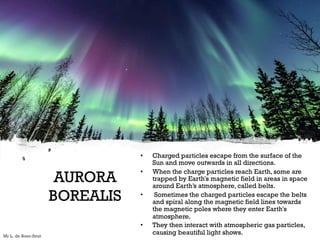
• Charged particles escape from the surface of the
Sun and move outwards in all directions.
• When the charge particles reach Earth, some are
trapped by Earth's magnetic field in areas in space
around Earth’s atmosphere, called belts.
• Sometimes the charged particles escape the belts
and spiral along the magnetic field lines towards
the magnetic poles where they enter Earth's
atmosphere.
• They then interact with atmospheric gas particles,
causing beautiful light shows.
Mr L. de Boer-Smit
ACTIVITY: Charging objects
INSTRUCTIONS:
Complete the activity on pg. 41-42 (Siyavula Book 9B)
MATERIALS:
• balloons (or a plastic comb)
• glass rod
• piece of knitted fabric (wool)
• PVC rod
• plastic ruler
• small pieces of paper
• water tap
INSTRUCTIONS:
1.Work in pairs.
2. Blow up a balloon and tie it closed so the air does not escape.
3. Hold the balloon a short distance away from your hair.What do you
notice?
Mr L. de Boer-Smit
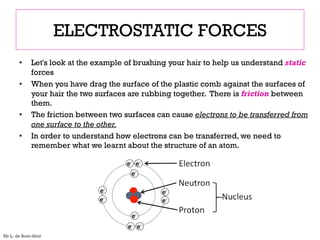
ELECTROSTATIC FORCES
• Let's look at the example of brushing your hair to help us understand static
forces
• When you have drag the surface of the plastic comb against the surfaces of
your hair the two surfaces are rubbing together. There is friction between
them.
• The friction between two surfaces can cause electrons to be transferred from
one surface to the other.
• In order to understand how electrons can be transferred, we need to
remember what we learnt about the structure of an atom.
Mr L. de Boer-Smit
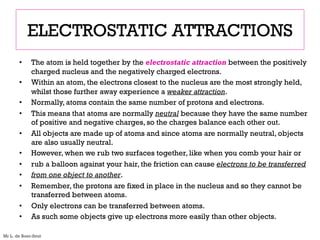
ELECTROSTATIC ATTRACTIONS
• The atom is held together by the electrostatic attraction between the positively
charged nucleus and the negatively charged electrons.
• Within an atom, the electrons closest to the nucleus are the most strongly held,
whilst those further away experience a weaker attraction.
• Normally, atoms contain the same number of protons and electrons.
• This means that atoms are normally neutral because they have the same number
of positive and negative charges, so the charges balance each other out.
• All objects are made up of atoms and since atoms are normally neutral, objects
are also usually neutral.
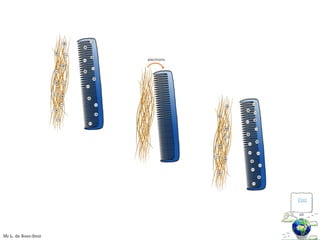
• However, when we rub two surfaces together, like when you comb your hair or
• rub a balloon against your hair, the friction can cause electrons to be transferred
• from one object to another.
• Remember, the protons are fixed in place in the nucleus and so they cannot be
transferred between atoms.
• Only electrons can be transferred between atoms.
• As such some objects give up electrons more easily than other objects.
Mr L. de Boer-Smit
Visit
Mr L. de Boer-Smit
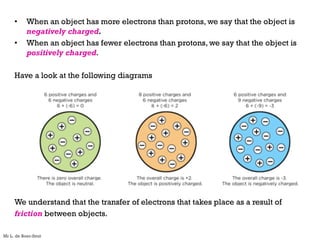
• When an object has more electrons than protons, we say that the object is
negatively charged.
• When an object has fewer electrons than protons, we say that the object is
positively charged.
Have a look at the following diagrams
We understand that the transfer of electrons that takes place as a result of
friction between objects.
Mr L. de Boer-Smit
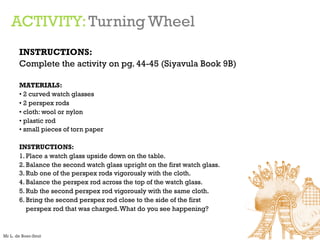
ACTIVITY:Turning Wheel
INSTRUCTIONS:
Complete the activity on pg. 44-45 (Siyavula Book 9B)
MATERIALS:
• 2 curved watch glasses
• 2 perspex rods
• cloth: wool or nylon
• plastic rod
• small pieces of torn paper
INSTRUCTIONS:
1. Place a watch glass upside down on the table.
2. Balance the second watch glass upright on the first watch glass.
3. Rub one of the perspex rods vigorously with the cloth.
4. Balance the perspex rod across the top of the watch glass.
5. Rub the second perspex rod vigorously with the same cloth.
6. Bring the second perspex rod close to the side of the first
perspex rod that was charged.What do you see happening?
Mr L. de Boer-Smit
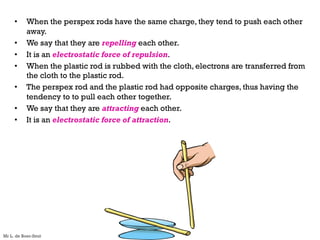
• When the perspex rods have the same charge, they tend to push each other
away.
• We say that they are repelling each other.
• It is an electrostatic force of repulsion.
• When the plastic rod is rubbed with the cloth, electrons are transferred from
the cloth to the plastic rod.
• The perspex rod and the plastic rod had opposite charges, thus having the
tendency to to pull each other together.
• We say that they are attracting each other.
• It is an electrostatic force of attraction.
Mr L. de Boer-Smit
• As with gravitational and magnetic force, the distance between charged
objects affects the strength of the electrostatic force.
• The closer the charged objects are, the stronger the force.
• The more charged the objects are, the stronger the electrostatic force
between them.
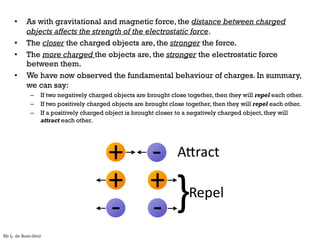
• We have now observed the fundamental behaviour of charges. In summary,
we can say:
– If two negatively charged objects are brought close together, then they will repel each other.
– If two positively charged objects are brought close together, then they will repel each other.
– If a positively charged object is brought closer to a negatively charged object, they will
attract each other.
Mr L. de Boer-Smit
ACTIVITY: van de Graaff generator
INSTRUCTIONS:
Complete the activity on pg. 46 (Siyavula Book 9B)
MATERIALS:
• Van de Graaff generator
INSTRUCTIONS
1.Turn on the generator.
2. Bring the small metal globe close to the generator.What do you see?
Mr L. de Boer-Smit
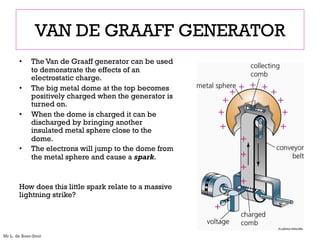
VAN DE GRAAFF GENERATOR
• The Van de Graaff generator can be used
to demonstrate the effects of an
electrostatic charge.
• The big metal dome at the top becomes
positively charged when the generator is
turned on.
• When the dome is charged it can be
discharged by bringing another
insulated metal sphere close to the
dome.
• The electrons will jump to the dome from
the metal sphere and cause a spark.
How does this little spark relate to a massive
lightning strike?
Mr L. de Boer-Smit
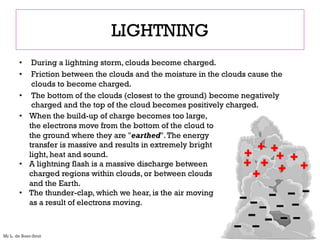
LIGHTNING
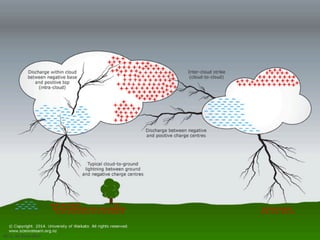
• During a lightning storm, clouds become charged.
• Friction between the clouds and the moisture in the clouds cause the
clouds to become charged.
• The bottom of the clouds (closest to the ground) become negatively
charged and the top of the cloud becomes positively charged.
• When the build-up of charge becomes too large,
the electrons move from the bottom of the cloud to
the ground where they are "earthed".The energy
transfer is massive and results in extremely bright
light, heat and sound.
• A lightning flash is a massive discharge between
charged regions within clouds, or between clouds
and the Earth.
• The thunder-clap, which we hear, is the air moving
as a result of electrons moving.
Mr L. de Boer-Smit
Mr L. de Boer-Smit
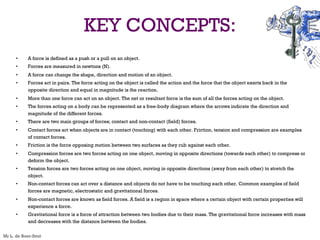
KEY CONCEPTS:
• A force is defined as a push or a pull on an object.
• Forces are measured in newtons (N).
• A force can change the shape, direction and motion of an object.
• Forces act in pairs. The force acting on the object is called the action and the force that the object exerts back in the
opposite direction and equal in magnitude is the reaction.
• More than one force can act on an object. The net or resultant force is the sum of all the forces acting on the object.
• The forces acting on a body can be represented as a free-body diagram where the arrows indicate the direction and
magnitude of the different forces.
• There are two main groups of forces; contact and non-contact (field) forces.
• Contact forces act when objects are in contact (touching) with each other. Friction, tension and compression are examples
of contact forces.
• Friction is the force opposing motion between two surfaces as they rub against each other.
• Compression forces are two forces acting on one object, moving in opposite directions (towards each other) to compress or
deform the object.
• Tension forces are two forces acting on one object, moving in opposite directions (away from each other) to stretch the
object.
• Non-contact forces can act over a distance and objects do not have to be touching each other. Common examples of field
forces are magnetic, electrostatic and gravitational forces.
• Non-contact forces are known as field forces. A field is a region in space where a certain object with certain properties will
experience a force.
• Gravitational force is a force of attraction between two bodies due to their mass. The gravitational force increases with mass
and decreases with the distance between the bodies.
Mr L. de Boer-Smit
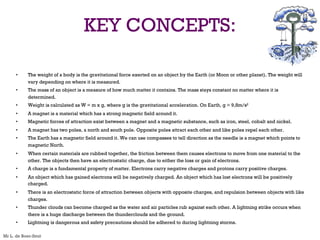
KEY CONCEPTS:
• The weight of a body is the gravitational force exerted on an object by the Earth (or Moon or other planet). The weight will
vary depending on where it is measured.
• The mass of an object is a measure of how much matter it contains. The mass stays constant no matter where it is
determined.
• Weight is calculated as W = m x g, where g is the gravitational acceleration. On Earth, g = 9,8m/s2
• A magnet is a material which has a strong magnetic field around it.
• Magnetic forces of attraction exist between a magnet and a magnetic substance, such as iron, steel, cobalt and nickel.
• A magnet has two poles, a north and south pole. Opposite poles attract each other and like poles repel each other.
• The Earth has a magnetic field around it. We can use compasses to tell direction as the needle is a magnet which points to
magnetic North.
• When certain materials are rubbed together, the friction between them causes electrons to move from one material to the
other. The objects then have an electrostatic charge, due to either the loss or gain of electrons.
• A charge is a fundamental property of matter. Electrons carry negative charges and protons carry positive charges.
• An object which has gained electrons will be negatively charged. An object which has lost electrons will be positively
charged.
• There is an electrostatic force of attraction between objects with opposite charges, and repulsion between objects with like
charges.
• Thunder clouds can become charged as the water and air particles rub against each other. A lightning strike occurs when
there is a huge discharge between the thunderclouds and the ground.
• Lightning is dangerous and safety precautions should be adhered to during lightning storms.
Mr L. de Boer-Smit
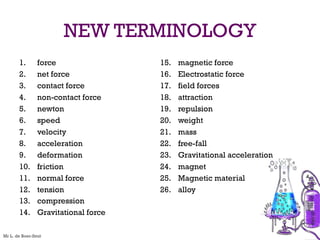
NEW TERMINOLOGY
1. force
2. net force
3. contact force
4. non-contact force
5. newton
6. speed
7. velocity
8. acceleration
9. deformation
10. friction
11. normal force
12. tension
13. compression
14. Gravitational force
15. magnetic force
16. Electrostatic force
17. field forces
18. attraction
19. repulsion
20. weight
21. mass
22. free-fall
23. Gravitational acceleration
24. magnet
25. Magnetic material
26. alloy
Mr L. de Boer-Smit
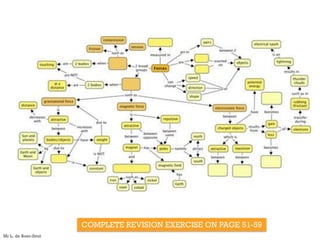
COMPLETE REVISION EXERCISE ON PAGE 51-59
Mr L. de Boer-Smit

Forces grade 9 slideshow used for grade 9

  • 1.
    FORCES - ENERGY ANDCHANGE - GRADE 9 TERM 3 Mr L. de Boer-Smit
  • 2.
    KEY QUESTIONS: • Whatis a force? • What effect can a force have on an object? • Do forces have to be between objects which are touching? Mr L. de Boer-Smit
  • 3.
    1.1 – TYPESOF FORCES: • WHAT ARE FORCES? • EFFECTS OF FORCES • PAIRS OF FORCES • REPRESENTING FORCES • TYPES OF FORCES Mr L. de Boer-Smit
  • 4.
    WHAT ARE FORCES? •Think of the following situation:You are all helping your teacher to rearrange the classroom and they asks you to move their desk from one side of the classroom to the other. – How would you do that? – The desk is too heavy for you to lift, so how do you get it across the classroom? • The type of movement, being experiences, would to either push or pull. In doing so, you have exerted a force on the desk to get it to move. Mr L. de Boer-Smit
  • 5.
    • A forceis a push or a pull on an object. • The unit in which we measure force is a newton (N). • The newton is named after Sir Isaac Newton, an English physicist and mathematician. • Sir Isaac Newton is recognised as one of the most influential scientists of all times. • The unit of force is named after him in recognition of his work in mechanics and his three laws of motion. Sir Isaac Newton (25 December 1642 - 20 March 1727). • We use forces every day of our lives. • Our own bodies rely on forces. • Our muscles pull on our bones to allow us to move. • Our feet push on the ground when we walk. • To open doors, to pick up our food - everything we do involves some kind of force. VISIT Mr L. de Boer-Smit
  • 6.
    ACTIVITY:What can forcesdo? INSTRUCTIONS: 1. Complete the activity on pg. 5-6 (Siyavula Book 9B) This activity is all about experimenting with different objects and seeing what happens to them when we push and pull them. Learners should see that pushing on solid objects accelerates them. Pushing or pulling on sponges, balloons and play dough distorts their shape and the ball can be made to move.. Mr L. de Boer-Smit
  • 7.
    EFFECTS OF FORCES Fromthe activity, you should have seen that forces can have the following effects: • Forces can change the shape of an object.This is called deformation. • Forces can change the motion of an object. If an object is stationary, a force can cause the object to start moving. Or, if an object is already moving, a force can cause an object to speed up or slow down. • Forces can change the direction in which an object is moving. • How do we describe the motion of an object? • When an object is moving, we say it has a velocity. Velocity:Velocity is the rate of change of the position of an object. • Velocity is the speed of an object and the direction in which it is moving. • Speed describes only how fast an object is moving, whereas velocity gives both how fast and in what direction the object is moving. Mr L. de Boer-Smit
  • 8.
    • An objectcan move at constant velocity. • This means it travels at the same speed in the same direction. • For example a car travelling along the highway at 100 km/h in a straight line has a constant velocity. However,what happens when the car moves faster or slows down? • We saw in the activity that we could change the motion of an object by applying a force to make it speed up or slow down. • The velocity of the object is changing over time due to a force acting on it. • This is called acceleration. Acceleration: Acceleration is the rate of change of a body's velocity with time. In other words, it is a measure of how an object's speed changes every second. Mr L. de Boer-Smit
  • 9.
    ACTIVITY: Is ita push or a pull? INSTRUCTIONS: Complete the activity on pg. 7-8 (Siyavula Book 9B) 1. Look at the pictures in the table. 2. Describe the action in each image. 3. Decide if the force being exerted is a push or a pull. 4. Describe the effect of the force. Mr L. de Boer-Smit
  • 10.
    ACTION PUSH orPULL EFFECT Mr L. de Boer-Smit
  • 11.
    ACTION PUSH orPULL EFFECT Mr L. de Boer-Smit
  • 12.
    PAIRS OF FORCES •Upon investigating the working of forces, we understand that whenever one object exerts a force on a second object, the second object exerts a force back on the first object. • We see this when one pushes against a wall. • We say that forces act in pairs. • Newton called the one force the action, and the other force the reaction, as shown in the following diagram. Mr L. de Boer-Smit
  • 13.
    • We alsosee that when you exerted a force on the wall, you experience the wall exerting a force back on you. • Forces act in pairs on different objects. • The force exerted by the second object is equal in strength and opposite in direction to the first force. • We know that more than one force can act on an object at the same time. • For example, when two students push or pull on another student. • The effect of the different forces acting together depends on how big each force is and what direction each force is acting in. • When two or more forces act on an object, then the forces combine to make a net (overall) force. Mr L. de Boer-Smit
  • 14.
    • When theforces are acting in opposite directions, but are not equal, we say that the net force is greater than 0 N.There is a resultant force. • If the forces are equal and acting in the same direction there will also be a resultant force. Imagine a tug-of-war. People on either side pull on the rope. If they exert forces of equal size then the rope remains stationary. • If one person is able to exert a larger force than the other, then the rope will move in the direction of the larger force. • This is because the forces are unbalanced and there is a net (resultant) force acting in the direction of the larger force. Mr L. de Boer-Smit
  • 15.
    • If twoindividuals were to pull and push in the same direction, we would find much larger net force as both forces are acting in the same direction and so they add together to produce a bigger overall net force. • We can work out the net forces acting on a body. • To do this, we first need to speak about how we represent the forces acting on a body. PULL PUSH Mr L. de Boer-Smit
  • 16.
    ACTIVITY: Pairs offorces. INSTRUCTIONS: Complete the activity on pg. 9-10 (Siyavula Book 9B) 1. Work in groups of three for this activity. 2. First, go up to your classroom wall and push against it. Describe what you feel below. 3. When you push on the wall, do you think the wall is pushing back on your hands? How does this force compare to the force you are exerting on the wall? 4. Stand in a triangle with your two partners and hold hands. Pull on each others' hands. Do you feel your partners' hands pulling back as you pull? 5. Still standing in a triangle, place your palms up against each other and push against each others' hands. Do you feel your partners' hands pushing back as you push? 6. Next, stand shoulder-to-shoulder with your two partners.The two learners on the outside must push against the shoulders of the learner in the middle. 7. What happens when you both push with the same force? 8. What happens when one of you pushes with a harder force than the other? 9. Next, the learner in the middle must stretch out his or her arms.The learners on the outside must pull on the middle learner's hands in opposite directions. 10. What happens when you both pull with equal force? 11. What happens when one of you pulls with a stronger force than the other? 12. What happens when one of you pulls and the other pushes? Mr L. de Boer-Smit
  • 17.
    Visit Mr L. deBoer-Smit
  • 18.
    REPRESENTING FORCES How dowe show a force? • When we want to draw a diagram to show what forces are acting, we use arrows to represent the forces. • We always show forces acting from the centre of the object on which it acts. • If we were to draw the force on a ball when it is pushed, it would be represented like this. CENTRE OF THE OBJECT DIRECTION OF THE FORCE MAGNITUDE OF THE FORCE Visit Mr L. de Boer-Smit
  • 19.
    • The directionof the arrow shows the direction in which the force is acting, and the length of the arrow is an indication of the size of the force. • A small force would be shown with a short arrow. A large force would be shown with a long arrow. • More than one force can act on an object at the same time. • The effect of the different forces acting together depends on how big each force is and what direction each force is acting in. Let's look at how we can represent the following situation: Jabu pulls Rod's arm with a force of 10 N, while Viantha pulls Rod's other arm with a force of 6 N. Mr L. de Boer-Smit
  • 20.
    • We canrepresent the forces acting on Rod in the following way: we use a circle to represent Rod and different length arrows to represent the forces acting on him. • This is called a free-body diagram. What is the net force acting on Rod? We can calculate it as follows: net force = 10 N + (- 6 N) = 4 N to the left. • If the forces all act in the same direction, then the net force is the sum of the different forces. Mr L. de Boer-Smit
  • 21.
    • Imagine youare pushing someone in a go-cart, and your friend comes to help you push harder. • There are now two forces acting on the person in the go-cart. • These forces are acting in the same direction so they are added together to produce a net force which is the sum of the two smaller forces. net force = F1 + F2 net force = 7 N + (+ 10 N) = 17 N to the right. Mr L. de Boer-Smit
  • 22.
    How do wemeasure a force? • We use an instrument called a spring balance (also called a force meter). • A spring balance is a simple device consisting of a spring which, when stretched, gives a reading of the force used to stretch the spring. SPRING BALANCE The functioning of a spring balance is dependent on Hooke’s Law which states that when a force stretches or compresses a spring, the distance that the spring moves from its rest position is directly proportional to the size of the force. Mr L. de Boer-Smit
  • 23.
    TYPES OF FORCES •So far, we have looked at forces acting on an object when the object causing the force is in contact with object experiencing the force. Do we always have to be in contact with an object in order to exert a force? • There are forces exerted by a magnets but they did not have to touch each other.That means that you do not have to be in contact with something in order to exert a force on it. • There are two types of forces: – Contact forces: objects are in contact with each other and exert forces on each other. – Non-contact (field) forces: objects are not in contact with each other and exert forces on each other. Mr L. de Boer-Smit
  • 24.
    ACTIVITY: Forces canact over a distance. INSTRUCTIONS: Complete the activity on pg. 13-14 (Siyavula Book 9B) MATERIALS: • bar magnets • metal paper clips INSTRUCTIONS: 1. Place one of the bar magnets on the table. 2. Bring the north end of another bar magnet close to the south end of the first bar magnet.What happens? 3. Bring the north end of one bar magnet close to the north end of the other bar magnet.What happens? 4. Place the paper clips on the table. 5. Bring a bar magnet over the paper clips. What do you observe? Mr L. de Boer-Smit
  • 25.
    1.2 – CONTACTFORCES • FRICTION • TENSION AND COMPRESSION Mr L. de Boer-Smit
  • 26.
    • Contact forcesare forces between objects which are touching each other. • Most of the forces that we looked at in the previous section were contact forces, for example, when you push a desk, or pull a go-cart.You are touching the object. What happens when you kick a ball across the grass? • The ball moves quickly at first but then slows down again. • Something has caused the ball to slow and stop moving. If the motion of the ball has changed then a force must have been exerted on it. • The force which opposes motion is called friction. • Friction forces always act in the opposite direction to the motion of the object. • Friction resists movement when the object and surface are in contact. What does that mean? • It means that if the ball is moving forward then friction acts backwards on the ball. FRICTION Mr L. de Boer-Smit
  • 27.
    Let use theexample of the soccer ball. If a pushing force was exerted on the ball to move it in the one direction (right) then frictional force would need to be experienced by the soccer ball, in the opposite direction (left), for the ball to slow down and become stationary. What factors will affect the amount of force required to move objects? We need to look at all the forces acting on an object. FRICTION PUSH Visit Mr L. de Boer-Smit
  • 28.
    In this exampleswe only showed the forces of the two learners pushing on the go-cart. What other forces are acting on this go-cart as it moves along? • Friction is acting on the go-cart in the opposite direction to the motion of the go-cart. • The go-cart also has a weight. As we learnt in Gr. 8 Planet Earth and Beyond, an object on earth has weight due to the gravitational force of attraction of the Earth on the object.This is a force acting on an object. We can now draw the friction and weight in the free-body diagram of the forces acting on the go-cart as follows. Mr L. de Boer-Smit
  • 29.
    • There isanother force acting on the go-cart. • Think of when you stand on the ground: you feel the ground beneath your feet. • This contact force is preventing you from penetrating the ground. • This is called the normal force. Visit Mr L. de Boer-Smit
  • 30.
    • The normalforce always acts perpendicularly to the surface that the object is resting on. • In simple situations such as when you are standing on the ground or the go-cart is travelling along a level surface, then the normal force is equal to the weight of the object, but in the opposite direction. • Think back to what we learnt about forces acting in pairs. On a flat, level surface, the normal force is the reaction force to the weight of the object. • This is shown in the diagram for a box resting on the floor. Mr L. de Boer-Smit
  • 31.
    We can nowcomplete the free-body diagram of the forces acting on the go-cart as follows: Mr L. de Boer-Smit
  • 32.
    • The forceof friction depends on the type of surface on which an object is moving and the normal force. • In order to get an object to move, a force greater than the frictional force needs to be applied in order to overcome the friction between the object and the surface. • We can now look at the example of pushing a friend in a go-cart again. There is friction between the go-cart and the ground. • The friction acts in the opposite direction to the forces pushing the go- cart forward. • Therefore, if there are two forces of 7N and 10N pushing the go-cart forward, and the friction is 5 N, we can show only these forces as follows: What is the net force acting on the go-cart? net force = 7 N + (+ 10 N) + (- 5 N) = 17 N – 5 N = 12 N to the right Visit Mr L. de Boer-Smit
  • 33.
    • Friction isadvantageous for a number of reasons. • For example, the friction between our feet and the ground enables us to move forward and prevents us from slipping. • Friction is also involved in keeping cars from skidding as the tyres experience friction between the tread and the roadway. Tyre Road Friction Force Mr L. de Boer-Smit
  • 34.
    INVESTIGATION: What is therelationship between normal force and friction? Complete the investigation on pg. 16-20 (Siyavula Book 9B) INVESTIGATIVE QUESTION: What is the relationship between the normal force and friction? AIM: To determine the relationship between the normal force and the size of the frictional force. In the situations that we are going to investigate, the object will be pulled along on a flat, level surface.We will increase its mass and measure the resulting frictional force. But how does this relate to the normal force? Mr L. de Boer-Smit
  • 35.
    TENSION AND COMPRESSION •There are other forces which are contact forces. • Look at the following drawing of a boy pulling on a block with a rope. • The boy is not touching the block directly.The boy is pulling the rope and the block is pulling back on the rope in the opposite direction. • This causes a tension force to exist in the rope. • The rope is tight and so there is tension in the rope. • Tension is a contact force.The tension in the rope pulls the block across the floor. Mr L. de Boer-Smit
  • 36.
    • Another exampleof a contact force is compression. • A compression force is a force which acts to deform or squash an object. Let's think of some examples. • If you take a ball of dough and crush it with your fingers, you are exerting a compression force on the dough. • The dough changes shape. It deforms. • Another example is crushing a tennis ball or a cooldrink can between the palms of your hands. Mr L. de Boer-Smit
  • 37.
    • The followingdiagram summarises the difference between tension and compression. Tension forces are two forces acting on one object in opposite directions (away from each other) to stretch the object.Compression forces are two forces acting on one object in opposite directions (towards each other) to compress or deform the object. Mr L. de Boer-Smit
  • 38.
    • There aremany other examples of compression forces in everyday life. • A bridge experiences both compression and tension due to the weight of the cars and other vehicles which pass over it as shown in the following diagram. • All of these examples are that of contact forces, which include friction, normal forces, compression and tension. • We are now going to look at the forces that act between bodies which do not touch. Mr L. de Boer-Smit
  • 39.
    1.3 – FIELD(NON-CONTACT) FORCES • GRAVITATIONAL FORCES • MAGNETIC FORCES • ELECTROSTATIC FORCE Mr L. de Boer-Smit
  • 40.
    GRAVIATIONAL FORCES • Afield is a region in space where an object (with certain properties) will experience a force. • Field forces are non-contact forces. • Non-contact forces are forces which act over a distance.They do not have to be touching. The most common examples of fields are: – gravitational field – magnetic field – electric field • When we discussed contact forces, we spoke about pushes and pulls. However, with field forces, it is better to talk about repulsion and attraction. Have you ever wondered why things fall down and not up? Visit Mr L. de Boer-Smit
  • 41.
    GRAVIATIONAL FORCES • Theforce which causes things to fall down towards the Earth and prevents us from falling off the planet is the gravitational force. • Gravitational forces exist between any two objects with mass and they are forces of attraction (pull). • The gravitational force is a force that attracts objects with mass towards each. other • Any object with mass exerts a gravitational force on any other object with mass. • The Earth exerts a gravitational pull on you, the desks in your classroom and the chairs in your classroom, holding you on the surface and stopping you from drifting off into space. • The Earth's gravitational force pulls everything down towards the centre of the Earth which is why when you drop an object like a book or an apple, it falls to the ground. However, do you know that you, your desk, your chair, and the falling apple and book exert an equal but opposite pull on the Earth? Mr L. de Boer-Smit
  • 42.
    • The Earthattracts us because it has such a large mass and so we are attracted downwards towards the centre of the Earth all the time. • The bigger the mass of the objects, the greater the force between them. • This means that two small objects would have a very weak gravitational attraction and so it has no noticeable effect. • However, bigger objects such as the Moon and the Earth have a much greater gravitational force. • As we know from Planet Earth and Beyond, all the planets in our solar system are held in orbit around the Sun by the gravitational force of attraction between the Sun and planets. Mr L. de Boer-Smit
  • 43.
    • The secondfactor which affects the gravitational force of attraction between objects is the distance between them. • The further objects are away from each other, the smaller the gravitational force. • All the components in our Universe are held together by a gravitational force. In summary we can say: – The greater the mass of the objects, the stronger the gravitational force of attraction between them. – The closer objects are to each other, the stronger the gravitational force between them. Mr L. de Boer-Smit
  • 44.
    INVESTIGATION: Dropping Objects Completethe investigation on pg. 25-27 (Siyavula Book 9B) INVESTIGATIVE QUESTION: Do different objects fall at the same rate? HYPOTHESIS: What do you think will happen? Mr L. de Boer-Smit
  • 45.
    Mass vs Weight •The mass of an object is the amount of matter in the object. • It tells you how many particles you have. eg. the mass of a wooden block tells us how many atoms there are. • Mass is measured in kilograms (kg) and is independent of where you measure it. • A wooden block with a mass of 10 kg on Earth also has a mass of 10 kg on the Moon. • However, an object's weight can change as it depends on the mass of the object and also the strength of the gravitational force acting on it. • Weight is measured in newtons (N) as it is the gravitational force of attraction exerted on an object by the Earth (or Moon or any other planet). • Therefore, the weight of an object will change when weighed in different places. The weight of a 10 kg block on Earth will be different to that on the Moon.Why do you think this is?Will the weight be more or less than on the Moon? Mr L. de Boer-Smit
  • 46.
    INVESTIGATION: What is therelationship between mass of an object and its weight. Complete the investigation on pg. 28-30 (Siyavula Book 9B) INVESTIGATIVE QUESTION: What is the relationship between the mass of an object and it's weight? HYPOTHESIS: Write a hypothesis for this investigation. Mr L. de Boer-Smit
  • 47.
    MEASURING WEIGHT • Weightis the force of gravity pulling you towards the centre of the Earth. • It is measured in newtons. • On Earth the gravitational force causes us all to accelerate towards the centre of the Earth. • The acceleration is called gravitational acceleration. • On Earth it is 9,8 m/s2 • Objects are in free-fall when the only force acting on them is the gravitational force. • Weight (W) is calculated by multiplying an object's mass (m) by the gravitational acceleration (g): weight = mass x gravitational acceleration w = m x g But what if you went to the Moon? Visit
  • 48.
    GRAVITY AND THEMOON • The Moon also has its own gravity. • The Moon is roughly six times smaller than the earth • The strength of gravity on the surface of the Moon is one-sixth that on the surface of the Earth, and so you would weigh one-sixth of what you do on Earth on the Moon. • On Jupiter you would weigh 2.5 times more than you do on Earth as Jupiter's gravity is 2.5 times that of the Earth's. Even though you would weigh different amounts (and feel lighter on the Moon and heavier on Jupiter) your actual mass would stay the same in both cases. g = 1,63N • fdf g = 9,8N Mr L. de Boer-Smit
  • 49.
    • An astronaut'smass remains the same wherever it is measured. • The astronaut's weight however depends on where you measure it, as you can see the astronaut weighs 1200 N on Earth but only 200 N on the Moon. So how much would you weigh on the Moon? Imagine you have a mass of 60 kg. Your weight on Earth would be 60 x 9,8 = 588 N. The gravitational acceleration on the Moon is 1,6 m/s2, so your weight would be 60 x 1,6 = 96 N on the Moon. Mr L. de Boer-Smit
  • 50.
    ACTIVITY:Weight and masscalculations. INSTRUCTIONS: Complete the activity on pg. 31-33 (Siyavula Book 9B) 1. A Ferrari has a mass of 1485 kg.What is its weight on Earth? w = m x g Mr L. de Boer-Smit
  • 51.
    ACTIVITY: How muchwould you weigh on other planets? INSTRUCTIONS: Complete the activity on pg. 33 (Siyavula Book 9B) MATERIALS: • weighing scales • calculator INSTRUCTIONS: 1. Measure your mass in kilograms. Record the value in the table 2. Use the values for the acceleration due to gravity on various planets to calculate what you would weigh on that planet. w = m x g Mr L. de Boer-Smit
  • 52.
    Mr L. deBoer-Smit
  • 53.
    MAGNETIC FORCES • Certainmaterials have strong magnetic fields around them. • These are called magnets. • All magnets have two poles, a north and a south pole. • Other materials are strongly attracted to magnets. • These materials are said to be magnetic. • Magnets exert forces on other magnets and magnetic materials. • Not all metals are attracted to magnets.Those that are attracted to magnets are known as magnetic materials. • There are very few magnetic materials.They are iron, nickel and cobalt. • Alloys which include any of the magnetic materials can also be attracted to magnets. Steel is an alloy which contains iron so steel can be attracted to a magnet. Visit Mr L. de Boer-Smit
  • 54.
    INVESTIGATION: Magnetic or non-magnetic. Completethe investigation on pg. 34-35 (Siyavula Book 9B) INVESTIGATIVE QUESTION: Which materials are magnetic and which are not? HYPOTHESIS: Write a hypothesis for this investigation. Mr L. de Boer-Smit
  • 55.
    ACTIVITY: Can magneticforces act through substance? INSTRUCTIONS: Complete the activity on pg. 36 (Siyavula Book 9B) MATERIALS: • bar magnets • paper • thin piece of wood • thick piece of wood • foil • paperclips INSTRUCTIONS: 1. Hold two north poles close together.What do you notice? 2. Hold two south poles close together.What do you notice? 3. Hold a north pole and a south pole close together.What do you notice? 4. Put the paper clips on the desk. 5.Try to pick up the paperclips with the magnet but put one of the other materials between the magnet and the paper clips. Are the paperclips still attracted to the magnet? 6.Try each of the different materials between the magnet and the paper clip. We already know that the force can attract at a distance. Mr L. de Boer-Smit
  • 56.
    MAGNETIC FORCES • Weknow now that like poles repel each other but opposite poles attract each other. • We have also seen that the magnetic force acts over a distance. • The magnet does not need to touch something in order to exert a force on it. • So a magnetic force is a non-contact or a field force. • This can be seen by studying force fields. Mr L. de Boer-Smit
  • 57.
    ACTIVITY:Visualizing magnetic force fields INSTRUCTIONS: Completethe activity on pg. 37-38 (Siyavula Book 9B) MATERIALS: • iron filings • two bar magnets • paper INSTRUCTIONS: 1. Put the bar magnet on the table. 2. Put the paper over the magnet. 3. Shake the iron filings onto the paper. 4. Use your finger to slowly push the filings around the magnet. 5.Take note of the pattern and draw it below. Mr L. de Boer-Smit
  • 58.
    FORCES FIELDS • Itis possible to visualise the magnetic force field around a magnet. • We know from our previous activities that the magnetic force acts over a distance.The field is the space around a magnet in which it can attract or repel another magnet. How do we draw a force field? • The pattern made using iron filings can be represented by field lines. • Field lines are used to show something we can’t actually see. • The closer the field lines are drawn together, the stronger the field being described.The more field lines that are drawn, the stronger the field. • The field lines go from the north pole to the south pole. Mr L. de Boer-Smit
  • 59.
    FORCES FIELDS The followingdiagram shows the field lines around a bar magnet. UNLIKE POLES ATTRACT LIKE POLES REPEL A field is strongest next to the magnet and gets weaker further away from the magnet. Mr L. de Boer-Smit
  • 60.
    EARTH’S MAGENTIC FIELD •The Earth is like a bar magnet with a North and a South Pole. • The Earth has a magnetic field that extents from the North to the South pole.You can imagine Earth's magnetic field as though there is a bar magnet running through the core with the magnet's south pole under Earth's North Pole. • No one knows for sure, but the theory is that the superhot liquid iron in the Earth's core moves in a rotational pattern, and these rotational forces lead to the weak magnetic forces around the Earth's rotational axis. • The Earth's magnetic field is the reason why we can use compasses to tell direction. Mr L. de Boer-Smit
  • 61.
    MAGENTIC POLES • Aplotting compass has a needle with a small magnet.The needle points to magnetic north because the small magnet is attracted to the opposite magnetic field and can be used to determine direction. Mr L. de Boer-Smit
  • 62.
    AURORA BOREALIS • Charged particlesescape from the surface of the Sun and move outwards in all directions. • When the charge particles reach Earth, some are trapped by Earth's magnetic field in areas in space around Earth’s atmosphere, called belts. • Sometimes the charged particles escape the belts and spiral along the magnetic field lines towards the magnetic poles where they enter Earth's atmosphere. • They then interact with atmospheric gas particles, causing beautiful light shows. Mr L. de Boer-Smit
  • 63.
    ACTIVITY: Charging objects INSTRUCTIONS: Completethe activity on pg. 41-42 (Siyavula Book 9B) MATERIALS: • balloons (or a plastic comb) • glass rod • piece of knitted fabric (wool) • PVC rod • plastic ruler • small pieces of paper • water tap INSTRUCTIONS: 1.Work in pairs. 2. Blow up a balloon and tie it closed so the air does not escape. 3. Hold the balloon a short distance away from your hair.What do you notice? Mr L. de Boer-Smit
  • 64.
    ELECTROSTATIC FORCES • Let'slook at the example of brushing your hair to help us understand static forces • When you have drag the surface of the plastic comb against the surfaces of your hair the two surfaces are rubbing together. There is friction between them. • The friction between two surfaces can cause electrons to be transferred from one surface to the other. • In order to understand how electrons can be transferred, we need to remember what we learnt about the structure of an atom. Mr L. de Boer-Smit
  • 65.
    ELECTROSTATIC ATTRACTIONS • Theatom is held together by the electrostatic attraction between the positively charged nucleus and the negatively charged electrons. • Within an atom, the electrons closest to the nucleus are the most strongly held, whilst those further away experience a weaker attraction. • Normally, atoms contain the same number of protons and electrons. • This means that atoms are normally neutral because they have the same number of positive and negative charges, so the charges balance each other out. • All objects are made up of atoms and since atoms are normally neutral, objects are also usually neutral. • However, when we rub two surfaces together, like when you comb your hair or • rub a balloon against your hair, the friction can cause electrons to be transferred • from one object to another. • Remember, the protons are fixed in place in the nucleus and so they cannot be transferred between atoms. • Only electrons can be transferred between atoms. • As such some objects give up electrons more easily than other objects. Mr L. de Boer-Smit
  • 66.
    Visit Mr L. deBoer-Smit
  • 67.
    • When anobject has more electrons than protons, we say that the object is negatively charged. • When an object has fewer electrons than protons, we say that the object is positively charged. Have a look at the following diagrams We understand that the transfer of electrons that takes place as a result of friction between objects. Mr L. de Boer-Smit
  • 68.
    ACTIVITY:Turning Wheel INSTRUCTIONS: Complete theactivity on pg. 44-45 (Siyavula Book 9B) MATERIALS: • 2 curved watch glasses • 2 perspex rods • cloth: wool or nylon • plastic rod • small pieces of torn paper INSTRUCTIONS: 1. Place a watch glass upside down on the table. 2. Balance the second watch glass upright on the first watch glass. 3. Rub one of the perspex rods vigorously with the cloth. 4. Balance the perspex rod across the top of the watch glass. 5. Rub the second perspex rod vigorously with the same cloth. 6. Bring the second perspex rod close to the side of the first perspex rod that was charged.What do you see happening? Mr L. de Boer-Smit
  • 69.
    • When theperspex rods have the same charge, they tend to push each other away. • We say that they are repelling each other. • It is an electrostatic force of repulsion. • When the plastic rod is rubbed with the cloth, electrons are transferred from the cloth to the plastic rod. • The perspex rod and the plastic rod had opposite charges, thus having the tendency to to pull each other together. • We say that they are attracting each other. • It is an electrostatic force of attraction. Mr L. de Boer-Smit
  • 70.
    • As withgravitational and magnetic force, the distance between charged objects affects the strength of the electrostatic force. • The closer the charged objects are, the stronger the force. • The more charged the objects are, the stronger the electrostatic force between them. • We have now observed the fundamental behaviour of charges. In summary, we can say: – If two negatively charged objects are brought close together, then they will repel each other. – If two positively charged objects are brought close together, then they will repel each other. – If a positively charged object is brought closer to a negatively charged object, they will attract each other. Mr L. de Boer-Smit
  • 71.
    ACTIVITY: van deGraaff generator INSTRUCTIONS: Complete the activity on pg. 46 (Siyavula Book 9B) MATERIALS: • Van de Graaff generator INSTRUCTIONS 1.Turn on the generator. 2. Bring the small metal globe close to the generator.What do you see? Mr L. de Boer-Smit
  • 72.
    VAN DE GRAAFFGENERATOR • The Van de Graaff generator can be used to demonstrate the effects of an electrostatic charge. • The big metal dome at the top becomes positively charged when the generator is turned on. • When the dome is charged it can be discharged by bringing another insulated metal sphere close to the dome. • The electrons will jump to the dome from the metal sphere and cause a spark. How does this little spark relate to a massive lightning strike? Mr L. de Boer-Smit
  • 73.
    LIGHTNING • During alightning storm, clouds become charged. • Friction between the clouds and the moisture in the clouds cause the clouds to become charged. • The bottom of the clouds (closest to the ground) become negatively charged and the top of the cloud becomes positively charged. • When the build-up of charge becomes too large, the electrons move from the bottom of the cloud to the ground where they are "earthed".The energy transfer is massive and results in extremely bright light, heat and sound. • A lightning flash is a massive discharge between charged regions within clouds, or between clouds and the Earth. • The thunder-clap, which we hear, is the air moving as a result of electrons moving. Mr L. de Boer-Smit
  • 74.
    Mr L. deBoer-Smit
  • 75.
    KEY CONCEPTS: • Aforce is defined as a push or a pull on an object. • Forces are measured in newtons (N). • A force can change the shape, direction and motion of an object. • Forces act in pairs. The force acting on the object is called the action and the force that the object exerts back in the opposite direction and equal in magnitude is the reaction. • More than one force can act on an object. The net or resultant force is the sum of all the forces acting on the object. • The forces acting on a body can be represented as a free-body diagram where the arrows indicate the direction and magnitude of the different forces. • There are two main groups of forces; contact and non-contact (field) forces. • Contact forces act when objects are in contact (touching) with each other. Friction, tension and compression are examples of contact forces. • Friction is the force opposing motion between two surfaces as they rub against each other. • Compression forces are two forces acting on one object, moving in opposite directions (towards each other) to compress or deform the object. • Tension forces are two forces acting on one object, moving in opposite directions (away from each other) to stretch the object. • Non-contact forces can act over a distance and objects do not have to be touching each other. Common examples of field forces are magnetic, electrostatic and gravitational forces. • Non-contact forces are known as field forces. A field is a region in space where a certain object with certain properties will experience a force. • Gravitational force is a force of attraction between two bodies due to their mass. The gravitational force increases with mass and decreases with the distance between the bodies. Mr L. de Boer-Smit
  • 76.
    KEY CONCEPTS: • Theweight of a body is the gravitational force exerted on an object by the Earth (or Moon or other planet). The weight will vary depending on where it is measured. • The mass of an object is a measure of how much matter it contains. The mass stays constant no matter where it is determined. • Weight is calculated as W = m x g, where g is the gravitational acceleration. On Earth, g = 9,8m/s2 • A magnet is a material which has a strong magnetic field around it. • Magnetic forces of attraction exist between a magnet and a magnetic substance, such as iron, steel, cobalt and nickel. • A magnet has two poles, a north and south pole. Opposite poles attract each other and like poles repel each other. • The Earth has a magnetic field around it. We can use compasses to tell direction as the needle is a magnet which points to magnetic North. • When certain materials are rubbed together, the friction between them causes electrons to move from one material to the other. The objects then have an electrostatic charge, due to either the loss or gain of electrons. • A charge is a fundamental property of matter. Electrons carry negative charges and protons carry positive charges. • An object which has gained electrons will be negatively charged. An object which has lost electrons will be positively charged. • There is an electrostatic force of attraction between objects with opposite charges, and repulsion between objects with like charges. • Thunder clouds can become charged as the water and air particles rub against each other. A lightning strike occurs when there is a huge discharge between the thunderclouds and the ground. • Lightning is dangerous and safety precautions should be adhered to during lightning storms. Mr L. de Boer-Smit
  • 77.
    NEW TERMINOLOGY 1. force 2.net force 3. contact force 4. non-contact force 5. newton 6. speed 7. velocity 8. acceleration 9. deformation 10. friction 11. normal force 12. tension 13. compression 14. Gravitational force 15. magnetic force 16. Electrostatic force 17. field forces 18. attraction 19. repulsion 20. weight 21. mass 22. free-fall 23. Gravitational acceleration 24. magnet 25. Magnetic material 26. alloy Mr L. de Boer-Smit
  • 78.
    COMPLETE REVISION EXERCISEON PAGE 51-59 Mr L. de Boer-Smit