

Genus : Ficus
Species: carica
Family: Moraceae
 Monoecious
 Deciduous tree or shrub Native to South
West Asia Naturalized in Mediterranean
region from Afghanistan and Portugal
 Edible in many countries like Iran, Turkey,
Pakistan,US, South Africa and Mexico
1. First or brevo crop in spring on last year
growth
2. Main crop on current year growth
 Dry and sunny areas with deep and fresh
soil
 Rocky areas (fro sea level to 1700 meter)
 Light and Medium Soil
 Well drained and nutrition poor soil
 Phearophyte: (Standing or running
water)
 Search ground water with deep rooted
system
 Due to water cool the environment and
good shelter for animals
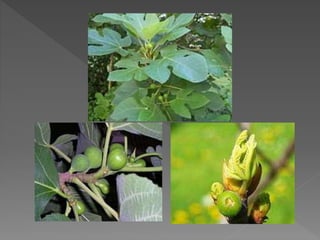
 Tree height is 9 – 10 meters with smooth
bark
 Leaves are large and lobed (12 – 25 cm
long, 10-18 cm across)
 Pyriform infructescence, the flesh fruit fig
with inner unisexual flower
 Fruit (3 – 5 cm long) green, when ripened
turn purple
 Fig has milky sap (laticifer) irritant to
human skin
 Flower not visible. Bloom inside
infructescence
 False or multiple fruit
Specialized fig Wasp is a pollinator
 Small orifice visible in the middle of the
fruit is a narrow passage allow fig wasp
for pollination
 Through seed it is not preferable
 Quicker and reliable methods are
vegetative layering and cutting in moist
perlite or sandy soil mix
 Root and stolen
• Alma
• Brow thrkey
• Celeste
• Desert King
• Italian black
• Italian white
• Kadota
• Lemon fig
• Mission – black, sweat
• Sheikh Zaid and Swari
• Root knot nematode
– Use Nematode free soil and seedling
• Fig Rust
– Copper Spray (May – June)
• Fig mosaic
– Disease free propagation pieces
 Source of Calcium and fiber
 Mission variety is the richest source of
fiber, copper, Mn, Mg and K, Ca and Vit.
 Laxative effect
 Anti oxidant
 Good source of phenols and flavonoid
 Consumed fresh, dried and as jam
 Sura At-tin (fig) opens with oath by the
fig and olive . This reveals its strength,
importance and history
Fig Botany

Fig Botany

  • 3.
    Genus : Ficus Species:carica Family: Moraceae
  • 4.
     Monoecious  Deciduoustree or shrub Native to South West Asia Naturalized in Mediterranean region from Afghanistan and Portugal  Edible in many countries like Iran, Turkey, Pakistan,US, South Africa and Mexico
  • 5.
    1. First orbrevo crop in spring on last year growth 2. Main crop on current year growth
  • 6.
     Dry andsunny areas with deep and fresh soil  Rocky areas (fro sea level to 1700 meter)  Light and Medium Soil  Well drained and nutrition poor soil
  • 7.
     Phearophyte: (Standingor running water)  Search ground water with deep rooted system  Due to water cool the environment and good shelter for animals
  • 8.
     Tree heightis 9 – 10 meters with smooth bark  Leaves are large and lobed (12 – 25 cm long, 10-18 cm across)  Pyriform infructescence, the flesh fruit fig with inner unisexual flower  Fruit (3 – 5 cm long) green, when ripened turn purple  Fig has milky sap (laticifer) irritant to human skin
  • 9.
     Flower notvisible. Bloom inside infructescence  False or multiple fruit Specialized fig Wasp is a pollinator  Small orifice visible in the middle of the fruit is a narrow passage allow fig wasp for pollination
  • 10.
     Through seedit is not preferable  Quicker and reliable methods are vegetative layering and cutting in moist perlite or sandy soil mix  Root and stolen
  • 12.
    • Alma • Browthrkey • Celeste • Desert King • Italian black • Italian white • Kadota • Lemon fig • Mission – black, sweat • Sheikh Zaid and Swari
  • 13.
    • Root knotnematode – Use Nematode free soil and seedling • Fig Rust – Copper Spray (May – June) • Fig mosaic – Disease free propagation pieces
  • 14.
     Source ofCalcium and fiber  Mission variety is the richest source of fiber, copper, Mn, Mg and K, Ca and Vit.  Laxative effect  Anti oxidant  Good source of phenols and flavonoid  Consumed fresh, dried and as jam
  • 15.
     Sura At-tin(fig) opens with oath by the fig and olive . This reveals its strength, importance and history