Fig
Fig
Plant Particulars
Size and form
3–5 feet; bush or small tree
Bloom season
Spring through summer
Fruiting season
Summer into fall
Family
Moraceae
Origin
The Mediterranean and Southwest
Asia
Fig
Ficus carica
FYE-kus KAIR-ih-kuh
To grow figs successfully in pots in the North, plants need an early
start in the spring and then a place that remains warm in the fall to
ensure that fruit will ripen. Outdoors, choose a warm, bright spot where
trees will be protected from late frosts, such as by a south-facing wall. If
growing conditions are kept warm in the wintertime, figs will hold their
foliage year-round. Plants go dormant and drop their leaves if exposed
to cold temperatures, lower light, or short daylength. If you don’t have
room to bring your fig trees inside your house for the winter, try keeping
them in your garage or basement, as long as temperatures don’t drop
too much below freezing.
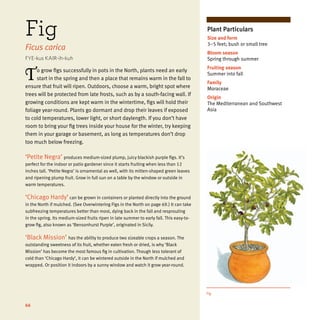
‘Petite Negra’ produces medium-sized plump, juicy blackish purple figs. It’s
perfect for the indoor or patio gardener since it starts fruiting when less than 12
inches tall. ‘Petite Negra’ is ornamental as well, with its mitten-shaped green leaves
and ripening plump fruit. Grow in full sun on a table by the window or outside in
warm temperatures.
‘Chicago Hardy’ can be grown in containers or planted directly into the ground
in the North if mulched. (See Overwintering Figs in the North on page 69.) It can take
subfreezing temperatures better than most, dying back in the fall and resprouting
in the spring. Its medium-sized fruits ripen in late summer to early fall. This easy-to-
grow fig, also known as ‘Bensonhurst Purple’, originated in Sicily.
‘Black Mission’ has the ability to produce two sizeable crops a season. The
outstanding sweetness of its fruit, whether eaten fresh or dried, is why ‘Black
Mission’ has become the most famous fig in cultivation. Though less tolerant of
cold than ‘Chicago Hardy’, it can be wintered outside in the North if mulched and
wrapped. Or position it indoors by a sunny window and watch it grow year-round.
66
Growing Conditions
Light: Full sun
Soil: Adaptable to most potting mixes
Minimum indoor temperature: 25°F (−4°C)
Hardiness outdoors: ‘Petite Negra’, Zone 8;
‘Chicago Hardy’, Zone 6; ‘Black Mission’, Zone
7. In Zones 6 and 7, trees need winter protec-
tion with mulch outdoors. No winter protection
is needed in Zone 8 and warmer.
Care
Fertilizing: Moderate feeder; feed weekly or
every other week with a balanced fertilizer
during active growth. Reduce or stop during
winter.
Pruning: Prune in late winter to early spring
before growth resumes to maintain a shapely
specimen.
Potential Problems
Pests: Not susceptible except under dry
conditions, and then beware of spider mites
Foliar disease: Not susceptible
Root disease: Not susceptible; strong root
system
	 A Symbolic Fruit
The fig tree has long been a symbol of abundance, fertility, and sweetness, go-
ing back to biblical times. In Mediterranean custom, figs represent strong family
ties, memories, and loyalties; a family gathering is never complete without fresh
figs or a fig dish.
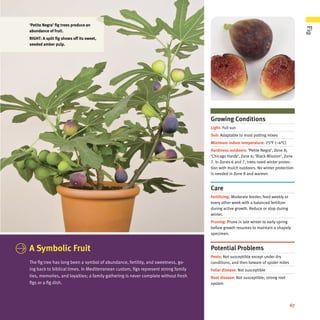
‘Petite Negra’ fig trees produce an
abundance of fruit.
RIGHT: A split fig shows off its sweet,
seeded amber pulp.
67 Fig
Facts About Figs
•	 According to USDA data, dried ‘Black
Mission’ figs are one of the richest
plant sources of dietary fiber, copper,
manganese, magnesium, potassium,
calcium, and vitamin K.
•	 Figs have a laxative effect and contain
many antioxidants such as flavonoids
and polyphenols.
•	 Eating two medium-sized figs per
day has been reported to produce
a significant increase in plasma
antioxidant capacity.
•	 Figs can produce two crops per year.
The spring fruit, called the breba crop,
is borne on the previous season’s
growth. The main crop forms on the
current season’s growth and ripens in
the fall.
•	 Figs must ripen on the tree. Once they
are picked they do not ripen.
•	 Fresh figs last only two to three days
in the refrigerator. However, you can
enjoy your figs for six to eight months
simply by drying them in the sun for
four or five days or in a dehydrator for
10–12 hours.
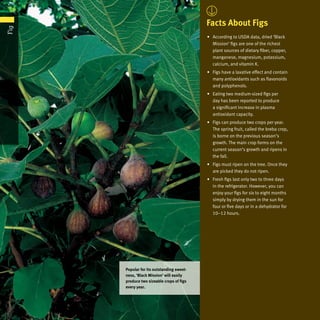
Popular for its outstanding sweet-
ness, ‘Black Mission’ will easily
produce two sizeable crops of figs
every year.
Fig
Combine the fresh fig pulp and balsamic
vinegar in a small saucepan. Simmer, stirring
constantly, for about 30 minutes, until reduced
to about 1½ cups. Add the confectioners’
sugar, and cool. Sweeten to taste with more
confectioners’ sugar, if desired.
Use immediately or store in an airtight
container in the refrigerator.
Makes about 1½ cups
	 ½ 	 cup fresh ‘Black Mission’ fig pulp
	 ½ 	 cup balsamic vinegar
	 ½ 	 cup confectioners’ sugar, plus more as needed
	 1 	 teaspoon vanilla
Recipes from the Tropical Kitchen
Balsamic Fig Reduction
This fig reduction can be used in sauces, appetizers, des-
serts, and more. If you use a premium-quality balsamic vin-
egar, it can be expensive to make, but a little goes a long way.
	 Overwintering Figs in the North
This technique for protecting figs was
passed on to us by Stanley Parchaiski
of Waterford, Connecticut, and will work
in areas as cold as Zone 5. Immigrant
Italian gardeners have used a similar
method for protecting figs in southern
New England for decades.
In the fall, once the frost has killed
the foliage, cut back your fig plant to
4–6 feet. If your plant is growing in a
plastic container, sink the container
in a garden bed so the soil in the pot
is at ground level. (This method may
not work as well for fig trees planted
in terra-cotta or wooden containers.) If
possible choose a spot against a south-
facing wall, which will add more warmth
and give protection in the spring when
the plant first resumes growth.
Wrap heavy string or rope around the
stems and branches and pull them
­together to form an upright column,
which will look rather like a long bundle
of kindling. Bind the bundle as tightly
as possible without damaging the
plant. Don’t be afraid of breaking the
tree’s main stem; it has tremendous
flexibility.
Wrap the bound column in pink fiber-
glass insulation. Use the roll type with
the paper backing facing outward. Wrap
from the ground up, and tie the insula-
tion in place with string. Next, cover
the entire column of insulation with a
plastic tarp or plastic sheeting; tie that
in place with string as well. For the final
step, set a pot over the top like a hat to
shed water. Mulch the base with some
straw to insulate the roots.
Unwrap your tree the following spring,
just after the danger of frost is past in
your area. The plant will immediately
leaf out and go into fruit; in fact, fruit
may form even before the new leaves
expand.
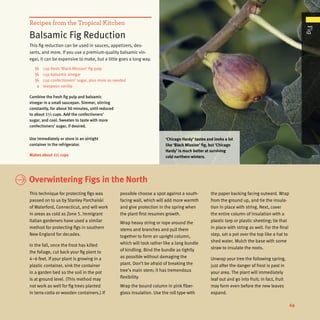
‘Chicago Hardy’ tastes and looks a lot
like ‘Black Mission’ fig, but ‘Chicago
Hardy’ is much better at surviving
cold northern winters.
69 Fig

Pohon Tin atau Fig

  • 2.
    Fig Fig Plant Particulars Size andform 3–5 feet; bush or small tree Bloom season Spring through summer Fruiting season Summer into fall Family Moraceae Origin The Mediterranean and Southwest Asia Fig Ficus carica FYE-kus KAIR-ih-kuh To grow figs successfully in pots in the North, plants need an early start in the spring and then a place that remains warm in the fall to ensure that fruit will ripen. Outdoors, choose a warm, bright spot where trees will be protected from late frosts, such as by a south-facing wall. If growing conditions are kept warm in the wintertime, figs will hold their foliage year-round. Plants go dormant and drop their leaves if exposed to cold temperatures, lower light, or short daylength. If you don’t have room to bring your fig trees inside your house for the winter, try keeping them in your garage or basement, as long as temperatures don’t drop too much below freezing. ‘Petite Negra’ produces medium-sized plump, juicy blackish purple figs. It’s perfect for the indoor or patio gardener since it starts fruiting when less than 12 inches tall. ‘Petite Negra’ is ornamental as well, with its mitten-shaped green leaves and ripening plump fruit. Grow in full sun on a table by the window or outside in warm temperatures. ‘Chicago Hardy’ can be grown in containers or planted directly into the ground in the North if mulched. (See Overwintering Figs in the North on page 69.) It can take subfreezing temperatures better than most, dying back in the fall and resprouting in the spring. Its medium-sized fruits ripen in late summer to early fall. This easy-to- grow fig, also known as ‘Bensonhurst Purple’, originated in Sicily. ‘Black Mission’ has the ability to produce two sizeable crops a season. The outstanding sweetness of its fruit, whether eaten fresh or dried, is why ‘Black Mission’ has become the most famous fig in cultivation. Though less tolerant of cold than ‘Chicago Hardy’, it can be wintered outside in the North if mulched and wrapped. Or position it indoors by a sunny window and watch it grow year-round. 66
  • 3.
    Growing Conditions Light: Fullsun Soil: Adaptable to most potting mixes Minimum indoor temperature: 25°F (−4°C) Hardiness outdoors: ‘Petite Negra’, Zone 8; ‘Chicago Hardy’, Zone 6; ‘Black Mission’, Zone 7. In Zones 6 and 7, trees need winter protec- tion with mulch outdoors. No winter protection is needed in Zone 8 and warmer. Care Fertilizing: Moderate feeder; feed weekly or every other week with a balanced fertilizer during active growth. Reduce or stop during winter. Pruning: Prune in late winter to early spring before growth resumes to maintain a shapely specimen. Potential Problems Pests: Not susceptible except under dry conditions, and then beware of spider mites Foliar disease: Not susceptible Root disease: Not susceptible; strong root system A Symbolic Fruit The fig tree has long been a symbol of abundance, fertility, and sweetness, go- ing back to biblical times. In Mediterranean custom, figs represent strong family ties, memories, and loyalties; a family gathering is never complete without fresh figs or a fig dish. ‘Petite Negra’ fig trees produce an abundance of fruit. RIGHT: A split fig shows off its sweet, seeded amber pulp. 67 Fig
  • 4.
    Facts About Figs • According to USDA data, dried ‘Black Mission’ figs are one of the richest plant sources of dietary fiber, copper, manganese, magnesium, potassium, calcium, and vitamin K. • Figs have a laxative effect and contain many antioxidants such as flavonoids and polyphenols. • Eating two medium-sized figs per day has been reported to produce a significant increase in plasma antioxidant capacity. • Figs can produce two crops per year. The spring fruit, called the breba crop, is borne on the previous season’s growth. The main crop forms on the current season’s growth and ripens in the fall. • Figs must ripen on the tree. Once they are picked they do not ripen. • Fresh figs last only two to three days in the refrigerator. However, you can enjoy your figs for six to eight months simply by drying them in the sun for four or five days or in a dehydrator for 10–12 hours. Popular for its outstanding sweet- ness, ‘Black Mission’ will easily produce two sizeable crops of figs every year. Fig
  • 5.
    Combine the freshfig pulp and balsamic vinegar in a small saucepan. Simmer, stirring constantly, for about 30 minutes, until reduced to about 1½ cups. Add the confectioners’ sugar, and cool. Sweeten to taste with more confectioners’ sugar, if desired. Use immediately or store in an airtight container in the refrigerator. Makes about 1½ cups ½ cup fresh ‘Black Mission’ fig pulp ½ cup balsamic vinegar ½ cup confectioners’ sugar, plus more as needed 1 teaspoon vanilla Recipes from the Tropical Kitchen Balsamic Fig Reduction This fig reduction can be used in sauces, appetizers, des- serts, and more. If you use a premium-quality balsamic vin- egar, it can be expensive to make, but a little goes a long way. Overwintering Figs in the North This technique for protecting figs was passed on to us by Stanley Parchaiski of Waterford, Connecticut, and will work in areas as cold as Zone 5. Immigrant Italian gardeners have used a similar method for protecting figs in southern New England for decades. In the fall, once the frost has killed the foliage, cut back your fig plant to 4–6 feet. If your plant is growing in a plastic container, sink the container in a garden bed so the soil in the pot is at ground level. (This method may not work as well for fig trees planted in terra-cotta or wooden containers.) If possible choose a spot against a south- facing wall, which will add more warmth and give protection in the spring when the plant first resumes growth. Wrap heavy string or rope around the stems and branches and pull them ­together to form an upright column, which will look rather like a long bundle of kindling. Bind the bundle as tightly as possible without damaging the plant. Don’t be afraid of breaking the tree’s main stem; it has tremendous flexibility. Wrap the bound column in pink fiber- glass insulation. Use the roll type with the paper backing facing outward. Wrap from the ground up, and tie the insula- tion in place with string. Next, cover the entire column of insulation with a plastic tarp or plastic sheeting; tie that in place with string as well. For the final step, set a pot over the top like a hat to shed water. Mulch the base with some straw to insulate the roots. Unwrap your tree the following spring, just after the danger of frost is past in your area. The plant will immediately leaf out and go into fruit; in fact, fruit may form even before the new leaves expand. ‘Chicago Hardy’ tastes and looks a lot like ‘Black Mission’ fig, but ‘Chicago Hardy’ is much better at surviving cold northern winters. 69 Fig