ALMOND
CONTENTS
 INTRODUCTION
USES
AREA AND PRODUCTION
TAXONOMY
BOTANY
CLIMATE AND SOIL
SPECIES AND CULTIVARS
PROPAGATION
PLANTING
POLLINATION
ROOTSTOCKS
TRAINING AND PRUNING
MANURES AND FERTILISERS
IRRIGATION & SOIL MANAGEMENT
HARVESTING & PROCESSING
 PESTS AND DISEASES
INTRODUCTION
 Almond is an important temperate
fruit crop known for its kernels
throughout the world.
 The Almond is also the name of the
edible and widely cultivated seed of
the tree.
 Almond is a deciduous tree.
USES
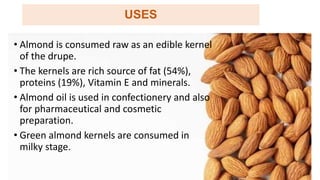
• Almond is consumed raw as an edible kernel
of the drupe.
• The kernels are rich source of fat (54%),
proteins (19%), Vitamin E and minerals.
• Almond oil is used in confectionery and also
for pharmaceutical and cosmetic
preparation.
• Green almond kernels are consumed in
milky stage.
AREA AND DISTRIBUTION
Worldwide 32,14,522 tonnes of almond is produced per year.
 California is the leading producer of almond in the world.
 Major growing countries : USA, Spain, Iran, Morocco (source:
Atlas Big)
 In India, Jammu & Kashmir is ahead in the production of almond
followed by Himachal Pradesh and Maharashtra. (source: NHB,
2021-22 1st Adv. Estimates)
TAXONOMICAL CLASSIFICATION
Scientific name : Prunus amygdalus
Family : Rosaceae
Sub-Family : Prunoideae
Order : Rosales
Origin : Central Asian mountain areas (India,
Iran and Pakistan)
Somatic chromosome number = 16
Basic chromosome number = 8
BOTANY
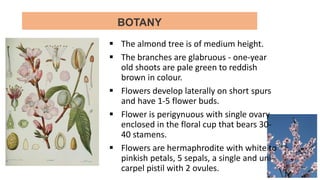
 The almond tree is of medium height.
 The branches are glabruous - one-year
old shoots are pale green to reddish
brown in colour.
 Flowers develop laterally on short spurs
and have 1-5 flower buds.
 Flower is perigynuous with single ovary
enclosed in the floral cup that bears 30-
40 stamens.
 Flowers are hermaphrodite with white to
pinkish petals, 5 sepals, a single and uni-
carpel pistil with 2 ovules.
CONTD..
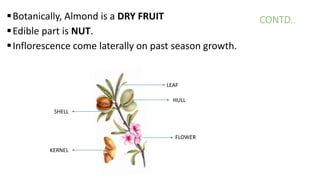
Botanically, Almond is a DRY FRUIT
Edible part is NUT.
Inflorescence come laterally on past season growth.
HULL
FLOWER
SHELL
KERNEL
LEAF
ALMOND INFLORESCENCE ALMOND TREE
CLIMATE AND SOIL
 Almond grows between 30º to 40º N latitude.
 The optimum altitude is 2500 ft. from MSL.
 The congenial temperature for the almond cultivation is 12º-
30ºC.
 The chilling requirement for normal bud sprouting is 200-700
hours.
 The limiting factor is spring frost during full bloom.
 South facing slopes are best for almond growing.
 Well drained loamy soils with pH 5.5- 6.8 is ideal.
SPECIES
SWEET ALMOND
• Prunus dulcis var. dulcis
• Predominantly sweet
• They are edible, consumed as
nuts, and as a source of almond
oil.
BITTER ALMOND
• Prunus dulcis var. amara
• Always bitter
• They are used in manufacturing
of flavouring extracts for foods
and liqueurs.
Inflorescence Inflorescence
TYPES OF ALMONDS
1. BUTTE ALMOND
Known as Padre almonds.
They have semi-hard shell with a light colour and
smooth surface.
2. NON- PAREIL ALMONDS
They have thin outer shell, with medium flat nuts that
have light colour and smooth surface.
3. CARMEL ALMONDS
Popular variety of Californian almonds. They have
long, flat, and semi-hard surface.
4. PEERLESS ALMONDS
They have light colour skin with thin, hard and long
outer shell along with smooth surface.
5. MOLAR ALMONDS
The outer shells are soft and easily removable. Molar
Tarragona is the most popular variety.
6. FERRADUEL
They possess thin, dark brown and flat outer shell.
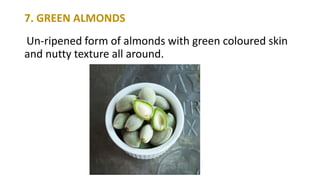
7. GREEN ALMONDS
Un-ripened form of almonds with green coloured skin
and nutty texture all around.
8. SONORA ALMONDS
Outer shell is thin, dark, and rough in appearance.
9. FRITZ ALMONDS
This is semi hard in texture with kernels darker in
colour.
CULTIVARS
A. Jammu and Kashmir: Makhdoom, Parbat, Waris, Shalimar,
Non-Pareil, IXL, etc
B. Himachal Pradesh :
High and mid-hills : Merced, Non- Pareil, IXL
Valley areas: Drake, Kathe, Peerless, Ne Plus Ultra
Dry temperate areas : Texas, IXL
KATHA
NE PLUS ULTRA
SHALIMAR
PROPAGATION
1. Direct sowing : December
2. Grafting - Tongue grafting :
Feb- Mar
3. Budding – T-budding : May
PLANTING
 One-year old grafted or budded
plants are planted in square,
contour, or terrace system.
 Spacing recommended is 5*5 m.
POLLINATION
 Almonds are highly cross pollinated crop.
 Thus every third row should be planted with a
pollinizer variety to provide 33% pollinizer.
Drake and Dhaber are self-pollinated.
 Honeybees are best pollinators for almonds.
Good pollination can be achieved by single
row of the main cultivar and pollinizer.
Grafting of wild peach and almond
ROOTSTOCKS
SEEDLING ROOTSTOCKS
- Seedlings of bitter almond- tolerant to drought, lime soils, iron
chlorosis.
-Wild peach
-Behmi
CLONAL ROOTSTOCKS
- GF677, 557
- Marianna 2624
- Myrobalan 2032
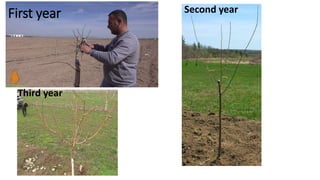
TRAINING AND PRUNING
• Almond plants are generally trained with open centre system.
• Plants are headed back 70-80 cm above the ground level.
• In the summer 3-4 well spaced branches on trunk in different
direction are selected while other unwanted branches are
pinched off.
• If these branches are not selected during summer then they
must be selected during dormant pruning.
First year Second year
Third year
CONTD..
• In young trees, only diseased, drywood
and the branches which are interfering
with each other should be removed.
• Water sprouts arising on the stem should
be removed.
• In old bearing trees, pruning is done to
remove one-fifth of the growth every
year.
MANURES AND FERTILIZERS
 Almond is a heavy feeder.
 The recommended manure and fertilizer dose for bearing almond
trees of 7 years old are
- FYM : 50-60 kg
- N:P:K = 500:350:700 g/plant
where in full dose of FYM, P and K are applied in Dec.
half dose of N- 1 month before flowering.
remaining half dose – after 1 month of 1st application.
IRRIGATION AND SOIL MANAGEMENT
 Almond trees should be irrigated at weekly
intervals during April, May and June.
Sod culture + mulching = best soil management
system.
 The ground to be cultivated to a depth of 10-15
cm during winter and in spring.
 Dry grass is used as the mulch for the basin.
Application of weedicide to control weeds.
HARVESTING
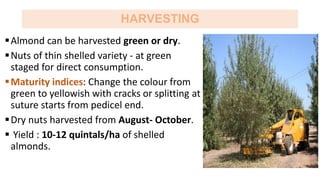
Almond can be harvested green or dry.
Nuts of thin shelled variety - at green
staged for direct consumption.
Maturity indices: Change the colour from
green to yellowish with cracks or splitting at
suture starts from pedicel end.
Dry nuts harvested from August- October.
 Yield : 10-12 quintals/ha of shelled
almonds.
PROCESSING
 After harvesting, the nuts are placed in a
shady place for dehulling where they can be
dried as well.
 The remaining after extracting kernel,
Hull : used for livestock bedding
Shell : used as dairy feed
PROCESSED PRODUCTS OF ALMOND
A GYST OF LIFECYCLE OF AN ALMOND TREE
PESTS OF ALMOND
PAVEMENT ANTS
Tetramorium caespitum
SOUTHERN FIRE ANTS
Solenopsis xyloni
DISEASES OF ALMOND
1. HULL ROT
Causal agent : Rhizopus stolonifer
2. ALMOND KERNEL SHRIVEL
Causal agent: Peach yellow leafroll
Phytoplasma
3. ALMOND LEAF SCORCH
Causal agent : Xylella fastidiosa
THANKYOU!!
SUBMITTED TO :
DR. VENKAT RAO
ASST. PROFESSOR OF FRUIT SCIENCE
COLLEGE OF HORTICULTURE,
BENGALURU
SUBMITTED BY :
SAVITHA H R – UHS20UG5266
SINCHANA N S – UHS20UG5267
SRIKANTH N – UHS20UG5268
SUSHMITHA SHETTY – UHS20UG5269

ALMOND final-1.pptx

  • 1.
  • 2.
    CONTENTS  INTRODUCTION USES AREA ANDPRODUCTION TAXONOMY BOTANY CLIMATE AND SOIL SPECIES AND CULTIVARS PROPAGATION PLANTING POLLINATION ROOTSTOCKS TRAINING AND PRUNING MANURES AND FERTILISERS IRRIGATION & SOIL MANAGEMENT HARVESTING & PROCESSING  PESTS AND DISEASES
  • 3.
    INTRODUCTION  Almond isan important temperate fruit crop known for its kernels throughout the world.  The Almond is also the name of the edible and widely cultivated seed of the tree.  Almond is a deciduous tree.
  • 4.
    USES • Almond isconsumed raw as an edible kernel of the drupe. • The kernels are rich source of fat (54%), proteins (19%), Vitamin E and minerals. • Almond oil is used in confectionery and also for pharmaceutical and cosmetic preparation. • Green almond kernels are consumed in milky stage.
  • 5.
    AREA AND DISTRIBUTION Worldwide32,14,522 tonnes of almond is produced per year.  California is the leading producer of almond in the world.  Major growing countries : USA, Spain, Iran, Morocco (source: Atlas Big)  In India, Jammu & Kashmir is ahead in the production of almond followed by Himachal Pradesh and Maharashtra. (source: NHB, 2021-22 1st Adv. Estimates)
  • 6.
    TAXONOMICAL CLASSIFICATION Scientific name: Prunus amygdalus Family : Rosaceae Sub-Family : Prunoideae Order : Rosales Origin : Central Asian mountain areas (India, Iran and Pakistan) Somatic chromosome number = 16 Basic chromosome number = 8
  • 7.
    BOTANY  The almondtree is of medium height.  The branches are glabruous - one-year old shoots are pale green to reddish brown in colour.  Flowers develop laterally on short spurs and have 1-5 flower buds.  Flower is perigynuous with single ovary enclosed in the floral cup that bears 30- 40 stamens.  Flowers are hermaphrodite with white to pinkish petals, 5 sepals, a single and uni- carpel pistil with 2 ovules.
  • 8.
    CONTD.. Botanically, Almond isa DRY FRUIT Edible part is NUT. Inflorescence come laterally on past season growth. HULL FLOWER SHELL KERNEL LEAF
  • 9.
  • 10.
    CLIMATE AND SOIL Almond grows between 30º to 40º N latitude.  The optimum altitude is 2500 ft. from MSL.  The congenial temperature for the almond cultivation is 12º- 30ºC.  The chilling requirement for normal bud sprouting is 200-700 hours.  The limiting factor is spring frost during full bloom.  South facing slopes are best for almond growing.  Well drained loamy soils with pH 5.5- 6.8 is ideal.
  • 11.
    SPECIES SWEET ALMOND • Prunusdulcis var. dulcis • Predominantly sweet • They are edible, consumed as nuts, and as a source of almond oil. BITTER ALMOND • Prunus dulcis var. amara • Always bitter • They are used in manufacturing of flavouring extracts for foods and liqueurs. Inflorescence Inflorescence
  • 12.
    TYPES OF ALMONDS 1.BUTTE ALMOND Known as Padre almonds. They have semi-hard shell with a light colour and smooth surface.
  • 13.
    2. NON- PAREILALMONDS They have thin outer shell, with medium flat nuts that have light colour and smooth surface.
  • 14.
    3. CARMEL ALMONDS Popularvariety of Californian almonds. They have long, flat, and semi-hard surface.
  • 15.
    4. PEERLESS ALMONDS Theyhave light colour skin with thin, hard and long outer shell along with smooth surface.
  • 16.
    5. MOLAR ALMONDS Theouter shells are soft and easily removable. Molar Tarragona is the most popular variety.
  • 17.
    6. FERRADUEL They possessthin, dark brown and flat outer shell.
  • 18.
    7. GREEN ALMONDS Un-ripenedform of almonds with green coloured skin and nutty texture all around.
  • 19.
    8. SONORA ALMONDS Outershell is thin, dark, and rough in appearance.
  • 20.
    9. FRITZ ALMONDS Thisis semi hard in texture with kernels darker in colour.
  • 21.
    CULTIVARS A. Jammu andKashmir: Makhdoom, Parbat, Waris, Shalimar, Non-Pareil, IXL, etc B. Himachal Pradesh : High and mid-hills : Merced, Non- Pareil, IXL Valley areas: Drake, Kathe, Peerless, Ne Plus Ultra Dry temperate areas : Texas, IXL
  • 22.
  • 23.
    PROPAGATION 1. Direct sowing: December 2. Grafting - Tongue grafting : Feb- Mar 3. Budding – T-budding : May
  • 25.
    PLANTING  One-year oldgrafted or budded plants are planted in square, contour, or terrace system.  Spacing recommended is 5*5 m.
  • 26.
    POLLINATION  Almonds arehighly cross pollinated crop.  Thus every third row should be planted with a pollinizer variety to provide 33% pollinizer. Drake and Dhaber are self-pollinated.  Honeybees are best pollinators for almonds. Good pollination can be achieved by single row of the main cultivar and pollinizer.
  • 27.
    Grafting of wildpeach and almond
  • 28.
    ROOTSTOCKS SEEDLING ROOTSTOCKS - Seedlingsof bitter almond- tolerant to drought, lime soils, iron chlorosis. -Wild peach -Behmi CLONAL ROOTSTOCKS - GF677, 557 - Marianna 2624 - Myrobalan 2032
  • 29.
    TRAINING AND PRUNING •Almond plants are generally trained with open centre system. • Plants are headed back 70-80 cm above the ground level. • In the summer 3-4 well spaced branches on trunk in different direction are selected while other unwanted branches are pinched off. • If these branches are not selected during summer then they must be selected during dormant pruning.
  • 30.
    First year Secondyear Third year
  • 31.
    CONTD.. • In youngtrees, only diseased, drywood and the branches which are interfering with each other should be removed. • Water sprouts arising on the stem should be removed. • In old bearing trees, pruning is done to remove one-fifth of the growth every year.
  • 32.
    MANURES AND FERTILIZERS Almond is a heavy feeder.  The recommended manure and fertilizer dose for bearing almond trees of 7 years old are - FYM : 50-60 kg - N:P:K = 500:350:700 g/plant where in full dose of FYM, P and K are applied in Dec. half dose of N- 1 month before flowering. remaining half dose – after 1 month of 1st application.
  • 33.
    IRRIGATION AND SOILMANAGEMENT  Almond trees should be irrigated at weekly intervals during April, May and June. Sod culture + mulching = best soil management system.  The ground to be cultivated to a depth of 10-15 cm during winter and in spring.  Dry grass is used as the mulch for the basin. Application of weedicide to control weeds.
  • 34.
    HARVESTING Almond can beharvested green or dry. Nuts of thin shelled variety - at green staged for direct consumption. Maturity indices: Change the colour from green to yellowish with cracks or splitting at suture starts from pedicel end. Dry nuts harvested from August- October.  Yield : 10-12 quintals/ha of shelled almonds.
  • 35.
    PROCESSING  After harvesting,the nuts are placed in a shady place for dehulling where they can be dried as well.  The remaining after extracting kernel, Hull : used for livestock bedding Shell : used as dairy feed
  • 36.
  • 37.
    A GYST OFLIFECYCLE OF AN ALMOND TREE
  • 38.
    PESTS OF ALMOND PAVEMENTANTS Tetramorium caespitum SOUTHERN FIRE ANTS Solenopsis xyloni
  • 39.
    DISEASES OF ALMOND 1.HULL ROT Causal agent : Rhizopus stolonifer
  • 40.
    2. ALMOND KERNELSHRIVEL Causal agent: Peach yellow leafroll Phytoplasma
  • 41.
    3. ALMOND LEAFSCORCH Causal agent : Xylella fastidiosa
  • 42.
  • 43.
    SUBMITTED TO : DR.VENKAT RAO ASST. PROFESSOR OF FRUIT SCIENCE COLLEGE OF HORTICULTURE, BENGALURU SUBMITTED BY : SAVITHA H R – UHS20UG5266 SINCHANA N S – UHS20UG5267 SRIKANTH N – UHS20UG5268 SUSHMITHA SHETTY – UHS20UG5269