15EE55C – DIGITAL SIGNAL PROCESSING AND
ITS APPLICATIONS
ELEMENTARY SIGNALS
Dr. M. Bakrutheen AP(SG)/EEE
Mr. K. Karthik Kumar AP/EEE
DEPARTMENT OF ELECTRICAL AND ELECTRONICS ENGINEERING
NATIONAL ENGINEERING COLLEGE, K.R. NAGAR, KOVILPATTI – 628 503
(An Autonomous Institution, Affiliated to Anna University – Chennai)
ELEMENTARY SIGNALS
 The elementary signals are used for analysis of systems. Such signals
are,
 Step
 Impulse
 Ramp
 Exponential
 Sinusoidal
UNIT STEP SIGNAL
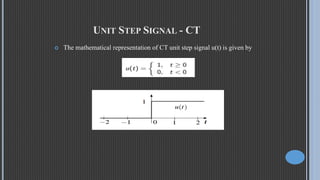
 The unit step signal has amplitude of 1 for positive value and amplitude
of 0 for negative value of independent variable
 It have two different parameter such as CT unit step signal u(t) and DT
unit step signal u(n).
UNIT STEP SIGNAL - CT
 The mathematical representation of CT unit step signal u(t) is given by
UNIT STEP SIGNAL - DT
 The mathematical representation of DT unit step signal u(n) is given by
UNIT IMPULSE SIGNAL
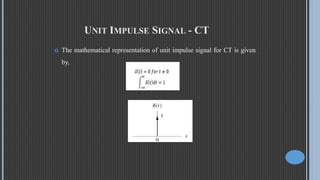
 Amplitude of unit impulse approaches 1 as the width approaches zero
and it has zero value at all other values.
 This is used to estimate the impulse response of LTI system
UNIT IMPULSE SIGNAL - CT
 The mathematical representation of unit impulse signal for CT is given
by,
UNIT IMPULSE SIGNAL - DT
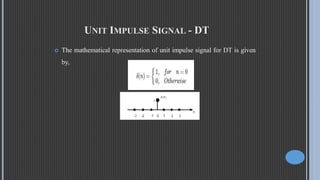
 The mathematical representation of unit impulse signal for DT is given
by,
RAMP SIGNAL
 CT Ramp signal is denoted by r(t).
 It is defined as r(t)
 DT Ramp signal is denoted by r(n), and it is defined as r(n)
REAL SINUSOIDAL SIGNAL - CT
 A (CT) real sinusoid is a function of the form
x(t) = Acos(ωt +θ),
where A, ω, and θ are real constants.
 Such a function is periodic with fundamental period T = 2π/|ω|
and fundamental frequency |ω|.
REAL SINUSOIDAL SIGNAL - DT
 A (DT) real sinusoid is a sequence of the form x(n) = Acos(Ωn+θ),
 where A, Ω, and θ are real constants.
 A real sinusoid is periodic if and only if Ω/2π is a rational number, in which case
the fundamental period is the smallest integer of the form 2πk/|Ω| where k is a
positive integer.
 For all integer k, xk(n) = Acos([Ω+2πk]n+θ) is the same sequence.
 An example of a periodic real sinusoid with fundamental period 12 is shown
plotted below
REAL EXPONENTIAL SIGNAL - CT
 A (CT) complex exponential is a function of the form x(t) = Aeλt ,
 where A and λ are complex constants.
 A complex exponential can exhibit one of a number of distinct modes of
behavior, depending on the values of its parameters A and λ.
 For example, as special cases, complex exponentials include real
exponentials and complex sinusoids.
REAL EXPONENTIAL SIGNAL – CT – SPECIAL CASE
 A real exponential can exhibit one of three distinct modes of behavior, depending on
the value of λ, as illustrated below.
 If λ > 0, x(t) increases exponentially as t increases (i.e., a growing exponential).
 If λ < 0, x(t) decreases exponentially as t increases (i.e., a decaying exponential).
 If λ = 0, x(t) simply equals the constant A.
REAL EXPONENTIAL SIGNAL - DT
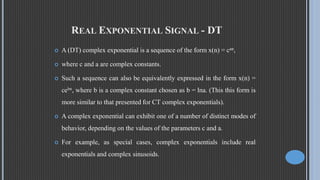
 A (DT) complex exponential is a sequence of the form x(n) = can,
 where c and a are complex constants.
 Such a sequence can also be equivalently expressed in the form x(n) =
cebn, where b is a complex constant chosen as b = lna. (This this form is
more similar to that presented for CT complex exponentials).
 A complex exponential can exhibit one of a number of distinct modes of
behavior, depending on the values of the parameters c and a.
 For example, as special cases, complex exponentials include real
exponentials and complex sinusoids.
REAL EXPONENTIAL SIGNAL – DT – SPECIAL CASE
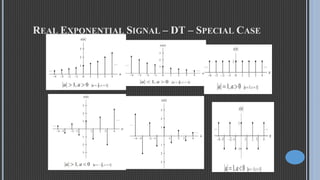
 A real exponential can exhibit one of several distinct modes of behavior,
depending on the magnitude and sign of a.
 If |a| > 1, the magnitude of x(n) increases exponentially as n increases
(i.e., a growing exponential).
 If |a| < 1, the magnitude of x(n) decreases exponentially as n increases
(i.e., a decaying exponential).
 If |a| = 1, the magnitude of x(n) is a constant, independent of n.
 If a > 0, x(n) has the same sign for all n.
 If a < 0, x(n) alternates in sign as n increases/decreases.
REAL EXPONENTIAL SIGNAL – DT – SPECIAL CASE
OTHER SIGNALS – RECTANGULAR - CT
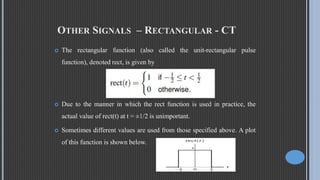
 The rectangular function (also called the unit-rectangular pulse
function), denoted rect, is given by
 Due to the manner in which the rect function is used in practice, the
actual value of rect(t) at t = ±1/2 is unimportant.
 Sometimes different values are used from those specified above. A plot
of this function is shown below.
OTHER SIGNALS – RECTANGULAR - DT
 A unit rectangular pulse is a sequence of the form
 where a and b are integer constants satisfying a < b.
 Such a sequence can be expressed in terms of the unit-step sequence as
p ( n) = u ( n − a ) − u ( n − b ). The graph of a unit rectangular pulse has
the general form shown below.
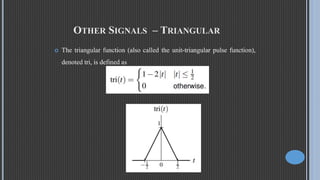
OTHER SIGNALS – TRIANGULAR
 The triangular function (also called the unit-triangular pulse function),
denoted tri, is defined as
OTHER SIGNALS – CARDINAL SINE FUNCTION
 The cardinal sine function, denoted sinc, is given by
 By l’Hopital’s rule, sinc 0 = 1.
 A plot of this function for part of the real line is shown below. [Note that
the oscillations in sinc(t) do not die out for finite t.]
OTHER SIGNALS – SIGNUM FUNCTION
 The signum function, denoted sgn, is defined as
 From its definition, one can see that the signum function simply
computes the sign of a number. A plot of this function is shown below.

Elementary signals

  • 1.
    15EE55C – DIGITALSIGNAL PROCESSING AND ITS APPLICATIONS ELEMENTARY SIGNALS Dr. M. Bakrutheen AP(SG)/EEE Mr. K. Karthik Kumar AP/EEE DEPARTMENT OF ELECTRICAL AND ELECTRONICS ENGINEERING NATIONAL ENGINEERING COLLEGE, K.R. NAGAR, KOVILPATTI – 628 503 (An Autonomous Institution, Affiliated to Anna University – Chennai)
  • 2.
    ELEMENTARY SIGNALS  Theelementary signals are used for analysis of systems. Such signals are,  Step  Impulse  Ramp  Exponential  Sinusoidal
  • 3.
    UNIT STEP SIGNAL The unit step signal has amplitude of 1 for positive value and amplitude of 0 for negative value of independent variable  It have two different parameter such as CT unit step signal u(t) and DT unit step signal u(n).
  • 4.
    UNIT STEP SIGNAL- CT  The mathematical representation of CT unit step signal u(t) is given by
  • 5.
    UNIT STEP SIGNAL- DT  The mathematical representation of DT unit step signal u(n) is given by
  • 6.
    UNIT IMPULSE SIGNAL Amplitude of unit impulse approaches 1 as the width approaches zero and it has zero value at all other values.  This is used to estimate the impulse response of LTI system
  • 7.
    UNIT IMPULSE SIGNAL- CT  The mathematical representation of unit impulse signal for CT is given by,
  • 8.
    UNIT IMPULSE SIGNAL- DT  The mathematical representation of unit impulse signal for DT is given by,
  • 9.
    RAMP SIGNAL  CTRamp signal is denoted by r(t).  It is defined as r(t)  DT Ramp signal is denoted by r(n), and it is defined as r(n)
  • 10.
    REAL SINUSOIDAL SIGNAL- CT  A (CT) real sinusoid is a function of the form x(t) = Acos(ωt +θ), where A, ω, and θ are real constants.  Such a function is periodic with fundamental period T = 2π/|ω| and fundamental frequency |ω|.
  • 11.
    REAL SINUSOIDAL SIGNAL- DT  A (DT) real sinusoid is a sequence of the form x(n) = Acos(Ωn+θ),  where A, Ω, and θ are real constants.  A real sinusoid is periodic if and only if Ω/2π is a rational number, in which case the fundamental period is the smallest integer of the form 2πk/|Ω| where k is a positive integer.  For all integer k, xk(n) = Acos([Ω+2πk]n+θ) is the same sequence.  An example of a periodic real sinusoid with fundamental period 12 is shown plotted below
  • 12.
    REAL EXPONENTIAL SIGNAL- CT  A (CT) complex exponential is a function of the form x(t) = Aeλt ,  where A and λ are complex constants.  A complex exponential can exhibit one of a number of distinct modes of behavior, depending on the values of its parameters A and λ.  For example, as special cases, complex exponentials include real exponentials and complex sinusoids.
  • 13.
    REAL EXPONENTIAL SIGNAL– CT – SPECIAL CASE  A real exponential can exhibit one of three distinct modes of behavior, depending on the value of λ, as illustrated below.  If λ > 0, x(t) increases exponentially as t increases (i.e., a growing exponential).  If λ < 0, x(t) decreases exponentially as t increases (i.e., a decaying exponential).  If λ = 0, x(t) simply equals the constant A.
  • 14.
    REAL EXPONENTIAL SIGNAL- DT  A (DT) complex exponential is a sequence of the form x(n) = can,  where c and a are complex constants.  Such a sequence can also be equivalently expressed in the form x(n) = cebn, where b is a complex constant chosen as b = lna. (This this form is more similar to that presented for CT complex exponentials).  A complex exponential can exhibit one of a number of distinct modes of behavior, depending on the values of the parameters c and a.  For example, as special cases, complex exponentials include real exponentials and complex sinusoids.
  • 15.
    REAL EXPONENTIAL SIGNAL– DT – SPECIAL CASE  A real exponential can exhibit one of several distinct modes of behavior, depending on the magnitude and sign of a.  If |a| > 1, the magnitude of x(n) increases exponentially as n increases (i.e., a growing exponential).  If |a| < 1, the magnitude of x(n) decreases exponentially as n increases (i.e., a decaying exponential).  If |a| = 1, the magnitude of x(n) is a constant, independent of n.  If a > 0, x(n) has the same sign for all n.  If a < 0, x(n) alternates in sign as n increases/decreases.
  • 16.
    REAL EXPONENTIAL SIGNAL– DT – SPECIAL CASE
  • 17.
    OTHER SIGNALS –RECTANGULAR - CT  The rectangular function (also called the unit-rectangular pulse function), denoted rect, is given by  Due to the manner in which the rect function is used in practice, the actual value of rect(t) at t = ±1/2 is unimportant.  Sometimes different values are used from those specified above. A plot of this function is shown below.
  • 18.
    OTHER SIGNALS –RECTANGULAR - DT  A unit rectangular pulse is a sequence of the form  where a and b are integer constants satisfying a < b.  Such a sequence can be expressed in terms of the unit-step sequence as p ( n) = u ( n − a ) − u ( n − b ). The graph of a unit rectangular pulse has the general form shown below.
  • 19.
    OTHER SIGNALS –TRIANGULAR  The triangular function (also called the unit-triangular pulse function), denoted tri, is defined as
  • 20.
    OTHER SIGNALS –CARDINAL SINE FUNCTION  The cardinal sine function, denoted sinc, is given by  By l’Hopital’s rule, sinc 0 = 1.  A plot of this function for part of the real line is shown below. [Note that the oscillations in sinc(t) do not die out for finite t.]
  • 21.
    OTHER SIGNALS –SIGNUM FUNCTION  The signum function, denoted sgn, is defined as  From its definition, one can see that the signum function simply computes the sign of a number. A plot of this function is shown below.